


 Скачать презентацию Workflow and Process Management WPM David Ding Management
bb8c0488dc236f51b43acade7e80acb3.ppt
- Количество слайдов: 62
 Workflow and Process Management (WPM) David Ding Management Department David Eccles School of Business, University of Utah Workflow and Process Management April 6, 2003 p 1
 Agenda 1. Research Commentary: Workflow Management Issues in e-Business 2. Automating the Discovery of AS-IS Business Process Models: Probabilistic and Algorithmic Approaches 3. Tools for Inventing Organizations: Towards a Handbook of Organizational Process 4. Dynamic Routing and Operational Controls in Workflow Management Systems Workflow and Process Management April 6, 2003 p 2
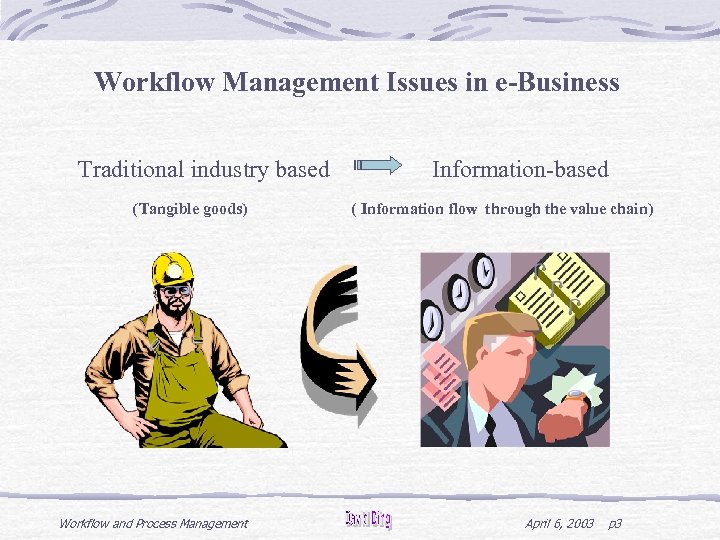 Workflow Management Issues in e-Business Traditional industry based (Tangible goods) Workflow and Process Management Information-based ( Information flow through the value chain) April 6, 2003 p 3
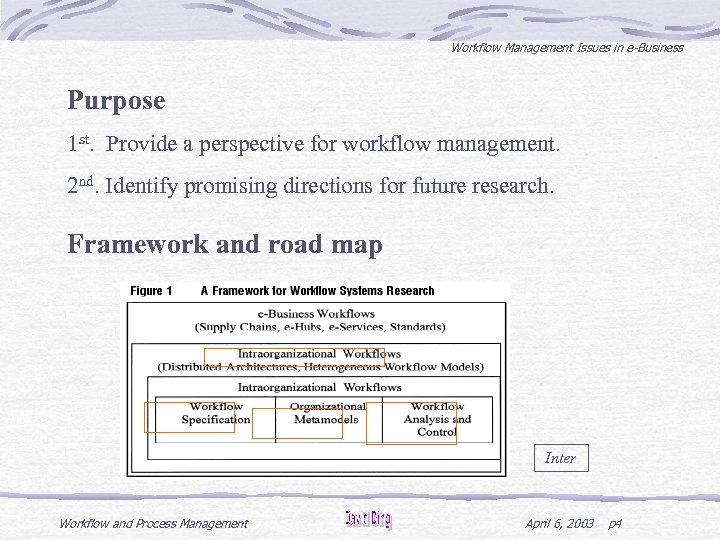 Workflow Management Issues in e-Business Purpose 1 st. Provide a perspective for workflow management. 2 nd. Identify promising directions for future research. Framework and road map Inter Workflow and Process Management April 6, 2003 p 4
 Workflow Management Issues in e-Business Intraorganizational Workflows 3 views of workflows management (general to specific) • Tasks executed by various resources in a value system • Automation of business process, information transferred • Characteristics of Predictability, Repeatable, Distributed, Automation, Idling. Workflow and Process Management April 6, 2003 p 5
 Workflow Management Issues in e-Business Specification and Modeling Workflow Components: Process model, task, work case, resource, role, data elements, state information, and constraints Specification Key issues: Task definition, task coordination, correctness of execution requirements. Modeling Approach: Petri. nets, ICN(Information Control Nets, Action. Workflow formalism, 200 products on the markets are implementing various models due to the diversity of above approach to modeling Workflow and Process Management April 6, 2003 p 6
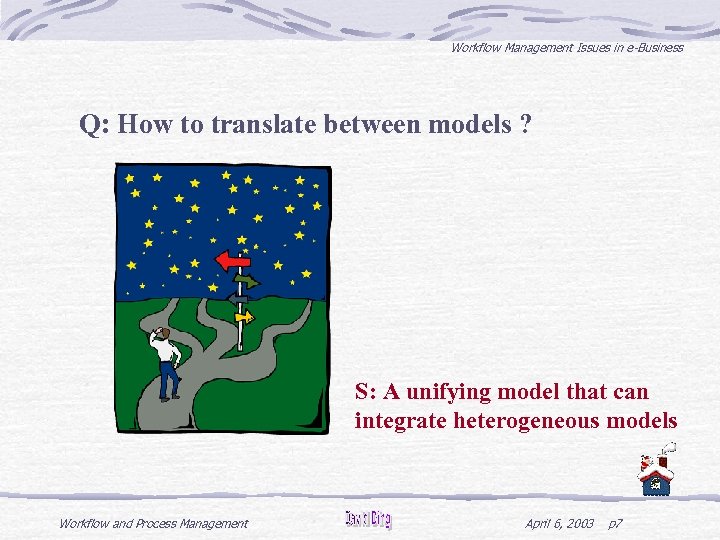 Workflow Management Issues in e-Business Q: How to translate between models ? S: A unifying model that can integrate heterogeneous models Workflow and Process Management April 6, 2003 p 7
 Workflow Management Issues in e-Business Organizational Modeling of Workflows Organizational awareness is required for a fit between work practice and the model/mechanism used by the workflow management system. Or integration of workflow models with organizational models Organization Model: Represents a logical hierarchy of roles that performed in the organization. Reflects organization structure, include separation of duties, and integrate work on delegation with security. Workflow and Process Management April 6, 2003 p 8
 Workflow Management Issues in e-Business Workflow Analysis, monitoring and control Structural analysis: Analyze the structure of processes and workflows during the design phase. Comprised of Validation: Test semantic completeness for predicting workflows in all scenarios, by interactive simulation Verification: Establish the syntactic correctness and eliminate redundancies, by checking for correctness Data usage analysis: Analyze patterns of data, prevent errors, by introducing the notion of transactions Gap: Verifying the context of workflows is required Workflow and Process Management April 6, 2003 p 9
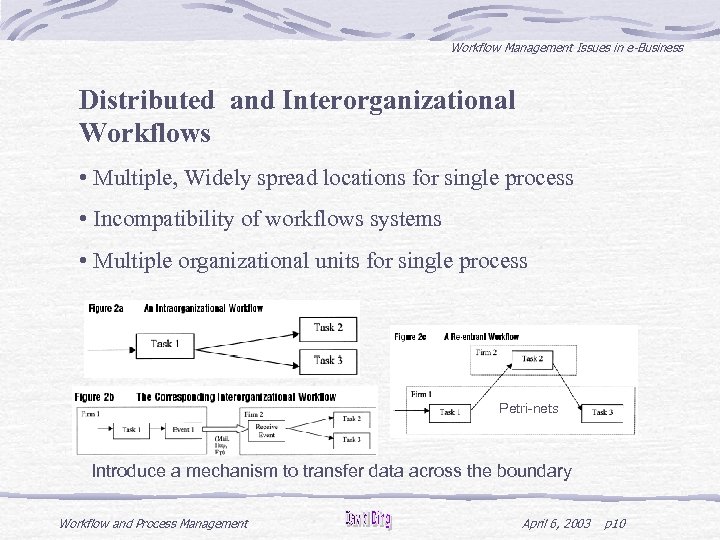 Workflow Management Issues in e-Business Distributed and Interorganizational Workflows • Multiple, Widely spread locations for single process • Incompatibility of workflows systems • Multiple organizational units for single process Petri-nets Introduce a mechanism to transfer data across the boundary Workflow and Process Management April 6, 2003 p 10
 Workflow Management Issues in e-Business Distributed and Interorganizational Workflows Restructuring workflow in distributed settings Q: Inconsistency and duplication for lacking of transparency across or boundaries S: Mapping disparate workflow models into one another Q: Task is delegated dynamically S: Dynamically allocation of tasks to servers Workflow and Process Management April 6, 2003 p 11
 Workflow Management Issues in e-Business Workflow issues in e-Business 1 st. Integrating ERP Applications with Supply Chains • Q 1: Design and optimization of e - supply chain Develop analytical tools for verification and validation of composite workflows • Q 2: How to Workflow-enable existing ERP: transaction driven, structured data Workflow: process based, unstructured data Workflow and Process Management April 6, 2003 p 12
 Workflow Management Issues in e-Business Workflow issues in e-Business 2 nd. B 2 B Exchanges and e-Hubs • Q 3: Design of a distribution channel based on e-hub Work out the details of information flows between various entities and the data structures for the shared information • Q 4: Mapping information and rules correctly Develop techniques for ensuring semantic integrity of the information and rules for mapping correctly • Q 5: Build complex workflows using B-2 -B exchange Workflow and Process Management April 6, 2003 p 13
 Workflow Management Issues in e-Business Workflow issues in e-Business 3 rd. E-Service Composition Q 6: Define the composition of plug-and-play services Q 7: Make sure the individual services interact with each other Q 7: Design better metamodels and build interface with intelligent systems to accommodate exception to normal conditions Q 8: Develop a comprehensive model to standardize e-Business Workflow and Process Management April 6, 2003 p 14
 Workflow Management Issues in e-Business Contribution Identify promising areas for further research • Specification of interorganizational workflow; • Design of better organizational metamodel; • Support for exception; • Development of standards to facilitate interorganizational e-commerce Workflow and Process Management April 6, 2003 p 15
 Automating the Discovery of AS-IS Business Process Models: Probabilistic and Algorithmic Approaches Assumption Discussion Workflow and Process Management April 6, 2003 p 16
 Automating the Discovery of AS-IS Business Process Models CLUE Q: Previous works on BPR and WM assume that AS-IS process models are known prior to reengineering. Gap: AS-IS process models are very difficult to extract S: A number of algorithms are postulated to discover, and come up with models of AS-IS business processes. Such methods have been implemented as tools which can automatically extract AS-IS process models. Traces of process behavior are recorded and a formal model of the process that account for the behavior is extracted. Workflow and Process Management April 6, 2003 p 17
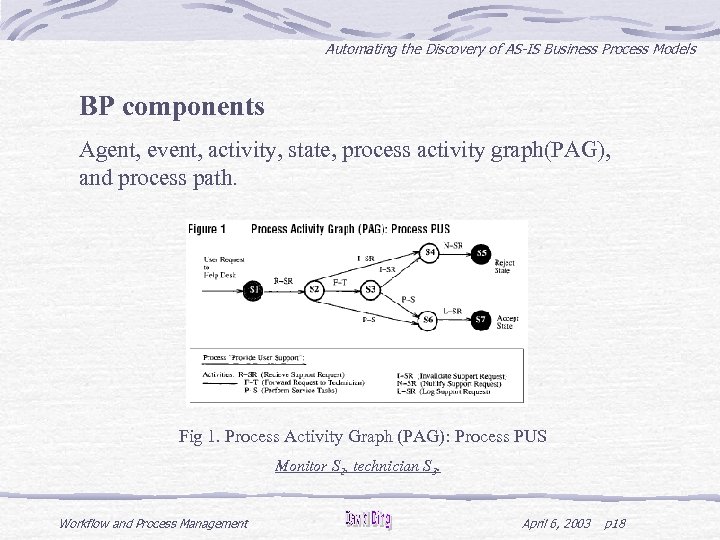 Automating the Discovery of AS-IS Business Process Models BP components Agent, event, activity, state, process activity graph(PAG), and process path. Fig 1. Process Activity Graph (PAG): Process PUS Monitor S 2, technician S 3. Workflow and Process Management April 6, 2003 p 18
 Automating the Discovery of AS-IS Business Process Models Non-trivial • PAG represents the activity flows of a BP model, and is a critical component of BP model. • Given a PAG for a process, control flow in the process will be able to be identified. Basic intuition • Experience and record a process by keeping a log of the events. • Frequently recur patterns present true process behavior. • Probabilistic and algorithmic strategies in Finite State Machine (FSM) are applied to extract PAGs from organizational behavior traces. Workflow and Process Management April 6, 2003 p 19
 Automating the Discovery of AS-IS Business Process Models The Probabilistic Strategy Examine the activity stream of a BP, use stochastic process modeling techniques to find the most probable activity sequence. 1 st. The nth order activity-sequence probability matrix is constructed 2 nd. The activity graph (AG) is drawn from the probability matrix 3 rd. Repetitive edges in AG are eliminated and all the remaining edges are newly and uniquely labeled 4 th. AG is converted into it dual, AG’ 5 th. AG’ is converted into the final Process Activity Graph for the BP by taking away illegal edges Workflow and Process Management April 6, 2003 p 20
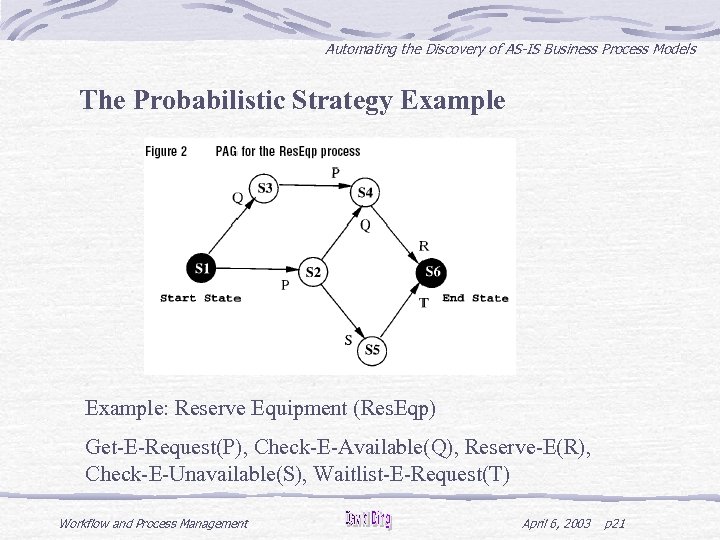 Automating the Discovery of AS-IS Business Process Models The Probabilistic Strategy Example: Reserve Equipment (Res. Eqp) Get-E-Request(P), Check-E-Available(Q), Reserve-E(R), Check-E-Unavailable(S), Waitlist-E-Request(T) Workflow and Process Management April 6, 2003 p 21
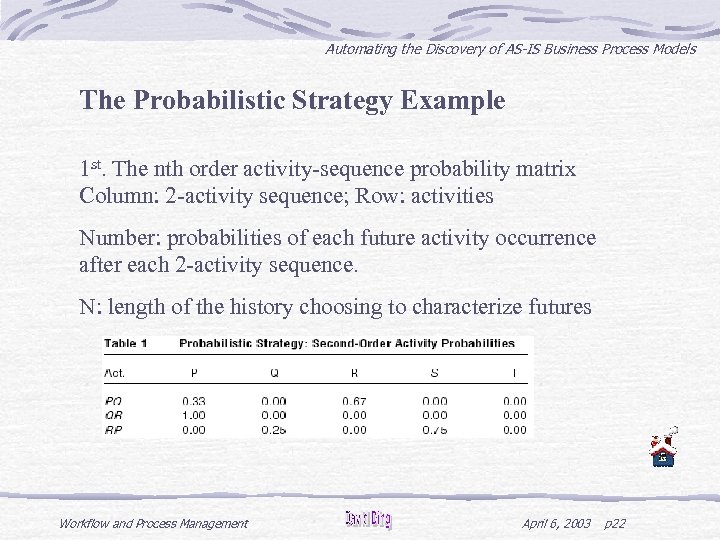 Automating the Discovery of AS-IS Business Process Models The Probabilistic Strategy Example 1 st. The nth order activity-sequence probability matrix Column: 2 -activity sequence; Row: activities Number: probabilities of each future activity occurrence after each 2 -activity sequence. N: length of the history choosing to characterize futures Workflow and Process Management April 6, 2003 p 22
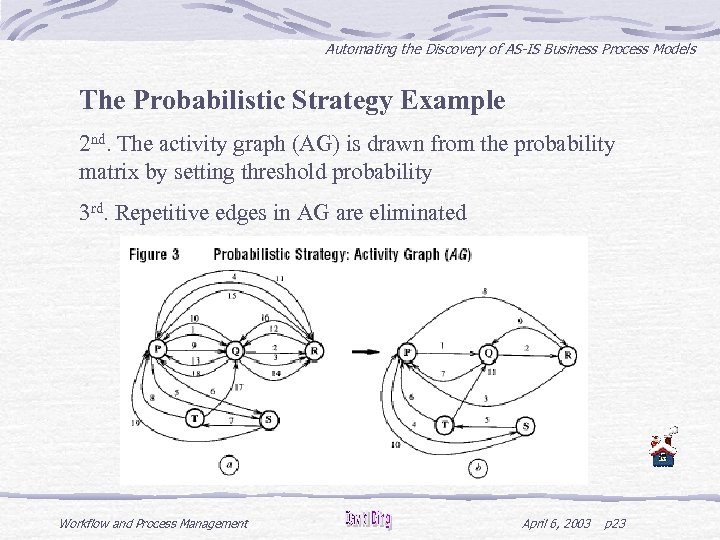 Automating the Discovery of AS-IS Business Process Models The Probabilistic Strategy Example 2 nd. The activity graph (AG) is drawn from the probability matrix by setting threshold probability 3 rd. Repetitive edges in AG are eliminated Workflow and Process Management April 6, 2003 p 23
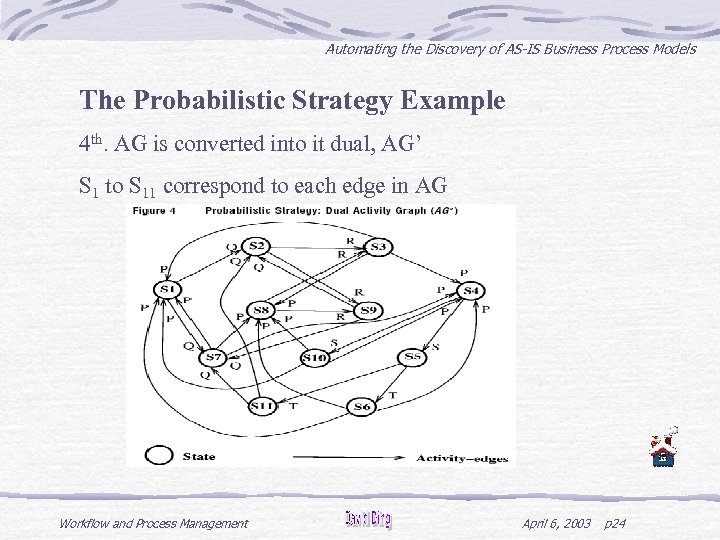 Automating the Discovery of AS-IS Business Process Models The Probabilistic Strategy Example 4 th. AG is converted into it dual, AG’ S 1 to S 11 correspond to each edge in AG Workflow and Process Management April 6, 2003 p 24
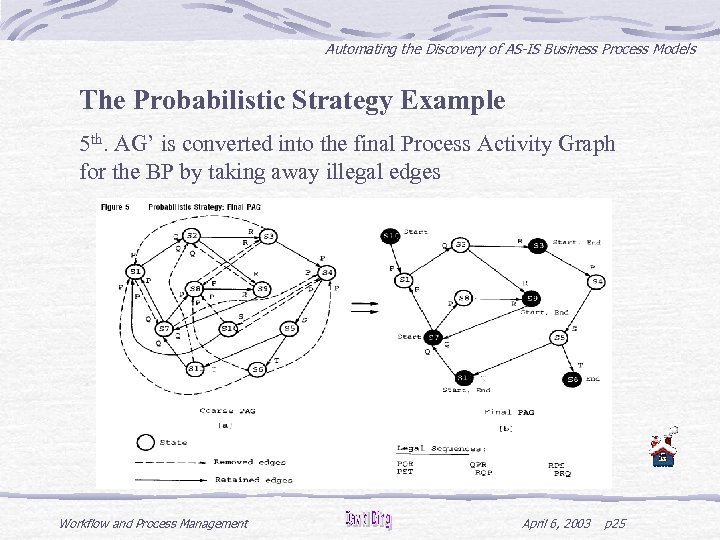 Automating the Discovery of AS-IS Business Process Models The Probabilistic Strategy Example 5 th. AG’ is converted into the final Process Activity Graph for the BP by taking away illegal edges Workflow and Process Management April 6, 2003 p 25
 Automating the Discovery of AS-IS Business Process Models The Algorithmic Strategy Extract a model of BP process algorithmically from a sample. B-F algorithm: Any state of a process is defined by what future behaviors can occur from it. Equivalence Classes: Two histories belong to same equivalence level if they have the same future identity. Workflow and Process Management April 6, 2003 p 26
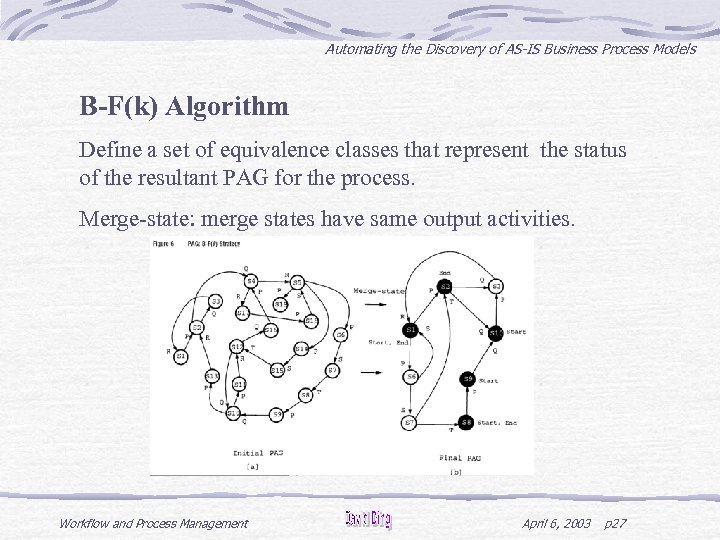 Automating the Discovery of AS-IS Business Process Models B-F(k) Algorithm Define a set of equivalence classes that represent the status of the resultant PAG for the process. Merge-state: merge states have same output activities. Workflow and Process Management April 6, 2003 p 27
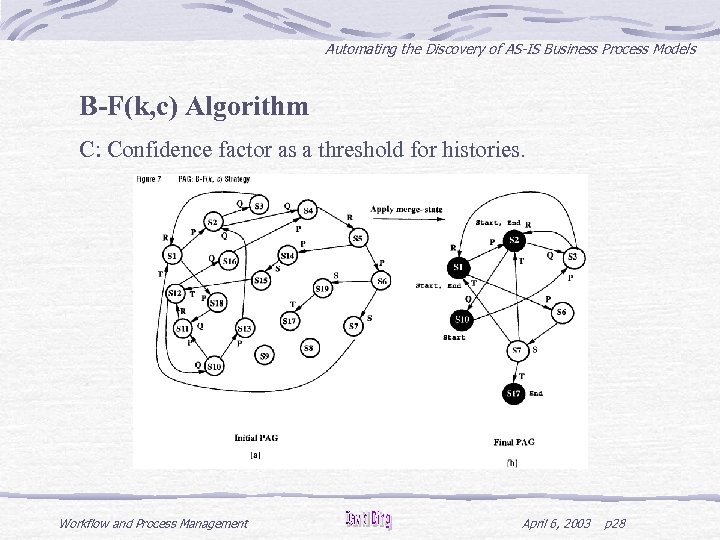 Automating the Discovery of AS-IS Business Process Models B-F(k, c) Algorithm C: Confidence factor as a threshold for histories. Workflow and Process Management April 6, 2003 p 28
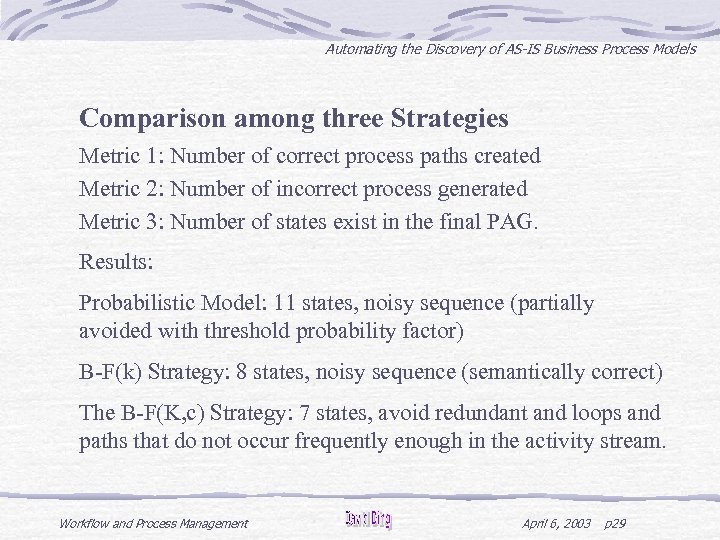 Automating the Discovery of AS-IS Business Process Models Comparison among three Strategies Metric 1: Number of correct process paths created Metric 2: Number of incorrect process generated Metric 3: Number of states exist in the final PAG. Results: Probabilistic Model: 11 states, noisy sequence (partially avoided with threshold probability factor) B-F(k) Strategy: 8 states, noisy sequence (semantically correct) The B-F(K, c) Strategy: 7 states, avoid redundant and loops and paths that do not occur frequently enough in the activity stream. Workflow and Process Management April 6, 2003 p 29
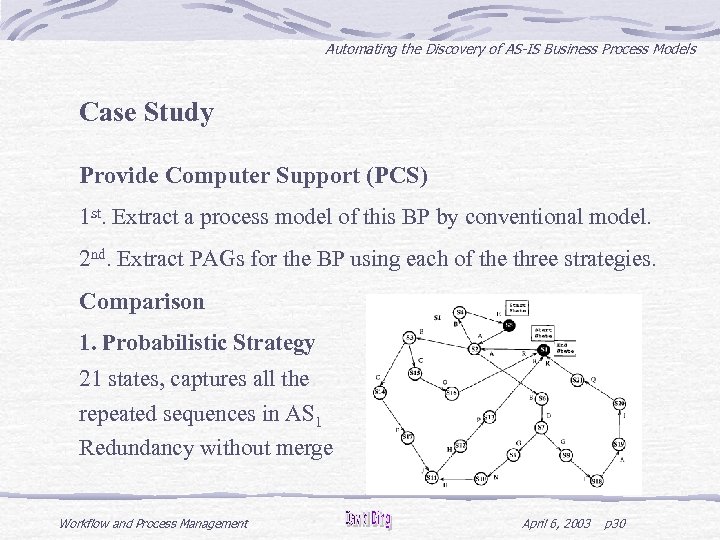 Automating the Discovery of AS-IS Business Process Models Case Study Provide Computer Support (PCS) 1 st. Extract a process model of this BP by conventional model. 2 nd. Extract PAGs for the BP using each of the three strategies. Comparison 1. Probabilistic Strategy 21 states, captures all the repeated sequences in AS 1 Redundancy without merge Workflow and Process Management April 6, 2003 p 30
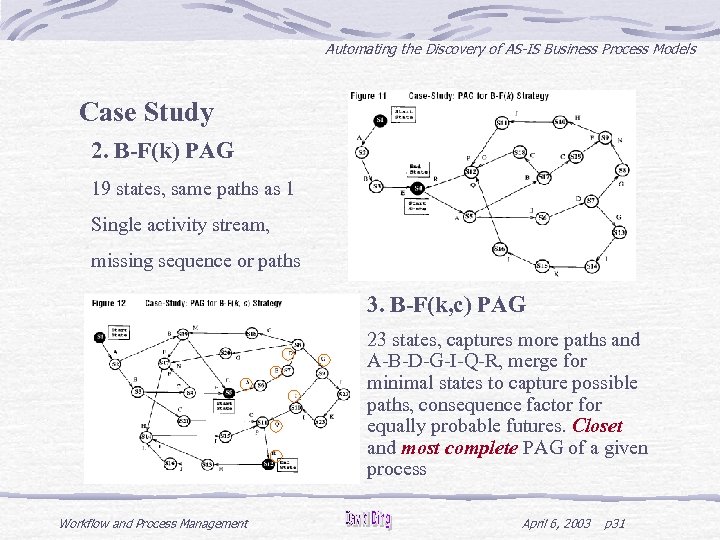 Automating the Discovery of AS-IS Business Process Models Case Study 2. B-F(k) PAG 19 states, same paths as 1 Single activity stream, missing sequence or paths 3. B-F(k, c) PAG 23 states, captures more paths and A-B-D-G-I-Q-R, merge for minimal states to capture possible paths, consequence factor for equally probable futures. Closet and most complete PAG of a given process Workflow and Process Management April 6, 2003 p 31
 Automating the Discovery of AS-IS Business Process Models Contribution Practical: Postulates a number of systematic procedures to extract AS-IS process model. Theoretical: Recognize the commonality between grammar discovery problem and the BP discovery problem. First to look at automating BP discovery. Future work Pursue ways of refining algorithms to discover control flows Workflow and Process Management April 6, 2003 p 32
 Tools for Inventing Organizations: Towards a Handbook of Organizational Process OUTLINE Gap: Need to innovate but lack the tool for doing so. A novel theoretical and empirical approach to tasks such as business process redesign and knowledge management is proposed. Goal: Provide a “proof of concept” that such a handbook are both technically feasible and managerially useful. Workflow and Process Management April 6, 2003 p 33
 Tools for Inventing Organizations: A Handbook Challenge • How to recognize and represent organizational processes? Flow charts and data-flow diagrams, Petri nets, and goalbased model • How to do this better? Analyzing and representing process with representation of similarity • Notions of specialization of processes • Managing dependencies Workflow and Process Management April 6, 2003 p 34
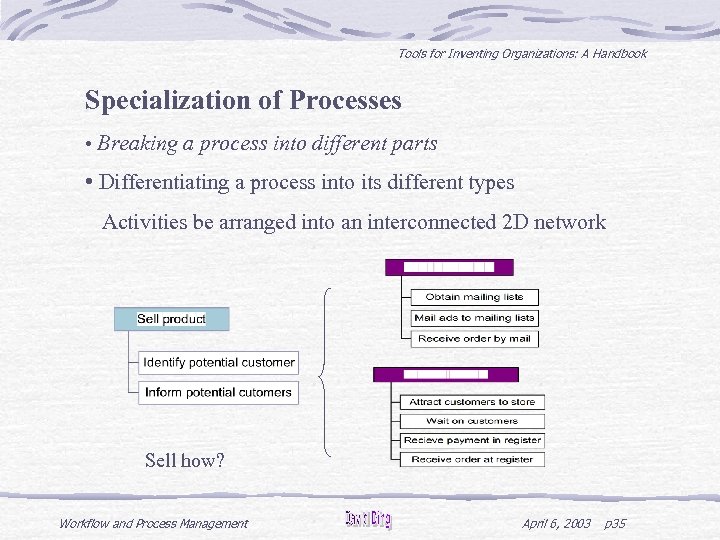 Tools for Inventing Organizations: A Handbook Specialization of Processes • Breaking a process into different parts • Differentiating a process into its different types Activities be arranged into an interconnected 2 D network Sell how? Workflow and Process Management April 6, 2003 p 35
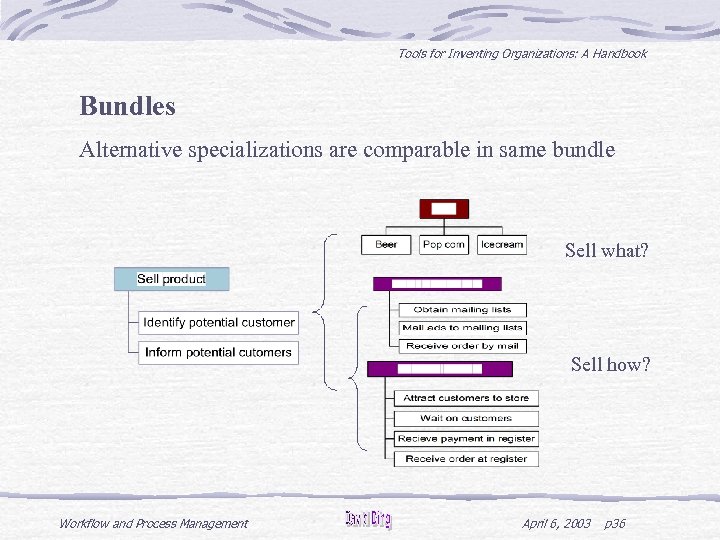 Tools for Inventing Organizations: A Handbook Bundles Alternative specializations are comparable in same bundle Sell what? Sell how? Workflow and Process Management April 6, 2003 p 36
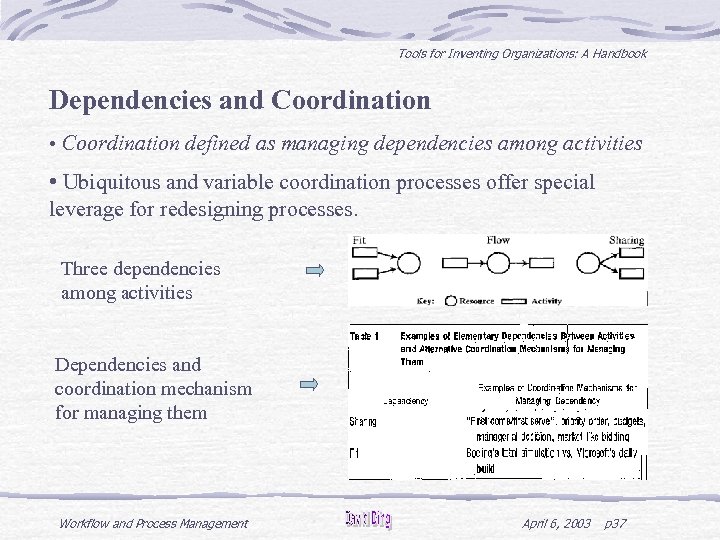 Tools for Inventing Organizations: A Handbook Dependencies and Coordination • Coordination defined as managing dependencies among activities • Ubiquitous and variable coordination processes offer special leverage for redesigning processes. Three dependencies among activities Dependencies and coordination mechanism for managing them Workflow and Process Management April 6, 2003 p 37
 Tools for Inventing Organizations: A Handbook Specialization and Decomposition of Dependencies • Some dependencies are specializations or being composed of others • Managing three dependencies amounts to having • Right Thing, at • Right Time, and in • Right Place. • Each dependencies has different processes for managing it Workflow and Process Management April 6, 2003 p 38
 Tools for Inventing Organizations: A Handbook Related works Organization Theory and Design • Classification, identifying alternatives, improvements • Importance of coordination in organizational design • Useful ways of organizing knowledge • Computer Science • Process Handbook uses both process specialization and dependencies with coordination mechanisms to generate and organize examples • Goal difference: Build systems to help people design and carry out processes, or support human-decision-makers Workflow and Process Management April 6, 2003 p 39
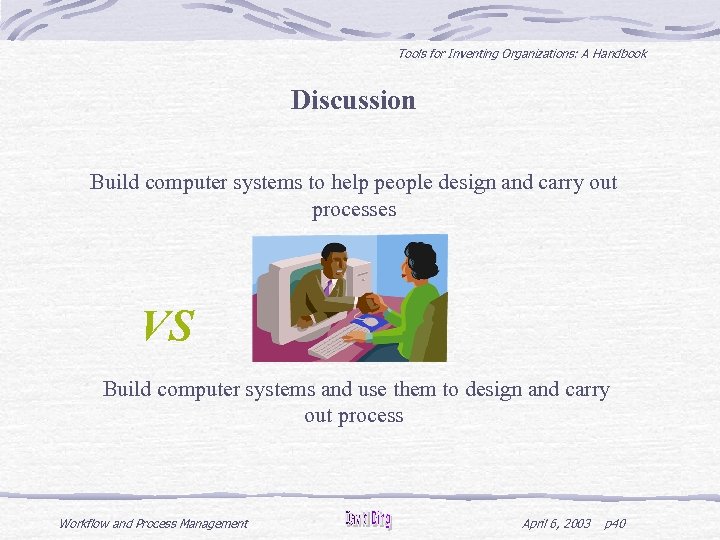 Tools for Inventing Organizations: A Handbook Discussion Build computer systems to help people design and carry out processes VS Build computer systems and use them to design and carry out process Workflow and Process Management April 6, 2003 p 40
 Tools for Inventing Organizations: A Handbook Process Handbook • VB based • Web user Interfaced (activities description, links, views of specializations and decompositions, automated support for inheritance and dependencies) • Information Contended (examples from organizations and generic business processes) • “Top down” and “bottom up” structured Workflow and Process Management April 6, 2003 p 41
 Tools for Inventing Organizations: A Handbook Process Handbook Example Firm A Experiencing problems with hiring process, who have invested into “as is” process analysis using conventional techniques. • Specification enables richer ways of indexing example pools • Analyzing hiring process from a coordination point of view, quickly identifying ways for managing the sharing dependency • “Passed through a doorway where all sorts of things that have never imagined before now seemed possible. ” Workflow and Process Management April 6, 2003 p 42
 Tools for Inventing Organizations: A Handbook Discussion Advantages • 1 st. Using a specialization hierarchy in combination with explicitly representation of coordination and dependencies, supports a rapid assessment of basic features of a process • 2 nd. The specialization hierarchy provided a powerful framework for generating new process ideas • 3 rd. “Process-oriented” , distinguish process with organizational structure or roles of particular people. • Identifying new ways of doing old tasks and managing connected process that span organizational boundaries Workflow and Process Management April 6, 2003 p 43
 Tools for Inventing Organizations: A Handbook Discussion Disadvantages • 1 st. Statistic process representation is more stable and routine than most business process actually are, • 2 nd. Explicitly representations of process will be interpreted by subjected too rigidly, should be a source. Workflow and Process Management April 6, 2003 p 44
 Tools for Inventing Organizations: A Handbook Contribution • Take advantage of human abilities to analyze, organize, and communicate knowledge • Approach depends on the quality and amount of human intelligence applied to the problem of generating and organizing knowledge in the system • The Handbook has an advantage over more formal approaches with allowing multiple alternatives coexist in the system. Workflow and Process Management April 6, 2003 p 45
 Time for BREAK! Workflow and Process Management April 6, 2003 p 46
 Dynamic Routing and Operational Controls in Workflow Management Systems OUTLINE Gap: A need to address the authorization, control issues, and handle exceptions in WMS. Goal: Develop a framework for managing workflows in an efficient and orderly manner with maximal degrees of flexibility. Workflow and Process Management April 6, 2003 p 47
 Dynamic Routing and Operational Controls Framework Conceptions Document, worker, role, task. • Field: Data element contained in a document that has a numerical or symbolic value • Work basket: A stack of documents waiting to be processed • Sequence dependency: Two tasks that must be performed by different roles in a given sequence create a sequence dependency Workflow and Process Management April 6, 2003 p 48
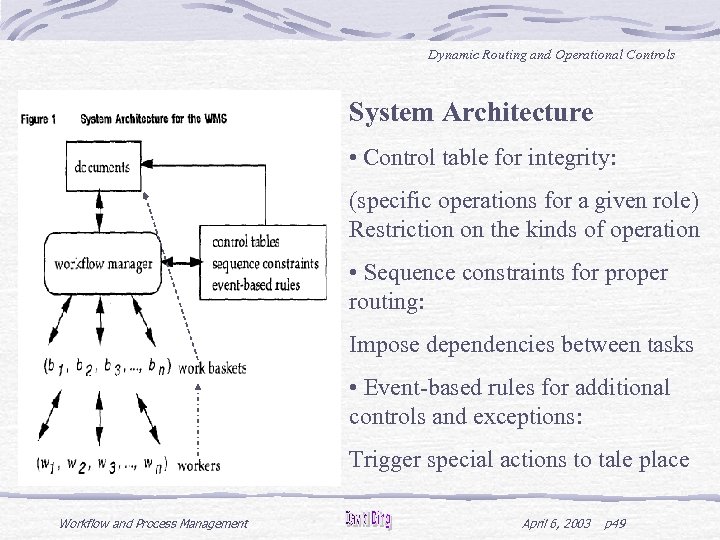 Dynamic Routing and Operational Controls System Architecture • Control table for integrity: (specific operations for a given role) Restriction on the kinds of operation • Sequence constraints for proper routing: Impose dependencies between tasks • Event-based rules for additional controls and exceptions: Trigger special actions to tale place Workflow and Process Management April 6, 2003 p 49
 Dynamic Routing and Operational Controls Framework Con’d • Work flow tables: specify authorizations for access; • Sequence constraints: specify order for access, which override work flow table; • Event-based rules: supersede above two and represents a more sophisticated means of managing the workflow and handling special situations. Workflow and Process Management April 6, 2003 p 50
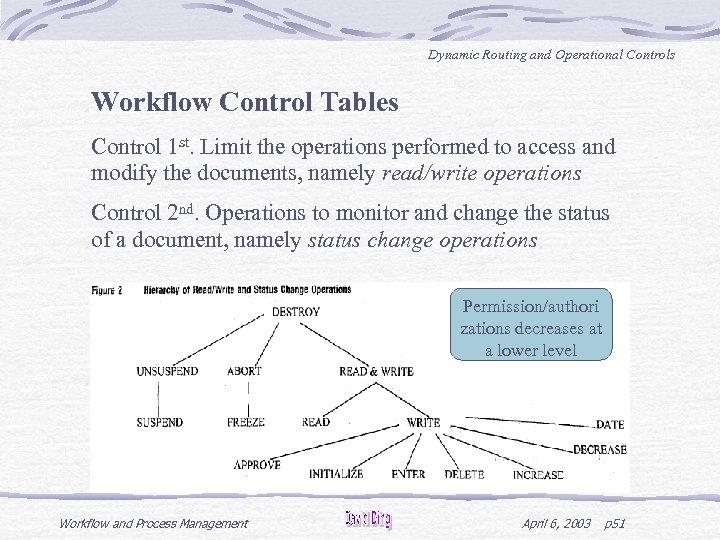 Dynamic Routing and Operational Controls Workflow Control Tables Control 1 st. Limit the operations performed to access and modify the documents, namely read/write operations Control 2 nd. Operations to monitor and change the status of a document, namely status change operations Permission/authori zations decreases at a lower level Workflow and Process Management April 6, 2003 p 51
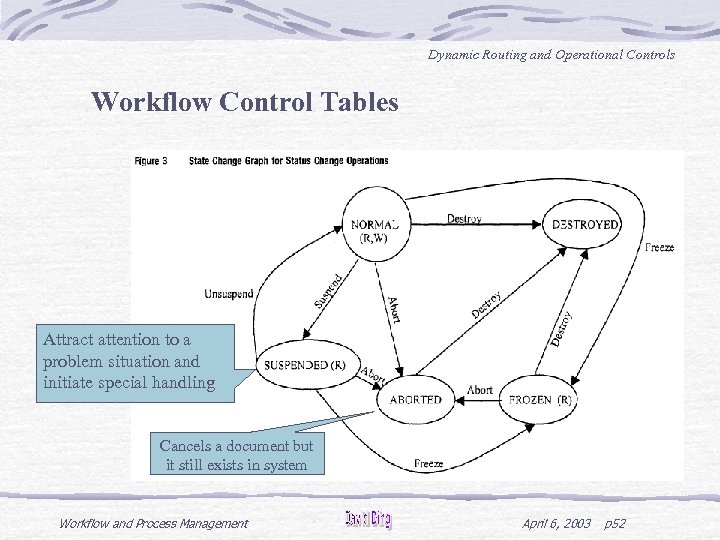 Dynamic Routing and Operational Controls Workflow Control Tables Attract attention to a problem situation and initiate special handling Cancels a document but it still exists in system Workflow and Process Management April 6, 2003 p 52
 Dynamic Routing and Operational Controls Workflow Sequence Constraints • Objective in this paper: support flexible routing by providing a routing scheme (the specification of routing paths that a workflow is required to follow) consisting of a set of sequence constraints (which specifies the rules that a document routing should observe so that the business procedures are not validated)to describe a business process. Workflow and Process Management April 6, 2003 p 53
 Dynamic Routing and Operational Controls Workflow Sequence Constraints PCL (Process Constraint Language) • Events: Action that considered relevant in a process involving routing of a workflow (Origin-S, freeze-E) • Precedence: Sequential relationships between events (Follow once, each, immediate, and not) • Clusters: PARA (parallel): ({e 1, e 2, …, en})m independent SEQ (sequential): ([e 1, e 2, …, en])m dependent Workflow and Process Management April 6, 2003 p 54
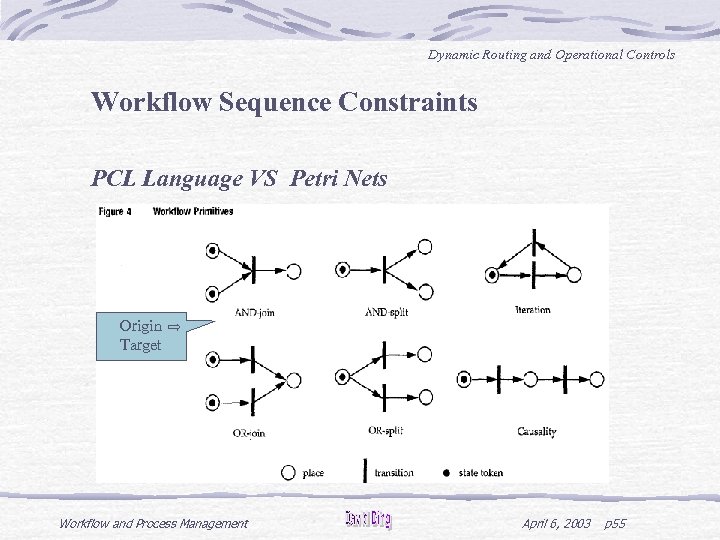 Dynamic Routing and Operational Controls Workflow Sequence Constraints PCL Language VS Petri Nets Origin Target Workflow and Process Management April 6, 2003 p 55
 Dynamic Routing and Operational Controls Workflow Sequence Constraints PCL Language VS Petri Nets PCL not only represents the constraints that apply to the routing scheme, but also permit those not specifically prohibited. PN is superior for graphical representation. Constraint verification and enforcement Enforce the partial ordering defined by sequence constraints and refuse routing paths that are not legitimate. Workflow and Process Management April 6, 2003 p 56
 Dynamic Routing and Operational Controls Event-Based Workflow Management Rules Gap: Operations cannot be supported by former two constraints because they cannot express events and conditions Employing in • Supporting sophistic routings on complex conditions • Monitoring quality and efficiency of operations • Prohibiting unauthorized operations (Control Rules) • Carrying out automatic operations (Operations Rules) • Handling exceptions Rules Workflow and Process Management April 6, 2003 p 57
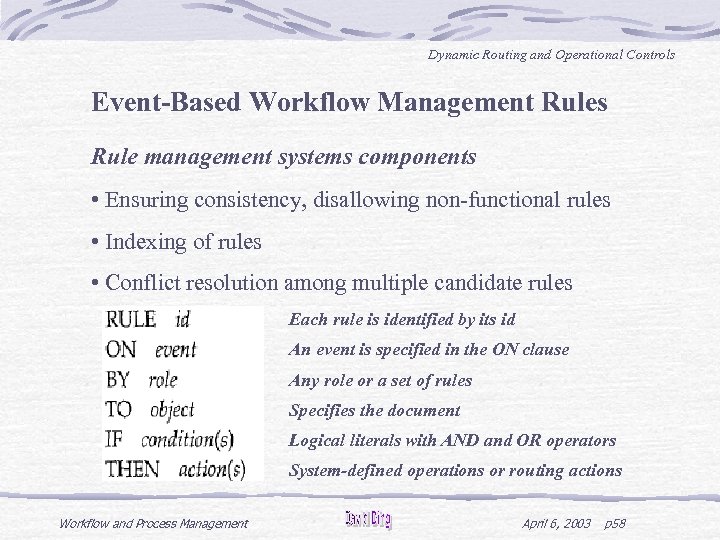 Dynamic Routing and Operational Controls Event-Based Workflow Management Rules Rule management systems components • Ensuring consistency, disallowing non-functional rules • Indexing of rules • Conflict resolution among multiple candidate rules Each rule is identified by its id An event is specified in the ON clause Any role or a set of rules Specifies the document Logical literals with AND and OR operators System-defined operations or routing actions Workflow and Process Management April 6, 2003 p 58
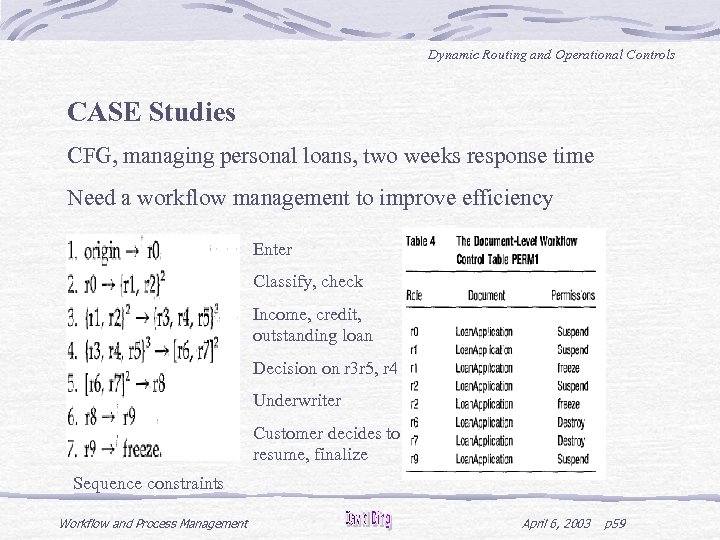 Dynamic Routing and Operational Controls CASE Studies CFG, managing personal loans, two weeks response time Need a workflow management to improve efficiency Enter Classify, check Income, credit, outstanding loan Decision on r 3 r 5, r 4 Underwriter Customer decides to resume, finalize Sequence constraints Workflow and Process Management April 6, 2003 p 59
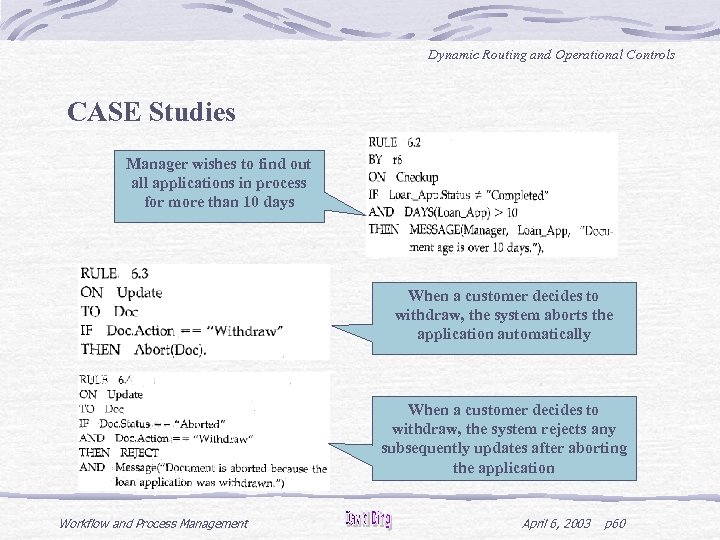 Dynamic Routing and Operational Controls CASE Studies Manager wishes to find out all applications in process for more than 10 days When a customer decides to withdraw, the system aborts the application automatically When a customer decides to withdraw, the system rejects any subsequently updates after aborting the application Workflow and Process Management April 6, 2003 p 60
 Dynamic Routing and Operational Controls Contribution • Release managers from certain routine and microlevel management activities, give them more time for making business decisions. • Emphasizes dynamic routing and is based on various tasks to be performed, and then imposing a minimal set of consequence constraints on the tasks. • Maximize the alternative routes that a document may take and increases parallelism without sacrificing accuracy. Workflow and Process Management April 6, 2003 p 61
 END Workflow and Process Management April 6, 2003 p 62