


 Скачать презентацию Work Session Personal Care Assisted Living Facilities
d54c61fac5ef14ce4711732f8f7f5a7d.ppt
- Количество слайдов: 17
 Work Session Personal Care / Assisted Living Facilities
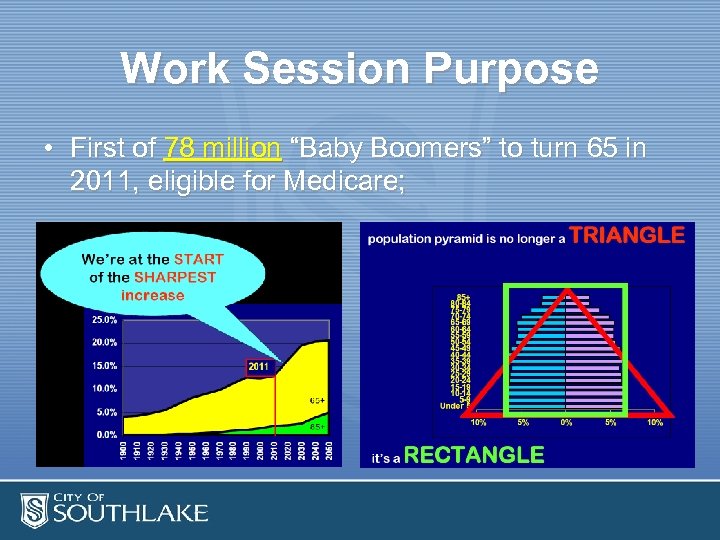 Work Session Purpose • First of 78 million “Baby Boomers” to turn 65 in 2011, eligible for Medicare;
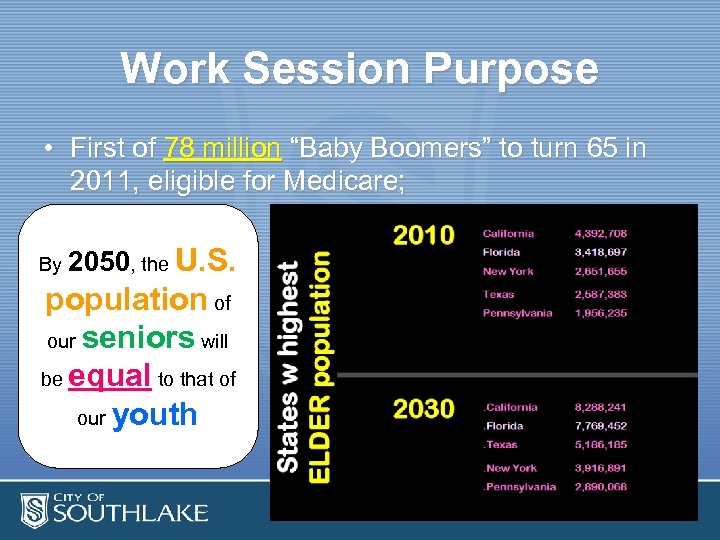 Work Session Purpose • First of 78 million “Baby Boomers” to turn 65 in 2011, eligible for Medicare; U. S. population of our seniors will be equal to that of our youth By 2050, the
 Work Session Purpose • First of 78 million “Baby Boomers” to turn 65 in 2011, eligible for Medicare; • Southlake dedicated to providing quality of life to residents of all ages; • In the wake of numerous proposals and increased market demand, regulations governing Personal Care / Assisted Living Facilities in Southlake ought to be reviewed; • Staff seeking direction from City Council.
 Current Zoning Regulations
 Personal Care Facilities An establishment that furnishes, in one or more facilities, food and shelter to four or more persons who are unrelated to the proprietor of the establishment; and provides personal care services; and in addition, provides minor treatment under the direction and supervision of the resident’s attending physician licensed by the Texas State Board of Medical Examiners, or services which meet some need beyond basic provision of food, shelter, and laundry. Incidental uses and/or services may include protective supervision, personal care, social and recreational services, transportation services, private or common kitchen/dining facilities, so long as such services are provided to residents only.
 Where Permitted • Not permitted in any zoning district by right • Requires Specific Use Permit (SUP) Approval • Permitted in all nonsingle family residential zoning districts with SUP Personal care facilities, are encouraged to be located within walking distance of shopping areas, medical offices, civic centers, public parks, religious facilities, and other related facilities or may be located in transitional areas adjacent to low and medium density residential developments when compatible and shall be subject to the requirements set forth in Section 45. 8 of this ordinance.
 SUP Regulations General Criteria Concept & Site Plan • Approval based on analysis of: • A letter describing the facility’s services, amenities, ancillary uses, proposed number of occupants and service personnel • A floor plan and list of intended uses – – – Location Site layout & design Adequacy of public infrastructure – Land use compatibility • Must meet state licensing requirements
 SUP Regulations Required Amenities Permitted Amenities • Cafeteria/Dining Room • Housekeeping Service • Furnish/Transportation to: • Encouraged examples: – – – Library Game Room Exercise Room – – – Chapel Swimming Pool / Jacuzzi Home Theater Arts & Crafts Facilities Green House Related Uses
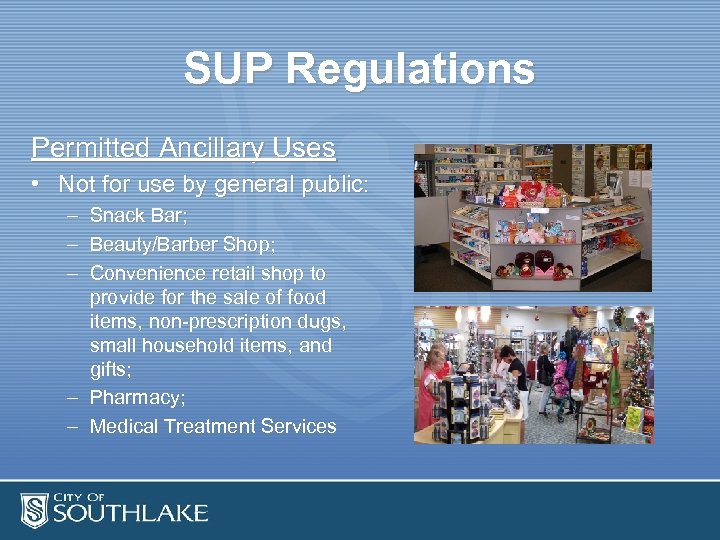 SUP Regulations Permitted Ancillary Uses • Not for use by general public: – – – Snack Bar; Beauty/Barber Shop; Convenience retail shop to provide for the sale of food items, non-prescription dugs, small household items, and gifts; – Pharmacy; – Medical Treatment Services
 SUP Regulations • Height: Limited to 1 story if within 100’ of singlefamily residential • Minimum Unit Floor Area: – – – 350 s. f. efficiency unit 450 s. f. one-bedroom unit 550 s. f. two-bedroom unit • Maximum Density: 12 du/acre • Parking: 10 spaces plus 1. 5 spaces per 3 beds
 State Definition An assisted living facility must be licensed as a Type A, Type B, or Type C facility. A facility's licensure type is based on the capability of the residents to evacuate the facility or the types of services the facility provides, or both. Type A. In a Type A facility, a resident: (1) must be physically and mentally capable of evacuating the facility without physical assistance from staff, (2) does not require routine attendance during nighttime sleeping hours; and (3) must be capable of following directions under emergency conditions.
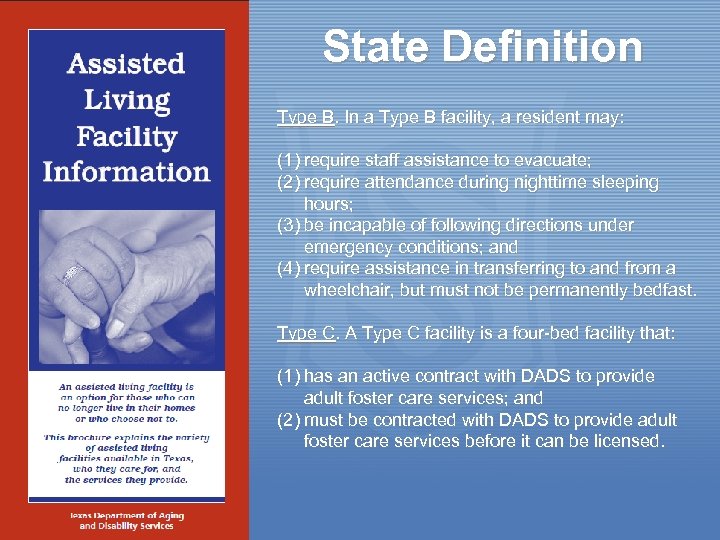 State Definition Type B. In a Type B facility, a resident may: (1) require staff assistance to evacuate; (2) require attendance during nighttime sleeping hours; (3) be incapable of following directions under emergency conditions; and (4) require assistance in transferring to and from a wheelchair, but must not be permanently bedfast. Type C. A Type C facility is a four-bed facility that: (1) has an active contract with DADS to provide adult foster care services; and (2) must be contracted with DADS to provide adult foster care services before it can be licensed.
 Amendment Possibilities • Increasing floor area requirements for dwelling units and other uses; • Address convenient accessibility through the number and location of elevators; • Provide semi-private gathering places for families; • Provide computer/internet access; and • Provide usable, walkable, and shaded open space areas with amenities (i. e. seating area, garden, water fountain).
 Other Considerations • Revising “Personal Care” to “Assisted Living” to be in line with the terminology of the Texas Department of Aging and Disability Services; • Reviewing policies on other senior-friendly uses, such as: – Adult Day Care – Mother-in-Law Suites – Other uses?
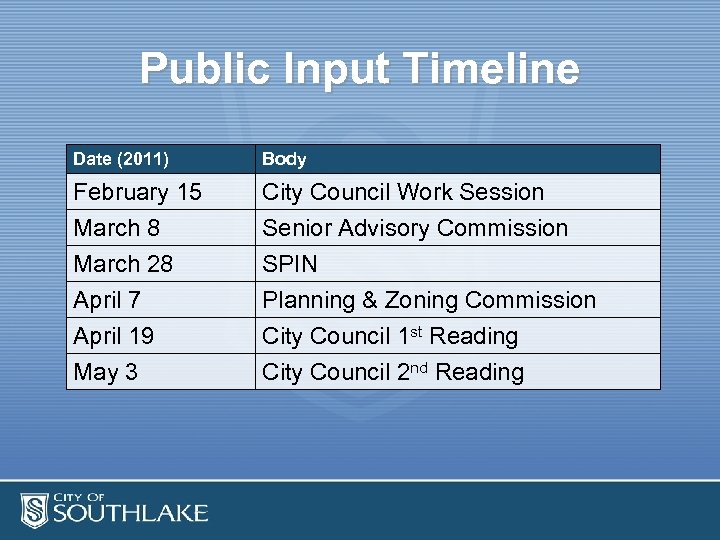 Public Input Timeline Date (2011) Body February 15 March 8 March 28 City Council Work Session Senior Advisory Commission SPIN April 7 April 19 May 3 Planning & Zoning Commission City Council 1 st Reading City Council 2 nd Reading
 Questions? Discussion / Direction