


 Скачать презентацию WORK RULES of the course History of management
lecture_1_2013.ppt
- Количество слайдов: 18
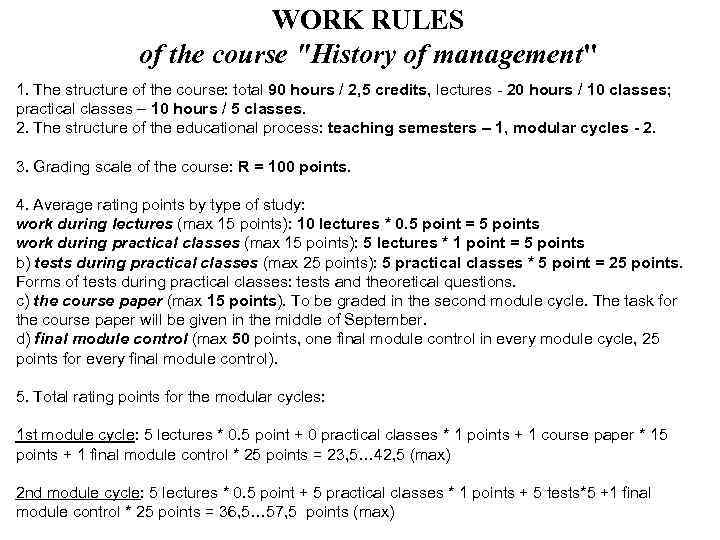 WORK RULES of the course "History of management" 1. The structure of the course: total 90 hours / 2, 5 credits, lectures - 20 hours / 10 classes; practical classes – 10 hours / 5 classes. 2. The structure of the educational process: teaching semesters – 1, modular cycles - 2. 3. Grading scale of the course: R = 100 points. 4. Average rating points by type of study: work during lectures (max 15 points): 10 lectures * 0. 5 point = 5 points work during practical classes (max 15 points): 5 lectures * 1 point = 5 points b) tests during practical classes (max 25 points): 5 practical classes * 5 point = 25 points. Forms of tests during practical classes: tests and theoretical questions. c) the course paper (max 15 points). To be graded in the second module cycle. The task for the course paper will be given in the middle of September. d) final module control (max 50 points, one final module control in every module cycle, 25 points for every final module control). 5. Total rating points for the modular cycles: 1 st module cycle: 5 lectures * 0. 5 point + 0 practical classes * 1 points + 1 course paper * 15 points + 1 final module control * 25 points = 23, 5… 42, 5 (max) 2 nd module cycle: 5 lectures * 0. 5 point + 5 practical classes * 1 points + 5 tests*5 +1 final module control * 25 points = 36, 5… 57, 5 points (max)
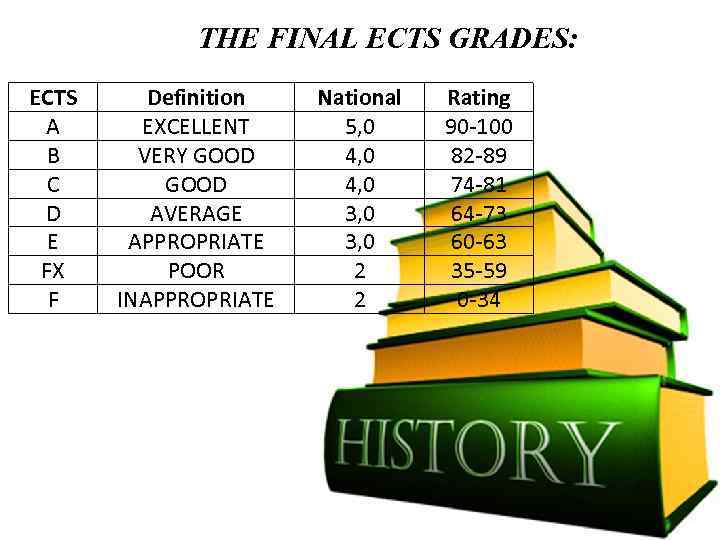 THE FINAL ECTS GRADES: ECTS A B C D E FX F Definition EXCELLENT VERY GOOD AVERAGE APPROPRIATE POOR INAPPROPRIATE National 5, 0 4, 0 3, 0 2 2 Rating 90 -100 82 -89 74 -81 64 -73 60 -63 35 -59 0 -34
 LECTURE 1 - THE EVOLUTION OF MANAGEMENT THEORY: INTRODUCTION OUTLINE: 1. Historical perspective 2. Definition of management 3. Time line of management thought
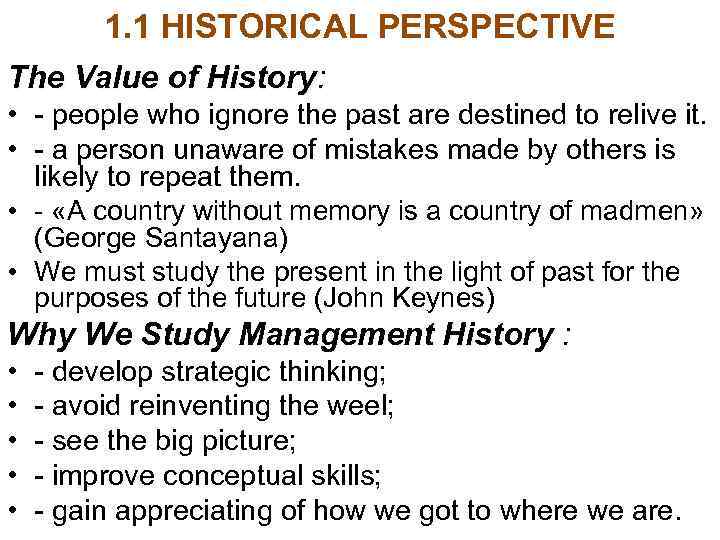 1. 1 HISTORICAL PERSPECTIVE The Value of History: • - people who ignore the past are destined to relive it. • - a person unaware of mistakes made by others is likely to repeat them. • - «А country without memory is a country of madmen» (George Santayana) • We must study the present in the light of past for the purposes of the future (John Keynes) Why We Study Management History : • • • - develop strategic thinking; - avoid reinventing the weel; - see the big picture; - improve conceptual skills; - gain appreciating of how we got to where we are.
 1. 2 HISTORICAL PERSPECTIVE Environmental factors influencing management thought: • • • - economic influences - social influences - political influences - technological influence - global influences
 2. 1 DEFINITION OF MANAGEMENT «manage» = from the Italian maneggiare “to handle — especially tools” = from the Latin manus “hand” « management» = from Old French ménagement “the art of conducting, directing”, = from Latin manu agere “to lead by the hand” Management - characterises the process of leading and directing all or part of an organization, often a business, through the deplopment and manipulation of resources (human, financial, material, intellectual or intangible).
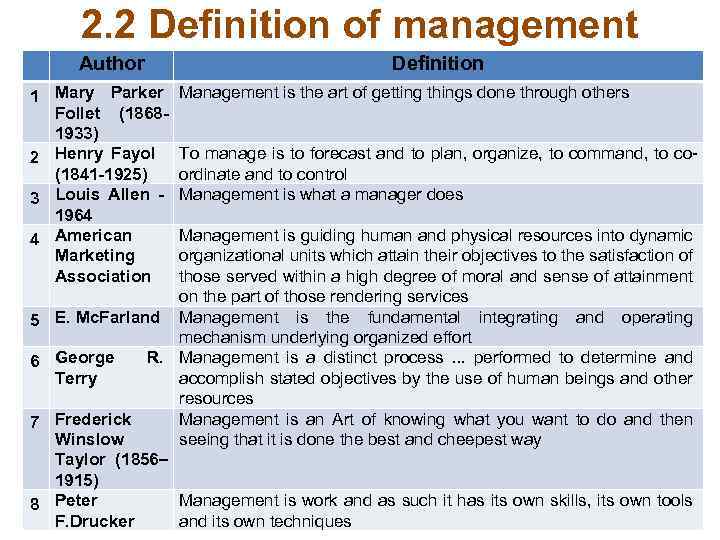 2. 2 Definition of management Author 1 Mary Parker Follet (18681933) 2 Henry Fayol (1841 -1925) 3 Louis Allen 1964 4 American Marketing Association Definition Management is the art of getting things done through others To manage is to forecast and to plan, organize, to command, to coordinate and to control Management is what a manager does Management is guiding human and physical resources into dynamic organizational units which attain their objectives to the satisfaction of those served within a high degree of moral and sense of attainment on the part of those rendering services 5 E. Mc. Farland Management is the fundamental integrating and operating mechanism underlying organized effort R. Management is a distinct process. . . performed to determine and 6 George Terry accomplish stated objectives by the use of human beings and other resources Management is an Art of knowing what you want to do and then 7 Frederick Winslow seeing that it is done the best and cheepest way Taylor (1856– 1915) Management is work and as such it has its own skills, its own tools 8 Peter F. Drucker and its own techniques
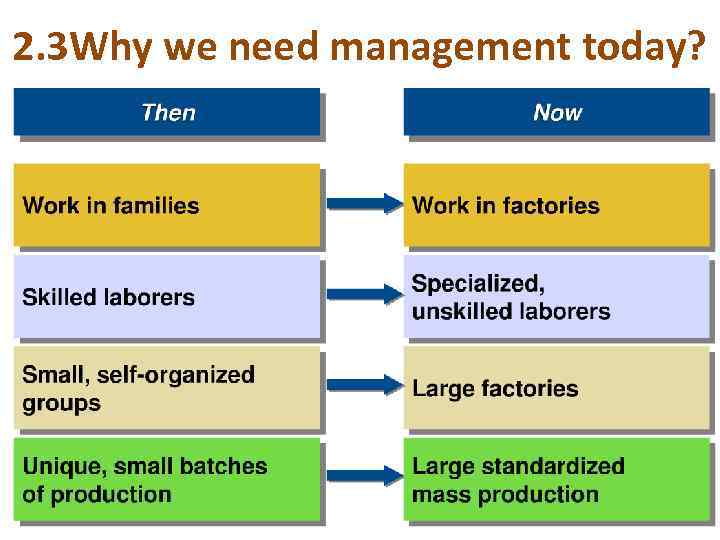 2. 3 Why we need management today?
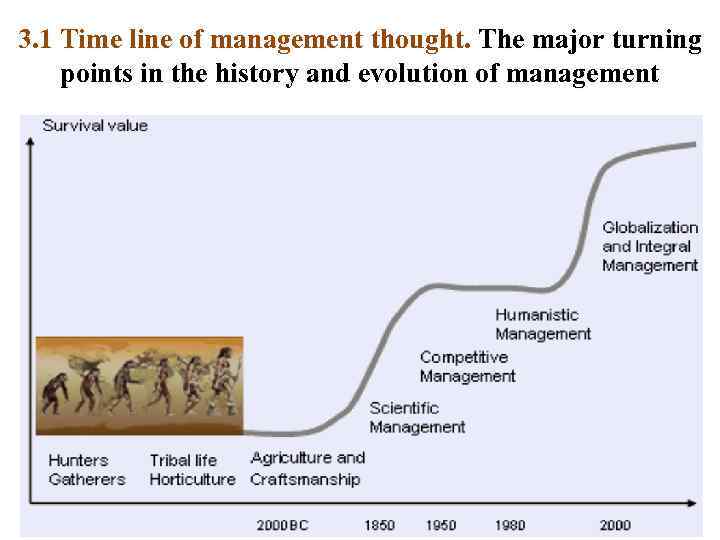 3. 1 Time line of management thought. The major turning points in the history and evolution of management
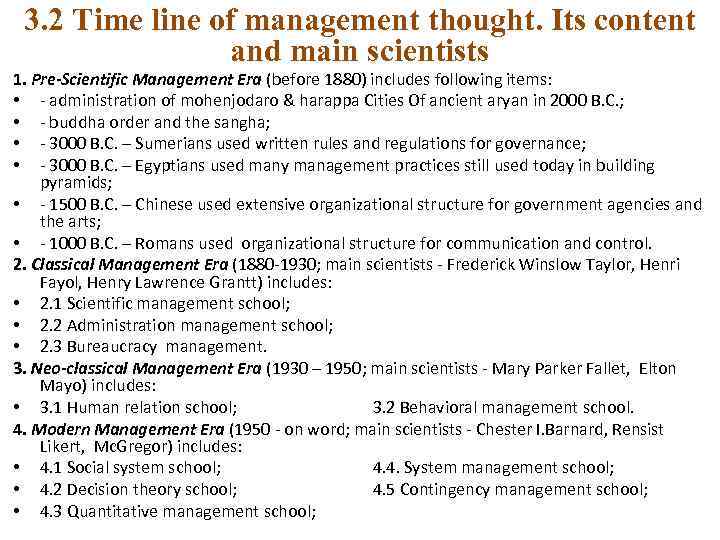 3. 2 Time line of management thought. Its content and main scientists 1. Pre-Scientific Management Era (before 1880) includes following items: • - administration of mohenjodaro & harappa Cities Of ancient aryan in 2000 B. C. ; • - buddha order and the sangha; • - 3000 В. С. – Sumerians used written rules and regulations for governance; • - 3000 B. C. – Egyptians used many management practices still used today in building pyramids; • - 1500 B. C. – Chinese used extensive organizational structure for government agencies and the arts; • - 1000 B. C. – Romans used organizational structure for communication and control. 2. Classical Management Era (1880 -1930; main scientists - Frederick Winslow Taylor, Henri Fayol, Henry Lawrence Grantt) includes: • 2. 1 Scientific management school; • 2. 2 Administration management school; • 2. 3 Bureaucracy management. 3. Neo-classical Management Era (1930 – 1950; main scientists - Mary Parker Fallet, Elton Mayo) includes: • 3. 1 Human relation school; 3. 2 Behavioral management school. 4. Modern Management Era (1950 - on word; main scientists - Chester I. Barnard, Rensist Likert, Mc. Gregor) includes: • 4. 1 Social system school; 4. 4. System management school; • 4. 2 Decision theory school; 4. 5 Contingency management school; • 4. 3 Quantitative management school;
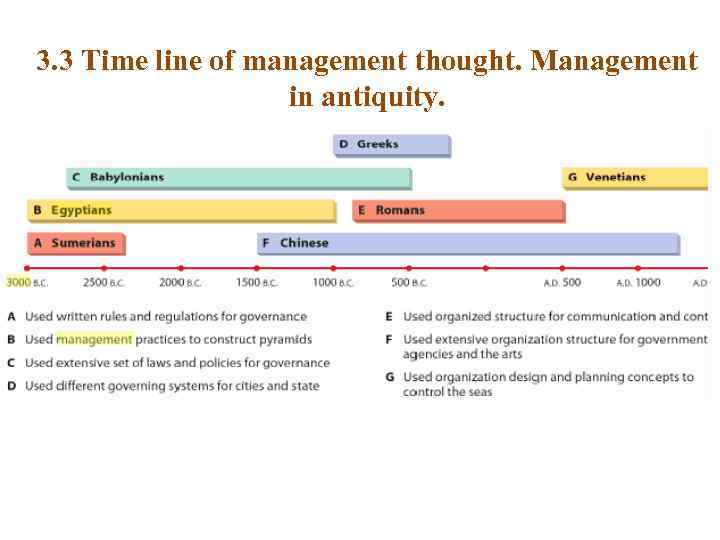 3. 3 Time line of management thought. Management in antiquity.
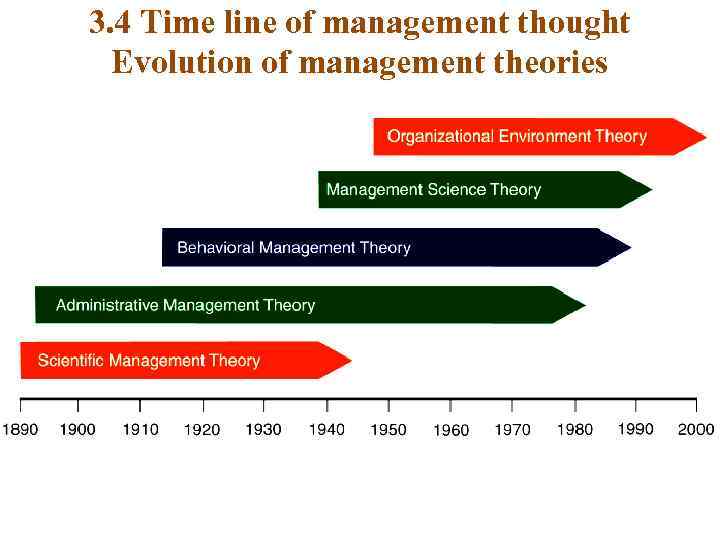 3. 4 Time line of management thought Evolution of management theories
 Conclusion: • The actual practice of management has been around for thousands of years. • Individuals from many different academic and professional areas have contributed to our knowledge of management. • There is no single theory of management that is universally accepted today.
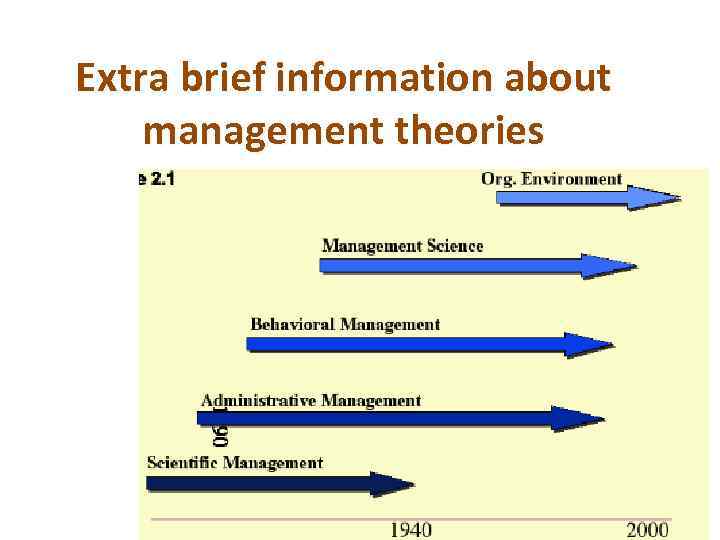 Extra brief information about management theories
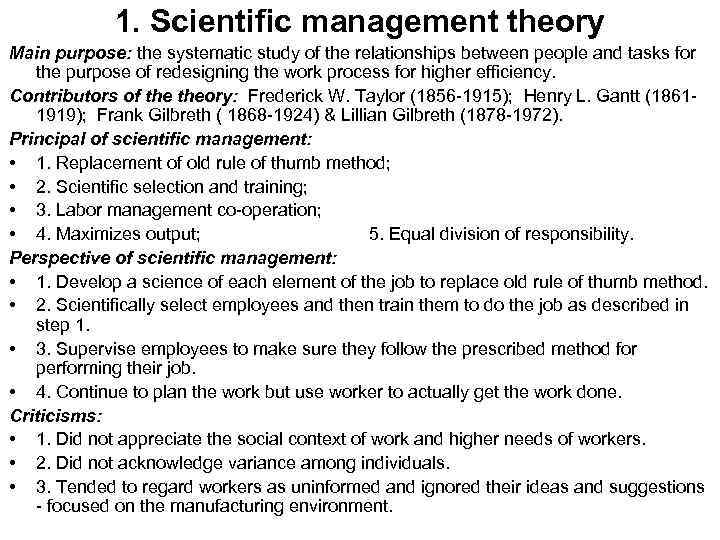 1. Scientific management theory Main purpose: the systematic study of the relationships between people and tasks for the purpose of redesigning the work process for higher efficiency. Contributors of theory: Frederick W. Taylor (1856 -1915); Henry L. Gantt (18611919); Frank Gilbreth ( 1868 -1924) & Lillian Gilbreth (1878 -1972). Principal of scientific management: • 1. Replacement of old rule of thumb method; • 2. Scientific selection and training; • 3. Labor management co-operation; • 4. Maximizes output; 5. Equal division of responsibility. Perspective of scientific management: • 1. Develop a science of each element of the job to replace old rule of thumb method. • 2. Scientifically select employees and then train them to do the job as described in step 1. • 3. Supervise employees to make sure they follow the prescribed method for performing their job. • 4. Continue to plan the work but use worker to actually get the work done. Criticisms: • 1. Did not appreciate the social context of work and higher needs of workers. • 2. Did not acknowledge variance among individuals. • 3. Tended to regard workers as uninformed and ignored their ideas and suggestions - focused on the manufacturing environment.
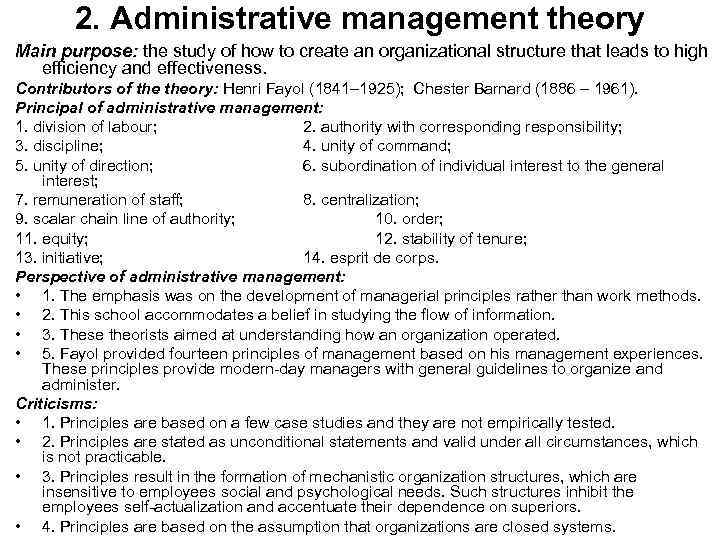 2. Administrative management theory Main purpose: the study of how to create an organizational structure that leads to high efficiency and effectiveness. Contributors of theory: Henri Fayol (1841– 1925); Chester Barnard (1886 – 1961). Principal of administrative management: 1. division of labour; 2. authority with corresponding responsibility; 3. discipline; 4. unity of command; 5. unity of direction; 6. subordination of individual interest to the general interest; 7. remuneration of staff; 8. centralization; 9. scalar chain line of authority; 10. order; 11. equity; 12. stability of tenure; 13. initiative; 14. esprit de corps. Perspective of administrative management: • 1. The emphasis was on the development of managerial principles rather than work methods. • 2. This school accommodates a belief in studying the flow of information. • 3. These theorists aimed at understanding how an organization operated. • 5. Fayol provided fourteen principles of management based on his management experiences. These principles provide modern-day managers with general guidelines to organize and administer. Criticisms: • 1. Principles are based on a few case studies and they are not empirically tested. • 2. Principles are stated as unconditional statements and valid under all circumstances, which is not practicable. • 3. Principles result in the formation of mechanistic organization structures, which are insensitive to employees social and psychological needs. Such structures inhibit the employees self-actualization and accentuate their dependence on superiors. • 4. Principles are based on the assumption that organizations are closed systems.
 3. Behavioral Management Theory Main purpose: the study of how managers should behave to motivate employees and encourage them to perform at high levels and be committed to the achievement of organizational goals: focuses on the way a manager should personally manage to motivate employees. Contributors of theory: Robert Owen (1771 – 1858); Mary Parker Follett (1868 – 1933) ; Elton Mayo (1880 - 1949); Douglas Mc. Gregor (1906 – 1964). Perspective of administrative management: • 1. The behavioral management school took management another step forward. • 2. By focusing on employees as individuals, as parts of work groups, behaviorists • forced management to view the work environment from another stance. • 3. Modern-day managers now view employees as individuals, as resources, and as • assets to be developed and worked with—not as machines. • 4. Contributors to the behavioral school advanced our understanding of management by emphasizing the importance of the individual within the organization—an element essentially ignored by writers of the classical school. Criticisms: • 1. The school integrated ideas from sociology, anthropology, and psychology with management theory, but its major limitation is its complexity. • 2. The behavioral school did not completely resolve issues concerning the nature of human motivation. Later studies were to dispute the belief that worker satisfaction was the prime cause of productivity.
 4. Management Science Theory Main purpose: an approach to management that uses rigorous quantitative techniques to maximize the use of organizational resources. Analizes complex systems of people, money, equipment, and procedures, with the goal of improving their effectiveness. Principal of management Science Theory: • 1. Management Science Theory includes: • - Quantitative management — utilizes linear programming, modeling, simulation systems and chaos theory. • - Operations management —techniques used to analyze all aspects of the production system. • - Total Quality Management (TQM) —focuses on analyzing input, conversion, and output activities to increase product quality. • - Management Information Systems (MIS) — provides information vital for effective decision making. 5. Organizational Environment Theory Main purpose: the set of forces and conditions that operate beyond an organization’s boundaries but affect a manager’s ability to acquire and utilize resources.