


 Скачать презентацию Work-Life Harmony Productivity AND Peace E Jeffrey Hill
dda68babd175a9032649934e1264a421.ppt
- Количество слайдов: 24
 Work-Life Harmony: Productivity AND Peace E. Jeffrey Hill, Ph. D. , CFLE BYU School of Family Life jeff_hill@byu. edu
 Brigham Young University Family Studies Center Background Work-Life Harmony Team n n Dr. E. Jeffrey Hill, BYU and n Dr. Graeme Russell, n Ellen Galinsky, CEO n Dr. Joseph Grzywacz, n Dr. D. Russell Crane, BYU n Mission: to make valuable contributions to families by encouraging, sponsoring, coordinating, and disseminating BYU’s intellectual effort related to the family Sponsors 30 projects in the United States and 10 other countries (Australia Bosnia, Cambodia, China, Japan, Russia, Singapore, South Africa, UK, and Vietnam) IBM Aequus Partners Families and Work Institute Wake Forest University
 Overview: Metaphor of Harmony vs. Balance n Work-Life Harmony Conceptual Model n Singapore National Study of Work-Life Harmony n – National Measure of Work-Life Harmony – Key Findings n IBM Global Work and Life Issues Surveys (1986 -2007) – Key Findings
 Work-Life Metaphors influence our thoughts n “Balance” and “Juggling”: are dominant work-family metaphors n Scarcity mentality based on time n Assumes a “Zero-Sum” game n Emphasis on conflict n Productivity comes at the expense of individual peace. n
 Harmony: A Better Metaphor n n n Harmony instead of Balance Person is the composer, orchestrator, and director of his/her own life. Life roles may harmonize or be dissonant (Work and family are preeminent) Emphasis on facilitation as well as conflict Productivity AND peace are BOTH possible simultaneously
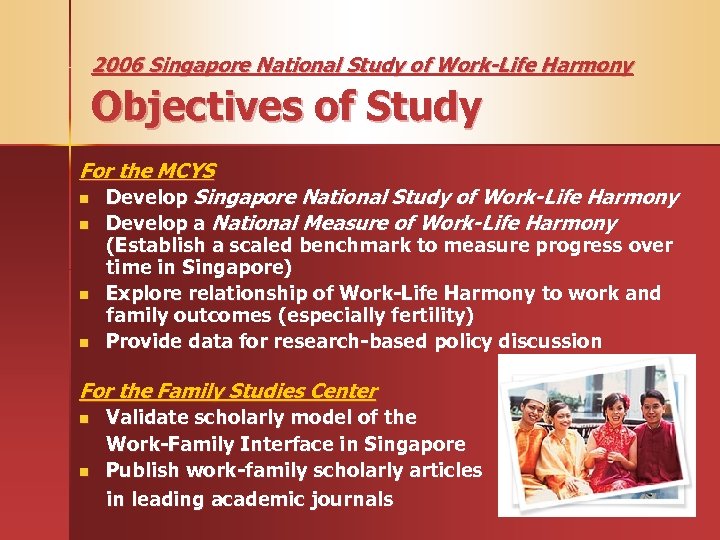 2006 Singapore National Study of Work-Life Harmony Objectives of Study For the MCYS n Develop Singapore National Study of Work-Life Harmony n Develop a National Measure of Work-Life Harmony n n (Establish a scaled benchmark to measure progress over time in Singapore) Explore relationship of Work-Life Harmony to work and family outcomes (especially fertility) Provide data for research-based policy discussion For the Family Studies Center n n Validate scholarly model of the Work-Family Interface in Singapore Publish work-family scholarly articles in leading academic journals
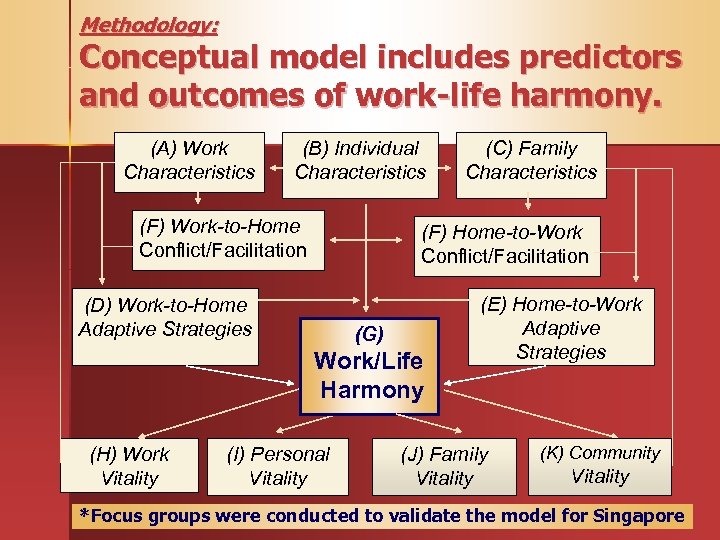 Methodology: Conceptual model includes predictors and outcomes of work-life harmony. (A) Work Characteristics (B) Individual Characteristics (F) Work-to-Home Conflict/Facilitation (F) Home-to-Work Conflict/Facilitation (D) Work-to-Home Adaptive Strategies (G) Work/Life Harmony (H) Work Vitality (C) Family Characteristics (I) Personal Vitality (E) Home-to-Work Adaptive Strategies (J) Family Vitality (K) Community Vitality *Focus groups were conducted to validate the model for Singapore
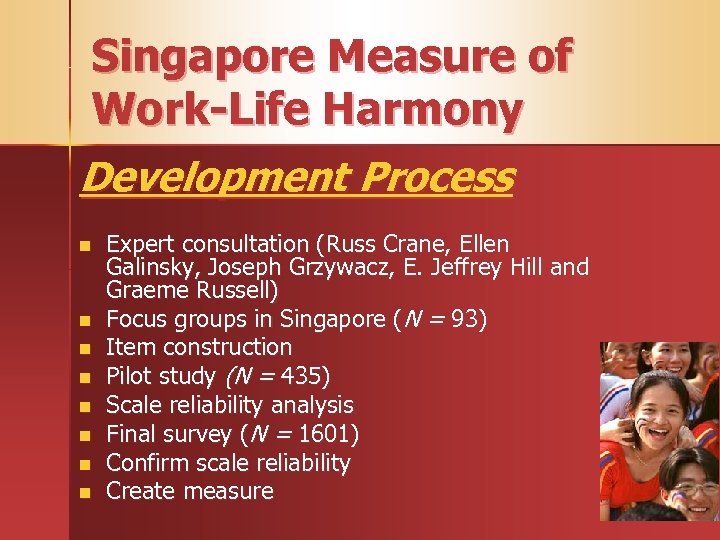 Singapore Measure of Work-Life Harmony Development Process n n n n Expert consultation (Russ Crane, Ellen Galinsky, Joseph Grzywacz, E. Jeffrey Hill and Graeme Russell) Focus groups in Singapore (N = 93) Item construction Pilot study (N = 435) Scale reliability analysis Final survey (N = 1601) Confirm scale reliability Create measure
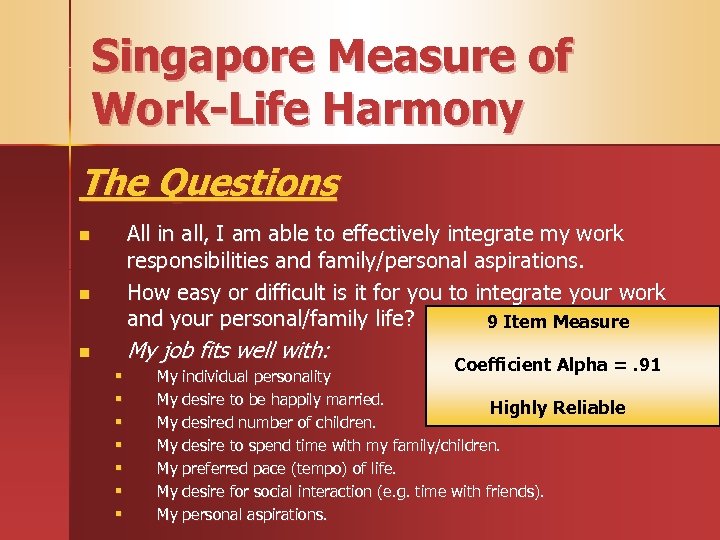 Singapore Measure of Work-Life Harmony The Questions All in all, I am able to effectively integrate my work responsibilities and family/personal aspirations. How easy or difficult is it for you to integrate your work and your personal/family life? 9 Item Measure n n My job fits well with: n § § § § Coefficient Alpha =. 91 My individual personality My desire to be happily married. Highly Reliable My desired number of children. My desire to spend time with my family/children. My preferred pace (tempo) of life. My desire for social interaction (e. g. time with friends). My personal aspirations.
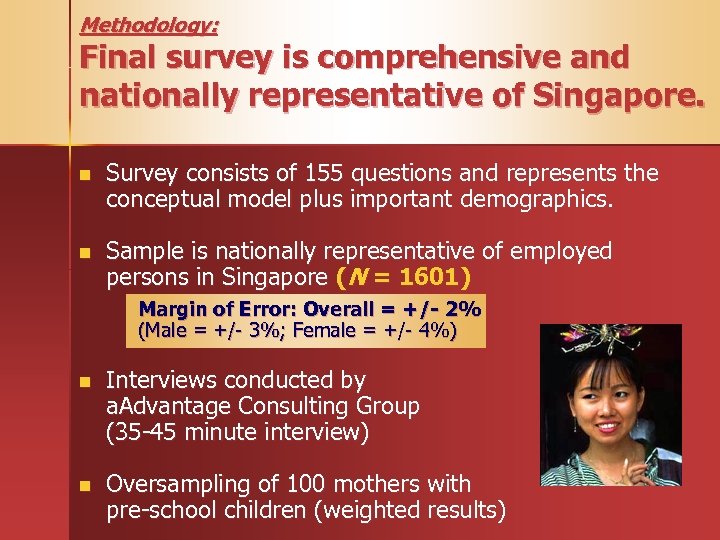 Methodology: Final survey is comprehensive and nationally representative of Singapore. n Survey consists of 155 questions and represents the conceptual model plus important demographics. n Sample is nationally representative of employed persons in Singapore (N = 1601) Margin of Error: Overall = +/- 2% (Male = +/- 3%; Female = +/- 4%) n Interviews conducted by a. Advantage Consulting Group (35 -45 minute interview) n Oversampling of 100 mothers with pre-school children (weighted results)
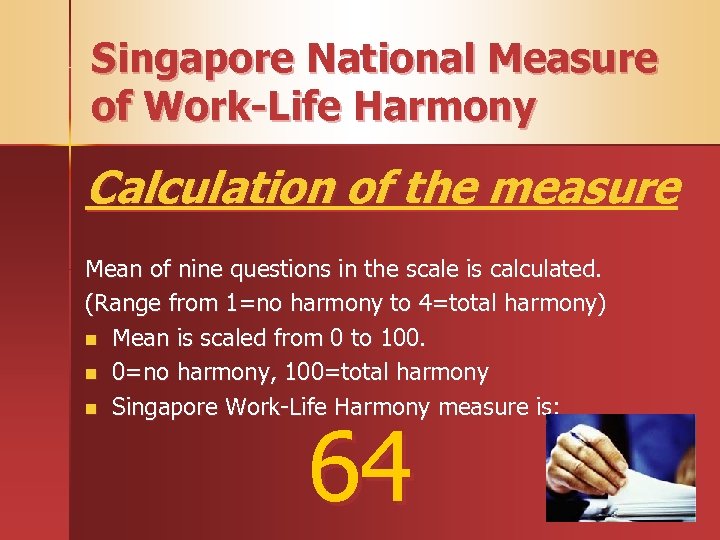 Singapore National Measure of Work-Life Harmony Calculation of the measure Mean of nine questions in the scale is calculated. (Range from 1=no harmony to 4=total harmony) n Mean is scaled from 0 to 100. n 0=no harmony, 100=total harmony n Singapore Work-Life Harmony measure is: 64
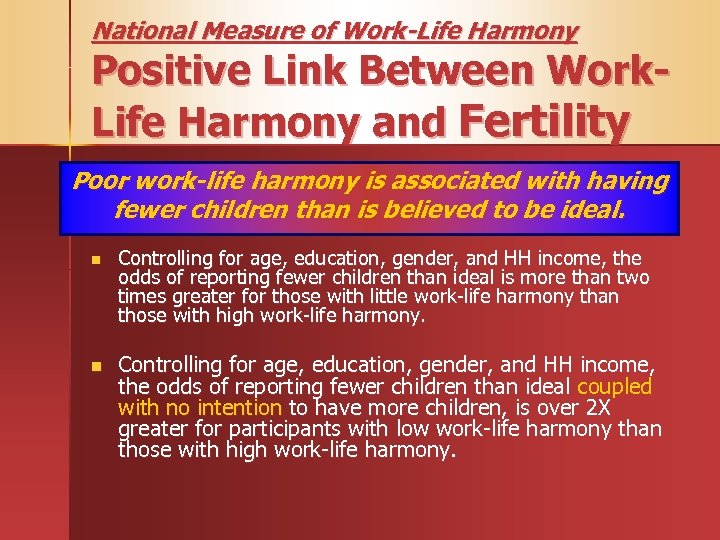 National Measure of Work-Life Harmony Positive Link Between Work. Life Harmony and Fertility Poor work-life harmony is associated with having fewer children than is believed to be ideal. n n Controlling for age, education, gender, and HH income, the odds of reporting fewer children than ideal is more than two times greater for those with little work-life harmony than those with high work-life harmony. Controlling for age, education, gender, and HH income, the odds of reporting fewer children than ideal coupled with no intention to have more children, is over 2 X greater for participants with low work-life harmony than those with high work-life harmony.
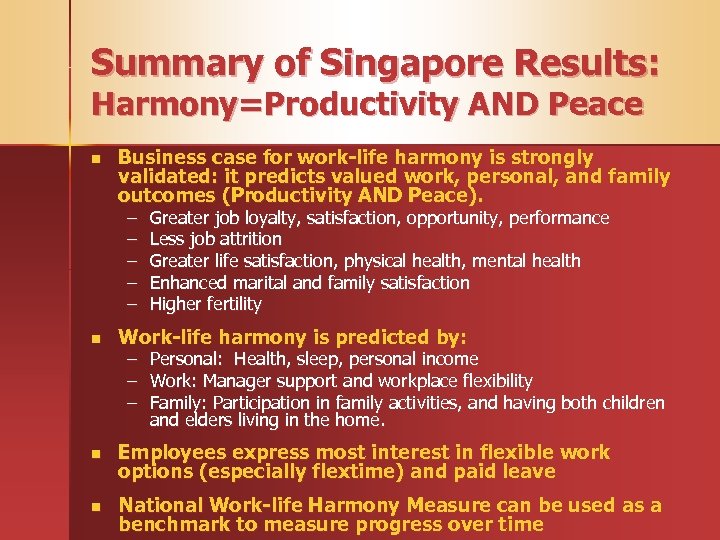 Summary of Singapore Results: Harmony=Productivity AND Peace n Business case for work-life harmony is strongly validated: it predicts valued work, personal, and family outcomes (Productivity AND Peace). – – – Greater job loyalty, satisfaction, opportunity, performance Less job attrition Greater life satisfaction, physical health, mental health Enhanced marital and family satisfaction Higher fertility n Work-life harmony is predicted by: n Employees express most interest in flexible work options (especially flextime) and paid leave n National Work-life Harmony Measure can be used as a benchmark to measure progress over time – Personal: Health, sleep, personal income – Work: Manager support and workplace flexibility – Family: Participation in family activities, and having both children and elders living in the home.
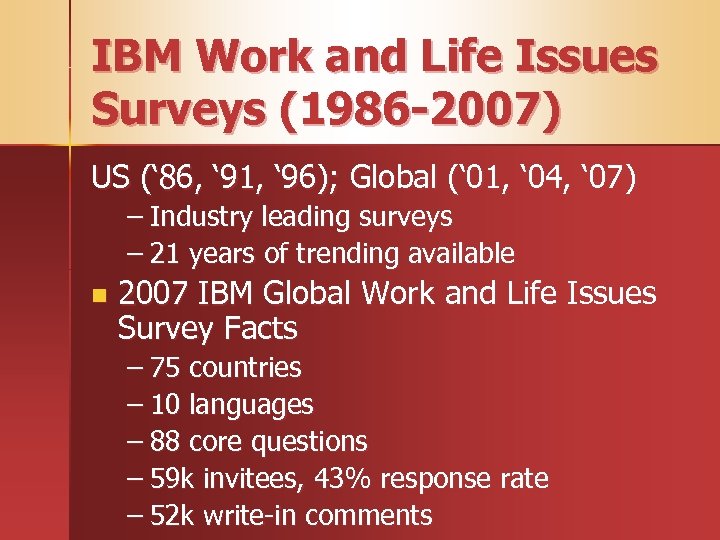 IBM Work and Life Issues Surveys (1986 -2007) US (‘ 86, ‘ 91, ‘ 96); Global (‘ 01, ‘ 04, ‘ 07) – Industry leading surveys – 21 years of trending available n 2007 IBM Global Work and Life Issues Survey Facts – 75 countries – 10 languages – 88 core questions – 59 k invitees, 43% response rate – 52 k write-in comments
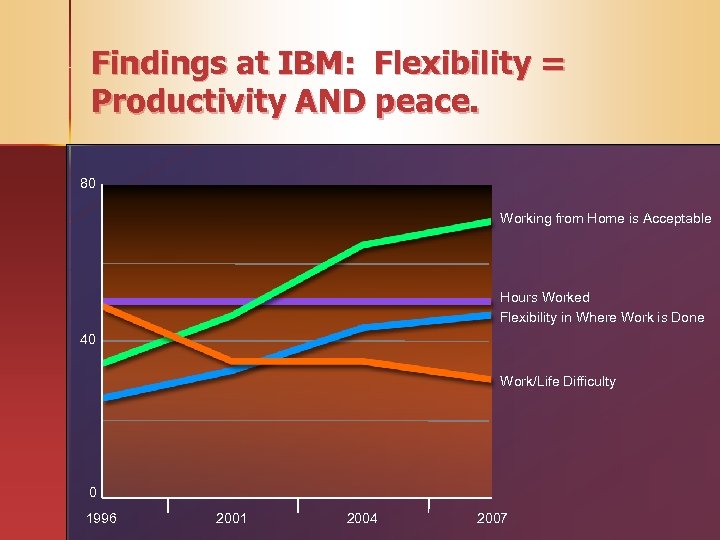 Findings at IBM: Flexibility = Productivity AND peace. 80 Working from Home is Acceptable Hours Worked Flexibility in Where Work is Done 40 Work/Life Difficulty 0 1996 2001 2004 2007
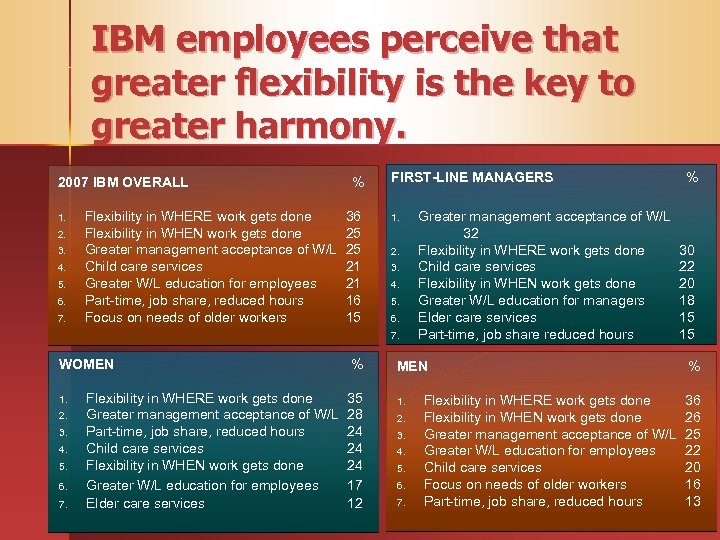 IBM employees perceive that greater flexibility is the key to greater harmony. 2007 IBM OVERALL 1. 2. 3. 4. 5. 6. 7. Flexibility in WHERE work gets done Flexibility in WHEN work gets done Greater management acceptance of W/L Child care services Greater W/L education for employees Part-time, job share, reduced hours Focus on needs of older workers % 36 25 25 21 21 16 15 FIRST-LINE MANAGERS 1. 2. 3. 4. 5. 6. 7. WOMEN 1. 2. 3. 4. 5. 6. 7. Flexibility in WHERE work gets done Greater management acceptance of W/L Part-time, job share, reduced hours Child care services Flexibility in WHEN work gets done Greater W/L education for employees Elder care services % 35 28 24 24 24 17 12 Greater management acceptance of W/L 32 Flexibility in WHERE work gets done Child care services Flexibility in WHEN work gets done Greater W/L education for managers Elder care services Part-time, job share reduced hours MEN 1. 2. 3. 4. 5. 6. 7. Flexibility in WHERE work gets done Flexibility in WHEN work gets done Greater management acceptance of W/L Greater W/L education for employees Child care services Focus on needs of older workers Part-time, job share, reduced hours % 30 22 20 18 15 15 % 36 26 25 22 20 16 13
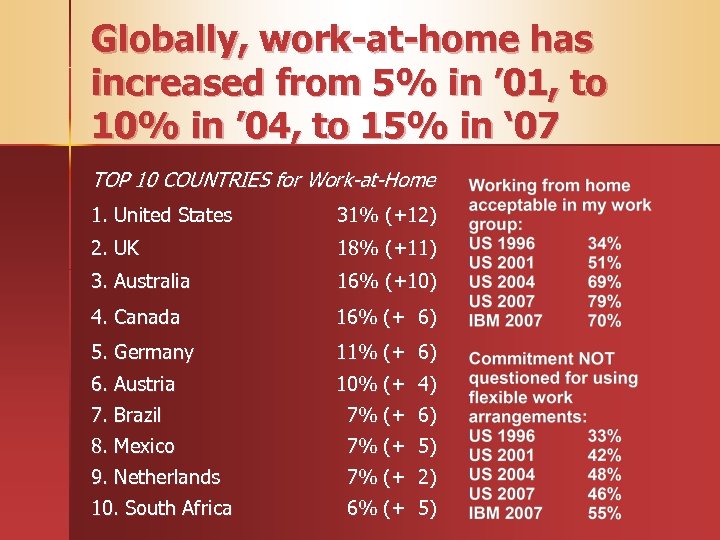 Globally, work-at-home has increased from 5% in ’ 01, to 10% in ’ 04, to 15% in ‘ 07 TOP 10 COUNTRIES for Work-at-Home 1. United States 31% (+12) 2. UK 18% (+11) 3. Australia 16% (+10) 4. Canada 16% (+ 6) 5. Germany 11% (+ 6) 6. Austria 10% (+ 4) 7. Brazil 7% (+ 6) 8. Mexico 7% (+ 5) 9. Netherlands 7% (+ 2) 10. South Africa 6% (+ 5)
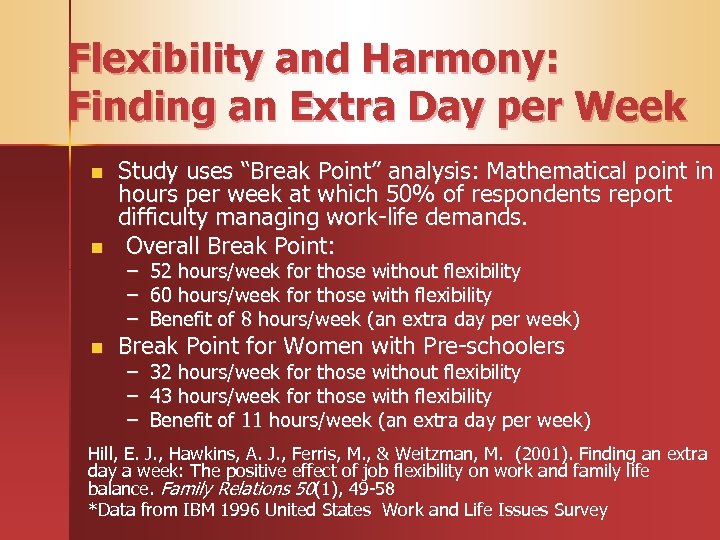 Flexibility and Harmony: Finding an Extra Day per Week n Study uses “Break Point” analysis: Mathematical point in hours per week at which 50% of respondents report difficulty managing work-life demands. Overall Break Point: n Break Point for Women with Pre-schoolers n – 52 hours/week for those without flexibility – 60 hours/week for those with flexibility – Benefit of 8 hours/week (an extra day per week) – 32 hours/week for those without flexibility – 43 hours/week for those with flexibility – Benefit of 11 hours/week (an extra day per week) Hill, E. J. , Hawkins, A. J. , Ferris, M. , & Weitzman, M. (2001). Finding an extra day a week: The positive effect of job flexibility on work and family life balance. Family Relations 50(1), 49 -58 *Data from IBM 1996 United States Work and Life Issues Survey
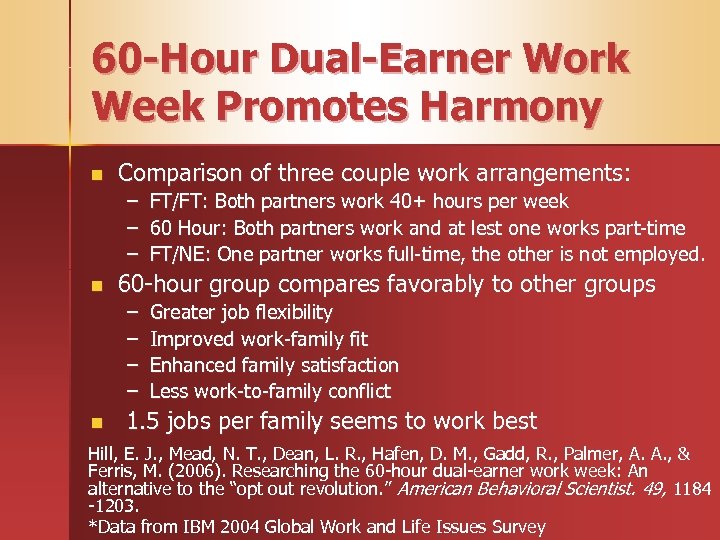 60 -Hour Dual-Earner Work Week Promotes Harmony n Comparison of three couple work arrangements: – FT/FT: Both partners work 40+ hours per week – 60 Hour: Both partners work and at lest one works part-time – FT/NE: One partner works full-time, the other is not employed. n 60 -hour group compares favorably to other groups – – n Greater job flexibility Improved work-family fit Enhanced family satisfaction Less work-to-family conflict 1. 5 jobs per family seems to work best Hill, E. J. , Mead, N. T. , Dean, L. R. , Hafen, D. M. , Gadd, R. , Palmer, A. A. , & Ferris, M. (2006). Researching the 60 -hour dual-earner work week: An alternative to the “opt out revolution. ” American Behavioral Scientist. 49, 1184 -1203. *Data from IBM 2004 Global Work and Life Issues Survey
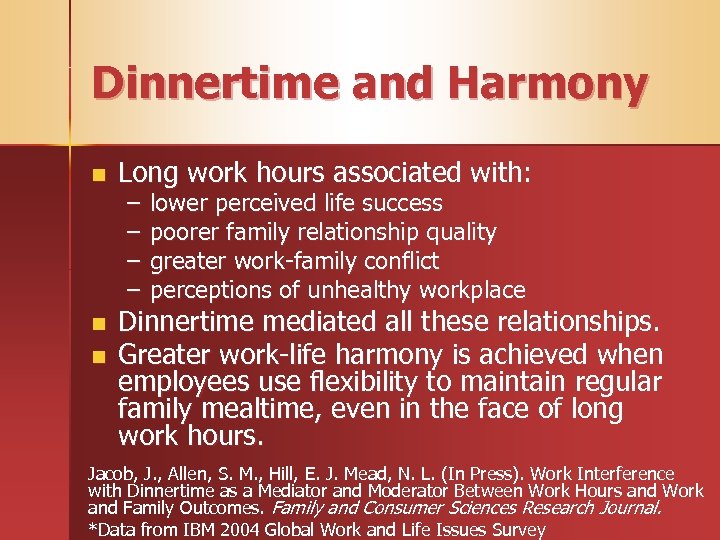 Dinnertime and Harmony n n n Long work hours associated with: – – lower perceived life success poorer family relationship quality greater work-family conflict perceptions of unhealthy workplace Dinnertime mediated all these relationships. Greater work-life harmony is achieved when employees use flexibility to maintain regular family mealtime, even in the face of long work hours. Jacob, J. , Allen, S. M. , Hill, E. J. Mead, N. L. (In Press). Work Interference with Dinnertime as a Mediator and Moderator Between Work Hours and Work and Family Outcomes. Family and Consumer Sciences Research Journal. *Data from IBM 2004 Global Work and Life Issues Survey
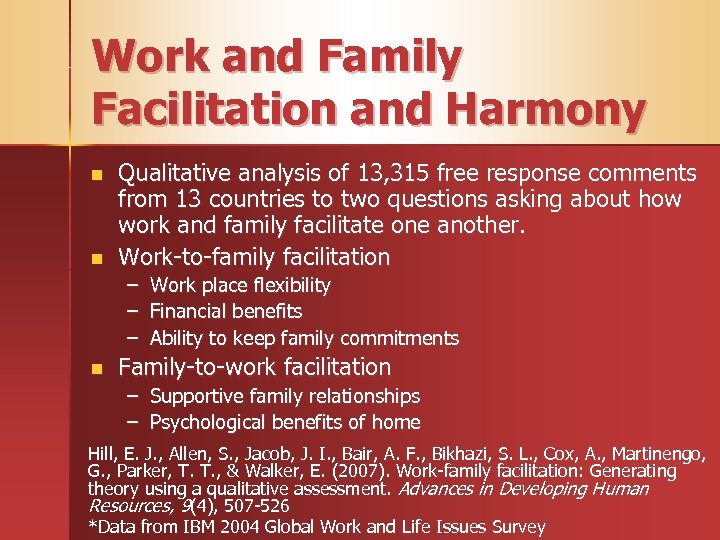 Work and Family Facilitation and Harmony n n Qualitative analysis of 13, 315 free response comments from 13 countries to two questions asking about how work and family facilitate one another. Work-to-family facilitation – – – n Work place flexibility Financial benefits Ability to keep family commitments Family-to-work facilitation – Supportive family relationships – Psychological benefits of home Hill, E. J. , Allen, S. , Jacob, J. I. , Bair, A. F. , Bikhazi, S. L. , Cox, A. , Martinengo, G. , Parker, T. T. , & Walker, E. (2007). Work-family facilitation: Generating theory using a qualitative assessment. Advances in Developing Human Resources, 9(4), 507 -526 *Data from IBM 2004 Global Work and Life Issues Survey
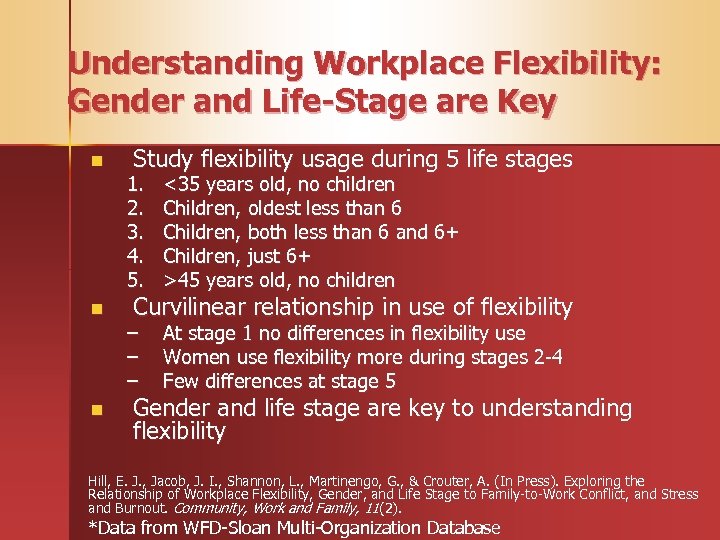 Understanding Workplace Flexibility: Gender and Life-Stage are Key n n n Study flexibility usage during 5 life stages 1. 2. 3. 4. 5. <35 years old, no children Children, oldest less than 6 Children, both less than 6 and 6+ Children, just 6+ >45 years old, no children – – – At stage 1 no differences in flexibility use Women use flexibility more during stages 2 -4 Few differences at stage 5 Curvilinear relationship in use of flexibility Gender and life stage are key to understanding flexibility Hill, E. J. , Jacob, J. I. , Shannon, L. , Martinengo, G. , & Crouter, A. (In Press). Exploring the Relationship of Workplace Flexibility, Gender, and Life Stage to Family-to-Work Conflict, and Stress and Burnout. Community, Work and Family, 11(2). *Data from WFD-Sloan Multi-Organization Database
 Implications The metaphor of harmony is more productive than the metaphor of balance. n Workplace flexibility is an important tool to promote harmony. – However, one size does not fit all n Research supports the business and personal case for harmony. n Productivity AND peace are BOTH possible simultaneously. n
 Work-Life Harmony: Productivity AND Peace THANK YOU! E. Jeffrey Hill, Ph. D. , CFLE BYU School of Family Life jeff_hill@byu. edu