


 Скачать презентацию Work in A Socially Diverse Environment Elements of
1d2caf66e8dfdb3cde221d20c2d65283.ppt
- Количество слайдов: 39
 Work in A Socially Diverse Environment Elements of Cultural Diversity Dealing with Misunderstandings Work in a Socially Diverse Environment 1
 Objectives At the end of this training session, the participants: Value customers and colleagues from different cultural groups and treat them with respect and sensitivity. Take into consideration cultural differences in all verbal and non-verbal communication. Make attempts to overcome language barriers by communicating through the use of gestures, sign language, or simple words in English or the other person's language.
 Multiculturalism Multicultural awareness becomes interesting and challenging as the international market continues to expend. A large portion of staff working in the hotels are foreignborn and come from various other countries and different culture and customs background. Foreign-born staff can become additional proficiency and versatility in serving our international guests.
 What is Culture? CULTURE IS THE WAY ANY GROUP DEFINES ITSELF. Culture can be defined as the framework for accepted modes of behavior among members of a particular society. These members tend to share similar value systems, they have common attitudes and they perceive things in like ways.
 What is Cultural Awareness all about anyway?
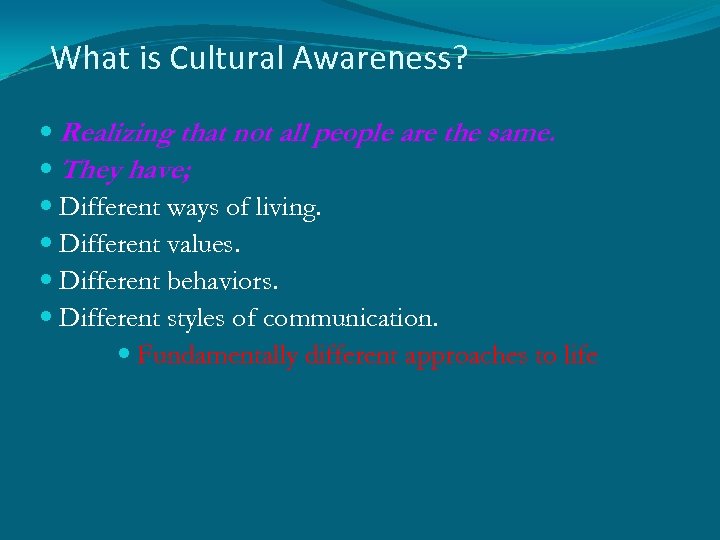 What is Cultural Awareness? Realizing that not all people are the same. . They have; Different ways of living. Different values. Different behaviors. Different styles of communication. Fundamentally different approaches to life
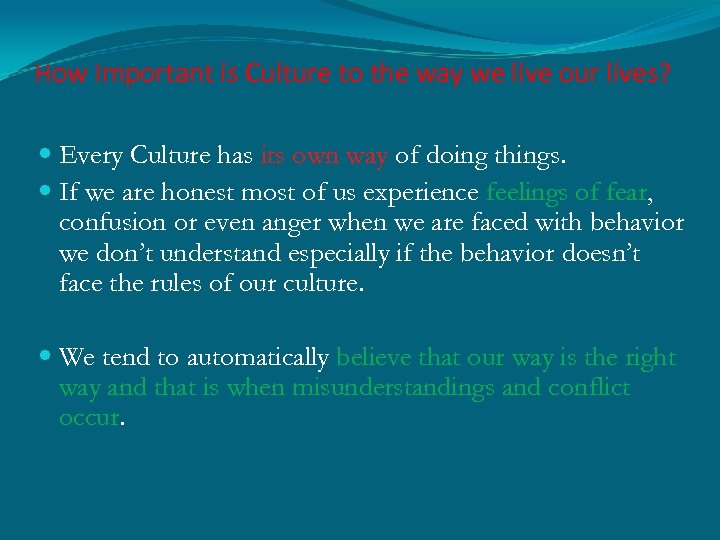 How Important is Culture to the way we live our lives? Every Culture has its own way of doing things. If we are honest most of us experience feelings of fear, confusion or even anger when we are faced with behavior we don’t understand especially if the behavior doesn’t face the rules of our culture. We tend to automatically believe that our way is the right way and that is when misunderstandings and conflict occur.
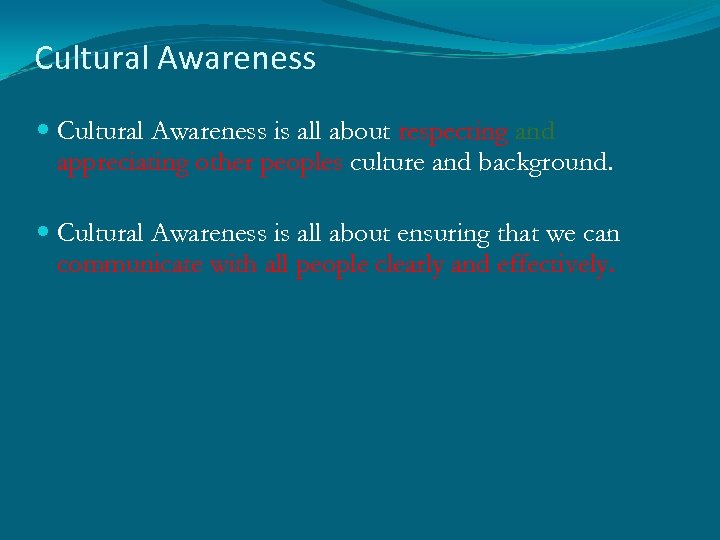 Cultural Awareness is all about respecting and appreciating other peoples culture and background. Cultural Awareness is all about ensuring that we can communicate with all people clearly and effectively.
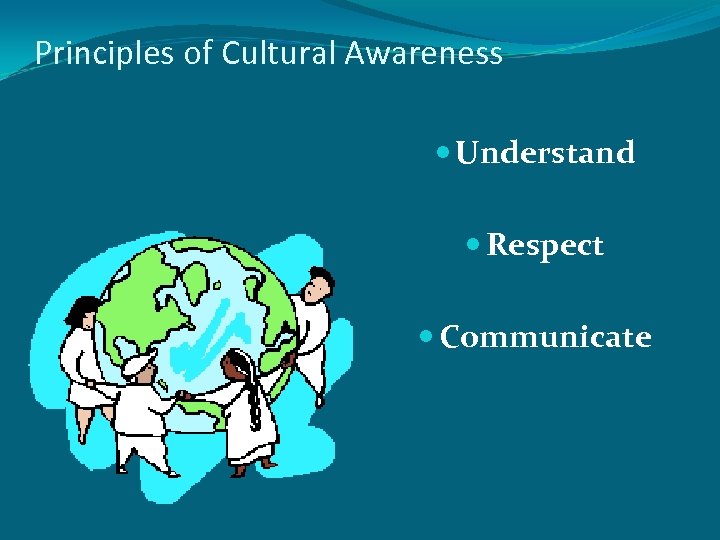 Principles of Cultural Awareness Understand Respect Communicate
 Why do we need to be culturally aware? To be able to meet the different needs and expectations of different customer groups. To be able to work as a team with co workers avoiding disputes and problems arising out of lack of awareness
 Multiculturalism is simply a term which describes the cultural and ethnic diversity. It is a policy for managing the consequences of cultural diversity in the interests of the individual and of society as a whole. This multiculturalism policy impacts on hospitality industry. Hospitality industry provide products, services and facilities to a wide and diverse cultural clientele.
 CULTURAL AWARENESS Cultural Awareness - knowing about other ways of life other than your own will help you provide the best possible service to all the customers you encounter day by day. It is recognising and appreciating the differences in customers and colleagues’ values and beliefs in such things : Culture Religion Language It is understanding: The significance of cultural values and mores Cultural diversity in the Australian population Cultural diversity of local and international customers Work in a Socially Diverse Environment 12
 INTERNATIONAL TOURISTS You will be dealing with International Tourists from lots of destinations: Asia Japan Korea China New Zealand America Europe Great Britain – the United Kingdom Africa Russia So it is important you develop an awareness of their different cultural expectations Work in a Socially Diverse Environment 13
 WHAT IS CULTURE? It is a way of life! Culture is everything people make or do - the way they organize their society according to the ideas, beliefs and values they hold. Manners Social institutions Customs Beliefs Rituals Laws Ideas & Thoughts Language Art and Artifacts Festivals/Celebrations Work Ethics Religions Beliefs Myths and legends Values Concept of self Morals Accepted behavior Family Structure Interpersonal relationships Communication Work in a Socially Diverse Environment 14
 Elements of Cultural Diversity Language Visitors of non-English speaking backgrounds need to have their requests listened to patiently and considerately as mis-pronunciations of certain words can cause embarrassment to them. Communication should be the same for everyone – clear, concise and informative Interpersonal relations Customs both formal and informal require different conventions for greetings, farewell, showing respect In German chewing gum is considered bad manners Work in a Socially Diverse Environment 15
 Cont. Dietary Requirements These include when to serve certain food items, how to prepare food and food presentation Religious Beliefs You are not expected to know about all religions – however you need an awareness of their beliefs – dietary habits, etc Festivals have different impacts for people from different cultures Different Work Ethics Some cultures attach a high degree of importance and commitment to their work, while others see work as a necessity to provide for their families. Others see it as presenting career and advancement opportunities Work in a Socially Diverse Environment 16
 Some cultural variances you should be aware of include: Forms of address Level of formality and informality Verbal and non verbal clues Appropriate non verbal behaviour Food preferences General service expectations Work Ethics Dress and appearance Religious beliefs Customer expectations Touch and personal space Work in a Socially Diverse Environment 17
 Other factors in a Socially Diverse environment include You need to be aware of the principles of equal employment opportunity and anti discrimination legislation. Equal Employment Opportunity (Commonwealth Authorities) Act 1987 (Cth) Anti Discrimination Act 1977 (NSW) They apply to issues of Gender Religion Race Age Sexual preference Disabilities Marital Status Work in a Socially Diverse Environment 18
 Advantages of working with members from different cultural backgrounds Cultural diversity enriches the group Sharing new ideas is stimulating Able to learn from other cultures Our way of thinking is being challenged Our team performance is improved Team members are more tolerant of other and perform at higher levels Team members feel they have a place in society/work environment Work in a Socially Diverse Environment 19
 HANDLING INTERNATIONAL TOURISTS - JAPANESE • Return a bow with a bow of the head - to show respect and • sensitivity • Avoid direct eye contact for extended periods • Japanese guests have a strong cultural tradition including the ritual of bathing - where soaking rather than washing is the main purpose. Therefore provide rooms with baths rather than showers. • Are generally very formal - touching is not considered acceptable • Japanese guest like prompt, efficient service Work in a Socially Diverse Environment 20
 • They prefer twin bedded accommodation - with bath • When greeting a Japanese guest - use last name followed by SAN - eg Mr Suzuki would be addressed as Suzuki SAN • Avoid speaking loudly - this will not help understanding and may cause offence Work in a Socially Diverse Environment 21
 HANDLING INTERNATIONAL TOURISTS AMERICANS • Americans are great questioners - they are by nature very inquisitive and can therefore be expected to ask lots of questions. • Americans are used to very attentive service - and they will give very detailed orders. • America is a vast country - with many varied people DON’T EXPECT ALL AMERICAN GUESTS TO BE ALIKE AS THEY COME FROM MANY DIFFERENT STATES AND CULTURAL BACKGROUNDS Work in a Socially Diverse Environment 22
 WORLD RELIGIONS CHRISTIANITY JUDAISM HINDUISM ISLAM BUDDHISM Sikhism Work in a Socially Diverse Environment 23
 CHRISTIANITY Based on the life of Jesus Christ - believe there is one God. Most followers belong to either: Catholic Protestant Eastern Orthodox Sunday is a holy day of rest and main festivals are: Christmas - 25 th Dec Lent - Period before Easter - Death & Resurrection of Jesus Christ Work in a Socially Diverse Environment 24
 JUDAISM Total way of life - spiritual and sociological Can be Orthodox, Reform or Liberal, Conservative or Hasidic Believe in one God - however don’t believe in resurrection of Jesus Includes worship - ceremonies and festivals Has strict dietary laws - permissible or kosher and prohibited foods Fish must have both scales & fins Shellfish are not permissible Four legged animals with cloven hooves that chew their cud are permissible - pork is not permitted Domestic birds can be eaten - but not birds of prey Work in a Socially Diverse Environment 25
 Cont. Meat and dairy products may not be cooked together Cooking and eating utensils used for meat must not be used with dairy products Saturday is the holy day of rest - beginning on sundown on Friday and ending at nightfall Saturday. Major festivals include: Passover - Festival of Spring Rosh Hashanah - Jewish New Year - (Sept - Oct) Yom Kippur - Holiest day of the year - (10 th day of New Year) marked by 24 hours of abstinence from food and water Work in a Socially Diverse Environment 26
 ISLAM Major World Religion bought to the world by the prophet Muhammad in 7 th Century Scriptures called Qu’ran or Koran and guides Muslims on all aspects of their life - spiritual, moral, social and economic Denounces gambling and drinking of alcohol. One of the largest and fastest growing religions Many women in Islamic society will wear traditional veils and long flowing black gowns Work in a Socially Diverse Environment 27
 Cont. Strict dietary laws - can eat beef, lamb or mutton but this must be slaughtered according to prescribed rituals. Pork and pork by-products are forbidden as is any animal that scavenges (pigs, goats, dogs, various birds). Adhere to teaching of Five Pillars of Islam Profession of faith Prayer - five times per day Almsgiving - Giving to charity Fasting - during Ramadan - no eating between dawn and sunset Pilgrimage - every Muslim should go to Mecca if they have the means and are able Work in a Socially Diverse Environment 28
 HINDUISM Ancient religion - evolved gradually over thousands of years Has many different sects holding diverse beliefs Believe in reincarnation and have many deities or gods. Hindus do not eat beef as the cow is a sacred animal Usually vegetarians - and have no set day as a holy day. Must avoid all physical, mental, emotional and moral hurt to any living creature Worship is generally individual and personal but festivals are a communal activity Work in a Socially Diverse Environment 29
 Sikhism Attempts to unite elements of Hinduism and Islam and is recognisable by the wearing of specific forms of dress – wearing of the Turban by males The beliefs include Reincarnation Worship of God – who is described as a spirit No images or artifacts should be used in worship That all religions display elements of truth The attainment of high moral standards Work in a Socially Diverse Environment 30
 BUDDHISM Originated in India in fifth century BC Evolved from Hinduism - into not so much a religion but a way of life Religion without a God Believe human beings are caught in the cycle of birth and deaths. No distinction of caste, social class or ethnic origin Five precepts are: Kill no living thing Don’t steal Don’t commit adultery Tell no lies Don’t drink intoxicants or take drugs Usually vegetarians and don’t drink alcohol Work in a Socially Diverse Environment 31
 What could go wrong? Some examples of cultural misunderstandings include: Late arrival to a private dinner in India is accepted and even expected In the Philippines they do not like to say no – they will say yes so as not to offend. Therefore yes may mean I agree or maybe In Chinese culture finishing all your food can be an insult to your host as it will be interpreted you are still hungry and they did not supply enough food In other cultures this is seen as an insult not to finish the meal and could mean you have not enjoyed the meal Work in a Socially Diverse Environment 32
 Issues that can be causes of misunderstanding includes: Poor communication styles Lack of confidence in language skills Use of colloquialisms and slang Speaking too quickly or quietly Not using active listening skills Not asking enough open questions The use of inappropriate body language Intolerance Poor observation Pre-made prejudice and value judgments Poor understanding of other cultures Work in a Socially Diverse Environment 33
 STRATEGIES TO DEAL WITH INTERNATIONAL TOURISTS • Don’t ridicule the guest - show respect for the person’s feelings • If problems occur, don’t give excuses or reasons it could only embarrass and upset the person more. • Learn from your mistakes - work out what went wrong and learn from it. • Study different cultures and religions to learn more - and find out what offends and why things like colors and numbers. Work in a Socially Diverse Environment 34
 Communication techniques to use to avoid misunderstandings Are you using the appropriate greeting – are they performed correctly and with respect? Do you use the correct verbal and non-verbal techniques – is it acceptable of not? Have you analysed the possible language barriers? What could they be? How can you overcome them? Providing signage with corresponding diagrams to assist Using universally understood gestures – applause, stop Be aware of: Internal services including staff who speak the appropriate language External services including interpreters and local cultural organisations Work in a Socially Diverse Environment 35
 How you can help to resolve misunderstandings? Follow recognised complaint handling or problem solving procedure ensuring you: Establish good customer service practices including: Tolerance of peoples’ differing beliefs and values Providing a prompt response to resolve misunderstandings Use efficient communication in language that is understood by the parties involved Work in a Socially Diverse Environment 36
 Cont. Display a friendly and courteous manner Use positive gestures and body language Report difficulties with cross cultural misunderstanding to Human Resource Office Supervisors Departmental managers wherever appropriate Work in a Socially Diverse Environment 37
 Organisational Strategies Staff training Using staff cultural skills – language and greetings Written communication and signs in different language where appropriate Promotion of cultural celebrations Flexibility Focusing on the similarities not the differences Adopting a variety of communication methods Developing a knowledge of support agencies and location of cultural buildings Offering flexibility in food service Work in a Socially Diverse Environment 38
 Personal Strategies Individual strategies including: Learning the basics of another language Develop an understanding and tolerance of cultural diversity Overcome prejudice and assumptions Use non-verbal communication skills Show interest in cultural events Follow organisational procedures to ensure visitors are informed and feel relaxed Actively seek to break down barriers Adopt a professional attitude at all time Work in a Socially Diverse Environment 39