 Скачать презентацию Work-based learning in Belgium Overview issues at stake
8cbeaa8c9aec174cbf3b7141975710ab.ppt
- Количество слайдов: 19



Work-based learning in Belgium Overview, issues at stake and political developments Thomas Lemaigre on behalf of the Belgian Refer. Net experts team Brussels – December 10 th, 2015
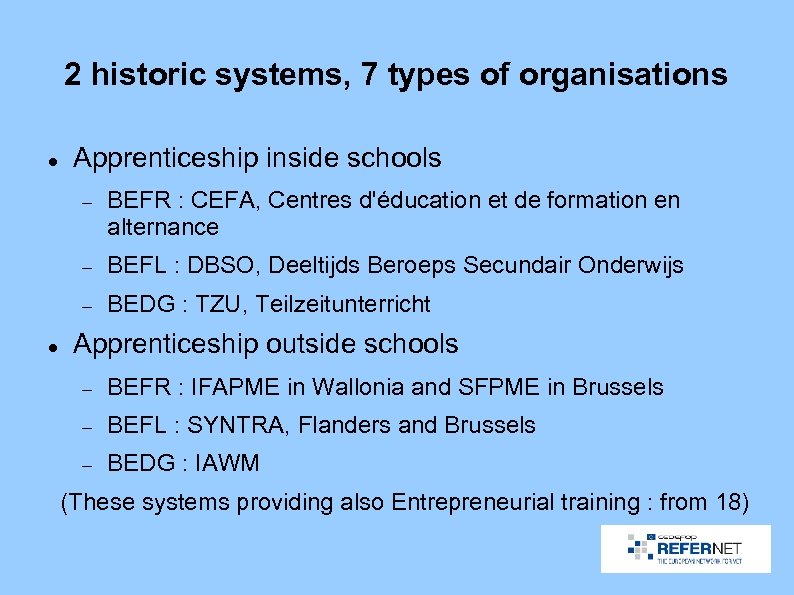
2 historic systems, 7 types of organisations Apprenticeship inside schools BEFL : DBSO, Deeltijds Beroeps Secundair Onderwijs BEFR : CEFA, Centres d'éducation et de formation en alternance BEDG : TZU, Teilzeitunterricht Apprenticeship outside schools BEFR : IFAPME in Wallonia and SFPME in Brussels BEFL : SYNTRA, Flanders and Brussels BEDG : IAWM (These systems providing also Entrepreneurial training : from 18)
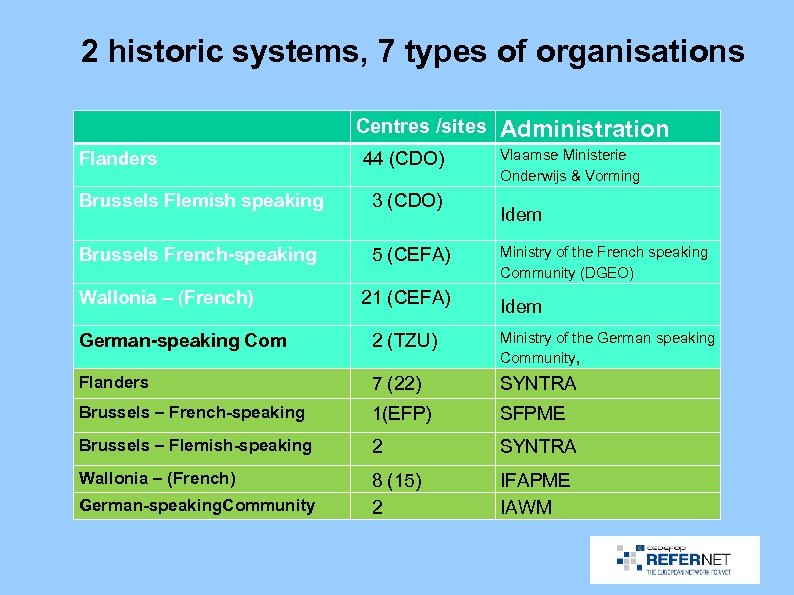
2 historic systems, 7 types of organisations Flanders Centres /sites 44 (CDO) Administration Vlaamse Ministerie Onderwijs & Vorming Brussels Flemish speaking 3 (CDO) Brussels French-speaking 5 (CEFA) Wallonia – (French) 21 (CEFA) German-speaking Com 2 (TZU) Ministry of the German speaking Community, Flanders 7 (22) SYNTRA Brussels – French-speaking 1(EFP) SFPME Brussels – Flemish-speaking 2 SYNTRA Wallonia – (French) 8 (15) 2 IFAPME IAWM German-speaking. Community Idem Ministry of the French speaking Community (DGEO) Idem
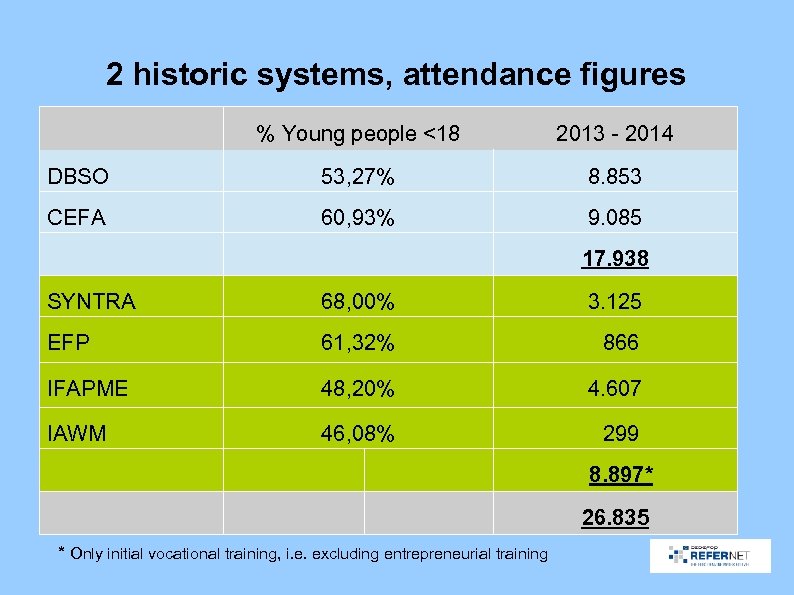
2 historic systems, attendance figures % Young people <18 2013 - 2014 DBSO 53, 27% 8. 853 CEFA 60, 93% 9. 085 17. 938 SYNTRA 68, 00% 3. 125 EFP 61, 32% 866 IFAPME 48, 20% 4. 607 IAWM 46, 08% 299 8. 897* 26. 835 * Only initial vocational training, i. e. excluding entrepreneurial training
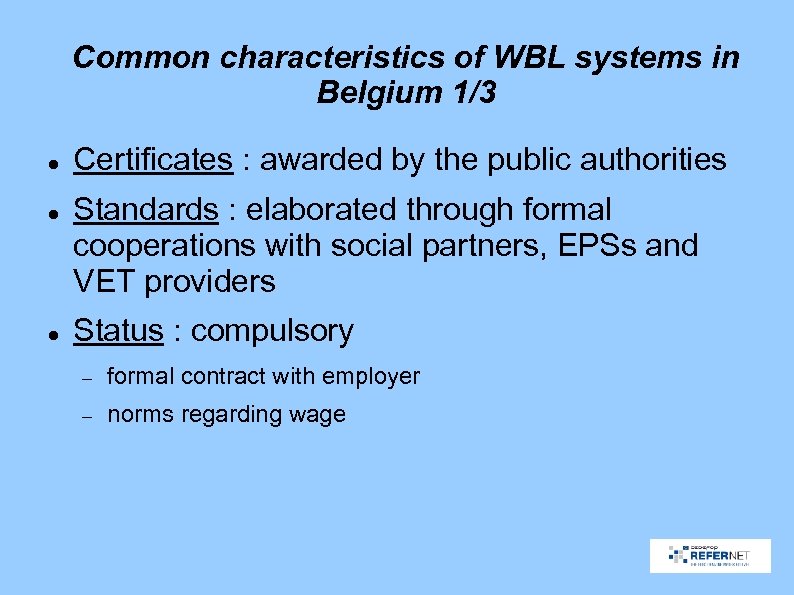
Common characteristics of WBL systems in Belgium 1/3 Certificates : awarded by the public authorities Standards : elaborated through formal cooperations with social partners, EPSs and VET providers Status : compulsory formal contract with employer norms regarding wage
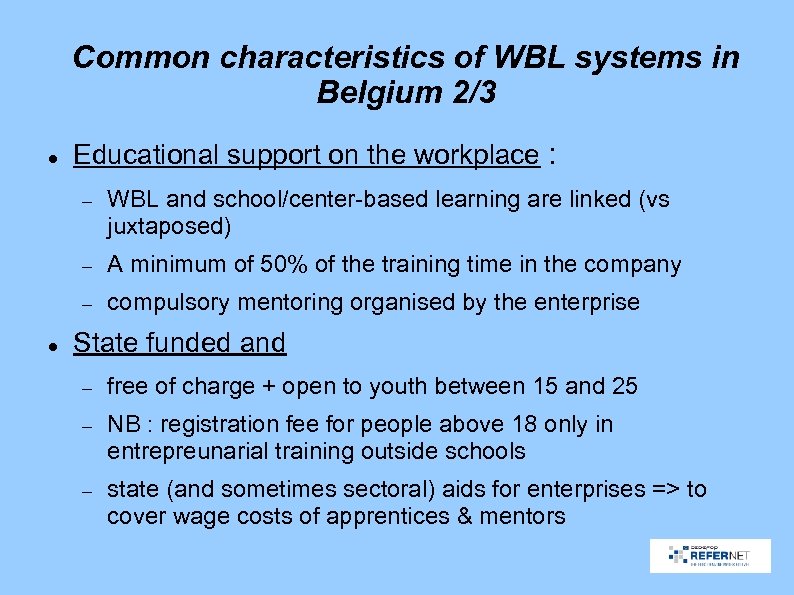
Common characteristics of WBL systems in Belgium 2/3 Educational support on the workplace : A minimum of 50% of the training time in the company WBL and school/center-based learning are linked (vs juxtaposed) compulsory mentoring organised by the enterprise State funded and free of charge + open to youth between 15 and 25 NB : registration fee for people above 18 only in entrepreunarial training outside schools state (and sometimes sectoral) aids for enterprises => to cover wage costs of apprentices & mentors
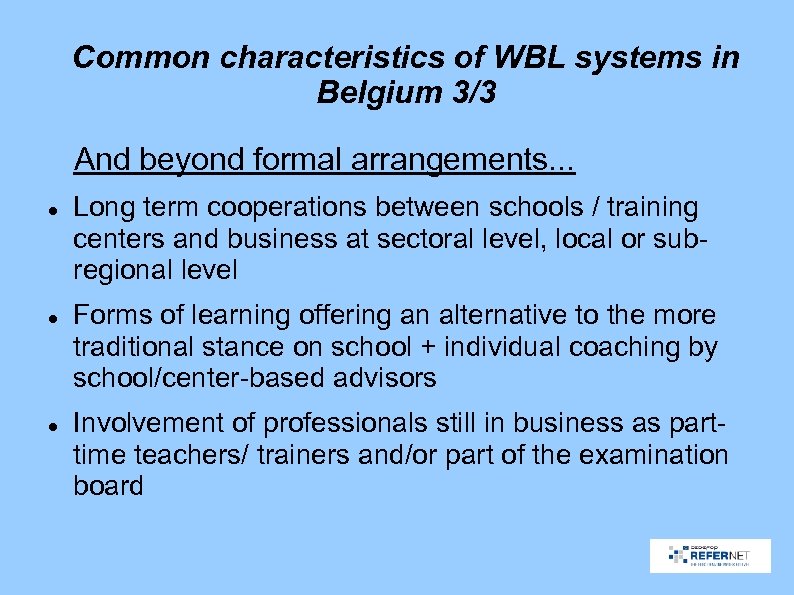
Common characteristics of WBL systems in Belgium 3/3 And beyond formal arrangements. . . Long term cooperations between schools / training centers and business at sectoral level, local or subregional level Forms of learning offering an alternative to the more traditional stance on school + individual coaching by school/center-based advisors Involvement of professionals still in business as parttime teachers/ trainers and/or part of the examination board
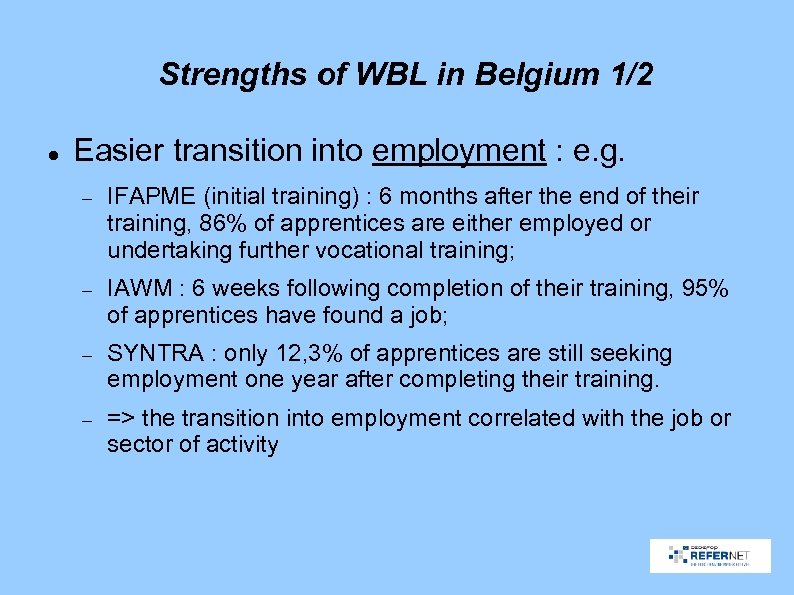
Strengths of WBL in Belgium 1/2 Easier transition into employment : e. g. IFAPME (initial training) : 6 months after the end of their training, 86% of apprentices are either employed or undertaking further vocational training; IAWM : 6 weeks following completion of their training, 95% of apprentices have found a job; SYNTRA : only 12, 3% of apprentices are still seeking employment one year after completing their training. => the transition into employment correlated with the job or sector of activity
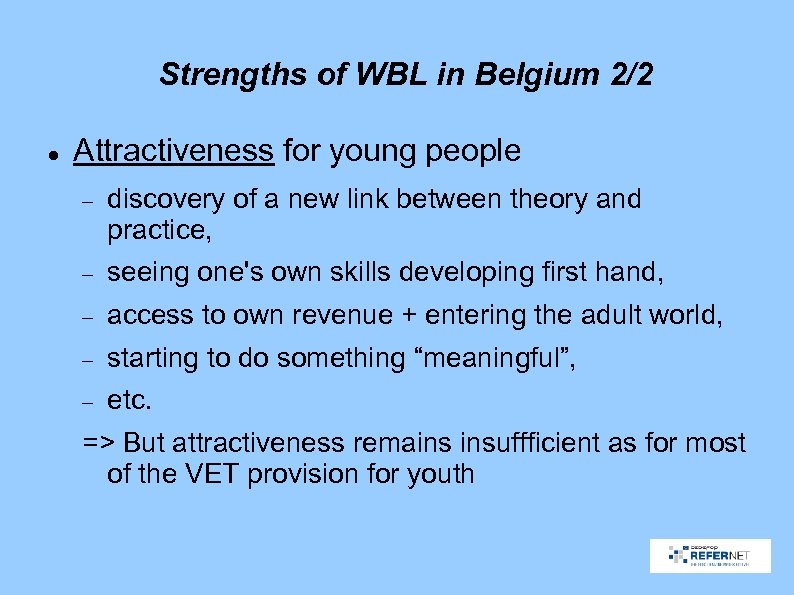
Strengths of WBL in Belgium 2/2 Attractiveness for young people discovery of a new link between theory and practice, seeing one's own skills developing first hand, access to own revenue + entering the adult world, starting to do something “meaningful”, etc. => But attractiveness remains insuffficient as for most of the VET provision for youth
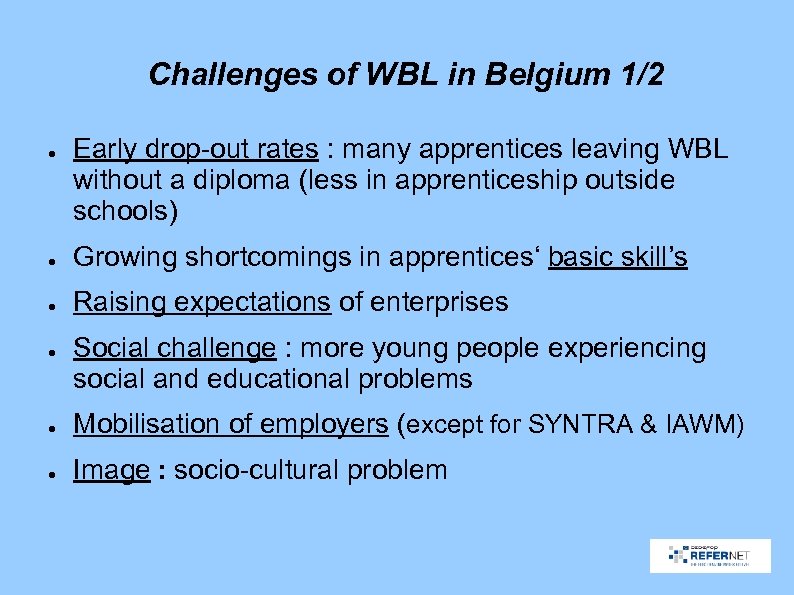
Challenges of WBL in Belgium 1/2 ● Early drop-out rates : many apprentices leaving WBL without a diploma (less in apprenticeship outside schools) ● Growing shortcomings in apprentices‘ basic skill’s ● Raising expectations of enterprises ● Social challenge : more young people experiencing social and educational problems ● Mobilisation of employers (except for SYNTRA & IAWM) ● Image : socio-cultural problem
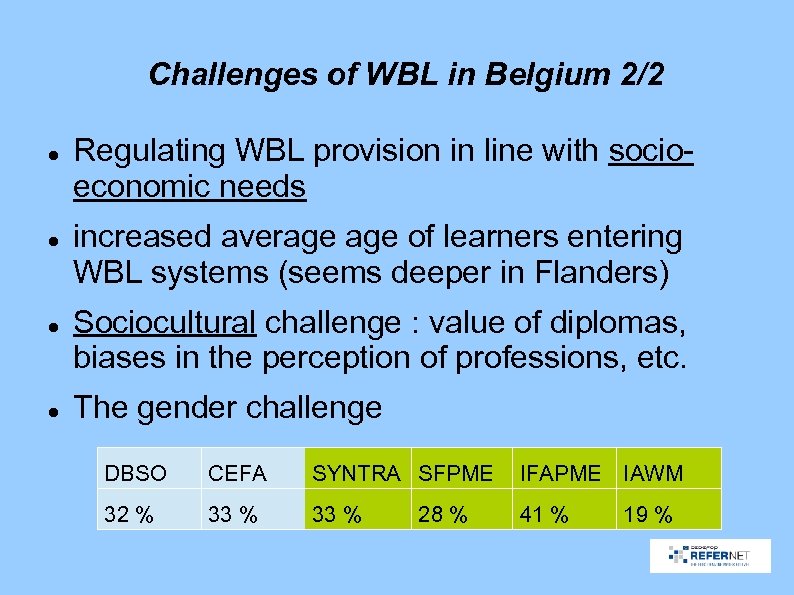
Challenges of WBL in Belgium 2/2 Regulating WBL provision in line with socioeconomic needs increased average of learners entering WBL systems (seems deeper in Flanders) Sociocultural challenge : value of diplomas, biases in the perception of professions, etc. The gender challenge DBSO CEFA SYNTRA SFPME IFAPME IAWM 32 % 33 % 41 % 28 % 19 %
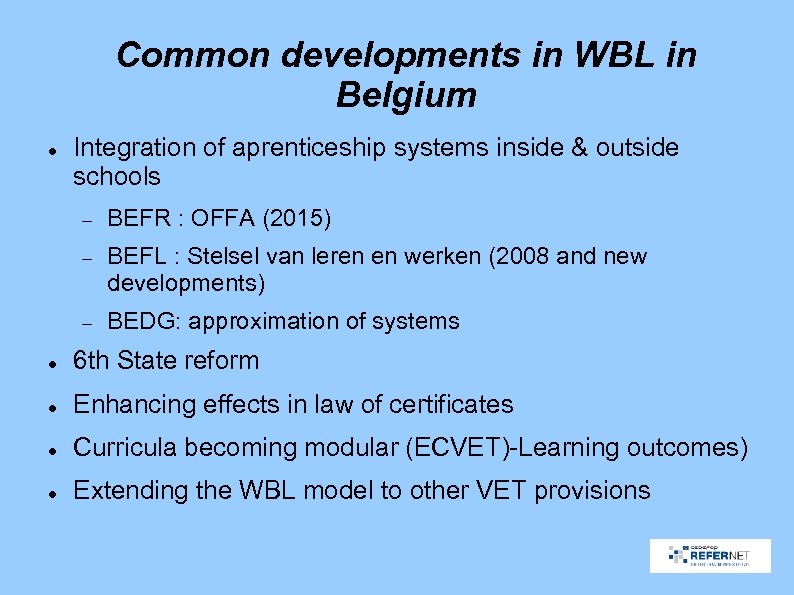
Common developments in WBL in Belgium Integration of aprenticeship systems inside & outside schools BEFR : OFFA (2015) BEFL : Stelsel van leren en werken (2008 and new developments) BEDG: approximation of systems 6 th State reform Enhancing effects in law of certificates Curricula becoming modular (ECVET)-Learning outcomes) Extending the WBL model to other VET provisions
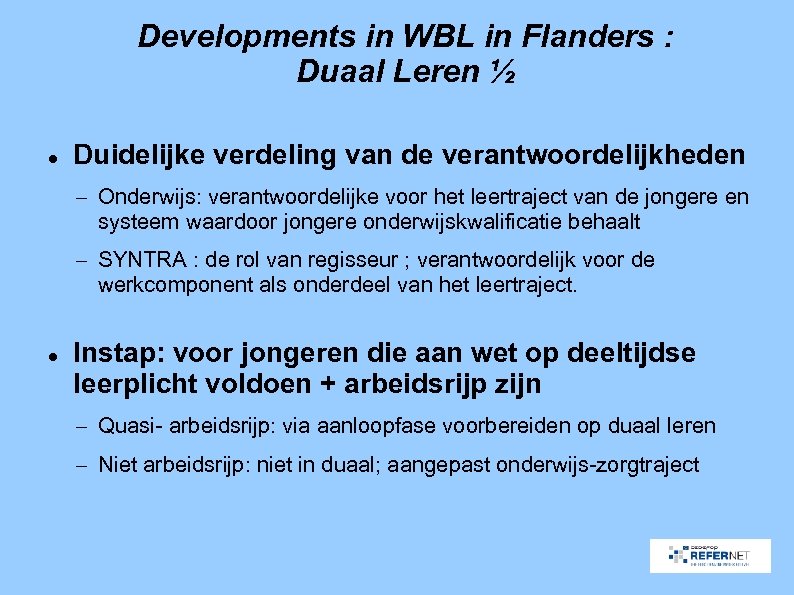
Developments in WBL in Flanders : Duaal Leren ½ Duidelijke verdeling van de verantwoordelijkheden – Onderwijs: verantwoordelijke voor het leertraject van de jongere en systeem waardoor jongere onderwijskwalificatie behaalt – SYNTRA : de rol van regisseur ; verantwoordelijk voor de werkcomponent als onderdeel van het leertraject. Instap: voor jongeren die aan wet op deeltijdse leerplicht voldoen + arbeidsrijp zijn – Quasi- arbeidsrijp: via aanloopfase voorbereiden op duaal leren – Niet arbeidsrijp: niet in duaal; aangepast onderwijs-zorgtraject
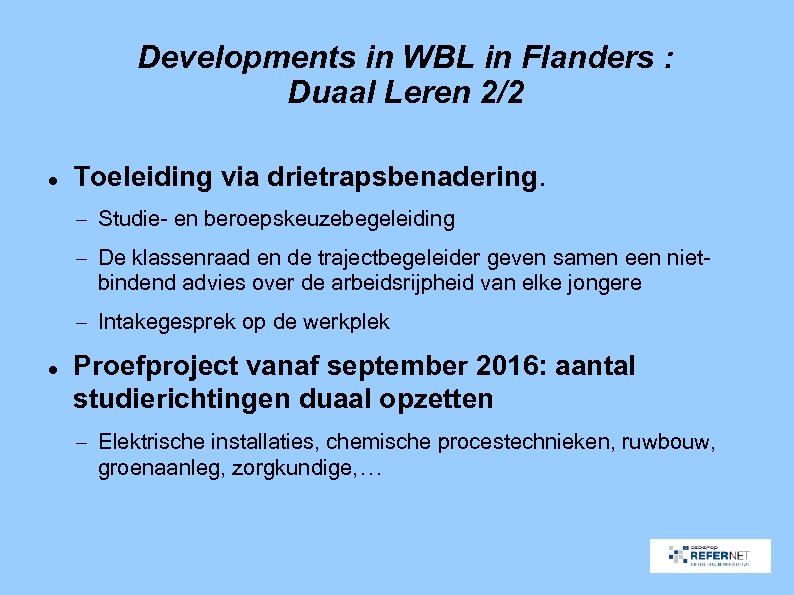
Developments in WBL in Flanders : Duaal Leren 2/2 Toeleiding via drietrapsbenadering. – Studie- en beroepskeuzebegeleiding – De klassenraad en de trajectbegeleider geven samen een nietbindend advies over de arbeidsrijpheid van elke jongere – Intakegesprek op de werkplek Proefproject vanaf september 2016: aantal studierichtingen duaal opzetten – Elektrische installaties, chemische procestechnieken, ruwbouw, groenaanleg, zorgkundige, …
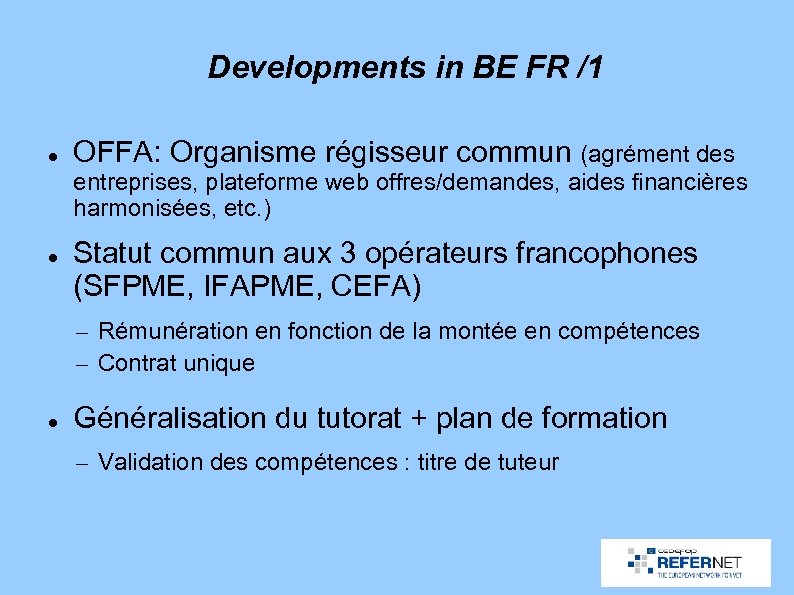
Developments in BE FR /1 OFFA: Organisme régisseur commun (agrément des entreprises, plateforme web offres/demandes, aides financières harmonisées, etc. ) Statut commun aux 3 opérateurs francophones (SFPME, IFAPME, CEFA) – Rémunération en fonction de la montée en compétences – Contrat unique Généralisation du tutorat + plan de formation – Validation des compétences : titre de tuteur
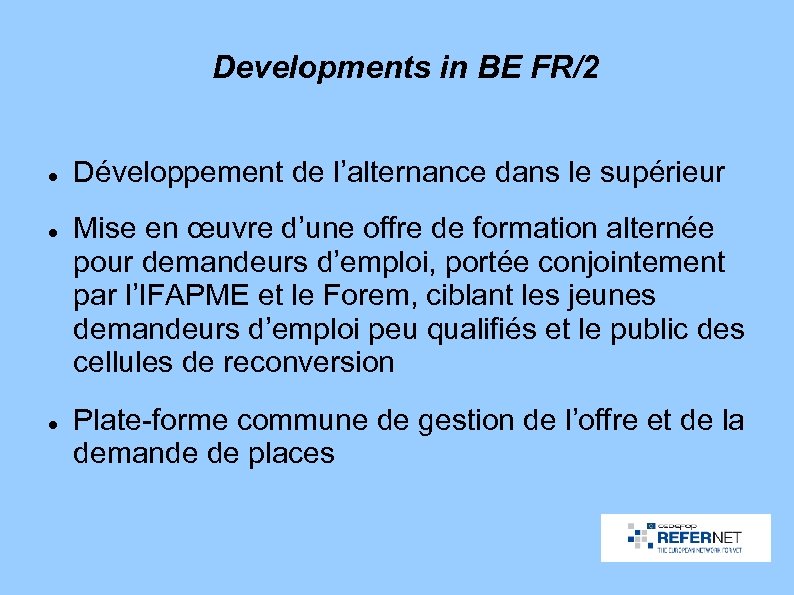
Developments in BE FR/2 Développement de l’alternance dans le supérieur Mise en œuvre d’une offre de formation alternée pour demandeurs d’emploi, portée conjointement par l’IFAPME et le Forem, ciblant les jeunes demandeurs d’emploi peu qualifiés et le public des cellules de reconversion Plate-forme commune de gestion de l’offre et de la demande de places
Developments in the Brussels Region Mise sur pied de l’Alliance Emploi-Formation. Enseignement (EFE): Task Force Soutenir les TPE dans l’engagement de stagiaires Mise en œuvre du plan d'action « Bruxellois dans la Fonction publique » Mars 2016: nouvelle formule de SPEP (stage de première expérience professionnelle), gérée par Actiris; la FPI à 100% gérée par Bruxelles Formation)
Developments in germanspeaking WBL 1/2 Projet gouvernemental (REK II) « Technischberufliche Ausbildung aufwerten » – Revalorisation de la formation technique et professionnelle, dans les écoles (fondamentales et secondaires) et les centres de formation d’apprentissage – Focus sur les MINT+ H : mathématiques, Informatique, Sciences naturelles, technologies et métiers d’artisanat
Developments in germanspeaking WBL 2/2 « Berufsintegration durch Ausbildungsbegleitung in der Dualen Ausbildung » – orientation et soutien renforcé : un trajet spécifique pour éviter l'abandon • des jeunes qui n’ont pas réussi l’examen d’entrée en apprentissage • et de ceux qui connaissent des ruptures de contrat. Poursuite rapprochement école technique et centre de formation apprentissage développé à Eupen St Vith
Скачать презентацию Work-based learning in Belgium Overview issues at stake
8cbeaa8c9aec174cbf3b7141975710ab.ppt