Скачать презентацию Word-Stock Formation Outline 1 l l l
Word-Stock Formation.ppt
- Количество слайдов: 78
 Word-Stock Formation
 Outline 1. l l l Morphological word formation: Affixation (suffixation, prefixation, suffixation -and-prefixation). Back formation. Abbreviation.
 l l Compounding (compound-derived words, abbreviated compounds, acronyms, initialisms). Blending.
 2. Semantic word-formation. l Generalization of meaning. l Specification of meaning. l Transposition. l Conversion.
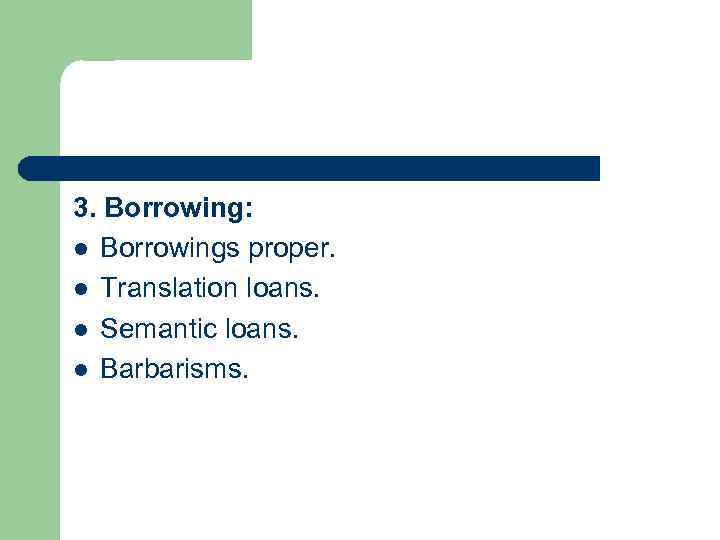 3. Borrowing: l Borrowings proper. l Translation loans. l Semantic loans. l Barbarisms.
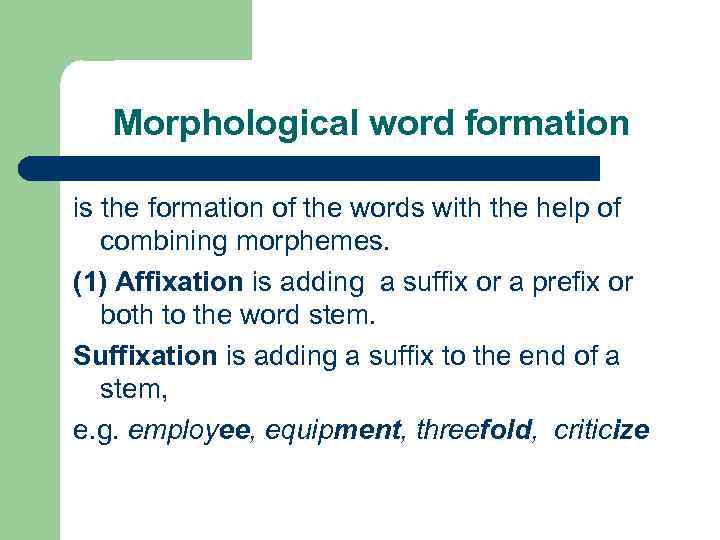 Morphological word formation is the formation of the words with the help of combining morphemes. (1) Affixation is adding a suffix or a prefix or both to the word stem. Suffixation is adding a suffix to the end of a stem, e. g. employee, equipment, threefold, criticize
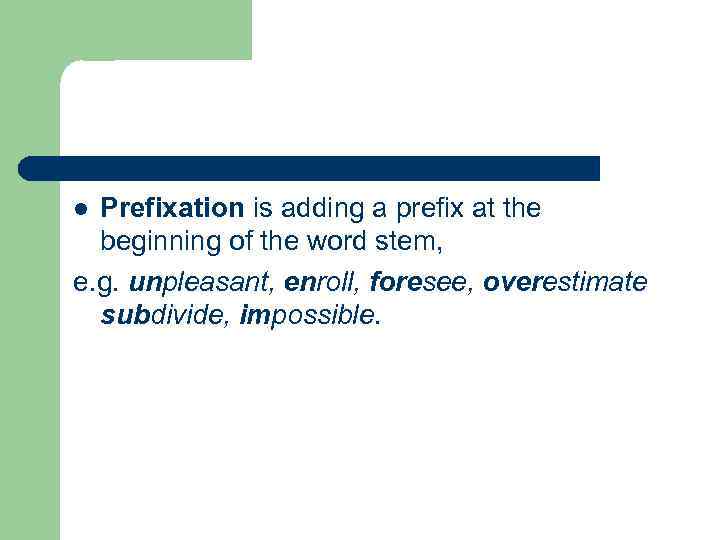 Prefixation is adding a prefix at the beginning of the word stem, e. g. unpleasant, enroll, foresee, overestimate subdivide, impossible. l
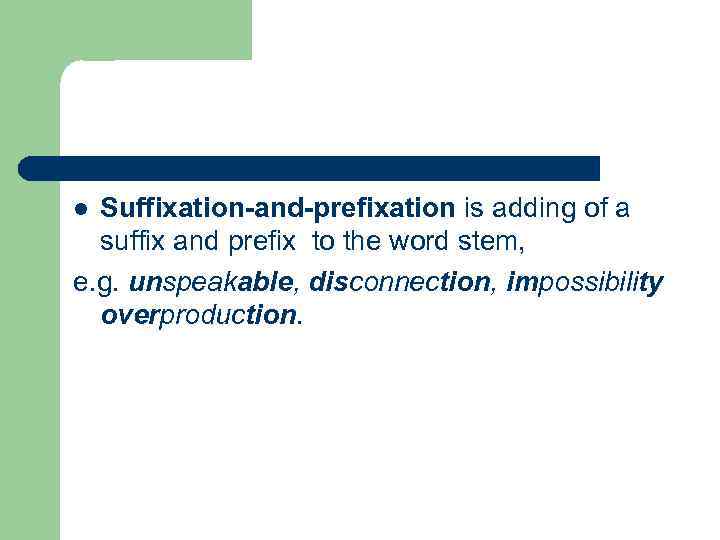 Suffixation-and-prefixation is adding of a suffix and prefix to the word stem, e. g. unspeakable, disconnection, impossibility overproduction. l
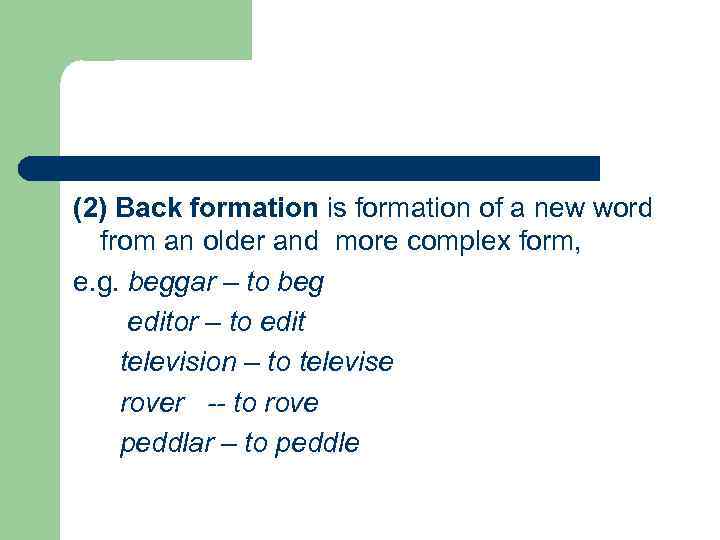 (2) Back formation is formation of a new word from an older and more complex form, e. g. beggar – to beg editor – to edit television – to televise rover -- to rove peddlar – to peddle
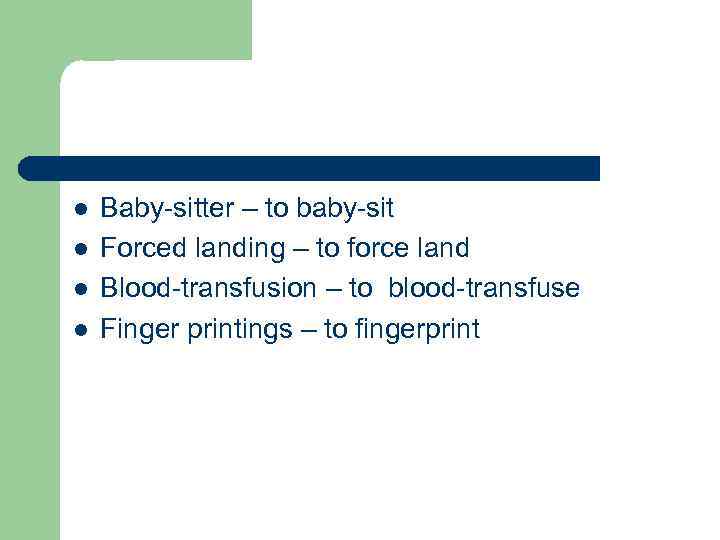 l l Baby-sitter – to baby-sit Forced landing – to force land Blood-transfusion – to blood-transfuse Finger printings – to fingerprint
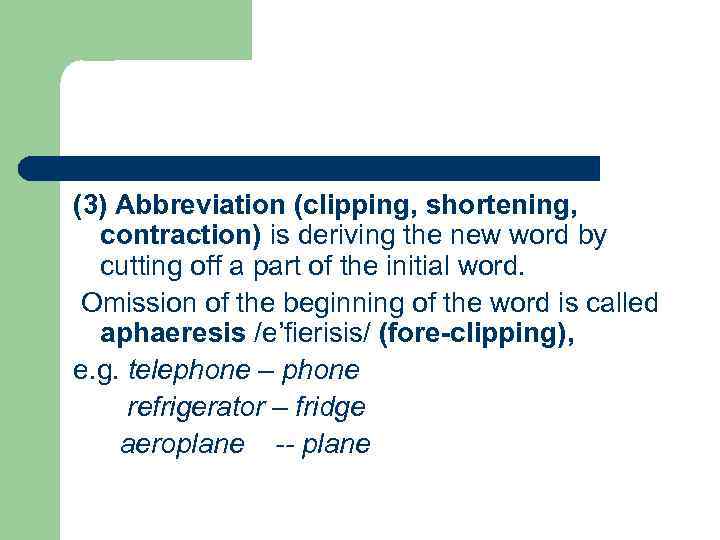 (3) Abbreviation (clipping, shortening, contraction) is deriving the new word by cutting off a part of the initial word. Omission of the beginning of the word is called aphaeresis /e’fierisis/ (fore-clipping), e. g. telephone – phone refrigerator – fridge aeroplane -- plane
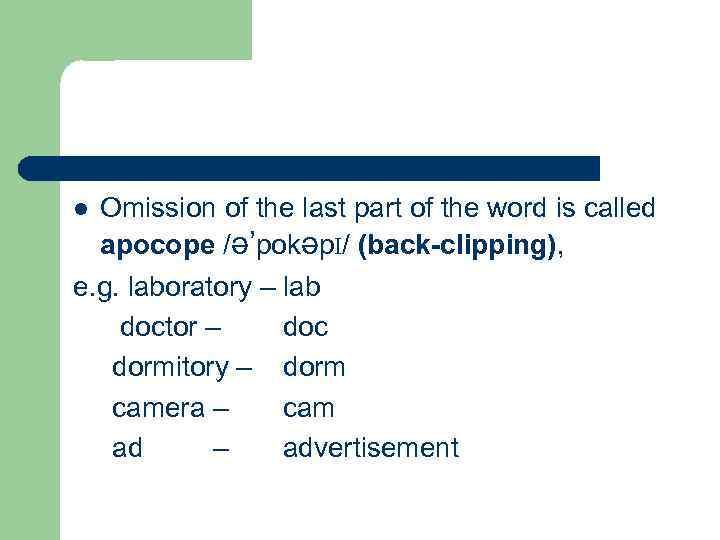 Omission of the last part of the word is called apocope /ə’pokəp. I/ (back-clipping), e. g. laboratory – lab doctor – doc dormitory – dorm camera – cam ad – advertisement l
 (4) Compounding is deriving a new word that consists of a combination of stems, e. g. dark-grey, sunlit, broadcast, whitewash , Anglo. Saxon, into, anything. Compounding is one of the most productive types (conversion and affixation). Compound-derived words are the words with the suffix added to the compound stem, e. g. housekeeper, trustworthy, heart-breaking
 Compounds are not homogeneous in structure. Traditionally three types are distinguished: neutral, morphological and syntactic.
 In neutral compounds the process of compounding is realized without any linking elements by a mere juxtaposition of two stems, e. g. blackbird, shop-window, sunflower, bedroom
 Subtypes of neutral compounds Simple neutral compounds: they consist of simple affixless stems. l Compounds which have affixes in their structure are called derived or derivational compounds, e. g. absent-mindedness, blue-eyed, goldenhaired, broadshouldered, film-goer, musiclover l
 The productivity of this type is confirmed by a considerable number of comparatively recent formations, e. g. teenager, babysitter, fourseater ("a car or a boat with four seats"), double-decker ("a ship or bus with two decks")
 Nonce-words are coined on this pattern which is another proof of its high productivity, e. g. luncher-out (a person who habitually takes his lunch in restaurants and not at home), goose-flesher (murder story)
 attention getter, go-getter (a pushing person) do-it-yourselfism dressuppable
 Contracted compounds have a shortened (abbreviated) stem in their structure, e. g. TV-set /-program/ -show V-day (Victory day), G-man (Government man "FBI agent"), T-shirt Hbag (handbag) l
 Acronyms are words that are composed of the first letters of some words, e. g. NATO (North Atlantic treaty Organization) UNESCO (United Nations Education Scientific and Cultural organization) l
 AIDS (acquired immune deficiency syndrome) Scuba (self-contained underwater breathing apparatus)
 Initialisms are an extreme kind of clipping. Only the initial letters of the words are put together and used as words. They are pronounced with the letters of the alphabet, e. g. AI (artificial intelligence) BP (blood pressure) VIP ( very important person) l
 l l l USA BBC MP UNO gf (girl friend)
 Morphological compounds l l l Morphological compounds are few in number. This type is non-productive. It is represented by words in which two compounding stems are combined by a linking vowel or consonant,
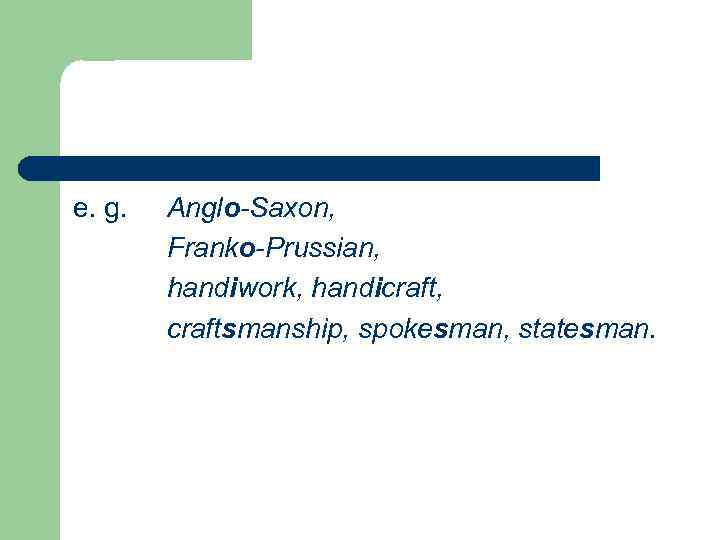 e. g. Anglo-Saxon, Franko-Prussian, handiwork, handicraft, craftsmanship, spokesman, statesman.
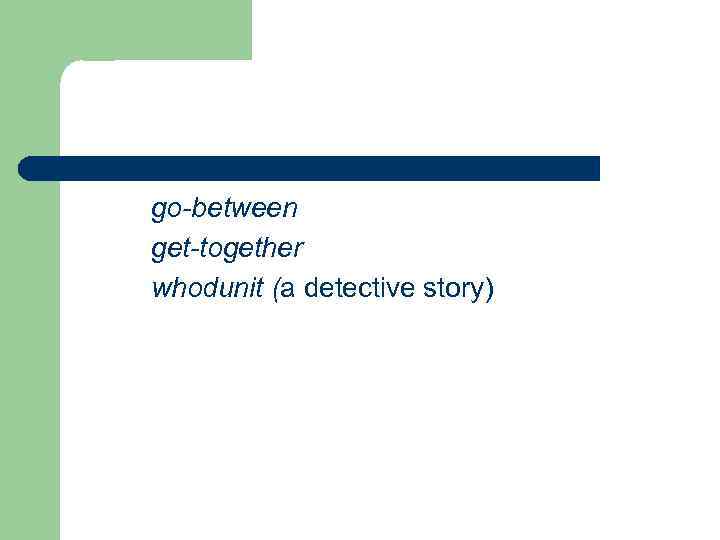
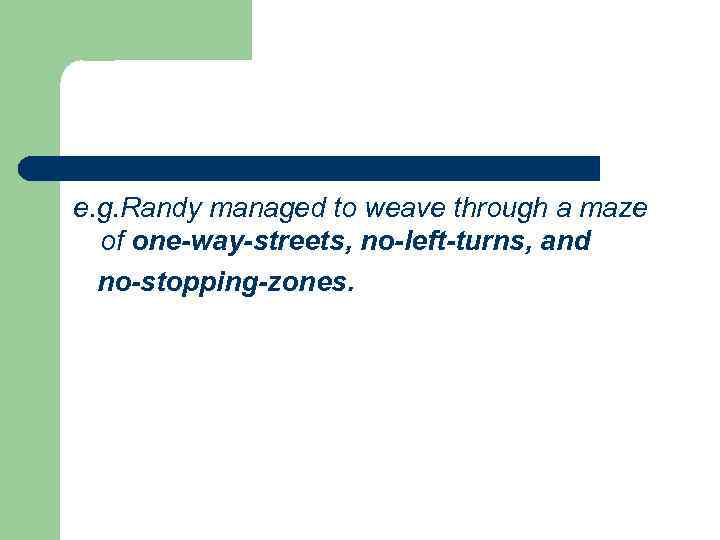
 Syntactic compounds are formed from segments of speech, preserving in their structure numerous traces of syntagmatic relations typical of speech: articles, prepositions, adverbs,
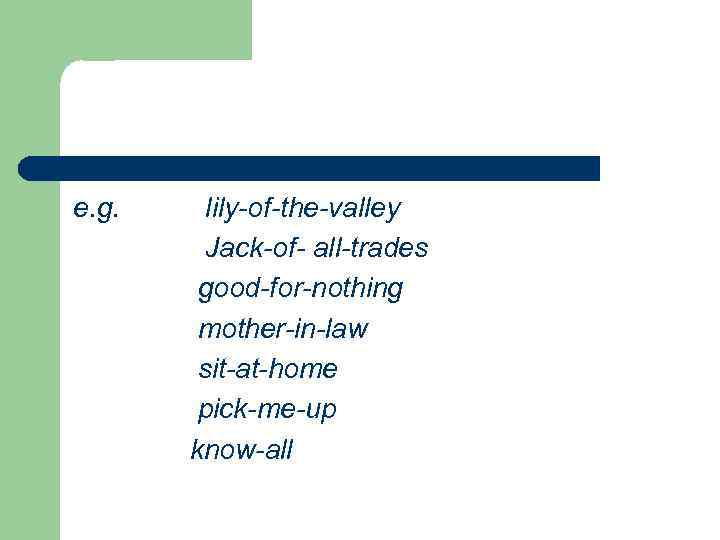 e. g. lily-of-the-valley Jack-of- all-trades good-for-nothing mother-in-law sit-at-home pick-me-up know-all
 go-between get-together whodunit (a detective story)
 e. g. Randy managed to weave through a maze of one-way-streets, no-left-turns, and no-stopping-zones.
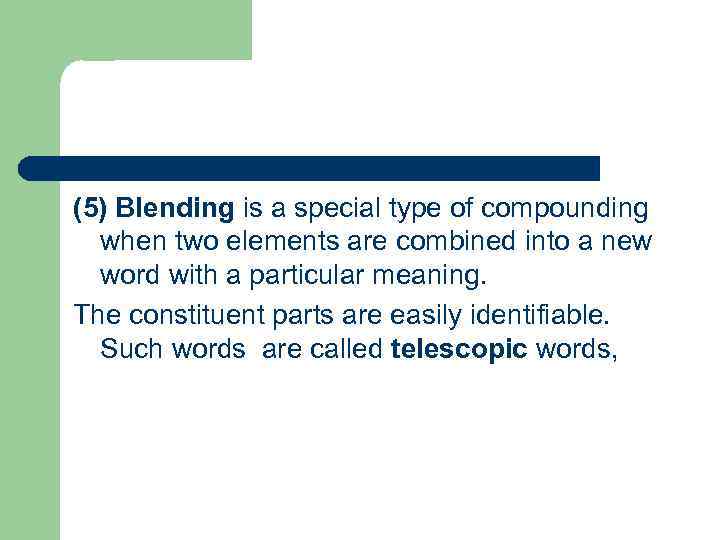 (5) Blending is a special type of compounding when two elements are combined into a new word with a particular meaning. The constituent parts are easily identifiable. Such words are called telescopic words,
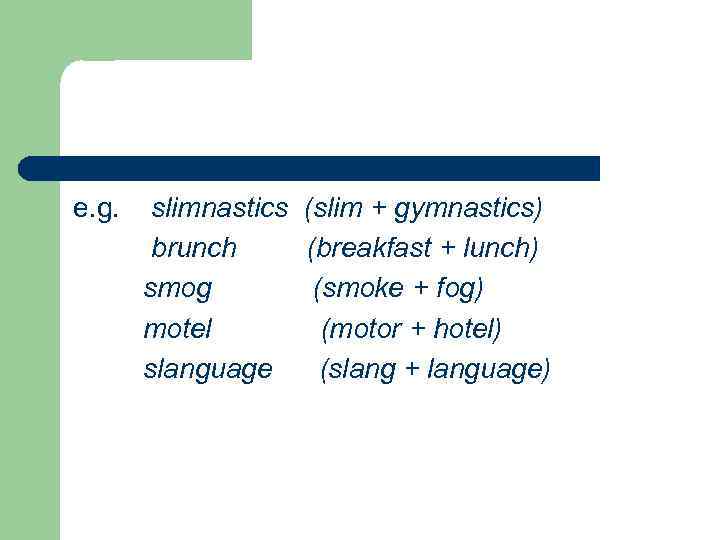 e. g. slimnastics (slim + gymnastics) brunch (breakfast + lunch) smog (smoke + fog) motel (motor + hotel) slanguage (slang + language)
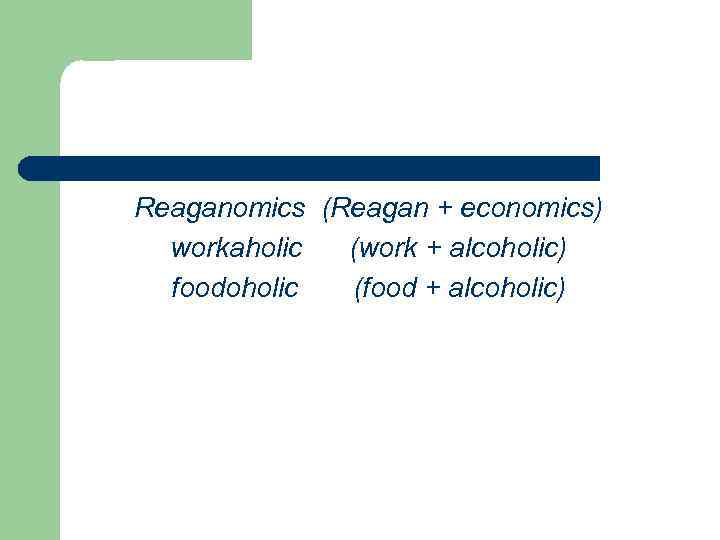 Reaganomics (Reagan + economics) workaholic (work + alcoholic) foodoholic (food + alcoholic)
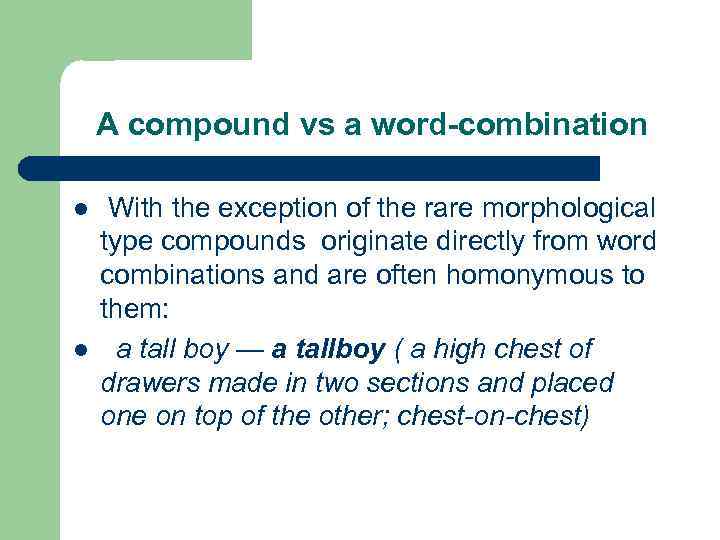 A compound vs a word-combination l l With the exception of the rare morphological type compounds originate directly from word combinations and are often homonymous to them: a tall boy — a tallboy ( a high chest of drawers made in two sections and placed one on top of the other; chest-on-chest)
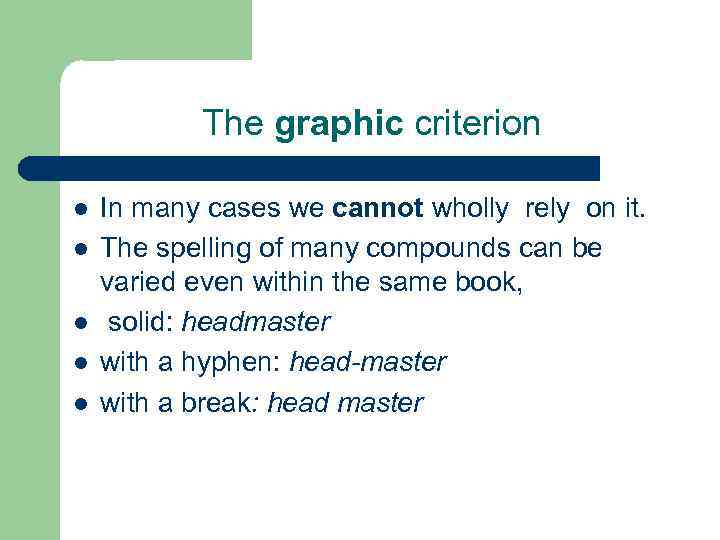 The graphic criterion l l l In many cases we cannot wholly rely on it. The spelling of many compounds can be varied even within the same book, solid: headmaster with a hyphen: head-master with a break: head master
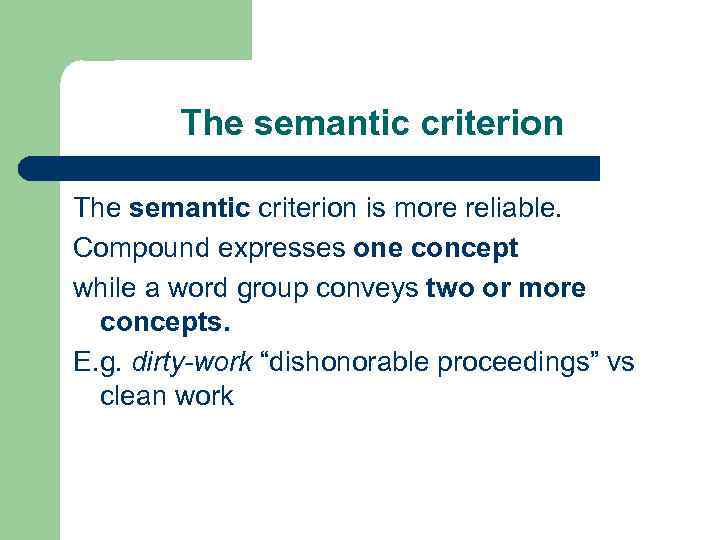 The semantic criterion is more reliable. Compound expresses one concept while a word group conveys two or more concepts. E. g. dirty-work “dishonorable proceedings” vs clean work
 The phonetic criterion is convincingly applicable to many compound nouns. There is a strong tendency for compounds to have a heavy stress on the first syllable, ‘blackboard, ‘blackbird ‘honeymoon, ‘doorway l
 l But there can be a double stress, e. g. in compound adjectives, gray-green, easy-going
 Morphological and syntactic criteria l l In word groups each of the constituents is independently open to grammatical changes; between the constituent parts of the wordgroup other words can be inserted while in compounds it is impossible.
 Conclusion only several criteria: semantic, morphological, syntactic, phonetic, and graphic can convincingly classify a lexical unit as either a compound word or a word group.
 Degree of semantic independence From the point of view of degree of semantic independence there are two types of relationships between the immediate constituents (ICs) of compounds: coordination and subordination
 Coordinative compounds l l In coordinative compounds the two ICs are semantically equally important (e. g. oak-tree, boyfriend, Anglo-American, etc. ).
 They fall into three groups: (1) Additive compounds that are built on stems of the independently functioning words of the same part of speech. They denote a person and an object at the same time, e. g. Afro-Asian, secretary-stenographer, a queenbee
 (2) Reduplicative compounds are made up by the repetition of the same base, e. g. goody-goody (a smugly virtuous person), l fifty-fifty, l hush-hush
 (3) Phonetically variated rhythmic twin forms Compounds formed by joining the phonetically variated rhythmic twin forms which either alliterate with the same initial consonant but vary the vowels e. g. zig-zag, sing-song,
 l l l or rhyme by varying the initial consonants e. g. walkie-talkie, fuddy-duddy (a person, esp an elderly one, who is extremely conservative or dull), hoity-toity (arrogant or haughty )
 Subordinative compounds l l In subordinative compounds the components are neither structurally nor semantically equal in significance but are based on the domination of the headmember which is, as a rule, the second IC
 The second IC is the semantically and grammatically dominant part of the word, which preconditions the part-of-speech meaning of the whole compound, e. g. stone-deaf, a baby-sitter
 From the functional POV compounds are viewed as words of different parts of speech. It is the head-member of the compound (the second IC) that is indicative of the lexical and grammatical category the compound belongs to.
 Compounds can be found in all parts of speech, but the bulk of compounds are nouns and adjectives.
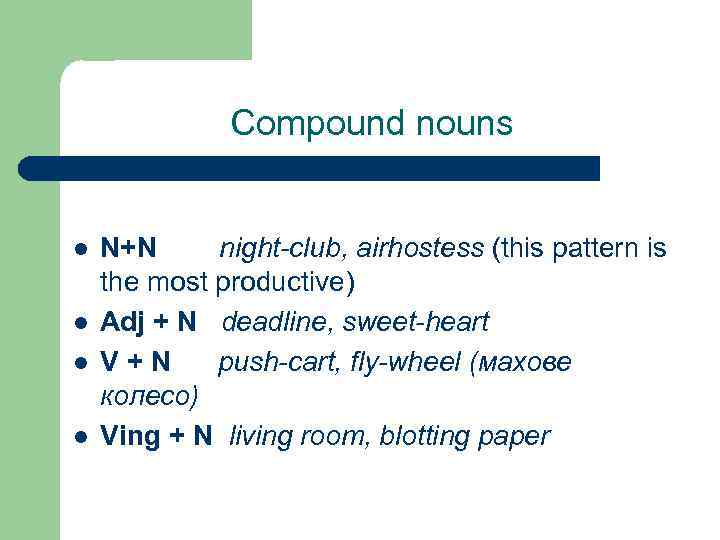 Compound nouns l l N+N night-club, airhostess (this pattern is the most productive) Adj + N deadline, sweet-heart V+N push-cart, fly-wheel (махове колесо) Ving + N living room, blotting paper
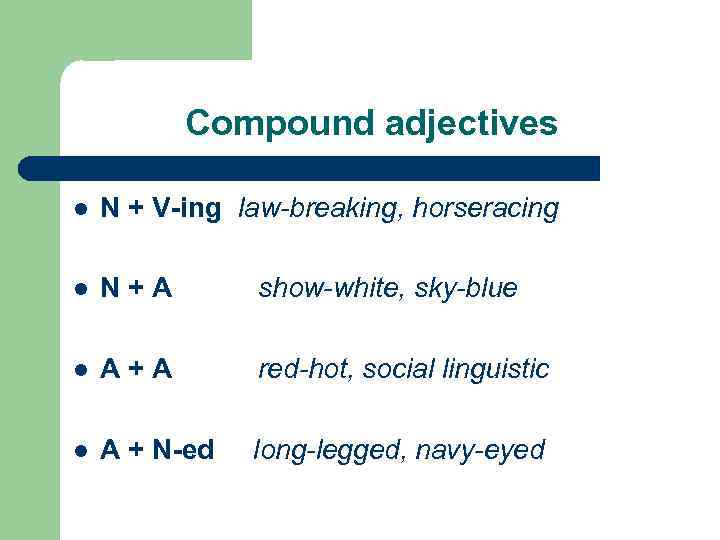 Compound adjectives l N + V-ing law-breaking, horseracing l N+A show-white, sky-blue l A+A red-hot, social linguistic l A + N-ed long-legged, navy-eyed
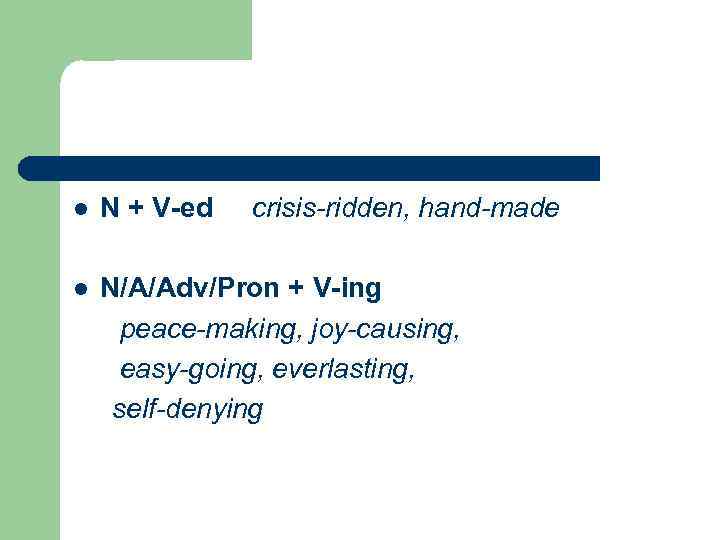 l N + V-ed crisis-ridden, hand-made l N/A/Adv/Pron + V-ing peace-making, joy-causing, easy-going, everlasting, self-denying
 Compound adverbs, pronouns are represented by an insignificant number of words, e. g. anything, inside, upright, somebody, otherwise, moreover, elsewhere, anything
 V + Prep l l A very characteristic development of Modern English is the growth of separable verbs of different types. This term suggested by W. N. Francis in his work “The structure of American English”.
 V + Prep l l Verbs of the type V + Prep function as simple ones. The most essential and typical in the class are verbs with postpositive particles, back, down, in, off, on, out, up.
 l l Some scholars call them verb-adverb combinations. Other terms are merged verbs, separable compounds, compound verbs and phrasal verbs
 2. Semantic word-formation is the formation of new meanings of a lexeme. A new meaning results from generalization or specifying the earlier meaning. Generalization of meaning is extending the previous meaning and making it more abstract. e. g. picture ‘smth painted’ > any ‘visual image’
 l l Manuscript: ‘smth handwritten’ > ‘any author’s copy written or typed’ to arrive (French borrowing) "to come to shore, to land” >the general meaning "to come“, e. g. to arrive in a village, town, city, country, at a hotel, hostel, college, theatre, place, etc.
any “hollow oblong cylindrical body”, e. g. water" src="https://present5.com/presentation/30655280_437288675/image-60.jpg" alt="Pipe: "a musical wind instrument“ > any “hollow oblong cylindrical body”, e. g. water" />
Pipe: "a musical wind instrument“ > any “hollow oblong cylindrical body”, e. g. water pipes In ME girl had the meaning of "a small child of either sex“ Now >"a small child of the female sex" l
 l l l So the range of meaning was somewhat narrowed. In its further semantic development the word gradually broadened its range of meaning, E. g. a young unmarried woman > any young woman, in modern colloquial English, woman
 Specification/ narrowing l Specification/ narrowing of the meaning occurs when a word of wide meaning acquires a narrower sense in which it is applicable only to some of the entities it previously denoted.
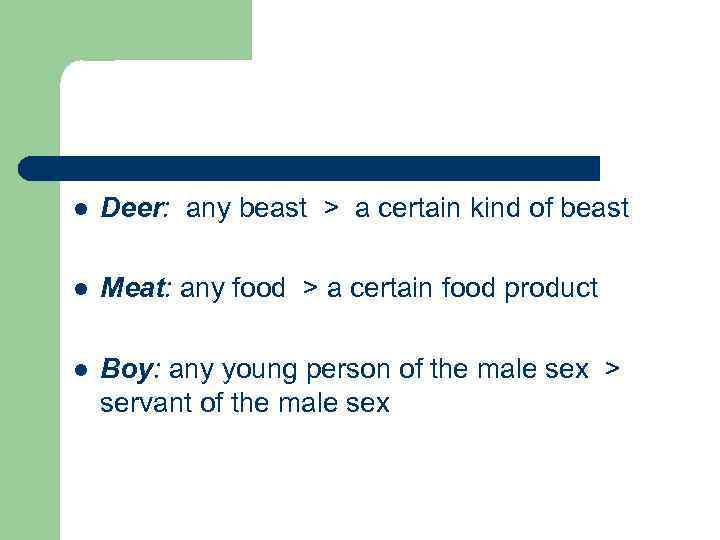 l Deer: any beast > a certain kind of beast l Meat: any food > a certain food product l Boy: any young person of the male sex > servant of the male sex
 Transposition l l is when an item develops a new sense within one and the same part of speech. The new sense results neither from specification nor from generalization of meaning. Its meaning relates to the previous meaning via contiguity “ суміжність” (metonymy) or likeness (metaphor).
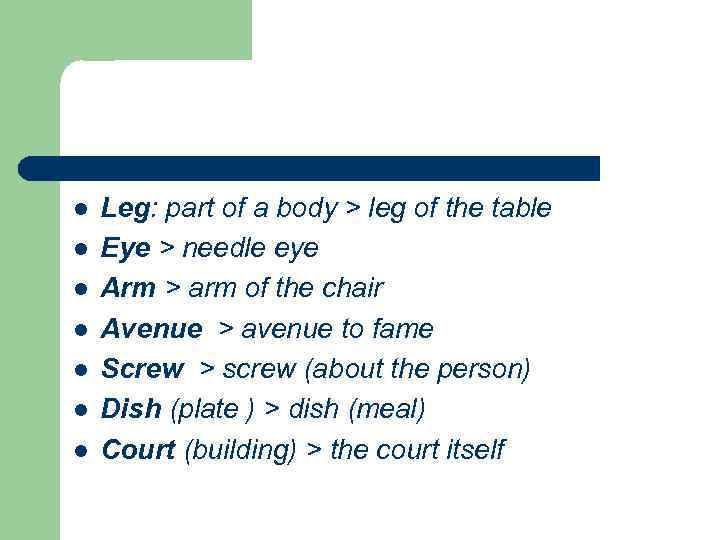 l l l l Leg: part of a body > leg of the table Eye > needle eye Arm > arm of the chair Avenue > avenue to fame Screw > screw (about the person) Dish (plate ) > dish (meal) Court (building) > the court itself
 Conversion l l Conversion is a process of word-formation in which the word comes to belong to a new word class without addition of any affix. The words changes its part of speech meaning and the formal grammatical features.
 N>V l l l N > V are the most numerous, e. g. hand > to hand, back>to back, face >to face, eye > to eye, monkey > to monkey, blackmail >to blackmail, honeymoon > to honeymoon,
 V>N l l , to do > do (event, incident ) e. g. This is the queerest do I've evercome across to go > go (energy) e. g. He has still plenty of go at his age.
 l l l More examples , to make > make, to run >run, to find > find, to catch >catch
 A>V pale >to pale, yellow > to yellow, l cool > to cool, grey > to grey, l rough > to rough e. g. We decided to rough it in the tents as the weather was warm l
 l l l Conversion may be accompanied by the change of stress, object > to object import > to import
 3. Borrowing l l l Borrowing is the process of introduction of the word from one language (source) into another (target) language. This word is modified in phonemic shape, spelling, paradigm or meaning according to the standards of the English language, paper < Fr papier
 Translation-loans l l Translation-loans are words and expressions made from the material available in the language after the patterns characteristic of the given language, but under the influence of some foreign words and expressions. They are morpheme-for-morpheme or word-for-word translations form the source language.
 e. g. mother tongue < lingua maternal (Latin) wall newspaper < стенгазета (Russian) the fair sex < la beau sexe (French)
 Semantic borrowing is the appearance of a new meaning due to the influence of a related word in another language, e. g. bureau is used in the political vocabulary, as in Political bureau (Russian)
 Barbarisms are words and phrases not assimilated by the target language. They have the form which they had in the source language, E. g. Latin p. m. Tabula rasa (an opportunity for a fresh start; clean slate) persona non grata De facto, de jure
 l l Japanese hara-kiri, sushi French coup d’etat, rendez-vous