


 Скачать презентацию Word segmentation effects of the native language and
6d744d28e832055f85860f77b97491f2.ppt
- Количество слайдов: 38
 Word segmentation: effects of the native language and of the native dialect Thierry Nazzi Laboratoire Psychologie de la Perception CNRS - Université Paris 5
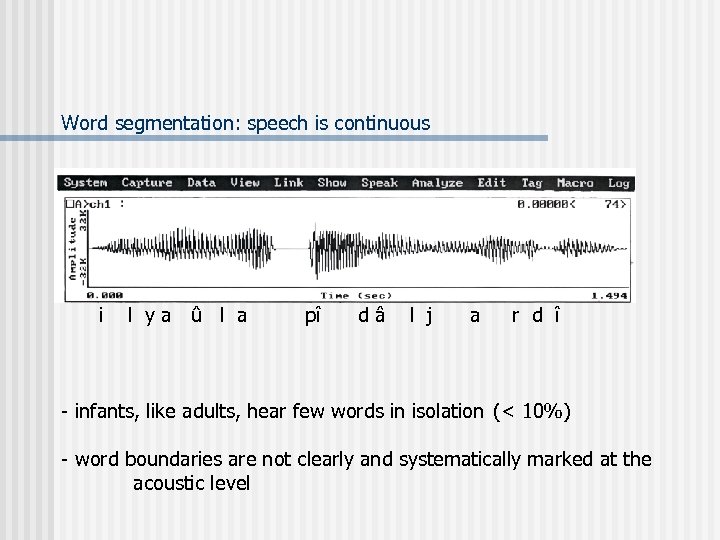 Word segmentation: speech is continuous i l ya û l a pî dâ l j a r d î - infants, like adults, hear few words in isolation (< 10%) - word boundaries are not clearly and systematically marked at the acoustic level
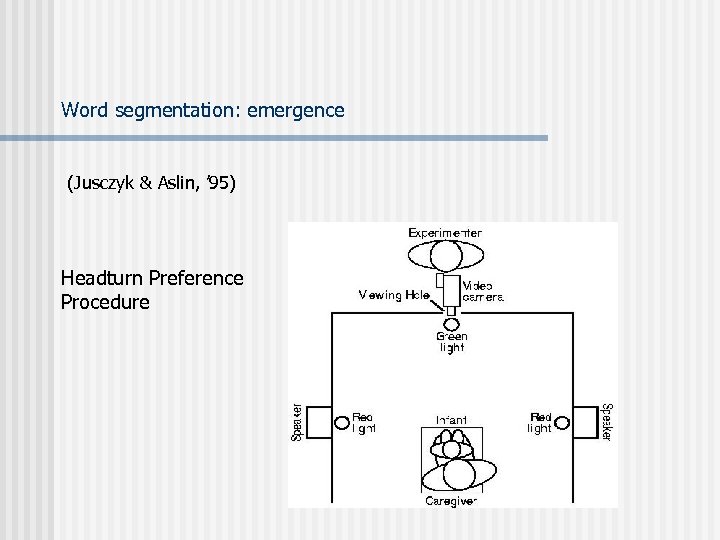 Word segmentation: emergence (Jusczyk & Aslin, ’ 95) Headturn Preference Procedure
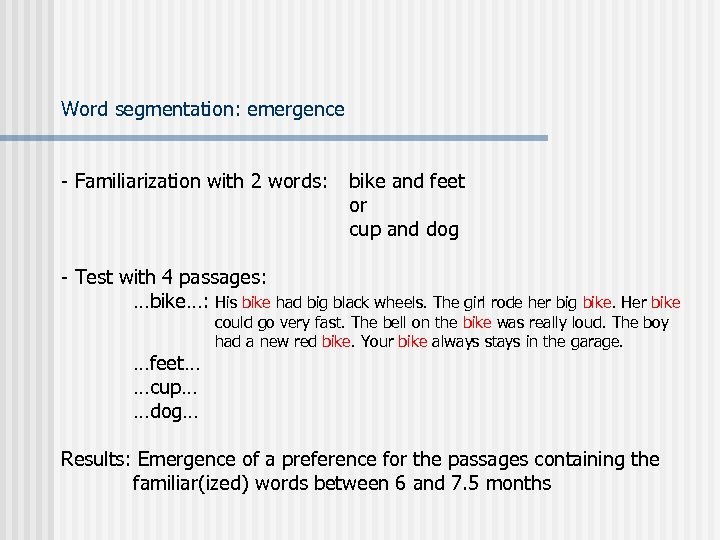 Word segmentation: emergence - Familiarization with 2 words: bike and feet or cup and dog - Test with 4 passages: …bike…: His bike had big black wheels. The girl rode her big bike. Her bike …feet… …cup… …dog… could go very fast. The bell on the bike was really loud. The boy had a new red bike. Your bike always stays in the garage. Results: Emergence of a preference for the passages containing the familiar(ized) words between 6 and 7. 5 months
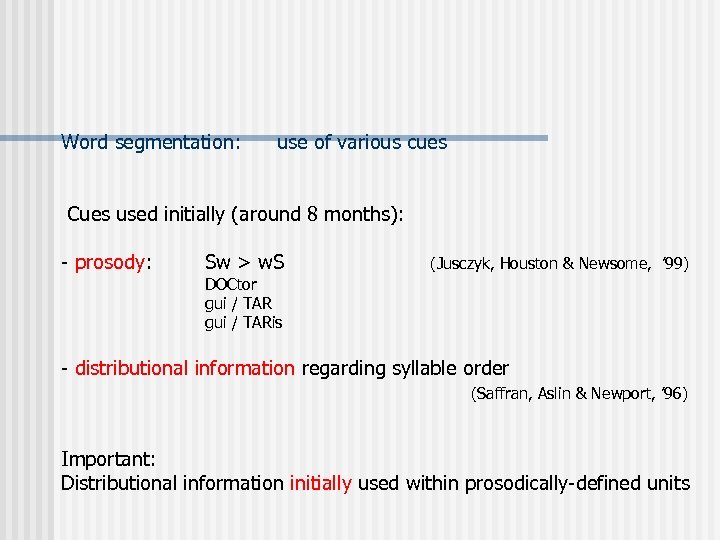 Word segmentation: use of various cues Cues used initially (around 8 months): - prosody: Sw > w. S (Jusczyk, Houston & Newsome, ’ 99) DOCtor gui / TARis - distributional information regarding syllable order (Saffran, Aslin & Newport, ’ 96) Important: Distributional information initially used within prosodically-defined units
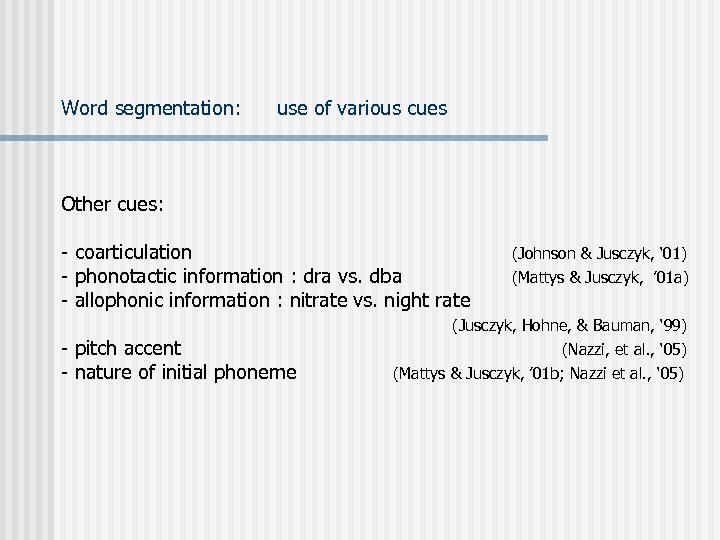 Word segmentation: use of various cues Other cues: - coarticulation - phonotactic information : dra vs. dba - allophonic information : nitrate vs. night rate - pitch accent - nature of initial phoneme (Johnson & Jusczyk, ‘ 01) (Mattys & Jusczyk, ’ 01 a) (Jusczyk, Hohne, & Bauman, ‘ 99) (Nazzi, et al. , ‘ 05) (Mattys & Jusczyk, ’ 01 b; Nazzi et al. , ‘ 05)
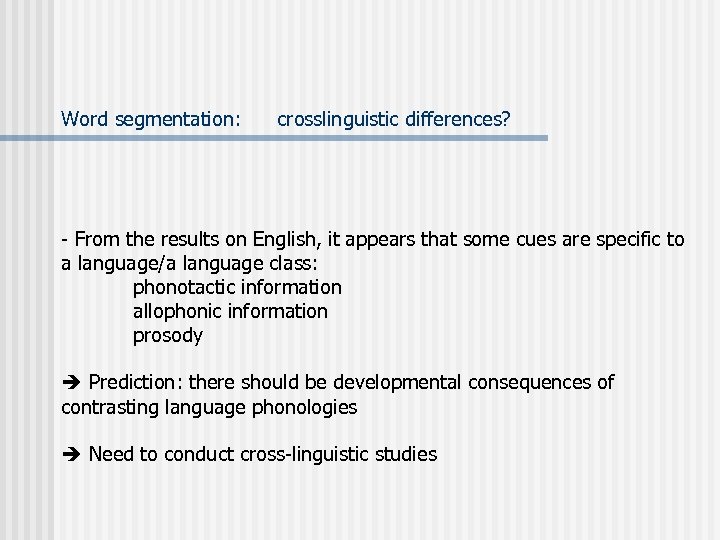 Word segmentation: crosslinguistic differences? - From the results on English, it appears that some cues are specific to a language/a language class: phonotactic information allophonic information prosody Prediction: there should be developmental consequences of contrasting language phonologies Need to conduct cross-linguistic studies
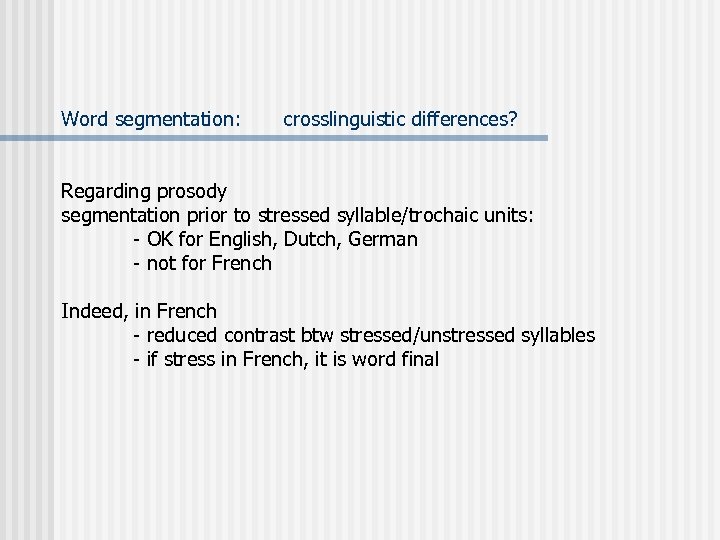 Word segmentation: crosslinguistic differences? Regarding prosody segmentation prior to stressed syllable/trochaic units: - OK for English, Dutch, German - not for French Indeed, in French - reduced contrast btw stressed/unstressed syllables - if stress in French, it is word final
 Word segmentation: crosslinguistic differences? Hypothesis: Prosodic segmentation will differ across rhythmic-based classes of languages
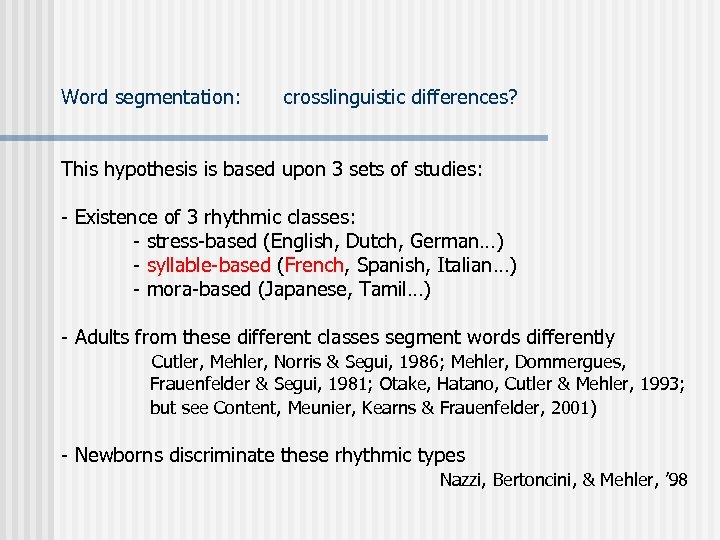 Word segmentation: crosslinguistic differences? This hypothesis is based upon 3 sets of studies: - Existence of 3 rhythmic classes: - stress-based (English, Dutch, German…) - syllable-based (French, Spanish, Italian…) - mora-based (Japanese, Tamil…) - Adults from these different classes segment words differently Cutler, Mehler, Norris & Segui, 1986; Mehler, Dommergues, Frauenfelder & Segui, 1981; Otake, Hatano, Cutler & Mehler, 1993; but see Content, Meunier, Kearns & Frauenfelder, 2001) - Newborns discriminate these rhythmic types Nazzi, Bertoncini, & Mehler, ’ 98
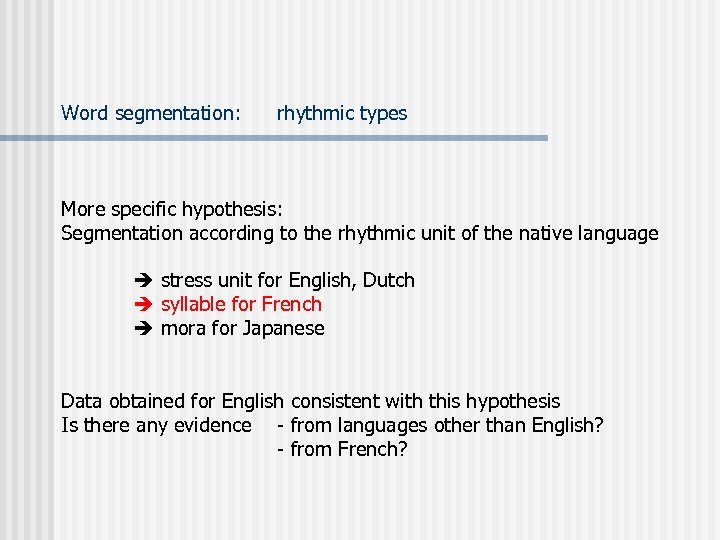 Word segmentation: rhythmic types More specific hypothesis: Segmentation according to the rhythmic unit of the native language stress unit for English, Dutch syllable for French mora for Japanese Data obtained for English consistent with this hypothesis Is there any evidence - from languages other than English? - from French?
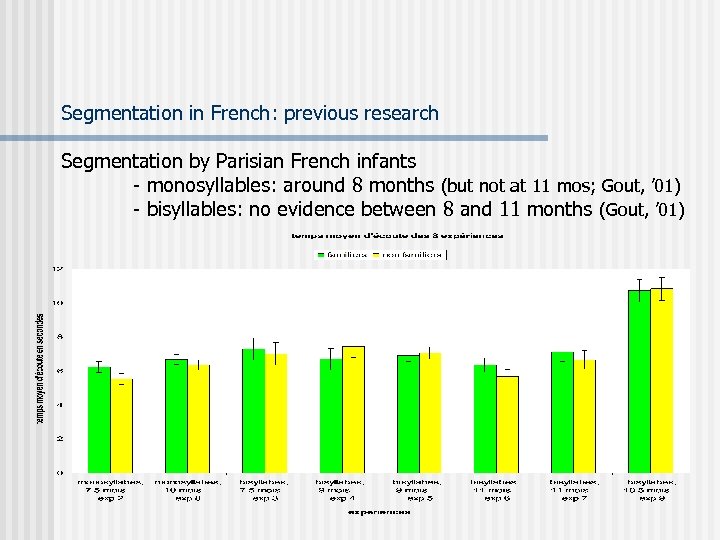 Segmentation in French: previous research Segmentation by Parisian French infants - monosyllables: around 8 months (but not at 11 mos; Gout, ’ 01) - bisyllables: no evidence between 8 and 11 months (Gout, ’ 01)
 Segmentation in French Gout (’ 01) results: compatible with idea that there are developmental consequences of contrasting language phonologies Role of the syllable? Our goal: Test the segmentation of bisyllabic words in French Are they segmented - as whole units? - as independent syllables?
 Segmentation in French Nazzi, Iakimova, Bertoncini, Frédonie & Alcantara (2006) Prediction for the segmentation of bisyllabic words in French Initially, syllables of bisyllabic words segmented independently - non-recognition of the whole word - recognition of each syllable independently Later, bisyllabic words segmented as whole units - recognition of the whole word - non-recognition of each syllable independently ?
 Segmentation in French Step 1 When do bisyllabic words start being segmented as wholes? Three age groups tested: 16 infants per age group 8 -month-olds 12 -month-olds 16 -month-olds
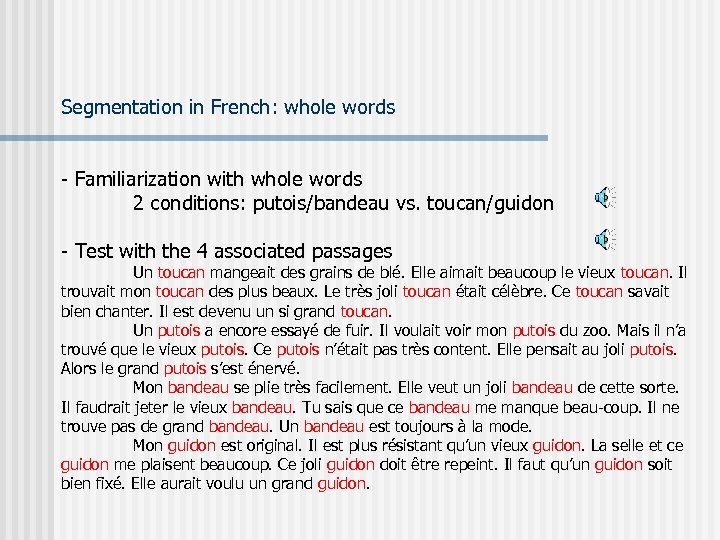 Segmentation in French: whole words - Familiarization with whole words 2 conditions: putois/bandeau vs. toucan/guidon - Test with the 4 associated passages Un toucan mangeait des grains de blé. Elle aimait beaucoup le vieux toucan. Il trouvait mon toucan des plus beaux. Le très joli toucan était célèbre. Ce toucan savait bien chanter. Il est devenu un si grand toucan. Un putois a encore essayé de fuir. Il voulait voir mon putois du zoo. Mais il n’a trouvé que le vieux putois. Ce putois n’était pas très content. Elle pensait au joli putois. Alors le grand putois s’est énervé. Mon bandeau se plie très facilement. Elle veut un joli bandeau de cette sorte. Il faudrait jeter le vieux bandeau. Tu sais que ce bandeau me manque beau-coup. Il ne trouve pas de grand bandeau. Un bandeau est toujours à la mode. Mon guidon est original. Il est plus résistant qu’un vieux guidon. La selle et ce guidon me plaisent beaucoup. Ce joli guidon doit être repeint. Il faut qu’un guidon soit bien fixé. Elle aurait voulu un grand guidon.
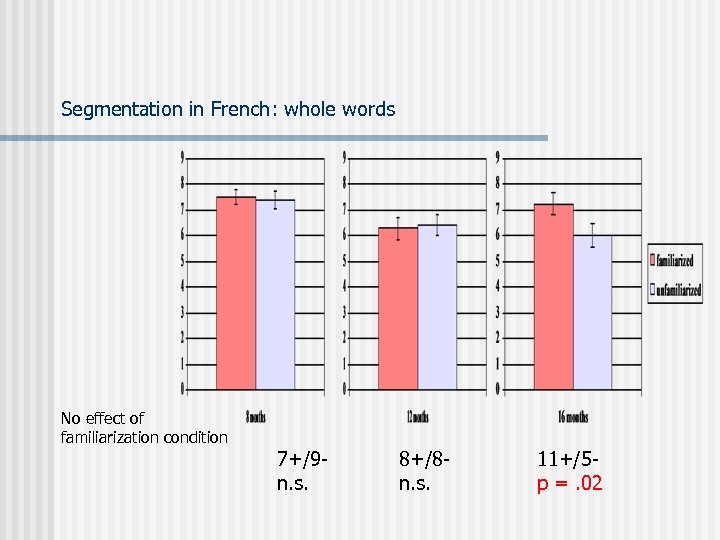 Segmentation in French: whole words No effect of familiarization condition 7+/9 n. s. 8+/8 n. s. 11+/5 p =. 02
 Segmentation in French: whole words - No evidence of whole word segmentation - at 8 months: as predicted by our hypothesis that infants start segmenting on the basis of the syllabic unit - at 12 months: consistent with Gout (2001) - Evidence of whole word segmentation at 16 months
 Segmentation in French - Step 2 Evidence for the segmentation of individual syllables at 12 months? Start with final syllables (more accented in French) Three age groups tested: 16 infants per age group 8 -month-olds 12 -month-olds 16 -month-olds
 Word segmentation in French: final syllables - Familiarization with final syllables 2 conditions: toi/can vs. deau/don - Test with the 4 associated passages Un toucan mangeait des grains de blé. Elle aimait beaucoup le vieux toucan. Il trouvait mon toucan des plus beaux. Le très joli toucan était célèbre. Ce toucan savait bien chanter. Il est devenu un si grand toucan. Un putois a encore essayé de fuir. Il voulait voir mon putois du zoo. Mais il n’a trouvé que le vieux putois. Ce putois n’était pas très content. Elle pensait au joli putois. Alors le grand putois s’est énervé. Mon bandeau se plie très facilement. Elle veut un joli bandeau de cette sorte. Il faudrait jeter le vieux bandeau. Tu sais que ce bandeau me manque beau-coup. Il ne trouve pas de grand bandeau. Un bandeau est toujours à la mode. Mon guidon est original. Il est plus résistant qu’un vieux guidon. La selle et ce guidon me plaisent beaucoup. Ce joli guidon doit être repeint. Il faut qu’un guidon soit bien fixé. Elle aurait voulu un grand guidon.
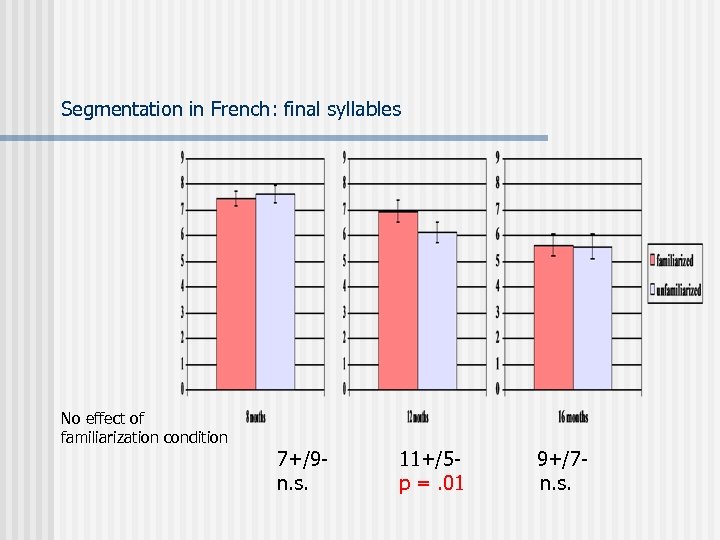 Segmentation in French: final syllables No effect of familiarization condition 7+/9 n. s. 11+/5 p =. 01 9+/7 n. s.
 Segmentation in French: final syllables - No evidence of final syllable segmentation - at 8 months: “delay” compared to English-learning infants - at 16 months: congruent with whole-word segmentation effects in English - Evidence of final syllable segmentation at 12 months as predicted by our hypothesis that infants start segmenting on the basis of the syllabic unit
 Segmentation in French - Step 3 Evidence for the segmentation of individual syllables at 12 months? Our proposal states that at the age at which final syllables are segmented, infants should also be able to segment initial syllables (less accented in French) One age group tested: (but 2 conditions) 16 infants per condition 12 -month-olds
 Segmentation in French: initial syllables - Familiarization with initial syllables 2 conditions: pu/tou vs. ban/gui - Test with the 4 associated passages Un toucan mangeait des grains de blé. Elle aimait beaucoup le vieux toucan. Il trouvait mon toucan des plus beaux. Le très joli toucan était célèbre. Ce toucan savait bien chanter. Il est devenu un si grand toucan. Un putois a encore essayé de fuir. Il voulait voir mon putois du zoo. Mais il n’a trouvé que le vieux putois. Ce putois n’était pas très content. Elle pensait au joli putois. Alors le grand putois s’est énervé. Mon bandeau se plie très facilement. Elle veut un joli bandeau de cette sorte. Il faudrait jeter le vieux bandeau. Tu sais que ce bandeau me manque beau-coup. Il ne trouve pas de grand bandeau. Un bandeau est toujours à la mode. Mon guidon est original. Il est plus résistant qu’un vieux guidon. La selle et ce guidon me plaisent beaucoup. Ce joli guidon doit être repeint. Il faut qu’un guidon soit bien fixé. Elle aurait voulu un grand guidon.
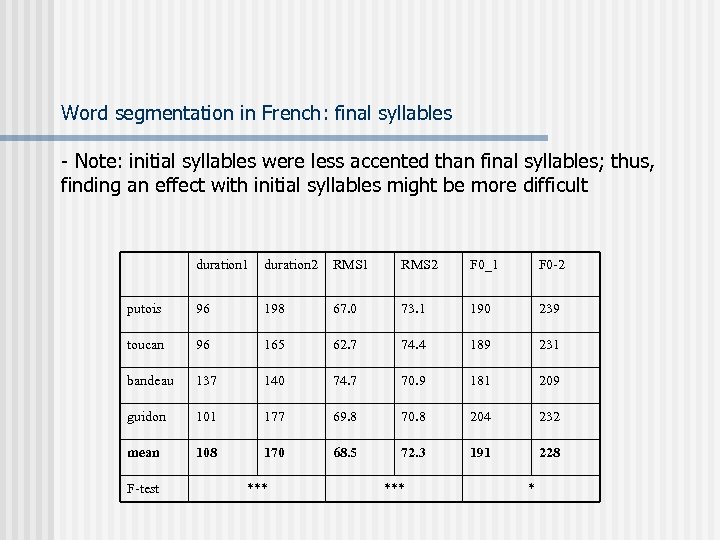 Word segmentation in French: final syllables - Note: initial syllables were less accented than final syllables; thus, finding an effect with initial syllables might be more difficult duration 1 duration 2 RMS 1 RMS 2 F 0_1 F 0 -2 putois 96 198 67. 0 73. 1 190 239 toucan 96 165 62. 7 74. 4 189 231 bandeau 137 140 74. 7 70. 9 181 209 guidon 101 177 69. 8 70. 8 204 232 mean 108 170 68. 5 72. 3 191 228 F-test *** *
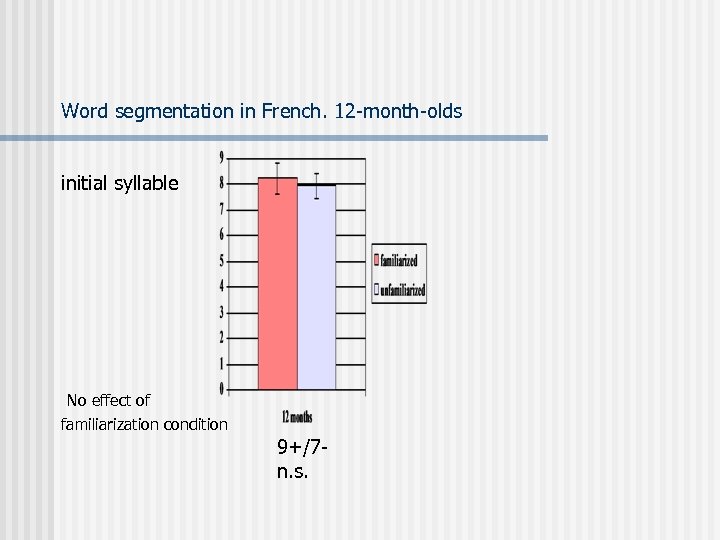 Word segmentation in French. 12 -month-olds initial syllable No effect of familiarization condition 9+/7 n. s.
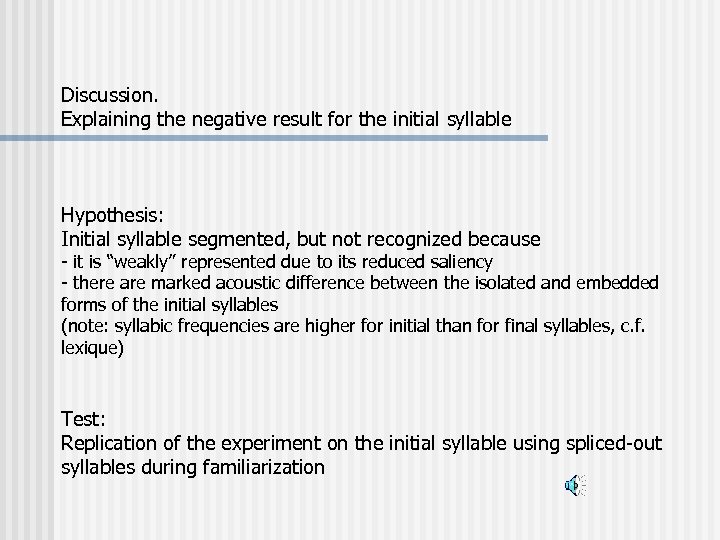 Discussion. Explaining the negative result for the initial syllable Hypothesis: Initial syllable segmented, but not recognized because - it is “weakly” represented due to its reduced saliency - there are marked acoustic difference between the isolated and embedded forms of the initial syllables (note: syllabic frequencies are higher for initial than for final syllables, c. f. lexique) Test: Replication of the experiment on the initial syllable using spliced-out syllables during familiarization
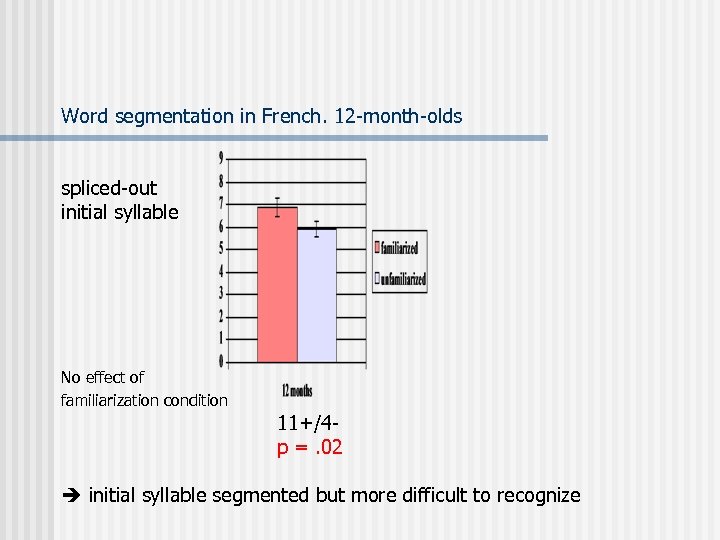 Word segmentation in French. 12 -month-olds spliced-out initial syllable No effect of familiarization condition 11+/4 p =. 02 initial syllable segmented but more difficult to recognize
 Word segmentation in French At 12 months Data compatible with - the hypothesis that there are crosslinguistic differences in the way segmentation procedures emerge in different languages - and more specifically: the hypothesis of the syllable as unit of early prosodic segmentation in French
 Word segmentation in French At 16 months Data compatible with - the segmentation of words as whole units - by that age, infants can probably use cues to word segmentation other than the early prosodic cue an explanation for the elusive syllable in French? (Content, Meunier, Kearns & Frauenfelder, 2001) (but test with ERPs)
 Word segmentation in French At 8 months Data compatible with - (slight? ) delay in the emergence of segmentation abilities in Frenchlearning infants (see also Dutch infants) - note that delay is more marked for the segmentation of bisyllabic words, which relies on cues other than prosodic cues
 Follow-up: towards an exploration of dialectal differences Data with French Canadian infants (Polka & Sundara, 2003) Segmentation of whole bisyllables at 8 months Canadian French dialect Parisian French dialect Possible factors involved in Parisian/Canadian French difference: - Language/dialect effect? Parisian French more difficult to segment than English and Canadian French - Speech style? Degree of Infant-directedness?
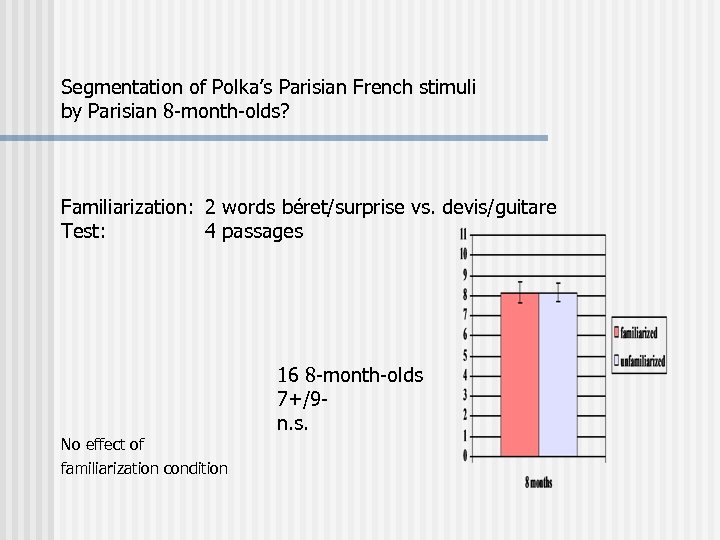 Segmentation of Polka’s Parisian French stimuli by Parisian 8 -month-olds? Familiarization: 2 words béret/surprise vs. devis/guitare Test: 4 passages No effect of familiarization condition 16 8 -month-olds 7+/9 n. s.
 Segmentation of bisyllabic words: Polka Parisian French stimuli - different from Canadian French infants using the same ID stimuli - similar to Parisian French infants using the less intonated stimuli Again, this suggests the non-segmentation of whole bisyllabic words from fluent speech by young Parisian French infants, even when using more pronounced ID stimuli - more of a dialect/language effect (ongoing: specify when Parisian French infants start segmenting these more pronounced ID stimuli)
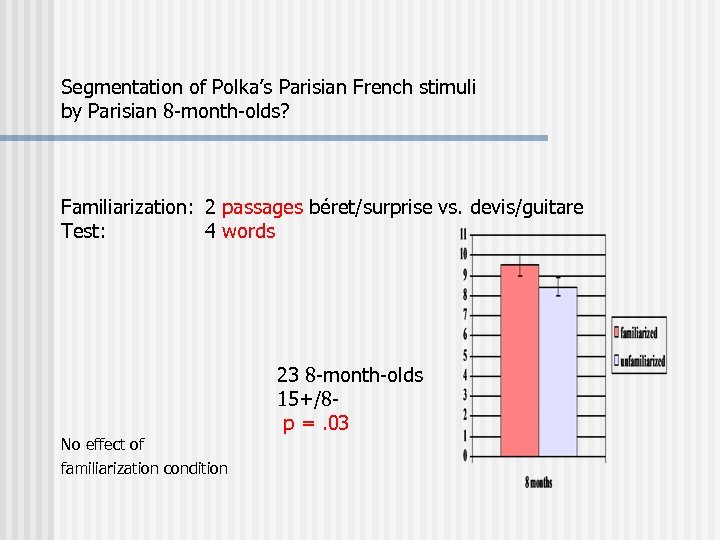 Segmentation of Polka’s Parisian French stimuli by Parisian 8 -month-olds? Familiarization: 2 passages béret/surprise vs. devis/guitare Test: 4 words No effect of familiarization condition 23 8 -month-olds 15+/8 p =. 03
 Segmentation of bisyllabic words: Polka Parisian French stimuli Order effects, different from English. Why? - possibility to use distributional information in passages-first paradigm, which is necessary for Parisian-French infants to “go beyond” syllabic segmentation and “retrieve” bisyllabic word forms? - differences in (number of) processes measured during the test phase? see Kooijman et al. (2005) ERP study on word segmentation in Dutch French dialect effects: - more intonational variations in Canadian French: induces an earlier use of this cue by Canadian French infants? see Nazzi et al. (2005)
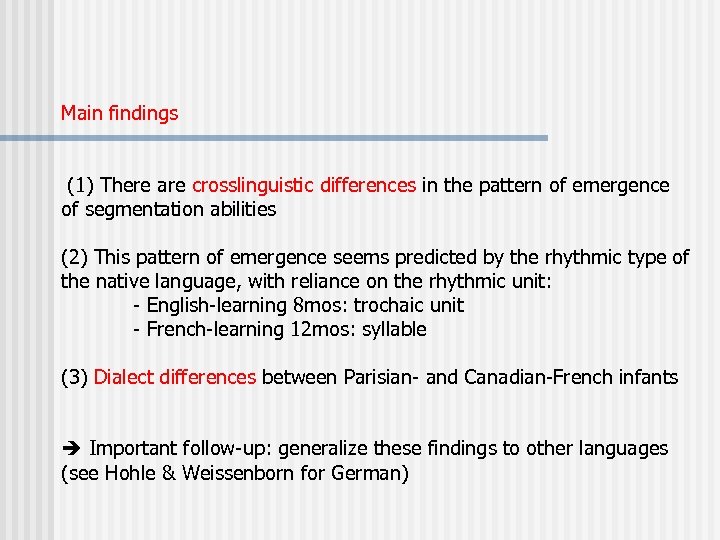 Main findings (1) There are crosslinguistic differences in the pattern of emergence of segmentation abilities (2) This pattern of emergence seems predicted by the rhythmic type of the native language, with reliance on the rhythmic unit: - English-learning 8 mos: trochaic unit - French-learning 12 mos: syllable (3) Dialect differences between Parisian- and Canadian-French infants Important follow-up: generalize these findings to other languages (see Hohle & Weissenborn for German)
 Thanks to Galina Iakimova Carmela Alcantara Josiane Bertoncini Scania de Schonen Séverine Frédonie Linda Polka Megha Sundara Supported by: Fyssen Foundation, European Science Foundation, Ministère de la Recherche