


 Скачать презентацию Word order typology Holger Diessel University of Jena
d872ad8be8841a0809c10dfa8f5824a4.ppt
- Количество слайдов: 64
 Word order typology Holger Diessel University of Jena holger. diessel@uni-jena. de http: //www. holger-diessel. de/
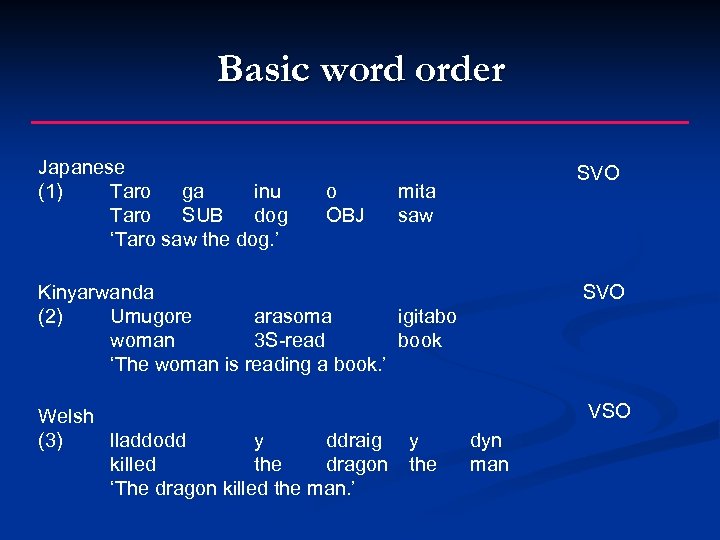 Basic word order Japanese (1) Taro ga inu Taro SUB dog ‘Taro saw the dog. ’ o OBJ SVO mita saw Kinyarwanda (2) Umugore arasoma igitabo woman 3 S-read book ‘The woman is reading a book. ’ SVO Welsh (3) lladdodd y ddraig killed the dragon ‘The dragon killed the man. ’ VSO y the dyn man
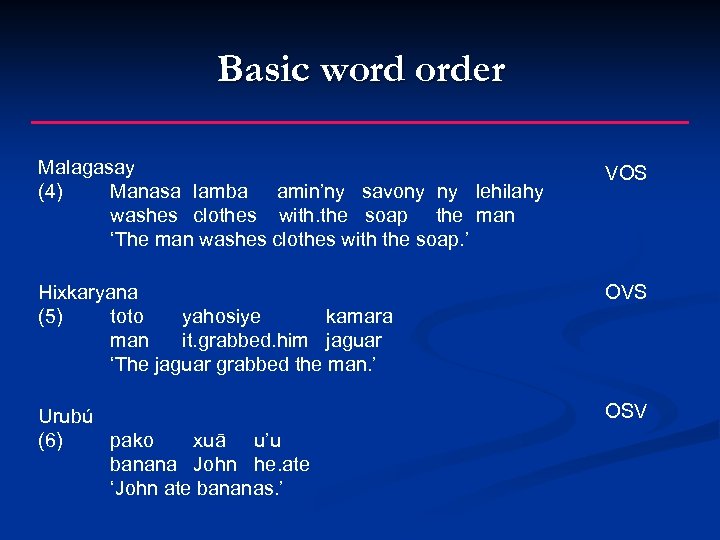 Basic word order Malagasay (4) Manasa lamba amin’ny savony ny lehilahy washes clothes with. the soap the man ‘The man washes clothes with the soap. ’ VOS Hixkaryana (5) toto yahosiye kamara man it. grabbed. him jaguar ‘The jaguar grabbed the man. ’ OVS Urubú (6) pako xuā u’u banana John he. ate ‘John ate bananas. ’ OSV
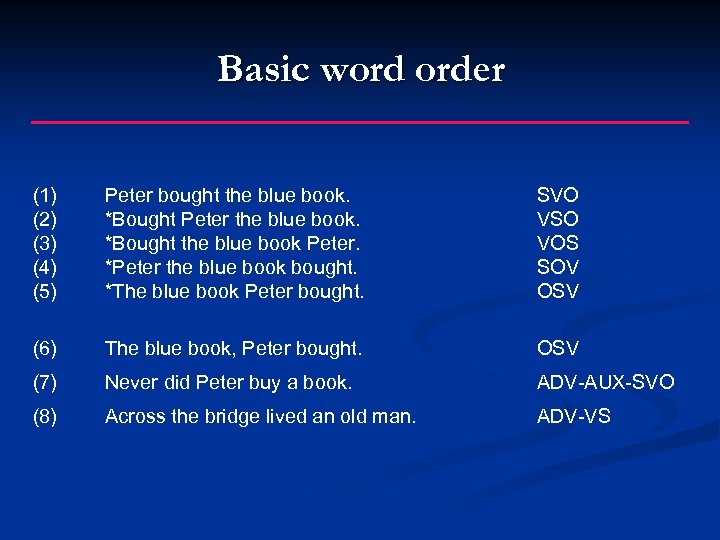 Basic word order (1) (2) (3) (4) (5) Peter bought the blue book. *Bought Peter the blue book. *Bought the blue book Peter. *Peter the blue book bought. *The blue book Peter bought. SVO VSO VOS SOV OSV (6) The blue book, Peter bought. OSV (7) Never did Peter buy a book. ADV-AUX-SVO (8) Across the bridge lived an old man. ADV-VS
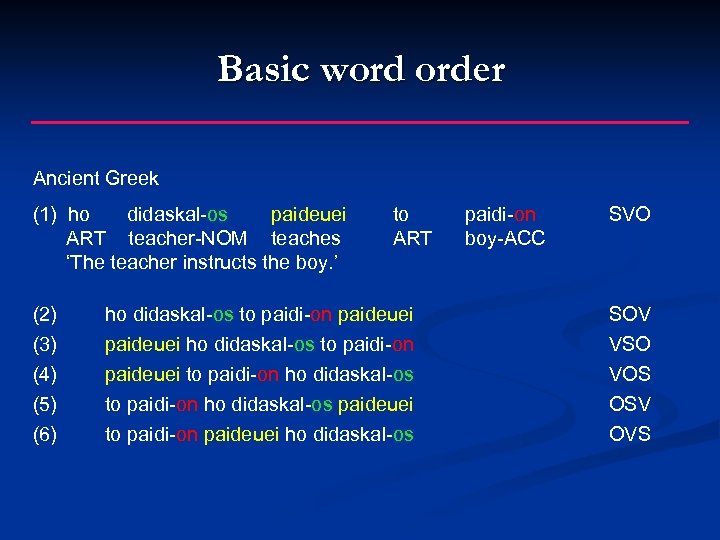 Basic word order Ancient Greek (1) ho didaskal-os paideuei ART teacher-NOM teaches ‘The teacher instructs the boy. ’ to ART paidi-on boy-ACC SVO (2) (3) (4) (5) ho didaskal-os to paidi-on paideuei to paidi-on ho didaskal-os paideuei SOV VSO VOS OSV (6) to paidi-on paideuei ho didaskal-os OVS
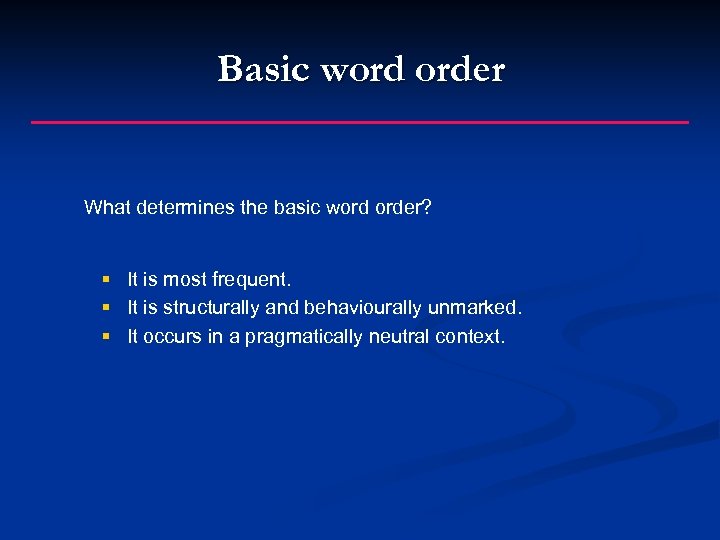 Basic word order What determines the basic word order? § It is most frequent. § It is structurally and behaviourally unmarked. § It occurs in a pragmatically neutral context.
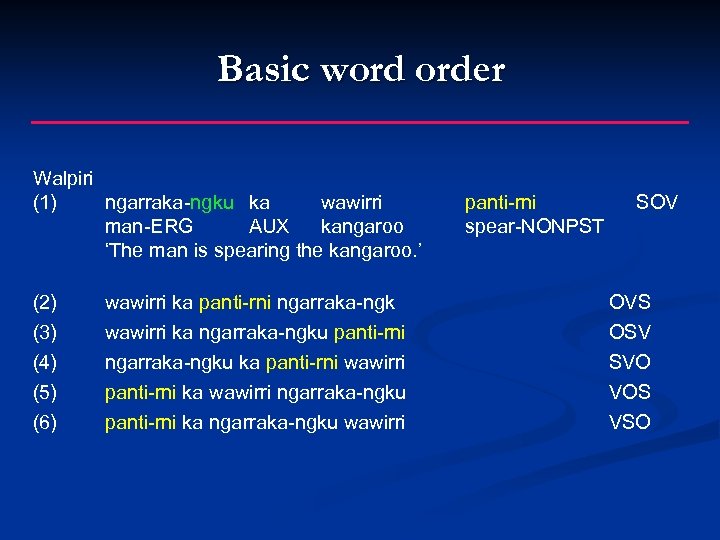 Basic word order Walpiri (1) ngarraka-ngku ka wawirri man-ERG AUX kangaroo ‘The man is spearing the kangaroo. ’ panti-rni spear-NONPST SOV (2) (3) (4) (5) wawirri ka panti-rni ngarraka-ngk wawirri ka ngarraka-ngku panti-rni ngarraka-ngku ka panti-rni wawirri panti-rni ka wawirri ngarraka-ngku OVS OSV SVO VOS (6) panti-rni ka ngarraka-ngku wawirri VSO
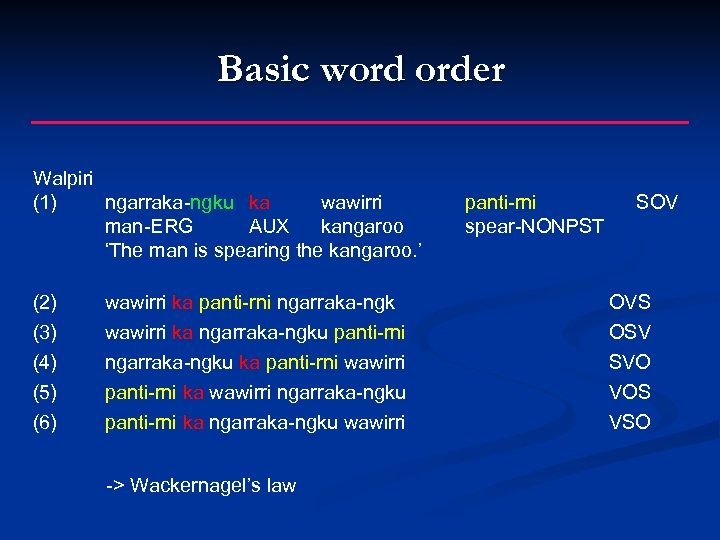 Basic word order Walpiri (1) ngarraka-ngku ka wawirri man-ERG AUX kangaroo ‘The man is spearing the kangaroo. ’ panti-rni spear-NONPST SOV (2) (3) (4) (5) wawirri ka panti-rni ngarraka-ngk wawirri ka ngarraka-ngku panti-rni ngarraka-ngku ka panti-rni wawirri panti-rni ka wawirri ngarraka-ngku OVS OSV SVO VOS (6) panti-rni ka ngarraka-ngku wawirri VSO -> Wackernagel’s law
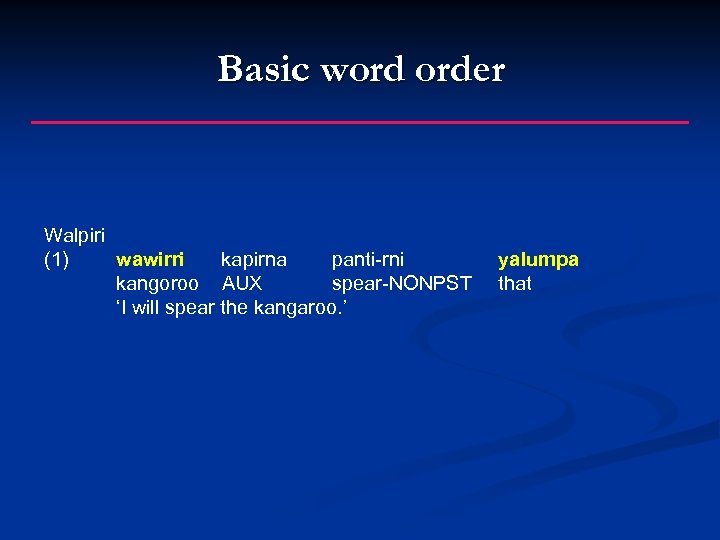 Basic word order Walpiri (1) wawirri kapirna panti-rni kangoroo AUX spear-NONPST ‘I will spear the kangaroo. ’ yalumpa that
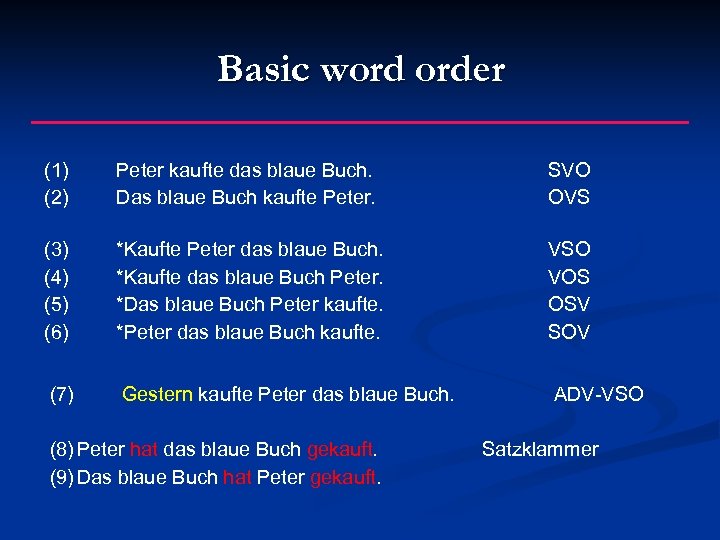 Basic word order (1) (2) Peter kaufte das blaue Buch. Das blaue Buch kaufte Peter. SVO OVS (3) (4) (5) (6) *Kaufte Peter das blaue Buch. *Kaufte das blaue Buch Peter. *Das blaue Buch Peter kaufte. *Peter das blaue Buch kaufte. VSO VOS OSV SOV (7) Gestern kaufte Peter das blaue Buch. ADV-VSO (8) Peter hat das blaue Buch gekauft. (9) Das blaue Buch hat Peter gekauft. Satzklammer
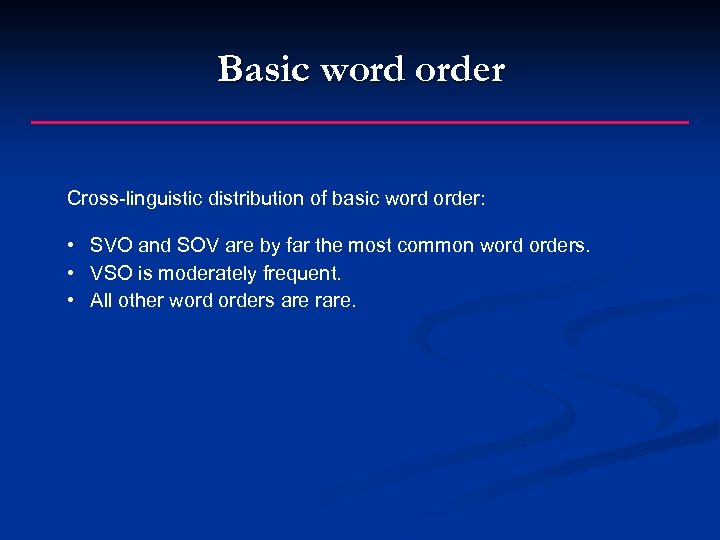 Basic word order Cross-linguistic distribution of basic word order: • SVO and SOV are by far the most common word orders. • VSO is moderately frequent. • All other word orders are rare.
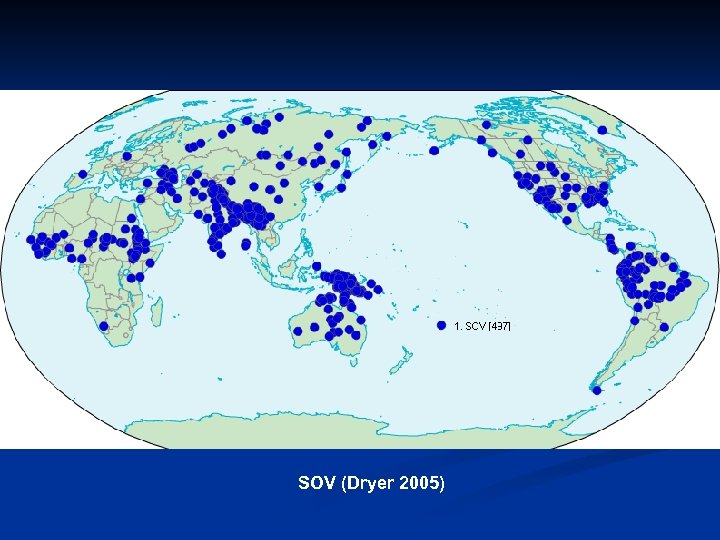 SOV (Dryer 2005)
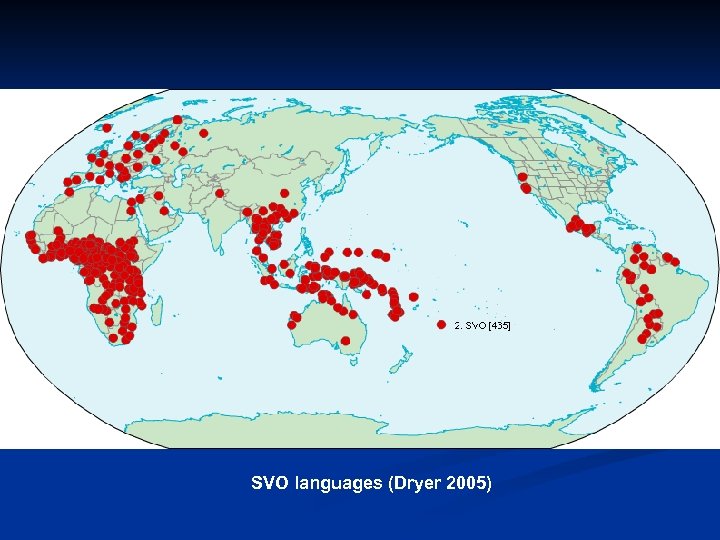 SVO languages (Dryer 2005)
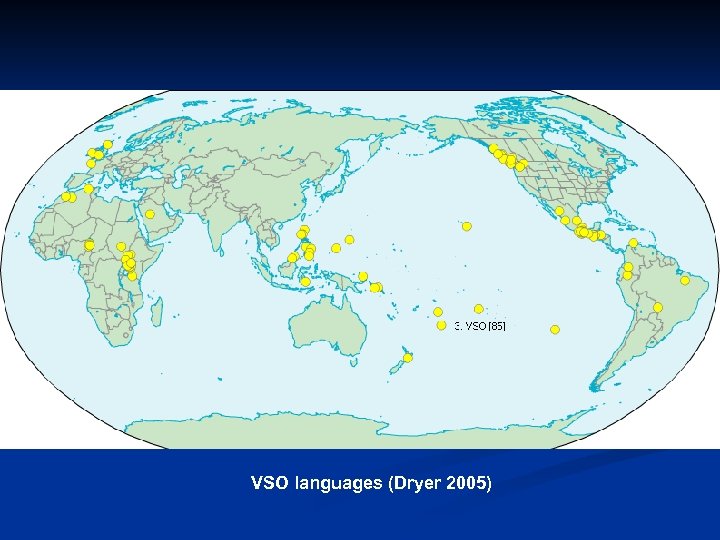 VSO languages (Dryer 2005)
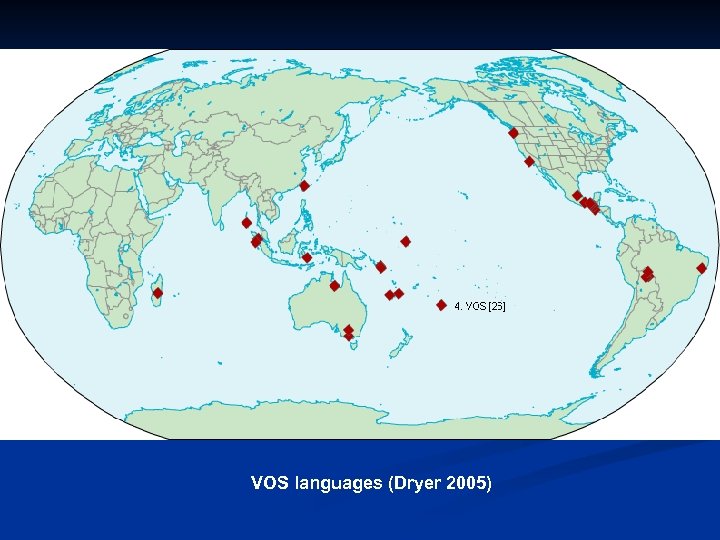 VOS languages (Dryer 2005)
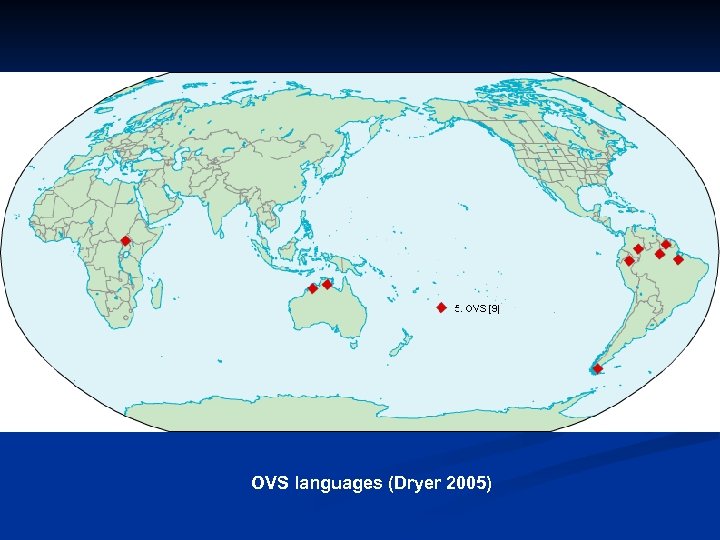 OVS languages (Dryer 2005)
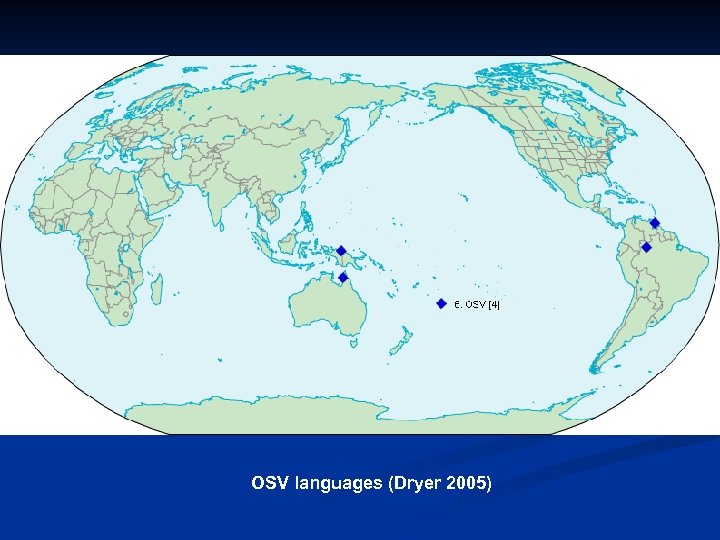 OSV languages (Dryer 2005)
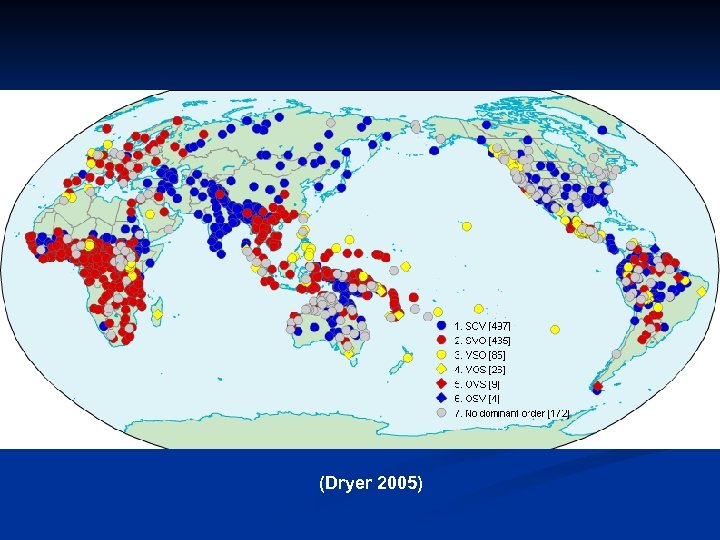 (Dryer 2005)
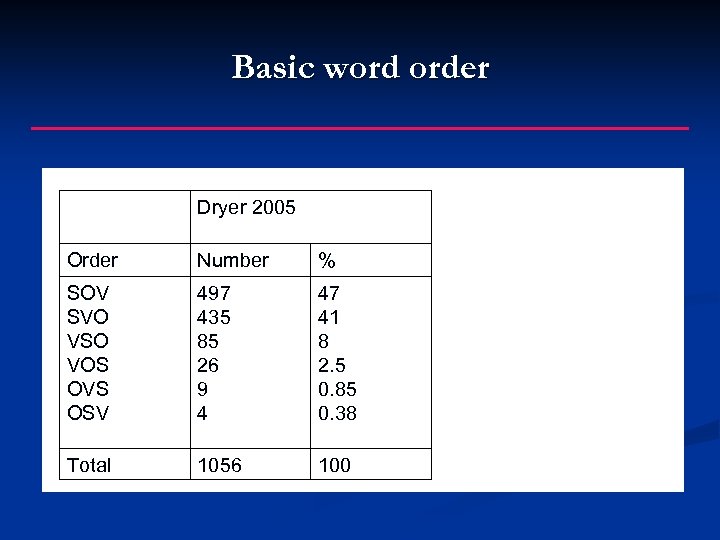 Basic word order Dryer 2005 Order Number % SOV SVO VSO VOS OVS OSV 497 435 85 26 9 4 47 41 8 2. 5 0. 85 0. 38 Total 1056 100
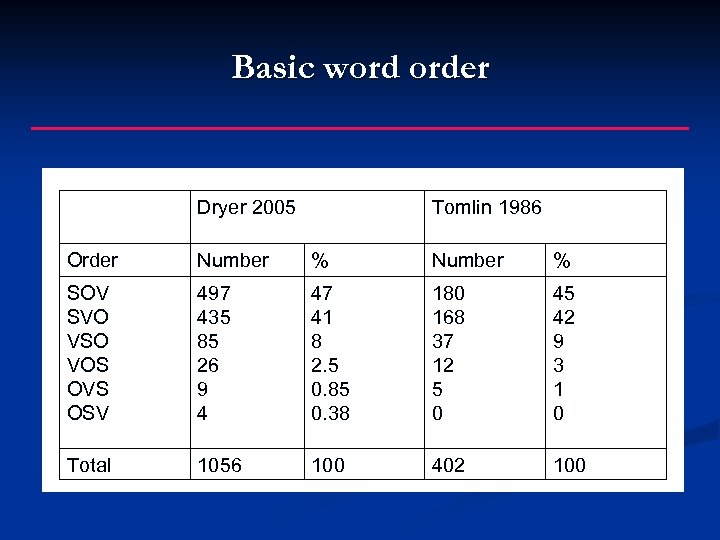 Basic word order Dryer 2005 Tomlin 1986 Order Number % SOV SVO VSO VOS OVS OSV 497 435 85 26 9 4 47 41 8 2. 5 0. 85 0. 38 180 168 37 12 5 0 45 42 9 3 1 0 Total 1056 100 402 100
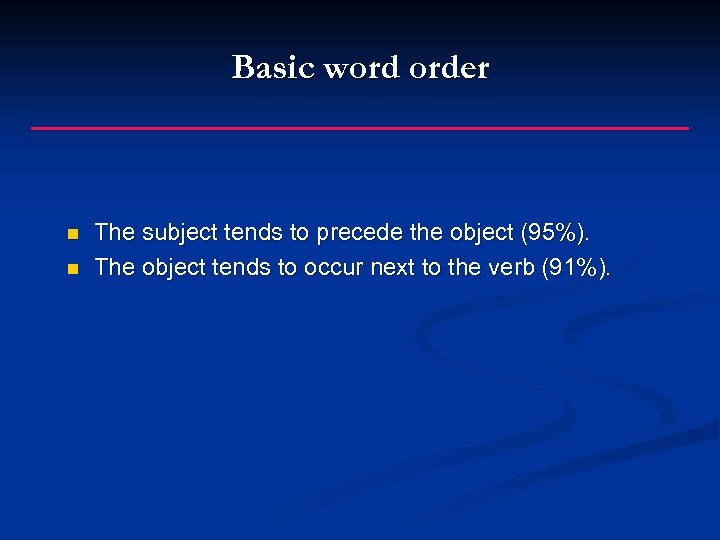 Basic word order n n The subject tends to precede the object (95%). The object tends to occur next to the verb (91%).
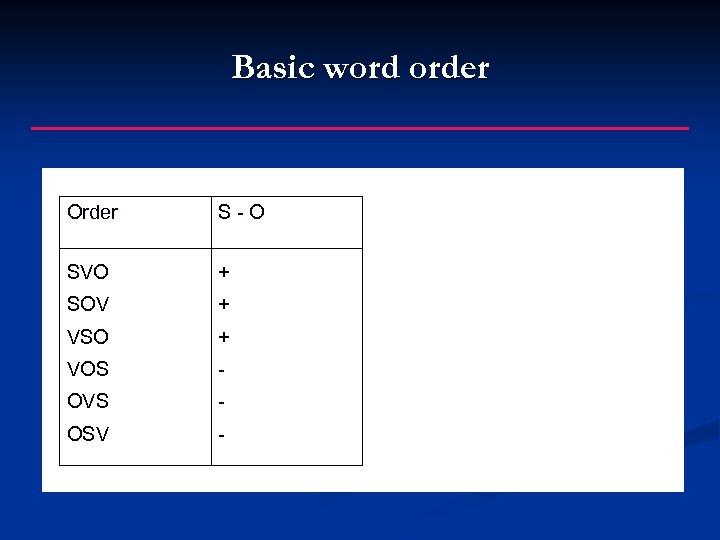 Basic word order Order S-O SVO + SOV + VSO + VOS - OVS - OSV -
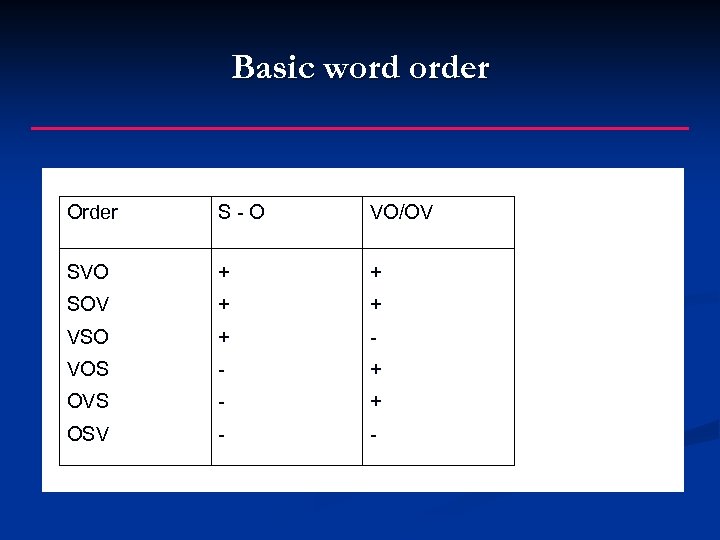 Basic word order Order S-O VO/OV SVO + + SOV + + VSO + - VOS - + OVS - + OSV - -
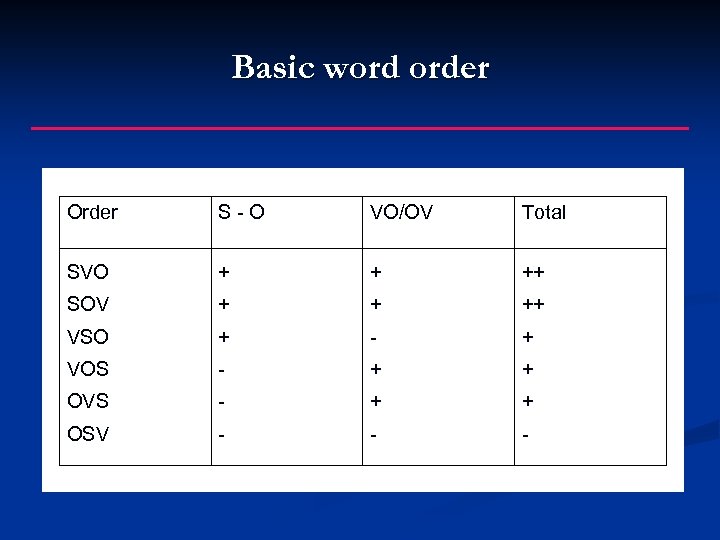 Basic word order Order S-O VO/OV Total SVO + + ++ SOV + + ++ VSO + - + VOS - + + OVS - + + OSV - - -
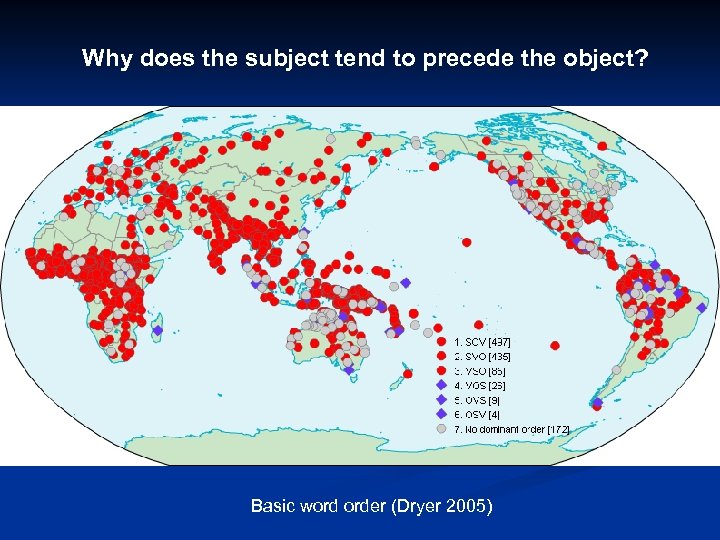 Why does the subject tend to precede the object? Basic word order (Dryer 2005)
 Why does the subject tend to precede verb and object? The subject tends to be the topic. (1) Peter noticed that Sally wasn’t there. She had to attend a class in linguistics. Given/old information helps the hearer to interpret the rest of the utterance, i. e. it provides an orientation at the beginning of the clause. The subject can be seen as a grammaticalized topic.
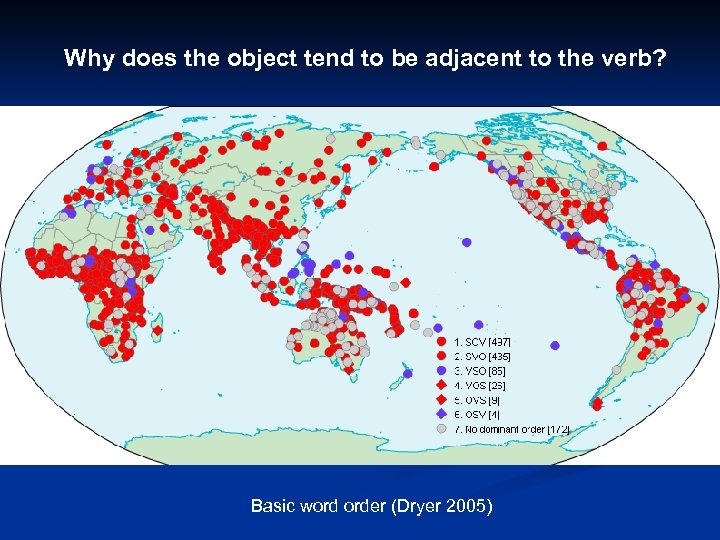 Why does the object tend to be adjacent to the verb? Basic word order (Dryer 2005)
 Why does the object tend to be adjacent to the verb? Verb and object form a tight conceptual unit. (1) They are hunting a fox. b. (2) a. They are fox-hunting. a. I am taking care of my sister’s baby. b. I am baby-sitting.
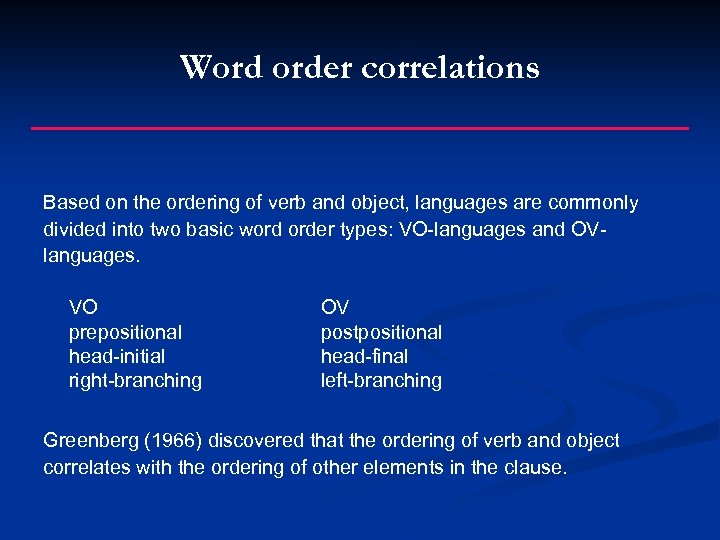 Word order correlations Based on the ordering of verb and object, languages are commonly divided into two basic word order types: VO-languages and OVlanguages. VO prepositional head-initial right-branching OV postpositional head-final left-branching Greenberg (1966) discovered that the ordering of verb and object correlates with the ordering of other elements in the clause.
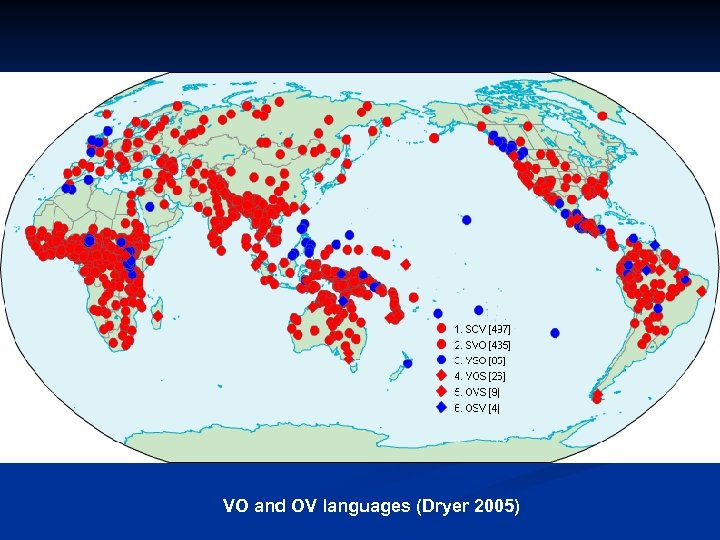 VO and OV languages (Dryer 2005)
![Prepositions vs. Postpositions (1) English Peter saw the man [in the garden]. (2) Japanese](https://present5.com/presentation/d872ad8be8841a0809c10dfa8f5824a4/image-31.jpg "Prepositions vs. Postpositions (1) English Peter saw the man [in the garden]. (2) Japanese") Prepositions vs. Postpositions (1) English Peter saw the man [in the garden]. (2) Japanese John ga [Mary to] [kurma de] [kobe ni] it-ta John SU Mary with car by Kobe to go. PST ‘John went to Kobe by car with Mary. ’
Prepositions vs. Postpositions (1) English Peter saw the man [in the garden]. (2) Japanese John ga [Mary to] [kurma de] [kobe ni] it-ta John SU Mary with car by Kobe to go. PST ‘John went to Kobe by car with Mary. ’
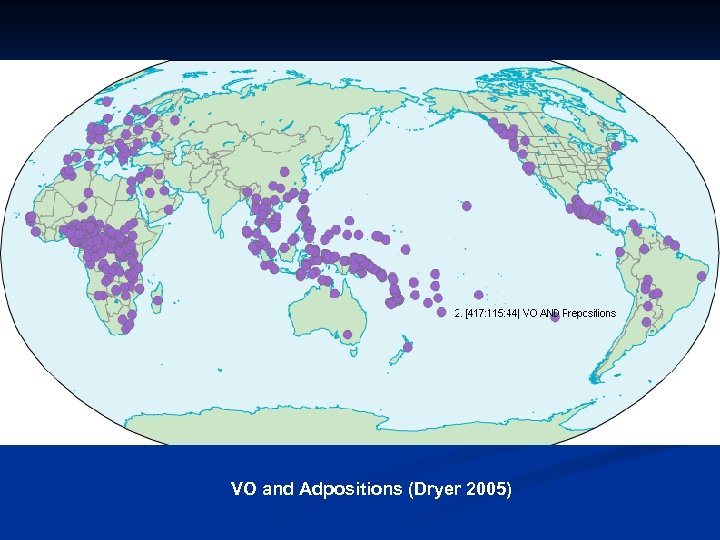 VO and Adpositions (Dryer 2005)
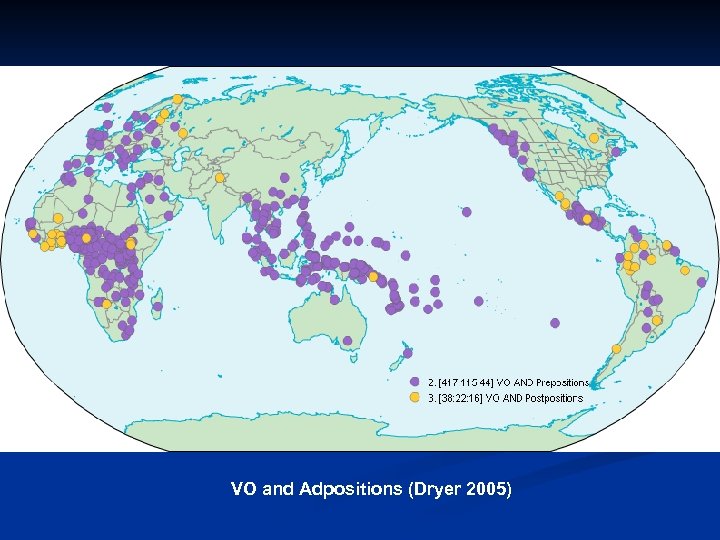 VO and Adpositions (Dryer 2005)
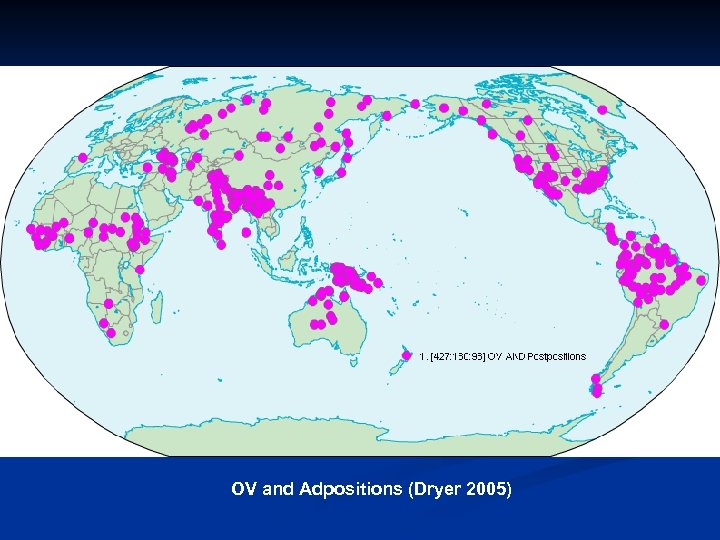 OV and Adpositions (Dryer 2005)
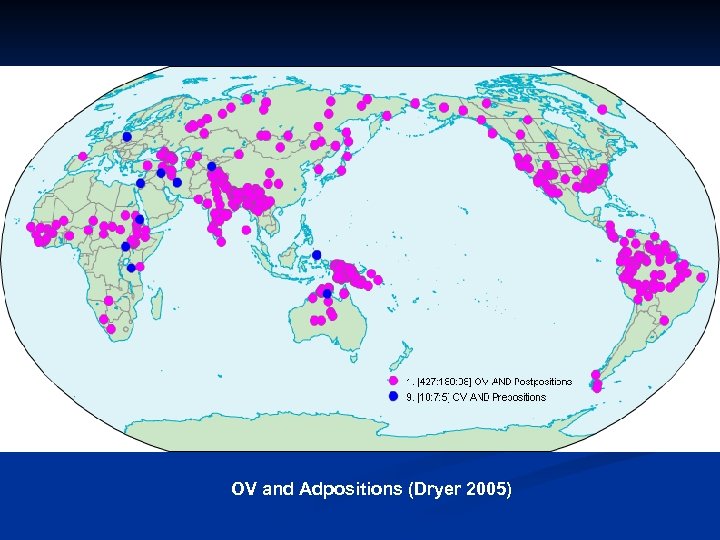 OV and Adpositions (Dryer 2005)
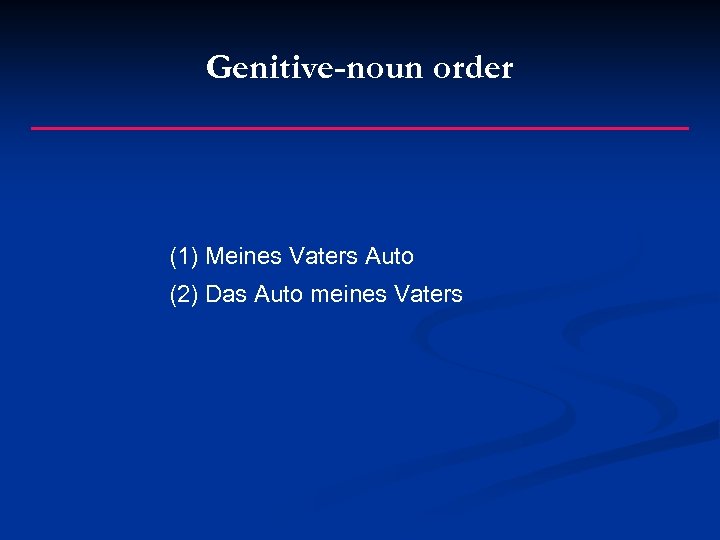 Genitive-noun order (1) Meines Vaters Auto (2) Das Auto meines Vaters
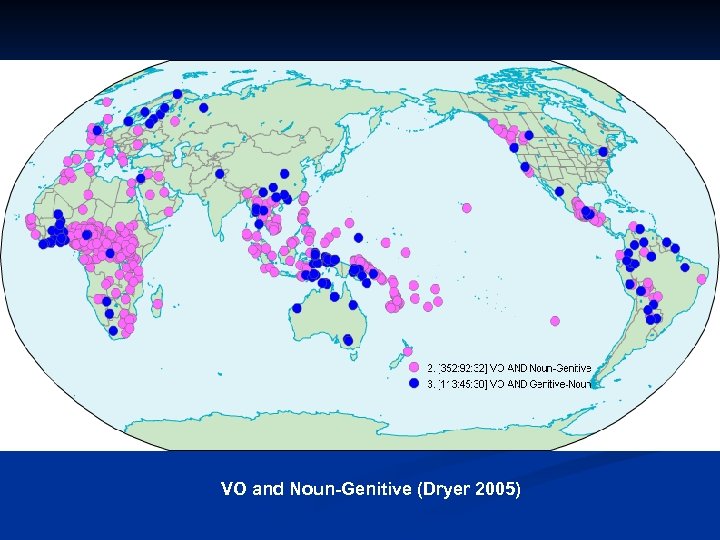 VO and Noun-Genitive (Dryer 2005)
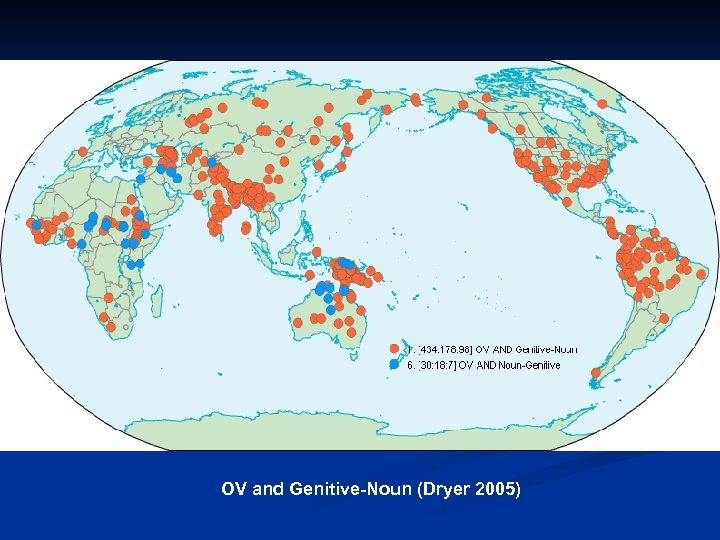 OV and Genitive-Noun (Dryer 2005)
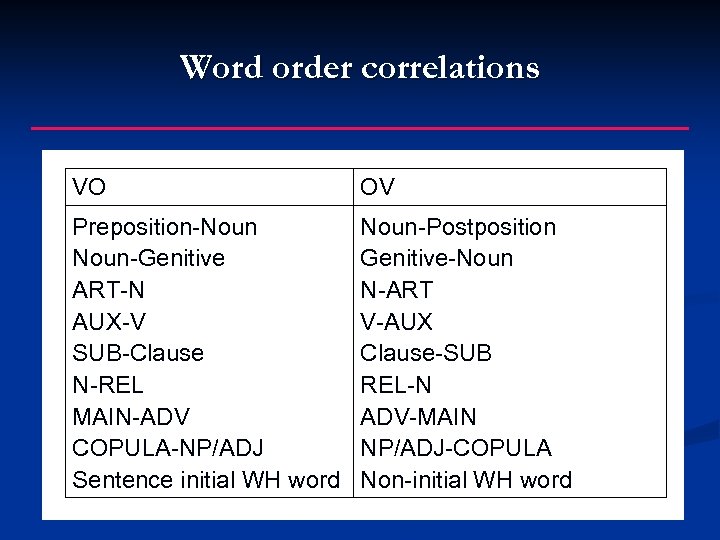 Word order correlations VO OV Preposition-Noun-Genitive ART-N AUX-V SUB-Clause N-REL MAIN-ADV COPULA-NP/ADJ Sentence initial WH word Noun-Postposition Genitive-Noun N-ART V-AUX Clause-SUB REL-N ADV-MAIN NP/ADJ-COPULA Non-initial WH word
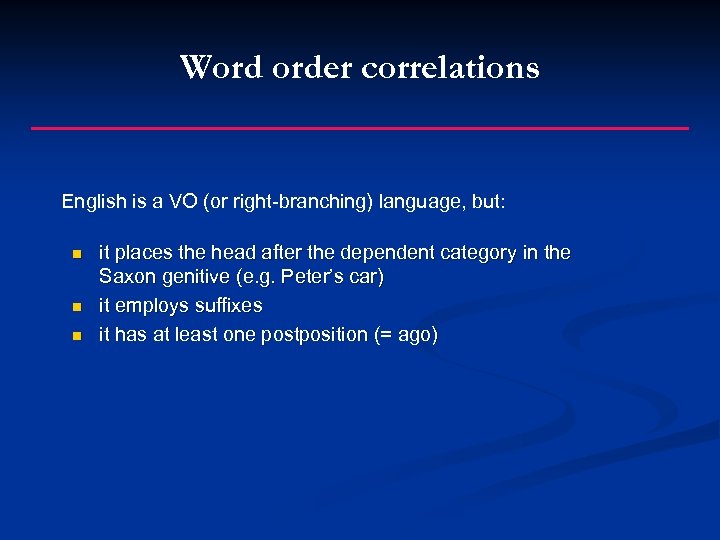 Word order correlations English is a VO (or right-branching) language, but: n n n it places the head after the dependent category in the Saxon genitive (e. g. Peter’s car) it employs suffixes it has at least one postposition (= ago)
![Noun-Relative clause order (1) English The man [I met].](https://present5.com/presentation/d872ad8be8841a0809c10dfa8f5824a4/image-41.jpg "Noun-Relative clause order (1) English The man [I met].") Noun-Relative clause order (1) English The man [I met].
Noun-Relative clause order (1) English The man [I met].
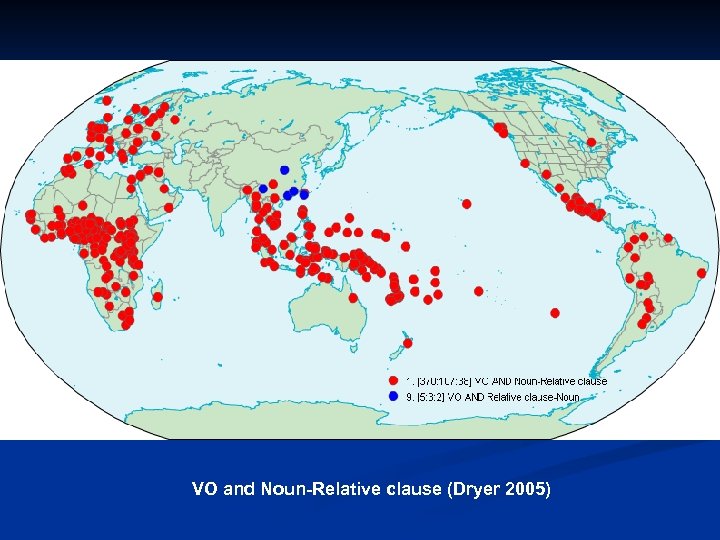 VO and Noun-Relative clause (Dryer 2005)
![Noun-Relative clause order (1) Japanese [Maria ga kai-ta] hon Maria SU write-PST book ‘The](https://present5.com/presentation/d872ad8be8841a0809c10dfa8f5824a4/image-43.jpg "Noun-Relative clause order (1) Japanese [Maria ga kai-ta] hon Maria SU write-PST book ‘The") Noun-Relative clause order (1) Japanese [Maria ga kai-ta] hon Maria SU write-PST book ‘The book that Mary wrote. ’
Noun-Relative clause order (1) Japanese [Maria ga kai-ta] hon Maria SU write-PST book ‘The book that Mary wrote. ’
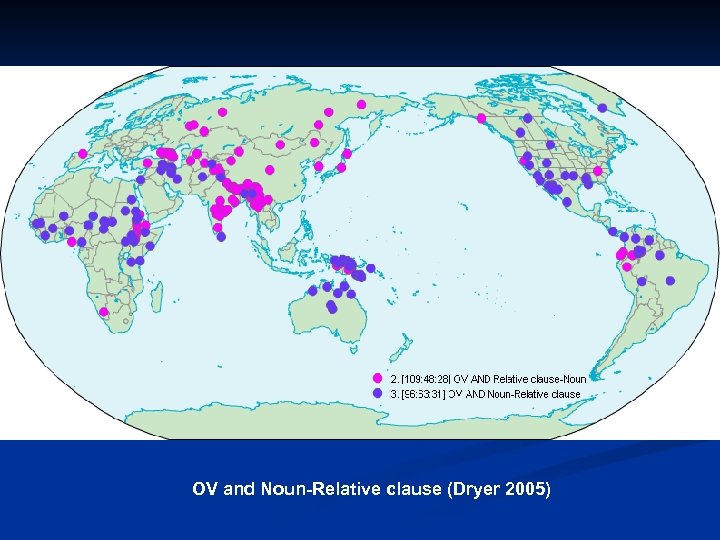 OV and Noun-Relative clause (Dryer 2005)
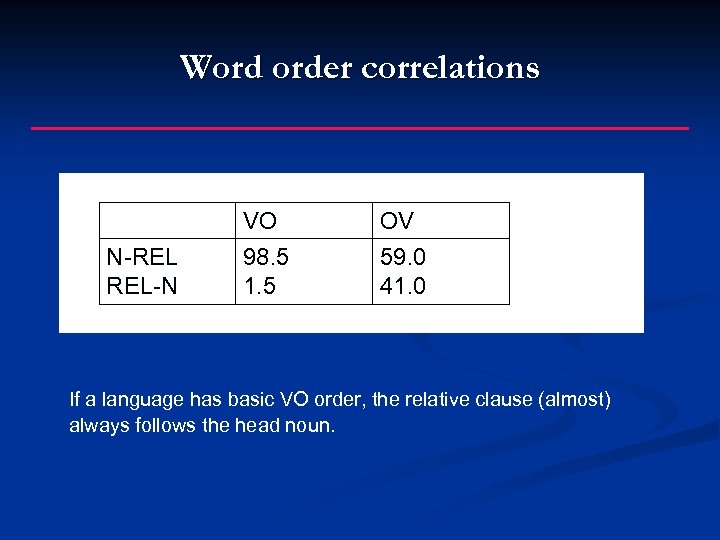 Word order correlations VO N-REL REL-N OV 98. 5 1. 5 59. 0 41. 0 If a language has basic VO order, the relative clause (almost) always follows the head noun.
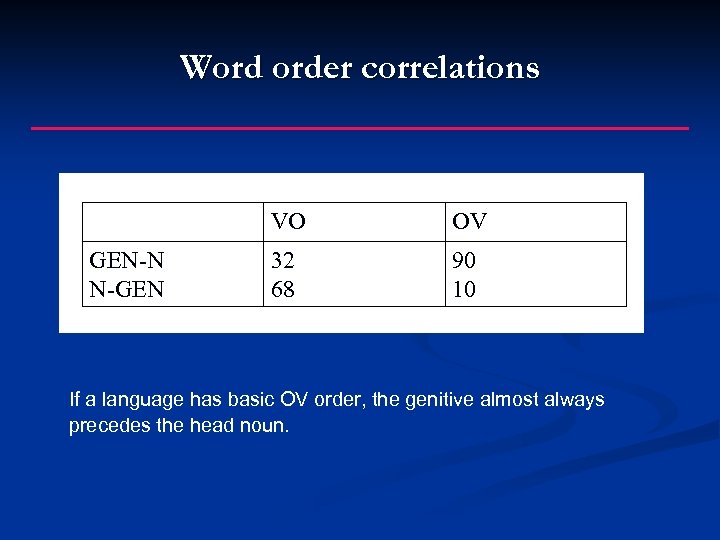 Word order correlations VO GEN-N N-GEN OV 32 68 90 10 If a language has basic OV order, the genitive almost always precedes the head noun.
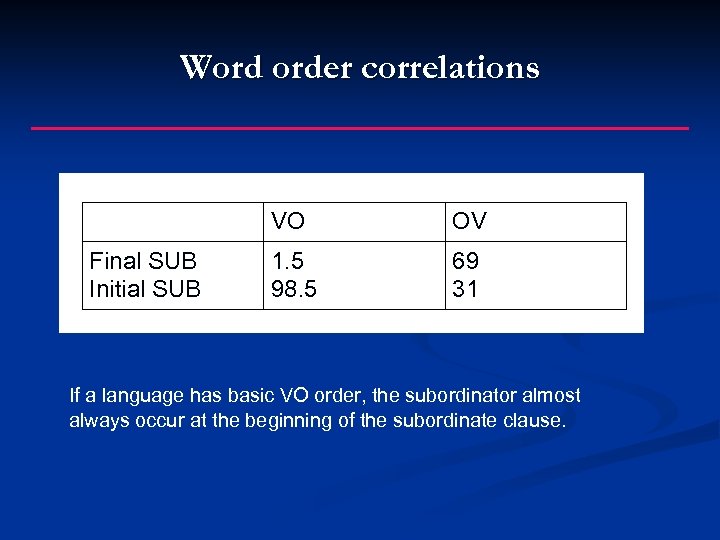 Word order correlations VO Final SUB Initial SUB OV 1. 5 98. 5 69 31 If a language has basic VO order, the subordinator almost always occur at the beginning of the subordinate clause.
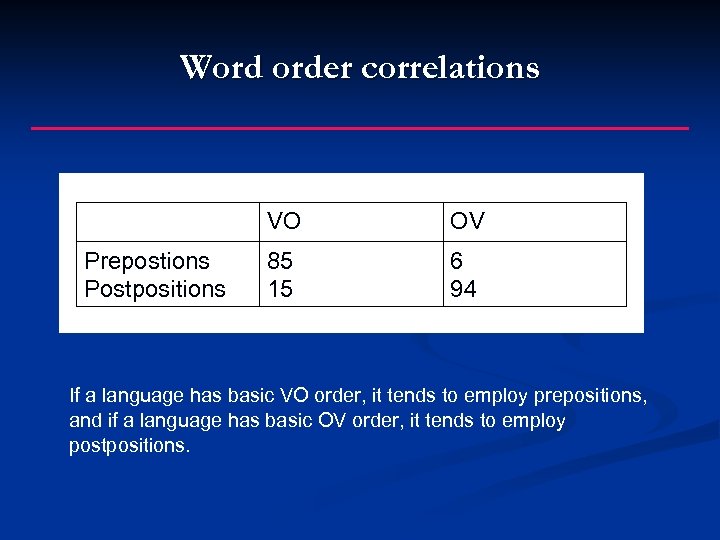 Word order correlations VO Prepostions Postpositions OV 85 15 6 94 If a language has basic VO order, it tends to employ prepositions, and if a language has basic OV order, it tends to employ postpositions.
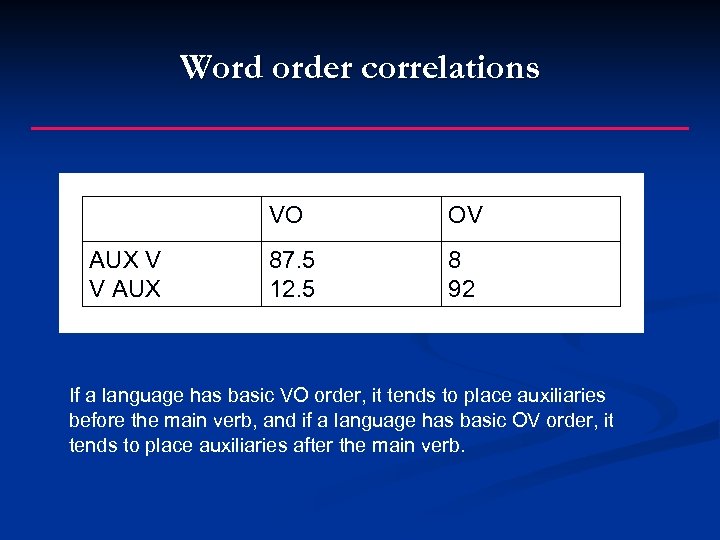 Word order correlations VO AUX V V AUX OV 87. 5 12. 5 8 92 If a language has basic VO order, it tends to place auxiliaries before the main verb, and if a language has basic OV order, it tends to place auxiliaries after the main verb.
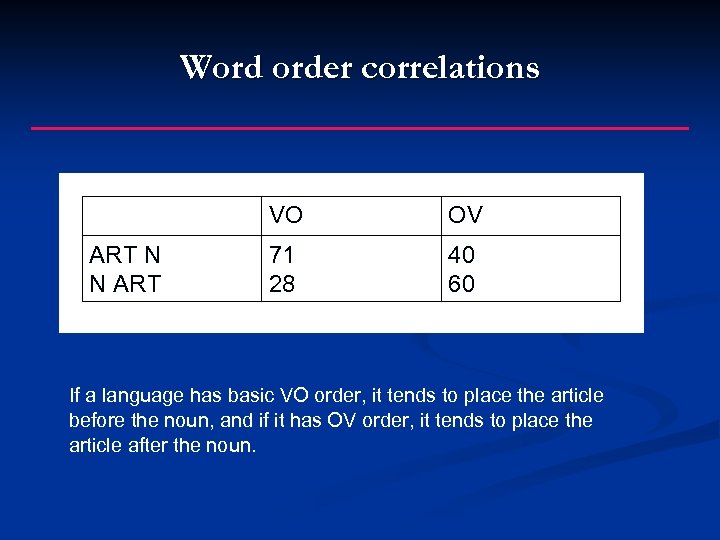 Word order correlations VO ART N N ART OV 71 28 40 60 If a language has basic VO order, it tends to place the article before the noun, and if it has OV order, it tends to place the article after the noun.
 Explaining word order correlations Implicational universals require an explanation in terms of competing motivations. n We have to explain the symmetry in constituent order across languages, i. e. why are there word order correlations? n We have to account for the exceptions, i. e. why do VO and OV languages do not pattern consistently?
 Word order correlations Cross-category harmony: Greenberg’s word order correlations reflect a crosslinguistic tendency to place head and dependent in a consistent order. [W. Lehmann 1972; Vennemann 1972]
![Word order correlations Cross-category harmony is based on the head-direction parameter. [Frazier 1985] head-initial](https://present5.com/presentation/d872ad8be8841a0809c10dfa8f5824a4/image-53.jpg "Word order correlations Cross-category harmony is based on the head-direction parameter. [Frazier 1985] head-initial") Word order correlations Cross-category harmony is based on the head-direction parameter. [Frazier 1985] head-initial head-final
Word order correlations Cross-category harmony is based on the head-direction parameter. [Frazier 1985] head-initial head-final
 Word order correlations Greenberg’s word order correlations are motivated by processing. Languages tend to be consistently right-branching or consistently leftbranching rather than mixed left- and right-branching because languages with consistent branching directions are easier to process. [Dryer 1992; Hawkins 1994, 2004]
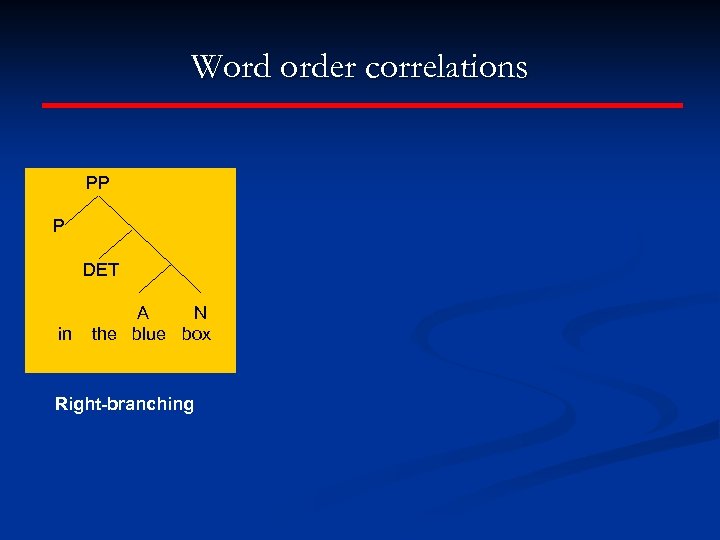 Word order correlations PP P DET in A N the blue box Right-branching
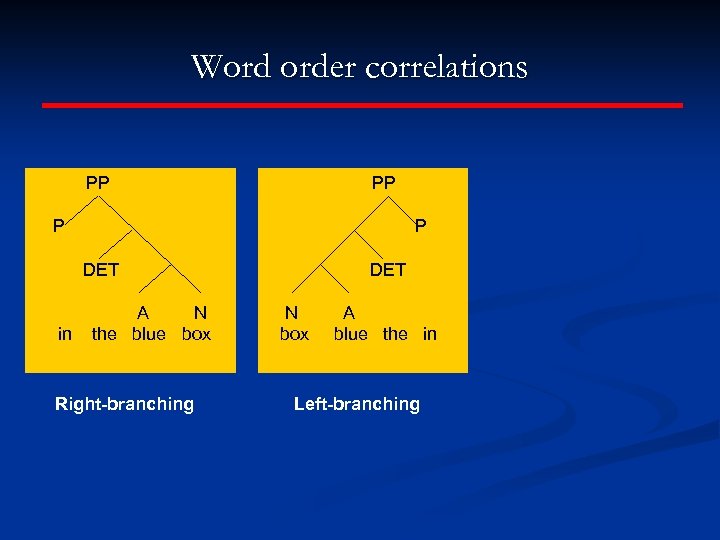 Word order correlations PP PP P P DET in A N the blue box Right-branching DET N box A blue the in Left-branching
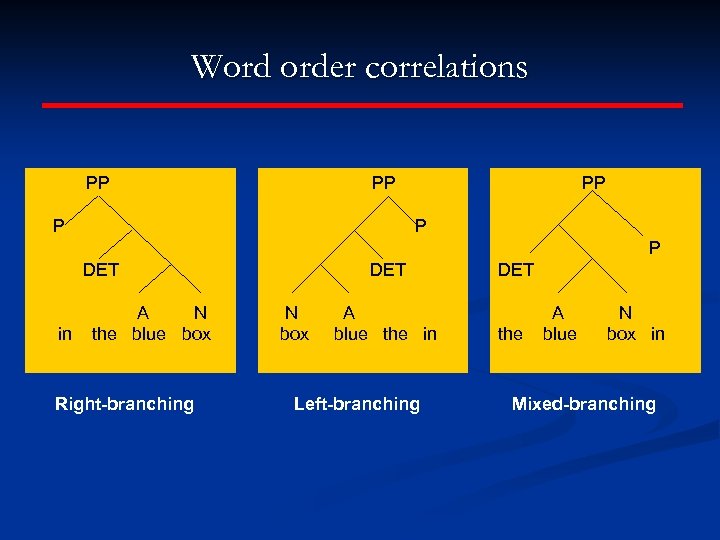 Word order correlations PP PP P P DET in A N the blue box Right-branching DET N box A blue the in Left-branching DET the A blue N box in Mixed-branching
![Processing PPs VP V VP PP P [played with] PP V NP NP P](https://present5.com/presentation/d872ad8be8841a0809c10dfa8f5824a4/image-58.jpg "Processing PPs VP V VP PP P [played with] PP V NP NP P") Processing PPs VP V VP PP P [played with] PP V NP NP P an old friend [with played]
Processing PPs VP V VP PP P [played with] PP V NP NP P an old friend [with played]
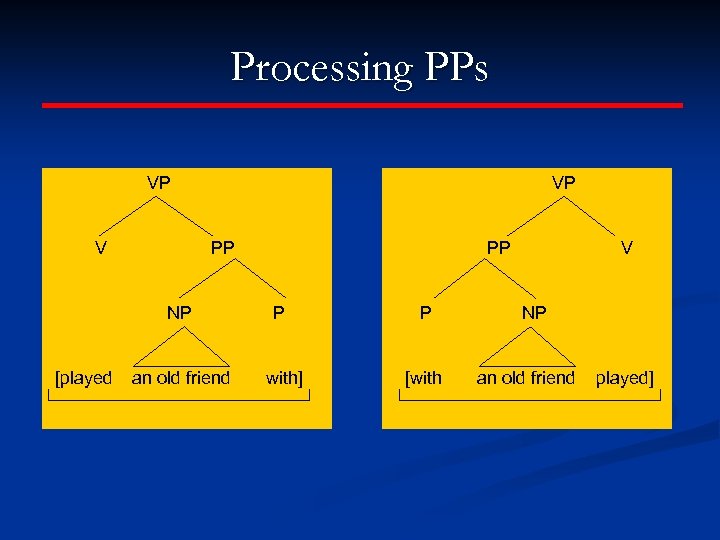 Processing PPs VP V VP PP PP NP [played P P an old friend with] [with V NP an old friend played]
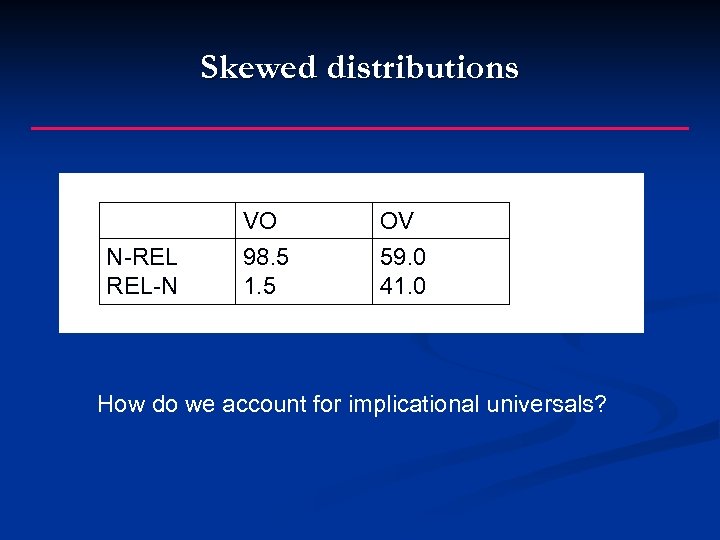 Skewed distributions VO N-REL REL-N OV 98. 5 1. 5 59. 0 41. 0 How do we account for implicational universals?
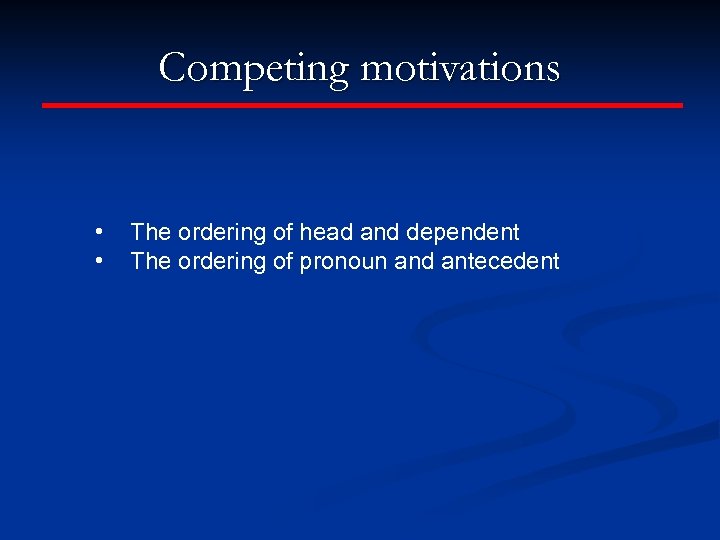 Competing motivations • • The ordering of head and dependent The ordering of pronoun and antecedent
![Relative clauses VP NP SREL NP V [whoi is sleeping] the mani (I)-saw](https://present5.com/presentation/d872ad8be8841a0809c10dfa8f5824a4/image-62.jpg "Relative clauses VP NP SREL NP V [whoi is sleeping] the mani (I)-saw") Relative clauses VP NP SREL NP V [whoi is sleeping] the mani (I)-saw
Relative clauses VP NP SREL NP V [whoi is sleeping] the mani (I)-saw
![Relative clauses VP NP SREL NP VP V NP V [whoi is sleeping] the](https://present5.com/presentation/d872ad8be8841a0809c10dfa8f5824a4/image-63.jpg "Relative clauses VP NP SREL NP VP V NP V [whoi is sleeping] the") Relative clauses VP NP SREL NP VP V NP V [whoi is sleeping] the mani (I)-saw NP NP V SREL NP V the mani [whoi is sleeping] (I)-saw
Relative clauses VP NP SREL NP VP V NP V [whoi is sleeping] the mani (I)-saw NP NP V SREL NP V the mani [whoi is sleeping] (I)-saw
 Competing motivations • • Head and dependent are easier to process if they are consistently ordered. Pronominal elements are easier to process if they follow their antecedent.