


 Скачать презентацию Word Order Choices Chapter 12 Longman Student Grammar
accdc2a1a7cbae9b059e94e58a23076b.ppt
- Количество слайдов: 12
 Word Order Choices Chapter 12 Longman Student Grammar of Spoken and Written English Biber; Conrad; Leech (2009, p. 397 -426)
 Introduction n The basic word order of English is subject + verb + object. In the present chapter, we discuss six grammatical devices to manipulate word order in clauses: fronting, inversion of subjects and verbs, existential there clauses, dislocation, clefting and variation in the ordering of objects. Some of these devices involve simply moving elements to different positions. Others require changing the clause in more complicated ways, such as changing the verb to passive voice. n n n Myrna makes the best cucumber salad. It’s Myrna who makes the best cucumber salad. (clefting) The best cucumber salad is made by Myrna. (passive)
 Grammar bite A n n n Many types of clause elements can be fronted (i. e. moved to the front of a clause): objects, nominals other than objects, predicatives, non-finite constructions, and some elements in dependent clauses Fronting is generally infrequent, but the frequency of each type varies across registers Fronting is typically used for cohesion and for special emphasis and contrast Inversion has two primary forms: subject-verb and subject-operator inversion. Other types of inversion occur in dependent clauses. Inversion can be used for cohesion, information flow, intensification and placement of focus
 Grammar bite B n n n Existential there is a grammatical subject but has no meaning content. Most existential clauses have the verb be, but the written registers use alternatives such as exist, come, and follow. The ‘idea subject’ of the existential clause is called the notional subject. It is usually an indefinite noun phrase. Many existential there clauses have adverbials or postmodification of the notional subject. This is because the obligatory elements of the clause usually contain little information. Existential clauses are used to introduce a new element (or series of elements) which is going to be the focus of the following discourse.
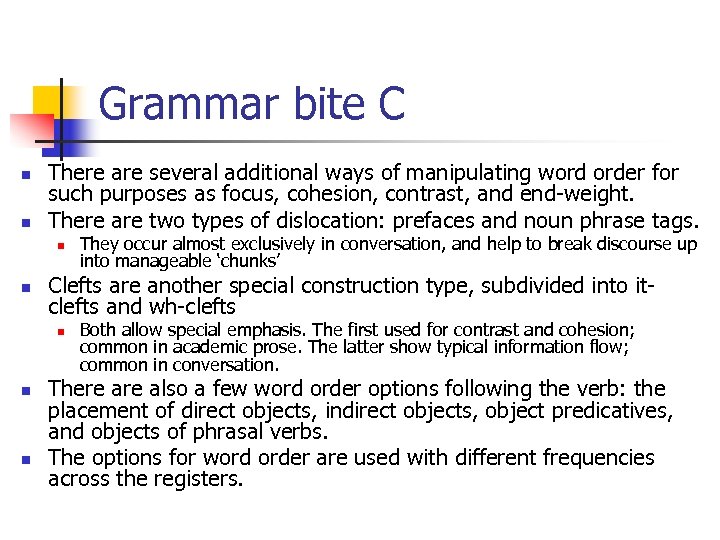 Grammar bite C n n There are several additional ways of manipulating word order for such purposes as focus, cohesion, contrast, and end-weight. There are two types of dislocation: prefaces and noun phrase tags. n n Clefts are another special construction type, subdivided into itclefts and wh-clefts n n n They occur almost exclusively in conversation, and help to break discourse up into manageable ‘chunks’ Both allow special emphasis. The first used for contrast and cohesion; common in academic prose. The latter show typical information flow; common in conversation. There also a few word order options following the verb: the placement of direct objects, indirect objects, object predicatives, and objects of phrasal verbs. The options for word order are used with different frequencies across the registers.
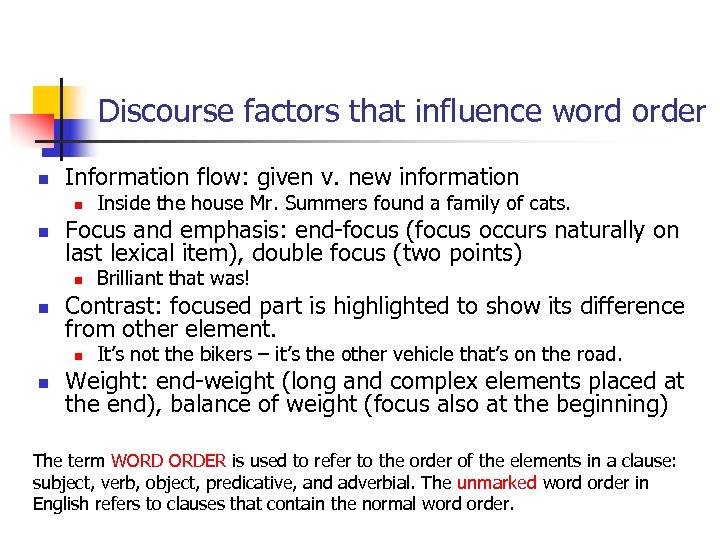 Discourse factors that influence word order n Information flow: given v. new information n n Focus and emphasis: end-focus (focus occurs naturally on last lexical item), double focus (two points) n n Brilliant that was! Contrast: focused part is highlighted to show its difference from other element. n n Inside the house Mr. Summers found a family of cats. It’s not the bikers – it’s the other vehicle that’s on the road. Weight: end-weight (long and complex elements placed at the end), balance of weight (focus also at the beginning) The term WORD ORDER is used to refer to the order of the elements in a clause: subject, verb, object, predicative, and adverbial. The unmarked word order in English refers to clauses that contain the normal word order.
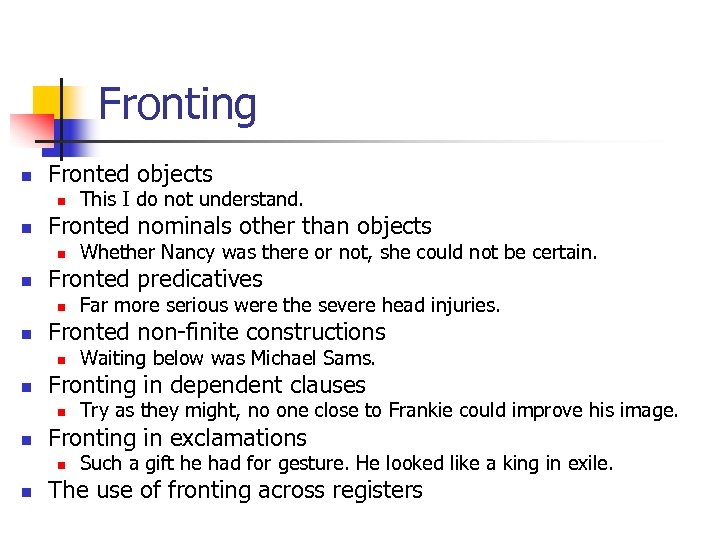 Fronting n Fronted objects n n Fronted nominals other than objects n n Try as they might, no one close to Frankie could improve his image. Fronting in exclamations n n Waiting below was Michael Sams. Fronting in dependent clauses n n Far more serious were the severe head injuries. Fronted non-finite constructions n n Whether Nancy was there or not, she could not be certain. Fronted predicatives n n This I do not understand. Such a gift he had for gesture. He looked like a king in exile. The use of fronting across registers
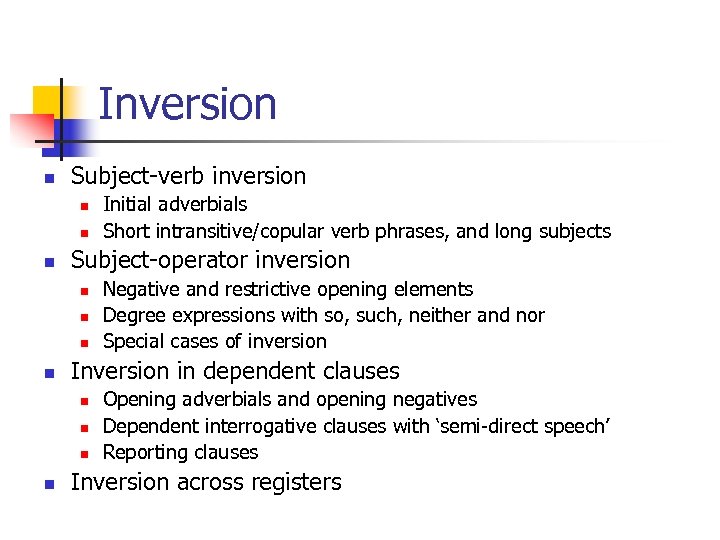 Inversion n Subject-verb inversion n Subject-operator inversion n n Negative and restrictive opening elements Degree expressions with so, such, neither and nor Special cases of inversion Inversion in dependent clauses n n Initial adverbials Short intransitive/copular verb phrases, and long subjects Opening adverbials and opening negatives Dependent interrogative clauses with ‘semi-direct speech’ Reporting clauses Inversion across registers
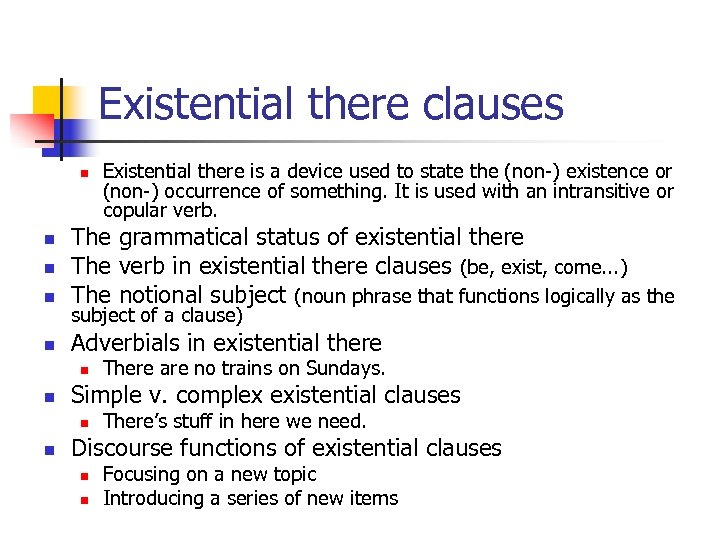 Existential there clauses n Existential there is a device used to state the (non-) existence or (non-) occurrence of something. It is used with an intransitive or copular verb. n The grammatical status of existential there The verb in existential there clauses (be, exist, come. . . ) The notional subject (noun phrase that functions logically as the n Adverbials in existential there n n subject of a clause) n n Simple v. complex existential clauses n n There are no trains on Sundays. There’s stuff in here we need. Discourse functions of existential clauses n n Focusing on a new topic Introducing a series of new items
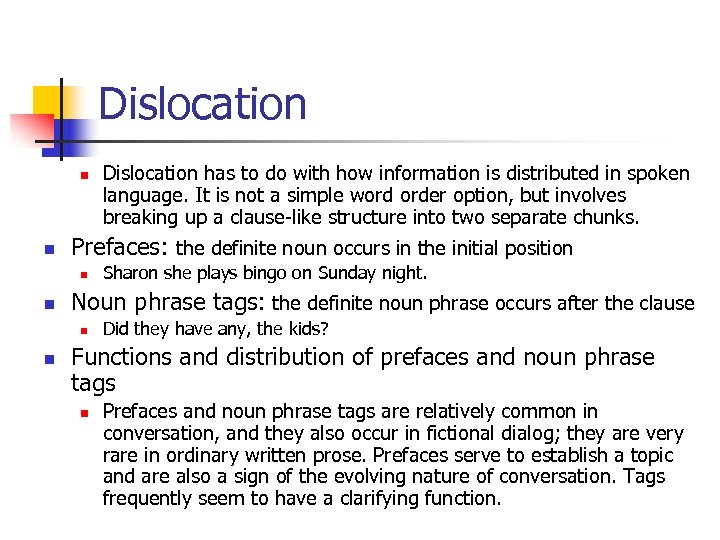 Dislocation n n Prefaces: the definite noun occurs in the initial position n n Sharon she plays bingo on Sunday night. Noun phrase tags: the definite noun phrase occurs after the clause n n Dislocation has to do with how information is distributed in spoken language. It is not a simple word order option, but involves breaking up a clause-like structure into two separate chunks. Did they have any, the kids? Functions and distribution of prefaces and noun phrase tags n Prefaces and noun phrase tags are relatively common in conversation, and they also occur in fictional dialog; they are very rare in ordinary written prose. Prefaces serve to establish a topic and are also a sign of the evolving nature of conversation. Tags frequently seem to have a clarifying function.
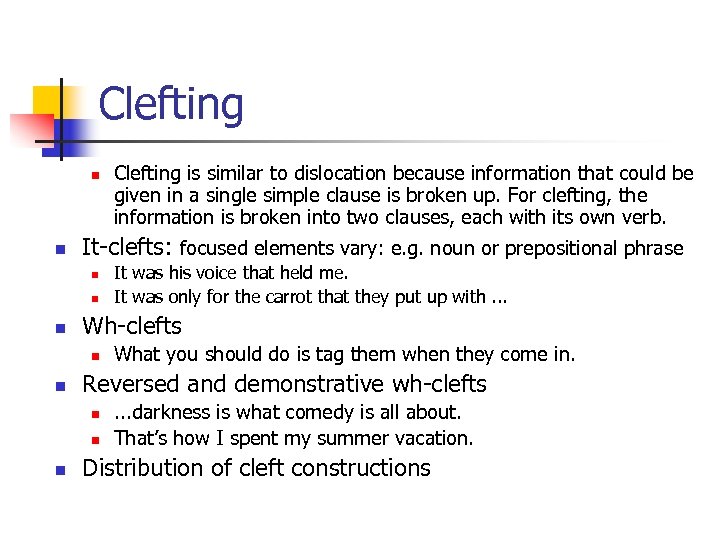 Clefting n n It-clefts: focused elements vary: e. g. noun or prepositional phrase n n n What you should do is tag them when they come in. Reversed and demonstrative wh-clefts n n n It was his voice that held me. It was only for the carrot that they put up with. . . Wh-clefts n n Clefting is similar to dislocation because information that could be given in a single simple clause is broken up. For clefting, the information is broken into two clauses, each with its own verb. . darkness is what comedy is all about. That’s how I spent my summer vacation. Distribution of cleft constructions
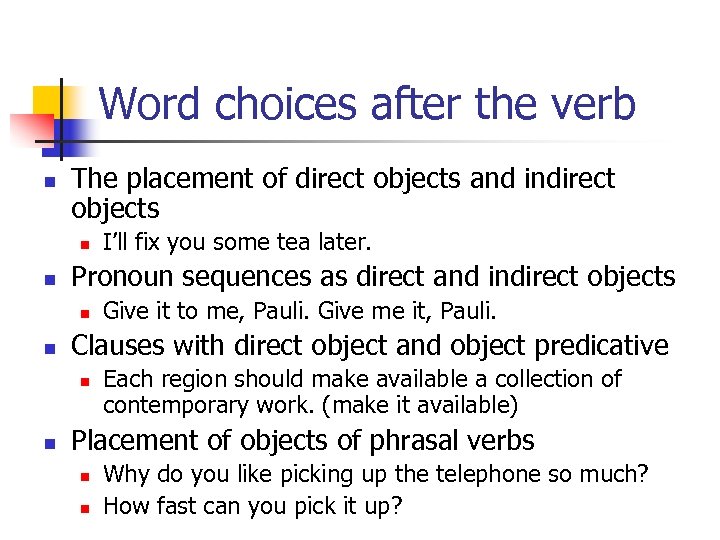 Word choices after the verb n The placement of direct objects and indirect objects n n Pronoun sequences as direct and indirect objects n n Give it to me, Pauli. Give me it, Pauli. Clauses with direct object and object predicative n n I’ll fix you some tea later. Each region should make available a collection of contemporary work. (make it available) Placement of objects of phrasal verbs n n Why do you like picking up the telephone so much? How fast can you pick it up?