


 Скачать презентацию WORD CLASSES IN GRAMMAR Lecture 3 Outline
2 Word Classes in Grammar.ppt
- Количество слайдов: 60
 WORD CLASSES IN GRAMMAR Lecture 3
 Outline: Traditional parts of speech Criteria for their distinguishing. The system of parts of speech in English. Notional and formal words. Other classifications
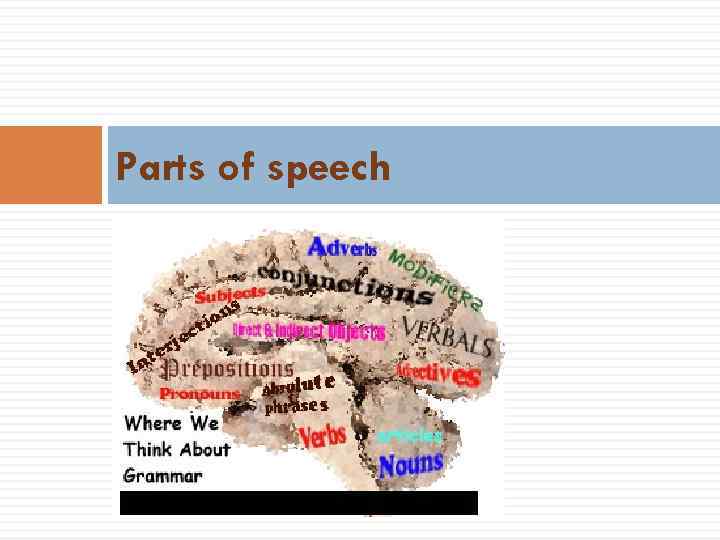 Parts of speech
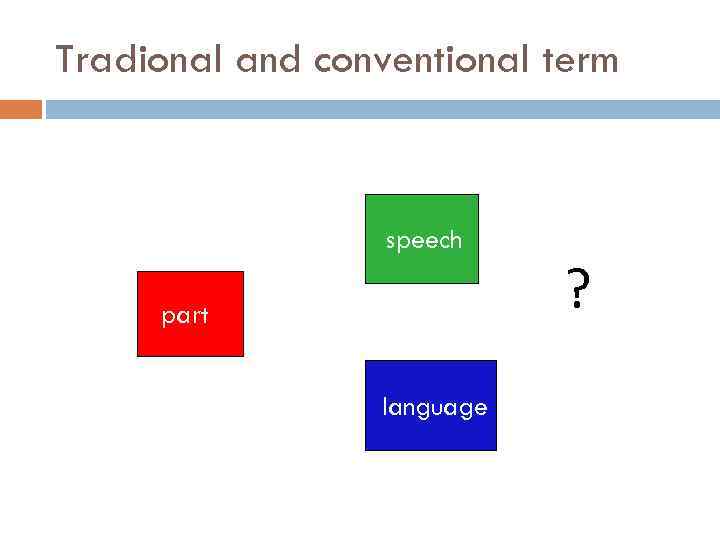 Tradional and conventional term speech part language ?
 Origin of the term Ancient Greece - 2 nd century B. C.
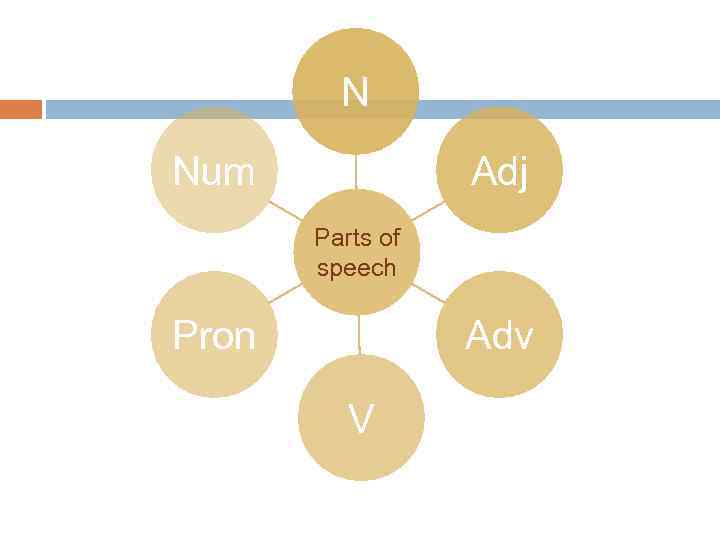 N Num Adj Parts of speech Pron Adv V
 A word class is a group of words, which, from a grammatical point of view, behave in the same way. (D. Crystal, 1995)
 A part of speech is a type of word differing from other types in some grammatical point. (B. A. Ilyish, 1971) V vs. N => tense is a distinctive feature *What is the past tense of the word ‘city’ ?
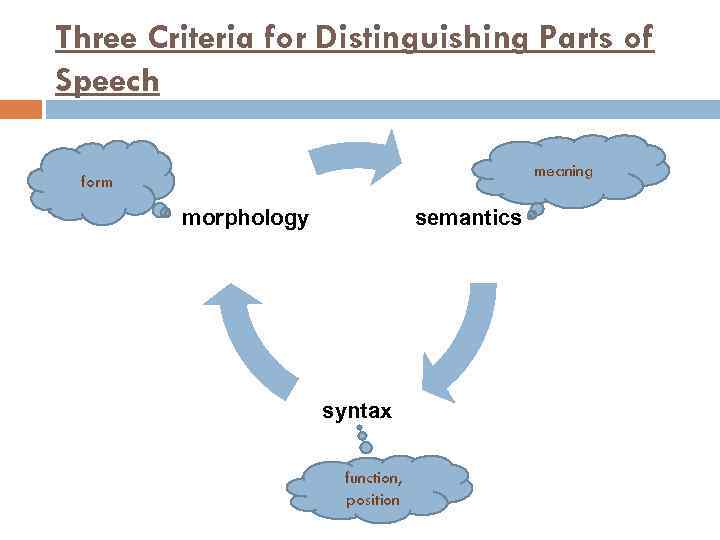 Three Criteria for Distinguishing Parts of Speech meaning form morphology semantics syntax function, position
 Part of speech criteria O. Jespersen (1933, 2007). Three criteria from Russian linguistics: V. V. Vinogradov, L. V. Scherba A. I. Smirnitsky B. A. Ilyish Interrelated criteria (E. Kubryakova 1979)
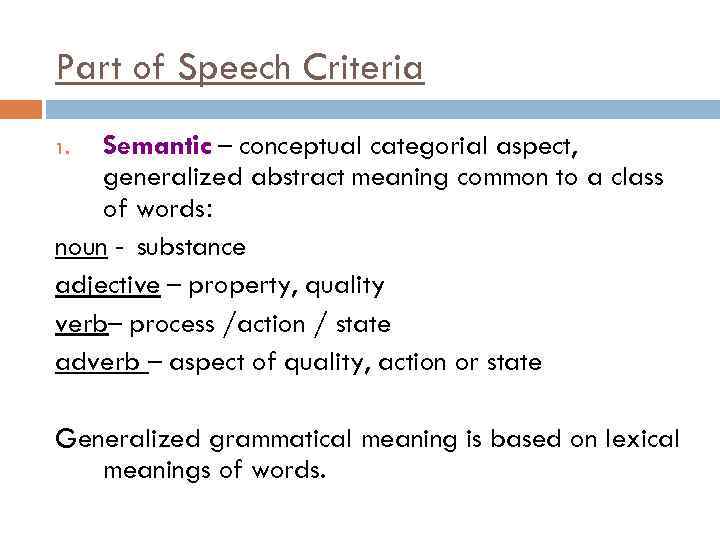 Part of Speech Criteria Semantic – conceptual categorial aspect, generalized abstract meaning common to a class of words: noun - substance adjective – property, quality verb– process /action / state adverb – aspect of quality, action or state 1. Generalized grammatical meaning is based on lexical meanings of words.
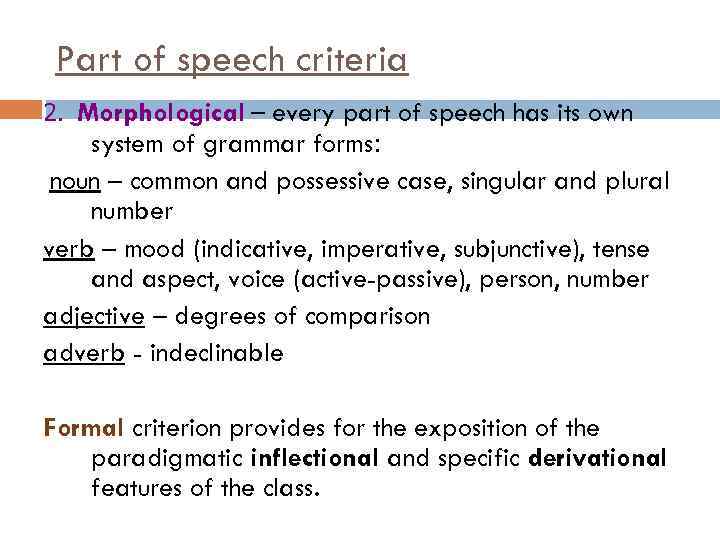 Part of speech criteria 2. Morphological – every part of speech has its own system of grammar forms: noun – common and possessive case, singular and plural number verb – mood (indicative, imperative, subjunctive), tense and aspect, voice (active-passive), person, number adjective – degrees of comparison adverb - indeclinable Formal criterion provides for the exposition of the paradigmatic inflectional and specific derivational features of the class.
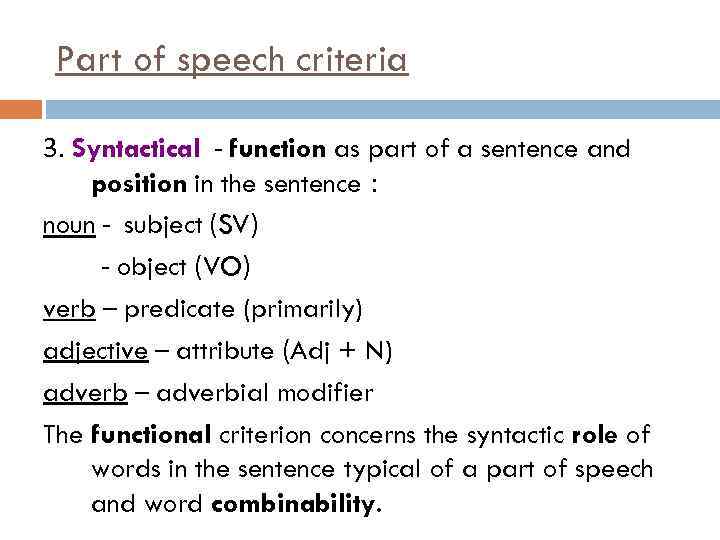 Part of speech criteria 3. Syntactical - function as part of a sentence and position in the sentence : noun - subject (SV) - object (VO) verb – predicate (primarily) adjective – attribute (Adj + N) adverb – adverbial modifier The functional criterion concerns the syntactic role of words in the sentence typical of a part of speech and word combinability.
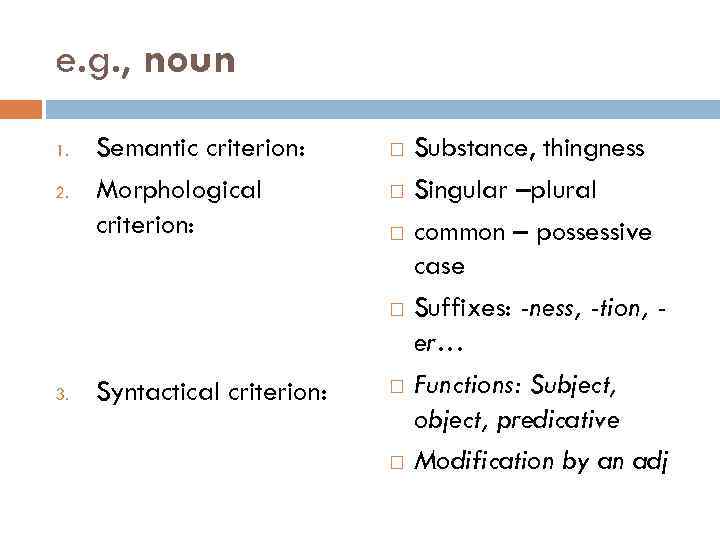 e. g. , noun 1. 2. Semantic criterion: Morphological criterion: 3. Syntactical criterion: Substance, thingness Singular –plural common – possessive case Suffixes: -ness, -tion, er… Functions: Subject, object, predicative Modification by an adj
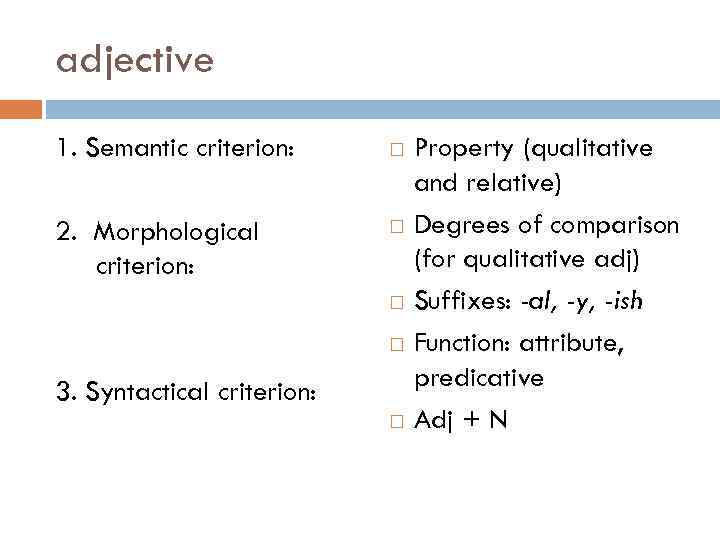 adjective 1. Semantic criterion: 2. Morphological criterion: 3. Syntactical criterion: Property (qualitative and relative) Degrees of comparison (for qualitative adj) Suffixes: -al, -y, -ish Function: attribute, predicative Adj + N
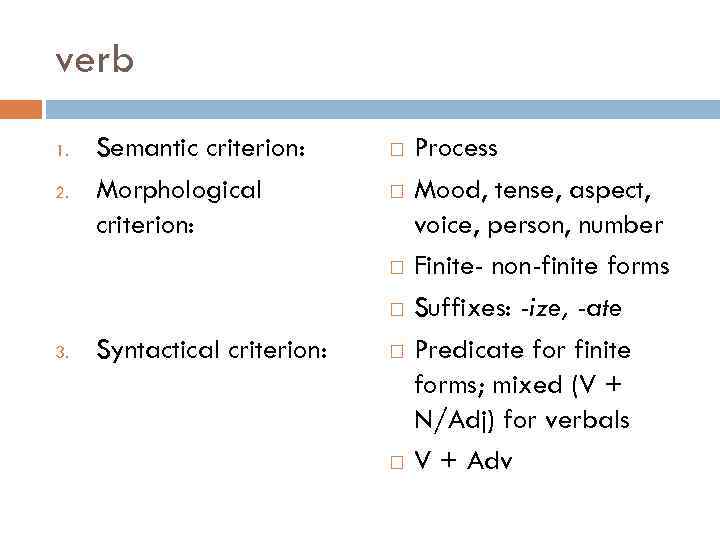 verb 1. 2. Semantic criterion: Morphological criterion: 3. Syntactical criterion: Process Mood, tense, aspect, voice, person, number Finite- non-finite forms Suffixes: -ize, -ate Predicate for finite forms; mixed (V + N/Adj) for verbals V + Adv
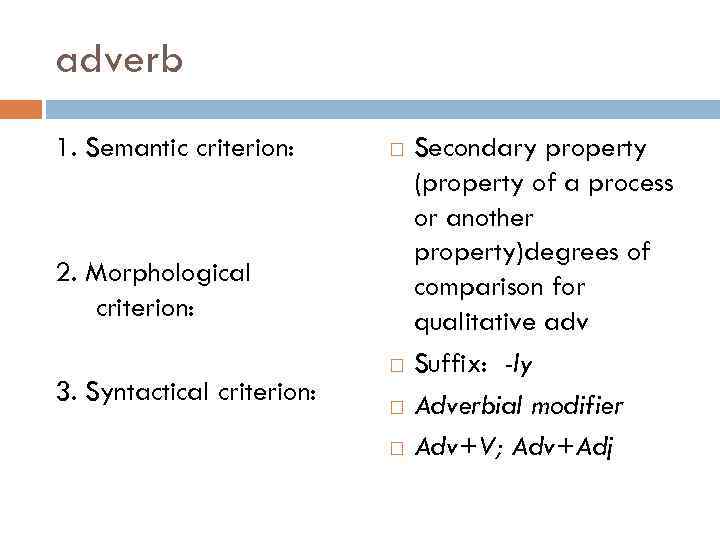 adverb 1. Semantic criterion: 2. Morphological criterion: 3. Syntactical criterion: Secondary property (property of a process or another property)degrees of comparison for qualitative adv Suffix: -ly Adverbial modifier Adv+V; Adv+Adj
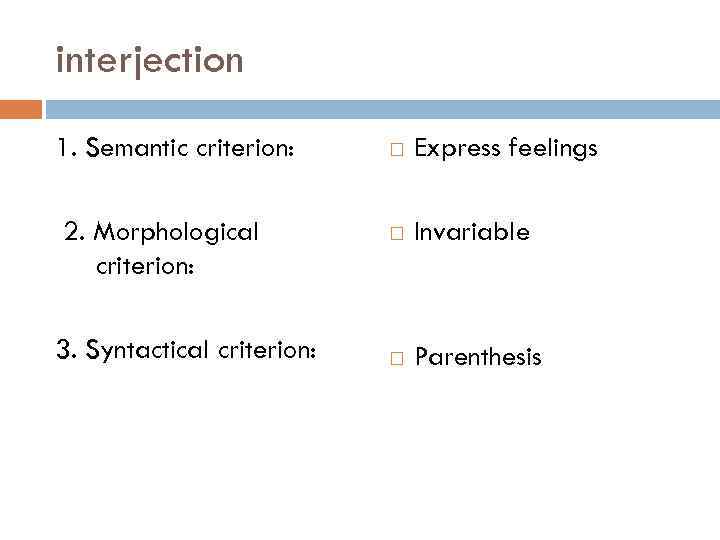 interjection 1. Semantic criterion: 2. Morphological criterion: 3. Syntactical criterion: Express feelings Invariable Parenthesis
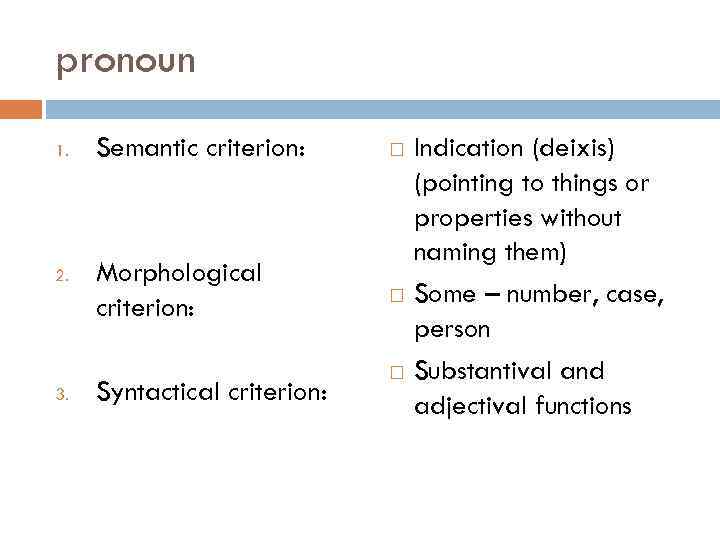 pronoun 1. 2. 3. Semantic criterion: Morphological criterion: Syntactical criterion: Indication (deixis) (pointing to things or properties without naming them) Some – number, case, person Substantival and adjectival functions
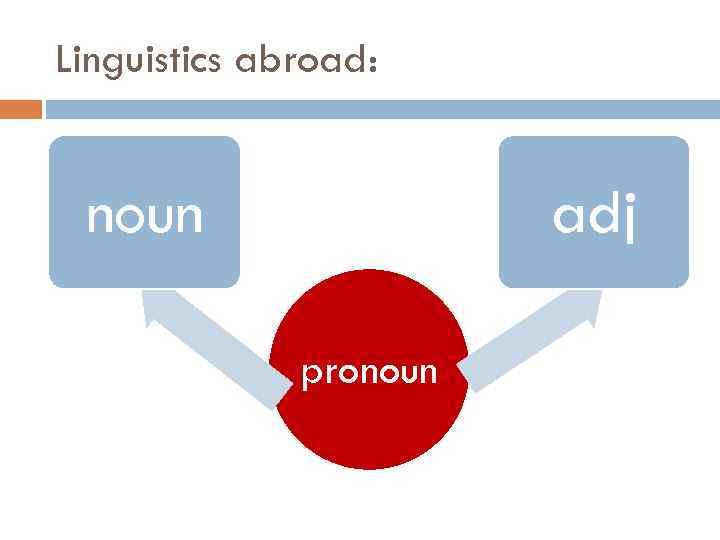 Linguistics abroad: noun adj pronoun
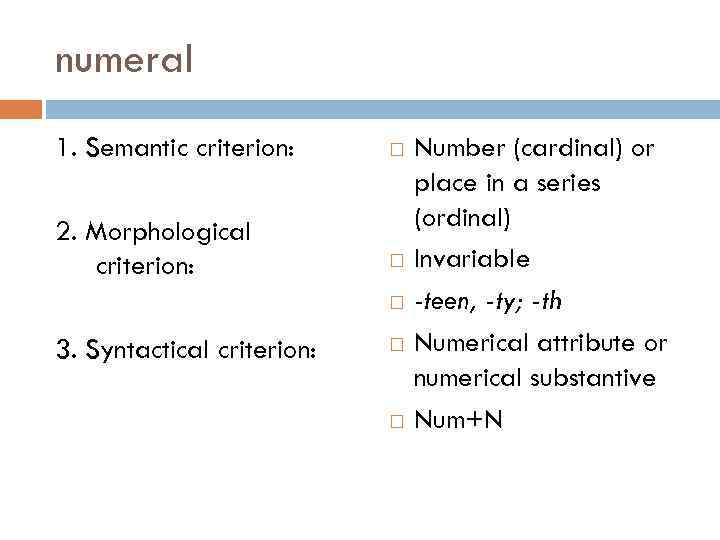 numeral 1. Semantic criterion: 2. Morphological criterion: 3. Syntactical criterion: Number (cardinal) or place in a series (ordinal) Invariable -teen, -ty; -th Numerical attribute or numerical substantive Num+N
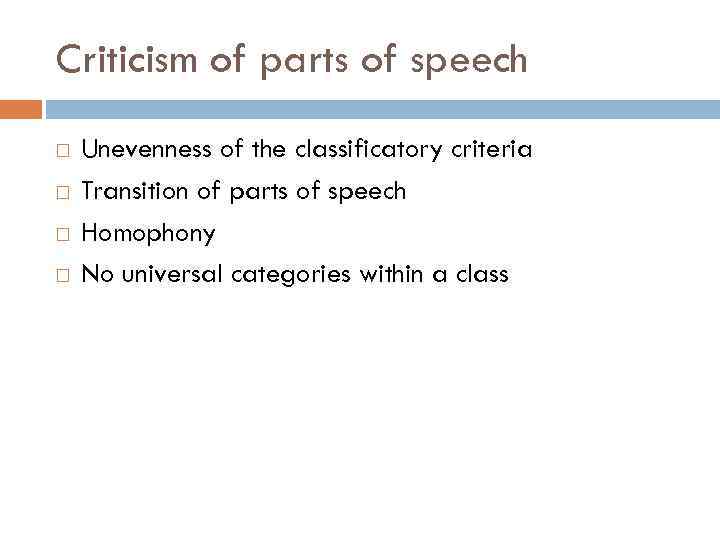 Criticism of parts of speech Unevenness of the classificatory criteria Transition of parts of speech Homophony No universal categories within a class
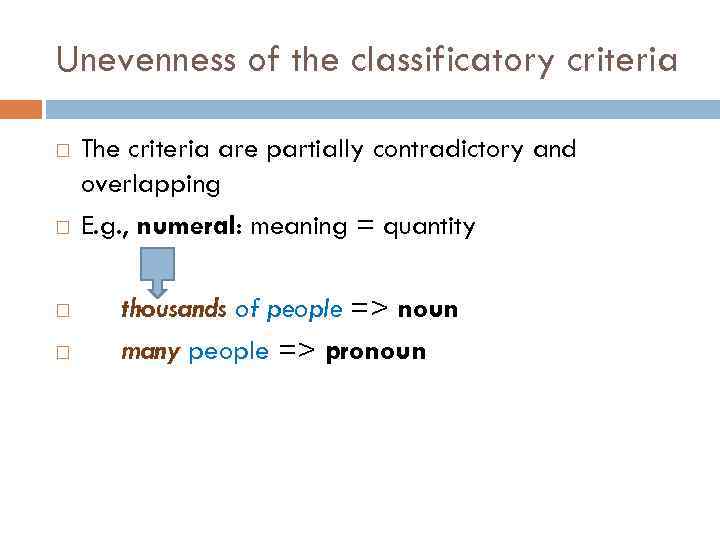 Unevenness of the classificatory criteria The criteria are partially contradictory and overlapping E. g. , numeral: meaning = quantity thousands of people => noun many people => pronoun
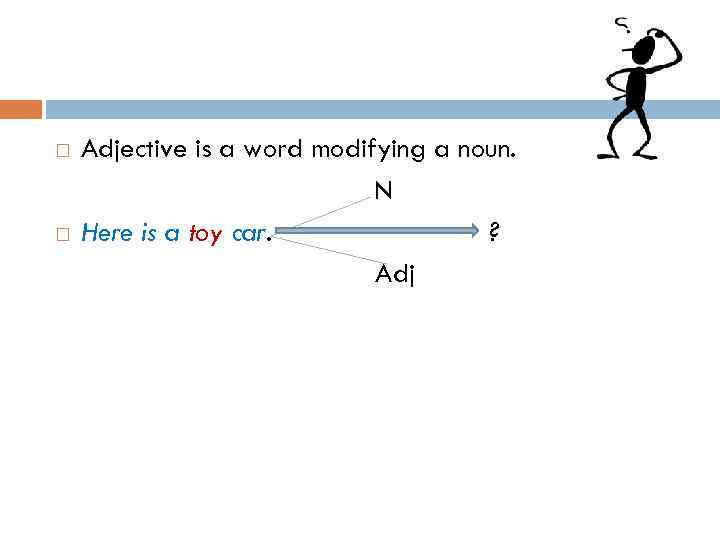 Adjective is a word modifying a noun. N Here is a toy car. ? Adj
 Adverb - indeclinable well – better – best a catch-all class that includes words with many different functions -ly is an adverb marker, but early, friendly, ugly are adjectives; tomorrow, fast, crosswise = adv
 Not all three criteria are applicable to all parts of speech. Some of them may fail. E. g. , semantic: N vs. V = substance : process We had a walk.
 Transition of parts of speech Conversion: Water, break, outlaw, laser, microwave and telephone N or V ? We must look to the hows and not just the whys.
 Homophony I hear a loud sound. They sound like bells. I have a sound reason.
 No universality within a class Not all nouns have possessive case Not all verbs have a passive voice form Not all adjectives have comparison forms
 Are there English words that are not included in any part of speech? Yes. No.
 Classifications of parts of speech
 traditional Parts of speech are lexico-grammatical (A. Smirnitsky) classes that differ by their general semantic features, morphological forms, and syntactical functions.
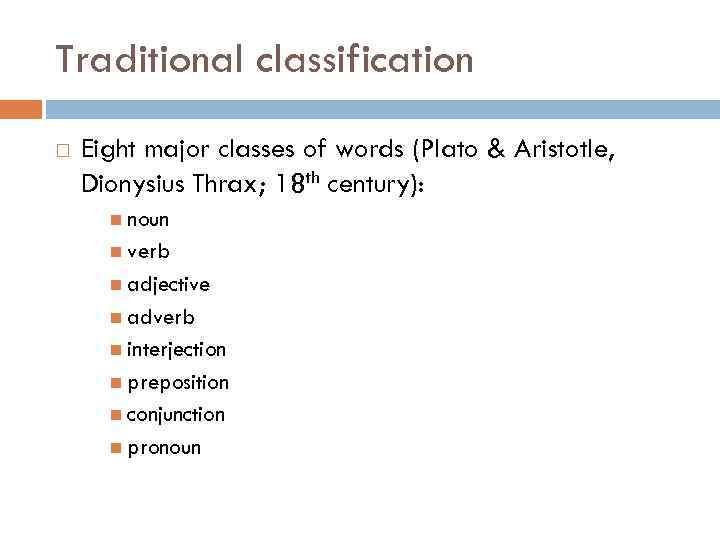 Traditional classification Eight major classes of words (Plato & Aristotle, Dionysius Thrax; 18 th century): noun verb adjective adverb interjection preposition conjunction pronoun
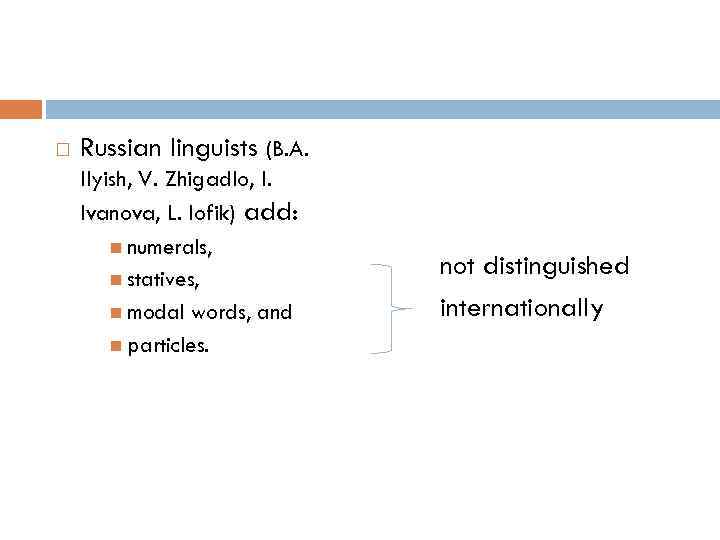 Russian linguists (B. A. Ilyish, V. Zhigadlo, I. Ivanova, L. Iofik) add: numerals, statives, modal words, and particles. not distinguished internationally
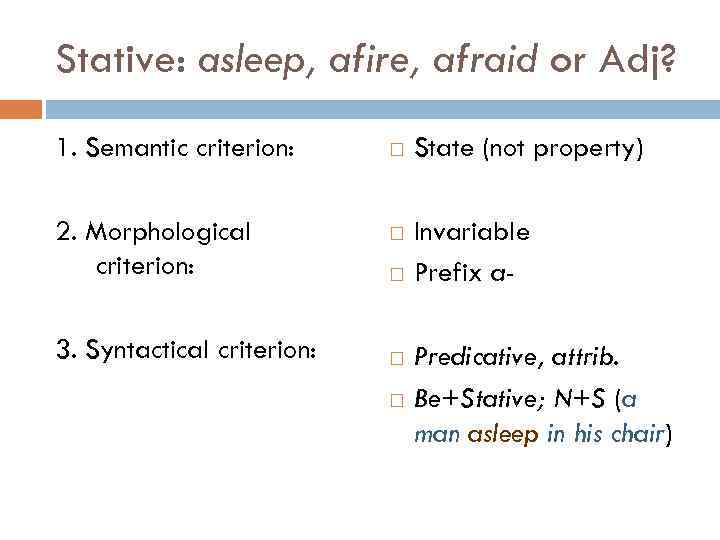 Stative: asleep, afire, afraid or Adj? 1. Semantic criterion: State (not property) 2. Morphological criterion: Invariable Prefix a- 3. Syntactical criterion: Predicative, attrib. Be+Stative; N+S (a man asleep in his chair)
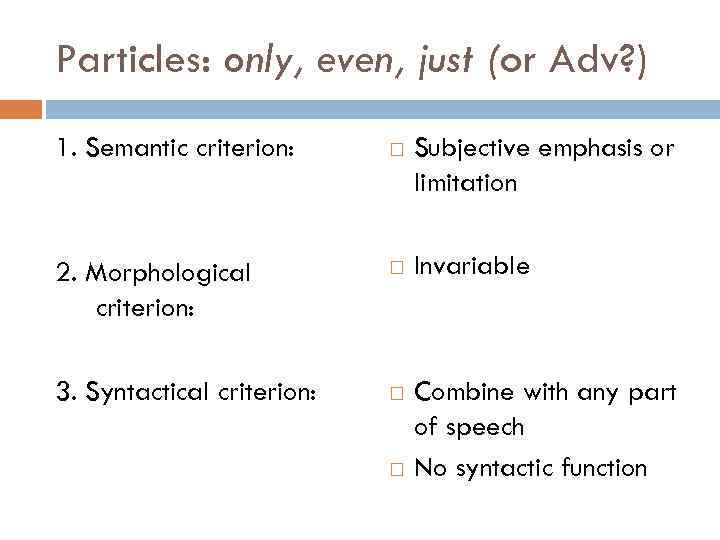 Particles: only, even, just (or Adv? ) 1. Semantic criterion: Subjective emphasis or limitation 2. Morphological criterion: Invariable 3. Syntactical criterion: Combine with any part of speech No syntactic function
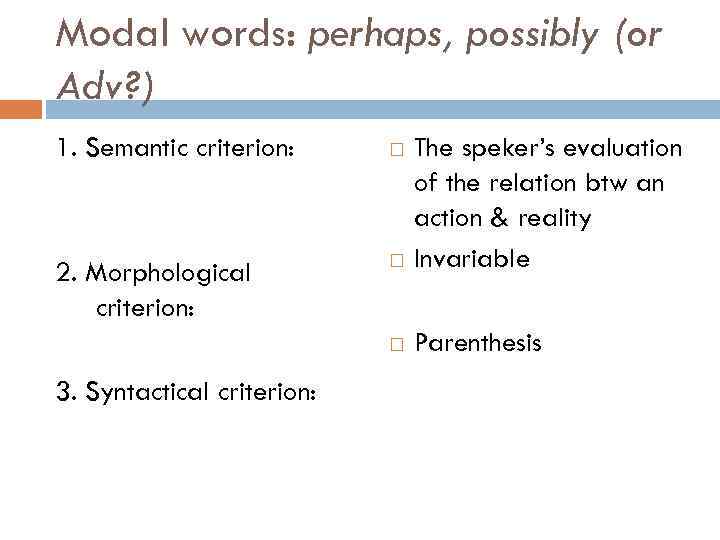 Modal words: perhaps, possibly (or Adv? ) 1. Semantic criterion: 2. Morphological criterion: The speker’s evaluation of the relation btw an action & reality Invariable Parenthesis 3. Syntactical criterion:
 Notional and functional parts of speech
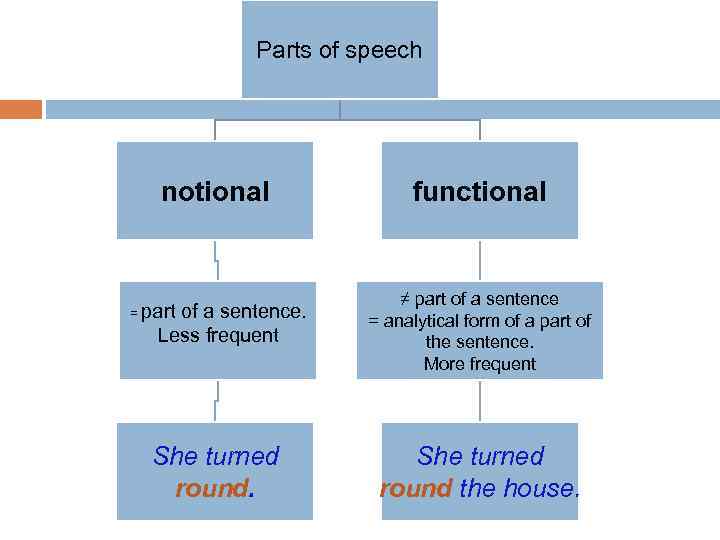 Parts of speech notional = part of a sentence. Less frequent She turned round. functional ≠ part of a sentence = analytical form of a part of the sentence. More frequent She turned round the house.
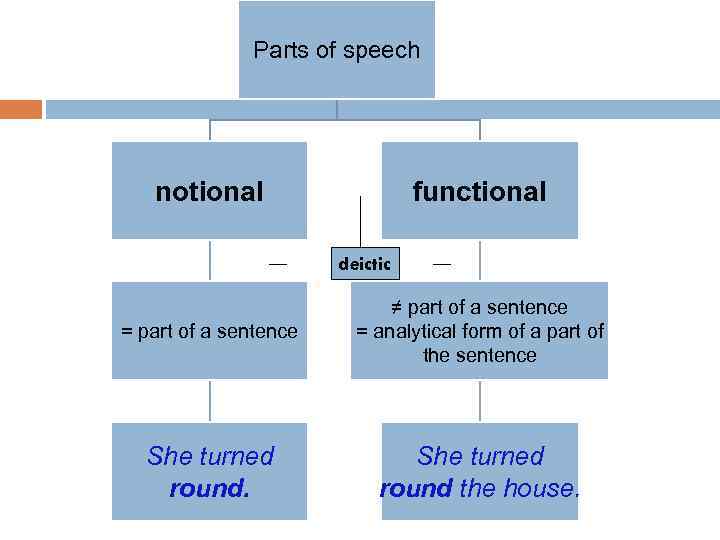 Parts of speech functional notional deictic = part of a sentence ≠ part of a sentence = analytical form of a part of the sentence She turned round the house.
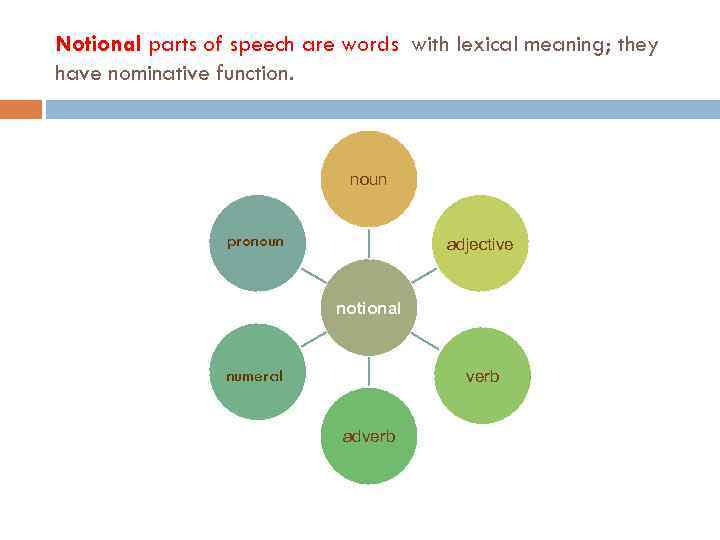 Notional parts of speech are words with lexical meaning; they have nominative function. noun pronoun adjective notional numeral verb adverb
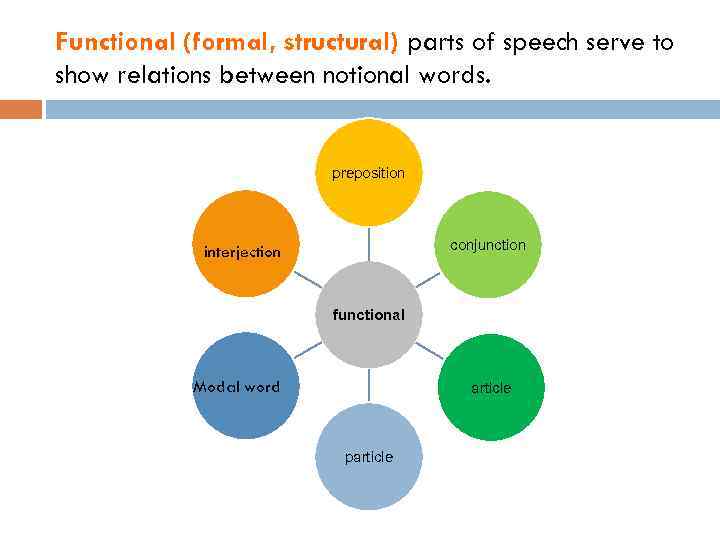 Functional (formal, structural) parts of speech serve to show relations between notional words. preposition conjunction interjection functional Modal word article particle
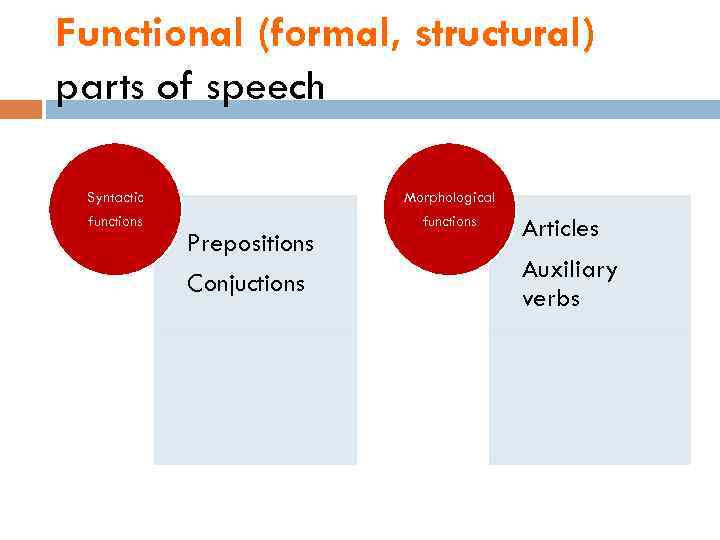 Functional (formal, structural) parts of speech Syntactic Morphological functions Prepositions Conjuctions Articles Auxiliary verbs
 Functional parts of speech (form) Invariable Phonetically weak
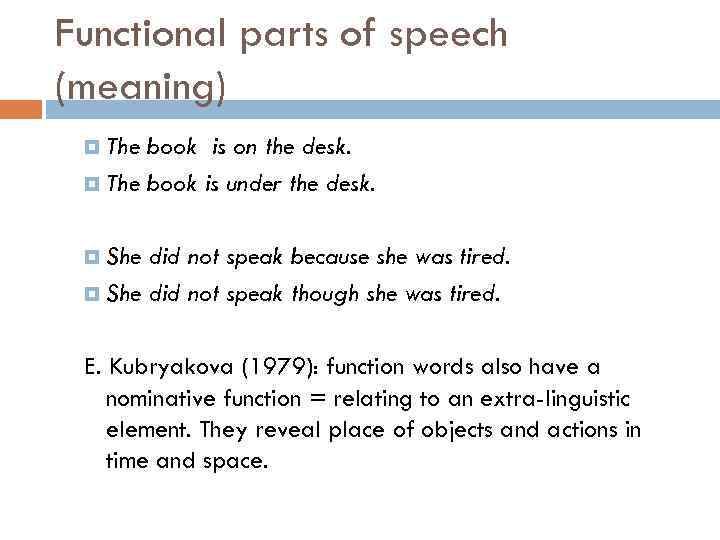 Functional parts of speech (meaning) The book is on the desk. The book is under the desk. She did not speak because she was tired. She did not speak though she was tired. E. Kubryakova (1979): function words also have a nominative function = relating to an extra-linguistic element. They reveal place of objects and actions in time and space.
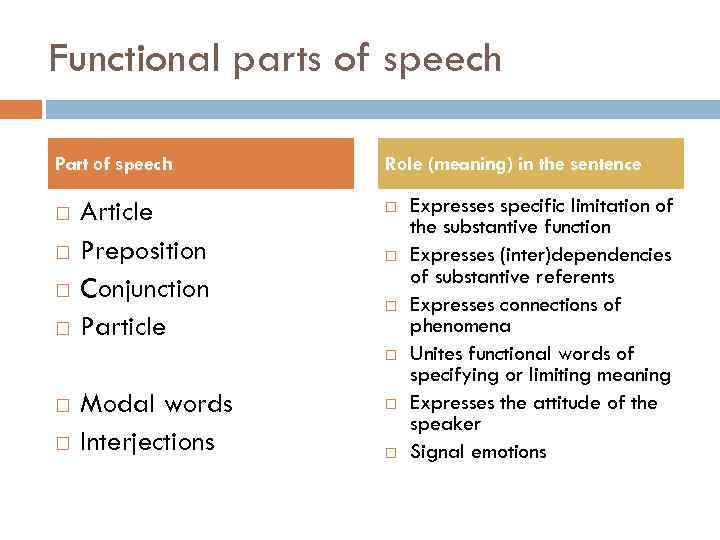 Functional parts of speech Part of speech Article Preposition Conjunction Particle Role (meaning) in the sentence Modal words Interjections Expresses specific limitation of the substantive function Expresses (inter)dependencies of substantive referents Expresses connections of phenomena Unites functional words of specifying or limiting meaning Expresses the attitude of the speaker Signal emotions
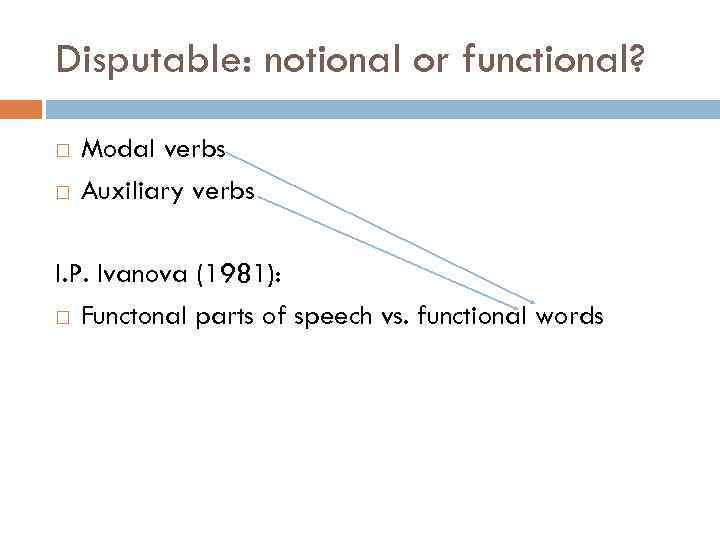
 Disputable: notional or functional? Modal verbs Auxiliary verbs I. P. Ivanova (1981): Functional parts of speech vs. functional words
 Disputable: notional or functional? Modal verbs Auxiliary verbs I. P. Ivanova (1981): Functonal parts of speech vs. functional words
 I. P. Ivanova: Functional words are notional words that have lost, under certain conditions, their lexical meaning and have maintained only grammatical function. Cf. I have a new TV set. I have lost my gloves.
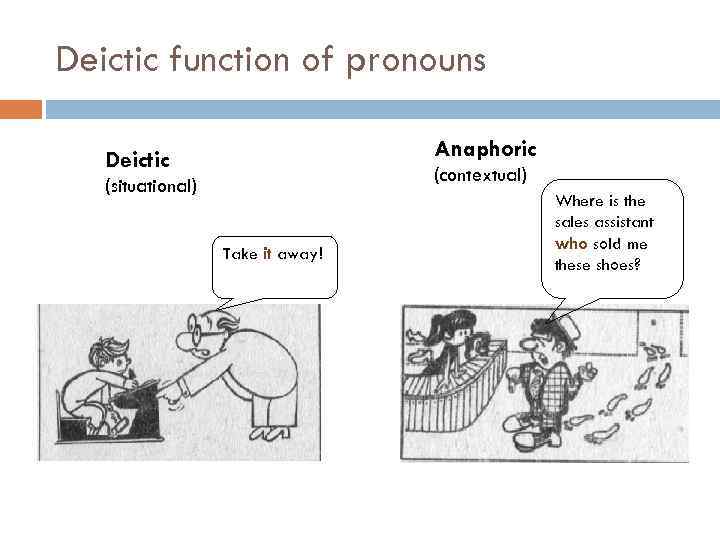 Deictic function of pronouns Anaphoric Deictic (contextual) (situational) Take it away! Where is the sales assistant who sold me these shoes?
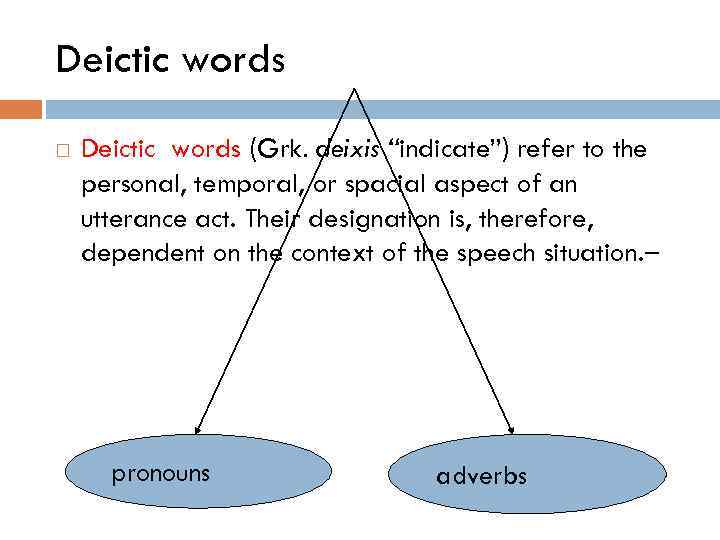 Deictic words (Grk. deixis “indicate”) refer to the personal, temporal, or spacial aspect of an utterance act. Their designation is, therefore, dependent on the context of the speech situation. – pronouns adverbs
 Other classifications
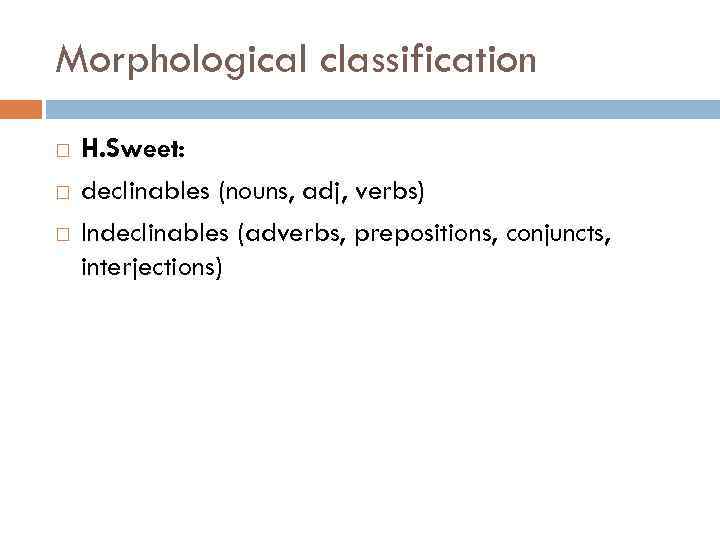 Morphological classification H. Sweet: declinables (nouns, adj, verbs) Indeclinables (adverbs, prepositions, conjuncts, interjections)
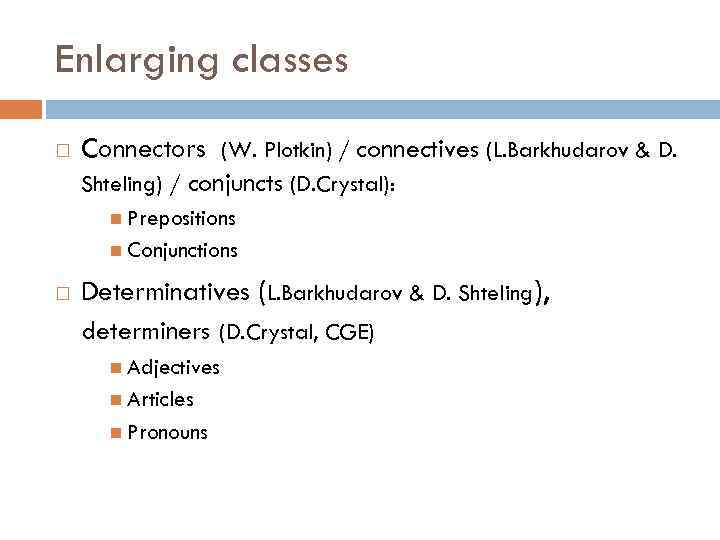 Enlarging classes Connectors (W. Plotkin) / connectives (L. Barkhudarov & D. Shteling) / conjuncts (D. Crystal): Prepositions Conjunctions Determinatives (L. Barkhudarov & D. Shteling), determiners (D. Crystal, CGE) Adjectives Articles Pronouns
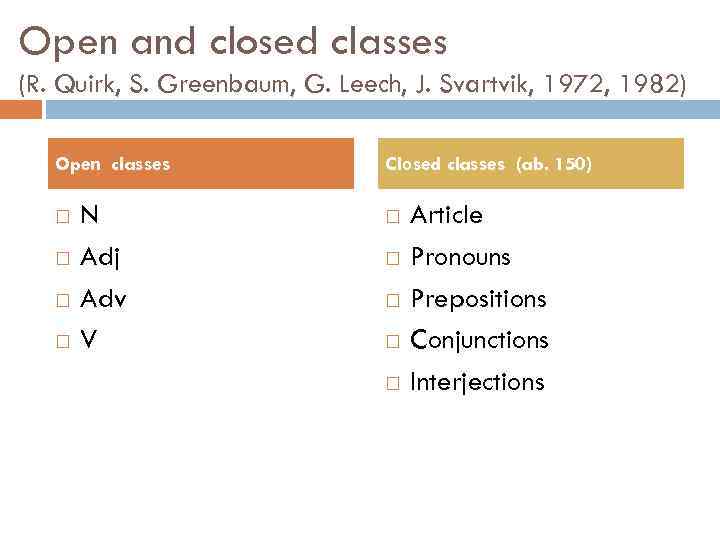 Open and closed classes (R. Quirk, S. Greenbaum, G. Leech, J. Svartvik, 1972, 1982) Open classes N Adj Adv V Closed classes (ab. 150) Article Pronouns Prepositions Conjunctions Interjections
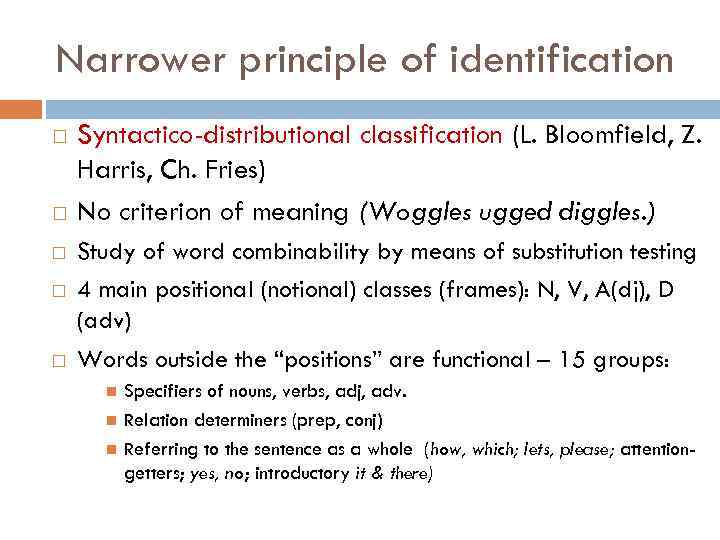 Narrower principle of identification Syntactico-distributional classification (L. Bloomfield, Z. Harris, Ch. Fries) No criterion of meaning (Woggles ugged diggles. ) Study of word combinability by means of substitution testing 4 main positional (notional) classes (frames): N, V, A(dj), D (adv) Words outside the “positions” are functional – 15 groups: Specifiers of nouns, verbs, adj, adv. Relation determiners (prep, conj) Referring to the sentence as a whole (how, which; lets, please; attentiongetters; yes, no; introductory it & there)
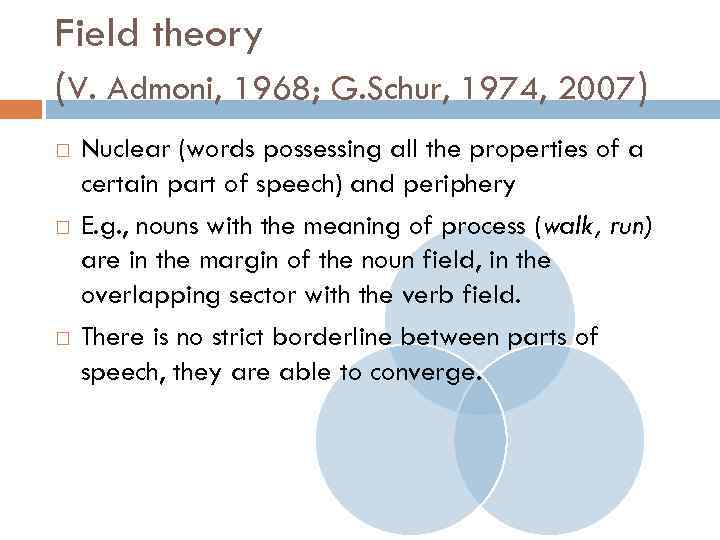 Field theory (V. Admoni, 1968; G. Schur, 1974, 2007) Nuclear (words possessing all the properties of a certain part of speech) and periphery E. g. , nouns with the meaning of process (walk, run) are in the margin of the noun field, in the overlapping sector with the verb field. There is no strict borderline between parts of speech, they are able to converge.
 Three little words you often see Are ARTICLES: a, and the. A NOUN's the name of anything, As: school or garden, toy, or swing. ADJECTIVES tell the kind of noun, As: great, small, pretty, white, or brown. VERBS tell of something being done: To read, write, count, sing, jump, or run. How things are done the ADVERBS tell, As: slowly, quickly, badly, well. CONJUNCTIONS join the words together, As: men and women, wind or weather. The PREPOSITION stands before A noun as: in or through a door. The INTERJECTION shows surprise As: Oh, how pretty! Ah! how wise! The whole are called the PARTS of SPEECH, Which reading, writing, speaking teach.
 Literature Адмони В. Г. Полевая структура частей речи // Вопросы теории частей речи. Л. , 1968, с. 98 -106 Бархударов Л. С. , Штелинг Д. А. Грамматика АЯ. - М. : ВШ, 1973 Блох М. Я. Теоретическая грамматика АЯ. – М. , 1983. Есперсен О. Философия грамматики. - М. : УРСС, 2002. Иванова И. П. , Бурлакова В. В. , Почепцов Г. Г. Теоретическая грамматика современного АЯ. – М. , 1981. Иофик Л. Л. , Чахоян Л. П. Хрестоматия по теоретической грамматике АЯ. – Л. : Просвещение, 1972 Ильиш Б. А. Строй современного английского языка. – Л. , 1971. Кубрякова Е. С. Части речи в ономасиологическом освещении. – М. : Наука. 1978 Плоткин В. Я. Строй английского языка. – М. : ВШ, 1989 Смирницкий А. И. Морфология АЯ. – М. , 1959. Щерба Л. В. Языковая система и речевая деятельность. – Л. : Наука, 1974 Щур Г. С. Теории поля в лигвистике. Изд. 2 -е. –М. : Изд-во ЛКИ, 2007
 Literature CGE = Carter R. , Mc. Carthy M. Cambridge Grammar of English. – CUP, 2006 Crystal D. The Cambridge Encyclopedia of the English Language. – CUP, 1995 Fries Ch. The structure of English. New York, 1952. Quirk R. , Greenbaum S. , Leech G. , Svartvik J. A University Grammar of English. – Moscow: Vyssaja Skola, Longman, 1982. . Sweet H. A New English grammar. Logical and historical. Oxford, 1940. Part 1 & 2.