


Word Building Fedorova U. 4 AOD
If viewed structurally, words appear to be divisible into smaller units which are called morphemes. Morphemes do not occur as free forms but only as constituents of words. Yet they possess meanings of their own. n All morphemes are subdivided into two large classes: roots (or radicals) and affixes. The latter, in their turn, fall into prefixes which precede the root in the structure of the word (as in re-read, mispronounce, unwell) and suffixes which follow the root (as in teach-er, cur-able, diet-ate).
n Words which consist of a root and an affix (or several affixes) are called derived words or derivatives and are produced by the process of word building known as affixation (or derivation). Derived words are extremely numerous in the English vocabulary. Successfully competing with this structural type is the so called root word which has only a root morpheme in its structure.
n This type is widely represented by a great number of words belonging to the original English stock or to earlier borrowings (house, room, book, work, port, street, table, etc. ), and, in Modern English, has been greatly enlarged by the type of word building called conversion (e. g. to hand, v. formed from the noun hand; to can, v. from can, п. ; topale, v. from pale, adj. ; a find, n. from to find, v. ; etc. ).
n Another wide spread word structure is a compound word consisting of two or more stems 1 (e. g. dining-room, bluebell, mother -in law, good-for-nothing). Words of this structural type are produced by the word building process called composition.
Affixation The process of affixation consists in coining a new word by adding an affix or several affixes to some root morpheme. From the etymological point of view affixes are classified into the same two large groups as words: native and borrowed.
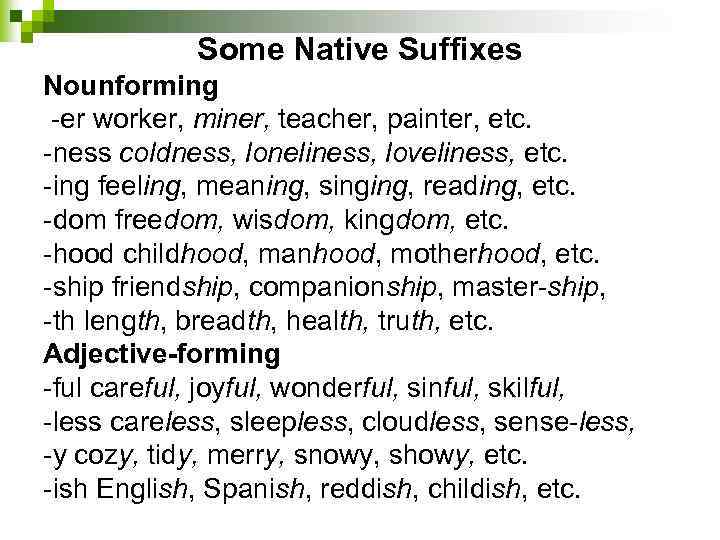
Some Native Suffixes Nounforming er worker, miner, teacher, painter, etc. ness coldness, loneliness, loveliness, etc. ing feeling, meaning, singing, reading, etc. dom freedom, wisdom, kingdom, etc. hood childhood, manhood, motherhood, etc. ship friendship, companionship, master ship, th length, breadth, health, truth, etc. Adjective-forming ful careful, joyful, wonderful, sinful, skilful, less careless, sleepless, cloudless, sense less, y cozy, tidy, merry, snowy, showy, etc. ish English, Spanish, reddish, childish, etc.
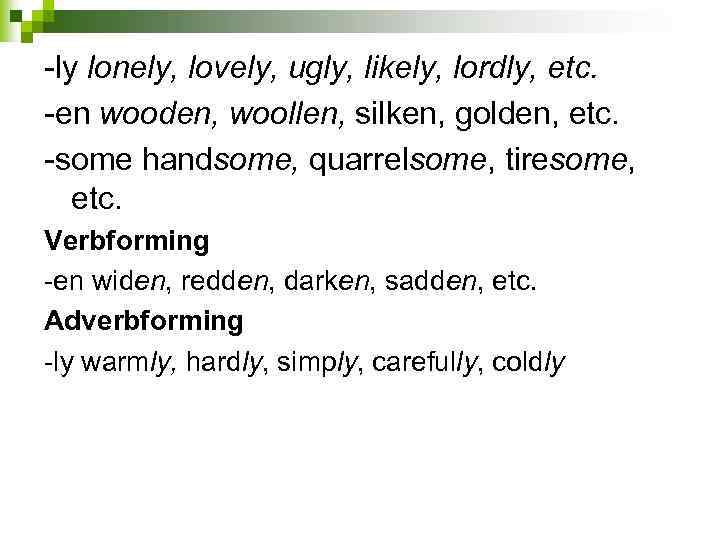
ly lonely, lovely, ugly, likely, lordly, etc. en wooden, woollen, silken, golden, etc. some handsome, quarrelsome, tiresome, etc. Verbforming en widen, redden, darken, sadden, etc. Adverbforming ly warmly, hardly, simply, carefully, coldly
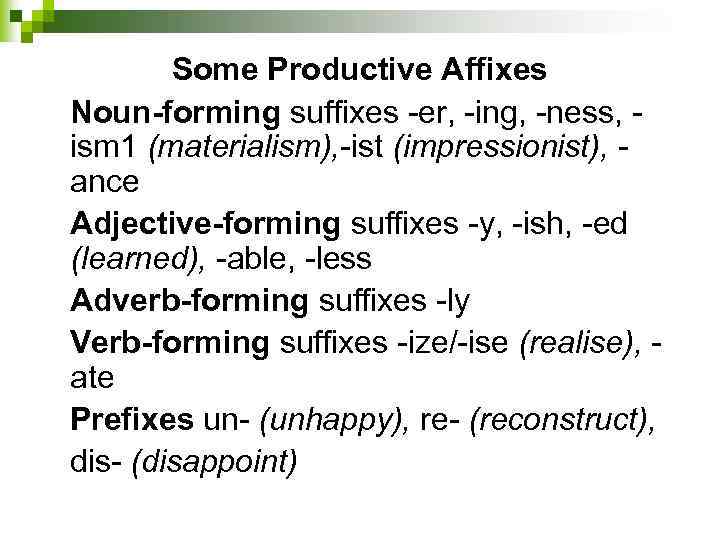
Some Productive Affixes Noun-forming suffixes er, ing, ness, ism 1 (materialism), ist (impressionist), ance Adjective-forming suffixes y, ish, ed (learned), able, less Adverb-forming suffixes ly Verb-forming suffixes ize/ ise (realise), ate Prefixes un (unhappy), re (reconstruct), dis (disappoint)
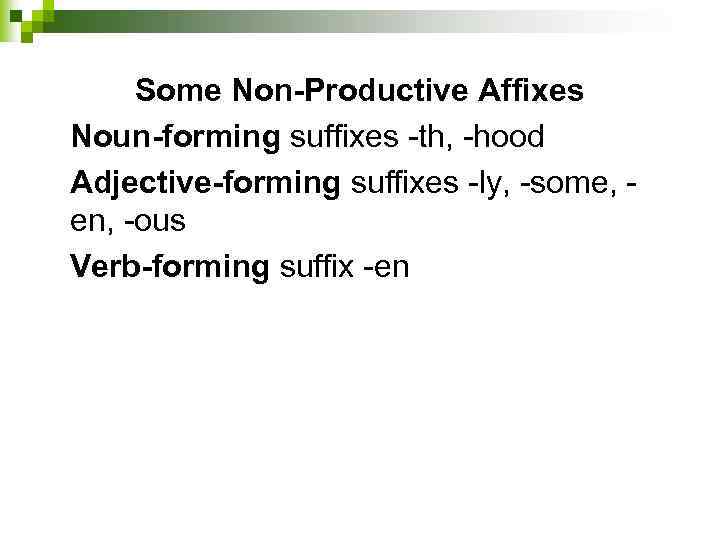
Some Non-Productive Affixes Noun-forming suffixes th, hood Adjective-forming suffixes ly, some, en, ous Verb-forming suffix en
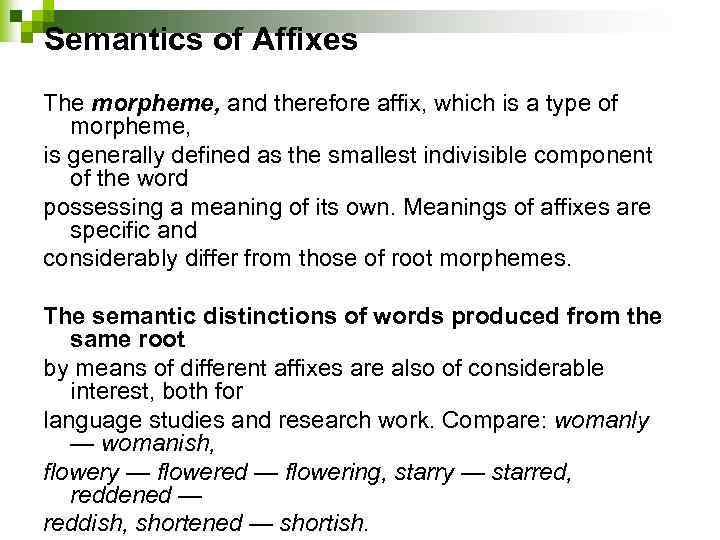
Semantics of Affixes The morpheme, and therefore affix, which is a type of morpheme, is generally defined as the smallest indivisible component of the word possessing a meaning of its own. Meanings of affixes are specific and considerably differ from those of root morphemes. The semantic distinctions of words produced from the same root by means of different affixes are also of considerable interest, both for language studies and research work. Compare: womanly — womanish, flowery — flowered — flowering, starry — starred, reddened — reddish, shortened — shortish.
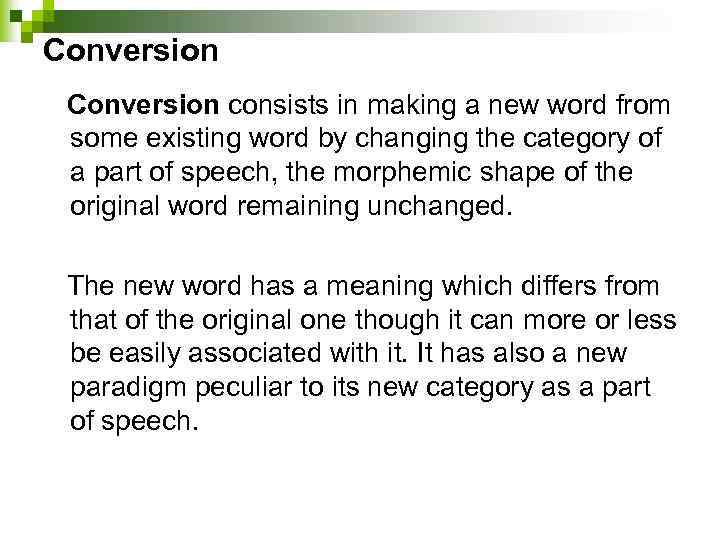
Conversion consists in making a new word from some existing word by changing the category of a part of speech, the morphemic shape of the original word remaining unchanged. The new word has a meaning which differs from that of the original one though it can more or less be easily associated with it. It has also a new paradigm peculiar to its new category as a part of speech.
The two categories of parts of speech especially affected by conversion are nouns and verbs. Verbs made from nouns are the most numerous amongst the words produced by conversion: e. g. to hand, to back, to face, to eye, to mouth, to nose, to dog, to wolf, to monkey, to can, to coal, to stage, to screen, to room, to floor, to blackmail, to blacklist, to honeymoon, and very many others. Nouns are frequently made from verbs: do (e. g. This is the queerest do I've ever come across. Do — event, incident), go (e. g. He has still plenty of go at his age. Go — energy), make, run, find, catch, cut, walk, worry, show, move, etc. Verbs can also be made from adjectives: to pale, to yellow, to cool, to grey, to rough (e. g. We decided to rough it in the tents as the weather was warm), etc. Other parts of speech are not entirely unsusceptible to conversion as the following examples show: to down, to out (as in a newspaper heading Diplomatist Outed from Budapest), the ups and downs, the ins and outs, like, n, (as in the like of me and the like of you).
Composition This type of word building, in which new words are produced by combining two or more stems, Traditionally three types are distinguished: neutral, morphological, syntactic. In neutral compounds the process of compounding is realised without any linking elements, by a mere juxtaposition of two stems, as in blackbird, shop-window, sunflower, bedroom, tallboy, etc. There are three subtypes of neutral compounds depending on the structure of the constituent stems. Compounds which have affixes in their structure are called derived or derivational compounds. E. g. absent-mindedness, blue-eyed, golden-haired, broad-shouldered, lady-killer, music-lover, honey-mooner, first-nighter, late-comer, newcomer, early-riser, evildoer.
Morphological compounds n This type is nonproductive. It is represented by words in which two compounding stems are combined by a linking vowel or consonant, e. g. Anglo. Saxon, Franko-Prussian, handiwork, handicraft, craftsmanship, spokesman, statesman
n In syntactic compounds (the term is arbitrary) we once more find a feature of specifically English word structure. These words are formed from segments of speech, preserving in their structure numerous traces of syntagmatic relations typical of speech: articles, prepositions, adverbs, as in the nouns lily-of-the-valley, Jack-of-all-trades, good-for-nothing, mother-in-law, sit-at-home.
Semi-Affixes Semi-affix is -man in a vast group of English nouns denoting people: sportsman, gentleman, nobleman, salesman, seaman, fisherman, countryman, statesman, policeman, chairman, etc. Semi affixes are -land (e. g. Ire land, Scotland, fatherland, wonderland), -like (e. g. ladylike, unladylike, businesslike, unbusiness like, starlike, flowerlike, etc. ), -worthy (e. g. seaworthy, btrustworthy, praiseworthy).
Shortening (Contraction) Shortenings (or contracted/curtailed words) are produced in two different ways. The first is to make a new word from a syllable (rarer, two) of the original word. The latter may lose its beginning (as in phone made from telephone, fence from defence), its ending (as in hols from holidays, vac from vacation, props from properties, ad from advertisement) or both the beginning and ending (as in flu from influenza, fridge from refrigerator). The second way of shortening is to make a new word from the initialletters of a word group: U. N. O. ['ju: neu] from the United Nations Organisation, B. B. C. from the British Broadcasting Corporation, M. P. from Member of Parliament.
Sound-Imitation Words coined by this interesting type of word building are made by imitating different kinds of sounds that may be produced by animals, birds, insects, human beings and inanimate objects. English dogs bark (cf. the R. лаять) or howl (cf. the R. выть). The English cock cries cock-adoodle-doo (cf. the R. ку-каре-ку). In England ducks quack and frogs croak (cf. the R. крякать said about ducks and квакать said about frogs). It is only English and Russian cats who seem capable of mutual understanding when they meet, for English cats mew or miaow (meow). The same can be said about cows: they moo (but also low). Some names of animals and especially of birds and insects are also produced by sound imitation: crow, cuckoo, humming-bird, whippoor-will, cricket.
Reduplication In reduplication new words are made by doubling a stem, either without any phonetic changes as in bye-bye (coll, for good-bye) or with a variation of the root vowel or consonant as in ping-pong, chitchat (this second type is called gradational reduplication). walkie-talkie ("a portable radio"), riff-raff ("the worthless or disreputable element of society"; "the dregs of society"), chi-chi (sl. for chic as in a chi-chi girl).
Back-Formation (Reversion) In all these cases the verb was made from the noun by subtracting what was mistakenly associated with the English suffix er. to work — worker in the case of the verbs to beg, to burgle, to cobble the process was reversed: instead of a noun made from a verb by affixation (as in painter from to paint), a verb was produced from a noun by subtraction. That is why this type of word building received the name of backformation or reversion. to butle from butler, to baby-sit from baby-sitter, to forceland from forced landing, to bloodtransfuse from bloodtransfuing sorry for everybody who isn't a girl and who can't come here, I am sure the college you attended when you were a boy couldn't have been so nice.
Tests Образуйте из данных глаголов новые глаголы путем присоединения префиксов: n de-: to compose, to compress, to code; n dis-: to join, to agree, to arm; to approve; n mis-: to inform, to understand, to lead – вести, to take; n pre-: to test, to cook, to determine; n fore-: to tell, to go; n under-: to estimate, to line, to dose, to pay.
Образуйте от приведенных существительных прилага тельные , используя суффиксы ful и less. Образец: event – событие: eventful – полный собы ий , богатый событиями; eventless – бедный событиями. n Use – польза; doubt – сомнение, harm – вред; success – успех; hope – надежда; care – забота, внимание; fruit – плод; help – помощь.
n n n Образуйте от данных глаголов существительные с по мощью суффикса -еr или -or. To lead, to write, to read, to visit, to speak, to sleep, to act, to direct, to conduct, to drive, to fight, to mine, to report, to sing, to skate, to swim, to teach, to travel, to sail, to invent, to found, to compose.
