 Скачать презентацию Woods Hole October 2011 EUROPEAN RESEARCH AREA ERA
8028468d4178183a7e99751f969ef19e.ppt
- Количество слайдов: 16



Woods Hole, October 2011 EUROPEAN RESEARCH AREA (ERA) and Marine Sciences What is the ERA aiming at ? An open space for knowledge, composed of all research and development activities, programmes and policies in Europe which involves a transnational perspective, in which synergies and complementarities are fully exploited. A. Dosdat
Woods Hole, October 2011 Why does Europe need an ERA ? To increase efficiency at global level by overcoming the fragmentation of research in Europe due to national and institutional barriers, increasing individual mobility, opening access to large infrastructures. How : the key actions -Transnational cooperation - Researcher mobility - Research infrastructures - Knowledge transfer to policy makers and to industry
Woods Hole, October 2011 From FP 7 (2007 -2013) to FP 8 « Horizon 2020 » (2014 -2020) What A major tool , the FPs. FP 7 inc, 4 major building blocks or Programmes 1. Cooperation (32 M€ 2007 -2013), in key thematics such as : • Food, agriculture and fisheries, biotechnology; Environment (including climate change); Energy (incl. marine renewable energy); Space (incl. Earth and Ocean observation). • + a cross-cutting issue : « Oceans of tomorrow » 2. Ideas (7, 5 M€ 2007 -2013) supports frontier research on the basis of individual scientific excellence (ERC).
Woods Hole, October 2011 From FP 7 (2007 -2013) to FP 8 « Horizon 2020 » (2014 -2020) 3. People (4, 8 M€ 2007 -2013) provides support for researcher mobility and career development, both inside the European Union and internationally 4. Capacities (4, 1 M€ 2007 -2013) strengthens the research capacities that Europe needs to become a knowledge-economy (research infrastructures, research for the benefit of SMEs, science in society, and international cooperation).
Woods Hole, October 2011 5. The future EU FP 8 for research and innovation (2014 -2020): - Consultation : Feb. to May 2011 ; CE communication : Déc. 2011 - Three pilars are expected : -Tackling Societal Challenges (incl. Food security and sustainable bioresources, climate change, energy, raw materials, health in the society …) -Industrial leadership and competitive frameworks (incl. ICT, Biotech, Space, …). -Excellence in the science base (incl. Frontier research, Skills, training and career development, Networking of and access to Ris, …) Ifremer / Direction for European and international Affairs (DAEI )

Woods Hole, October 2011 Simplified access
Woods Hole, October 2011 A new emerging tool : the Joint Programming Initiative (JPI) Why : the FP represents ~6% of the total expenses in R&D. Need for coordinating the remaining 94%. What : JPI is a concerted and joint planning, implementation and evaluation of national research programmes : • to tackle the challenges that cannot be solved solely on the national level • to increase the value of relevant national and EU R&D and infrastructure investments JPI « Healthy and productive seas and oceans » vision include : - marine food sources (including sustainable aquaculture) - under-explored marine biodiversity & marine renewable energy - growing vulnerability of coastal areas - understanding and mitigating the impact of climate change - integrated knowledge base
Woods Hole, October 2011 Joint Programming Initiative (JPI) WHO The EU Member states at ministerial level, including the national research councils. WHEN 2012 -2013 : preparatory phase, including strategic scientific & innovation plan, implementation agenda and governance issues 2014 : implementation through the coordination of national budgets on common programmes, inc. non competitive money
Woods Hole, October 2011 EIT (European Institute of Innovation & Technology) To increase European sustainable growth and competitiveness by reinforcing the innovation capacity. creation of Knowledge Innovation Communities (KICs) : - which links the higher education, research and business sectors to one another. - to provide the conditions for a new generation of entrepreneurs and innovators to emerge KIC Marine « Resources from the sea » , for the sustainable development of living and non-living marine resources, inc. : -short-term commercial services -medium-term technological capacity-building -long-term capacity building in education and training -long-term analytic « think-tank » capacities and services => through projects co-funded by the EU.
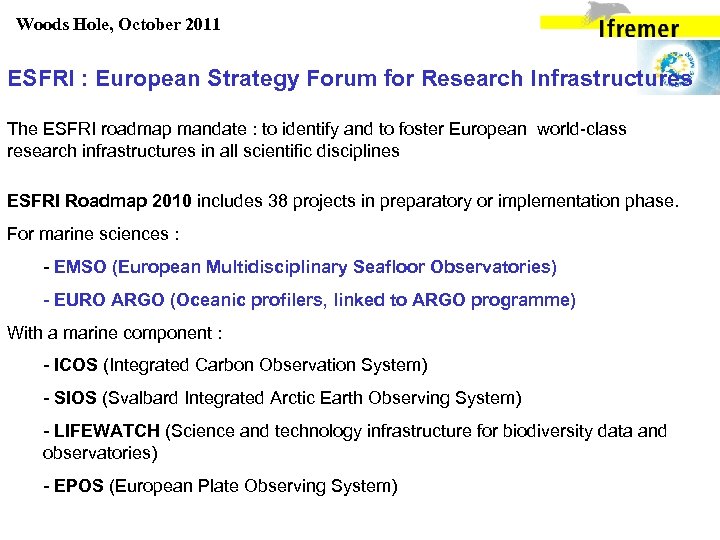
Woods Hole, October 2011 ESFRI : European Strategy Forum for Research Infrastructures The ESFRI roadmap mandate : to identify and to foster European world-class research infrastructures in all scientific disciplines ESFRI Roadmap 2010 includes 38 projects in preparatory or implementation phase. For marine sciences : - EMSO (European Multidisciplinary Seafloor Observatories) - EURO ARGO (Oceanic profilers, linked to ARGO programme) With a marine component : - ICOS (Integrated Carbon Observation System) - SIOS (Svalbard Integrated Arctic Earth Observing System) - LIFEWATCH (Science and technology infrastructure for biodiversity data and observatories) - EPOS (European Plate Observing System)
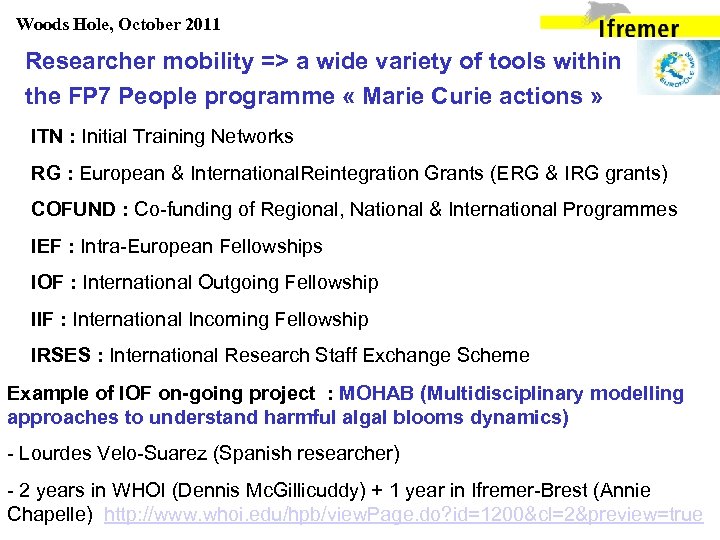
Woods Hole, October 2011 Researcher mobility => a wide variety of tools within the FP 7 People programme « Marie Curie actions » ITN : Initial Training Networks RG : European & International. Reintegration Grants (ERG & IRG grants) COFUND : Co-funding of Regional, National & International Programmes IEF : Intra-European Fellowships IOF : International Outgoing Fellowship IIF : International Incoming Fellowship IRSES : International Research Staff Exchange Scheme Example of IOF on-going project : MOHAB (Multidisciplinary modelling approaches to understand harmful algal blooms dynamics) - Lourdes Velo-Suarez (Spanish researcher) - 2 years in WHOI (Dennis Mc. Gillicuddy) + 1 year in Ifremer-Brest (Annie Chapelle) http: //www. whoi. edu/hpb/view. Page. do? id=1200&cl=2&preview=true
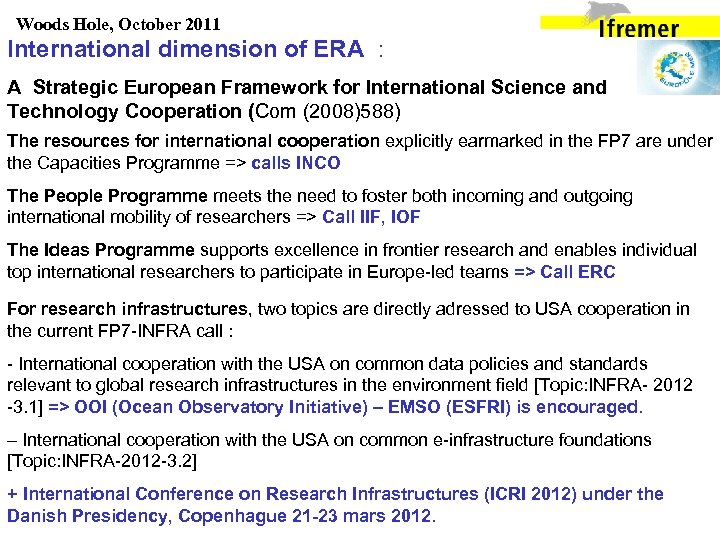
Woods Hole, October 2011 International dimension of ERA : A Strategic European Framework for International Science and Technology Cooperation (Com (2008)588) The resources for international cooperation explicitly earmarked in the FP 7 are under the Capacities Programme => calls INCO The People Programme meets the need to foster both incoming and outgoing international mobility of researchers => Call IIF, IOF The Ideas Programme supports excellence in frontier research and enables individual top international researchers to participate in Europe-led teams => Call ERC For research infrastructures, two topics are directly adressed to USA cooperation in the current FP 7 -INFRA call : - International cooperation with the USA on common data policies and standards relevant to global research infrastructures in the environment field [Topic: INFRA- 2012 -3. 1] => OOI (Ocean Observatory Initiative) – EMSO (ESFRI) is encouraged. – International cooperation with the USA on common e-infrastructure foundations [Topic: INFRA-2012 -3. 2] + International Conference on Research Infrastructures (ICRI 2012) under the Danish Presidency, Copenhague 21 -23 mars 2012.
Woods Hole, October 2011 Thank you for your attention Antoine Dosdat antoine. dosdat@ifremer. fr
Woods Hole, October 2011 GMES (Global Monitoring for Environment and Security) The European Programme for the establishment of an European capacity for Earth Observation The satellites power of observation coupled with the multiplication of insitu automated measurements = > for an operational observation of land, ocean and atmosphere, a near real-time data service and forecast capacity. Six thematic areas are developed : marine, land, atmosphere, emergency, security and climate change (on-going setting-up). The GMES marine service « My Ocean » : - based on the combination of space and in situ observations (incl. ARGO profilers, oceanic moorings, drifters, ships, …), and on data assimilation, - provides information on the ocean for the large scale (worldwide coverage) and regional scales (main European basins and seas) : temperature, salinity, currents, ice extent, sea level, primary ecosystems, … Pre-operational phase : 2009 -2013 ; Full operational : 2014
Woods Hole, October 2011 European Marine Observation and Data Network (EMODNET) Not directly an ERA action but closely linked with the marine research community (which is the main data provider), the commission proposed an European marine observation and data network (EMODNET) for the benefit of all users of the sea. The "proof of concept" of EMODNET is being tested through pilot portals for marine data in the field of : • hydrography : • geology : • biology : • chemistry : • physics : • + functional habitat maps : Pilot actions : 2009 -2013 ; Full operational : 2014
European Research Area (ERA) and Marine Sciences Marine Strategy Framework Directive (adopted in June 2008) • to achieve Good Environmental Status (GES) of the EU's marine waters by 2020, • to protect the resource base upon which marine-related economic and social activities depend. Not directly an ERA action but its implementation relies on the marine research community expertise and data acquisition capability. 11 descriptors for determining Good Environmental Status : 1 Biological diversity 2 Non-indigeous species 3 Commercially exploited fish and shellfish 4 Marine food webs 5 Eutrophication 7 Hydrographical conditions 6 Sea floor integrity 8 Concentration of contaminants 9 Contaminants in fish and other seafood 11 Introduction of energy, underwater noise 10 Marine litter
Скачать презентацию Woods Hole October 2011 EUROPEAN RESEARCH AREA ERA
8028468d4178183a7e99751f969ef19e.ppt