


 Скачать презентацию Woods Hole Oceanographic Institute Understanding Intellectual Property June
c0c2a0c272a19a55161235448aa0b6a7.ppt
- Количество слайдов: 17
 Woods Hole Oceanographic Institute Understanding Intellectual Property June 4, 2008 Boston New York San Francisco Washington, DC
 Objectives Understand: • IP definitions • How to protect IP • When to know to file a patent • What the process of filing a patent entails • How to evaluate patent value
 Overview of Concepts • • • Intellectual Property Trademarks Trade Secrets Patents Combinations of Protection i. e. Patent and Copyright
 What is Intellectual Property? • “Intellectual Property” IS Property – You can own it, sell it, lease it, mortgage it, pay taxes on it, and address a trespass to it – You can also lose it to theft • You need to protect it as you would protect your house or your car – Don’t let anyone else take it or use it without permission – Don’t tell anyone how to break in and don’t pass out keys randomly
 Non-Disclosure Agreements • A Non-Disclosure Agreement, or “NDA” or “Confidentiality Agreement, ” is a contract between two or more parties where the agreement is a promise that information conveyed will be maintained in secrecy. • Should be signed by any non-inventor with whom you are discussing an invention on which you are working. – If you share the information openly, then you might lose the right to patent an invention or the ability to prove ownership or precedence
 Non-Disclosure Agreements • Can protect any type of information • Can be in writing or oral • Can prevent a written description of an invention from being deemed a “publication” • Can allow you to ask a court to stop a party from making disclosures • Are critical when disclosing a trade secret
 Trademark and Service Mark Trademark: a Mark under which you sell goods and services. The term "trademark" often refers to both trademarks and service marks. A trademark is a word, phrase, symbol or design that identifies the source of the goods of one party from those of others. – House Marks (Coke, IBM, Virtual Ink) – Product Marks (Thinkpad, Mimio) A service mark is the same as a trademark, except that it identifies the source of a service rather than a product.
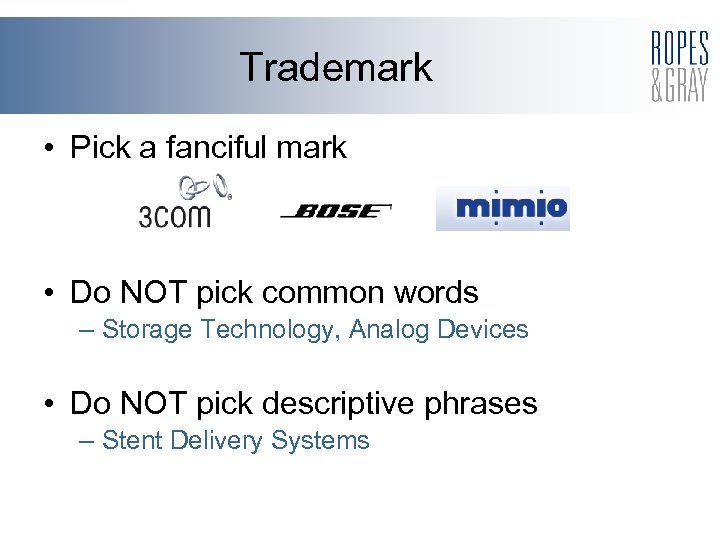 Trademark • Pick a fanciful mark • Do NOT pick common words – Storage Technology, Analog Devices • Do NOT pick descriptive phrases – Stent Delivery Systems
 Protecting Trademarks and Service Marks • You do NOT need to register a trademark or service mark to protect it. You can establish rights in a mark by use of the mark. – However, federal trademark registration provides several advantages: • constructive notice of ownership • legal presumption of nationwide ownership of mark • ability to bring an action in federal court • a basis to obtain foreign registration • basis to ask Customs Service to stop importation of infringing foreign goods • Use "TM" (trademark) or "SM" (service mark) anytime. • Use the federal registration symbol "®" only after the mark is registered - not while an application is pending.
 Trade Secret • Generally includes: – Confidential/proprietary information that has commercial value – Provided that the information is not generally available to public, and that the owner takes reasonable measures to keep information secret • No formal filing needed • Trade secrets may include inventions not yet patented or portions of a work that are not fully protected by copyright
 Trade Secret Protection • Rules vary from state to state • Cornerstone is information you keep secret • • • Be aware of what you say If you don’t take significant steps to keep the information secret, then it will lose its protected status This often runs counter to the other purposes of information use and sharing at a research institution • • Consider in advance how you should set the balance The Economic Espionage Act of 1996 (“EEA”) • • Criminal penalties for individual and corporate offenders The EEA does not criminalize every theft of trade secrets.
 Patents A Patent is a Federally granted right to exclude competitors from using your technology for 20 years from the date of filing the patent application. • Can be granted only to man-made inventions that are: (1) novel, (2) non-obvious, and (3) useful. • Inventor must successfully disclose and claim an invention in order to receive a patent.
 The Application Process • The Application Process breaks down into four main projects • Determining what to Patent • Determining when to File • Preparing one or more Patent Applications • Prosecuting the Applications
 What to Patent • Most Important Step: Determining What to Patent – Not a Nobel Prize – Most patents are to improvements • Stents, balloon stents, coated stents • Do NOT ask “What can I get a patent on? ” • Ask instead: – “What do I want a patent on? ” – “What is of commercial value to our Institute? ” • Compare against the prior art
 When to File • • Before you lose US or Foreign rights Before a public disclosure Before an “on sale” bar In time to have a patent to protect your products
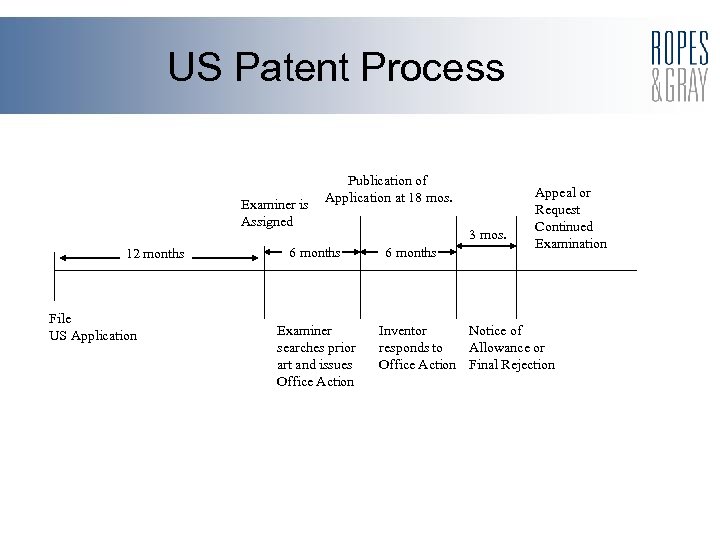 US Patent Process Examiner is Assigned 12 months File US Application Publication of Application at 18 mos. 6 months Examiner searches prior art and issues Office Action 3 mos. 6 months Appeal or Request Continued Examination Inventor Notice of responds to Allowance or Office Action Final Rejection
 Thanks for your time.