 Скачать презентацию Wood Biofuels Bill Hubbard and Sarah Ashton Southern
82dd1d71948b1abe28693f9aafae3654.ppt
- Количество слайдов: 38



Wood Biofuels Bill Hubbard and Sarah Ashton Southern Regional Extension Forestry
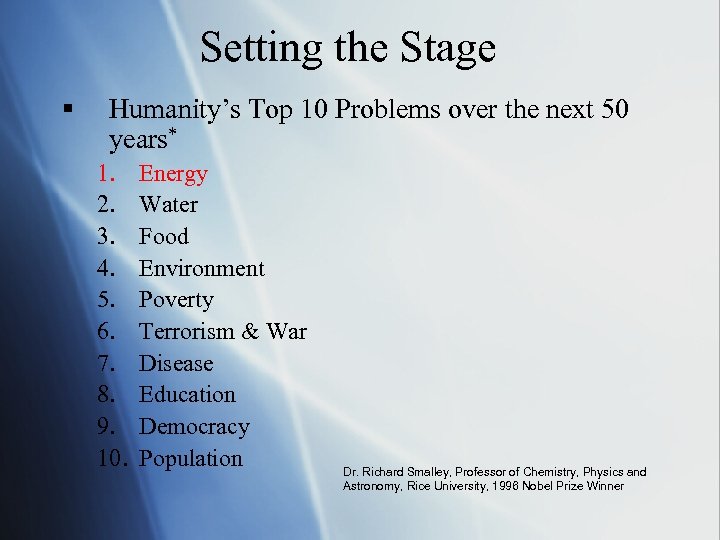
Setting the Stage § Humanity’s Top 10 Problems over the next 50 years* 1. 2. 3. 4. 5. 6. 7. 8. 9. 10. Energy Water Food Environment Poverty Terrorism & War Disease Education Democracy Population Dr. Richard Smalley, Professor of Chemistry, Physics and Astronomy, Rice University, 1996 Nobel Prize Winner
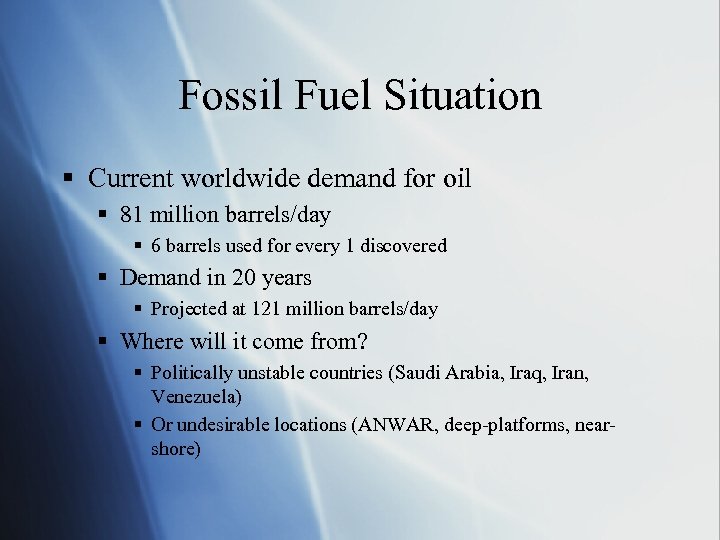
Fossil Fuel Situation § Current worldwide demand for oil § 81 million barrels/day § 6 barrels used for every 1 discovered § Demand in 20 years § Projected at 121 million barrels/day § Where will it come from? § Politically unstable countries (Saudi Arabia, Iraq, Iran, Venezuela) § Or undesirable locations (ANWAR, deep-platforms, nearshore)
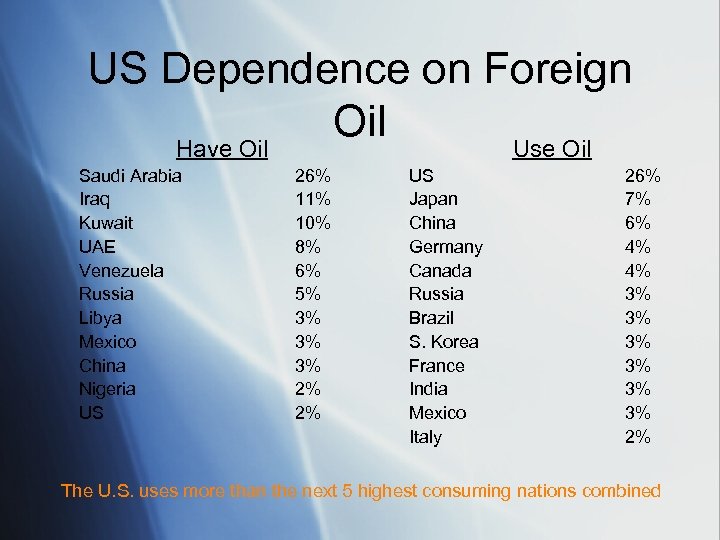
US Dependence on Foreign Oil Have Oil Use Oil Saudi Arabia Iraq Kuwait UAE Venezuela Russia Libya Mexico China Nigeria US 26% 11% 10% 8% 6% 5% 3% 3% 3% 2% 2% US Japan China Germany Canada Russia Brazil S. Korea France India Mexico Italy 26% 7% 6% 4% 4% 3% 3% 3% 2% The U. S. uses more than the next 5 highest consuming nations combined
Climate Change is Real and Creates Real Impacts Hurricane Katrina Mountain Pine Beetle

So what does all this mean?
One Alternative is the Utilization of Woody Biomass as Fuel § We have an abundance of woody biomass that, in general, needs to be extracted for various reasons including: § § § Woody weed control, Integrated Pest Management, Fuel Load Reduction, Improving growth rates of standing timber, Salvage § But is NOT always extracted or utilized
What is Woody Biomass? § Woody biomass is the accumulated mass, above and below ground, of the wood, bark, and leaves of living and dead woody shrubs and trees.
What is Bioenergy? § Energy produced from biomass including woody biomass, agricultural biomass, and other biological materials § Includes electricity, heat, and transportation fuels
Availability of Biomass § OECD – commercial, industry-led § Asia and Latin America – modern, commercial § Africa – harvested informally Source: IEA 2003. Renewables Information. Paris
§ § Utilization of Biomass is the most important renewable energy source in the world today 10. 6% world total energy supply - 77. 4% total renewable energy supply § § Solid biomass has grown at 1. 8% Liquid biomass has grown at 84% Liquid Biomass 0. 7% Renewable Municipal Solid Waste 1. 20% Solid biomass/ charcoal 77. 4% Gas from Biomass 0. 50% Source: IEA 2003. Renewables Information. Paris
Biomass in the United States § Domestic energy production § 9% renewable: 47% biomass: 72% wood-based 2% Wind 45% Hydroelectric 5% Geothermal 47% Biomass 1% Solar Source: Energy Information Administration 2004
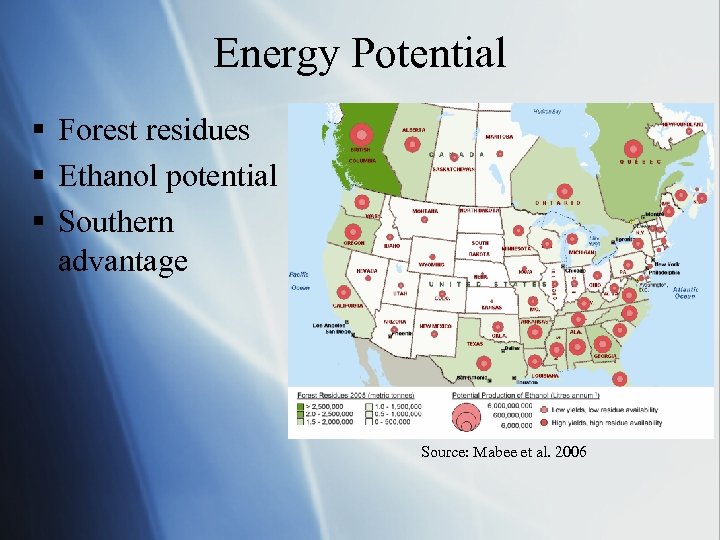
Energy Potential § Forest residues § Ethanol potential § Southern advantage Source: Mabee et al. 2006
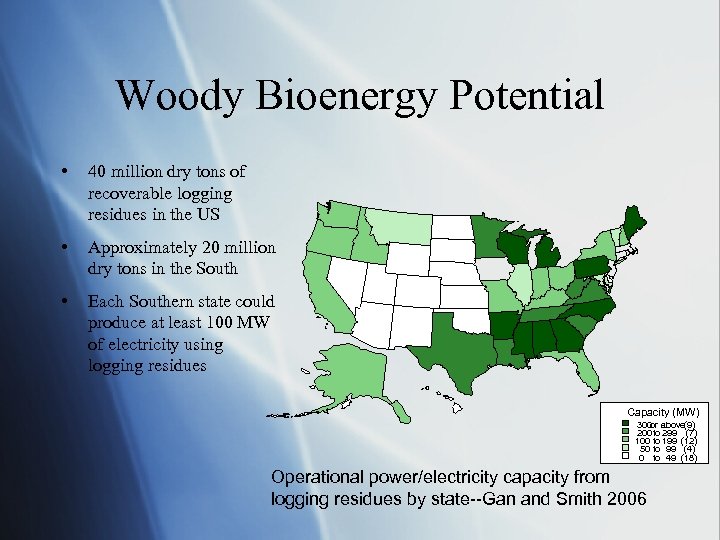
Woody Bioenergy Potential • 40 million dry tons of recoverable logging residues in the US • Approximately 20 million dry tons in the South • Each Southern state could produce at least 100 MW of electricity using logging residues Capacity (MW) 300 or above(9) 200 to 299 (7) 100 to 199 (12) 50 to 99 (4) 0 to 49 (18) Operational power/electricity capacity from logging residues by state--Gan and Smith 2006
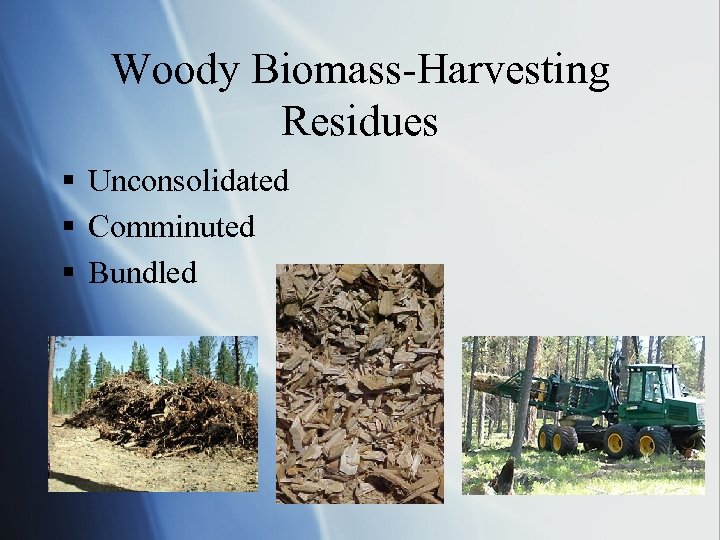
Woody Biomass-Harvesting Residues § Unconsolidated § Comminuted § Bundled
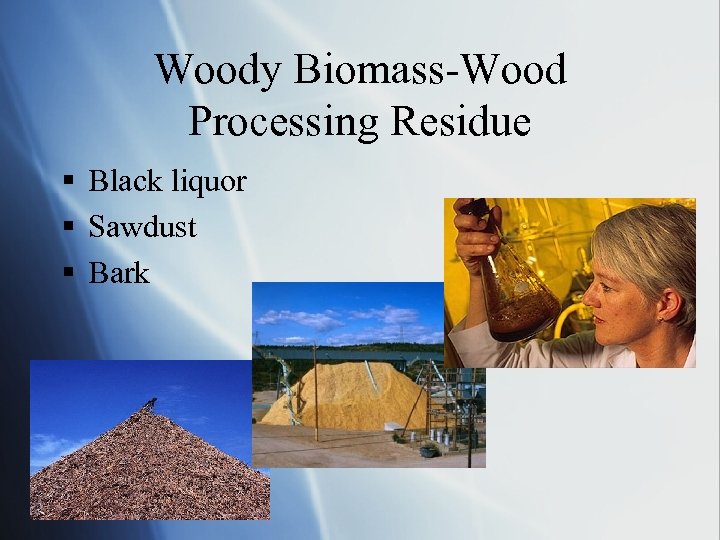
Woody Biomass-Wood Processing Residue § Black liquor § Sawdust § Bark
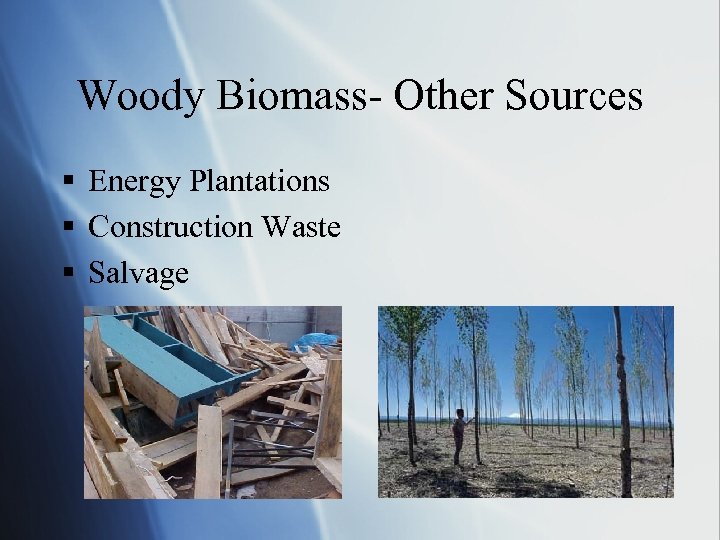
Woody Biomass- Other Sources § Energy Plantations § Construction Waste § Salvage
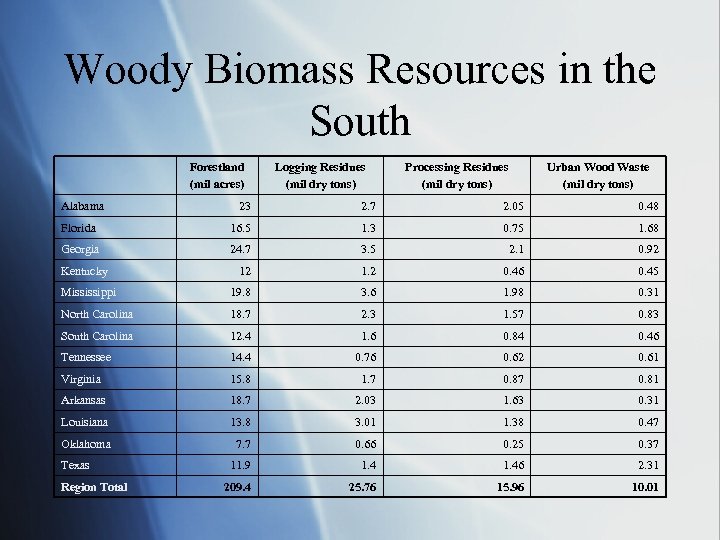
Woody Biomass Resources in the South Forestland (mil acres) Alabama Logging Residues (mil dry tons) Processing Residues (mil dry tons) Urban Wood Waste (mil dry tons) 23 2. 7 2. 05 0. 48 Florida 16. 5 1. 3 0. 75 1. 68 Georgia 24. 7 3. 5 2. 1 0. 92 12 1. 2 0. 46 0. 45 Mississippi 19. 8 3. 6 1. 98 0. 31 North Carolina 18. 7 2. 3 1. 57 0. 83 South Carolina 12. 4 1. 6 0. 84 0. 46 Tennessee 14. 4 0. 76 0. 62 0. 61 Virginia 15. 8 1. 7 0. 81 Arkansas 18. 7 2. 03 1. 63 0. 31 Louisiana 13. 8 3. 01 1. 38 0. 47 Oklahoma 7. 7 0. 66 0. 25 0. 37 11. 9 1. 46 2. 31 209. 4 25. 76 15. 96 10. 01 Kentucky Texas Region Total
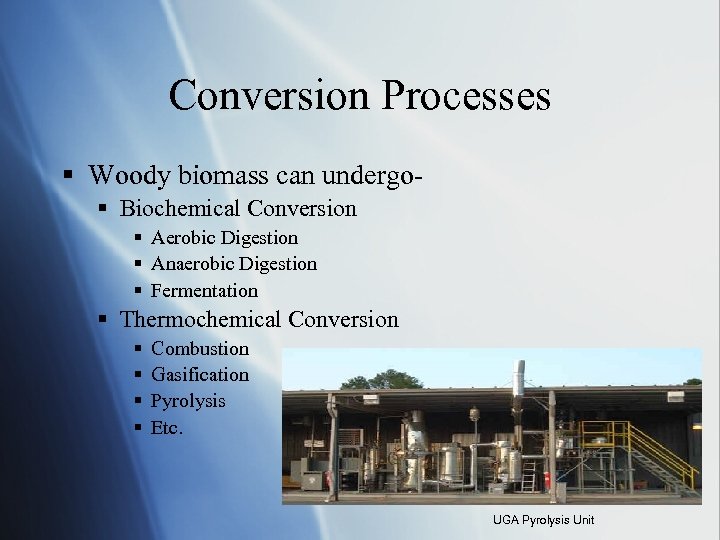
Conversion Processes § Woody biomass can undergo§ Biochemical Conversion § Aerobic Digestion § Anaerobic Digestion § Fermentation § Thermochemical Conversion § § Combustion Gasification Pyrolysis Etc. UGA Pyrolysis Unit
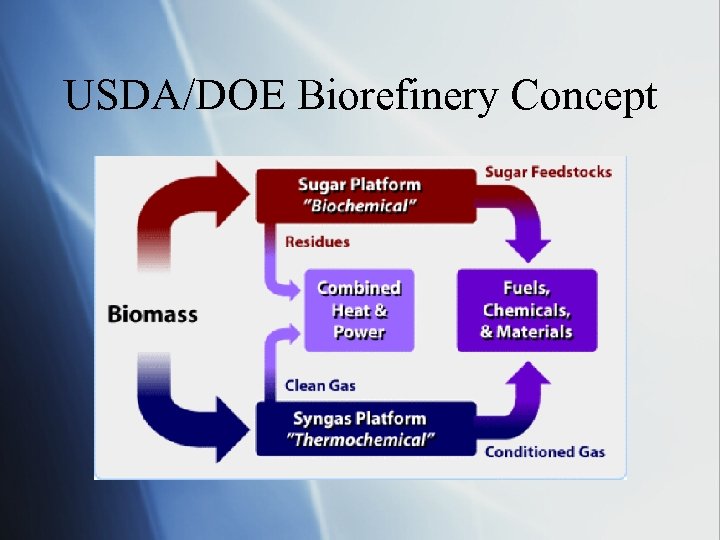
USDA/DOE Biorefinery Concept
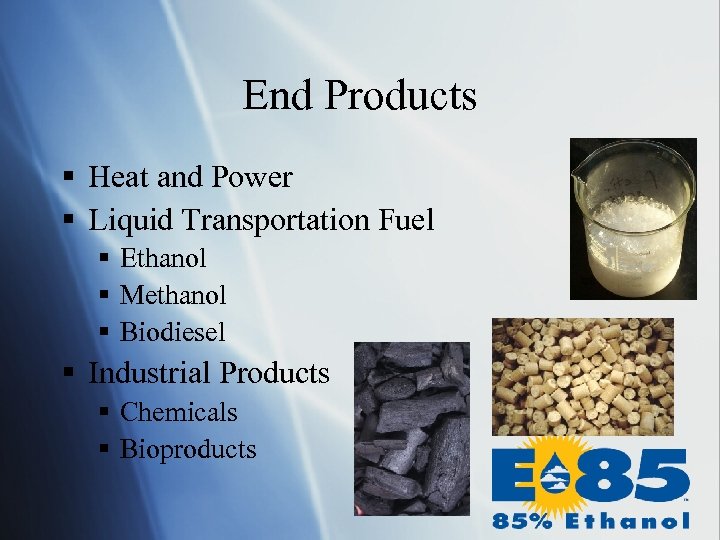
End Products § Heat and Power § Liquid Transportation Fuel § Ethanol § Methanol § Biodiesel § Industrial Products § Chemicals § Bioproducts
Solid and Gaseous Biofuels Opportunities § Solid § Char § Pellets § Chips § Gas § Syngas § Biogas
Bioenergy § Producing bioenergy in the form of heat and power from woody biomass is the “lowest hanging fruit”.
Example-- Forest Products § Forest products industry is largest user of forest biomass for energy § 70% of energy in-house § Created from by-products
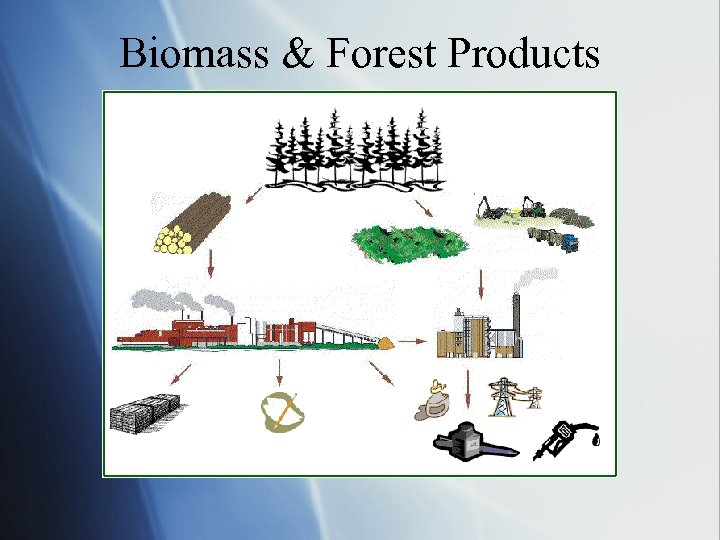
Biomass & Forest Products
Liquid Biofuels Opportunities § Ethanol § Bio-diesel
Liquid Biofuels § President Bush’s 2006 and 2007 State of the Union Addresses § Mentioned ethanol from wood chips § Set a goal to have more than 7. 5 billion gallons of ethanol and biodiesel in the nation’s fuel supply by 2012 § Pledged $250 million to help achieve “homegrown cellulosic ethanol”
Liquid Biofuels § Fermentation, pyrolysis and gasification. § Tech not currently available at a commercial scale § Breaking the cellulose and hemicellulose free from lignin in a cost effective manner remains a primary barrier § Several firms say they hold the key § Range Fuels
Benefits of Using Woody Biomass § Environmental Benefits § Economic Benefits § Energy Benefits
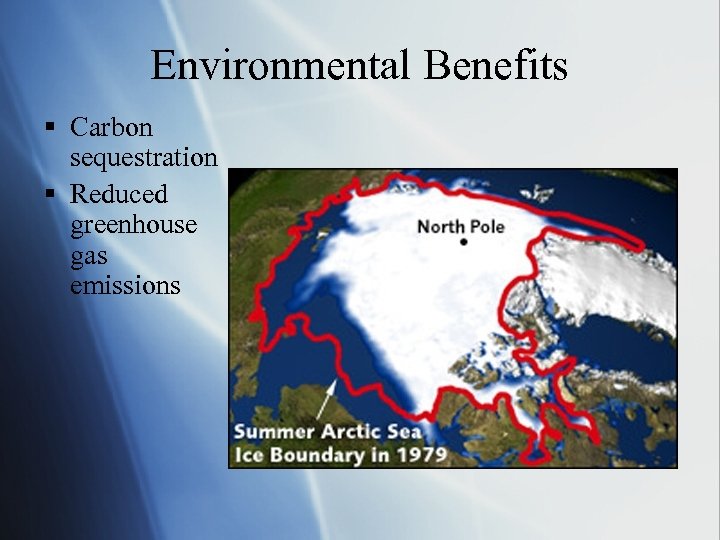
Environmental Benefits § Carbon sequestration § Reduced greenhouse gas emissions
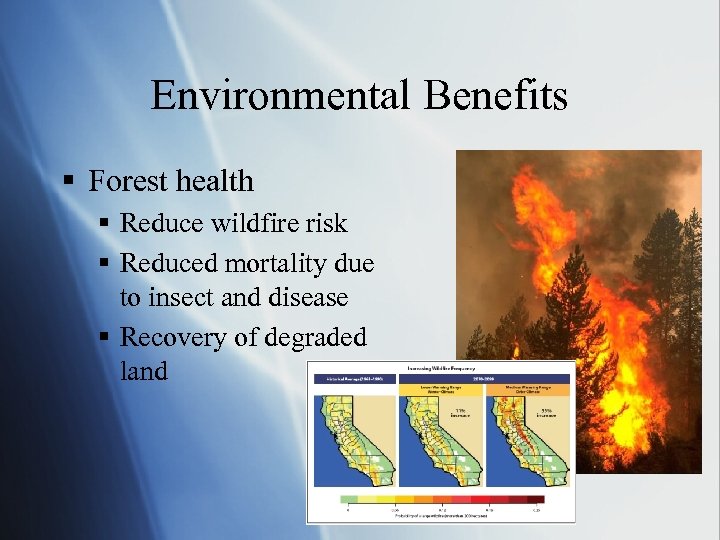
Environmental Benefits § Forest health § Reduce wildfire risk § Reduced mortality due to insect and disease § Recovery of degraded land
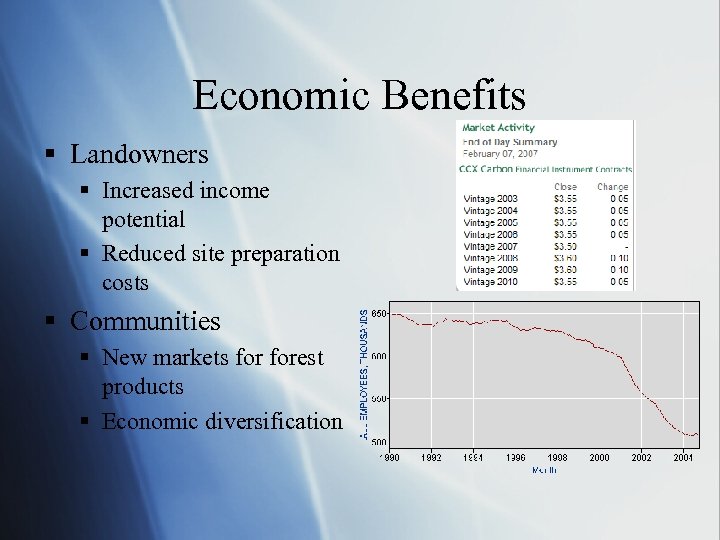
Economic Benefits § Landowners § Increased income potential § Reduced site preparation costs § Communities § New markets forest products § Economic diversification
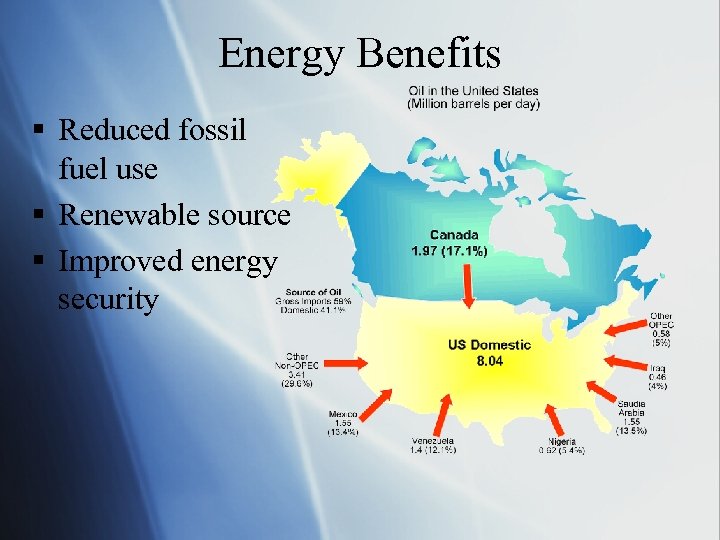
Energy Benefits § Reduced fossil fuel use § Renewable source § Improved energy security
Promoting Biomass § Market Formation § Bioenergy systems § Biofuels § Challenges
Market Formation § System-level focus across entire value chain § Biomass production § Harvesting, transport, processing § Utilization and energy generation capacity § Direct combustion § Conversion technology § Consumer demand § Marketing messages § Reliable and affordable § Enables secure energy future
Challenges in Bioenergy § § § Supply and Market Development Integration Competitiveness and Mainstreaming Sustainability Transportation Conversion Technologies
Creating Synergies § Energy sector § Greater use of by-products for fuel § Sale of excess electricity to the grid § Agriculture § Cooperate in market development for ethanol
Conclusions § Forest biomass is an attractive renewable energy source. § It provides environmental, economic, and energy benefits to society. § Challenges and barriers do exist. § § Market development Technology Collaboration Education
Скачать презентацию Wood Biofuels Bill Hubbard and Sarah Ashton Southern
82dd1d71948b1abe28693f9aafae3654.ppt