


 Скачать презентацию WMO Intercomparison of Instruments and methods for the
f994aef7151d47a7a3b86133bd3141e0.ppt
- Количество слайдов: 37
 WMO Intercomparison of Instruments and methods for the Measurement of Solid Precipitation and Snow on the Ground, WMO-SPICE: Pre-SPICE Studies R. Rasmussen(1) , R. Nitu (2), B. Baker(3), E Lanzinger (4), D Yang(7), C Smith(7), Y. A. Roulet (5), B Goodison((15) , H Liang(6), F Sabatini(8), J Kochendorfer (3), M Wolff(9) , J Hendrikx (10), E Vuerich(11), L Lanza(12), P. Joe(2), O Aulamo(13), V Vuglinsky(14) , Michael Earle(2) , Jeffery Hoover(2), S Landolt(1) National Center for Atmospheric Research, Boulder, USA, rasmus@ucar. edu (2) Environmemt Canada, Toronto, Canada, Rodica. nitu@ec. gc. ca , 3) NOAA Air Resources Laboratory, Oak Ridge, TN, 37830 , 4)Deutscher Wetterdienst, Hamburg, Germany, (5)Météo Suisse, PAYERNE, Switzerland, (6)China Meteorological Administration, BEIJING, China. 7)Environment Canada, Saskatoon, Canada. (8) CNR-IBIMET, Institute of Biometeorology, Florence, Italy, (9)Norwegian Meteorological Institute, Oslo, Norway, (10)Montana State University, Montana, U. S. A. , (11) Italian Met Service – Air Force, Centre of Meteorological Experimentations, Vigna di Valle (Rome) Italy, 12) DICAT - Department of Civil, Environmental and Territorial Engineering, University of Genoa , GENOVA Italy , 13) Finnish Meteorological Institute, Arctic Research Centre, Sodankyla , (14) State Hydrological institute, St. Petersburg, Russian Federation, (15) World meteorological Organization, EC-PORS, GCOS, Geneva Switzerland
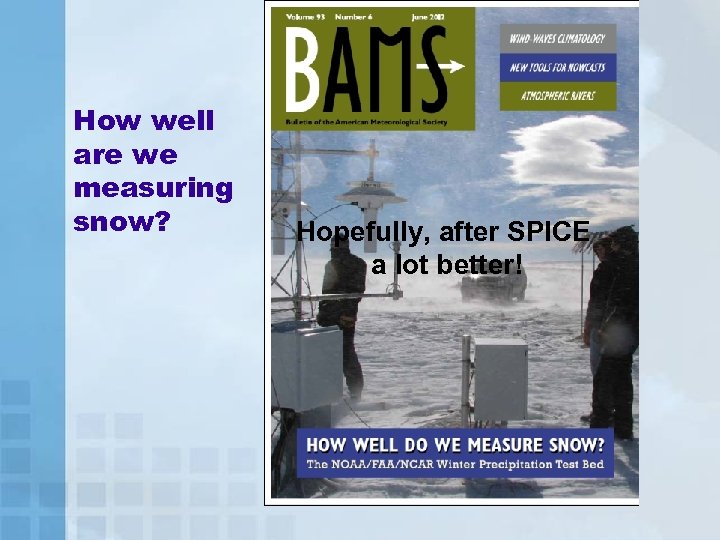
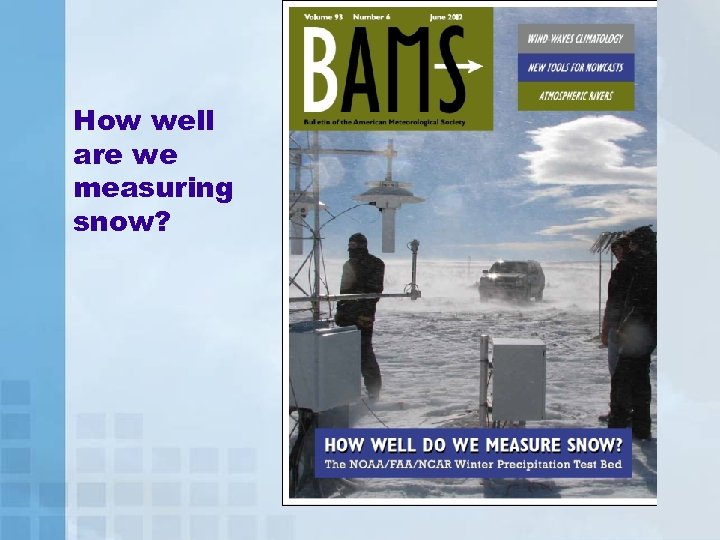 How well are we measuring snow?
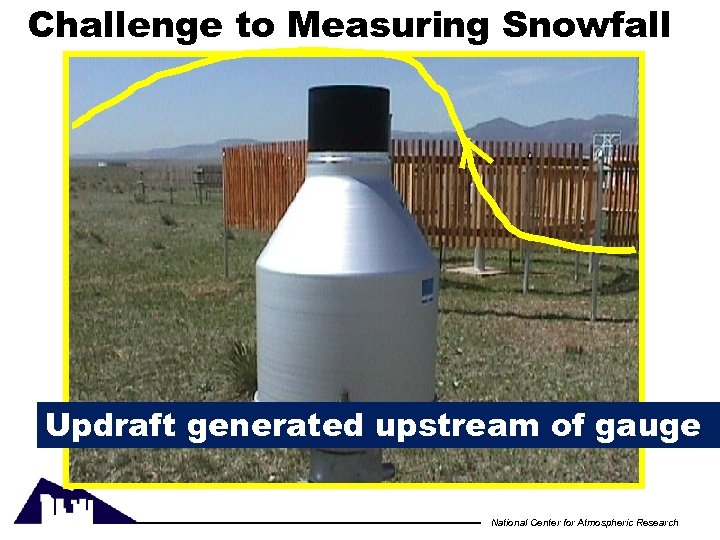 Challenge to Measuring Snowfall Updraft generated upstream of gauge National Center for Atmospheric Research
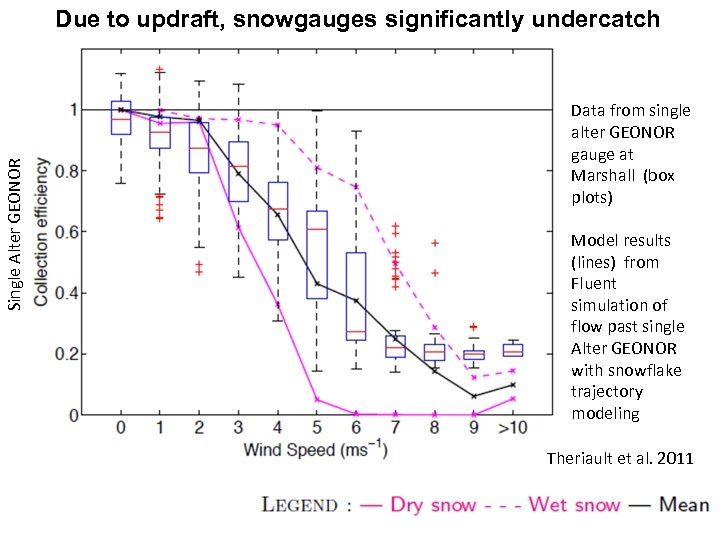 Single Alter GEONOR Due to updraft, snowgauges significantly undercatch Data from single alter GEONOR gauge at Marshall (box plots) Model results (lines) from Fluent simulation of flow past single Alter GEONOR with snowflake trajectory modeling Theriault et al. 2011
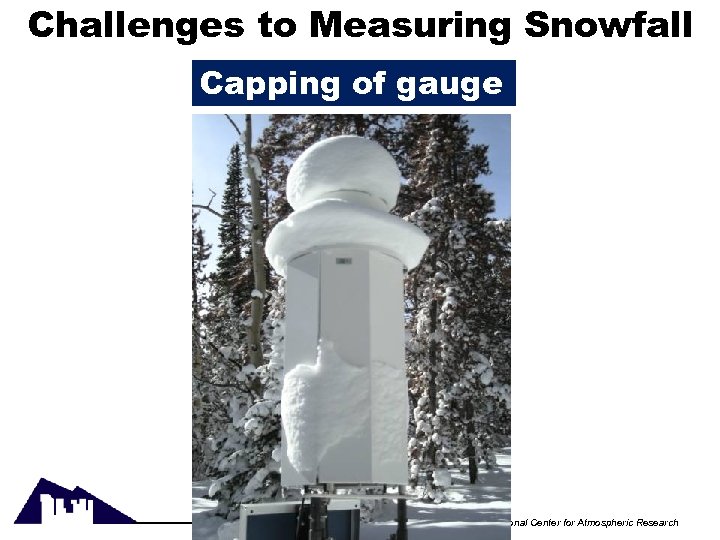 Challenges to Measuring Snowfall Capping of gauge National Center for Atmospheric Research
 Key goal of Pre-SPICE: Establish Field Reference Systems for SPICE • Need to establish a recognized field reference using automatic gauges to calculate the undercatch as a function of wind speed (transfer function). – Proposed configuration: DFIR shield surrounding a Weighing Gauge (WG) – Develop transfer functions to characterize the proposed reference against the WMO Secondary Reference (Tretyakov gauge inside DFIR); • Options for the configuration of a Filed Reference using WG: – Type of WG: proposed Geonor T-200, OTT Pluvio 2; – Configuration of WG: ▪ heated/non-heated; ▪ wind shield: – DFIR, – Double Alter, Belfort Double Alter.
 Instruments and Site Focus for Pre-SPICE – A WMO secondary field reference, using a manual Tretyakov gauge installed in a DFIR, was used in Canada and Finland. – A DFIR shield surrounding an automatic precipitation weighing gauge was configured and assessed as a field working reference in Canada (CARE and Bratt’s Lake), Finland (Jokioinen), Norway (Haukeliseter), and USA (Boulder), (DFAR) Week long meeting was held the week of June 11 th in – In Switzerland, the focus of the pre-SPICE experiment was the Boulder, Colorado to review the results of the Preassessment of the heating of a weighing gauge, in alpine SPICE testing conditions, in the presence of large amounts of snowfall. – A laboratory calibration of the instruments considered for use as part of the working field reference was performed at the Precipitation Intensity Lead Centre in Genoa (Italy). This focused on the testing of the weighing gauges at temperatures representative of the winter operating conditions.
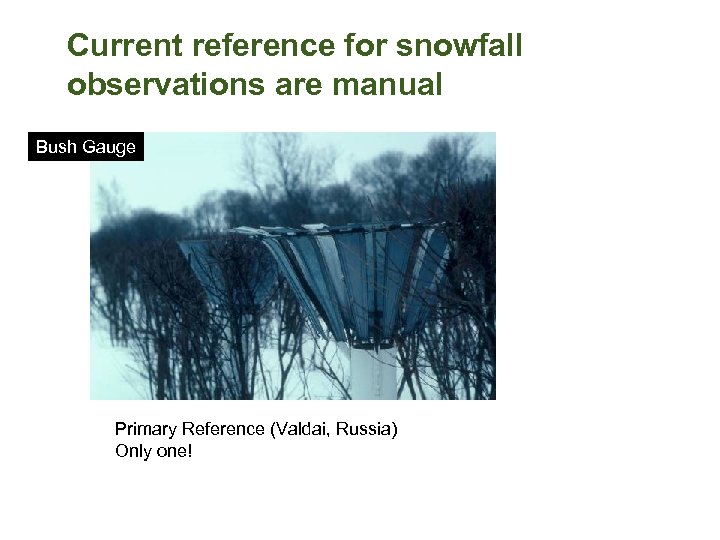 Current reference for snowfall observations are manual Bush Gauge Primary Reference (Valdai, Russia) Only one!
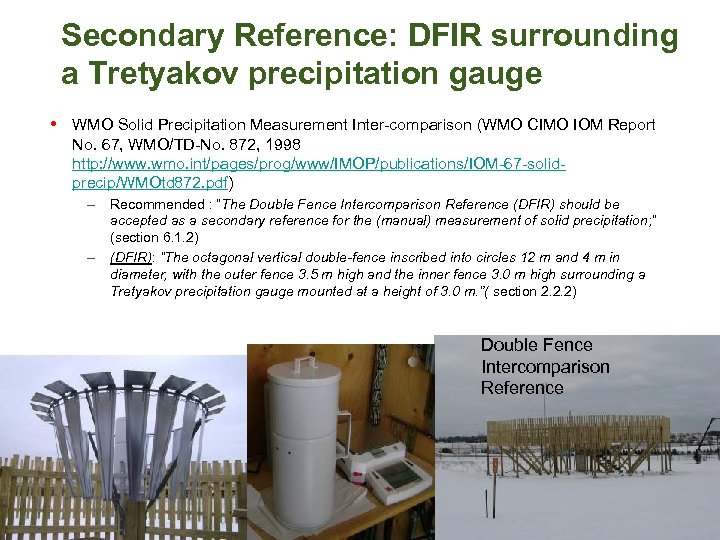 Secondary Reference: DFIR surrounding a Tretyakov precipitation gauge • WMO Solid Precipitation Measurement Inter-comparison (WMO CIMO IOM Report No. 67, WMO/TD-No. 872, 1998 http: //www. wmo. int/pages/prog/www/IMOP/publications/IOM-67 -solidprecip/WMOtd 872. pdf) – – Recommended : “The Double Fence Intercomparison Reference (DFIR) should be accepted as a secondary reference for the (manual) measurement of solid precipitation; ” (section 6. 1. 2) (DFIR): “The octagonal vertical double-fence inscribed into circles 12 m and 4 m in diameter, with the outer fence 3. 5 m high and the inner fence 3. 0 m high surrounding a Tretyakov precipitation gauge mounted at a height of 3. 0 m. ”( section 2. 2. 2) Double Fence Intercomparison Reference DRAFT – Page 11 – 19 March 2018
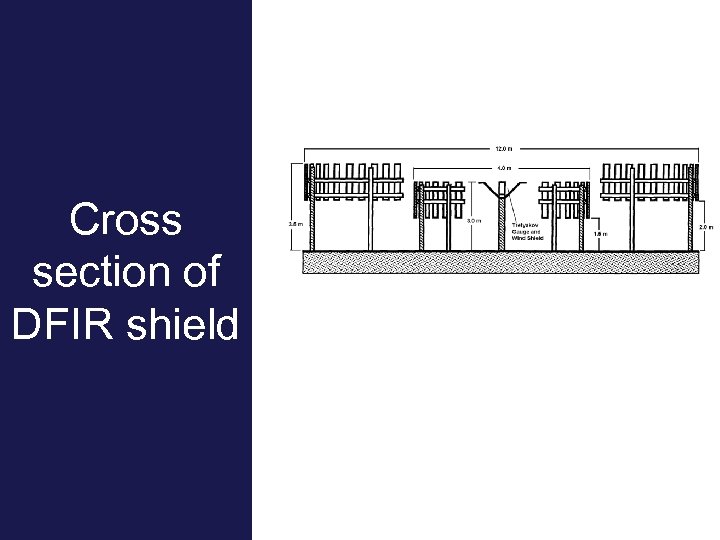 Cross section of DFIR shield
 Federal Department of Home Affairs FDHA Federal Office of Meteorology and Climatology Meteo. Swiss Pre-SPICE Winter 2011 -2012 Set-up and some results from Weissfluhjoch/Davos 11. 6. 2012
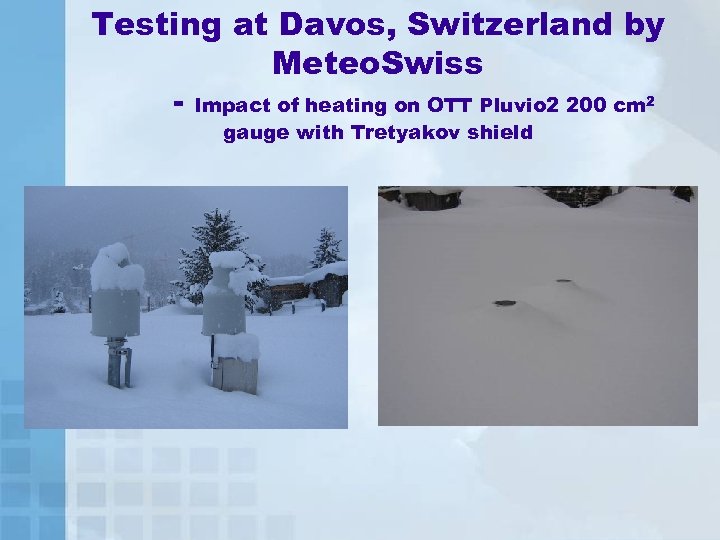 Testing at Davos, Switzerland by Meteo. Swiss - Impact of heating on OTT Pluvio 2 200 cm 2 gauge with Tretyakov shield
 21. 02. 2012 Title of presentation | Subtitle Author 15
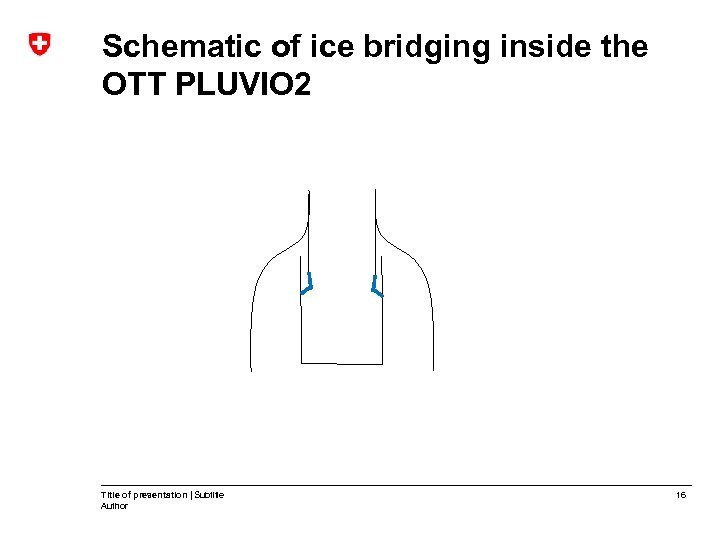 Schematic of ice bridging inside the OTT PLUVIO 2 Title of presentation | Subtitle Author 16
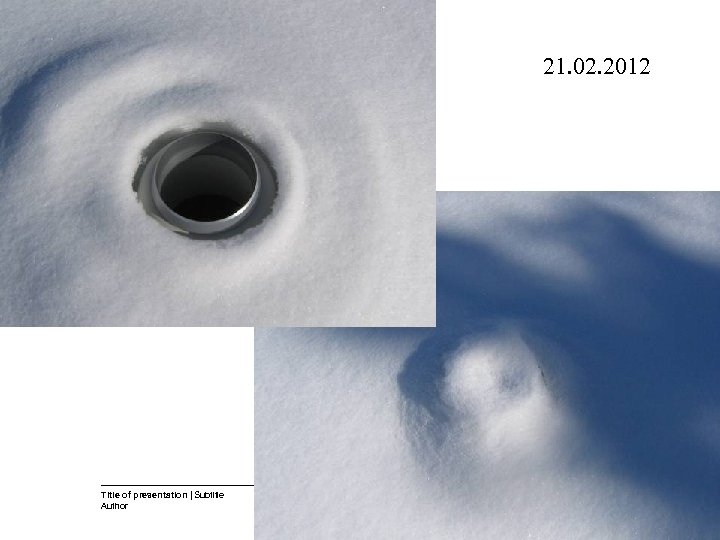
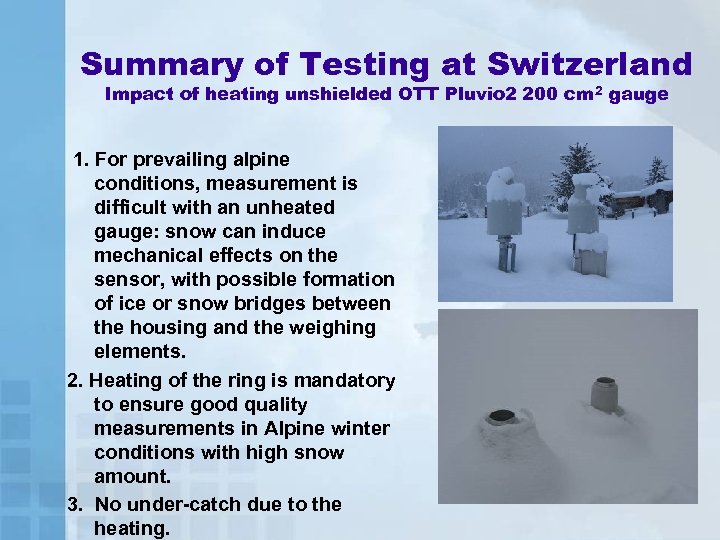 Summary of Testing at Switzerland Impact of heating unshielded OTT Pluvio 2 200 cm 2 gauge 1. For prevailing alpine conditions, measurement is difficult with an unheated gauge: snow can induce mechanical effects on the sensor, with possible formation of ice or snow bridges between the housing and the weighing elements. 2. Heating of the ring is mandatory to ensure good quality measurements in Alpine winter conditions with high snow amount. 3. No under-catch due to the heating.
 Jokioinen: Pre-SPICE field 60° 48' 50. 44" N, 23° 29' 51. 40” E, 104 m, from the sea level Measurements 19. 02. 2012 – 30. 04. 2012 Manual measurements only once every day at 0600 UTC Compared manual measurement in DFIR with Tretyakov shield and can with automated measurement in DFIR with OTT Pluvio 2 gauge Finnish Meteorological Institute 19/03/2018 18
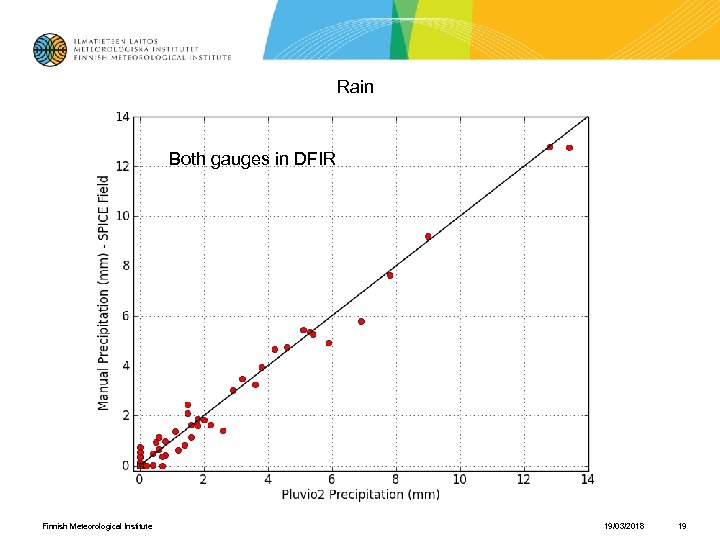 Rain Both gauges in DFIR Finnish Meteorological Institute 19/03/2018 19
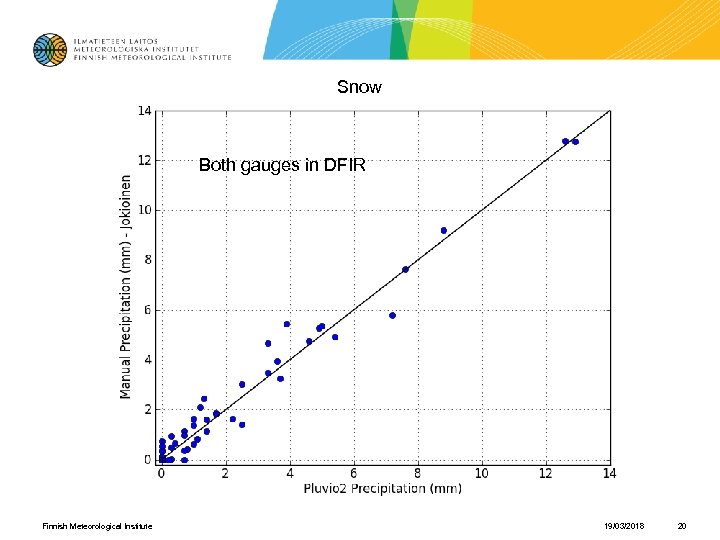 Snow Both gauges in DFIR Finnish Meteorological Institute 19/03/2018 20
 Results from testing in Finland: The daily precipitation amount from the automated gauge in the DFIR compared well with the manual measurement from the Tretyakov can also in a DFIR. Suggests that can use an automated gauge in a DFIR as a reference for SPICE (DFAR). Finnish Meteorological Institute 19/03/2018 21
 Summary of results from the Canadian contribution to Pre-SPICE Toward the definition of a SPICE field reference Rodica Nitu, Paul Joe, Daqing Yang, Craig Smith, Michael Earle, Jeff Hoover, Jim Waller, Faisal Boudala Pre-SPICE Workshop Boulder, Colorado June 11, 2012
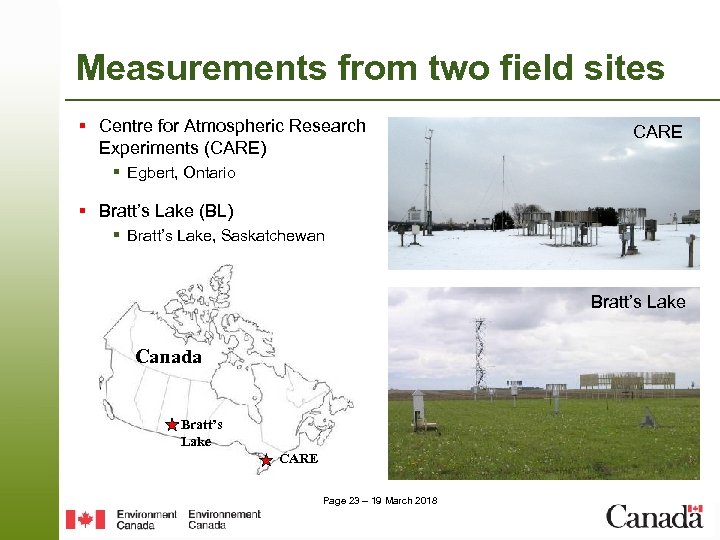 Measurements from two field sites § Centre for Atmospheric Research Experiments (CARE) CARE § Egbert, Ontario § Bratt’s Lake (BL) § Bratt’s Lake, Saskatchewan Bratt’s Lake Canada Bratt’s Lake CARE Page 23 – 19 March 2018
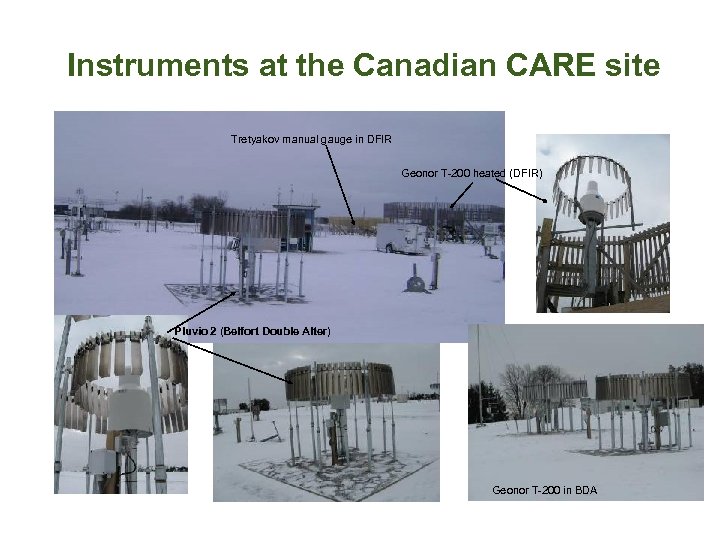 Instruments at the Canadian CARE site Tretyakov manual gauge in DFIR Geonor T-200 heated (DFIR) Pluvio 2 (Belfort Double Alter) Geonor T-200 in BDA
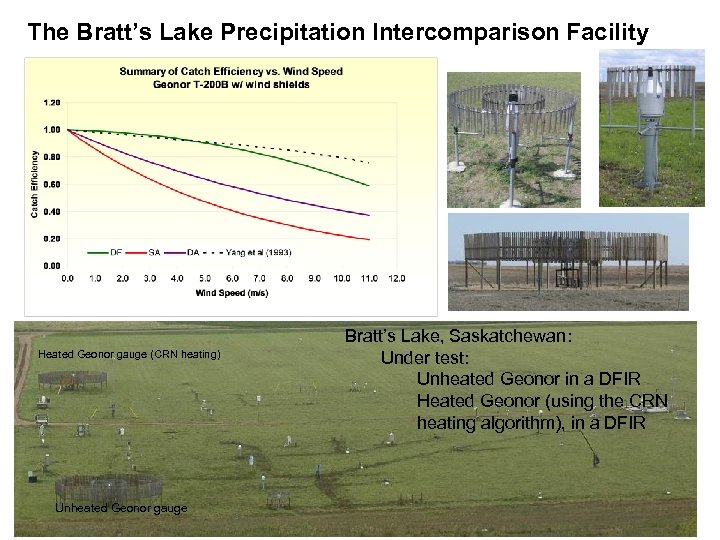 The Bratt’s Lake Precipitation Intercomparison Facility Heated Geonor gauge (CRN heating) Unheated Geonor gauge Bratt’s Lake, Saskatchewan: Under test: Unheated Geonor in a DFIR Heated Geonor (using the CRN heating algorithm), in a DFIR
 Summary of Canadian Pre-SPICE testing § Rim heating has a positive impact on the gauge performance (accuracy, improved catch), both GEONOR T-200 or OTT PLUVIO 2. § Both GEONOR T-200 and OTT PLUVIO 2 performed well in terms of accuracy § Either GEONOR T-200 or OTT PLUVIO 2 acceptable at weighing gauge for Field Reference Page 26 – 19 March 2018
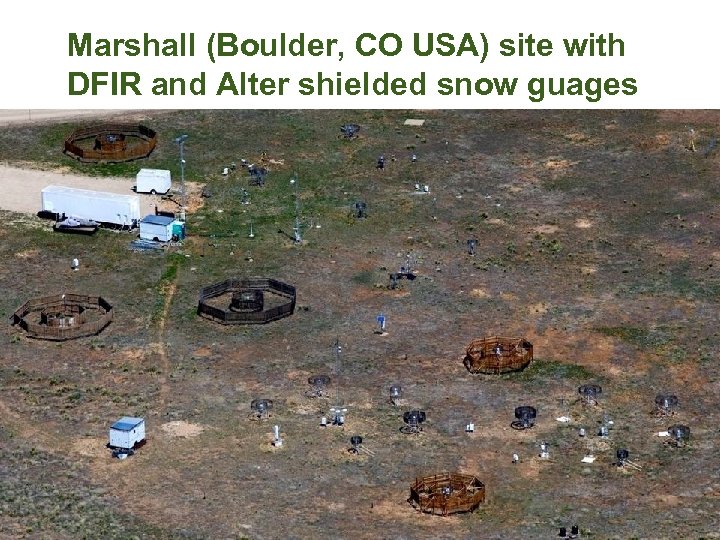 Marshall (Boulder, CO USA) site with DFIR and Alter shielded snow guages DRAFT – Page 27 – 19 March 2018
 Summary of Pre-SPICE Results from Marshall Field Site, USA 1. Gauge performance in Small DFIR and standard DFIR similar in terms of accuracy. 2. Provided estimate of the performance of various wind shield types. 3. Noted the importance of heating the entire collection tube of the GEONOR T-200 gauge. 4. Noted that the current OTT PLUVIO 2 heating algorithm may not be sufficient for heavy, wet snow conditions (dumps occurred in this situation).
 Test site Haukeliseter, Norway Pre-SPICE Data Mareile Wolff, Ketil Isaksen, Ragnar Brækkan Norwegian Meteorological Institute, Oslo, Norway
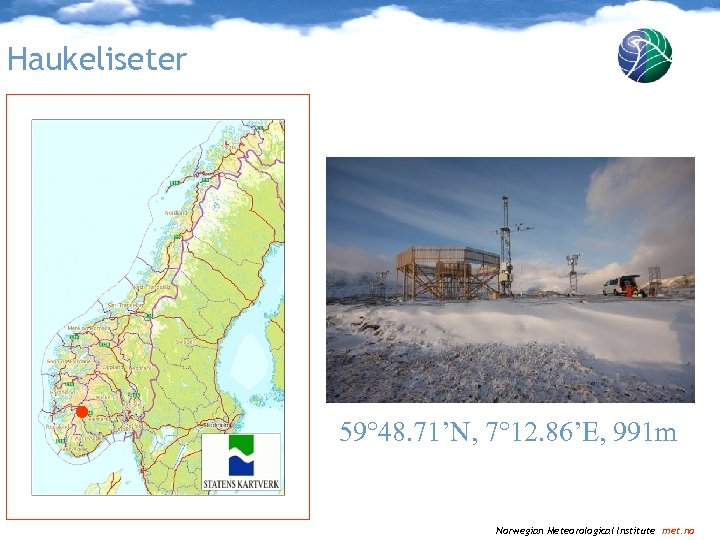 Haukeliseter 59° 48. 71’N, 7° 12. 86’E, 991 m Norwegian Meteorological Institute met. no
 Summary Identified the need for improved identification of the onset and offset of weak precipitiation events - Suggested use of a precipitation detector, yes/no sensor, video camera Blowing snow needs to be taken into account in open, high alpine sites Norwegian Meteorological Institute met. no
 WMO-CIMO LEAD CENTRE “BENEDETTO CASTELLI” ON PRECIPITATION INTENSITY ITALY Laboratory tests of SPICE reference instruments 2 nd WMO SPICE, Boulder , CO, USA, 11 -15 June 2012 32
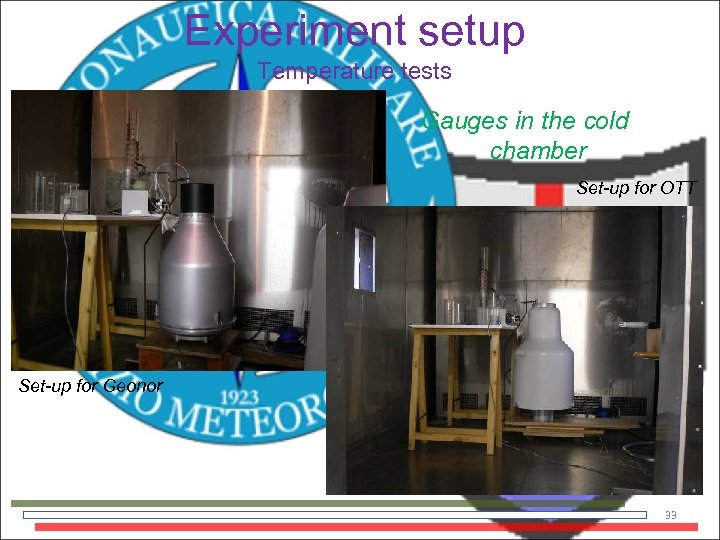 Experiment setup Temperature tests Gauges in the cold chamber Set-up for OTT Set-up for Geonor 33
 Conclusions 3/3 The dynamic tests show that both gauges are able to reproduce likely real world events with comparable performance; The results from laboratory tests open the way for possible improvements of their accuracy and precision (including low intensities, the interest for SPICE) The Lead Centre is currently conducting additional tests. Matteo Colli from the U. of Genoa is currently visiting NCAR and testing the GEONOR T-200 gauge with the NCAR snow machine for heater performance for various snowfall rate and temperature conditions (snow capping elimination). 34
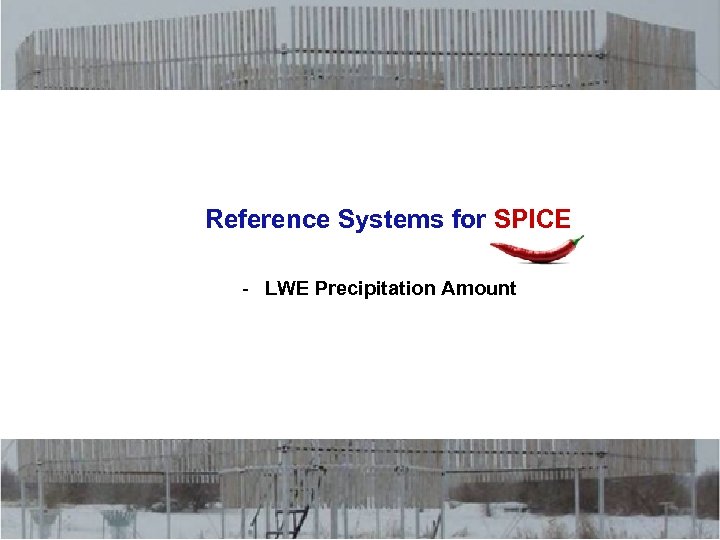 Deutscher Wetterdienst TI 23 - Sensorik Reference Systems for SPICE - LWE Precipitation Amount
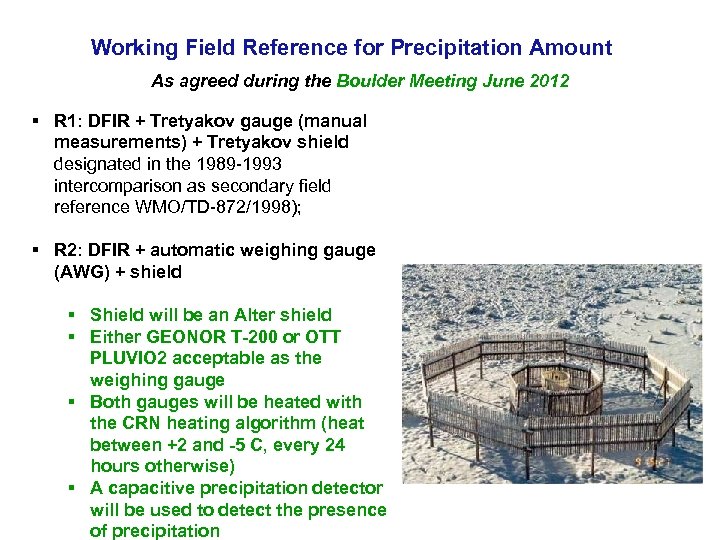 Working Field Reference for Precipitation Amount As agreed during the Boulder Meeting June 2012 § R 1: DFIR + Tretyakov gauge (manual measurements) + Tretyakov shield designated in the 1989 -1993 intercomparison as secondary field reference WMO/TD-872/1998); § R 2: DFIR + automatic weighing gauge (AWG) + shield § Shield will be an Alter shield § Either GEONOR T-200 or OTT PLUVIO 2 acceptable as the weighing gauge § Both gauges will be heated with the CRN heating algorithm (heat between +2 and -5 C, every 24 hours otherwise) § A capacitive precipitation detector will be used to detect the presence of precipitation
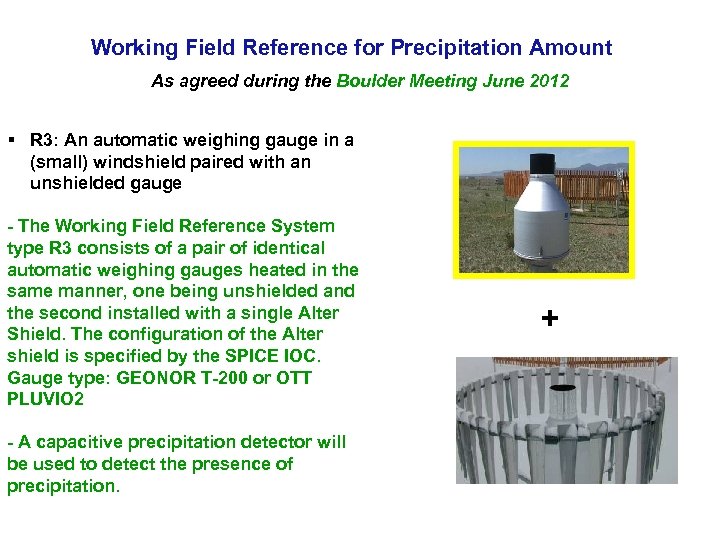 Working Field Reference for Precipitation Amount As agreed during the Boulder Meeting June 2012 § R 3: An automatic weighing gauge in a (small) windshield paired with an unshielded gauge - The Working Field Reference System type R 3 consists of a pair of identical automatic weighing gauges heated in the same manner, one being unshielded and the second installed with a single Alter Shield. The configuration of the Alter shield is specified by the SPICE IOC. Gauge type: GEONOR T-200 or OTT PLUVIO 2 - A capacitive precipitation detector will be used to detect the presence of precipitation. A + +
 How well are we measuring snow? Hopefully, after SPICE a lot better!
 Thank You! http: //www. wmo. int/pages/prog/www/IMOP/reports/2 011/Joint_ET-II_IOC-SPICE. pdf rasmus@ucar. edu