 Скачать презентацию WMO Forum Social and Economic Applications and Benefits
5f61611f23c94c3f22a11202598f9c2c.ppt
- Количество слайдов: 19



WMO Forum: Social and Economic Applications and Benefits of Weather, Climate and Water Services Geneva 8 -11 April Haleh Kootval
Review of WMO’s work on Socio. Economic Issues • WMO events and publication relating to socio-economic issues date back to 1960 s • Two major international conferences on Economic and Social Benefits of Meteorological and Hydrological Services held in 1990 and 1994 Recommendations from both conferences emphasized the need for ü Greater user / supplier of information and services interaction ü Studies to identify user needs ü Methodologies to assess benefits ü Training to be provided
Task Force on Socio-economic Benefits WMO (PWS) established the Task Force on Socio. Economic Benefits of Meteorological / Hydrogical Services (2006) to respond to statements and requests by WMO constituent bodies • • Assess opportunities to improve the interactions between the providers and users of weather, climate and water (WCW) services Build an inventory of the existing decision-making tools incorporating WCW information • Assemble case studies of the use of WCW in decision making • Develop a plan to provide WMO with guidance in how to assist NMHSs to fully assess and enhance the socio-economic benefits • Contribute to the preparations for the WMO International Conference on Social and Economic Benefits of WCW, Madrid 2007 Composition: experts from information provider and user communities: rather unusual
Madrid Conference 2007 • WMO International Conference on Secure and Sustainable Living, Madrid, March 2007 • Purpose: ü To contribute to secure and sustainable living for all peoples of the world by evaluating and demonstrating, and ultimately enhancing, the social and economic benefits of weather, climate and water services ü To provide a forum for dialogue among the producers and end-users of weather, climate and water-related information
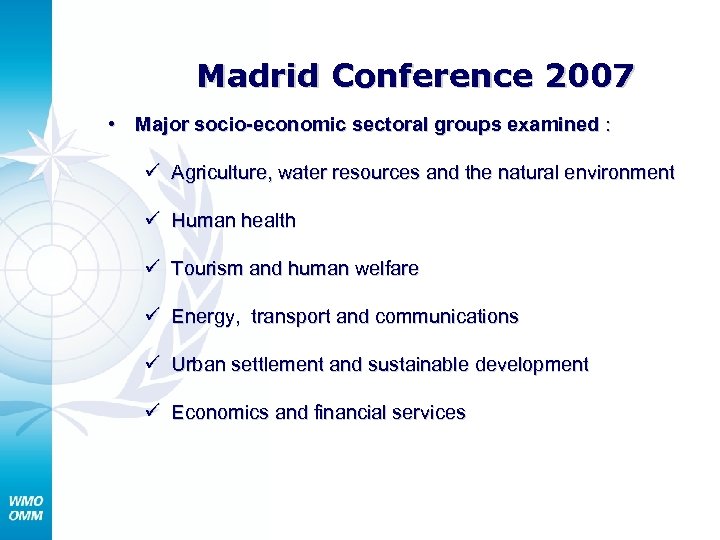
Madrid Conference 2007 • Major socio-economic sectoral groups examined : ü Agriculture, water resources and the natural environment ü Human health ü Tourism and human welfare ü Energy, transport and communications ü Urban settlement and sustainable development ü Economics and financial services
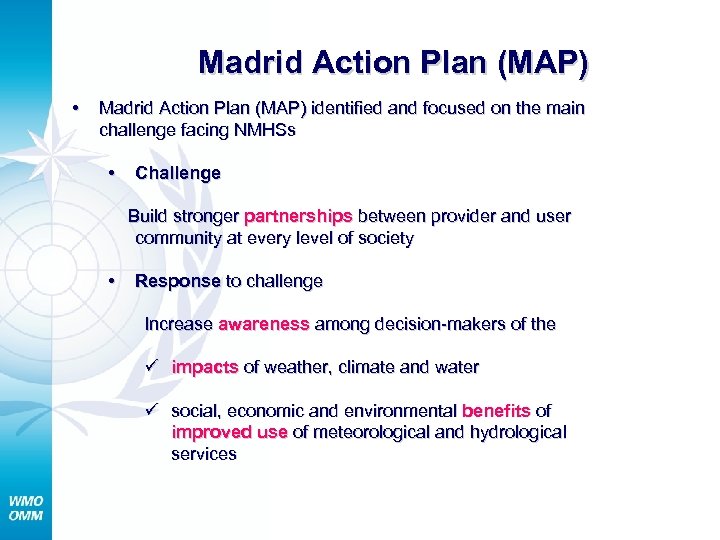
Madrid Action Plan (MAP) • Madrid Action Plan (MAP) identified and focused on the main challenge facing NMHSs • Challenge Build stronger partnerships between provider and user community at every level of society • Response to challenge Increase awareness among decision-makers of the ü impacts of weather, climate and water ü social, economic and environmental benefits of improved use of meteorological and hydrological services
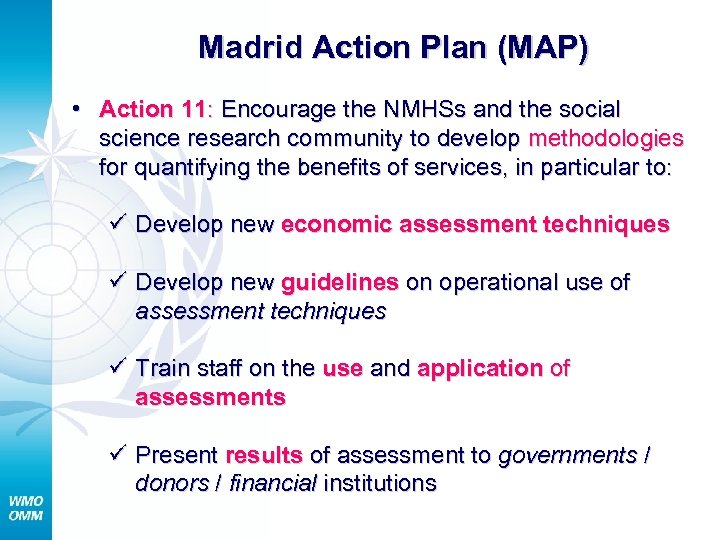
Madrid Action Plan (MAP) • Action 11: Encourage the NMHSs and the social science research community to develop methodologies for quantifying the benefits of services, in particular to: ü Develop new economic assessment techniques ü Develop new guidelines on operational use of assessment techniques ü Train staff on the use and application of assessments ü Present results of assessment to governments / donors / financial institutions
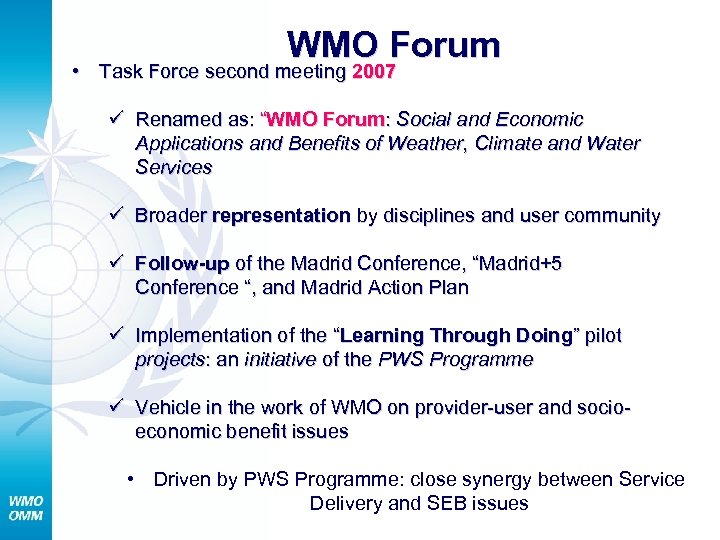
WMO Forum • Task Force second meeting 2007 ü Renamed as: “WMO Forum: Social and Economic Applications and Benefits of Weather, Climate and Water Services ü Broader representation by disciplines and user community ü Follow-up of the Madrid Conference, “Madrid+5 Conference “, and Madrid Action Plan ü Implementation of the “Learning Through Doing” pilot projects: an initiative of the PWS Programme ü Vehicle in the work of WMO on provider-user and socioeconomic benefit issues • Driven by PWS Programme: close synergy between Service Delivery and SEB issues
Other WMO Activities • A number of conferences and workshops jointly by PWS Programme and others within WMO especially Regional Office Europe (Workshop in Sofia 2008; Lucerne Conference 2011; Workshop for Heads of Met Services Africa 2011) • RAVI (Europe) actively engaged in SEB (TT/SEB) • Body of works exists on benefits and assessment methods • To be collected and reviewed for potential contribution to the outcome of present meeting
The Present Meeting • 4 th Meeting of the Forum: simple agenda • WMO Executive Council Resolution in 2012 • WMO to collaborate with WB to compile methodologies for assessment of socioeconomic benefits of hydromet services • Disseminate through an authoritative joint WMO-WB guidance document • Pilot/demonstration projects on benefits of services provided by NMHSs
The Present Meeting • The resulting document should provide practical guidance and steps to assist NMHSs to conduct socio-economic benefit studies (not an academic exercise) • Ultimately these benefits will demonstrate/measure the impact of services provided and delivered by NMHSs to a range of users
Service Delivery • WMO Cg-XVI Geneva, (2011) approved “The WMO Strategy for Service Delivery” • Cg-XVI requested Secretary-General to prepare an Implementation Plan for the Strategy • EC-64 requested EC Working Group on Service Delivery (ECWG-SD) to monitor this work; • PWS programme supported ECWG-SD in developing the IP by facilitating consultations with PRAs, PTCs, experts from NMHSs and with WMO Programmes.
Goal of the Strategy To help NMHSs raise standards of service delivery in the provision of products and services to their users
Objective of the Implementation Plan Lay out a path to guide WMO Members and constituent bodies in realizing the goal of the Strategy
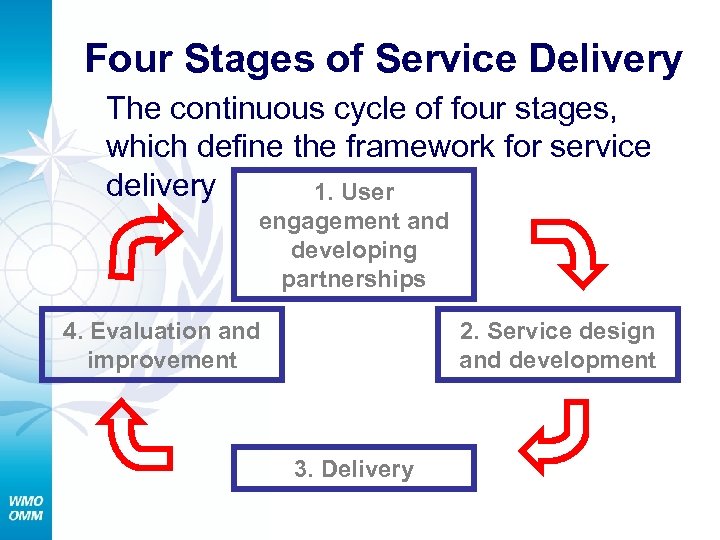
Four Stages of Service Delivery The continuous cycle of four stages, which define the framework for service delivery 1. User engagement and developing partnerships 4. Evaluation and improvement 2. Service design and development 3. Delivery
Content of the IP • Introduction: (background and purpose of the IP; and benefits derived from improved service delivery); • Implementation approach: (Global; Regional; National; the Service Delivery Progress Model and Advancing to Higher levels of Service Delivery) • National Implementation: (steps to implement improved service delivery) • WMO constituent bodies Implementation: (Roles of ECWG-SD, RAs, TCs, Secretariat) • Assessment reports • Milestones: measuring progress
Milestones to Measure Progress of Implementation Plan • Short-Term (2 -year) Time Frame • Medium-Term (6 -year) • Long-Term (10 -year)
Linkages • The Strategy does not exist in isolation; Linkages with relevant initiatives and activities: • WMO Strategic Plan • Global Framework for Climate Services (GFCS) especially the User Interaction Platform (UIP) • Quality Management System (QMS) • Training • Capacity development • The Madrid Action Plan (MAP)
THANK YOU HKOOTVAL@WMO. INT
Скачать презентацию WMO Forum Social and Economic Applications and Benefits
5f61611f23c94c3f22a11202598f9c2c.ppt