


 Скачать презентацию WMO Experts Workshop Davos 8 -10 March 2004
8ac06139ab6e84334a0370536d9a5344.ppt
- Количество слайдов: 20
 WMO Experts Workshop Davos, 8. -10. March 2004 GAWPFR Network for Aerosol Optical Depth Christoph Wehrli Physikalisch-Meteorologisches Observatorium Dorfstrasse 33, 7260 Davos Dorf, Switzerland • • • What is measured and how Network extent Calibration scheme and Quality Control Results from selected stations Comparison with other networks Sustainability and perspective
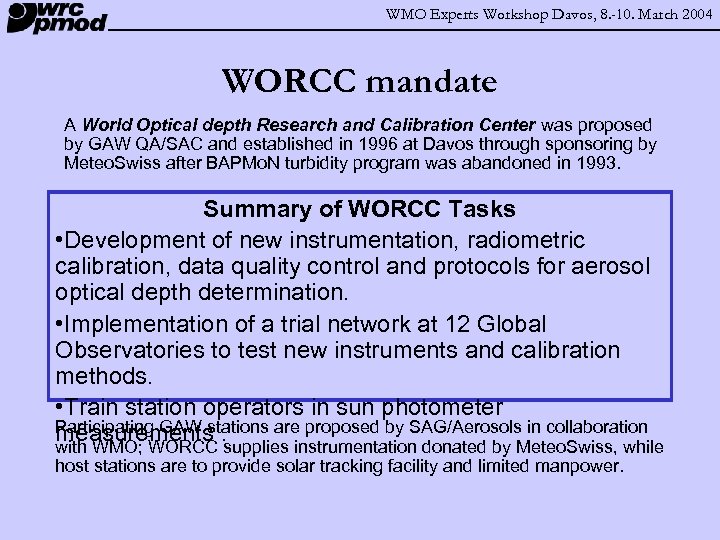 WMO Experts Workshop Davos, 8. -10. March 2004 WORCC mandate A World Optical depth Research and Calibration Center was proposed by GAW QA/SAC and established in 1996 at Davos through sponsoring by Meteo. Swiss after BAPMo. N turbidity program was abandoned in 1993. Summary of WORCC Tasks • Development of new instrumentation, radiometric calibration, data quality control and protocols for aerosol optical depth determination. • Implementation of a trial network at 12 Global Observatories to test new instruments and calibration methods. • Train station operators in sun photometer Participating GAW stations are proposed by SAG/Aerosols in collaboration measurements. supplies instrumentation donated by Meteo. Swiss, while with WMO; WORCC host stations are to provide solar tracking facility and limited manpower.
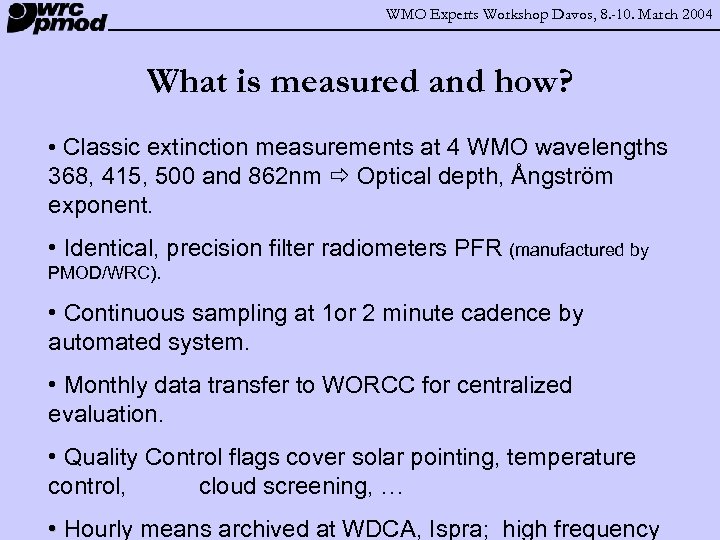 WMO Experts Workshop Davos, 8. -10. March 2004 What is measured and how? • Classic extinction measurements at 4 WMO wavelengths 368, 415, 500 and 862 nm Optical depth, Ångström exponent. • Identical, precision filter radiometers PFR (manufactured by PMOD/WRC). • Continuous sampling at 1 or 2 minute cadence by automated system. • Monthly data transfer to WORCC for centralized evaluation. • Quality Control flags cover solar pointing, temperature control, cloud screening, … • Hourly means archived at WDCA, Ispra; high frequency
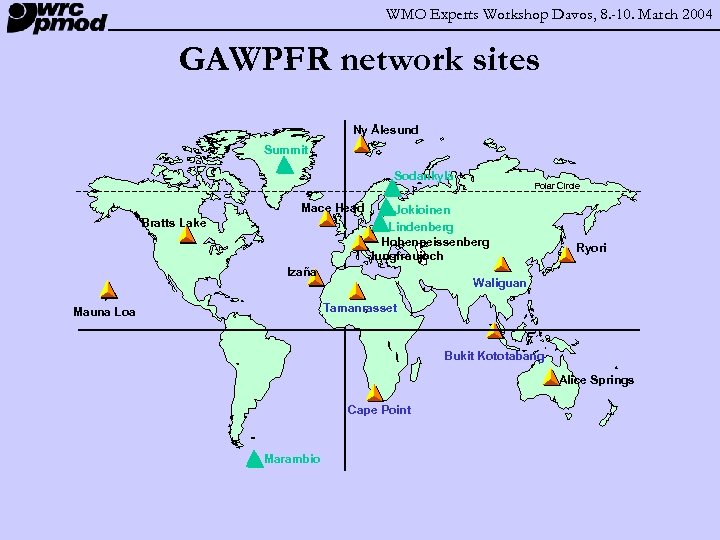 WMO Experts Workshop Davos, 8. -10. March 2004 GAWPFR network sites Ny Ålesund Summit Sodankylä Mace Head Bratts Lake Polar Circle Jokioinen Lindenberg Hohenpeissenberg Jungfraujoch Izaña Ryori Waliguan Tamanrasset Mauna Loa Bukit Kototabang Alice Springs Cape Point Marambio
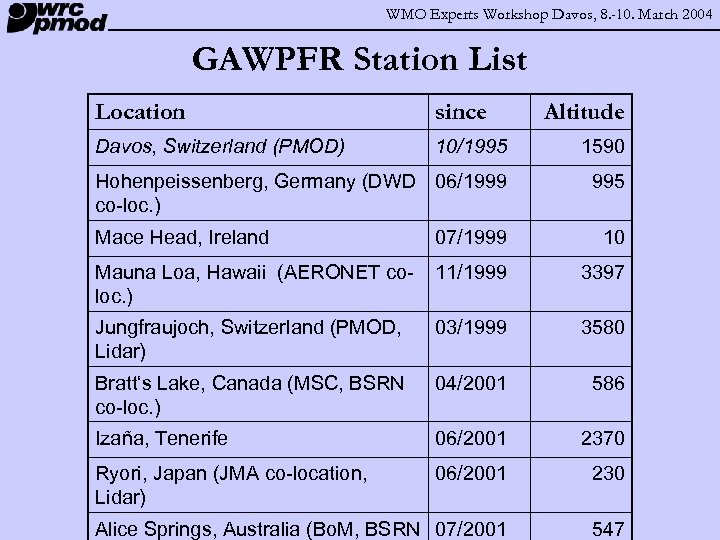 WMO Experts Workshop Davos, 8. -10. March 2004 GAWPFR Station List Location since Altitude Davos, Switzerland (PMOD) 10/1995 1590 Hohenpeissenberg, Germany (DWD 06/1999 co-loc. ) 995 Mace Head, Ireland 07/1999 10 Mauna Loa, Hawaii (AERONET coloc. ) 11/1999 3397 Jungfraujoch, Switzerland (PMOD, Lidar) 03/1999 3580 Bratt‘s Lake, Canada (MSC, BSRN co-loc. ) 04/2001 586 Izaña, Tenerife 06/2001 2370 Ryori, Japan (JMA co-location, Lidar) 06/2001 230 Alice Springs, Australia (Bo. M, BSRN 07/2001 547
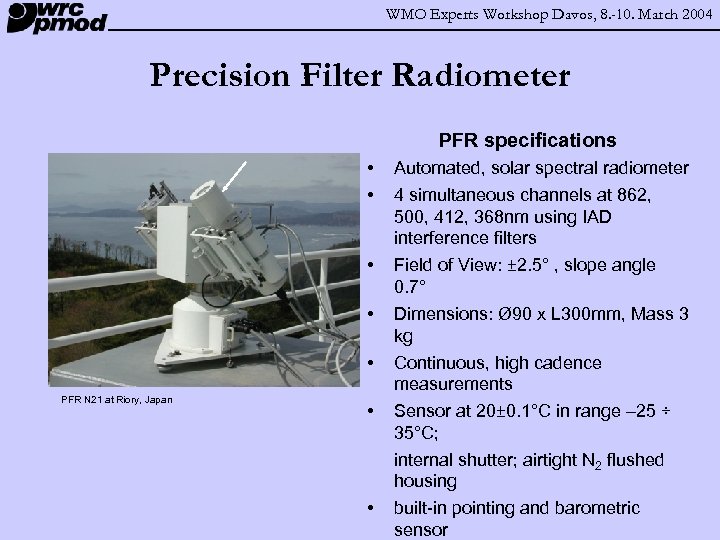 WMO Experts Workshop Davos, 8. -10. March 2004 Precision Filter Radiometer PFR specifications • • • PFR N 21 at Riory, Japan • • Automated, solar spectral radiometer 4 simultaneous channels at 862, 500, 412, 368 nm using IAD interference filters Field of View: ± 2. 5° , slope angle 0. 7° Dimensions: Ø 90 x L 300 mm, Mass 3 kg Continuous, high cadence measurements Sensor at 20± 0. 1°C in range – 25 ÷ 35°C; internal shutter; airtight N 2 flushed housing built-in pointing and barometric sensor
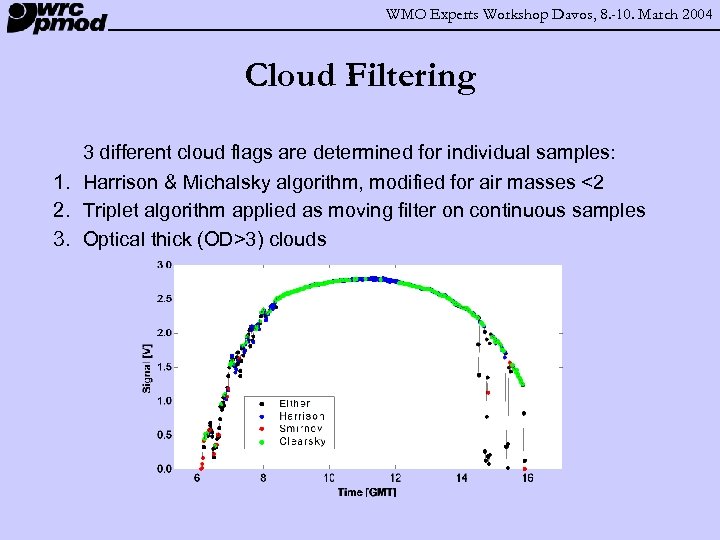 WMO Experts Workshop Davos, 8. -10. March 2004 Cloud Filtering 3 different cloud flags are determined for individual samples: 1. Harrison & Michalsky algorithm, modified for air masses <2 2. Triplet algorithm applied as moving filter on continuous samples 3. Optical thick (OD>3) clouds
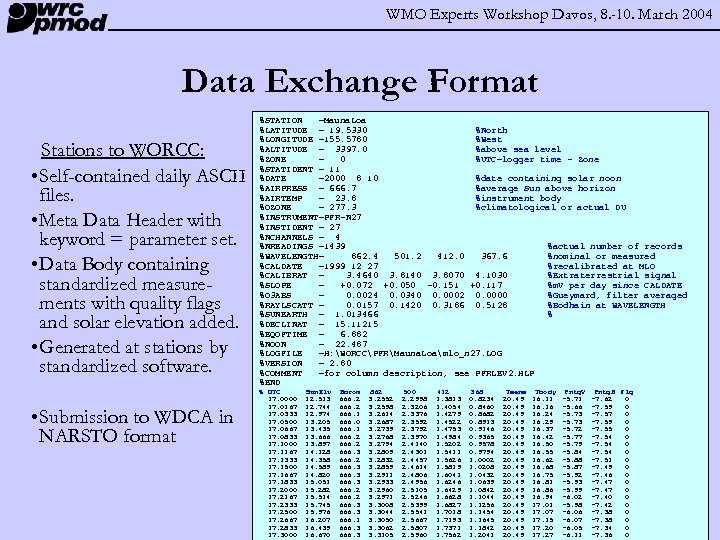 WMO Experts Workshop Davos, 8. -10. March 2004 Data Exchange Format Stations to WORCC: • Self-contained daily ASCII files. • Meta Data Header with keyword = parameter set. • Data Body containing standardized measurements with quality flags and solar elevation added. • Generated at stations by standardized software. • Submission to WDCA in NARSTO format %STATION =Mauna. Loa %LATITUDE = 19. 5330 %North %LONGITUDE =155. 5780 %West %ALTITUDE = 3397. 0 %above sea level %ZONE = 0 %UTC=logger time - Zone %STATIDENT = 11 %DATE =2000 8 10 %date containing solar noon %AIRPRESS = 666. 7 %average Sun above horizon %AIRTEMP = 23. 8 %instrument body %OZONE = 277. 3 %climatological or actual DU %INSTRUMENT=PFR-N 27 %INSTIDENT = 27 %NCHANNELS = 4 %NREADINGS =1439 %actual number of records %WAVELENGTH= 862. 4 501. 2 412. 0 367. 6 %nominal or measured %CALDATE =1999 12 27 %recalibrated at MLO %CALIBRAT = 3. 4640 3. 8140 3. 8070 4. 1030 %Extraterrestrial signal %SLOPE = +0. 072 +0. 050 -0. 151 +0. 117 %m. V per day since CALDATE %O 3 ABS = 0. 0024 0. 0340 0. 0002 0. 0000 %Gueymard, filter averaged %RAYLSCATT = 0. 0157 0. 1420 0. 3186 0. 5128 %Bodhain at WAVELENGTH %SUNEARTH = 1. 013466 % %DECLINAT = 15. 11215 %EQOFTIME = 6. 882 %NOON = 22. 487 %LOGFILE =H: WORCCPFRMauna. Loamlo_n 27. LOG %VERSION = 2. 80 %COMMENT =for column description, see PFRLEV 2. HLP %END % UTC 17. 0000 17. 0167 17. 0333 17. 0500 17. 0667 17. 0833 17. 1000 17. 1167 17. 1333 17. 1500 17. 1667 17. 1833 17. 2000 17. 2167 17. 2333 17. 2500 17. 2667 17. 2833 17. 3000 Sun. Elv 12. 513 12. 744 12. 974 13. 205 13. 435 13. 666 13. 897 14. 128 14. 358 14. 589 14. 820 15. 051 15. 282 15. 514 15. 745 15. 976 16. 207 16. 439 16. 670 Barom 666. 2 666. 1 666. 0 666. 1 666. 2 666. 3 666. 1 666. 3 862 3. 2552 3. 2598 3. 2614 3. 2687 3. 2739 3. 2768 3. 2794 3. 2809 3. 2832 3. 2859 3. 2911 3. 2933 3. 2960 3. 2971 3. 3008 3. 3044 3. 3050 3. 3062 3. 3105 500 2. 2998 2. 3206 2. 3376 2. 3592 2. 3792 2. 3970 2. 4140 2. 4301 2. 4457 2. 4614 2. 4806 2. 4956 2. 5105 2. 5246 2. 5399 2. 5541 2. 5667 2. 5807 2. 5960 412 1. 3813 1. 4054 1. 4279 1. 4522 1. 4753 1. 4984 1. 5202 1. 5411 1. 5626 1. 5819 1. 6041 1. 6246 1. 6429 1. 6628 1. 6827 1. 7018 1. 7193 1. 7371 1. 7562 368 0. 8234 0. 8460 0. 8682 0. 8913 0. 9146 0. 9365 0. 9578 0. 9794 1. 0002 1. 0208 1. 0432 1. 0639 1. 0842 1. 1044 1. 1256 1. 1454 1. 1645 1. 1842 1. 2041 Tsens 20. 49 20. 49 Tbody 16. 11 16. 16 16. 24 16. 29 16. 37 16. 42 16. 50 16. 55 16. 62 16. 68 16. 75 16. 81 16. 86 16. 94 17. 01 17. 07 17. 15 17. 20 17. 27 Pntg. V -5. 71 -5. 66 -5. 73 -5. 72 -5. 77 -5. 79 -5. 84 -5. 88 -5. 87 -5. 92 -5. 93 -5. 99 -6. 02 -5. 98 -6. 06 -6. 07 -6. 05 -6. 11 Pntg. H Flg -7. 62 0 -7. 59 0 -7. 57 0 -7. 59 0 -7. 55 0 -7. 54 0 -7. 51 0 -7. 49 0 -7. 46 0 -7. 47 0 -7. 40 0 -7. 42 0 -7. 38 0 -7. 34 0 -7. 36 0
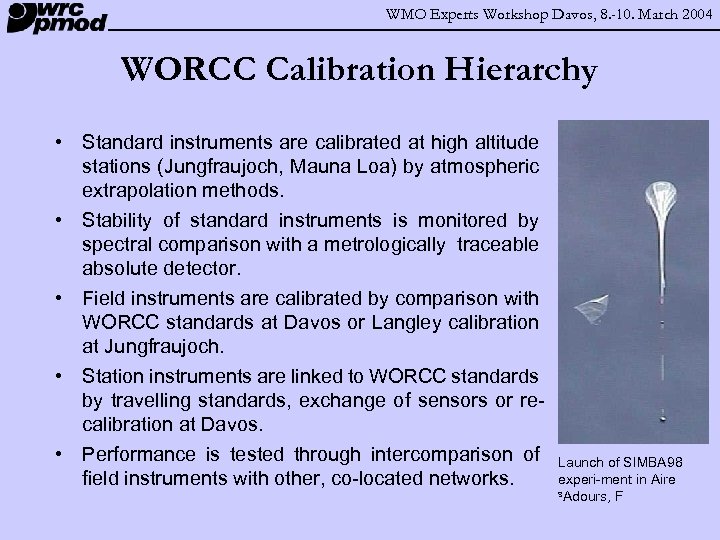 WMO Experts Workshop Davos, 8. -10. March 2004 WORCC Calibration Hierarchy • Standard instruments are calibrated at high altitude stations (Jungfraujoch, Mauna Loa) by atmospheric extrapolation methods. • Stability of standard instruments is monitored by spectral comparison with a metrologically traceable absolute detector. • Field instruments are calibrated by comparison with WORCC standards at Davos or Langley calibration at Jungfraujoch. • Station instruments are linked to WORCC standards by travelling standards, exchange of sensors or recalibration at Davos. • Performance is tested through intercomparison of field instruments with other, co-located networks. Launch of SIMBA 98 experi-ment in Aire s. Adours, F
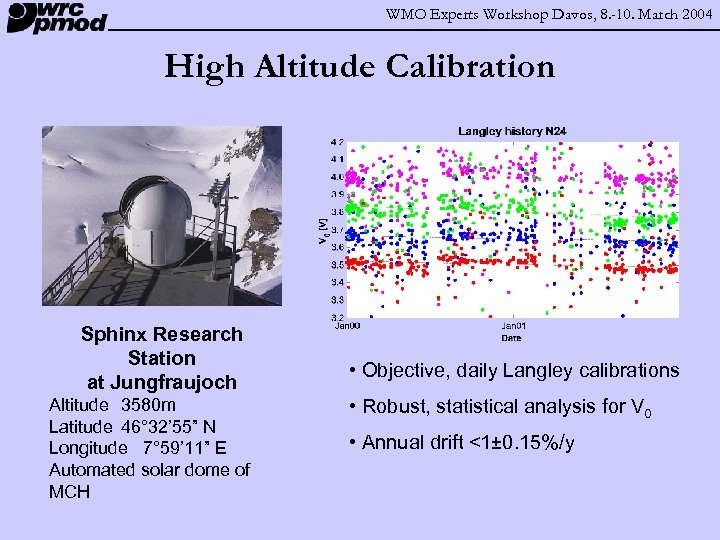 WMO Experts Workshop Davos, 8. -10. March 2004 High Altitude Calibration Sphinx Research Station at Jungfraujoch Altitude 3580 m Latitude 46° 32’ 55” N Longitude 7° 59’ 11” E Automated solar dome of MCH • Objective, daily Langley calibrations • Robust, statistical analysis for V 0 • Annual drift <1± 0. 15%/y
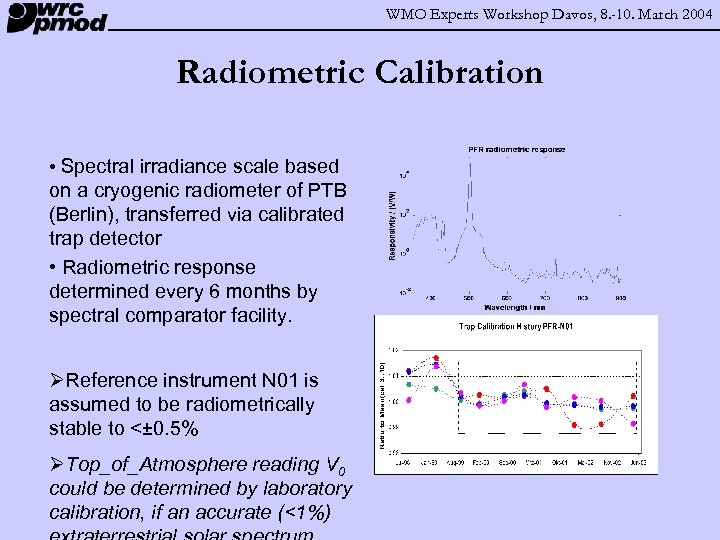 WMO Experts Workshop Davos, 8. -10. March 2004 Radiometric Calibration • Spectral irradiance scale based on a cryogenic radiometer of PTB (Berlin), transferred via calibrated trap detector • Radiometric response determined every 6 months by spectral comparator facility. ØReference instrument N 01 is assumed to be radiometrically stable to <± 0. 5% ØTop_of_Atmosphere reading V 0 could be determined by laboratory calibration, if an accurate (<1%)
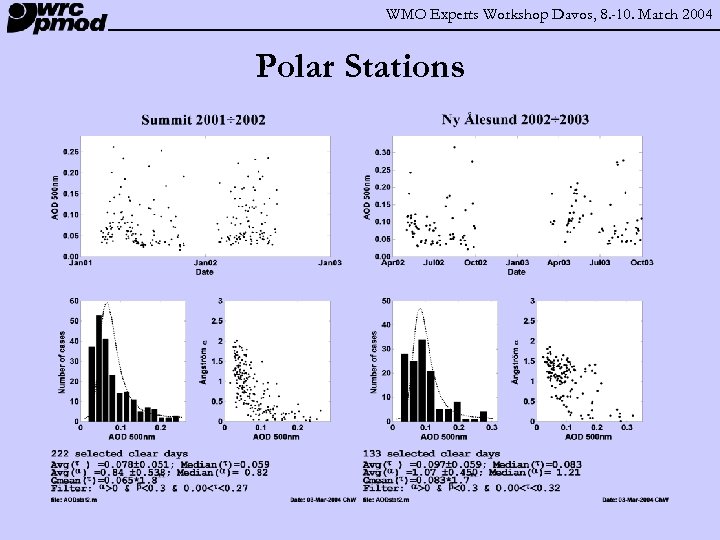 WMO Experts Workshop Davos, 8. -10. March 2004 Polar Stations
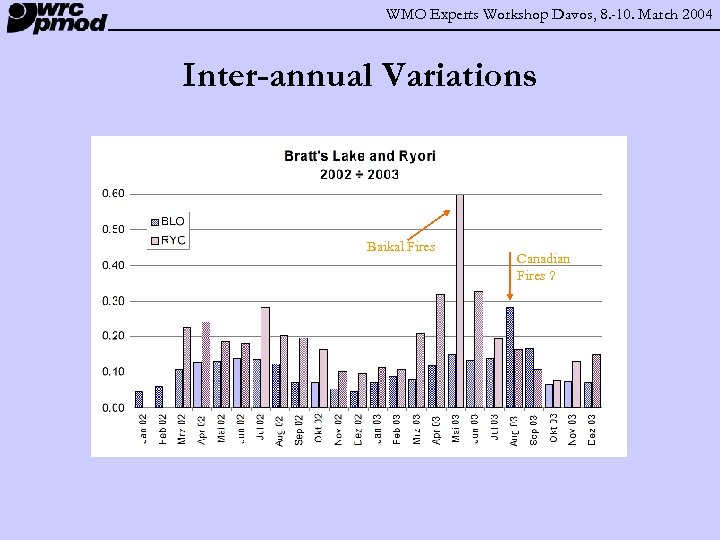 WMO Experts Workshop Davos, 8. -10. March 2004 Inter-annual Variations Baikal Fires Canadian Fires ?
 WMO Experts Workshop Davos, 8. -10. March 2004 MLO Comparison 2000: Methodology Mauna Loa co-location site for Aeronet and GAW/PFR • AERONET/CIMEL and GAW/PFR data compared at individual samples level • Aeronet Level 2 data (380, 440, 500, 870 nm) as published on internet † • GAW/PFR with interpolated calibration (drift <0. 25%/year) Ø CIMEL channels are interpolated to WMO wavelengths of PFR by Ångström’s law using instantaneously derived wavelength exponents. Ø PFR one minute samples are interpolated in time to CIMEL observation scheme † with kind permission of Dr. Brent Holben, Aeronet PI, NASA/GSFC
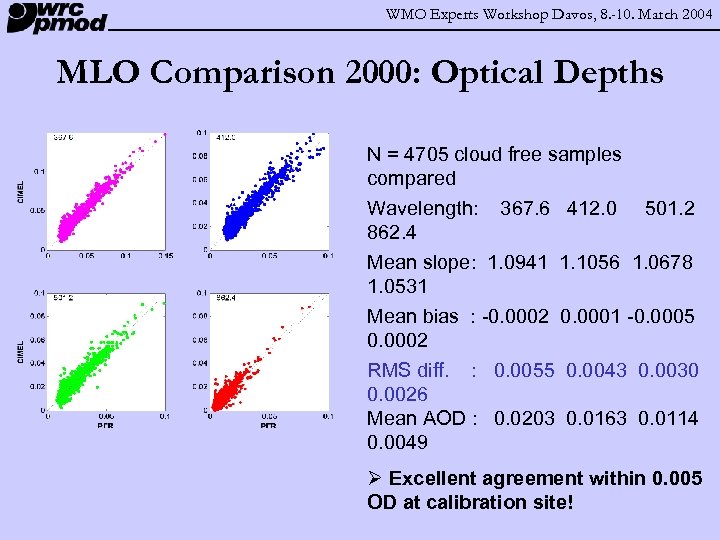 WMO Experts Workshop Davos, 8. -10. March 2004 MLO Comparison 2000: Optical Depths N = 4705 cloud free samples compared Wavelength: 367. 6 412. 0 501. 2 862. 4 Mean slope: 1. 0941 1. 1056 1. 0678 1. 0531 Mean bias : -0. 0002 0. 0001 -0. 0005 0. 0002 RMS diff. : 0. 0055 0. 0043 0. 0030 0. 0026 Mean AOD : 0. 0203 0. 0163 0. 0114 0. 0049 Ø Excellent agreement within 0. 005 OD at calibration site!
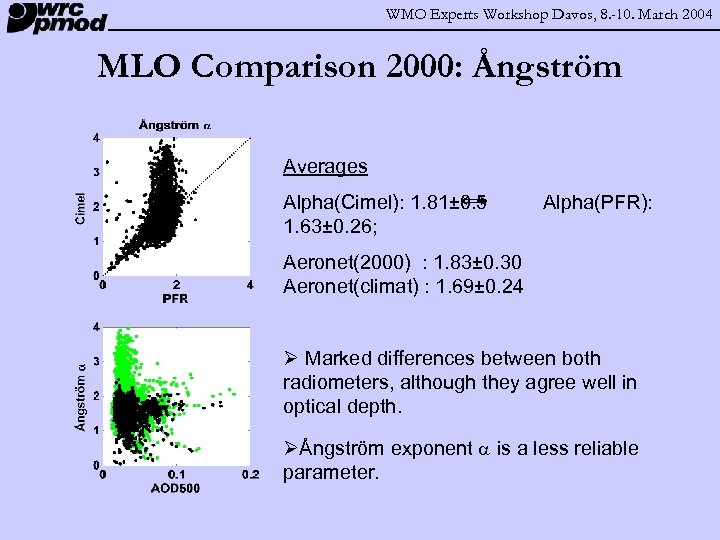 WMO Experts Workshop Davos, 8. -10. March 2004 MLO Comparison 2000: Ångström Averages Alpha(Cimel): 1. 81± 0. 5 1. 63± 0. 26; Alpha(PFR): Aeronet(2000) : 1. 83± 0. 30 Aeronet(climat) : 1. 69± 0. 24 Ø Marked differences between both radiometers, although they agree well in optical depth. ØÅngström exponent is a less reliable parameter.
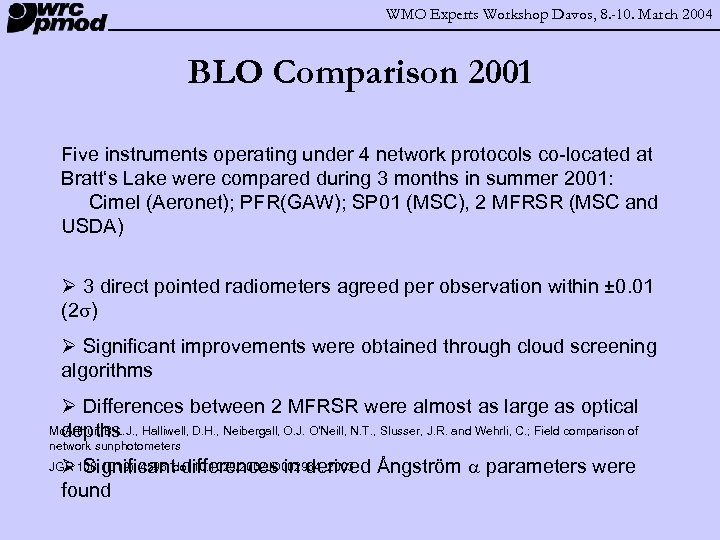 WMO Experts Workshop Davos, 8. -10. March 2004 BLO Comparison 2001 Five instruments operating under 4 network protocols co-located at Bratt‘s Lake were compared during 3 months in summer 2001: Cimel (Aeronet); PFR(GAW); SP 01 (MSC), 2 MFRSR (MSC and USDA) Ø 3 direct pointed radiometers agreed per observation within ± 0. 01 (2 ) Ø Significant improvements were obtained through cloud screening algorithms Ø Differences between 2 MFRSR were almost as large as optical Mc. Arthur, B. L. J. , Halliwell, D. H. , Neibergall, O. J. O'Neill, N. T. , Slusser, J. R. and Wehrli, C. ; Field comparison of depths network sunphotometers Ø Significant differences in derived Ångström parameters were found JGR 108, (D 19), 4596, doi: 10. 1029/2002 JD 002964, 2003
 WMO Experts Workshop Davos, 8. -10. March 2004 Sustainability • GAWPFR network is in transition from trial phase to operational status. Long-term aspect requires stable structures and resources. • WORCC’s additional role as central facility for data collection, evaluation and quality assurance is under revision; resources are limited. • All 8 current stations are willing to continue measurements as in trial phase. • Distributed processing: most station would process data on-site, when supplied with automated software; some have difficulties providing additional manpower.
 WMO Experts Workshop Davos, 8. -10. March 2004 Future Perspectives and Questions • WORCC should focus on providing calibration services, including different instrumentation and wavelengths. • Archiving of QC measurements besides averaged results. • Network Expansion: filling gaps in global coverage. Additional GAW stations using alternative instruments? Lacking solar trackers. • Network Collaboration: with BSRN for centralized processing? With other networks: subject of this workshop.
 WMO Experts Workshop Davos, 8. -10. March 2004