


 Скачать презентацию WMO EXPERT ADVISORY GROUP ON FINANCIAL RISK TRANSFER
01d9e7bc9e130a868496f6e78724ddfc.ppt
- Количество слайдов: 25
 WMO EXPERT ADVISORY GROUP ON FINANCIAL RISK TRANSFER EAG-FRT-I Session 2: Traditional and Alternative Risk Transfer Markets (Physical assets and property) and Needs for Meteorological, Hydrological and Climate Services Geneva, 13 December 2011 Rowan Douglas, CEO Willis Global Analytics and Chairman Willis Research Network
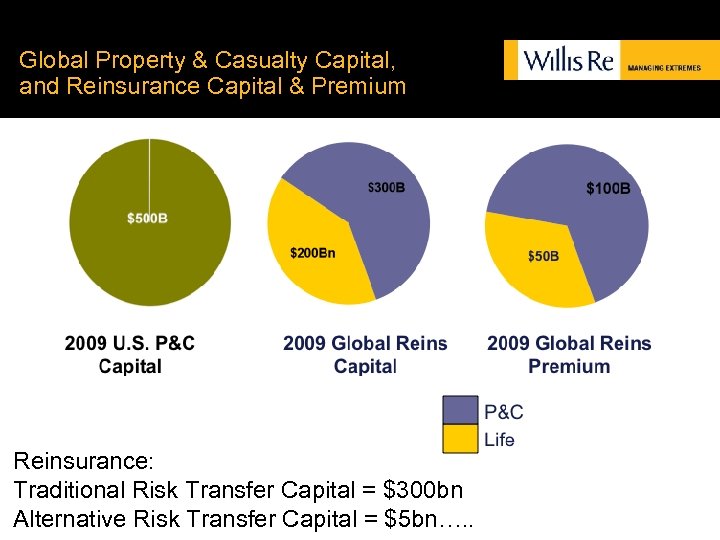 Global Property & Casualty Capital, and Reinsurance Capital & Premium Reinsurance: Traditional Risk Transfer Capital = $300 bn Alternative Risk Transfer Capital = $5 bn…. .
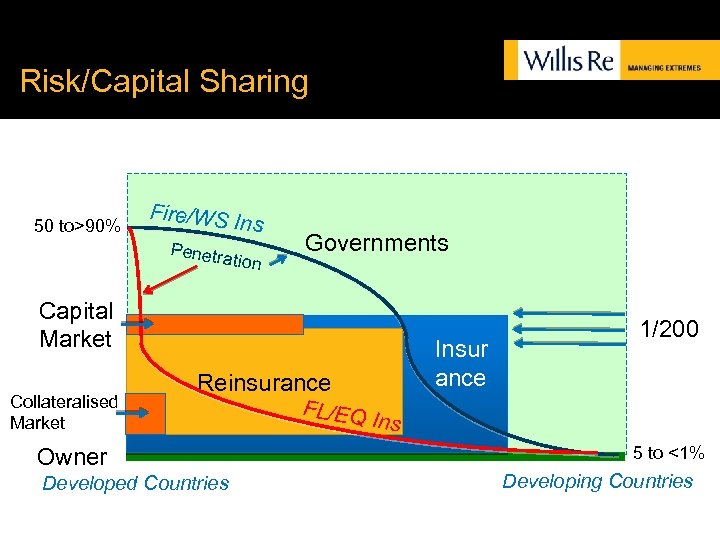 Risk/Capital Sharing 50 to>90% Fire/WS I ns Penetra tion Governments Capital Market Collateralised Market Insur ance Reinsurance Owner Developed Countries FL/EQ 1/200 Ins 5 to <1% Developing Countries
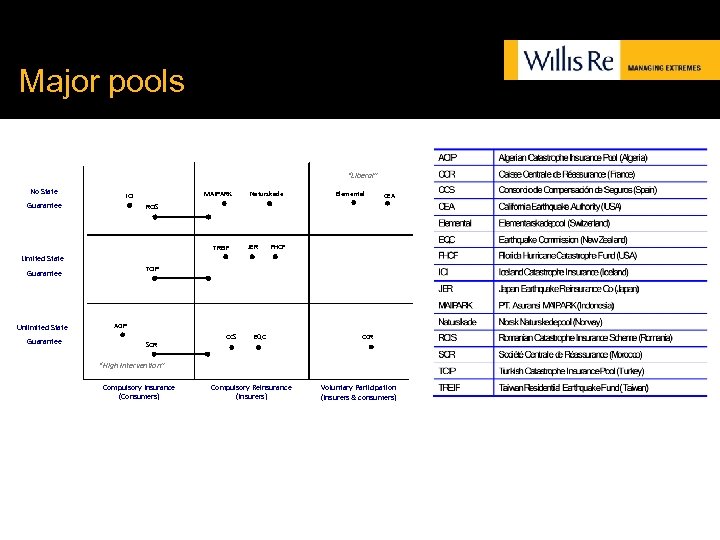 Major pools “Liberal” No State MAIPARK ICI Guarantee Naturskade Elemental CEA RCIS TREIF JER FHCF Limited State TCIP Guarantee Unlimited State Guarantee ACIP SCR CCS EQC CCR “High Intervention” Compulsory Insurance (Consumers) Compulsory Reinsurance (Insurers) Voluntary Participation (Insurers & consumers)
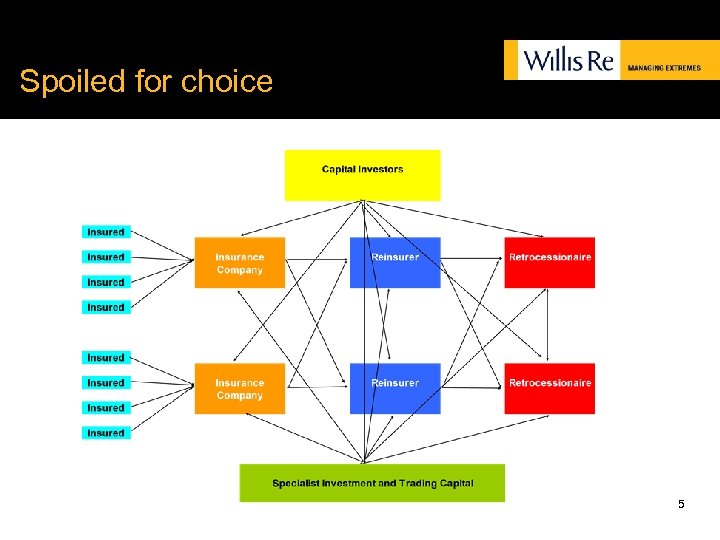 Spoiled for choice 5
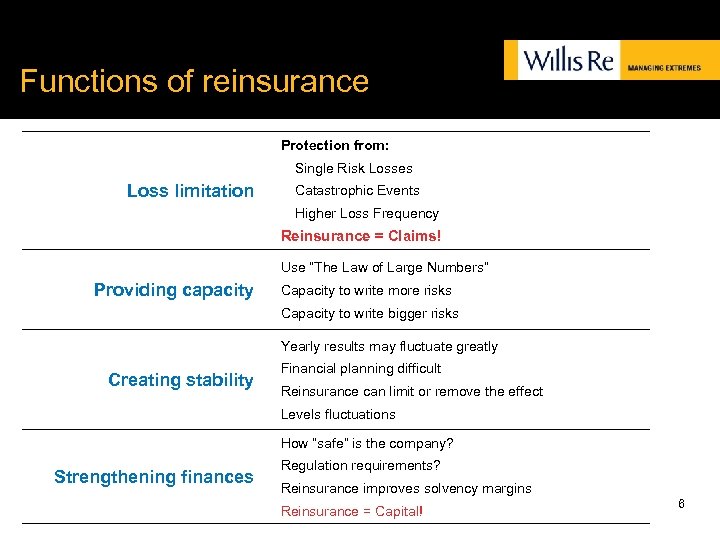 Functions of reinsurance Protection from: Single Risk Losses Loss limitation Catastrophic Events Higher Loss Frequency Reinsurance = Claims! Use “The Law of Large Numbers” Providing capacity Capacity to write more risks Capacity to write bigger risks Yearly results may fluctuate greatly Creating stability Financial planning difficult Reinsurance can limit or remove the effect Levels fluctuations How “safe” is the company? Strengthening finances Regulation requirements? Reinsurance improves solvency margins Reinsurance = Capital! 6
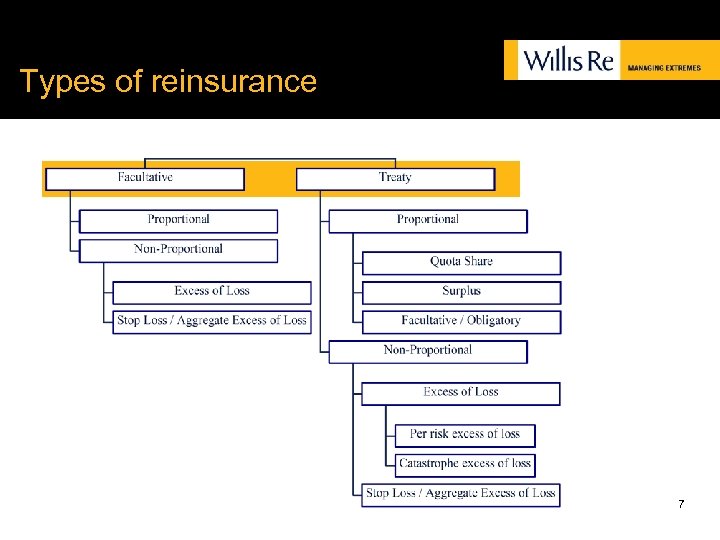 Types of reinsurance 7
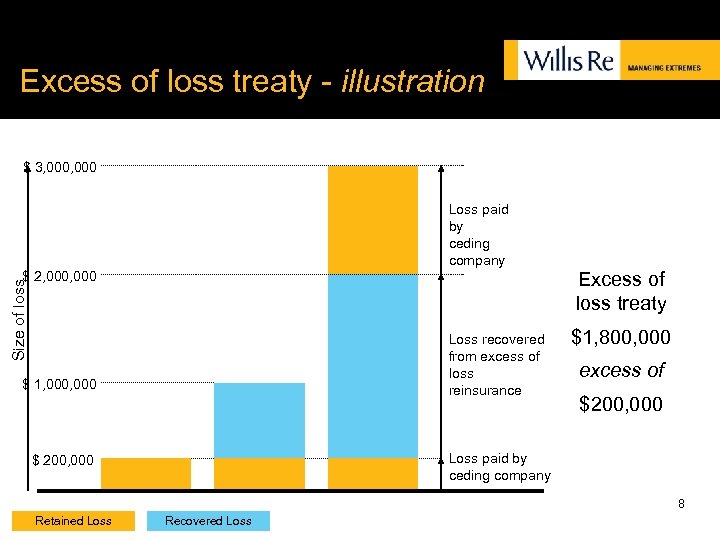 Excess of loss treaty - illustration $ 3, 000 Loss paid by ceding company Excess of loss treaty Size of loss $ 2, 000 Loss recovered from excess of loss reinsurance $ 1, 000 $1, 800, 000 excess of $200, 000 Loss paid by ceding company $ 200, 000 8 Retained Loss Recovered Loss
 Overview of traditional reinsurance · Starting point for all buyers – · Ability to meet many needs – · · No company would purchase reinsurance without first considering traditional coverage Balance sheet de-leveraging, volatility control, “lights on” coverage, etc. Benchmark for all alternative reinsurance considerations – – Is it more or less expensive than traditional reinsurance? Does it offer more or less coverage? Maturity of market – Offers many positives and few negatives 9
 Benefits of traditional reinsurance · · · Execution – Ease: transaction costs understood; standardized approach to marketing and placement – Speed: faster than almost all forms of alternative coverage Predictability of cost – Less volatile capital allows brokers to forecast pricing accurately Market access: breadth of market offers global choice Supply of capacity – More than all alternative sources combined · Leading to soft market pricing advantages – Other alternatives are sometimes opportunistic capacity Flexibility of coverage – Contract language, Ultimate Net Loss coverage, minimal basis risk Scalability: can meet growth demands of all but most extreme clients 10
 Challenges and suitability of traditional reinsurance · Challenges · Intelligent capital: it can be difficult to discover and exploit new opportunities – Susceptibility to market cycles – Quality of credit: ability to settle all claims after “mega cats” Who is the product best suited for? – Suits all companies regardless of size or structure (stock / mutual) · Small niche companies not economical for non-traditional markets · $500 M+ coverage requires traditional market to some extent Who should not buy the product? · – – Companies with portfolios which model punitively and find it more difficult to get coverage at economic terms 11
 Other considerations for traditional reinsurance · · Rating agency / regulatory view – – Transparency: easily analyzed Credit risk can be mitigated by syndication Market trends that affect price, capacity, availability – · Less affected by capital volatility, due to long term commitment of reinsurance specialists in the marketplace – Natural catastrophes, primary industry results, regulation Data & key metrics used in evaluating the products – – Predominantly, experience and exposure Subjective arguments considered in pricing process 12
 Overview of Industry Loss Warranties · Industry loss warranties (ILWs) – Cover triggered by an index of insured industry loss – Cover payoff can be pro-rata or digital – Cover can be tailored to specific region and peril · e. g. Florida Wind, California EQ – Index providers vary by region · PCS in the US · PERILS · ABI in Europe in the UK · Swiss Re / Munich Re worldwide 13
 Benefits to a carrier of ILWs · ILWs are – Easy to execute – Easy to model – Relatively anonymous · Carrier does not have to share exposure data – An access route to non-traditional capital · i. e. hedge funds, banks, etc. – Often cheaper than traditional reinsurance 14
 Common challenges of ILWs · Basis risk is always an issue for ILWs – Unless the ILW trigger is chosen well, substantial risk exists that the cover will not respond as expected – The index itself may not respond as expected · e. g. initial estimates from PCS for Katrina were less than $10 B · ILWs do not get full reinsurance credit from rating agencies 15
 Overview of Exchange Traded Derivatives · Exchange traded cat derivatives (ETDs) – Cover triggered by an index of some sort · Typically parametric – Payoff can be pro-rata or digital – Can be tailored to specific region – ILWs can be traded on exchange using PCS index – Most used parametric index is the CME Hurricane Index (CHI) – Do not have to show an indemnified loss to collect claim 16
 Benefits to a carrier of ETDs · ETDs are – Easy to model – Completely anonymous – An access route to non-traditional capital · i. e. hedge funds, banks, etc. – Often “cheaper” than traditional reinsurance 17
 Common challenges of ETDs · Basis risk is always an issue for ETDs – Unless the trigger / index is chosen well, substantial risk exists that the cover will not respond as expected · ETDs do not get full reinsurance credit from rating agencies · Trading ETDs requires infrastructure not normally found in reinsurance – Clearing bank relationships, inter-dealer brokers, etc. 18
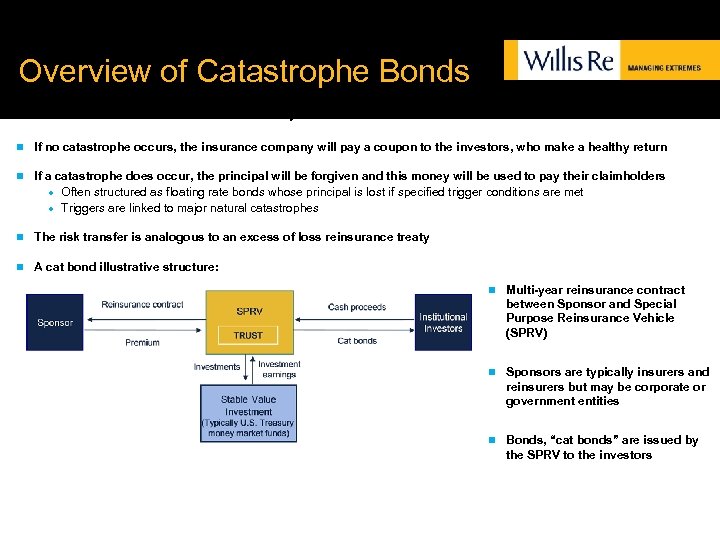 Overview of Catastrophe Bonds A catastrophe bond (“cat bond”) is a security that transfers a specified set of risks from a sponsor to investors n If no catastrophe occurs, the insurance company will pay a coupon to the investors, who make a healthy return n If a catastrophe does occur, the principal will be forgiven and this money will be used to pay their claimholders · Often structured as floating rate bonds whose principal is lost if specified trigger conditions are met · Triggers are linked to major natural catastrophes n The risk transfer is analogous to an excess of loss reinsurance treaty n A cat bond illustrative structure: n Multi-year reinsurance contract between Sponsor and Special Purpose Reinsurance Vehicle (SPRV) n Sponsors are typically insurers and reinsurers but may be corporate or government entities n Bonds, “cat bonds” are issued by the SPRV to the investors
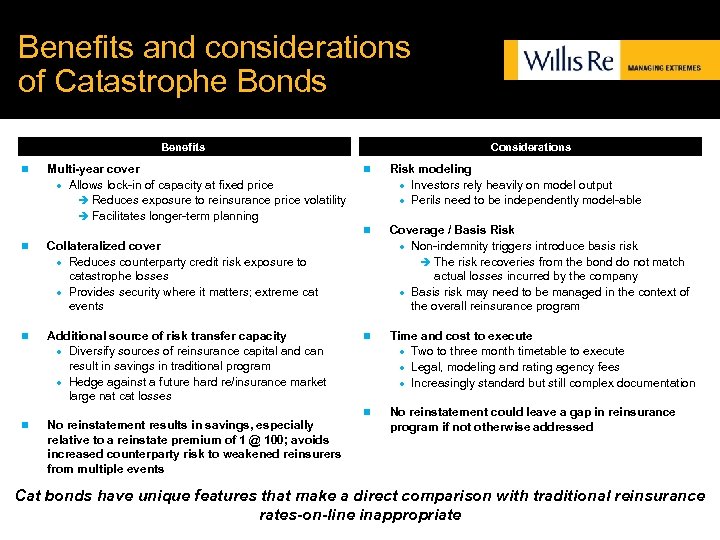 Benefits and considerations of Catastrophe Bonds Benefits n Additional source of risk transfer capacity · Diversify sources of reinsurance capital and can result in savings in traditional program · Hedge against a future hard re/insurance market large nat cat losses n No reinstatement results in savings, especially relative to a reinstate premium of 1 @ 100; avoids increased counterparty risk to weakened reinsurers from multiple events Risk modeling · Investors rely heavily on model output · Perils need to be independently model-able Coverage / Basis Risk · Non-indemnity triggers introduce basis risk è The risk recoveries from the bond do not match actual losses incurred by the company · Basis risk may need to be managed in the context of the overall reinsurance program n Time and cost to execute · Two to three month timetable to execute · Legal, modeling and rating agency fees · Increasingly standard but still complex documentation n No reinstatement could leave a gap in reinsurance program if not otherwise addressed Collateralized cover · Reduces counterparty credit risk exposure to catastrophe losses · Provides security where it matters; extreme cat events n n Multi-year cover · Allows lock-in of capacity at fixed price è Reduces exposure to reinsurance price volatility è Facilitates longer-term planning Considerations Cat bonds have unique features that make a direct comparison with traditional reinsurance rates-on-line inappropriate
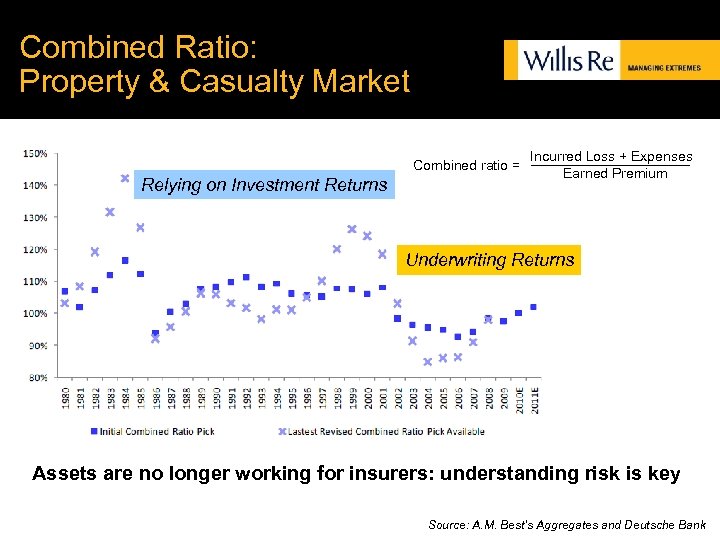 Combined Ratio: Property & Casualty Market Combined ratio = Relying on Investment Returns Incurred Loss + Expenses Earned Premium Underwriting Returns Assets are no longer working for insurers: understanding risk is key Source: A. M. Best’s Aggregates and Deutsche Bank
 Insurance Product Risk The uncertainty of the insurance business lies in the fact that the costs of goods sold is not known at the time of production/contract (Deutsche Bank, 2010) Modelling must be an intrinsic part of the product
 Calculable Loss: Platforms for Trading Risk Models: Vendor and in-house tools >90% of WW property exposure and 90% GDP related risk represented in models (EQ, WS, Terror, FL, Fire, Surge, Tsunami and more) Thesis: The primary purpose of vendor catastrophe models is to provide a “currency” to trade with
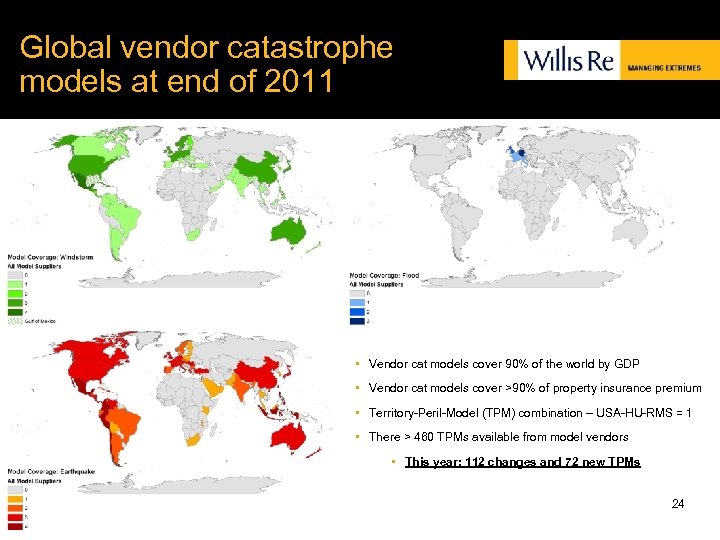 Global vendor catastrophe models at end of 2011 • Vendor cat models cover 90% of the world by GDP • Vendor cat models cover >90% of property insurance premium • Territory-Peril-Model (TPM) combination – USA-HU-RMS = 1 • There > 460 TPMs available from model vendors • This year: 112 changes and 72 new TPMs 24
 2011 – end of year report · · · 2011 – the year of the “cat” (according to the Vietnamese calendar) Impact on traditional and capital markets – – Re/insurers profits exhausted after events in Japan, NZ, Australia, US Thai floods could be the tipping point – impact on capital 1 cat bond has a full loss to investors after tornado losses in the US Potential market hardening and rate increases Impact of model changes – · Better (or worse) understanding of cat models – implementation of latest science and state of the art methodology leading to significant changes in loss estimates – – Traditional reinsurance slight increase in rates Reduction in cat bonds purchased in 2011 Traditional vs ART – – Traditional much cheaper than ART – ART are fully dependant on a modelled approach – whether the triggering metric or a probabilistic model for pricing – – ART coverage aimed primarily at protecting extreme / tail events New ART mechanisms being developed to reduce the price and make it more competitive with the traditional market Traditional cover broad and flexible 25