


 Скачать презентацию WM-2010 ENVIRONET section Phoenix 7 -11 March 2010
4a91633c34fca8e3daee13355026eadc.ppt
- Количество слайдов: 34
 WM-2010, ENVIRONET section Phoenix 7 -11 March 2010 The IAEA Ongoing Activities in Supporting Environmental Remediation Projects in Central Asian Countries Russell Edge (IAEA Project officer) & Oleg Voitsekhovych (UHMI, CMSET, consultant) IAEA International Atomic Energy Agency
 Scope for discussion • • • Brief description of the Problems Ongoing IAEA relevant activities Main Progress and Findings Common problems Country Specific needs Recommendations and expectations from ENVIRONET IAEA 2
 Why Central Asia countries and IAEA Concern Kazakhstan, Kyrgyzstan, Tajikistan, Uzbekistan ¨common history for Uranium Industry development in past, similar legacy site problems, similar economical difficulties and lack of experience qinterested in managing and/or remediating the legacy of former uranium mining and milling activities to protect their population and environment IAEA 3
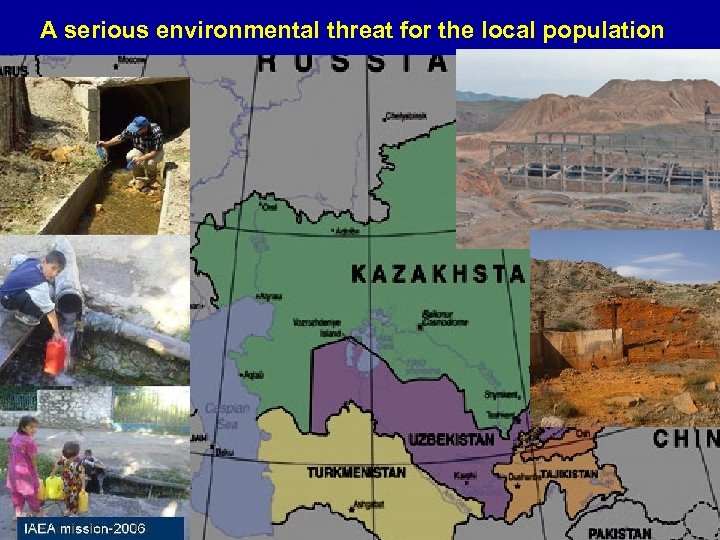 A serious environmental threat for the local population IAEA 4
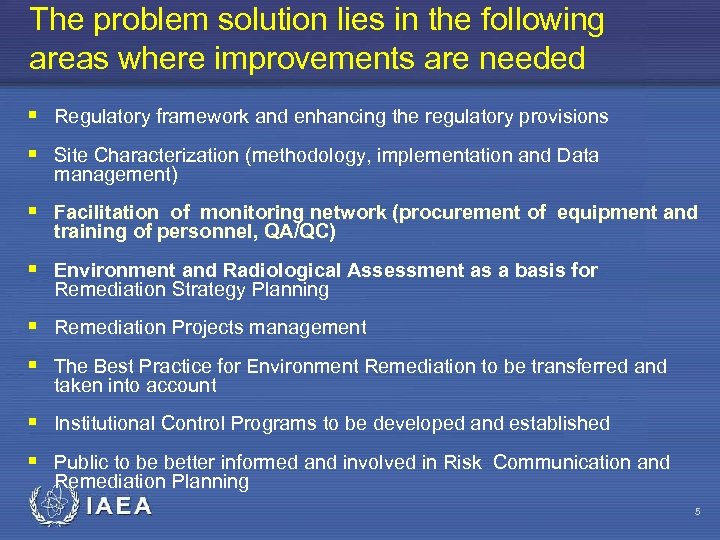 The problem solution lies in the following areas where improvements are needed § Regulatory framework and enhancing the regulatory provisions § Site Characterization (methodology, implementation and Data management) § Facilitation of monitoring network (procurement of equipment and training of personnel, QA/QC) § Environment and Radiological Assessment as a basis for Remediation Strategy Planning § Remediation Projects management § The Best Practice for Environment Remediation to be transferred and taken into account § Institutional Control Programs to be developed and established § Public to be better informed and involved in Risk Communication and Remediation Planning IAEA 5
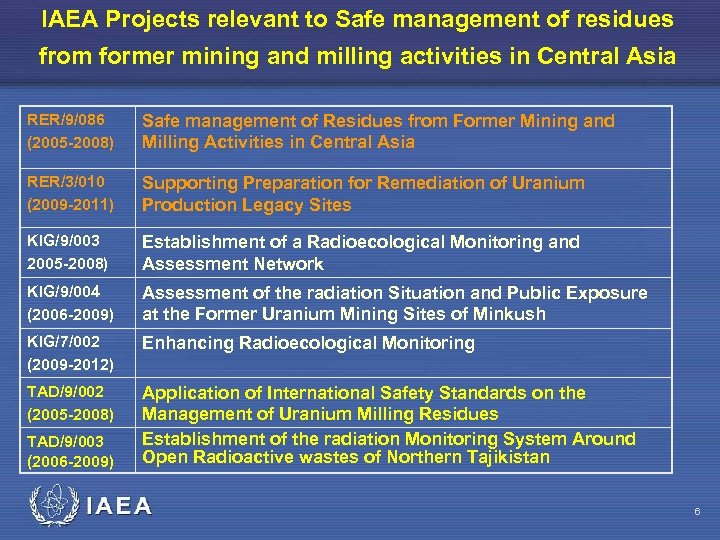 IAEA Projects relevant to Safe management of residues from former mining and milling activities in Central Asia RER/9/086 (2005 -2008) Safe management of Residues from Former Mining and Milling Activities in Central Asia RER/3/010 (2009 -2011) Supporting Preparation for Remediation of Uranium Production Legacy Sites KIG/9/003 2005 -2008) Establishment of a Radioecological Monitoring and Assessment Network KIG/9/004 (2006 -2009) Assessment of the radiation Situation and Public Exposure at the Former Uranium Mining Sites of Minkush KIG/7/002 (2009 -2012) Enhancing Radioecological Monitoring TAD/9/002 (2005 -2008) Application of International Safety Standards on the Management of Uranium Milling Residues Establishment of the radiation Monitoring System Around Open Radioactive wastes of Northern Tajikistan TAD/9/003 (2006 -2009) IAEA 6
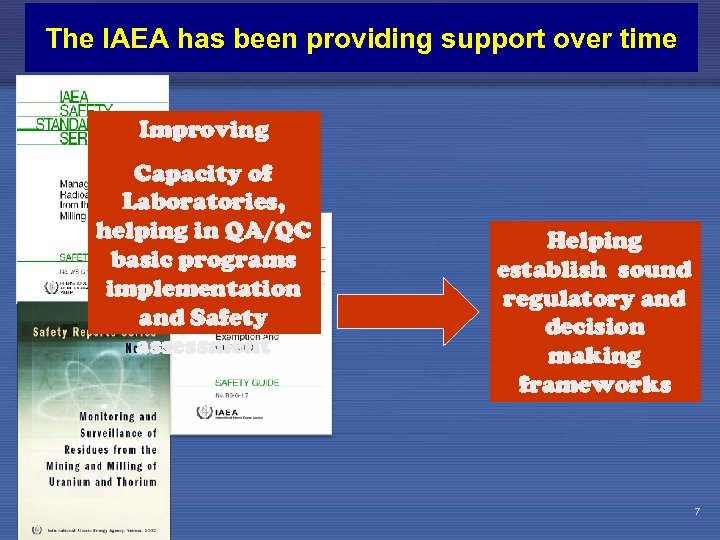 The IAEA has been providing support over time Improving Capacity of Laboratories, helping in QA/QC basic programs implementation and Safety assessment IAEA Helping establish sound regulatory and decision making frameworks 7
 Assessment in some specific Case Studies Tajikistan Kyrgyzstan Uzbekistan Kazakhstan IAEA 8
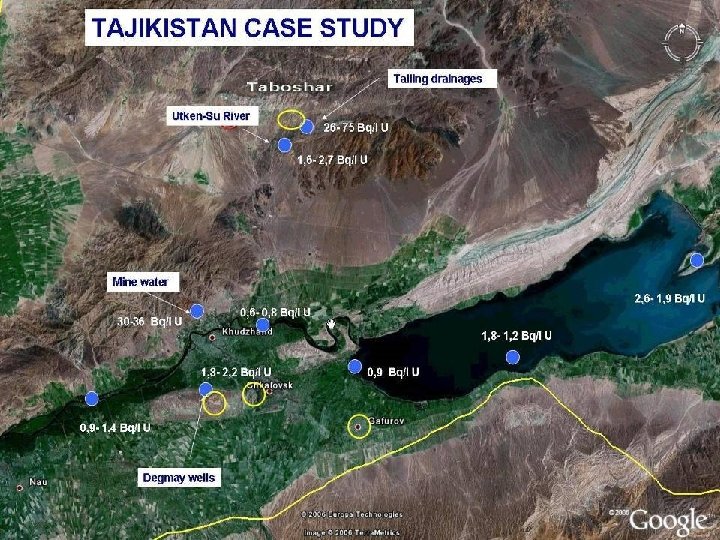 IAEA 9
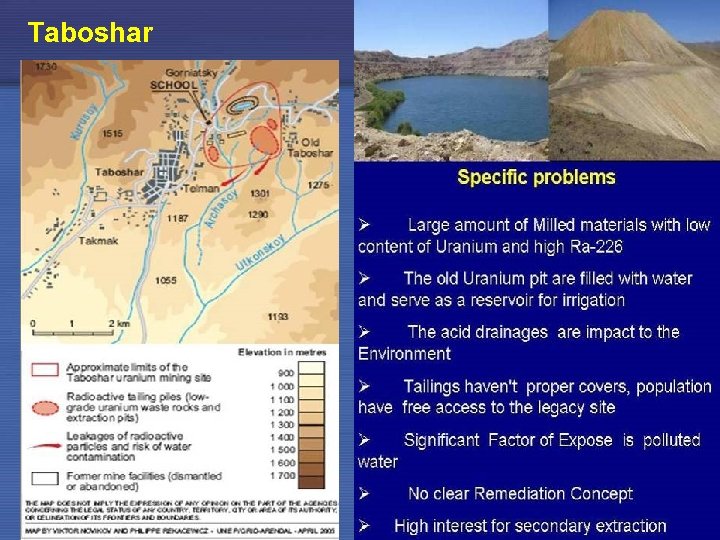 Тaboshar IAEA 10
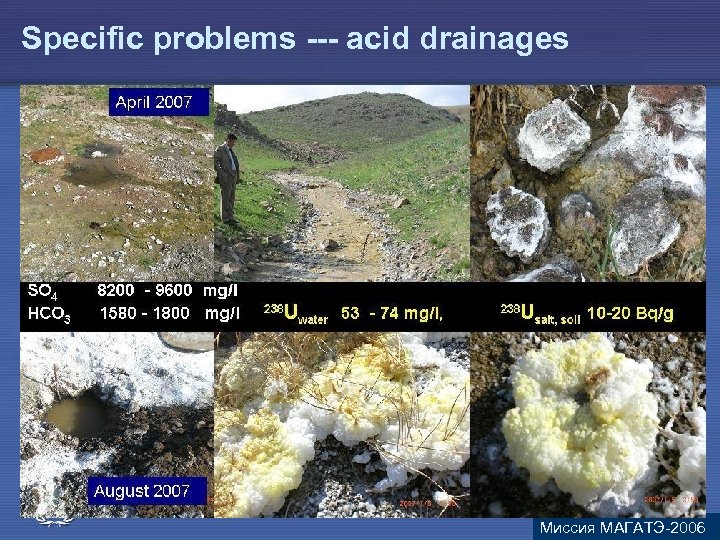 Specific problems --- acid drainages IAEA 11 Миссия МАГАТЭ-2006
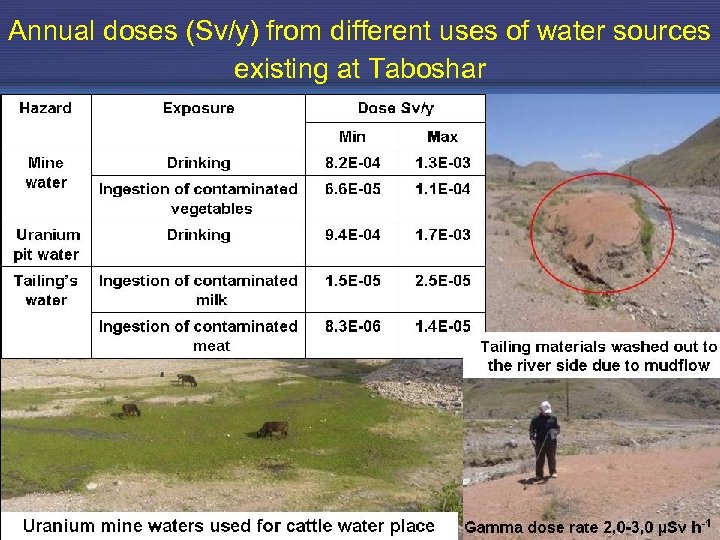 Annual doses (Sv/y) from different uses of water sources existing at Taboshar IAEA 12
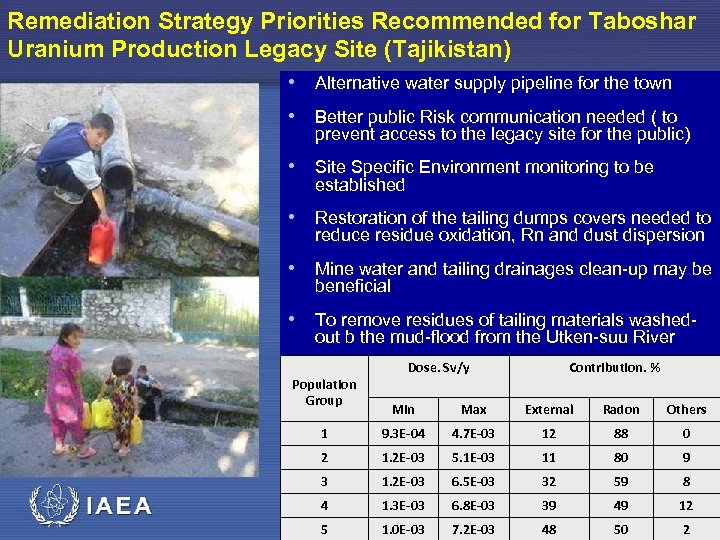 Remediation Strategy Priorities Recommended for Taboshar Uranium Production Legacy Site (Tajikistan) • Alternative water supply pipeline for the town • Better public Risk communication needed ( to prevent access to the legacy site for the public) • Site Specific Environment monitoring to be established • Restoration of the tailing dumps covers needed to reduce residue oxidation, Rn and dust dispersion • Mine water and tailing drainages clean-up may be beneficial • To remove residues of tailing materials washedout b the mud-flood from the Utken-suu River Population Group Dose. Sv/y Contribution. % Max External Radon Others 1 9. 3 E-04 4. 7 E-03 12 88 0 2 1. 2 E-03 5. 1 E-03 11 80 9 3 IAEA Min 1. 2 E-03 6. 5 E-03 32 59 8 4 1. 3 E-03 6. 8 E-03 39 49 12 13 5 1. 0 E-03 7. 2 E-03 48 50 2
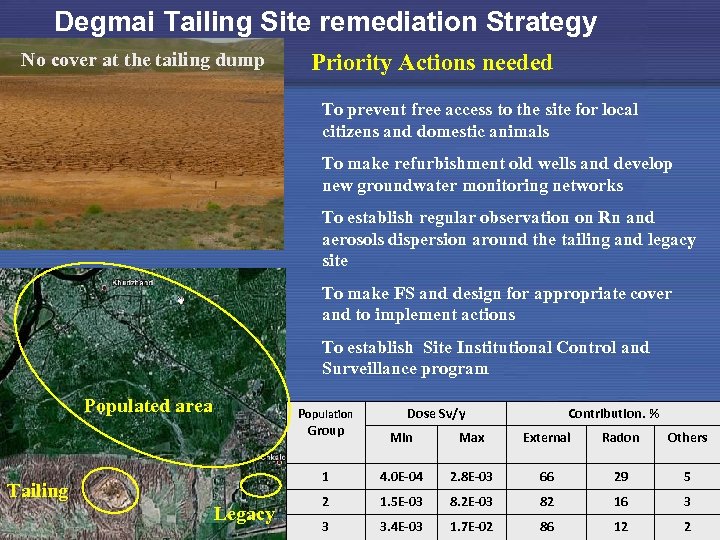 Degmai Tailing Site remediation Strategy No cover at the tailing dump Priority Actions needed To prevent free access to the site for local citizens and domestic animals To make refurbishment old wells and develop new groundwater monitoring networks To establish regular observation on Rn and aerosols dispersion around the tailing and legacy site To make FS and design for appropriate cover and to implement actions To establish Site Institutional Control and Surveillance program Populated area Tailing Population Group Dose Sv/y Contribution. % Legacy Max External Radon Others 1 IAEA Min 4. 0 E-04 2. 8 E-03 66 29 5 2 1. 5 E-03 8. 2 E-03 82 16 3 3 3. 4 E-03 1. 7 E-02 86 12 2 14
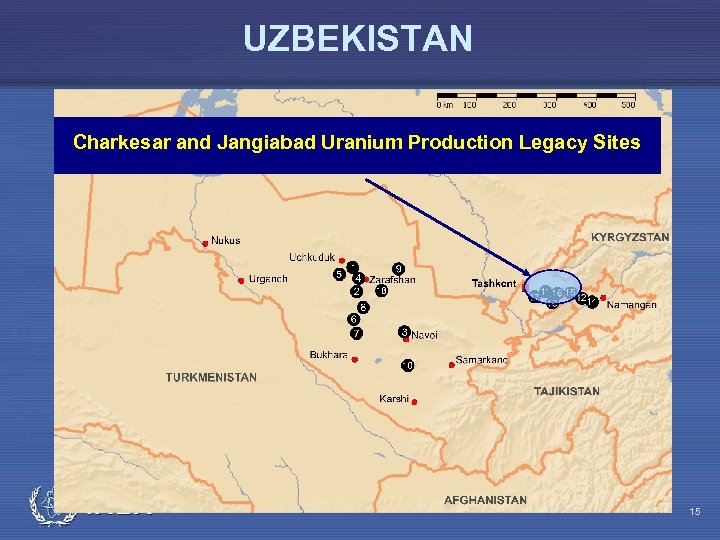 UZBEKISTAN Charkesar and Jangiabad Uranium Production Legacy Sites IAEA 15
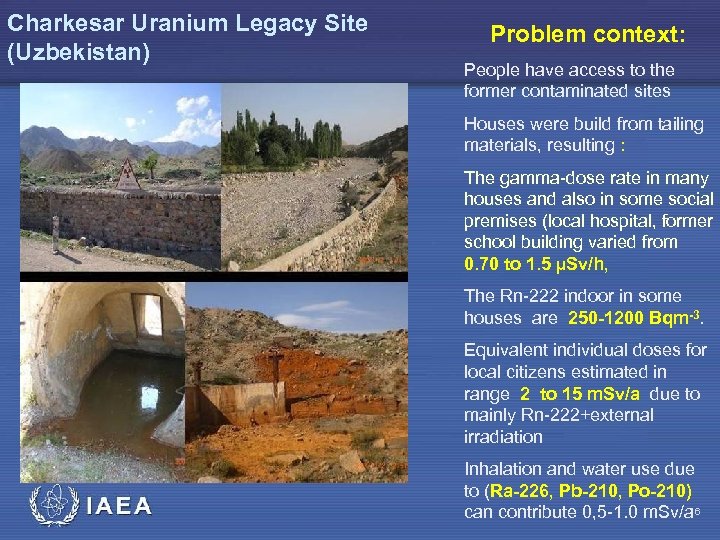 Charkesar Uranium Legacy Site (Uzbekistan) Problem context: People have access to the former contaminated sites Houses were build from tailing materials, resulting : The gamma-dose rate in many houses and also in some social premises (local hospital, former school building varied from 0. 70 to 1. 5 µSv/h, The Rn-222 indoor in some houses are 250 -1200 Bqm-3. Equivalent individual doses for local citizens estimated in range 2 to 15 m. Sv/a due to mainly Rn-222+external irradiation IAEA Inhalation and water use due to (Ra-226, Pb-210, Po-210) 16 can contribute 0, 5 -1. 0 m. Sv/a
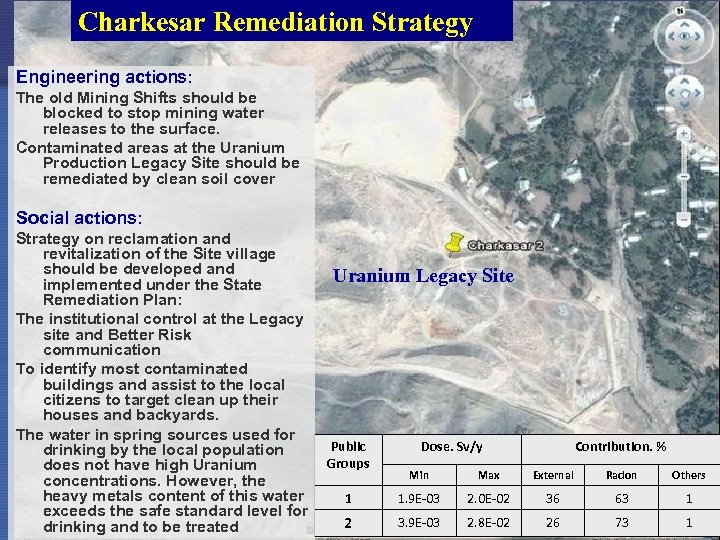 Charkesar Remediation Strategy Uzbekistan Specific Needs Engineering actions: The old Mining Shifts should be blocked to stop mining water releases to the surface. Contaminated areas at the Uranium Production Legacy Site should be remediated by clean soil cover Social actions: Strategy on reclamation and revitalization of the Site village should be developed and implemented under the State Remediation Plan: The institutional control at the Legacy site and Better Risk communication To identify most contaminated buildings and assist to the local citizens to target clean up their houses and backyards. The water in spring sources used for drinking by the local population does not have high Uranium concentrations. However, the heavy metals content of this water IAEA exceeds the safe standard level for drinking and to be treated Uranium Legacy Site Public Groups Dose. Sv/y Contribution. % Min Max External Radon Others 1. 9 E-03 2. 0 E-02 36 63 1 IAEA 2 RER-9086 TC 3. 9 E-03 2. 8 E-02 26 73 1 1 17
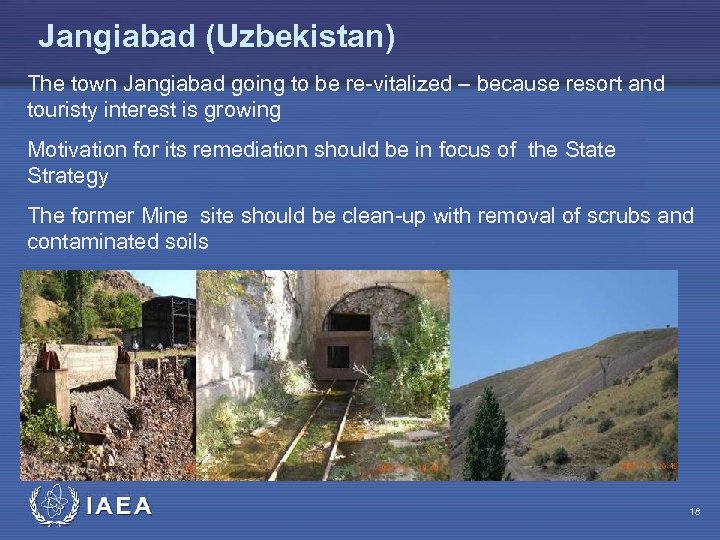 Jangiabad (Uzbekistan) The town Jangiabad going to be re-vitalized – because resort and touristy interest is growing Motivation for its remediation should be in focus of the State Strategy The former Mine site should be clean-up with removal of scrubs and contaminated soils The mine water should be under monitoring and regulatory control under Sanitary Radiological Service of Uzbekistan IAEA 18
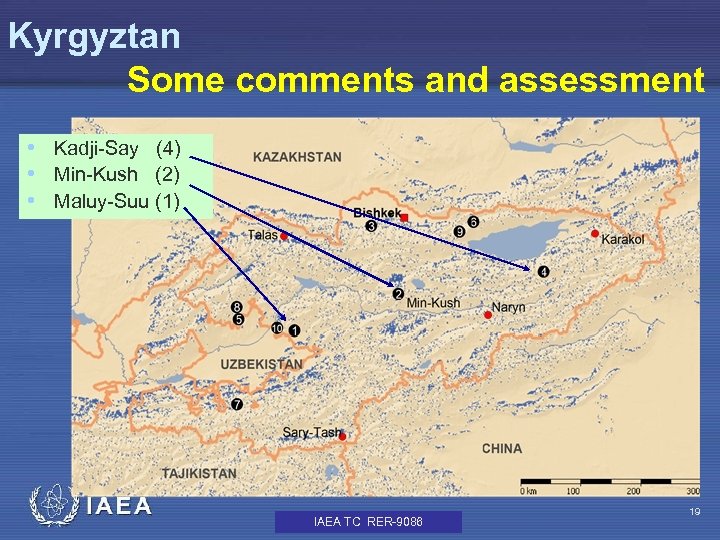 Kyrgyztan Some comments and assessment • Kadji-Say (4) • Min-Kush (2) • Maluy-Suu (1) IAEA TC RER-9086 19
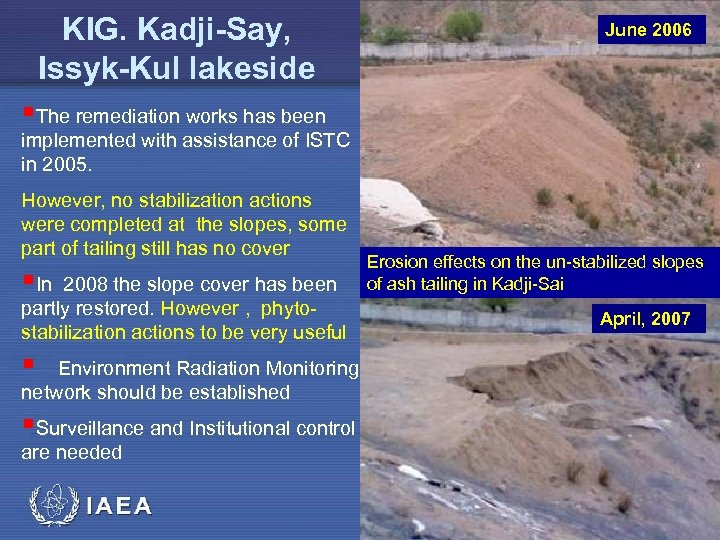 KIG. Kadji-Say, Issyk-Kul lakeside June 2006 §The remediation works has been implemented with assistance of ISTC in 2005. However, no stabilization actions were completed at the slopes, some part of tailing still has no cover §In 2008 the slope cover has been partly restored. However , phytostabilization actions to be very useful Erosion effects on the un-stabilized slopes of ash tailing in Kadji-Sai April, 2007 § Environment Radiation Monitoring network should be established §Surveillance and Institutional control are needed IAEA 20
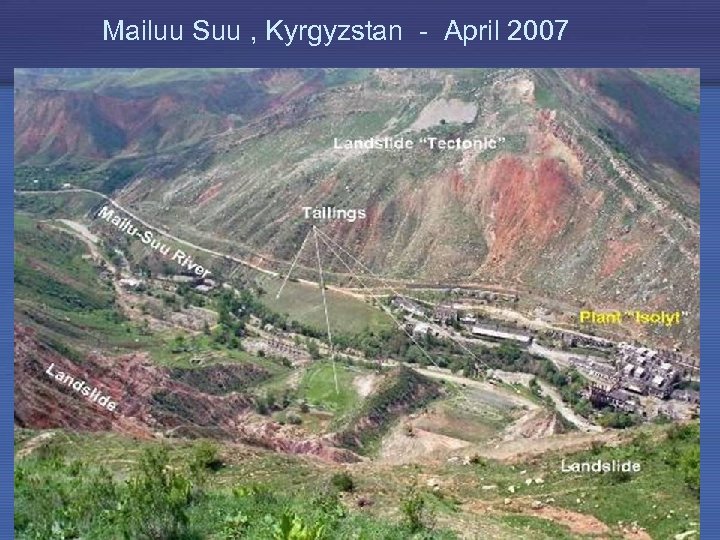 Mailuu Suu , Kyrgyzstan - April 2007 IAEA 21
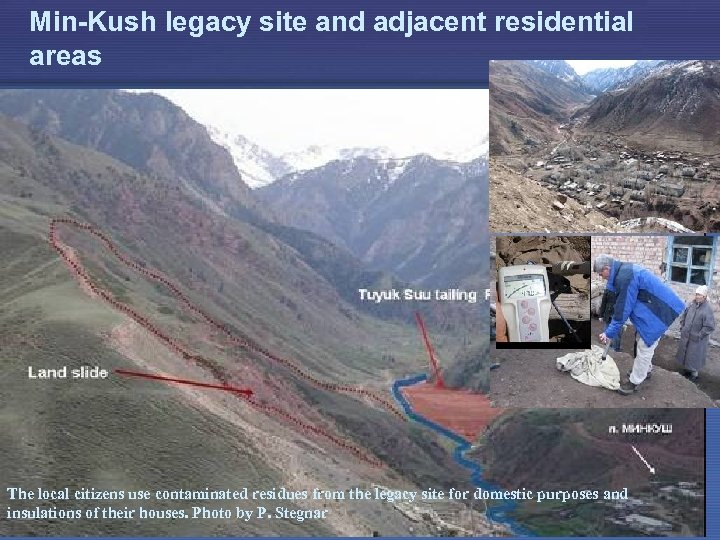 Min-Kush legacy site and adjacent residential areas The local citizens use contaminated residues from the legacy site for domestic purposes and IAEA insulations of their houses. Photo by P. Stegnar 22
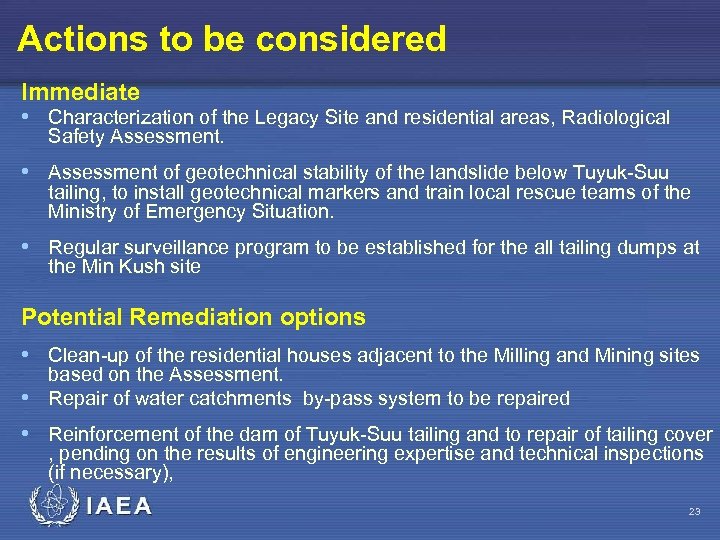 Actions to be considered Immediate • Characterization of the Legacy Site and residential areas, Radiological Safety Assessment. • Assessment of geotechnical stability of the landslide below Tuyuk-Suu tailing, to install geotechnical markers and train local rescue teams of the Ministry of Emergency Situation. • Regular surveillance program to be established for the all tailing dumps at the Min Kush site Potential Remediation options • Clean-up of the residential houses adjacent to the Milling and Mining sites based on the Assessment. • Repair of water catchments by-pass system to be repaired • Reinforcement of the dam of Tuyuk-Suu tailing and to repair of tailing cover , pending on the results of engineering expertise and technical inspections (if necessary), IAEA 23
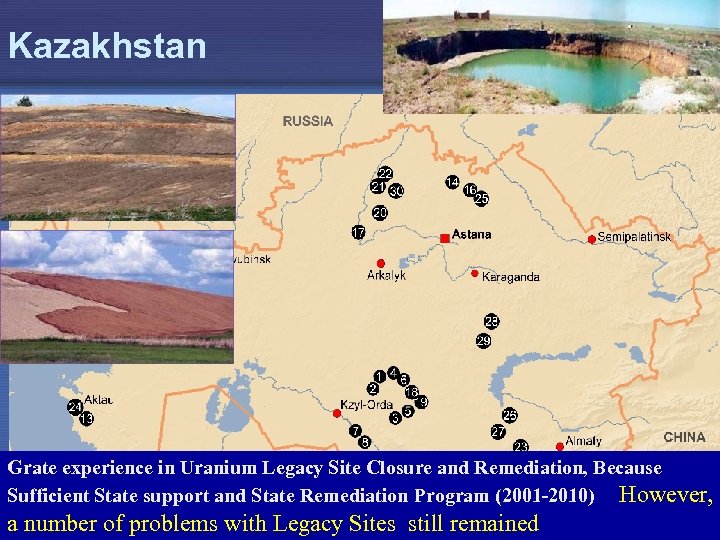 Kazakhstan Grate experience in Uranium Legacy Site Closure and Remediation, Because Sufficient State support and State Remediation Program (2001 -2010) However, IAEA a number of problems with Legacy Sites still remained 24
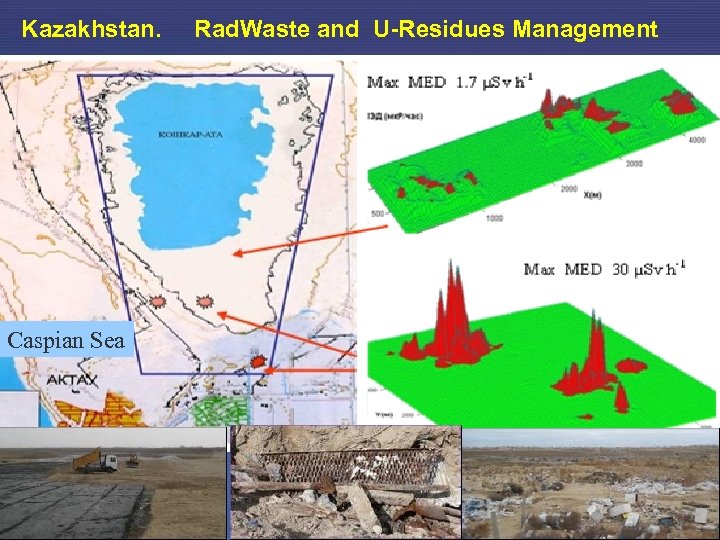 Kazakhstan. Rad. Waste and U-Residues Management Caspian Sea IAEA 25
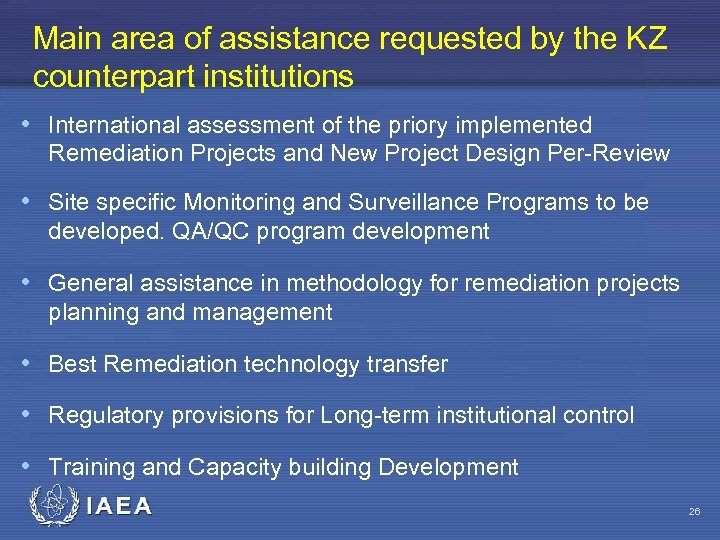 Main area of assistance requested by the KZ counterpart institutions • International assessment of the priory implemented Remediation Projects and New Project Design Per-Review • Site specific Monitoring and Surveillance Programs to be developed. QA/QC program development • General assistance in methodology for remediation projects planning and management • Best Remediation technology transfer • Regulatory provisions for Long-term institutional control • Training and Capacity building Development IAEA 26
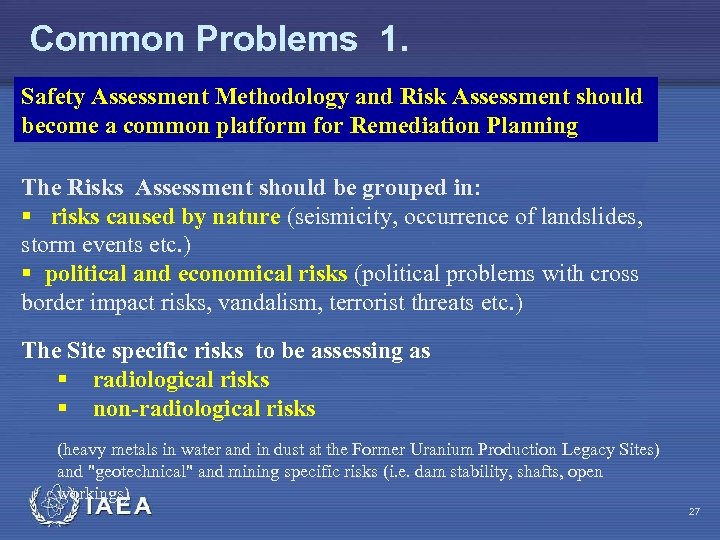 Common Problems 1. Safety Assessment Methodology and Risk Assessment should become a common platform for Remediation Planning The Risks Assessment should be grouped in: § risks caused by nature (seismicity, occurrence of landslides, storm events etc. ) § political and economical risks (political problems with cross border impact risks, vandalism, terrorist threats etc. ) The Site specific risks to be assessing as § radiological risks § non-radiological risks (heavy metals in water and in dust at the Former Uranium Production Legacy Sites) and "geotechnical" and mining specific risks (i. e. dam stability, shafts, open workings) IAEA 27
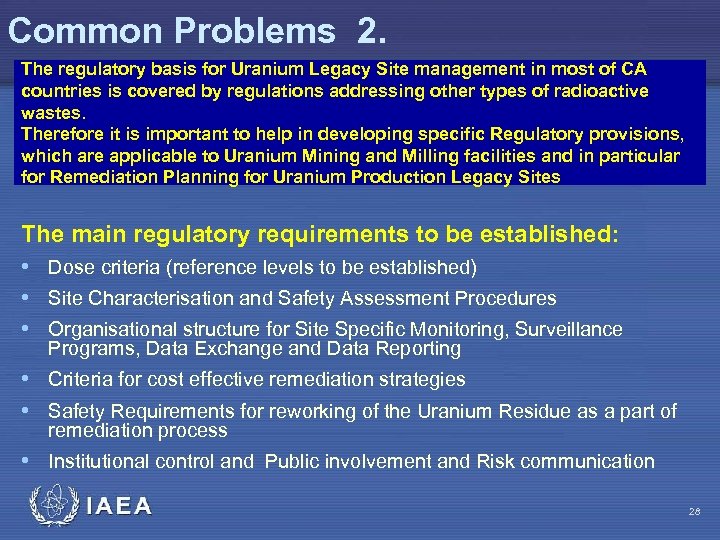 Common Problems 2. The regulatory basis for Uranium Legacy Site management in most of CA countries is covered by regulations addressing other types of radioactive wastes. Therefore it is important to help in developing specific Regulatory provisions, which are applicable to Uranium Mining and Milling facilities and in particular for Remediation Planning for Uranium Production Legacy Sites The main regulatory requirements to be established: • Dose criteria (reference levels to be established) • Site Characterisation and Safety Assessment Procedures • Organisational structure for Site Specific Monitoring, Surveillance Programs, Data Exchange and Data Reporting • Criteria for cost effective remediation strategies • Safety Requirements for reworking of the Uranium Residue as a part of remediation process • Institutional control and Public involvement and Risk communication IAEA 28
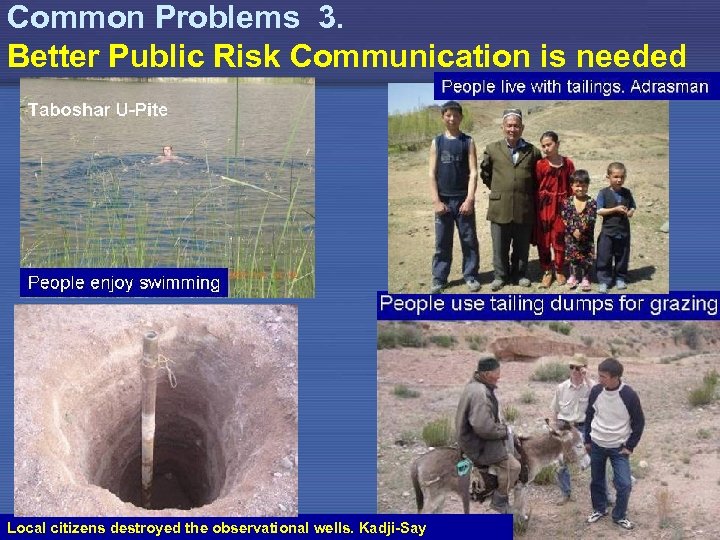 Common Problems 3. Better Public Risk Communication is needed IAEA Local citizens destroyed the observational wells. Kadji-Say 29
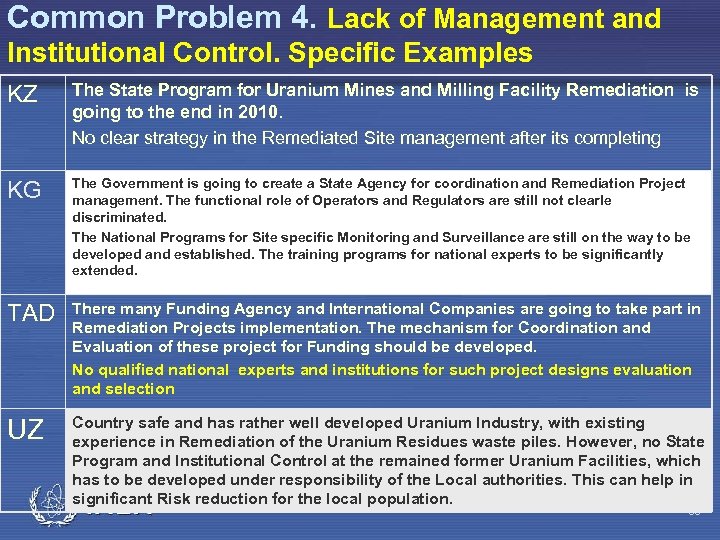 Common Problem 4. Lack of Management and Institutional Control. Specific Examples KZ The State Program for Uranium Mines and Milling Facility Remediation is going to the end in 2010. No clear strategy in the Remediated Site management after its completing KG The Government is going to create a State Agency for coordination and Remediation Project management. The functional role of Operators and Regulators are still not clearle discriminated. The National Programs for Site specific Monitoring and Surveillance are still on the way to be developed and established. The training programs for national experts to be significantly extended. TAD There many Funding Agency and International Companies are going to take part in Remediation Projects implementation. The mechanism for Coordination and Evaluation of these project for Funding should be developed. No qualified national experts and institutions for such project designs evaluation and selection UZ Country safe and has rather well developed Uranium Industry, with existing experience in Remediation of the Uranium Residues waste piles. However, no State Program and Institutional Control at the remained former Uranium Facilities, which has to be developed under responsibility of the Local authorities. This can help in significant Risk reduction for the local population. IAEA 30
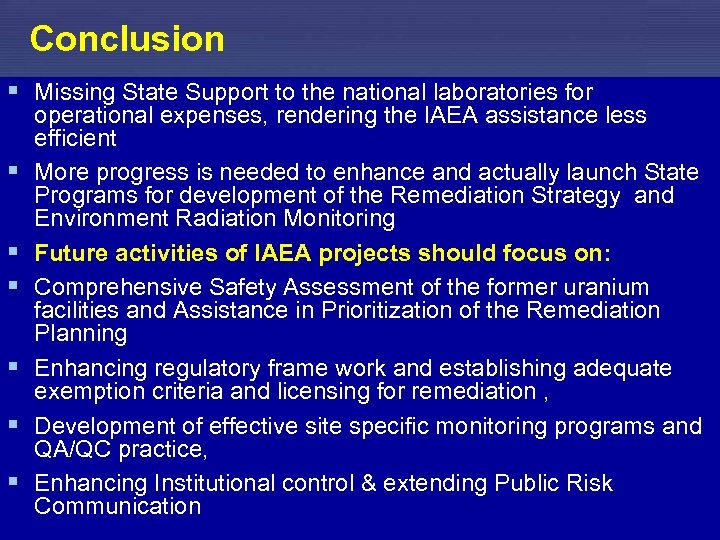 Conclusion § Missing State Support to the national laboratories for § § § operational expenses, rendering the IAEA assistance less efficient More progress is needed to enhance and actually launch State Programs for development of the Remediation Strategy and Environment Radiation Monitoring Future activities of IAEA projects should focus on: Comprehensive Safety Assessment of the former uranium facilities and Assistance in Prioritization of the Remediation Planning Enhancing regulatory frame work and establishing adequate exemption criteria and licensing for remediation , Development of effective site specific monitoring programs and QA/QC practice, Enhancing Institutional control & extending Public Risk IAEA Communication 31
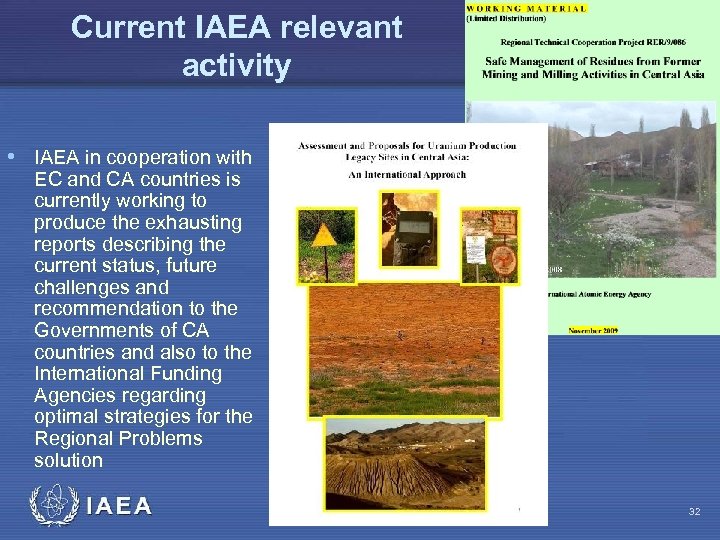 Current IAEA relevant activity • IAEA in cooperation with EC and CA countries is currently working to produce the exhausting reports describing the current status, future challenges and recommendation to the Governments of CA countries and also to the International Funding Agencies regarding optimal strategies for the Regional Problems solution IAEA 32
 Expectations from ENVIRONET • Information and experience exchange aiming to help countries to understand better the regional problems and strategies for their solutions • Assistance in regulatory norms development, using best examples in the countries, which already solved the similar problems. • Consultancy and support of Service to be provided for Risk Assessment and Risk communication • Technical support of the practical activities in the countries, including Strategies and Monitoring Programs, capacity building development and Remediation Strategy Planning • Assistance in Best practice transfer, Remediation project management and innovations • Justification and evaluation of already ongoing projects in cooperation with other International Organizations and Funding Agencies • Support of the Center of excellence and informational Networks IAEA 33
 • THANKS R. Edge@iaea. org (IAEA) o. voitsekhovych@gmail. com (UHMI) IAEA 34