


 Скачать презентацию Wivenhoe Park Essex 1816 The picture is one
английские художники.pptx
- Количество слайдов: 4
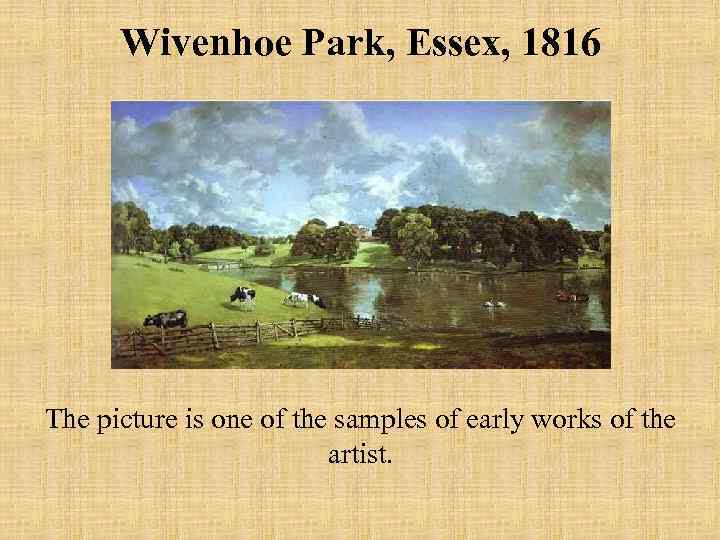 Wivenhoe Park, Essex, 1816 The picture is one of the samples of early works of the artist.
 JOHN CONSTABLE (1776 -1837). John Constable was born on 11 June, 1776 in the village of East Bergholt in the south-east of England. His father was the owner of several millers. The boy spent whole days on his father's mill, located on the River Stour, and was drawing in his spare time. In 1796, John began taking lessons from London's artist John Thomas Smith. He helped Constable to prepare for entry to the Royal Academy, where he was admitted in 1799. John was a diligent student, he was attending all classes, carefully was studying anatomy and was writing copies of old masters' works. He was elected to the Royal Academy in February 1829. In 1831 he was appointed Visitor at the Royal Academy, where he seems to have been popular with the students. In 1835, his last lecture to students of the Royal Academy, in which he praised Raphael and called the Academy the "cradle of British art", was "cheered most heartily". He died on the night of the 31 March 1837.
 Description There are the following strengths of the picture, one of which is a game of light and air effects. On the other hand, Constable is immune from error, he didn't need to include and anticipate, and only need not to distort the truth of nature and have a keen eye. So there are the sense of depth and airspace, filling the canvas, the illusion of a bright sunny day at the picture. In the foreground we can feel the coolness of the shadow falling from the tree under which the crown and the artist was working on the landscape in the background. Central place on the canvas is occupied a spatially of opposing surface of the water and the sky, which actually create internal unity. The water reflects the sky and the size and variability of spatial freedom environment visually increase. Another achievement of Constable is color of the sky. Only two colors, gray and blue, and their numerous tones convey sunlight. Nature itself tells about artist's receptions, giving birth to a viewer's feelings. And here again, the artist makes love to the world.
 Technique, features and feelings. Constable used the direct observation of nature, he was one of the first European artists who began to paint landscapes from nature. This landscape is a clear indication that Constable didn't pay any attention to the composition, depicting what was before his eyes. But principles of realistic landscape were born on the basis of this approach. He painted a typical English afternoon, the bright sun breaks through the clouds. Constable showed an infinite variety of natural beauty and amazing shimmering , sparkling light falling on the grass, leaves and pond and intensifies the sound of colorful iridescence. The artist painted by bold restless strokes was recreating the freshness and lively dynamics of paints, gradation of light, changing state of light and air. The motive of the picture is simple. That landscape is natural and cozy, but the composition is majestic. However, the speciality of the canvas in the panorama and juicy realistic paints. It conveys a sense of peace and harmonious unity of nature.