 Скачать презентацию WITHIN THE VEIL HEBREWS AND 1844 Félix H
5f43b6f812ba0ff231b84aec0dba6e71.ppt
- Количество слайдов: 67



“WITHIN THE VEIL”: HEBREWS AND 1844 Félix H. Cortez Andrews University
S AS A BATTLEG ROUND ON THE SANCTUA RY
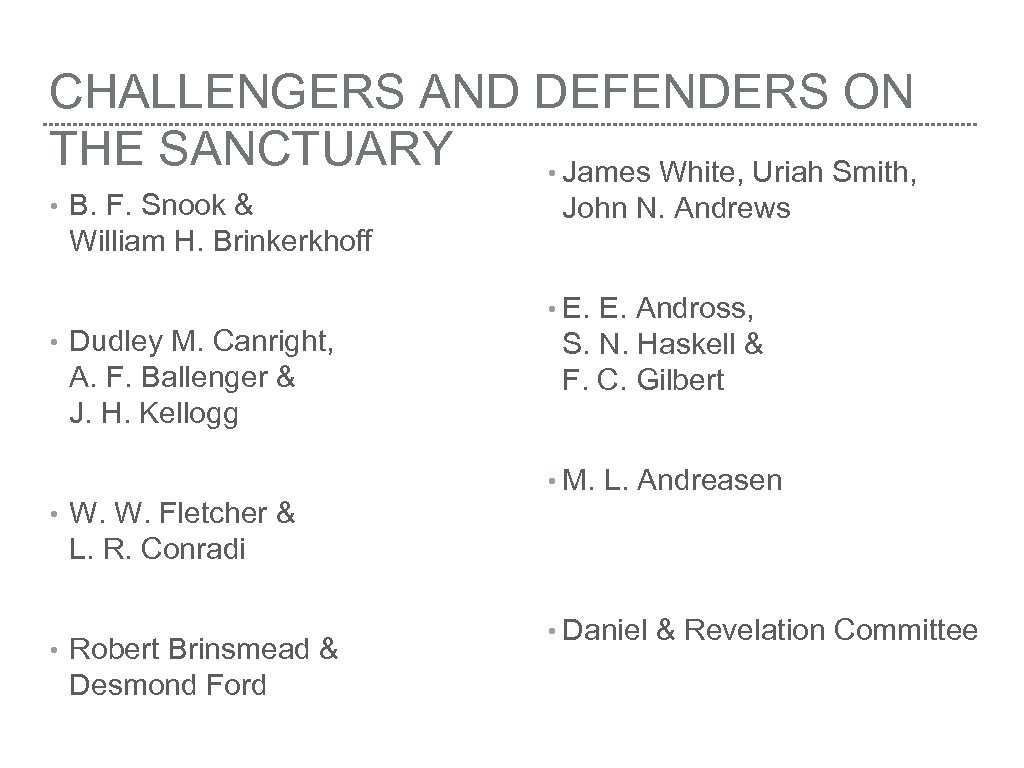
CHALLENGERS AND DEFENDERS ON THE SANCTUARY • James White, Uriah Smith, • B. F. Snook & John N. Andrews William H. Brinkerkhoff • E. E. Andross, • Dudley M. Canright, A. F. Ballenger & J. H. Kellogg S. N. Haskell & F. C. Gilbert • M. L. Andreasen • W. W. Fletcher & L. R. Conradi • Robert Brinsmead & Desmond Ford • Daniel & Revelation Committee
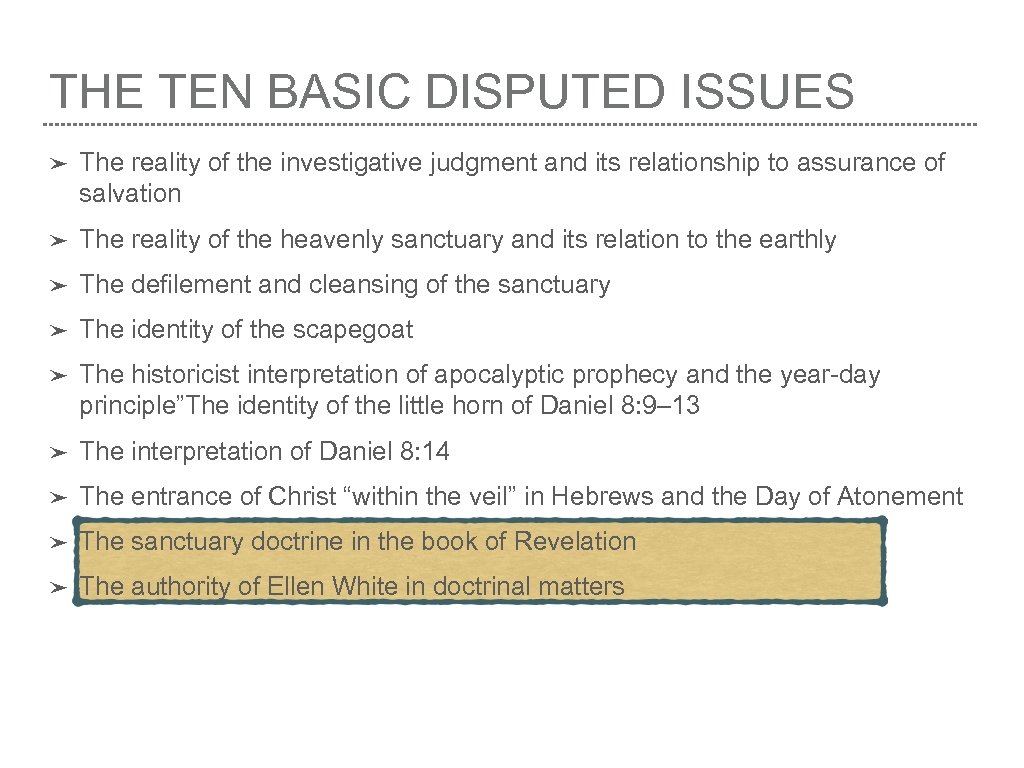
THE TEN BASIC DISPUTED ISSUES ➤ The reality of the investigative judgment and its relationship to assurance of salvation ➤ The reality of the heavenly sanctuary and its relation to the earthly ➤ The defilement and cleansing of the sanctuary ➤ The identity of the scapegoat ➤ The historicist interpretation of apocalyptic prophecy and the year-day principle”The identity of the little horn of Daniel 8: 9– 13 ➤ The interpretation of Daniel 8: 14 ➤ The entrance of Christ “within the veil” in Hebrews and the Day of Atonement ➤ The sanctuary doctrine in the book of Revelation ➤ The authority of Ellen White in doctrinal matters
Hebrews provided our pioneers with the initial insights to resolve the dilemma of the 1844 disappointment. The Epistle pointed them not to the church or the earth as the sanctuary to be cleansed in the Christian era but to the heavenly sanctuary … Frank B. Holbrook, ed. , Issues in the Book of Hebrews (DARCOM 4), xi.
Strange as it may seem, the book that brought great joy to our pioneer has caused other Adventist to withdraw from the church. The charge is that Hebrews denies the Adventist belief that Christ mediates in a two-phased priestly ministry … with the latter ministry beginning in 1844 … Frank B. Holbrook, ed. , Issues in the Book of Hebrews (DARCOM 4), xi.
Ford asserted that he could not find an allusion to Daniel (p. 169) or any reference to a ministry in two phases of the resurrected Jesus (p. 163). Frank B. Holbrook, ed. , Doctrine of the Sanctuary: A Historical Survey (DARCOM 5), 218.
“(1) Does Hebrews explicitly teach Christ’s two-phased priestly ministry? (2) Does Hebrews deny Christ’s two-phased priestly ministry? ” No to both questions. “To the Reader, ” Issues in the Book of Hebrews (DARCOM Series 4; Silver Spring, Md. : Biblical Research Institute, 1989), xi.
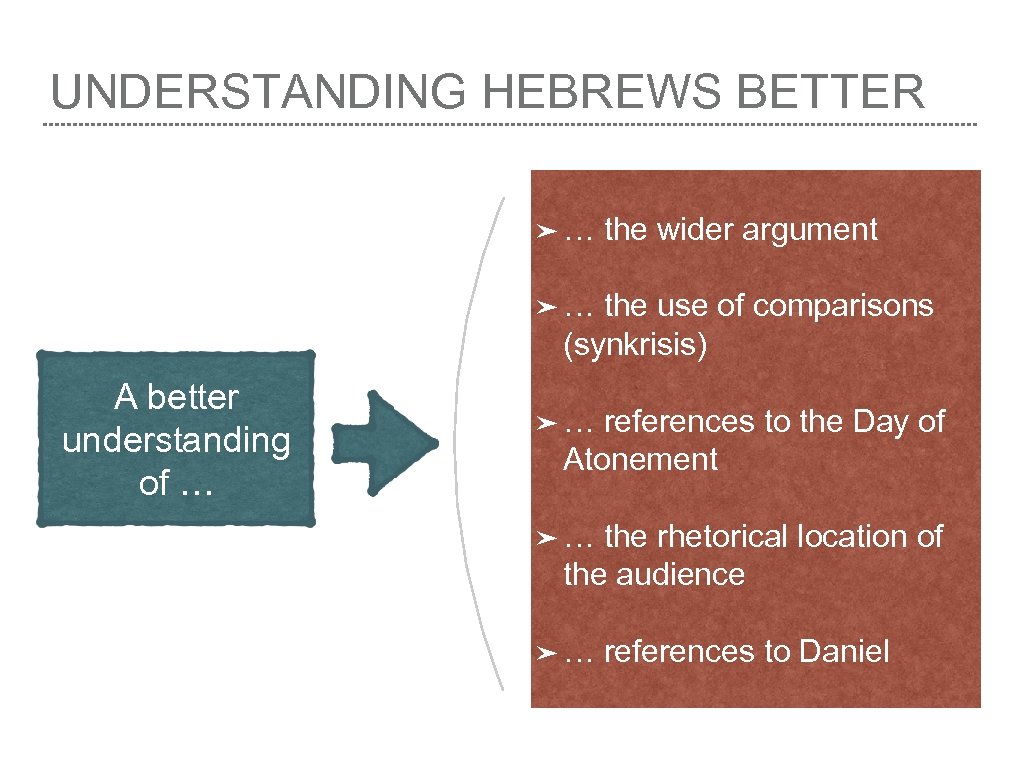
UNDERSTANDING HEBREWS BETTER ➤ … the wider argument ➤ … the use of comparisons (synkrisis) A better understanding of … ➤ … references to the Day of Atonement ➤ … the rhetorical location of the audience ➤ … references to Daniel
1844 AND THE WIDER ARGUME NT
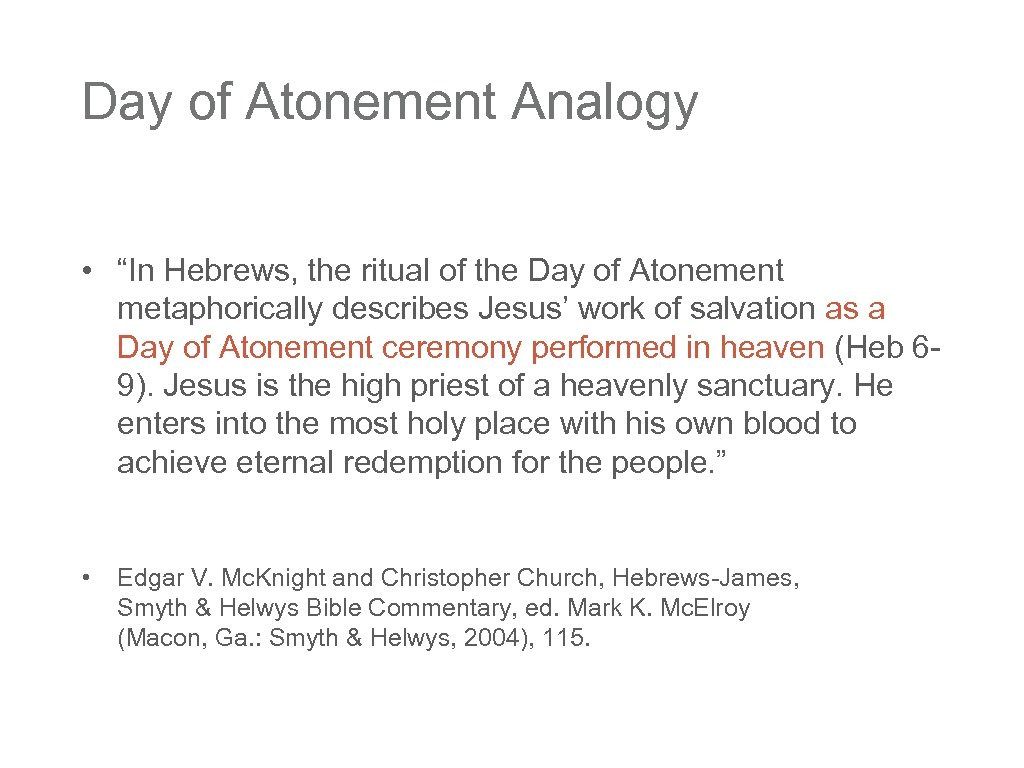
Day of Atonement Analogy • “In Hebrews, the ritual of the Day of Atonement metaphorically describes Jesus’ work of salvation as a Day of Atonement ceremony performed in heaven (Heb 69). Jesus is the high priest of a heavenly sanctuary. He enters into the most holy place with his own blood to achieve eternal redemption for the people. ” • Edgar V. Mc. Knight and Christopher Church, Hebrews-James, Smyth & Helwys Bible Commentary, ed. Mark K. Mc. Elroy (Macon, Ga. : Smyth & Helwys, 2004), 115.
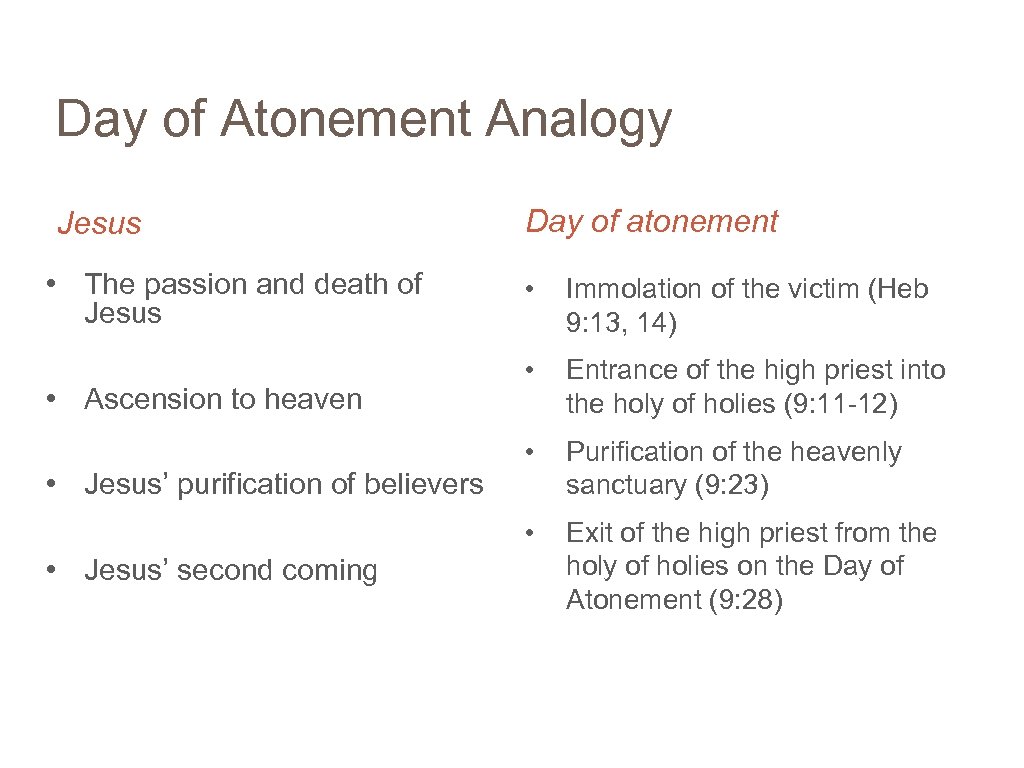
Day of Atonement Analogy Jesus • The passion and death of Jesus Day of atonement Immolation of the victim (Heb 9: 13, 14) • Entrance of the high priest into the holy of holies (9: 11 -12) • Purification of the heavenly sanctuary (9: 23) • • Ascension to heaven • Exit of the high priest from the holy of holies on the Day of Atonement (9: 28) • Jesus’ purification of believers • Jesus’ second coming
![Hebrews is “[le] divine commentaire” of Lev 16. Emile Guers, quoted by F. Dunkel,](https://present5.com/presentation/5f43b6f812ba0ff231b84aec0dba6e71/image-13.jpg "Hebrews is “[le] divine commentaire” of Lev 16. Emile Guers, quoted by F. Dunkel,")
Hebrews is “[le] divine commentaire” of Lev 16. Emile Guers, quoted by F. Dunkel, “Expiation et Jour des Expiations dans L’épître aux Hebreux, ” RRef 33, no. 2 (1982): 63. … a “christological pesher on the cultic text of Leviticus (16: 15). ” Timo Eskola, Messiah and the Throne: Jewish Merkabah Mysticism and Early Christian Exaltation Discourse (WUNT 142; Tübingen: Mohr [Siebeck], 2001), 357.
Day of Atonement Is not the Key to the Argument • “The key to this central section is not Yom Kippur itself, but the connection that the author makes between the cult and the new covenant. ” • James Patrick Scullion, "A Traditio-Historical Study of the Day of Atonement" (Ph. D. diss. , Catholic University of America, 1990), 252.
THE NEW COVENANT RITUAL IS THE KEY – Jesus is the mediator of a new covenant (7: 22; 8: 6; 9: 15) – His death is the “blood of the covenant” (10: 29; 12: 24; 13: 20). – The sprinkling of Jesus’ blood in heaven is for the inauguration of the new covenant (10: 19, 29; 12: 24; 13: 20; cf. 9: 15 -23). – The ritual for the ratification of the Mosaic covenant with blood provides the type to Jesus’ death and ascension (9: 15 -23)
A Temptation Difficult to Escape • William R. G. Loader warned: the peculiarity of the Day of Atonement “must not be stressed so much, that it is described as the essential theme or predominant thought of this section. ” – William R. G. Loader, Sohn und Hoherpriester: Eine traditionsgeschichtliche Untersuchung zur Christologie des Hebräerbriefes (WMANT 53; Neukirchen-Vluyn: Neukirchener Verlag, 1981), 172. • Harold W. Attridge critiques Loader: • In his discussion of the high priestly act of Christ, Loader, while noting the rich texture of Hebrews, concentrates primarily on the Yom Kippur typology. While this is certainly an important element of the author’s complex argument in chap. 9, it is not clear that it is the dominant one. Rather, what seems ultimately to control the development of his theme is the notion that Christ’s death is primarily a covenant sacrifice, a theme to which Loader gives insufficient attention. • Harold W. Attridge, Review of Sohn und Hoherpriester: Eine traditionsgeschichtliche Untersuchung zur Christologie des Hebräerbriefes, by William R. G. Loader, JBL 103 (1984): 304 (emphasis his).
THE WIDER ARGUMENT OF HEBREWS ➤ God has spoken to us (Heb 1: 1 -2; 2: 1 -4; 3: 7, 12; 4: 12; 5: 11; 12: 18– 29) ➤ The purpose is to encourage an audience that is discouraged (Heb 2: 1– 4; 3: 12– 19; 5: 11– 6: 8; 10: 25, 32– 39; 12: 12 -17; 13: 12) ➤ What has God been saying? ➤ The function of Old Testament quotations in Hebrews
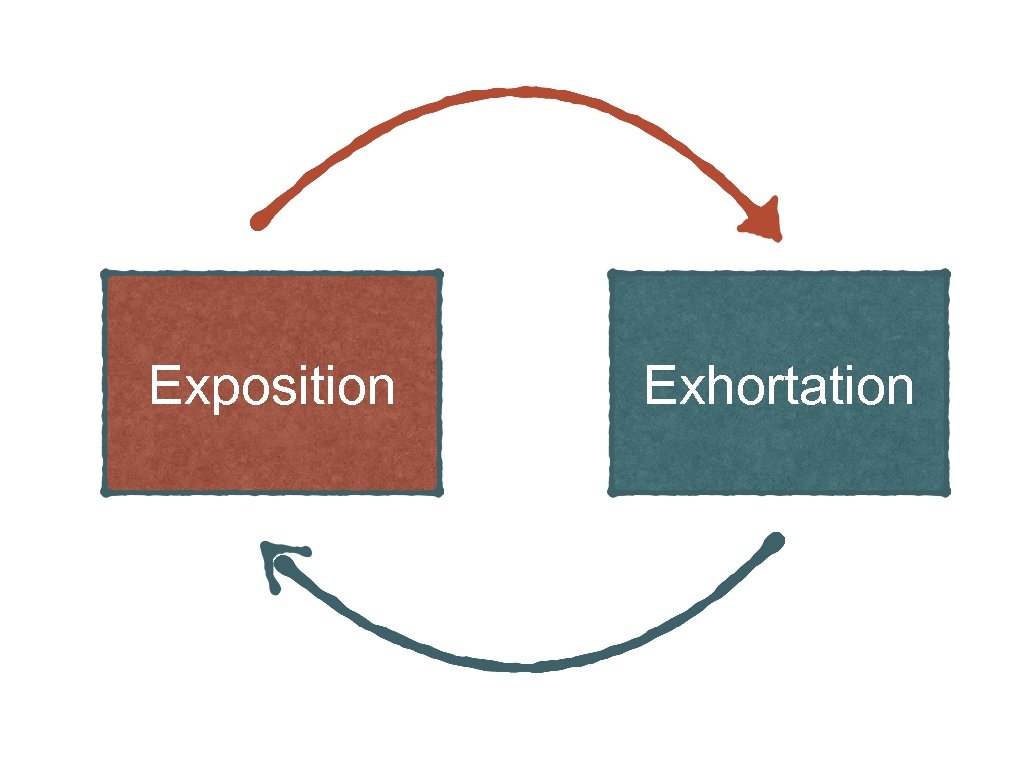
Exposition Exhortation
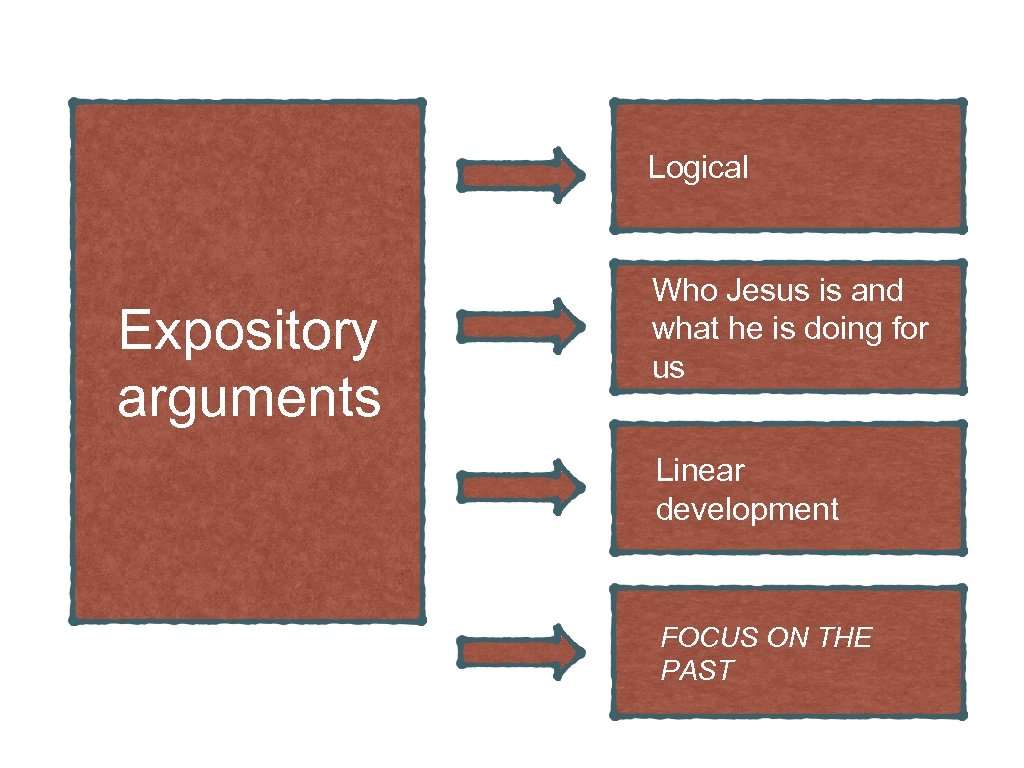
Logical Expository arguments Who Jesus is and what he is doing for us Linear development FOCUS ON THE PAST
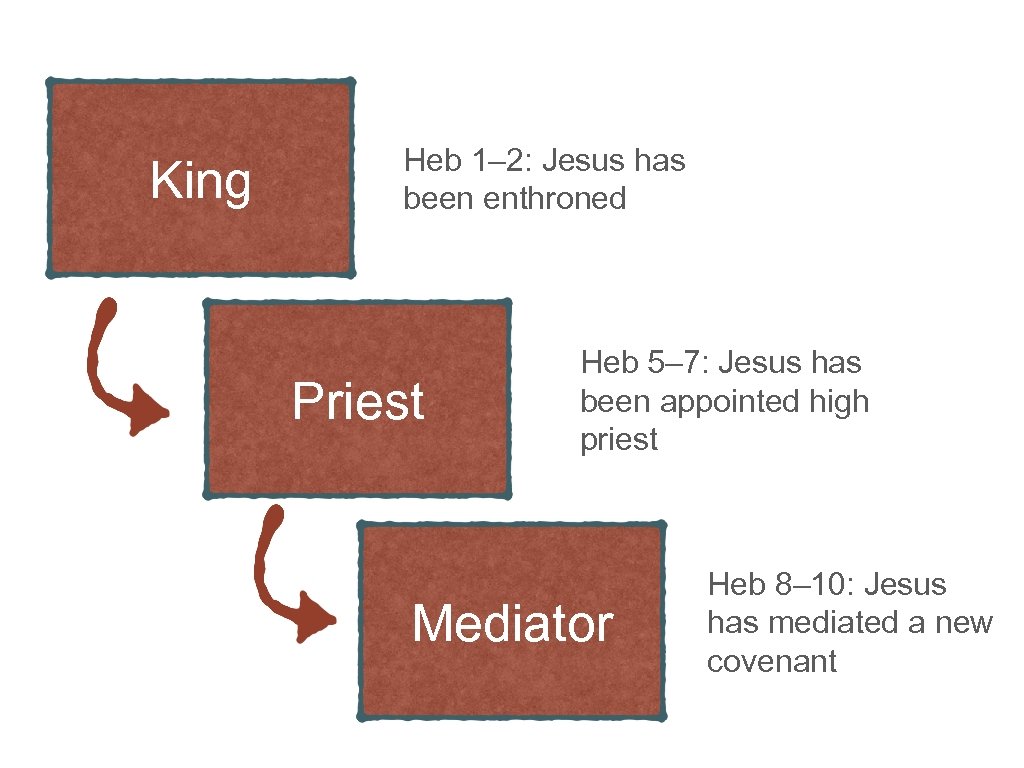
King Heb 1– 2: Jesus has been enthroned Priest Heb 5– 7: Jesus has been appointed high priest Mediator Heb 8– 10: Jesus has mediated a new covenant
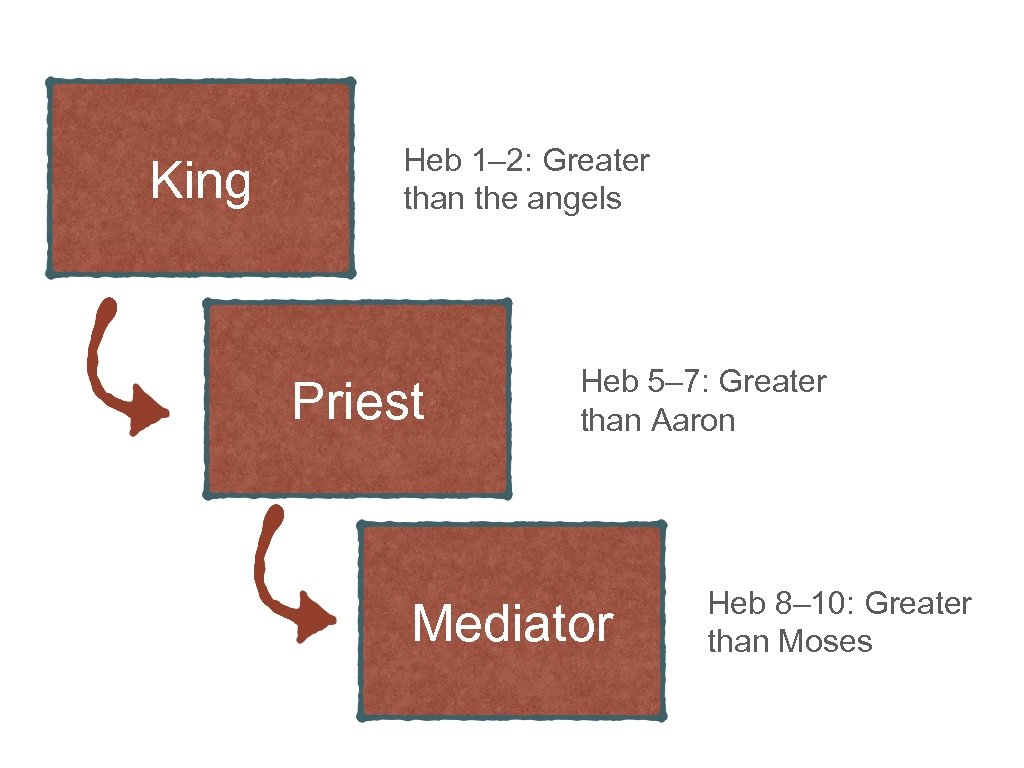
King Heb 1– 2: Greater than the angels Priest Heb 5– 7: Greater than Aaron Mediator Heb 8– 10: Greater than Moses
A DIFFERENT PERSPECTIVE • Three Premises: – Hebrews conceives Jesus’ ascension as the inauguration of his office as “Son” at the “right hand of God” (Heb 1: 3, 13; 8: 1 -2; 10: 12 -13; 12: 1 -2; cf. 4: 14 -16). – he title “Son”—or “Son of God”—is used eminently as a royal title. – Hebrews understands the title “Son” as the fulfillment of the promise made to David (2 Sam 7: 14; cf. Heb 1: 5). – All other achievements related to Jesus’ ascension are a function of, or derive from, the Son’s installation as ruler.
Jesus is the Son “. . . for the author of Hebrews, Jesus’ primary status is not that of Melchizedekian high priest but son of God. . In many ways Jesus’ work may be compared with that of his biblical predecessors, namely Moses and the high priest, but in each case it is his sonship which is used to highlight the contrast between his status and theirs. ” Marie E. Isaacs, Sacred Space, 178.
Heb 1– 4: The Son is King • The Catena (1: 5 -14): Describes the enthronement of the Son • Jesus’ kingship fulfills the promises of the Davidic Covenant (2 Sam 7) – – Jesus is “heir of all things” (Heb 1: 2; cf. Ps 2: 8) It has a great “name” (Heb 1: 4; cf. 2 Sam 7: 9) Is God’s Son (Heb 1: 5; cf. 2 Sam 7: 14; Ps 2: 7) His throne is established forever (Heb 1: 8 -12; cf. 2 Sam 7: 13 -16) – Leads the people into the rest (Heb 3: 3 -4; 2 Sam 7: 11). – He is the builder with God of the house of God (Heb 3: 1 -6; 8: 2; 2 Sam 7: 13).
The Son is High Priest • The author deliberately relates Jesus’ appointment as high priest to his status as Son: – So also Christ did not glorify himself in becoming a high priest, but was appointed by the one who said to him, “You are my Son, today I have begotten you”; as he says also in another place, “You are a priest forever, according to the order of Melchizedek” (Heb 5: 5 -6).
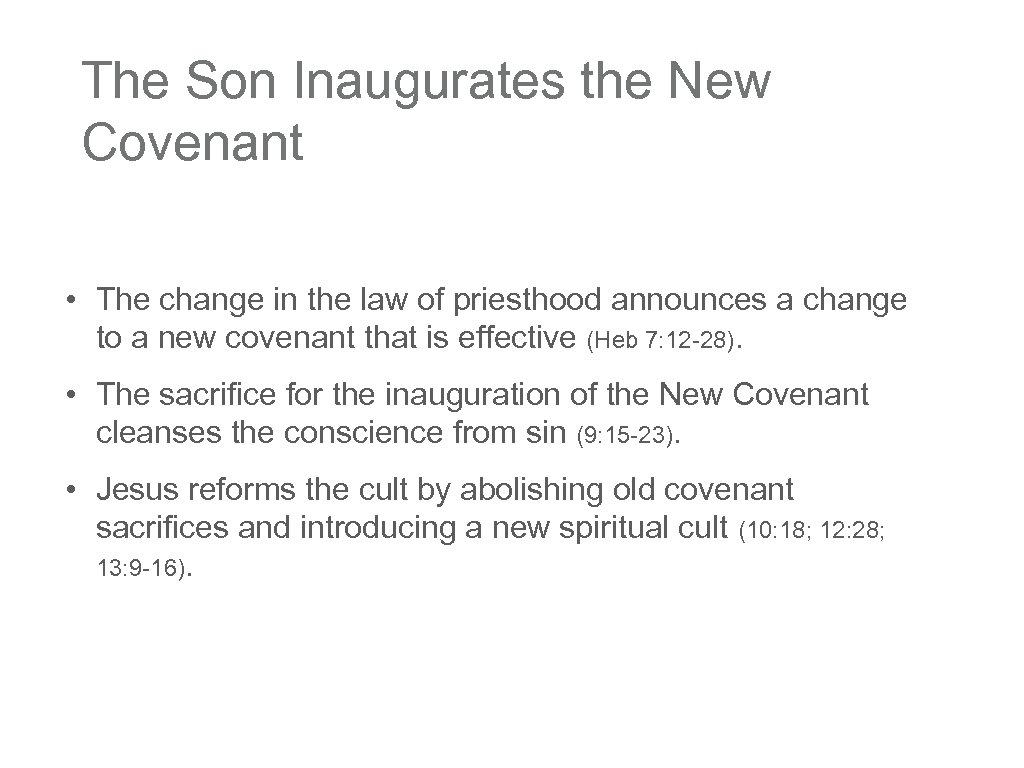
The Son Inaugurates the New Covenant • The change in the law of priesthood announces a change to a new covenant that is effective (Heb 7: 12 -28). • The sacrifice for the inauguration of the New Covenant cleanses the conscience from sin (9: 15 -23). • Jesus reforms the cult by abolishing old covenant sacrifices and introducing a new spiritual cult (10: 18; 12: 28; 13: 9 -16).
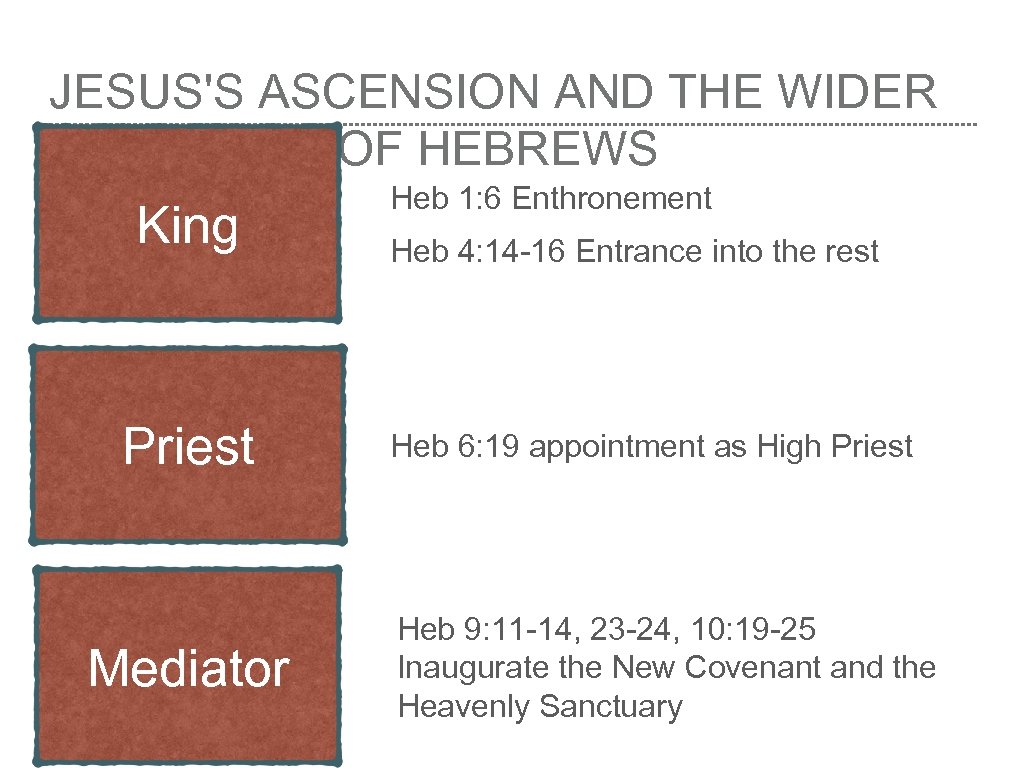
JESUS'S ASCENSION AND THE WIDER ARGUMENT OF HEBREWS King Priest Mediator Heb 1: 6 Enthronement Heb 4: 14 -16 Entrance into the rest Heb 6: 19 appointment as High Priest Heb 9: 11 -14, 23 -24, 10: 19 -25 Inaugurate the New Covenant and the Heavenly Sanctuary
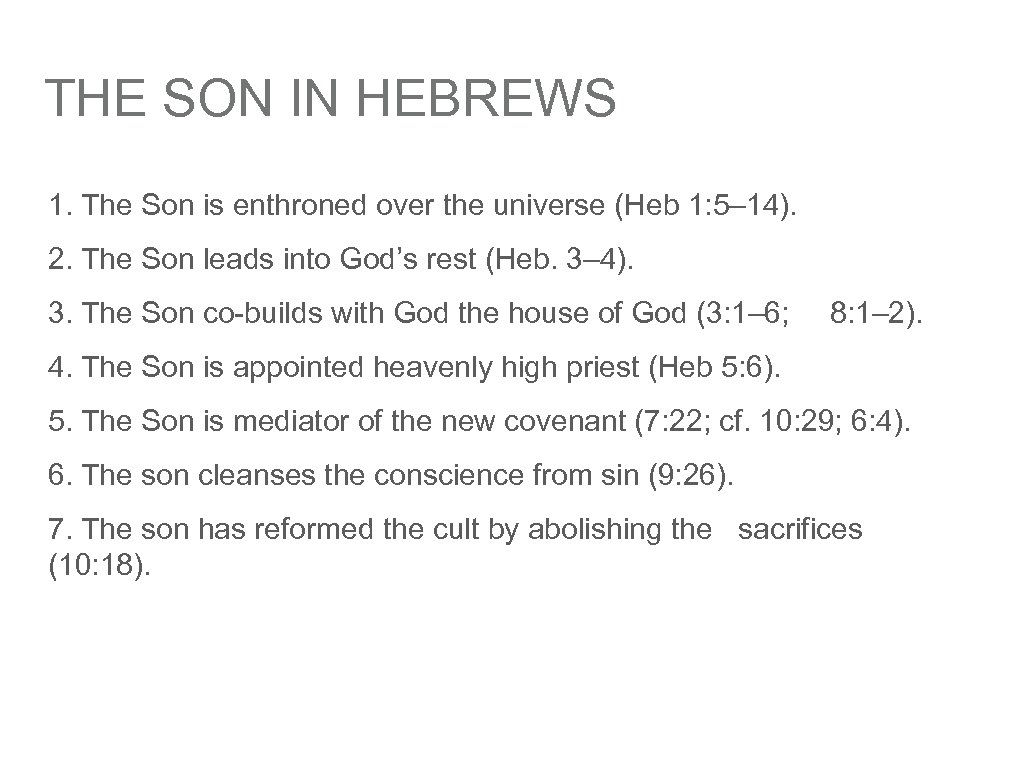
THE SON IN HEBREWS 1. The Son is enthroned over the universe (Heb 1: 5– 14). 2. The Son leads into God’s rest (Heb. 3– 4). 3. The Son co-builds with God the house of God (3: 1– 6; 8: 1– 2). 4. The Son is appointed heavenly high priest (Heb 5: 6). 5. The Son is mediator of the new covenant (7: 22; cf. 10: 29; 6: 4). 6. The son cleanses the conscience from sin (9: 26). 7. The son has reformed the cult by abolishing the sacrifices (10: 18).
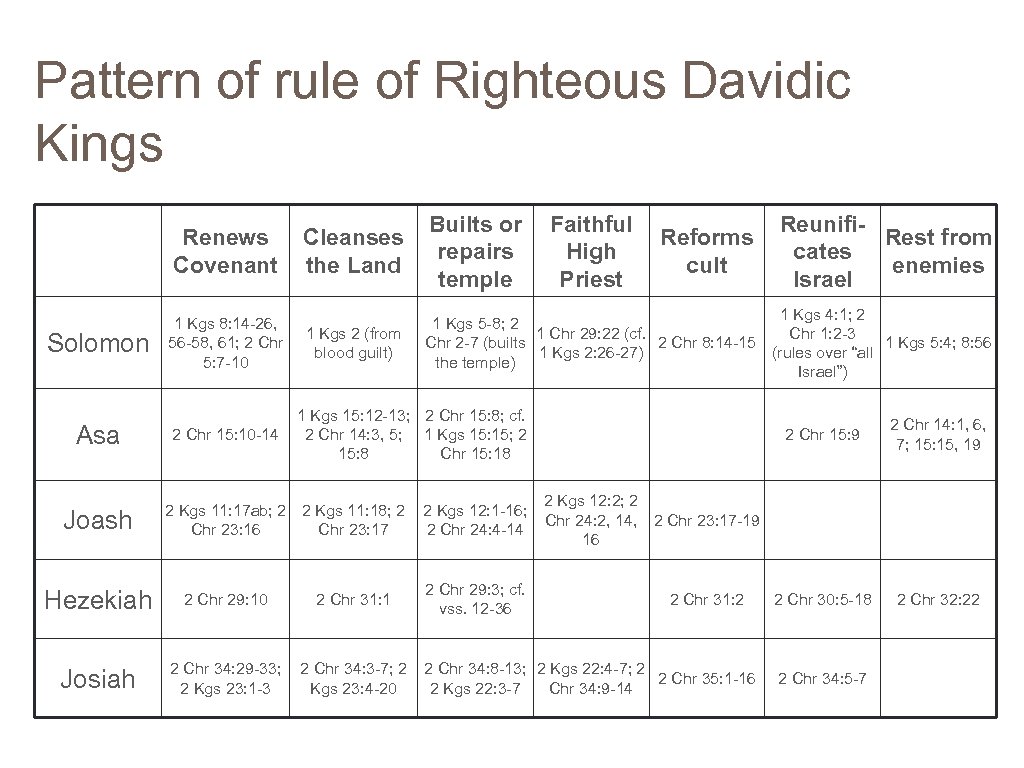
Pattern of rule of Righteous Davidic Kings Renews Covenant Solomon Asa Joash Hezekiah Josiah 1 Kgs 8: 14 -26, 56 -58, 61; 2 Chr 5: 7 -10 Cleanses the Land Builts or repairs temple Faithful High Priest 1 Kgs 2 (from blood guilt) 1 Kgs 4: 1; 2 1 Kgs 5 -8; 2 Chr 1: 2 -3 1 Chr 29: 22 (cf. Chr 2 -7 (builts 2 Chr 8: 14 -15 1 Kgs 5: 4; 8: 56 1 Kgs 2: 26 -27) (rules over “all the temple) Israel”) Reforms cult 1 Kgs 15: 12 -13; 2 Chr 15: 8; cf. 2 Chr 15: 10 -14 2 Chr 14: 3, 5; 1 Kgs 15: 15; 2 15: 8 Chr 15: 18 Reunifi. Rest from cates enemies Israel 2 Chr 15: 9 2 Chr 14: 1, 6, 7; 15: 15, 19 2 Chr 30: 5 -18 2 Chr 32: 22 2 Kgs 12: 2; 2 2 Kgs 11: 17 ab; 2 2 Kgs 11: 18; 2 2 Kgs 12: 1 -16; Chr 24: 2, 14, 2 Chr 23: 17 -19 Chr 23: 16 Chr 23: 17 2 Chr 24: 4 -14 16 2 Chr 29: 10 2 Chr 31: 1 2 Chr 29: 3; cf. vss. 12 -36 2 Chr 31: 2 2 Chr 34: 29 -33; 2 Chr 34: 3 -7; 2 2 Chr 34: 8 -13; 2 Kgs 22: 4 -7; 2 2 Chr 35: 1 -16 2 Kgs 23: 1 -3 Kgs 23: 4 -20 2 Kgs 22: 3 -7 Chr 34: 9 -14 2 Chr 34: 5 -7
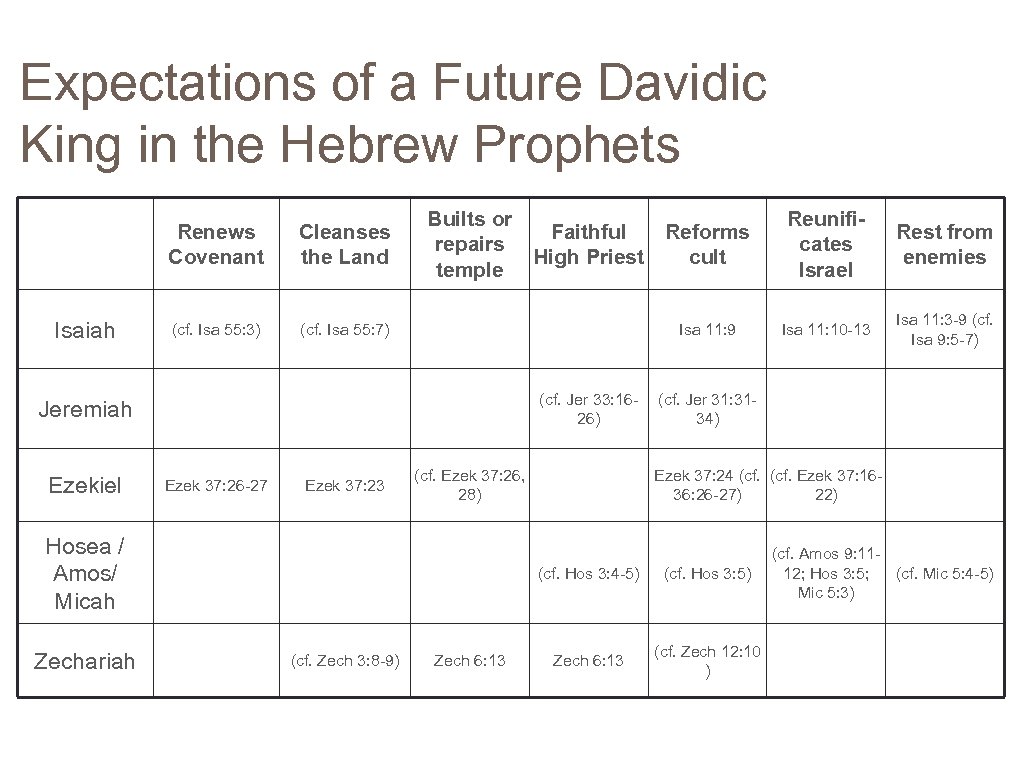
Expectations of a Future Davidic King in the Hebrew Prophets Renews Covenant Isaiah Cleanses the Land (cf. Isa 55: 3) Builts or Faithful Reforms repairs High Priest cult temple (cf. Isa 55: 7) Isa 11: 9 (cf. Jer 33: 1626) Jeremiah Ezekiel Ezek 37: 26 -27 Ezek 37: 23 (cf. Ezek 37: 26, 28) Hosea / Amos/ Micah Zechariah Zech 6: 13 Rest from enemies Isa 11: 10 -13 Isa 11: 3 -9 (cf. Isa 9: 5 -7) (cf. Jer 31: 3134) Ezek 37: 24 (cf. Ezek 37: 1636: 26 -27) 22) (cf. Hos 3: 4 -5) (cf. Zech 3: 8 -9) Reunificates Israel (cf. Hos 3: 5) Zech 6: 13 (cf. Zech 12: 10 ) (cf. Amos 9: 1112; Hos 3: 5; (cf. Mic 5: 4 -5) Mic 5: 3)
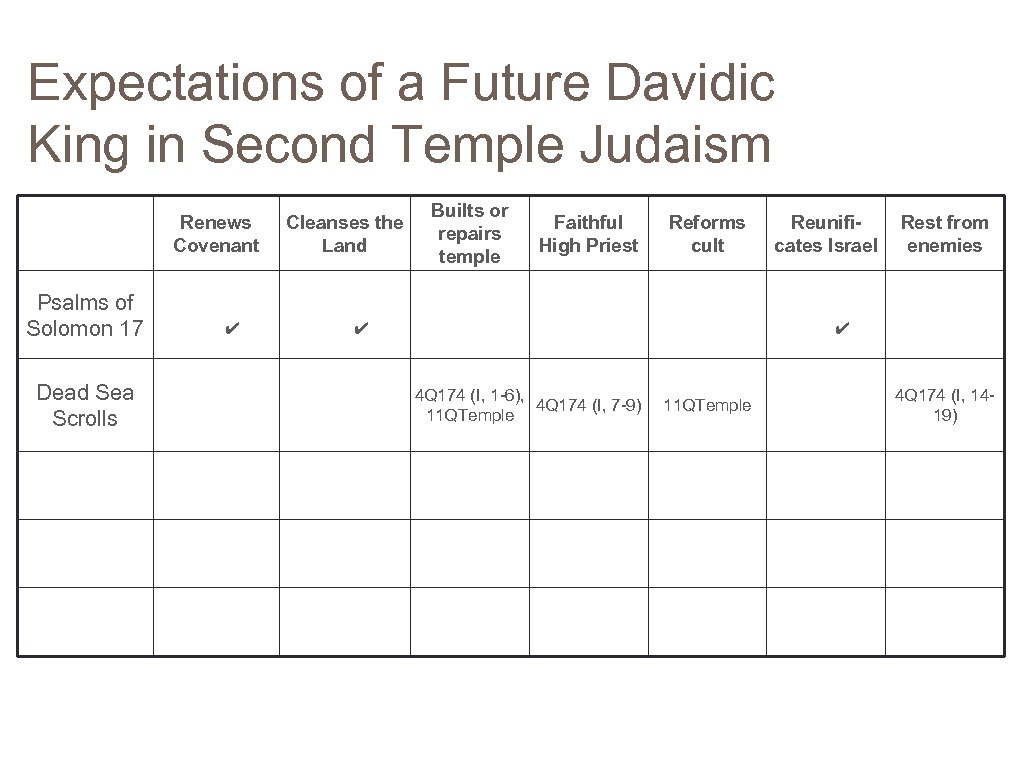
Expectations of a Future Davidic King in Second Temple Judaism Renews Covenant Psalms of Solomon 17 Dead Sea Scrolls Cleanses the Land ✔ Builts or repairs temple Faithful High Priest Reforms cult ✔ Reunificates Israel Rest from enemies ✔ 4 Q 174 (I, 1 -6), 4 Q 174 (I, 7 -9) 11 QTemple 4 Q 174 (I, 1419)
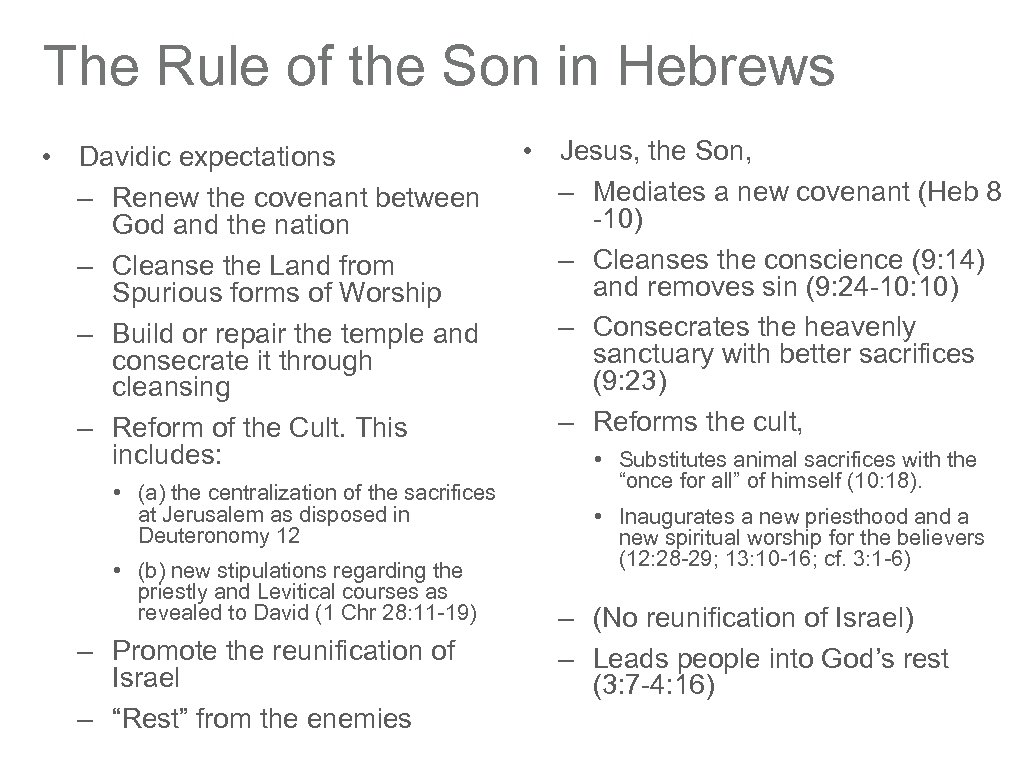
The Rule of the Son in Hebrews • Davidic expectations – Renew the covenant between God and the nation – Cleanse the Land from Spurious forms of Worship – Build or repair the temple and consecrate it through cleansing – Reform of the Cult. This includes: • (a) the centralization of the sacrifices at Jerusalem as disposed in Deuteronomy 12 • (b) new stipulations regarding the priestly and Levitical courses as revealed to David (1 Chr 28: 11 -19) – Promote the reunification of Israel – “Rest” from the enemies • Jesus, the Son, – Mediates a new covenant (Heb 8 -10) – Cleanses the conscience (9: 14) and removes sin (9: 24 -10: 10) – Consecrates the heavenly sanctuary with better sacrifices (9: 23) – Reforms the cult, • Substitutes animal sacrifices with the “once for all” of himself (10: 18). • Inaugurates a new priesthood and a new spiritual worship for the believers (12: 28 -29; 13: 10 -16; cf. 3: 1 -6) – (No reunification of Israel) – Leads people into God’s rest (3: 7 -4: 16)
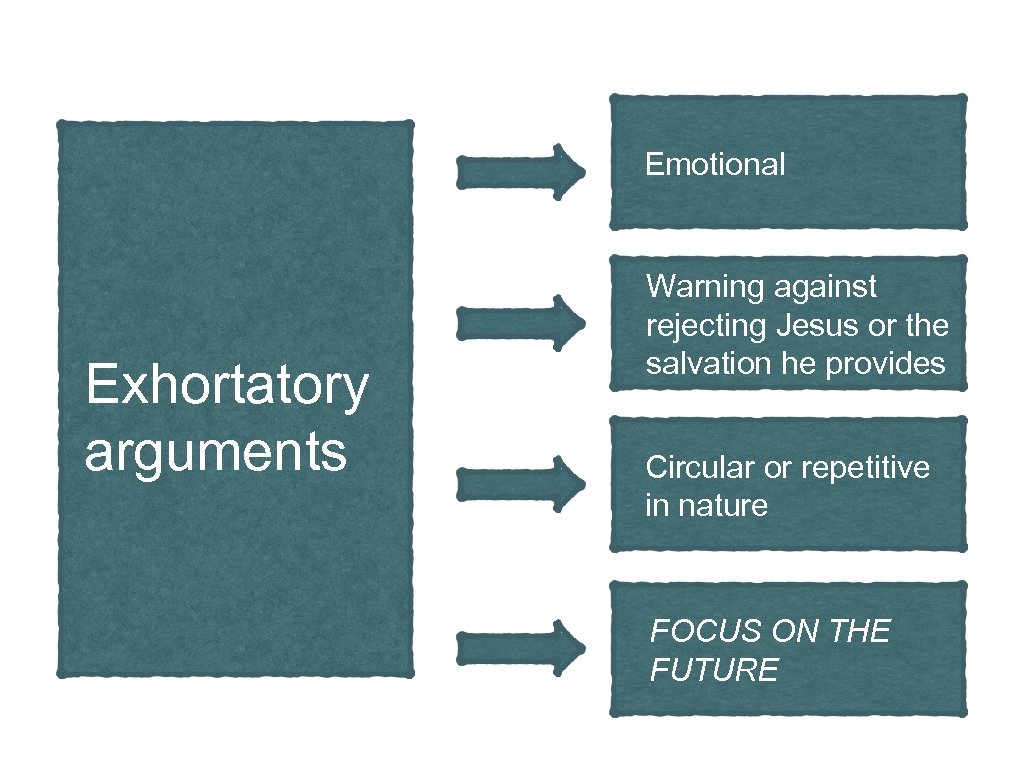
Emotional Exhortatory arguments Warning against rejecting Jesus or the salvation he provides Circular or repetitive in nature FOCUS ON THE FUTURE
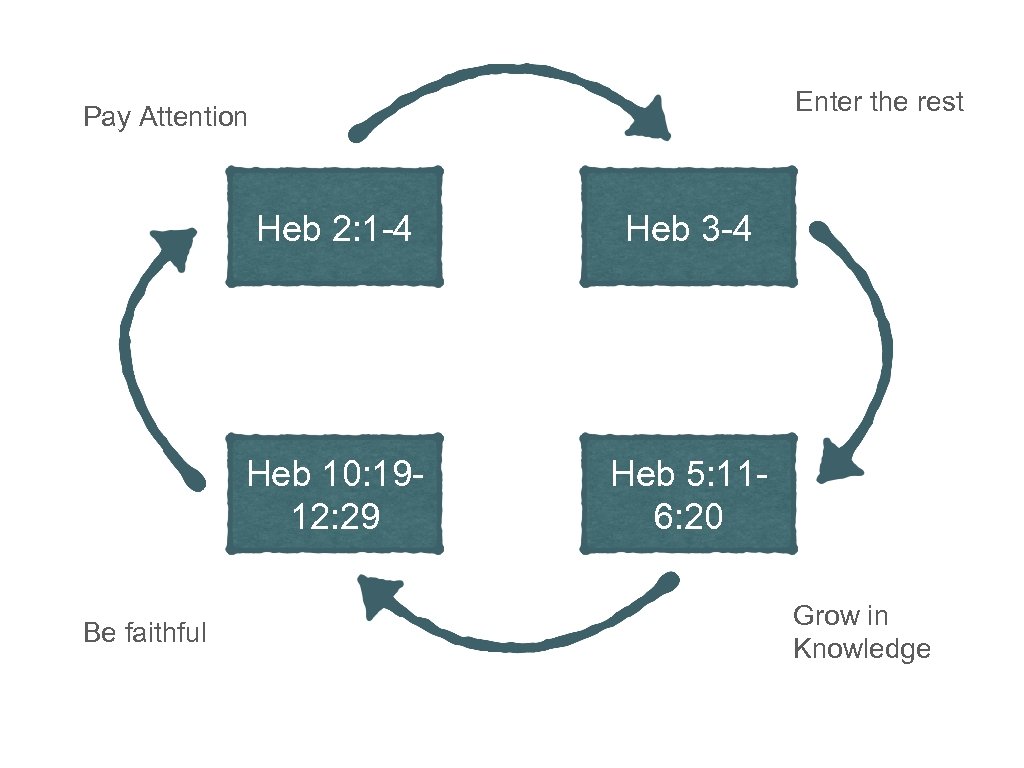
Enter the rest Pay Attention Heb 2: 1 -4 Heb 10: 1912: 29 Be faithful Heb 3 -4 Heb 5: 116: 20 Grow in Knowledge
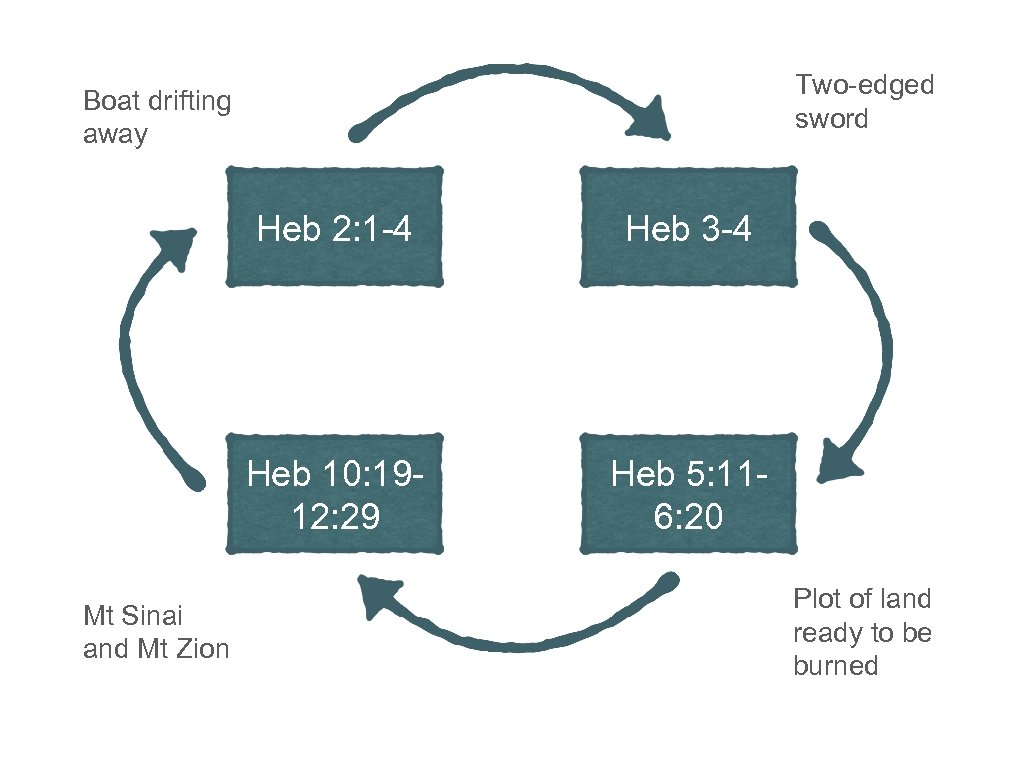
Two-edged sword Boat drifting away Heb 2: 1 -4 Heb 10: 1912: 29 Mt Sinai and Mt Zion Heb 3 -4 Heb 5: 116: 20 Plot of land ready to be burned
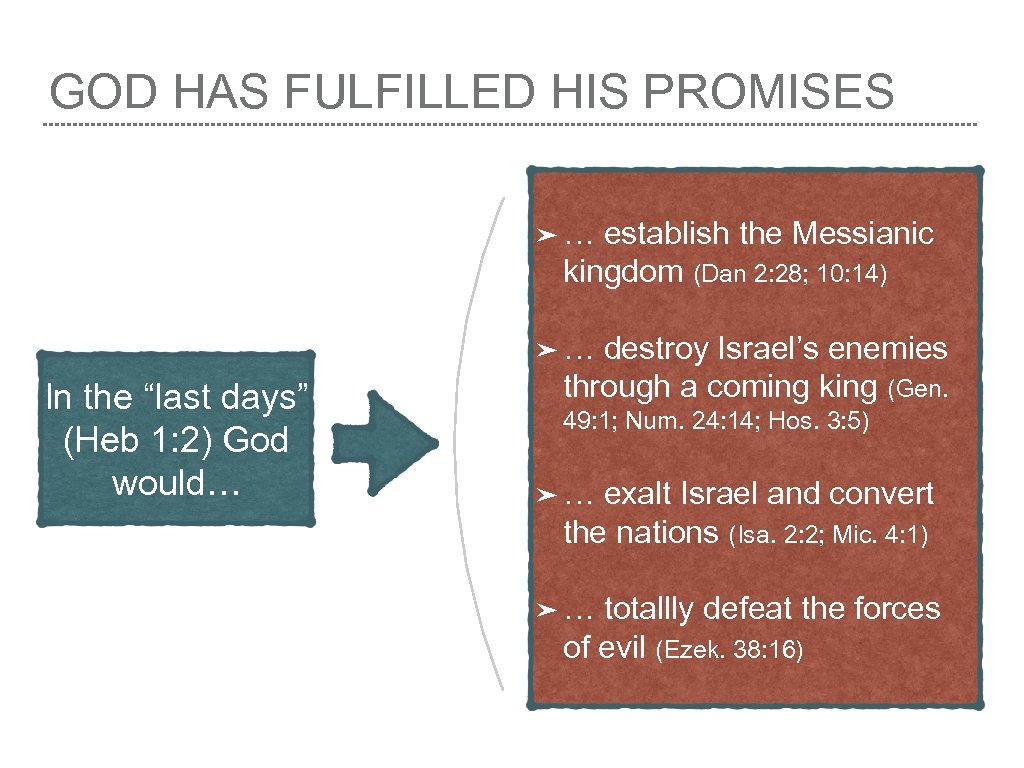
GOD HAS FULFILLED HIS PROMISES ➤ … establish the Messianic kingdom (Dan 2: 28; 10: 14) ➤ … destroy Israel’s enemies In the “last days” (Heb 1: 2) God would… through a coming king (Gen. 49: 1; Num. 24: 14; Hos. 3: 5) ➤ … exalt Israel and convert the nations (Isa. 2: 2; Mic. 4: 1) ➤ … totallly defeat the forces of evil (Ezek. 38: 16)
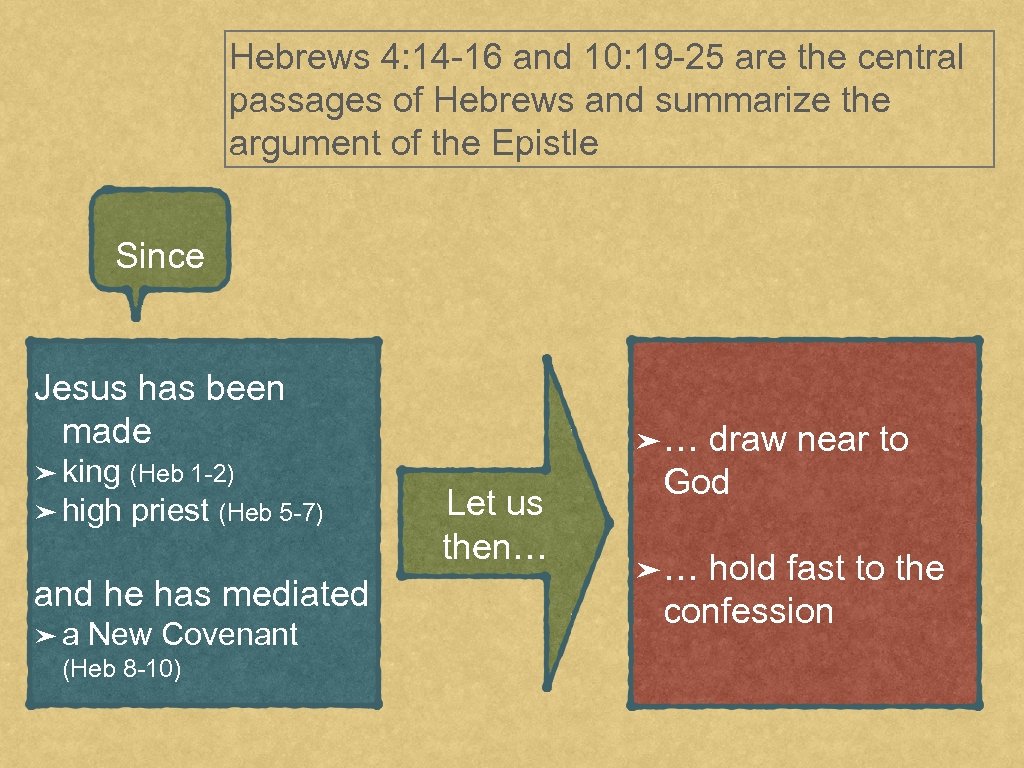
Hebrews 4: 14 -16 and 10: 19 -25 are the central passages of Hebrews and summarize the argument of the Epistle Since Jesus has been made ➤ king (Heb 1 -2) ➤ high priest (Heb 5 -7) and he has mediated ➤ a New Covenant (Heb 8 -10) ➤… draw near to Let us then… God ➤… hold fast to the confession
“ Let us hold fast our confession. -Heb 4: 14; cf. 10: 23
RHETORI CAL LOCATIO N OF THE AUDIENC E
SUBJECTION OF ENEMIES But when Christ had offered for all time a single sacrifice for sins, "he sat down at the right hand of God, " and since then has been waiting "until his enemies would be made a footstool for his feet. ” Heb. 10: 12– 13
SUBJECTION OF ENEMIES But each in his own order: Christ the first fruits, then at his coming those who belong to Christ. Then comes the end, when he hands over the kingdom to God the Father, after he has destroyed every ruler and every authority and power. For he must reign until he has put all his enemies under his feet. The last enemy to be destroyed is death. 1 Cor 15: 23– 26.
THE USE OF COMPARI SONS (SYNKRIS IS)
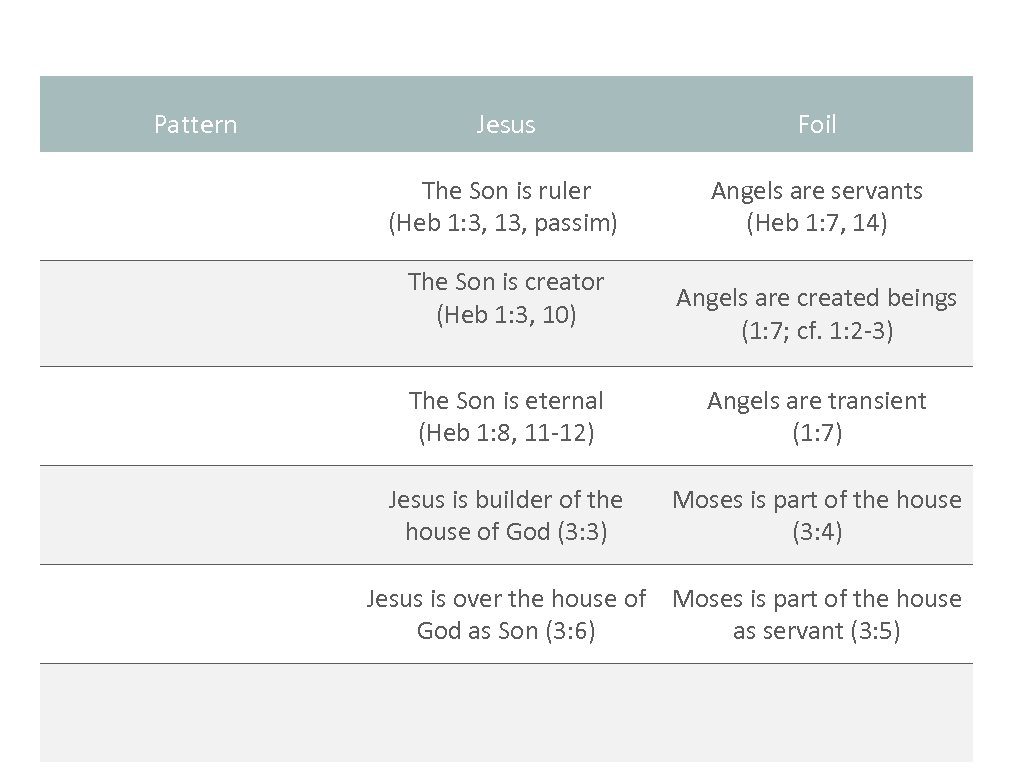
Pattern Jesus Foil The Son is ruler (Heb 1: 3, 13, passim) Angels are servants (Heb 1: 7, 14) The Son is creator (Heb 1: 3, 10) Angels are created beings (1: 7; cf. 1: 2 -3) The Son is eternal (Heb 1: 8, 11 -12) Angels are transient (1: 7) Jesus is builder of the house of God (3: 3) Moses is part of the house (3: 4) Jesus is over the house of Moses is part of the house God as Son (3: 6) as servant (3: 5)
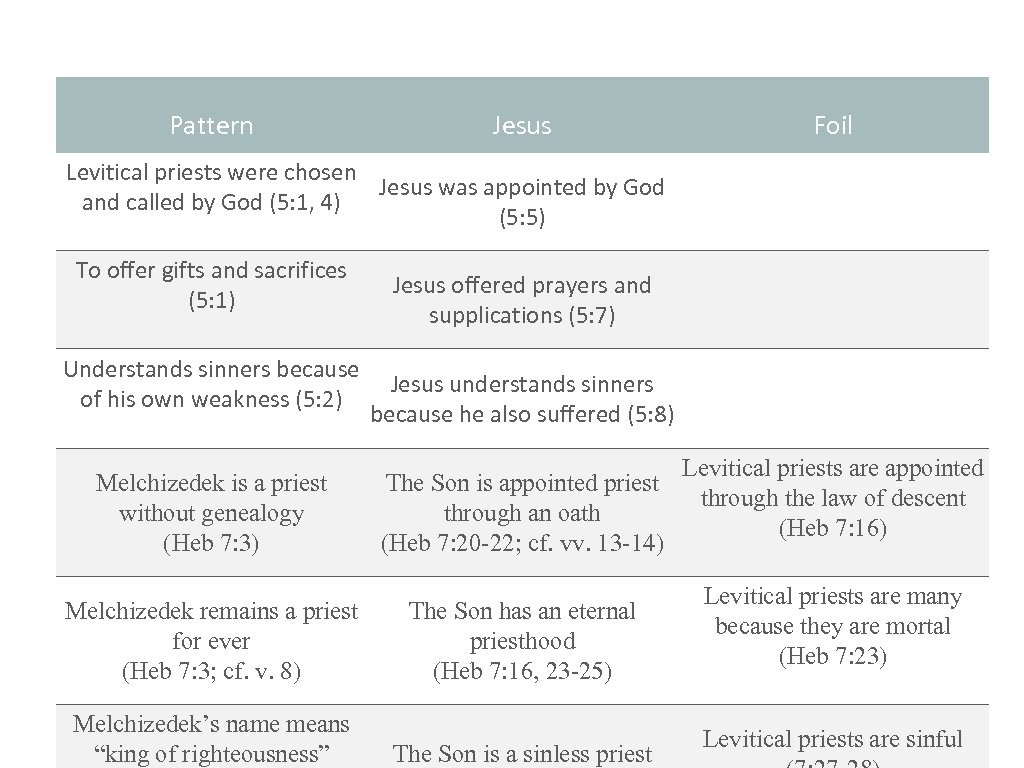
Pattern Jesus Foil Levitical priests were chosen Jesus was appointed by God and called by God (5: 1, 4) (5: 5) To offer gifts and sacrifices (5: 1) Jesus offered prayers and supplications (5: 7) Understands sinners because Jesus understands sinners of his own weakness (5: 2) because he also suffered (5: 8) Melchizedek is a priest without genealogy (Heb 7: 3) The Son is appointed priest through an oath (Heb 7: 20 -22; cf. vv. 13 -14) Levitical priests are appointed through the law of descent (Heb 7: 16) Melchizedek remains a priest for ever (Heb 7: 3; cf. v. 8) The Son has an eternal priesthood (Heb 7: 16, 23 -25) Levitical priests are many because they are mortal (Heb 7: 23) Melchizedek’s name means “king of righteousness” The Son is a sinless priest Levitical priests are sinful
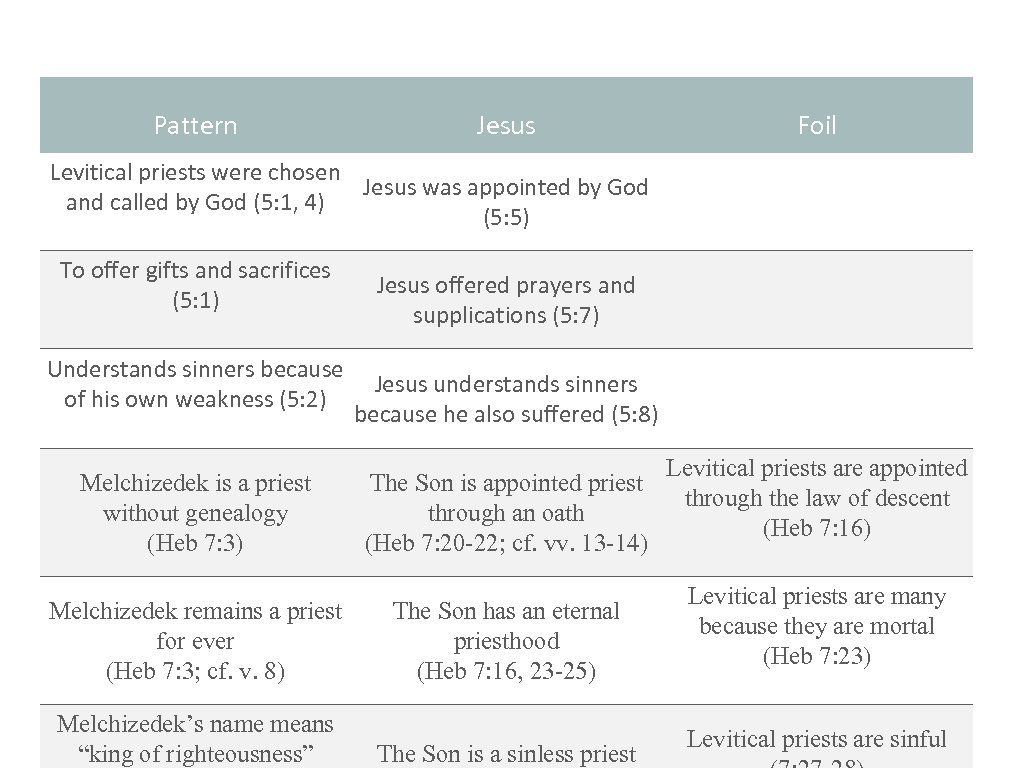
Pattern Jesus Foil Levitical priests were chosen Jesus was appointed by God and called by God (5: 1, 4) (5: 5) To offer gifts and sacrifices (5: 1) Jesus offered prayers and supplications (5: 7) Understands sinners because Jesus understands sinners of his own weakness (5: 2) because he also suffered (5: 8) Melchizedek is a priest without genealogy (Heb 7: 3) The Son is appointed priest through an oath (Heb 7: 20 -22; cf. vv. 13 -14) Levitical priests are appointed through the law of descent (Heb 7: 16) Melchizedek remains a priest for ever (Heb 7: 3; cf. v. 8) The Son has an eternal priesthood (Heb 7: 16, 23 -25) Levitical priests are many because they are mortal (Heb 7: 23) Melchizedek’s name means “king of righteousness” The Son is a sinless priest Levitical priests are sinful
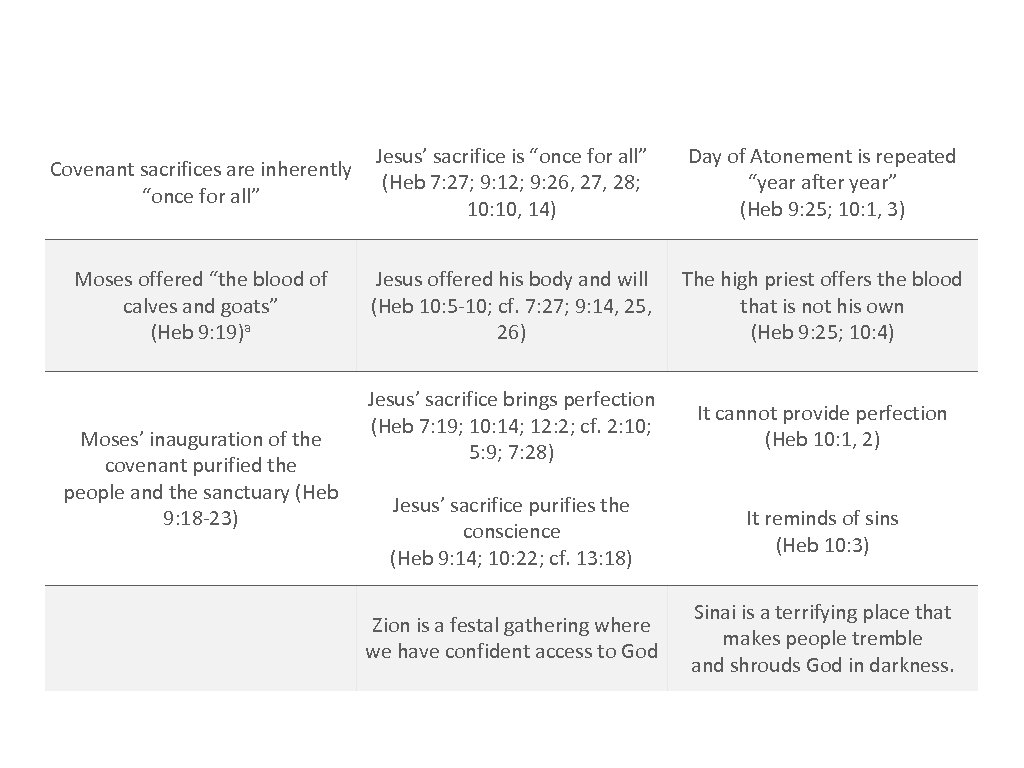
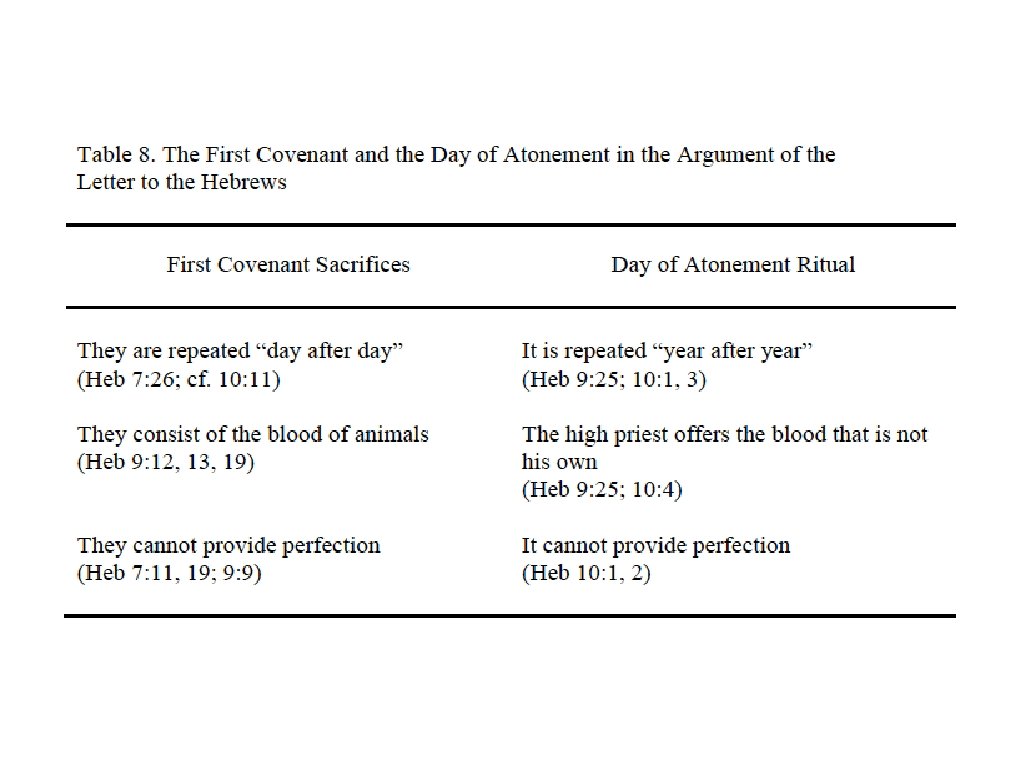
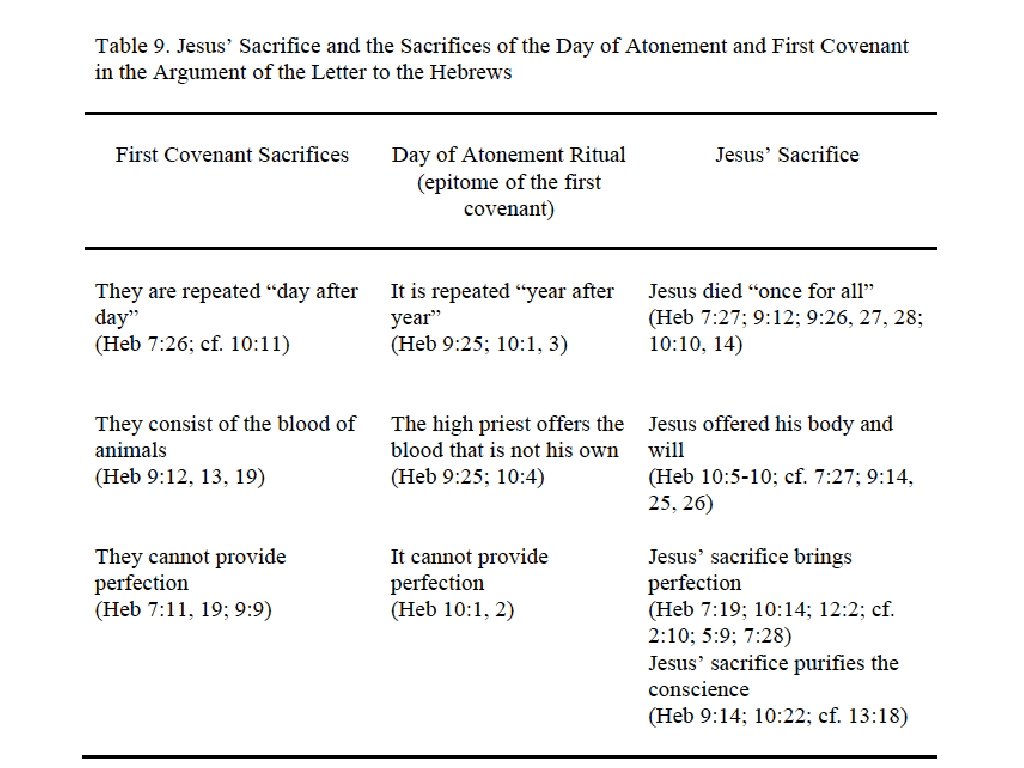
Jesus’ sacrifice is “once for all” Covenant sacrifices are inherently (Heb 7: 27; 9: 12; 9: 26, 27, 28; “once for all” 10: 10, 14) Day of Atonement is repeated “year after year” (Heb 9: 25; 10: 1, 3) Moses offered “the blood of calves and goats” (Heb 9: 19)a Jesus offered his body and will (Heb 10: 5 -10; cf. 7: 27; 9: 14, 25, 26) The high priest offers the blood that is not his own (Heb 9: 25; 10: 4) Moses’ inauguration of the covenant purified the people and the sanctuary (Heb 9: 18 -23) Jesus’ sacrifice brings perfection (Heb 7: 19; 10: 14; 12: 2; cf. 2: 10; 5: 9; 7: 28) Jesus’ sacrifice purifies the conscience (Heb 9: 14; 10: 22; cf. 13: 18) It cannot provide perfection (Heb 10: 1, 2) It reminds of sins (Heb 10: 3) Zion is a festal gathering where we have confident access to God Sinai is a terrifying place that makes people tremble and shrouds God in darkness.
REFEREN CES TO THE DAY OF ATONEM ENT

ALLUSIO NS TO DANIEL
HEBREWS’ DANIELIC PERSPECTIVE Long ago God spoke to our ancestors in many and various ways by the prophets, but in these last days he has spoken to us by a Son Heb 1: 1– 2
DANIELIC THEOLOGY IN THE BACKGROUND “To finish the transgression, to put an end to sin” (Dan 9: 24) —“to remove sin” (Heb 9: 26). “To atone for iniquity” (Dan 9: 24) —“a death has occurred that redeems them from the transgressions under the first covenant” (Heb 9: 15). “To anoint a most holy place” (Dan 9: 24) —inauguration of a new priesthood together with the inauguration of a new covenant (Heb 9: 18– 23; cf. chaps. 5– 7). “make a strong covenant with many” (Dan 9: 27) —inauguration of a new covenant (Heb 9: 15– 23). “make sacrifice and offering cease” (Dan 9: 27) —Jesus’ sacrifice brings the offerings to an end (Heb 10: 18; cf. 1– 18).
KINGDOM RECEIVED THROUGH JUDGMENT And just as it is appointed for mortals to die once, and after that the judgment, so Christ, having been offered once to bear the sins of many, will appear a second time, not to deal with sin, but to save those who are eagerly waiting for him. Heb 9: 27– 28
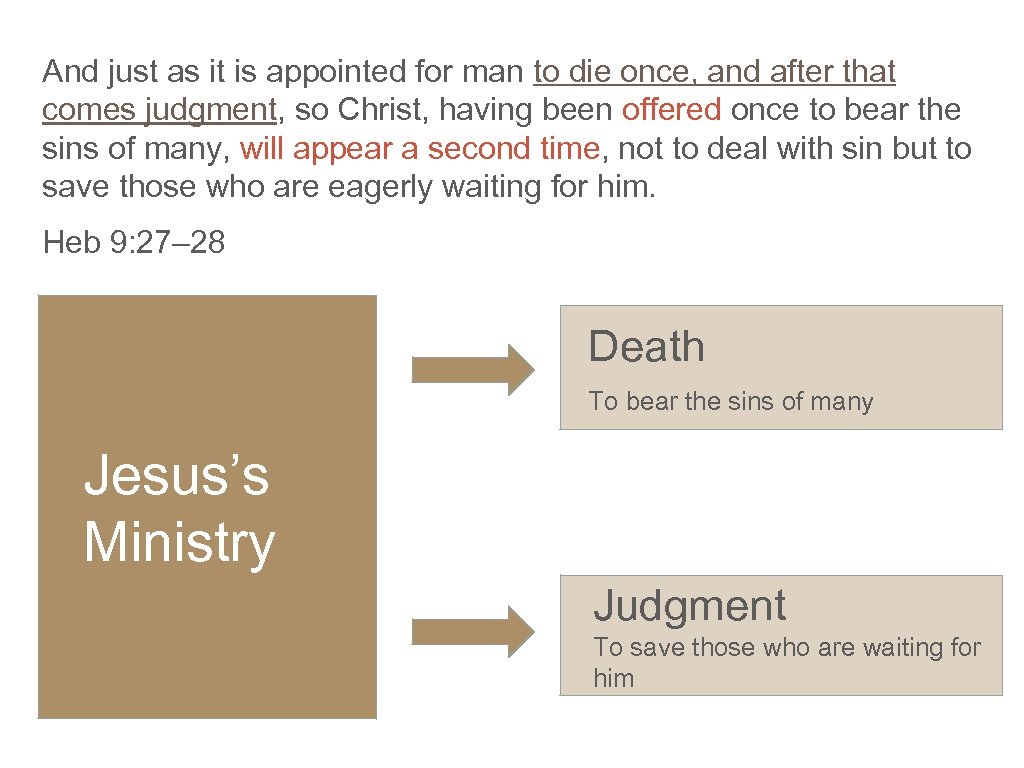
And just as it is appointed for man to die once, and after that comes judgment, so Christ, having been offered once to bear the sins of many, will appear a second time, not to deal with sin but to save those who are eagerly waiting for him. Heb 9: 27– 28 Death To bear the sins of many Jesus’s Ministry Judgment To save those who are waiting for him
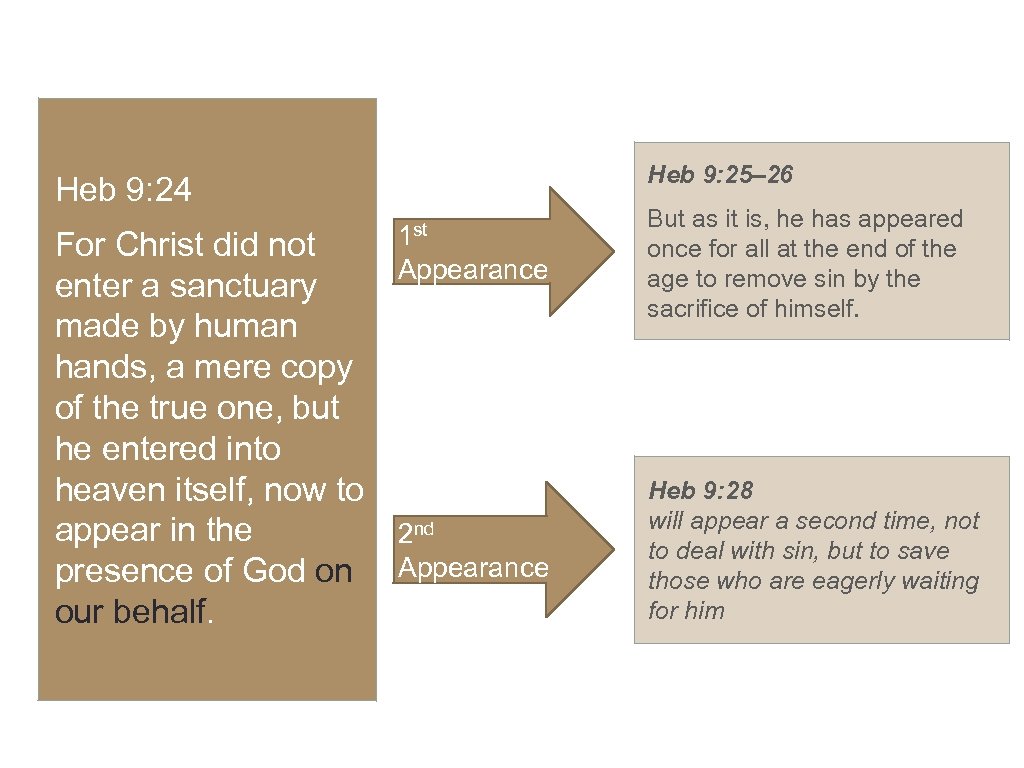
Heb 9: 25– 26 Heb 9: 24 1 st For Christ did not Appearance enter a sanctuary made by human hands, a mere copy of the true one, but he entered into heaven itself, now to appear in the 2 nd presence of God on Appearance our behalf. But as it is, he has appeared once for all at the end of the age to remove sin by the sacrifice of himself. Heb 9: 28 will appear a second time, not to deal with sin, but to save those who are eagerly waiting for him
A KINGDOM BEQUEATHED See that you do not refuse the one who is speaking; for if they did not escape when they refused the one who warned them on earth, how much less will we escape if we reject the one who warns from heaven! At that time his voice shook the earth; but now he has promised, "Yet once more I will shake not only the earth but also the heaven. ”
A KINGDOM BEQUEATHED This phrase, "Yet once more, " indicates the removal of what is shaken-- that is, created things-- so that what cannot be shaken may remain. 28 Therefore, since we are receiving a kingdom that cannot be shaken, let us give thanks, by which we offer to God an acceptable worship with reverence and awe; 29 for indeed our God is a consuming fire. Heb 12: 25– 29.
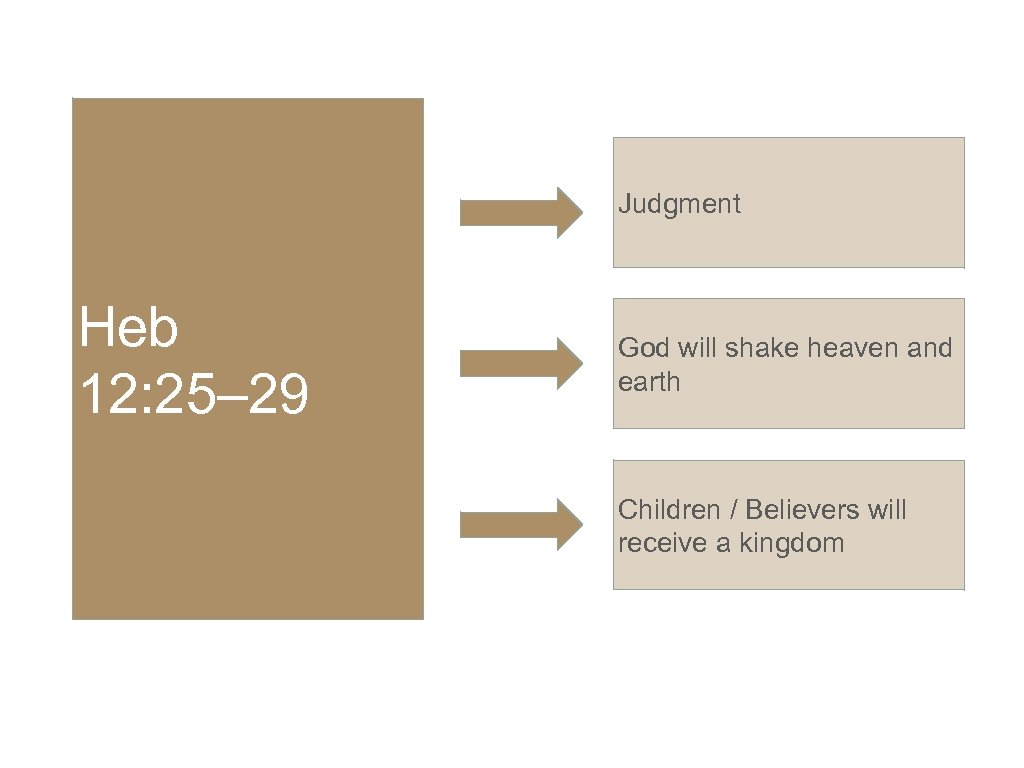
Judgment Heb 12: 25– 29 God will shake heaven and earth Children / Believers will receive a kingdom
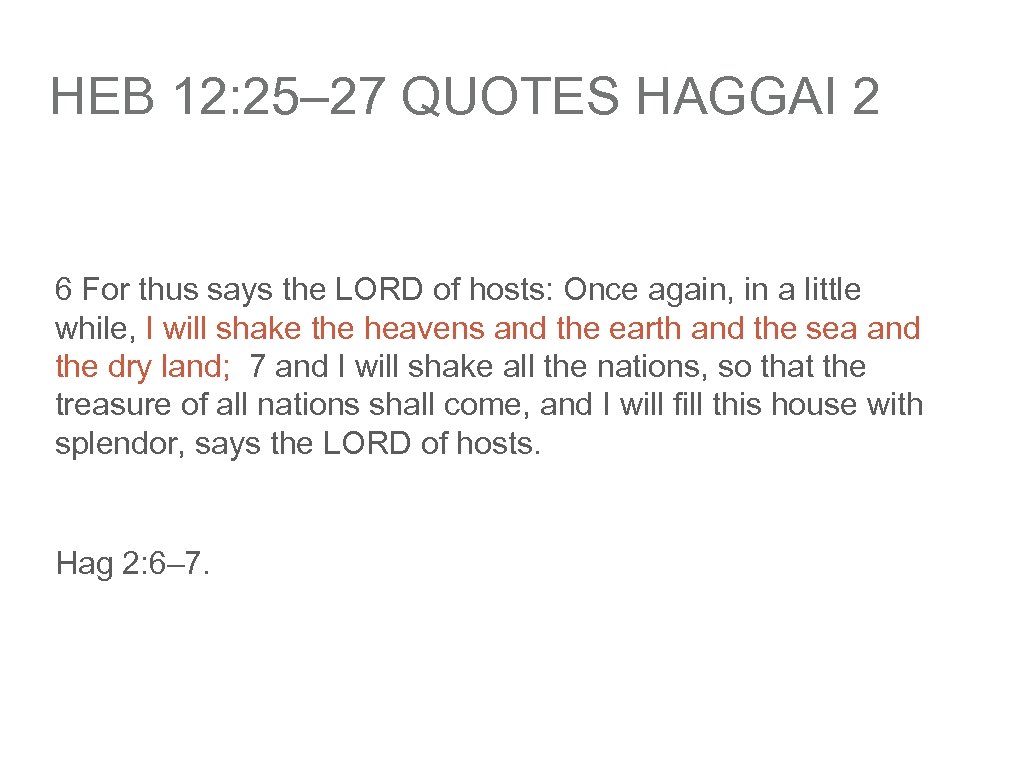
HEB 12: 25– 27 QUOTES HAGGAI 2 6 For thus says the LORD of hosts: Once again, in a little while, I will shake the heavens and the earth and the sea and the dry land; 7 and I will shake all the nations, so that the treasure of all nations shall come, and I will fill this house with splendor, says the LORD of hosts. Hag 2: 6– 7.
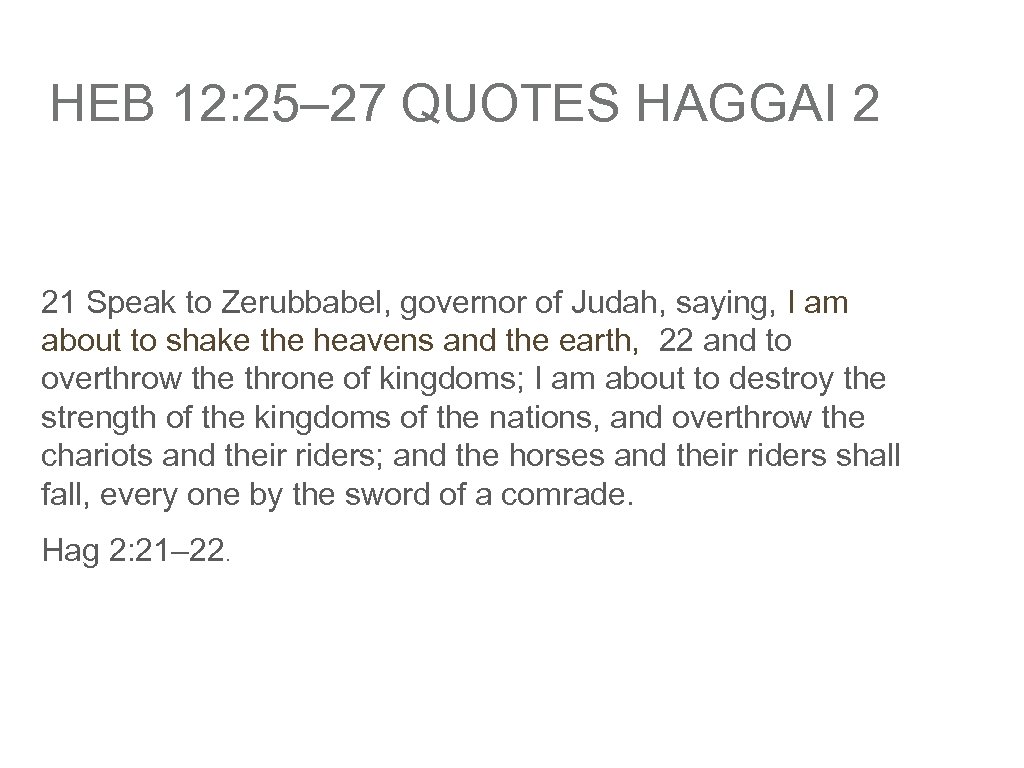
HEB 12: 25– 27 QUOTES HAGGAI 2 21 Speak to Zerubbabel, governor of Judah, saying, I am about to shake the heavens and the earth, 22 and to overthrow the throne of kingdoms; I am about to destroy the strength of the kingdoms of the nations, and overthrow the chariots and their riders; and the horses and their riders shall fall, every one by the sword of a comrade. Hag 2: 21– 22.
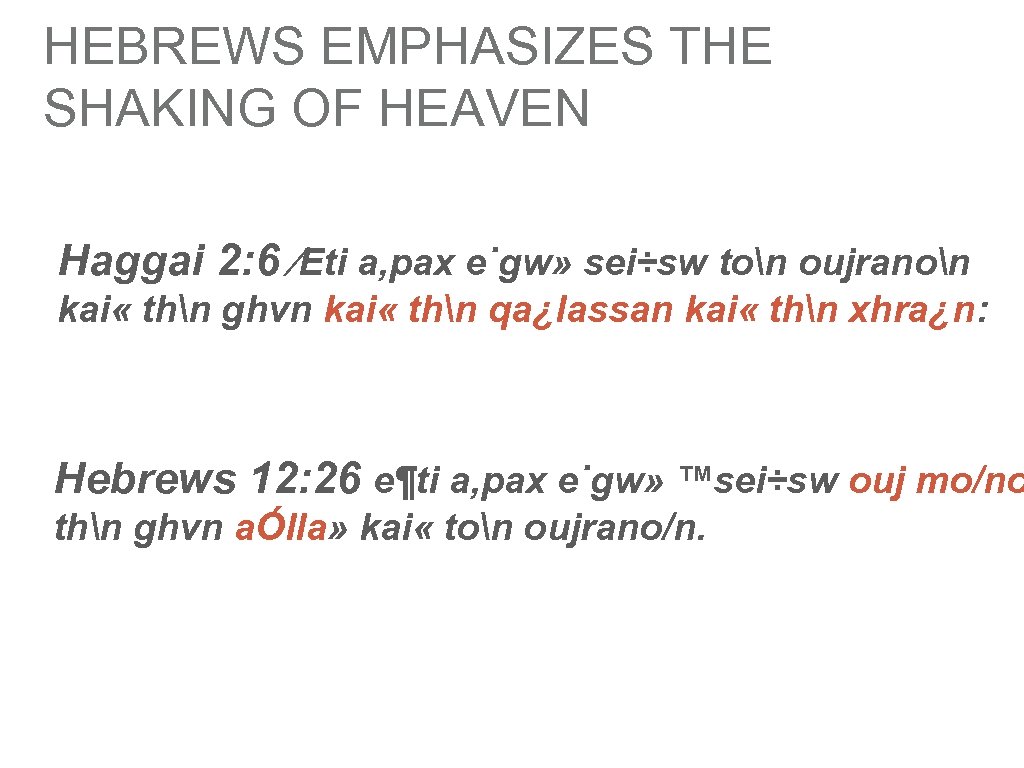
HEBREWS EMPHASIZES THE SHAKING OF HEAVEN Haggai 2: 6 ⁄Eti a‚pax e˙gw» sei÷sw ton oujranon kai « thn ghvn kai « thn qa¿lassan kai « thn xhra¿n: Hebrews 12: 26 e¶ti a‚pax e˙gw» ™sei÷sw ouj mo/no thn ghvn aÓlla» kai « ton oujrano/n.
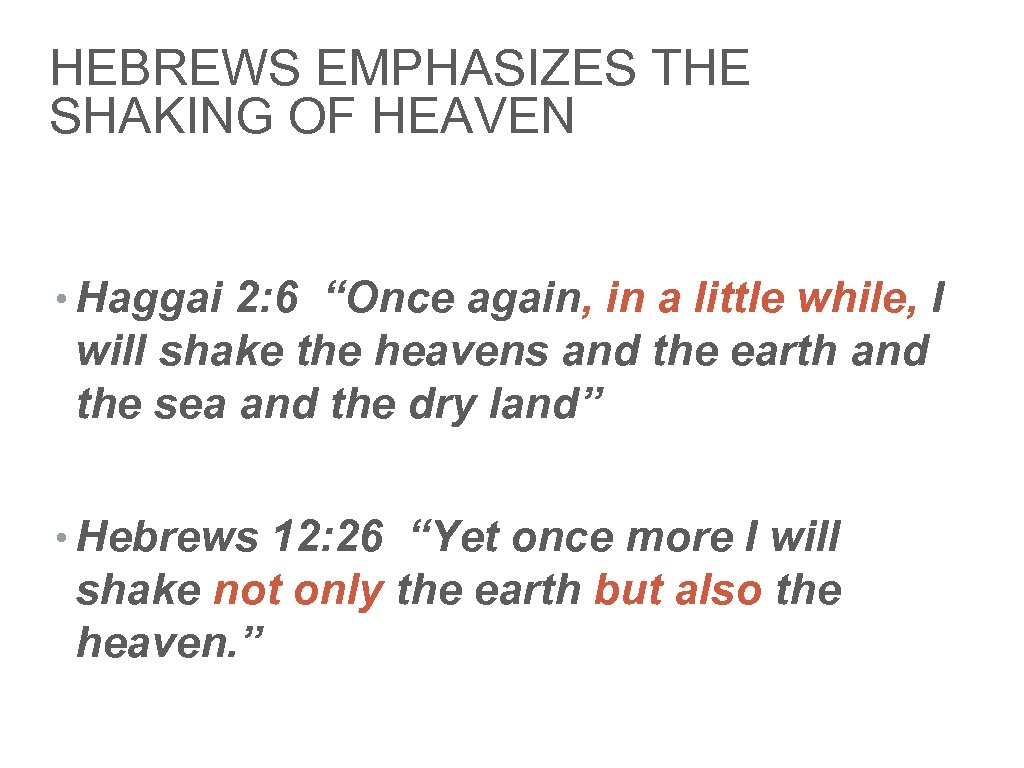
HEBREWS EMPHASIZES THE SHAKING OF HEAVEN • Haggai 2: 6 “Once again, in a little while, I will shake the heavens and the earth and the sea and the dry land” • Hebrews 12: 26 “Yet once more I will shake not only the earth but also the heaven. ”
HEBREWS EMPHASIZES THE FINALITY OF THE SHAKING • Hebrews 12: 26 “Yet once more I will shake not only the earth but also the heaven. ”
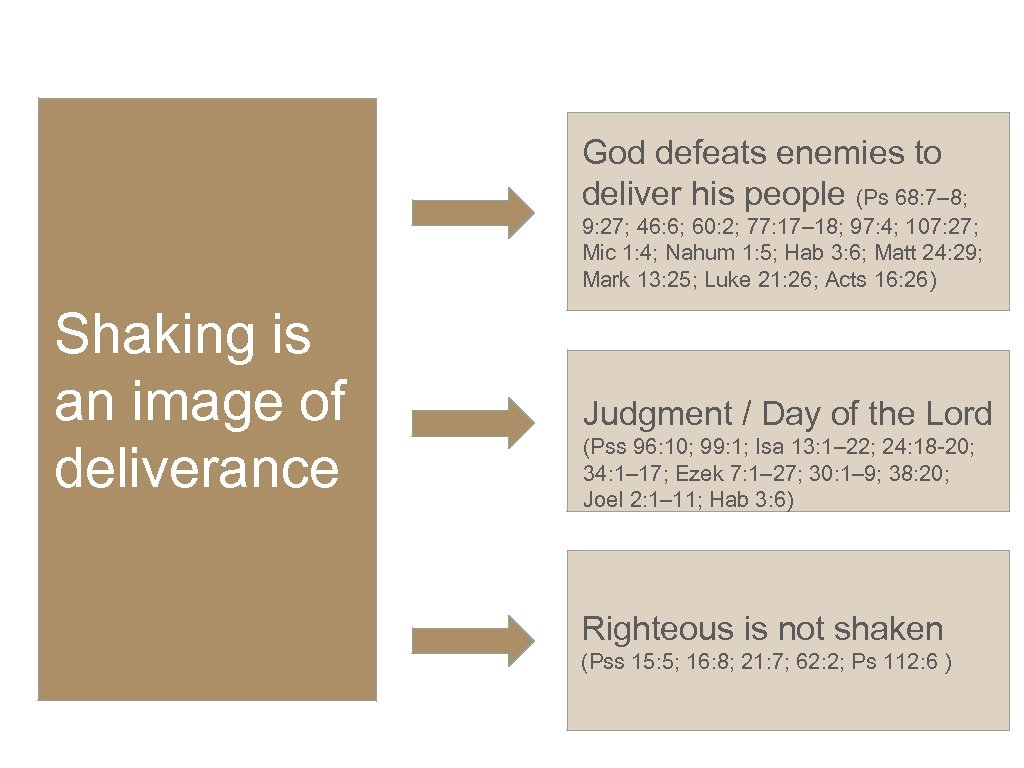
God defeats enemies to deliver his people (Ps 68: 7– 8; 9: 27; 46: 6; 60: 2; 77: 17– 18; 97: 4; 107: 27; Mic 1: 4; Nahum 1: 5; Hab 3: 6; Matt 24: 29; Mark 13: 25; Luke 21: 26; Acts 16: 26) Shaking is an image of deliverance Judgment / Day of the Lord (Pss 96: 10; 99: 1; Isa 13: 1– 22; 24: 18 -20; 34: 1– 17; Ezek 7: 1– 27; 30: 1– 9; 38: 20; Joel 2: 1– 11; Hab 3: 6) Righteous is not shaken (Pss 15: 5; 16: 8; 21: 7; 62: 2; Ps 112: 6 )
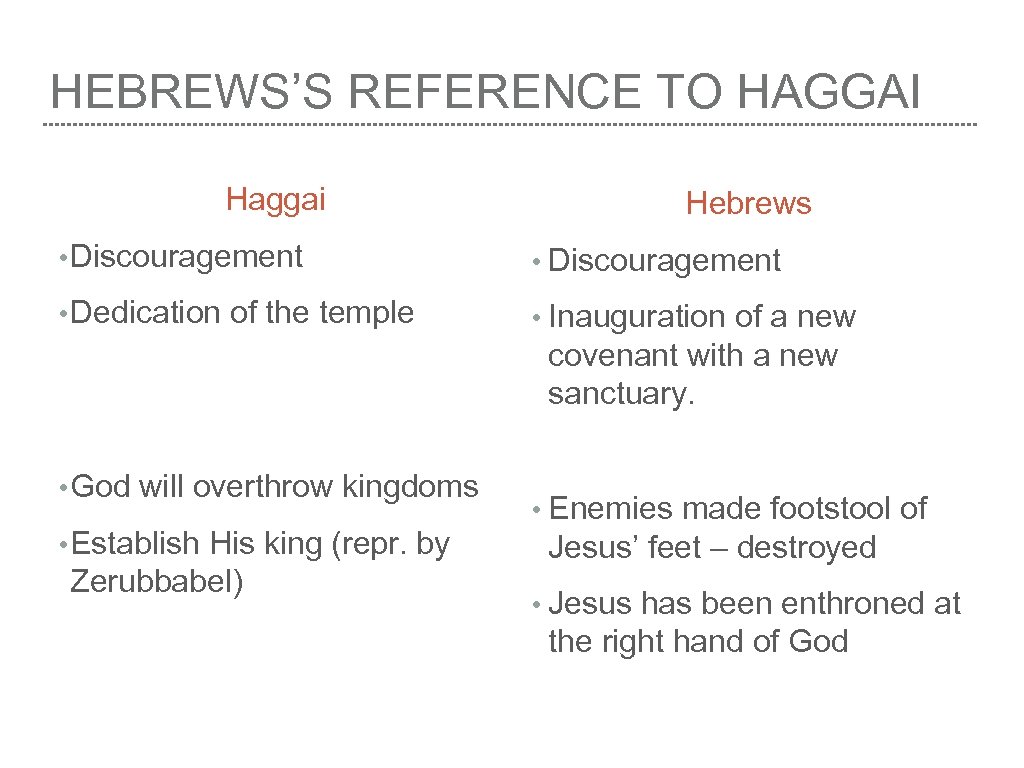
HEBREWS’S REFERENCE TO HAGGAI Haggai Hebrews • Discouragement • Dedication of the temple • Inauguration of a new covenant with a new sanctuary. • God will overthrow kingdoms • Establish His king (repr. by Zerubbabel) • Enemies made footstool of Jesus’ feet – destroyed • Jesus has been enthroned at the right hand of God
THE HOLY ONES RECEIVE THE KINGDOM "As for these four great beasts, four kings shall arise out of the earth. 18 But the holy ones of the Most High shall receive the kingdom and possess the kingdom forever-- forever and ever. ” Dan 7: 18
KINGDOM RECEIVED THROUGH JUDGMENT Then the court shall sit in judgment, and his dominion shall be taken away, to be consumed and totally destroyed. The kingship and dominion and the greatness of the kingdoms under the whole heaven shall be given to the people of the holy ones of the Most High; their kingdom shall be an everlasting kingdom, and all dominions shall serve and obey them. ” Dan 7: 26– 27
Скачать презентацию WITHIN THE VEIL HEBREWS AND 1844 Félix H
5f43b6f812ba0ff231b84aec0dba6e71.ppt