 Скачать презентацию WITFOR Themes Building the Infrastructure Education Means Collaboration
1b7d4f9d88f9de5938bd669a99510d32.ppt
- Количество слайдов: 77



WITFOR Themes Building the Infrastructure Education Means Collaboration between intergovernmental agencies
ICTs in Education: Can digital Dividend replace Digital Divide? Can Digital dividend replace digital divide?
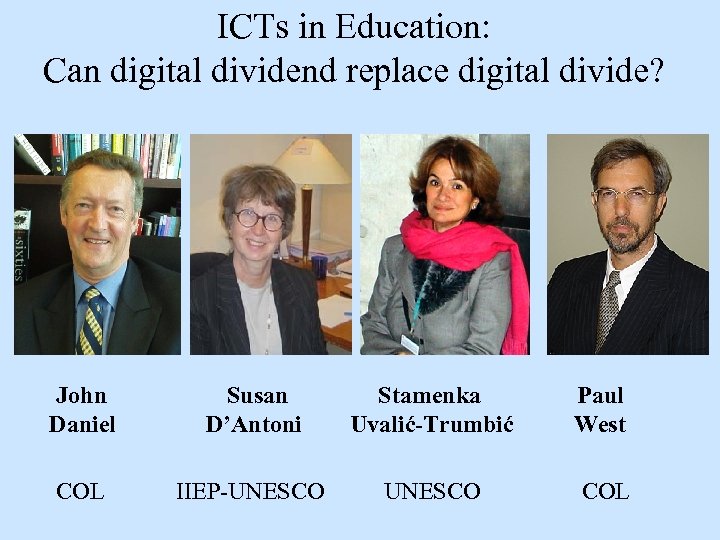
ICTs in Education: Can digital dividend replace digital divide? John Daniel Susan D’Antoni Stamenka Uvalić-Trumbić Paul West COL IIEP-UNESCO COL
Our aim Development through Learning
Our aims - government interest in e. Learning - barriers to e. Learning – how to respond? - recommendations for coordination - the role of educational leaders
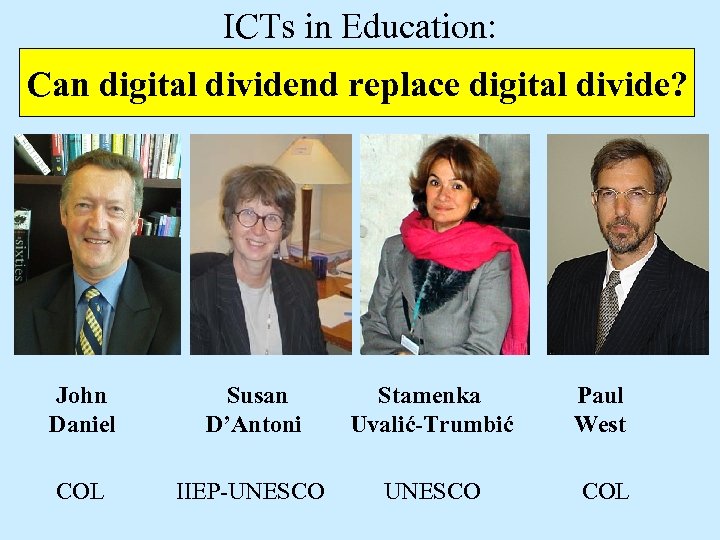
ICTs in Education: Can digital dividend replace digital divide? John Daniel Susan D’Antoni Stamenka Uvalić-Trumbić Paul West COL IIEP-UNESCO COL
The major trend Growth in demand -World Conference on HE (1988)
The major trend Growth in demand -World Conference on HE (1988) “the most radical renewal of PSE ever required”
The major trend Growth in demand -World Conference on HE (1988) “the most radical renewal of PSE ever required” - WCHE + 5 (2003)
The Challenge 1. Demography: 7 -8 billion (50% young) in developing world by 2025
The Challenge 1. Demography: 7 -8 billion (50% young) in developing world by 2025 2. Discrepancy: Developed = APR 40% plus Developing = APR 10% minus
“…at no time in human history did the welfare (or poverty) of nations depend in such a direct manner on the quality and outreach of higher education systems and institutions” (UNESCO, 2003).
- Proliferation of new providers - Cross-border offerings
- Proliferation of new providers - Cross-border offerings BUT “cross-border post-secondary education is, for the moment at least, a negligible phenomenon in developing countries” Daniel, Kanwar & Uvalić-Trumbić (2005)
BUT “cross-border post-secondary education is, for the moment at least, a negligible phenomenon in developing countries” Daniel, Kanwar & Uvalić-Trumbić (2005) THEREFORE the developing world needs home-grown solutions – is e. Learning one of them?
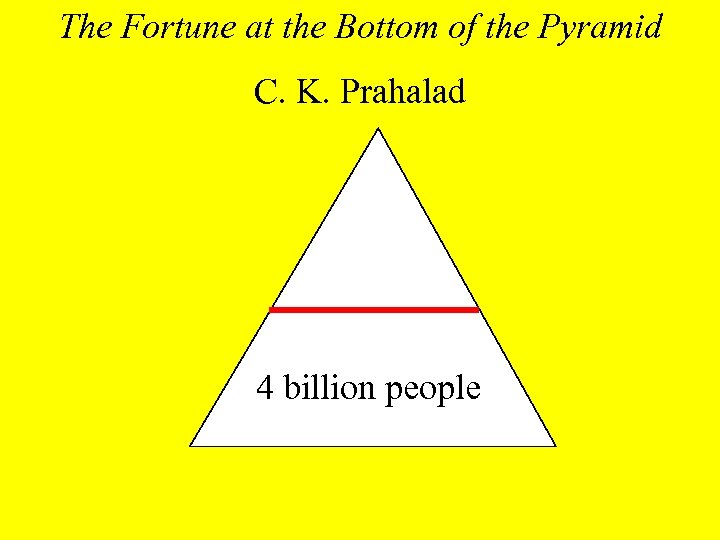
The Fortune at the Bottom of the Pyramid C. K. Prahalad 4 billion people
C. K. Prahalad The Fortune at the Bottom of the Pyramid ‘for companies with the resources and persistence to compete at the bottom of the world economic pyramid, the prospective rewards include growth, profits and incalculable contributions to humankind’
C. K. Prahalad The Fortune at the Bottom of the Pyramid An APR of 35% within this group would yield 150 million additional post-secondary students, far more than total current enrolments worldwide.
C. K. Prahalad The Fortune at the Bottom of the Pyramid ‘radical innovations in technology and business models’ ‘an ideal of highly distributed small scale operations married to world-scale capabilities’
C. K. Prahalad The Fortune at the Bottom of the Pyramid ‘helping people improve their lives by producing and distributing products and services in culturally sensitive, environmentally sustainable and economically profitable ways’
Does e. Learning fit the bill?
TECHNOLOGY (Internet connections) Communication links are altering dramatically the way that poor villages in the developing world function.
BUT Can we take advantage of the opportunity? ? ?
The most promising innovation OPEN EDUCATIONAL RESOURCES (OERs) = open course content, open source software and tools
The most promising innovation OPEN EDUCATIONAL RESOURCES (OERs) apply to teaching and learning the basic principle of sharing that underpins academic research
Barriers to sharing courseware: -‘Not invented here’ - Copyright - Non-digital formats
Re-usable Learning Objects ~ Published research articles
e. Learning - 4 questions: - Accessible? 1. Connectivity?
e. Learning - 4 questions: - Accessible? 1. Connectivity? 2. OERs available?
Availability of OERs -OECD/UNESCO mapping OER initiatives - UNESCO-IIEP International Community of Interest – FOSS New Forum on OERs and open content
Availability of OERs -OECD/UNESCO mapping OER initiatives - UNESCO-IIEP International Community of Interest – FOSS New Forum on OERs and open content - COL Access to multiple LORs
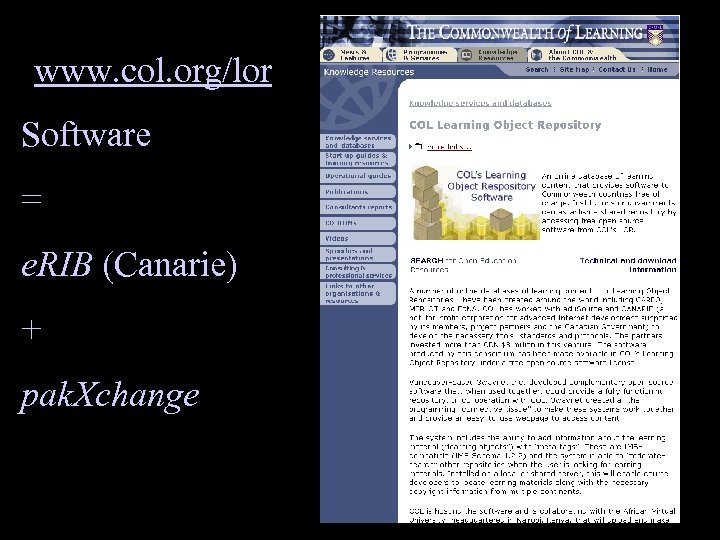
www. col. org/lor Software = e. RIB (Canarie) + pak. Xchange
e. Learning - 4 questions: - Accessible? Appropriate?
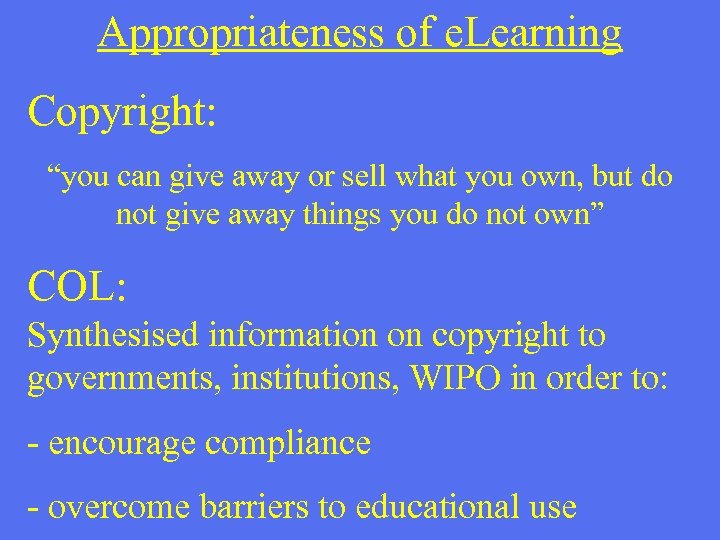
Appropriateness of e. Learning Copyright: “you can give away or sell what you own, but do not give away things you do not own” COL: Synthesised information on copyright to governments, institutions, WIPO in order to: - encourage compliance - overcome barriers to educational use
e. Learning - 4 questions: - Accessible? Appropriate? Accredited?
e. Learning: - Does it require new QA criteria?
e. Learning: - Does it require new QA criteria? - How to promote trust and confidence?
e. Learning: - Does it require new QA criteria? - How to promote trust and confidence? UNESCO/OECD Guidelines on Quality Provision in Cross-Border Higher Education: Six stakeholders: Governments; institutions; QA agencies; student associations; professional bodies; qualification recognition agencies
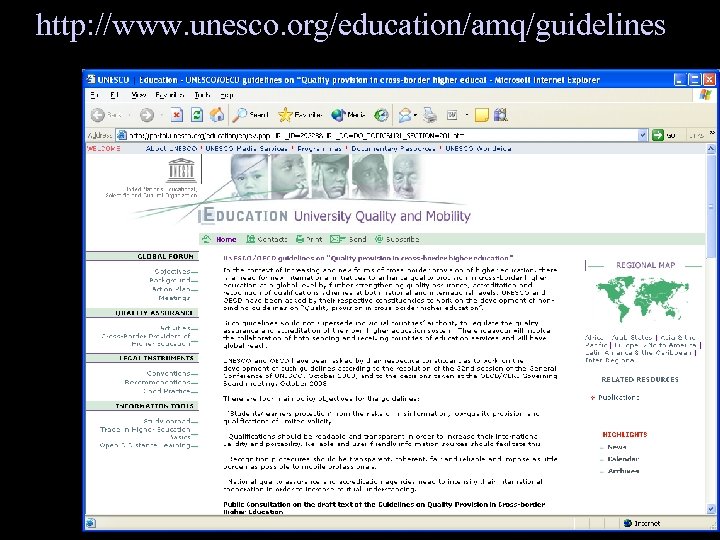
http: //www. unesco. org/education/amq/guidelines
e. Learning: - Does it require new QA criteria? - How to promote trust and confidence? - Build QA capacity UNESCO HE ODL Knowledge Base www. unesco. org/odl
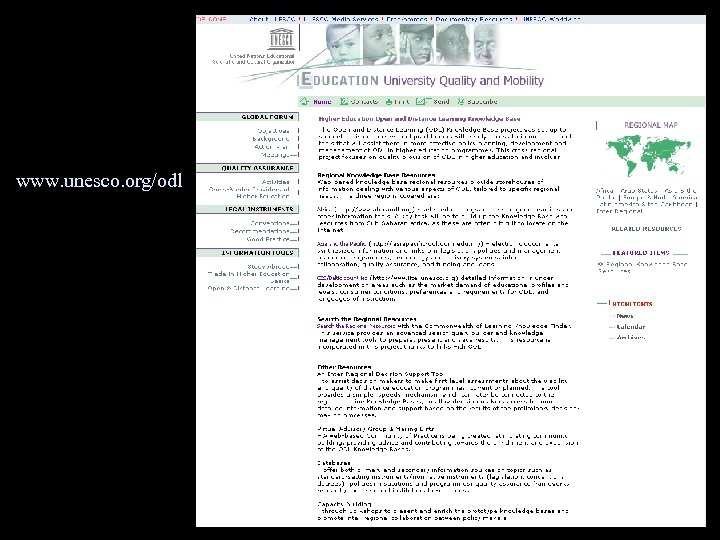
www. unesco. org/odl
e. Learning - 4 questions: - Accessible? - Appropriate? - Accredited? - Affordable?
e. Learning - 4 questions: Answers vital because: - Some holdouts against e. Learning - Developing countries interested
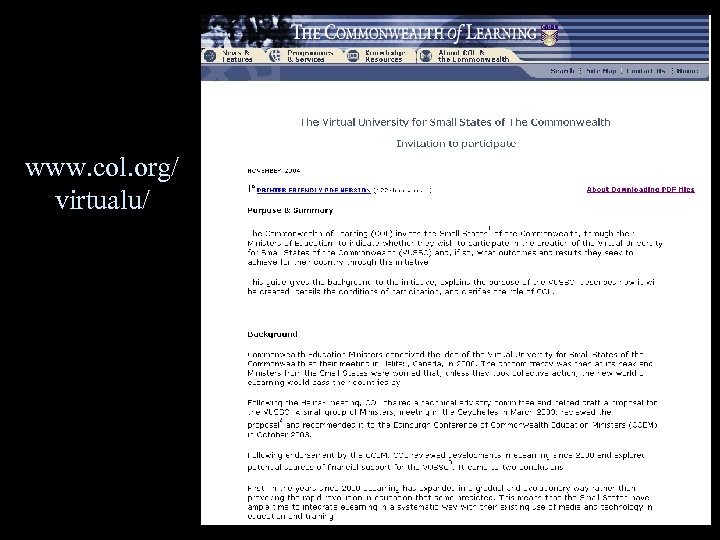
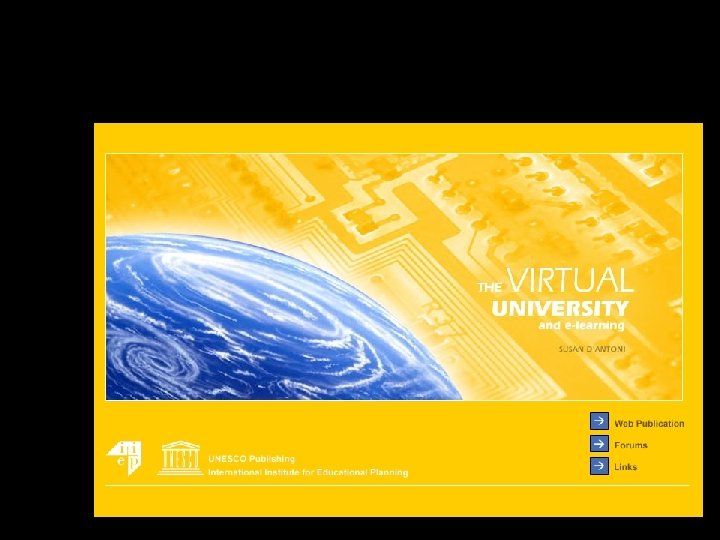
www. col. org/ virtualu/
ISSUES FOR GOVERNMENTS AND INSTITUTIONS 1. Interests and role of governments? 2. Interests and roles of institutions?
ISSUES FOR GOVERNMENTS AND INSTITUTIONS 1. Interests of governments in e. Learning? 2. - Efficiency 3. - Effectiveness 4. - Economy 5.
ISSUES FOR GOVERNMENTS AND INSTITUTIONS 1. Interests of governments in e. Learning? 2. - Efficiency 3. - Effectiveness 4. - Economy 5. by combining technology with new forms of organisation… 6. e. Learning can extend further the open university revolution
ISSUES FOR GOVERNMENTS AND INSTITUTIONS 1. Interests of governments in e. Learning? 2. - Efficiency 3. - Effectiveness 4. - Economy 5. and supports campus teaching well as distance learning as
ISSUES FOR GOVERNMENTS AND INSTITUTIONS 1. Role of governments in e. Learning? 2. DON’T operate (except gov’t functions) 3. DO 4. create the right context
Barriers to e. Learning Issues of bandwidth: • Telecoms legislation and monopolies • Little joint buying • Poor policy and management • Little affordable Internet access off campus • Ignorance of copyright laws & exemptions
Barriers to e. Learning Issues of bandwidth: • Telecoms legislation and monopolies “developing country institutions can pay over 100 times more for Internet access than in the industrialised world. ”
Barriers to e. Learning Issues of bandwidth: • Telecoms legislation and monopolies Expensive connectivity handicaps institutions and countries.
Barriers to e. Learning Issues of bandwidth: 2. Little joint buying: Institutions should club together to buy bandwidth
Barriers to e. Learning Issues of bandwidth: 3. Poor policy and management: - Define acceptable use
Barriers to e. Learning Issues of bandwidth: 3. Poor policy and management: - Define acceptable use - Maximise benefits day and night
Barriers to e. Learning Issues of bandwidth: 3. Poor policy and management: - Define acceptable use - Maximise benefits day and night - Extended hours of access
Barriers to e. Learning NON-TECHNICAL ISSUES
Barriers to e. Learning NON-TECHNICAL ISSUES • Institutional development and organisation - General policy on e. Learning - Policy on OERs
Barriers to e. Learning NON-TECHNICAL ISSUES 2. Management - New structure? - Existing structure? - Distinct entity? - Training
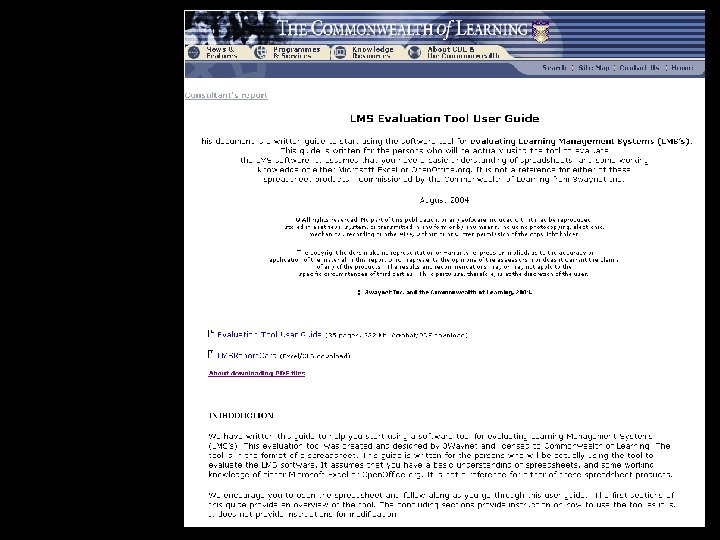
Barriers to e. Learning NON-TECHNICAL ISSUES 2. Management - Training (e. g. LMSs) www. col. org/Consultancies/04 LMSEvaluation. htm
Barriers to e. Learning NON-TECHNICAL ISSUES 3. Academic issues - Choice of programme
Barriers to e. Learning NON-TECHNICAL ISSUES 3. Academic issues - Choice of programme - Being student-centred
Barriers to e. Learning NON-TECHNICAL ISSUES 4. National and international environment - Partnerships and cooperation to avoid dependence on others
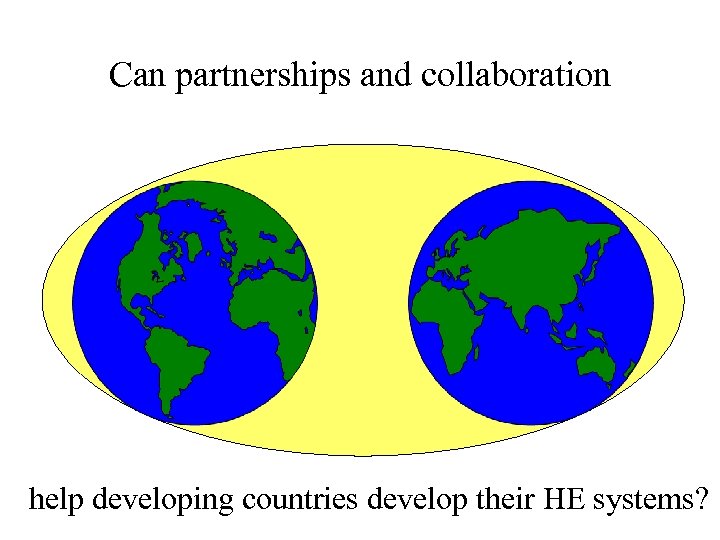
Can partnerships and collaboration help developing countries develop their HE systems?
- How to enhance collaboration? - What can we do?
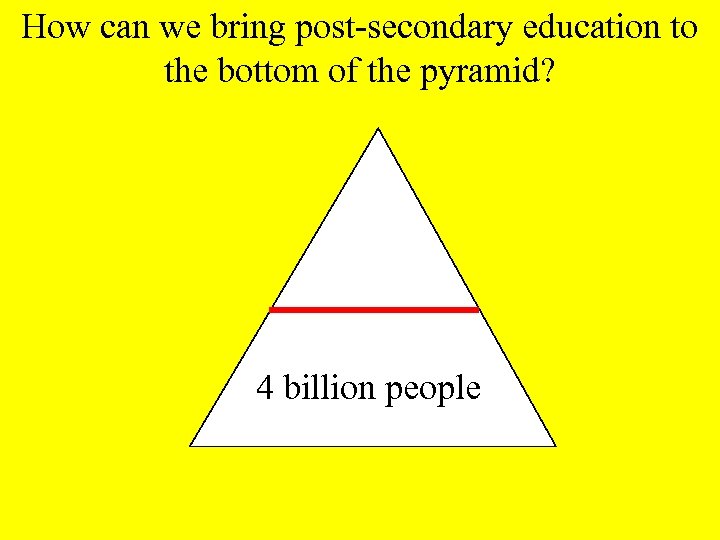
How can we bring post-secondary education to the bottom of the pyramid? 4 billion people
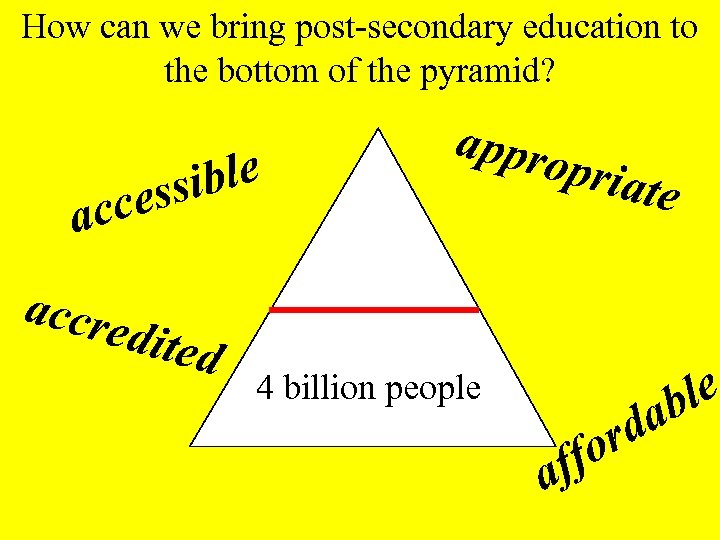
How can we bring post-secondary education to the bottom of the pyramid? ible ess acc appro priat e accre dited 4 billion people af rd fo le ab
Mechanisms for collaboration - Virtual Forums (e. g. UNESCO-IIEP)
Mechanisms for collaboration - Virtual Forums (e. g. UNESCO-IIEP) - Funding collaboration (e. g. Hewlett)
Mechanisms for collaboration - Virtual Forums (e. g. UNESCO-IIEP) - Funding collaboration (e. g. Hewlett) - Linking LORs (learning = common wealth)
Mechanisms for collaboration - Virtual Forums (e. g. UNESCO-IIEP) - Funding collaboration (e. g. Hewlett) - Linking LORs (learning = common wealth) - Training in policy and practice
Mechanisms for collaboration - Virtual Forums (e. g. UNESCO-IIEP) - Funding collaboration (e. g. Hewlett) - Linking LORs (learning = common wealth) - Training in policy and practice - International collaboration (UNESCO/OECD)
“our aim must be to combine connectivity with open educational resources so as to create a global intellectual commons accessible to the whole of humankind”
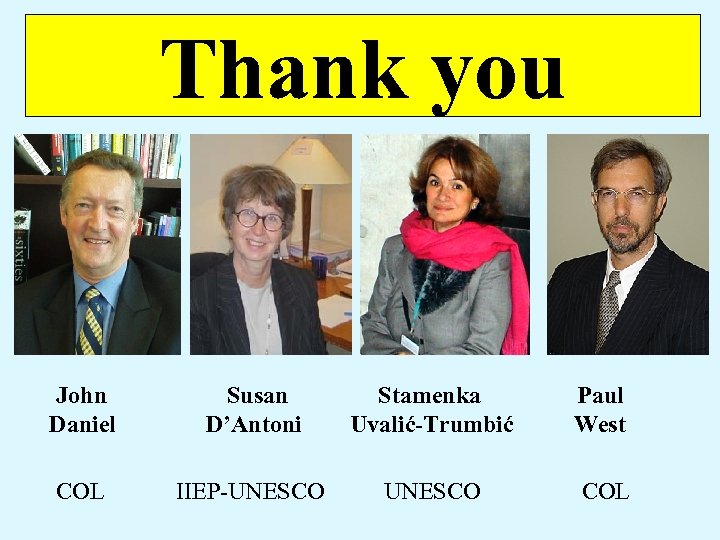
Thank you John Daniel Susan D’Antoni Stamenka Uvalić-Trumbić Paul West COL IIEP-UNESCO COL
 Скачать презентацию WITFOR Themes Building the Infrastructure Education Means Collaboration
1b7d4f9d88f9de5938bd669a99510d32.ppt