 Скачать презентацию Wireless Vo IP C 3 R 94922096 謝明龍
134bd1f5508808ad9aeb3f764fbadcec.ppt
- Количество слайдов: 57



Wireless Vo. IP C 3 R 94922096 謝明龍 R 94922088 關尚儒
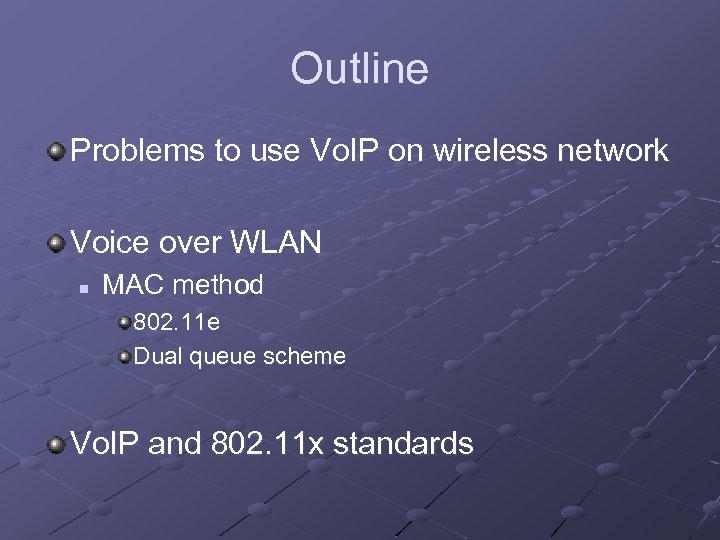
Outline Problems to use Vo. IP on wireless network Voice over WLAN n MAC method 802. 11 e Dual queue scheme Vo. IP and 802. 11 x standards
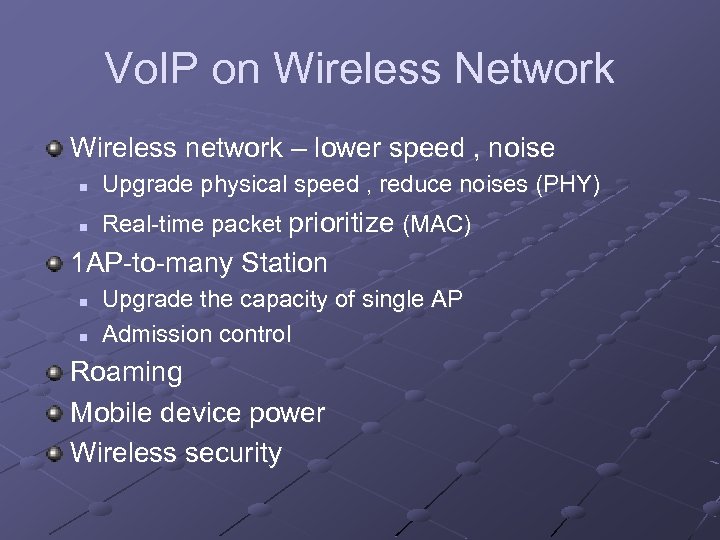
Vo. IP on Wireless Network Wireless network – lower speed , noise n Upgrade physical speed , reduce noises (PHY) n Real-time packet prioritize (MAC) 1 AP-to-many Station n n Upgrade the capacity of single AP Admission control Roaming Mobile device power Wireless security

Voice over WLAN
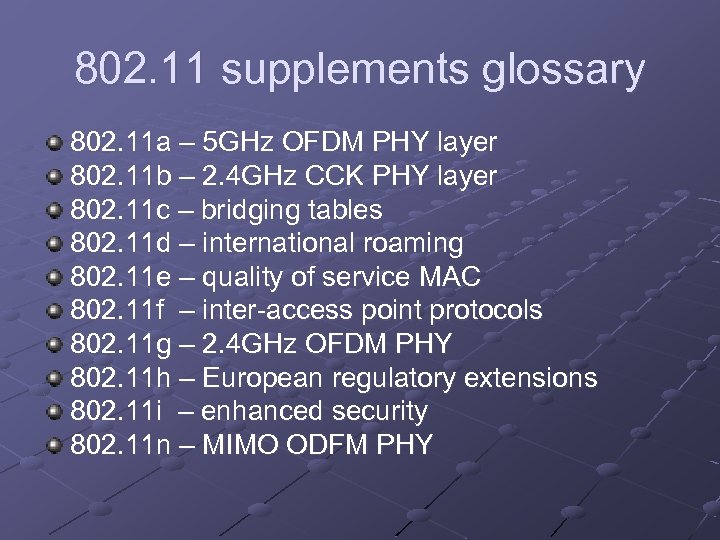
802. 11 supplements glossary 802. 11 a – 5 GHz OFDM PHY layer 802. 11 b – 2. 4 GHz CCK PHY layer 802. 11 c – bridging tables 802. 11 d – international roaming 802. 11 e – quality of service MAC 802. 11 f – inter-access point protocols 802. 11 g – 2. 4 GHz OFDM PHY 802. 11 h – European regulatory extensions 802. 11 i – enhanced security 802. 11 n – MIMO ODFM PHY
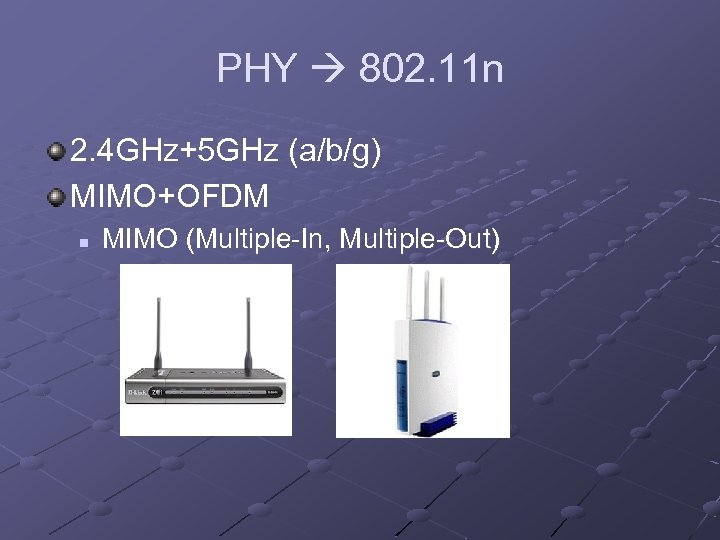
PHY 802. 11 n 2. 4 GHz+5 GHz (a/b/g) MIMO+OFDM n MIMO (Multiple-In, Multiple-Out)
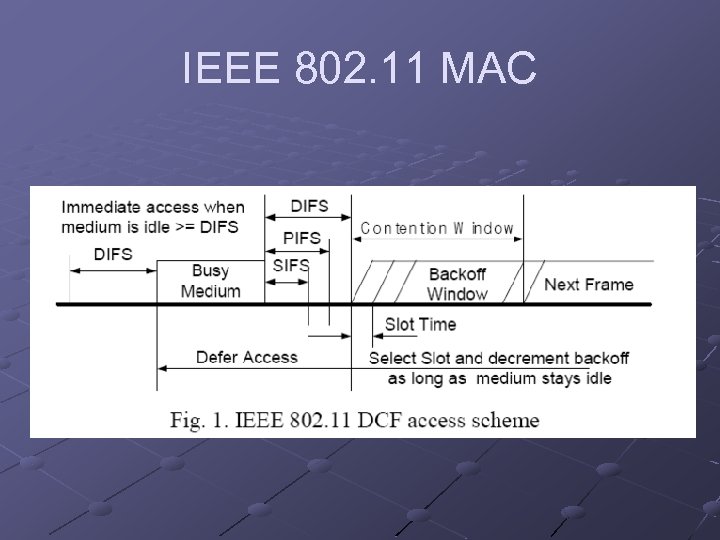
IEEE 802. 11 MAC

Dual Queue Strategy
Dual Queue Strategy The 802. 11 e MAC implementation cannot be done by just upgrading the firmware of an existing MAC controller chip only It is difficult to Upgrade (replace) the existing APs
Dual Queue Strategy above 802. 11 the MAC controller n n Original NIC driver FIFO queue New NIC driver RT + NRT queue Strict priority queuing Effect of MAC HW Queue
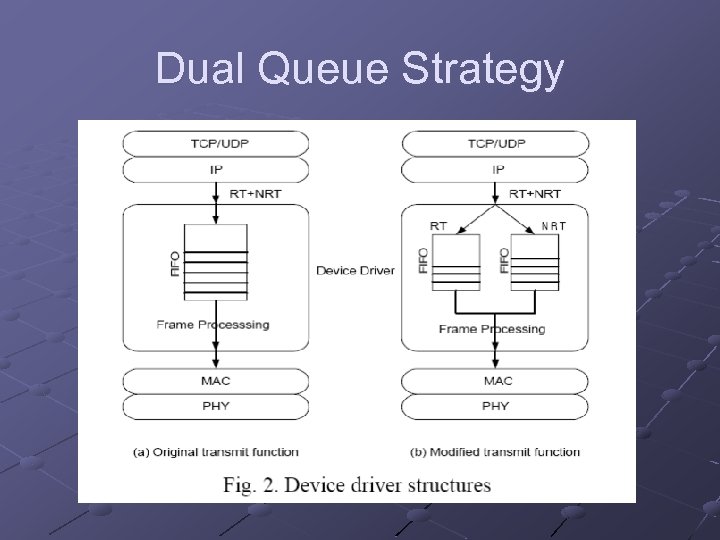
Dual Queue Strategy
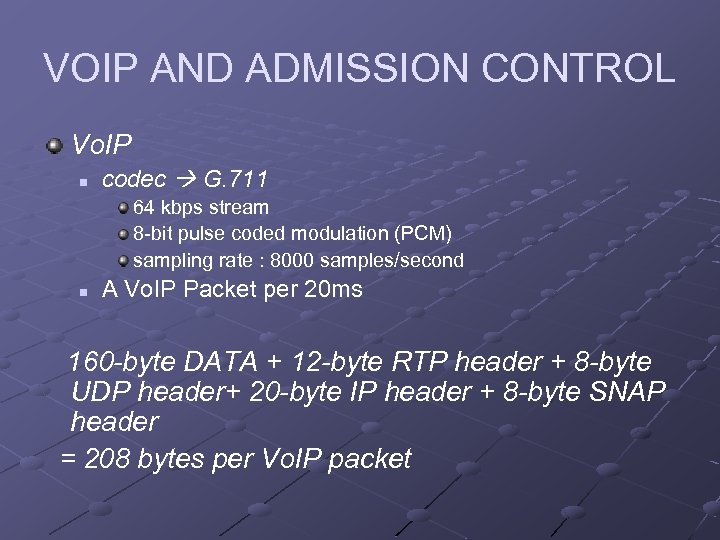
VOIP AND ADMISSION CONTROL Vo. IP n codec G. 711 64 kbps stream 8 -bit pulse coded modulation (PCM) sampling rate : 8000 samples/second n A Vo. IP Packet per 20 ms 160 -byte DATA + 12 -byte RTP header + 8 -byte UDP header+ 20 -byte IP header + 8 -byte SNAP header = 208 bytes per Vo. IP packet
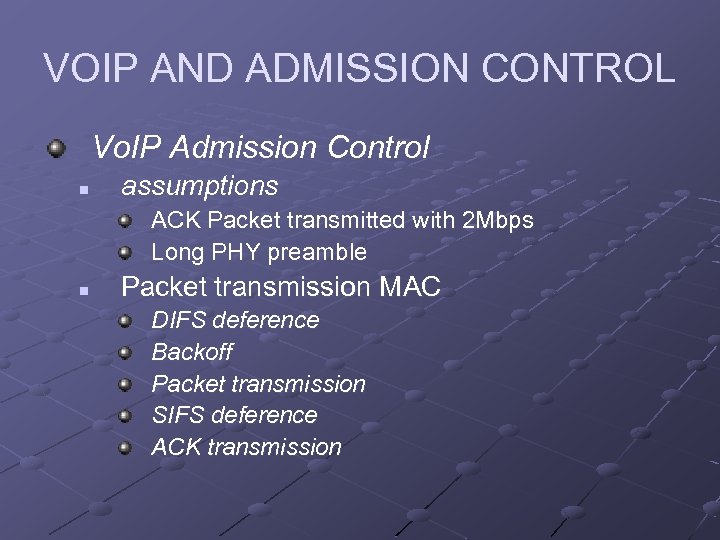
VOIP AND ADMISSION CONTROL Vo. IP Admission Control n assumptions ACK Packet transmitted with 2 Mbps Long PHY preamble n Packet transmission MAC DIFS deference Backoff Packet transmission SIFS deference ACK transmission
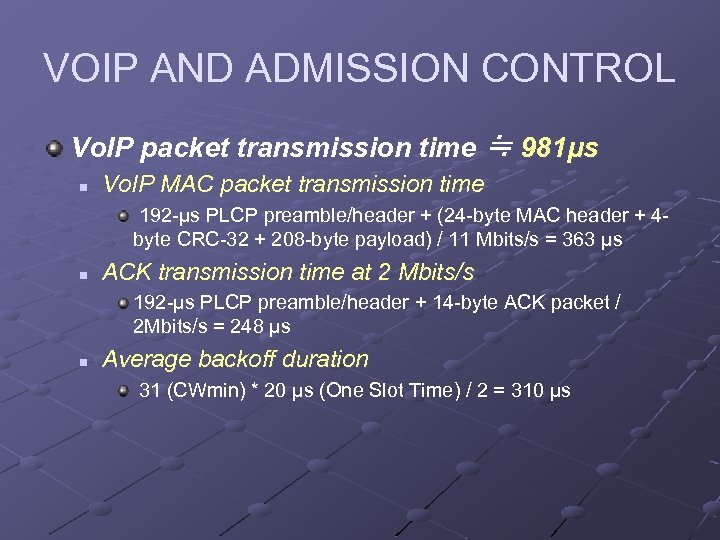
VOIP AND ADMISSION CONTROL Vo. IP packet transmission time ≒ 981μs n Vo. IP MAC packet transmission time 192 -μs PLCP preamble/header + (24 -byte MAC header + 4 byte CRC-32 + 208 -byte payload) / 11 Mbits/s = 363 μs n ACK transmission time at 2 Mbits/s 192 -μs PLCP preamble/header + 14 -byte ACK packet / 2 Mbits/s = 248 μs n Average backoff duration 31 (CWmin) * 20 μs (One Slot Time) / 2 = 310 μs
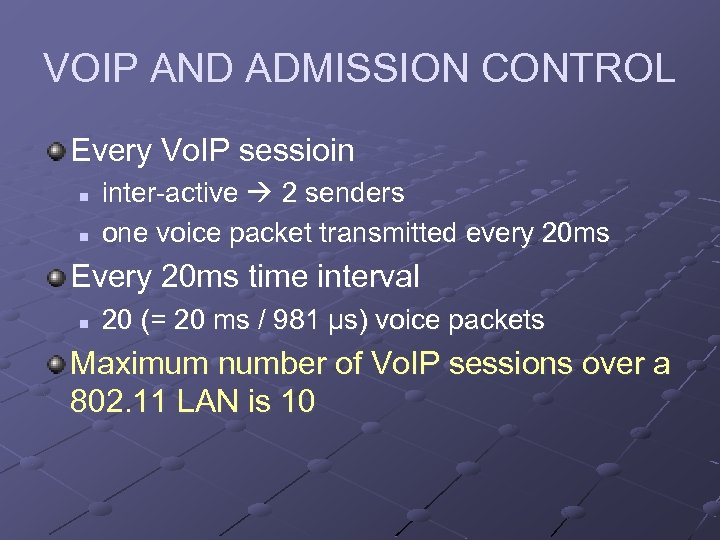
VOIP AND ADMISSION CONTROL Every Vo. IP sessioin n n inter-active 2 senders one voice packet transmitted every 20 ms Every 20 ms time interval n 20 (= 20 ms / 981 μs) voice packets Maximum number of Vo. IP sessions over a 802. 11 LAN is 10
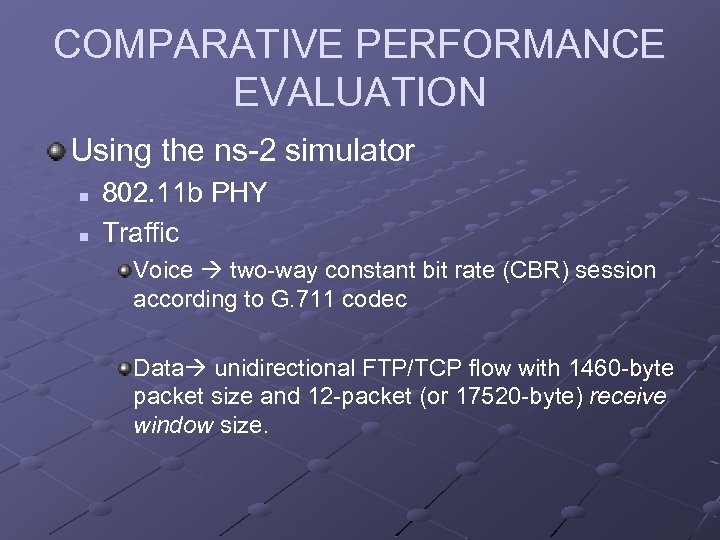
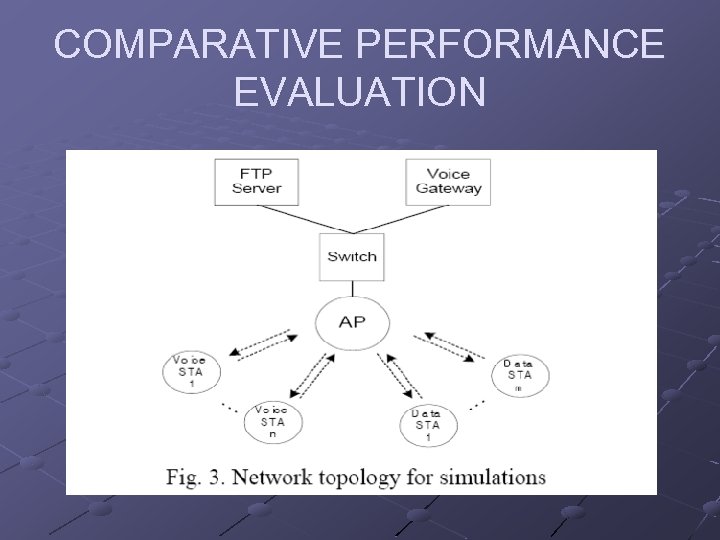
COMPARATIVE PERFORMANCE EVALUATION Using the ns-2 simulator n n 802. 11 b PHY Traffic Voice two-way constant bit rate (CBR) session according to G. 711 codec Data unidirectional FTP/TCP flow with 1460 -byte packet size and 12 -packet (or 17520 -byte) receive window size.
COMPARATIVE PERFORMANCE EVALUATION
EVALUATION RESULT Pure Vo. IP Effect of Vo. IP with different TCP session numbers Performance with Dual queue Unfairness of NRT Packet Effect of MAC HW Queue
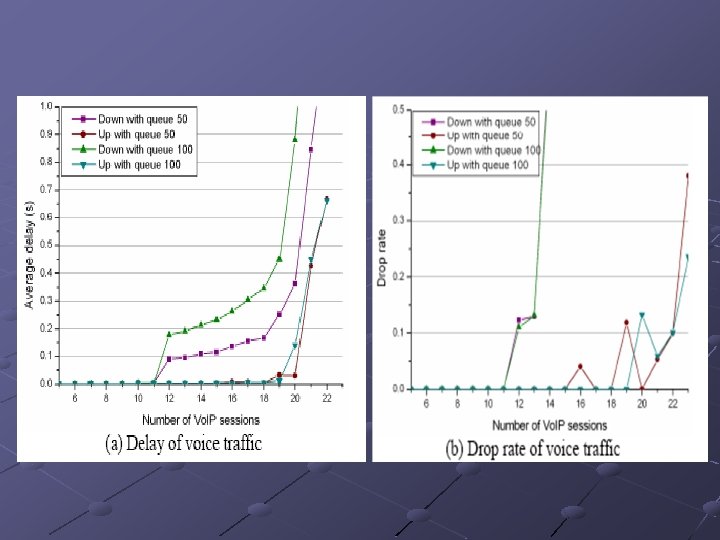
Observation Compare to our Evaluation n packet drop rate 50 packets for the RT queue size Downlink is disadvantaged Simulation results are based on 11 Mbps
EVALUATION RESULT Pure Vo. IP Effect of Vo. IP with different TCP session numbers Performance with Dual queue Unfairness of NRT Packet Effect of MAC HW Queue
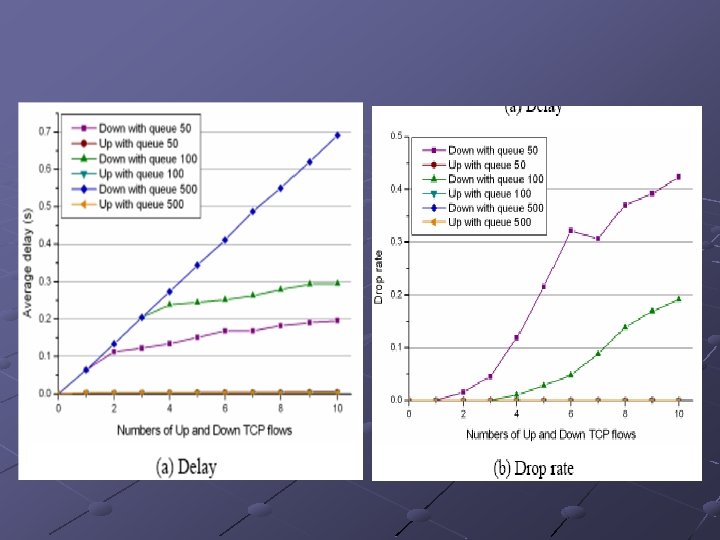
Observation Effect of queue size
EVALUATION RESULT Pure Vo. IP Effect of Vo. IP with different TCP session numbers Performance with Dual queue Unfairness of NRT Packet Effect of MAC HW Queue
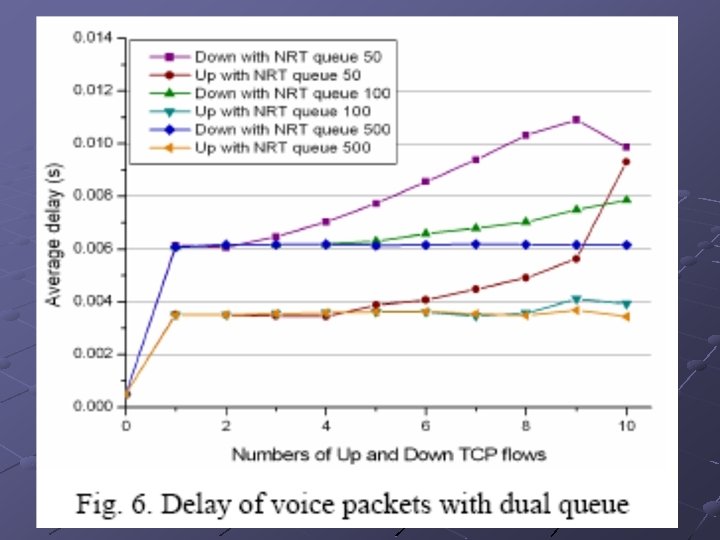
Observation worst case delay 11 ms n n Queuing delay with the single queue MAC HW queue wireless channel access NRT queues n n Size = 50 or 100 increase as the number of TCP flows increases Size = 500 almost no change in delay
EVALUATION RESULT Pure Vo. IP Effect of Vo. IP with different TCP session numbers Performance with Dual queue Unfairness of NRT Packet Effect of MAC HW Queue
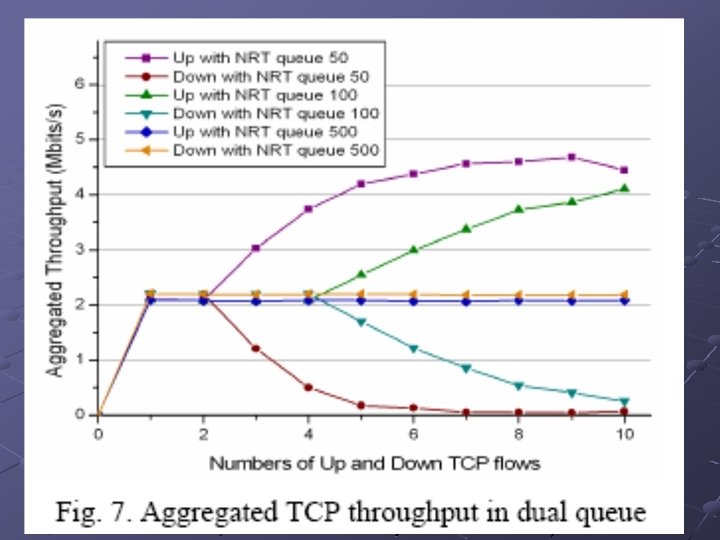
Observation Unfairness n between upstream and downstream TCP flows with the queue sizes of 50 and 100 Queue size for the AP should be large enough - This is good for us
EVALUATION RESULT Pure Vo. IP Effect of Vo. IP with different TCP session numbers Performance with Dual queue Unfairness of NRT Packet Effect of MAC HW Queue
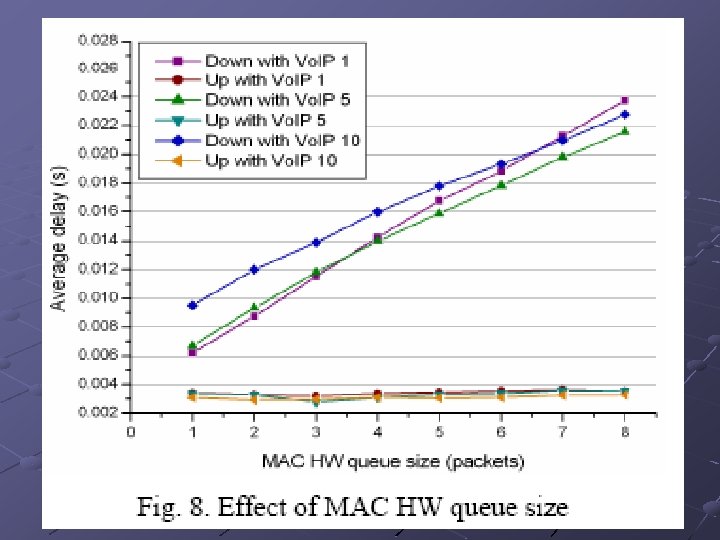
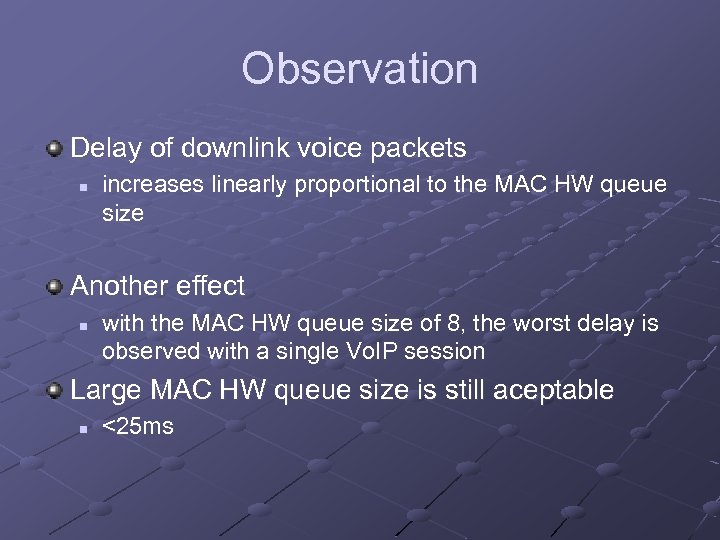
Observation Delay of downlink voice packets n increases linearly proportional to the MAC HW queue size Another effect n with the MAC HW queue size of 8, the worst delay is observed with a single Vo. IP session Large MAC HW queue size is still aceptable n <25 ms
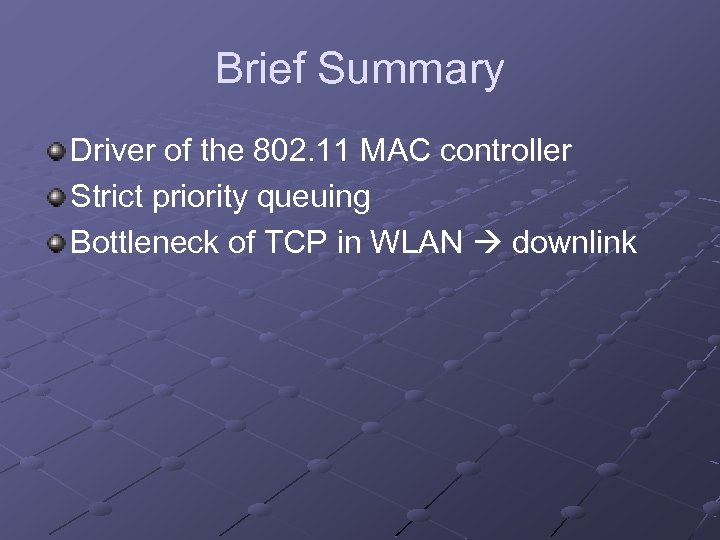
Brief Summary Driver of the 802. 11 MAC controller Strict priority queuing Bottleneck of TCP in WLAN downlink
Vo. IP and 802. 11 e Qo. S standards
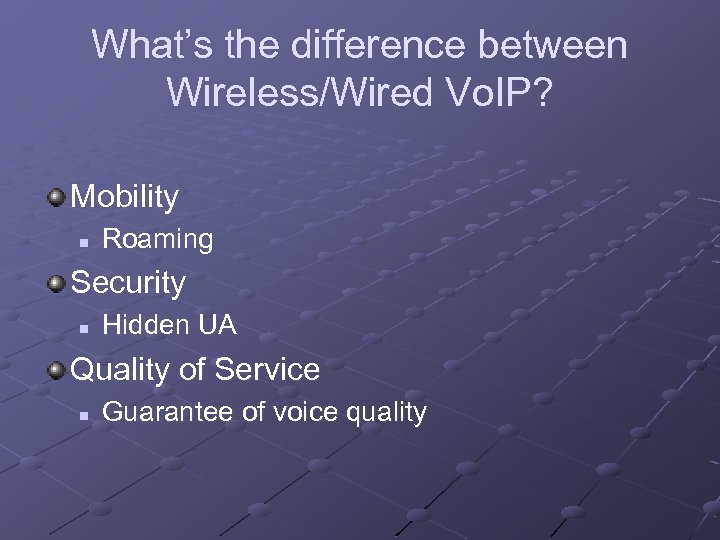
What’s the difference between Wireless/Wired Vo. IP? Mobility n Roaming Security n Hidden UA Quality of Service n Guarantee of voice quality
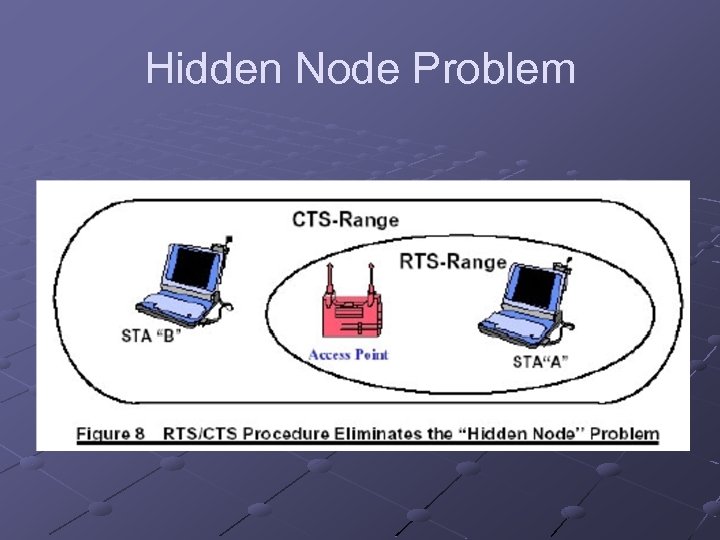
Hidden Node Problem
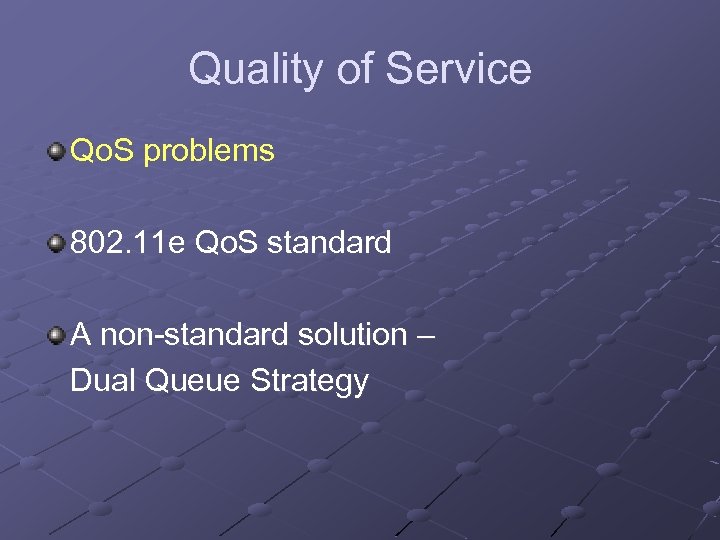
Quality of Service Qo. S problems 802. 11 e Qo. S standard A non-standard solution – Dual Queue Strategy
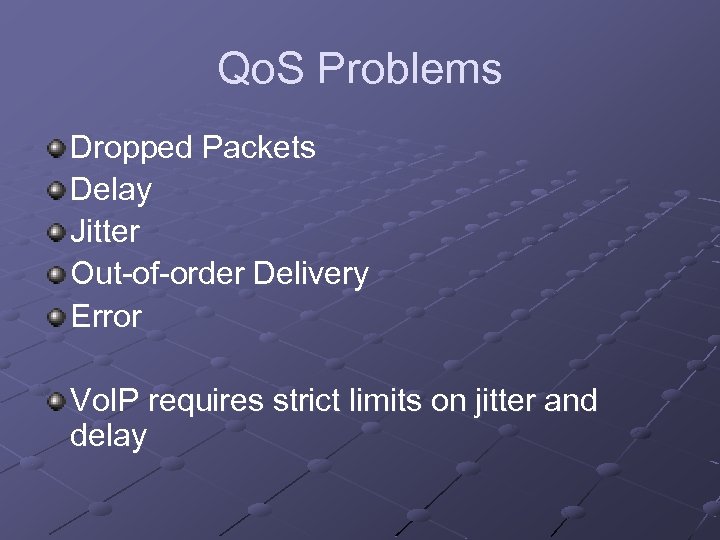
Qo. S Problems Dropped Packets Delay Jitter Out-of-order Delivery Error Vo. IP requires strict limits on jitter and delay
Quality of Service Qo. S problems 802. 11 e Qo. S standard A non-standard solution – Dual Queue Strategy
IEEE 802. 11 e A draft standard of July 2005 It defines a set of Qo. S enhancements for WLAN applications and enhances the IEEE 802. 11 Media Access Control (MAC) layer
Coordination Function For stations to decide which one has the right to deliver its packets 802. 11: DCF & PCF 802. 11 e: EDCF & HCF
Original 802. 11 MAC Distributed Coordination Function (DCF) Point Coordination Function (PCF)
Distributed Coordination Function (DCF) Share the medium between multiple stations Rely on CSMA/CA and optional 802. 11 RTS/CTS
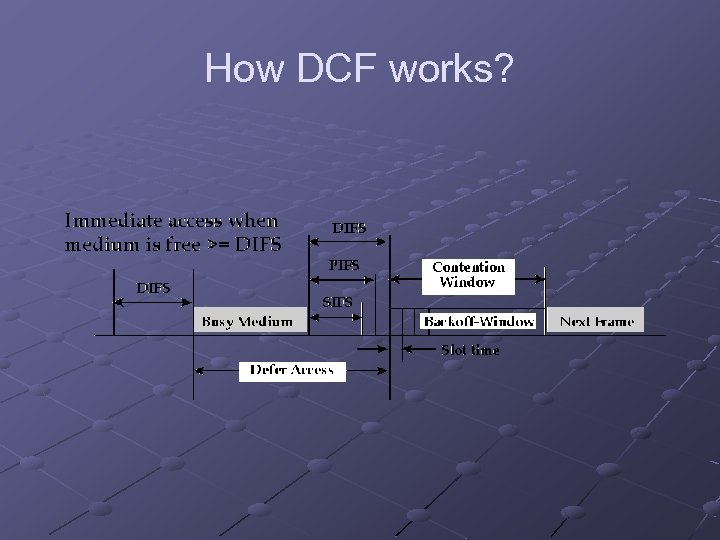
How DCF works?
DCF Limitations When many collisions occur, the available bandwidth will be lower No notion of high or low priority traffic A station may keep the medium If the station has a lower bitrate, all other stations will suffer from that No Qo. S guarantees
Original 802. 11 MAC Distributed Coordination Function (DCF) Point Coordination Function (PCF)
Point Coordination Function (PCF) Available only in "infrastructure" mode Optional mode, only very few APs or Wi-Fi adapters actually implement it Beacon frame, Contention Period, and Contention Free Period
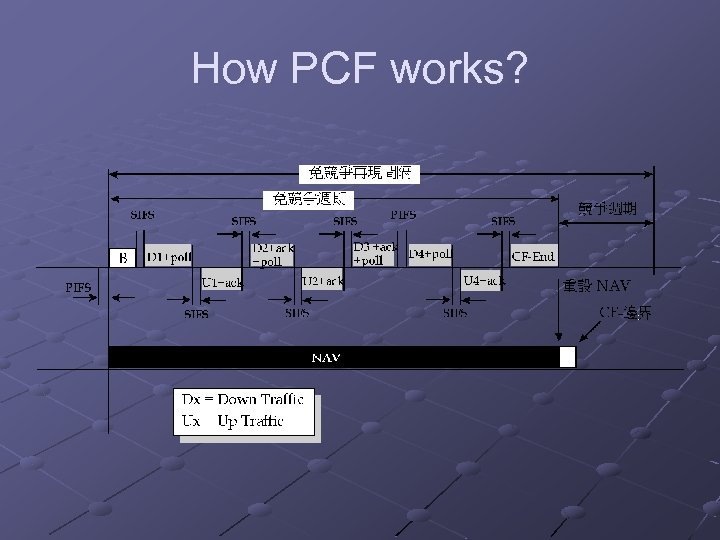
How PCF works?
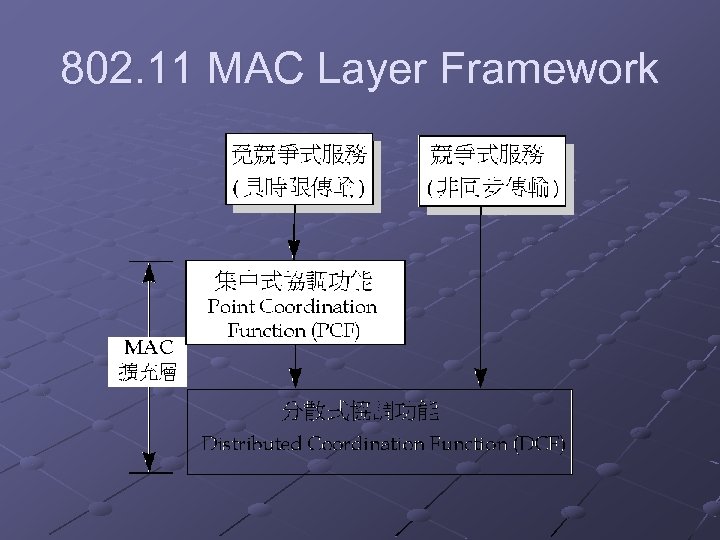
802. 11 MAC Layer Framework
802. 11 e MAC Protocol Operation Enhanced DCF (EDCF) Hybrid Coordination Function (HCF)
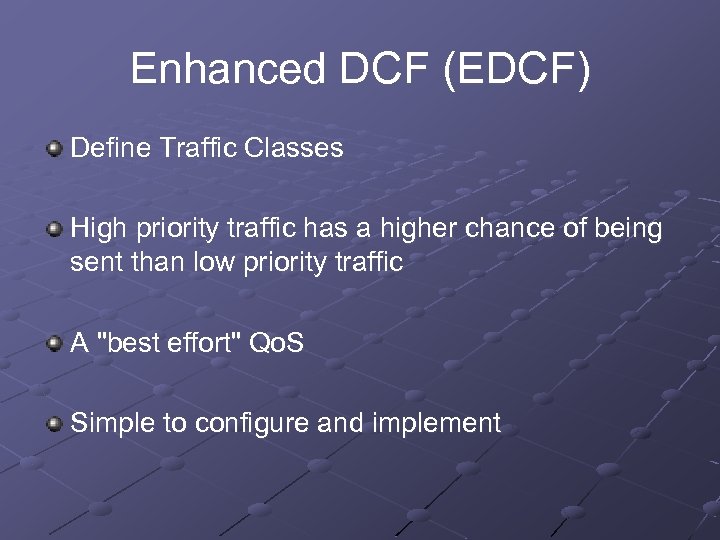
Enhanced DCF (EDCF) Define Traffic Classes High priority traffic has a higher chance of being sent than low priority traffic A "best effort" Qo. S Simple to configure and implement
802. 11 e MAC Protocol Operation Enhanced DCF (EDCF) Hybrid Coordination Function (HCF)
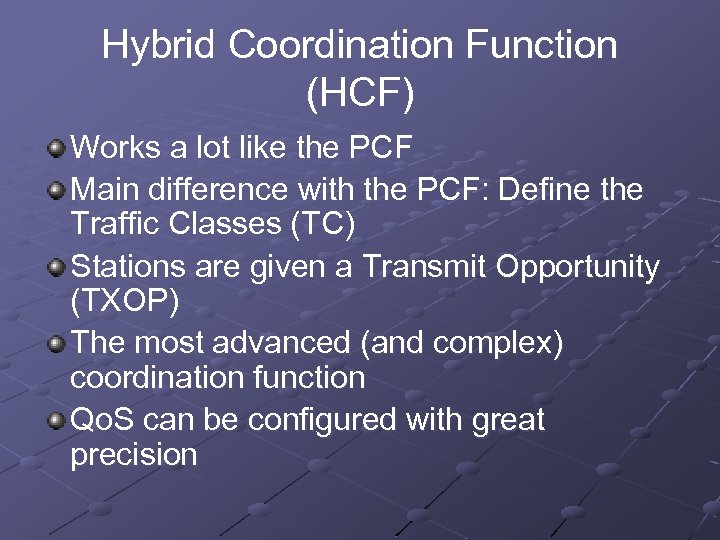
Hybrid Coordination Function (HCF) Works a lot like the PCF Main difference with the PCF: Define the Traffic Classes (TC) Stations are given a Transmit Opportunity (TXOP) The most advanced (and complex) coordination function Qo. S can be configured with great precision

Conclusion
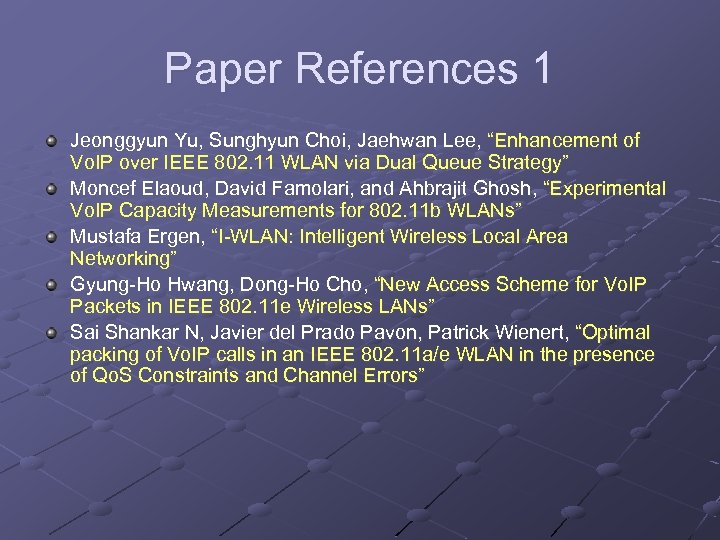
Paper References 1 Jeonggyun Yu, Sunghyun Choi, Jaehwan Lee, “Enhancement of Vo. IP over IEEE 802. 11 WLAN via Dual Queue Strategy” Moncef Elaoud, David Famolari, and Ahbrajit Ghosh, “Experimental Vo. IP Capacity Measurements for 802. 11 b WLANs” Mustafa Ergen, “I-WLAN: Intelligent Wireless Local Area Networking” Gyung-Ho Hwang, Dong-Ho Cho, “New Access Scheme for Vo. IP Packets in IEEE 802. 11 e Wireless LANs” Sai Shankar N, Javier del Prado Pavon, Patrick Wienert, “Optimal packing of Vo. IP calls in an IEEE 802. 11 a/e WLAN in the presence of Qo. S Constraints and Channel Errors”
Paper Reference 2 Experimental Vo. IP capacity measurements for 802. 11 b WLANs Enhancement of Vol. P over IEEE 802. 11 WLAN via dual queue strategy An experimental study of throughput for UDP and Vo. IP traffic in IEEE 802. 11 b networks Admission control for Vo. IP traffic in IEEE 802. 11 networks How well can the IEEE 802. 11 wireless LAN support quality of service
Web Site References http: //www. ieee. or. com/Archive/80211/802_11 e_ Qo. S_files/frame. htm http: //en. wikipedia. org/wiki/IEEE_802. 11 http: //www. cs. nthu. edu. tw/~nfhuang/chap 13. htm #13. 1 http: //www. eettaiwan. com/ART_8800360909_67 5327_3 f 3 ffd 7 b_no. HTM http: //it. sohu. com/2003/12/11/09/article 2167509 85. shtml
Скачать презентацию Wireless Vo IP C 3 R 94922096 謝明龍
134bd1f5508808ad9aeb3f764fbadcec.ppt