


 Скачать презентацию Wireless Tutorial Part 2 The IEEE s Wireless Ethernet
e66fd617cd906f43f0da8c3f623827f5.ppt
- Количество слайдов: 96
 Wireless Tutorial Part 2 The IEEE’s Wireless Ethernet Keeps Going and Growing 4 G Tutorial: Vive la Différence? Fanny Mlinarsky octo. Scope Brough Turner Dialogic
 Agenda 10: 30 – 12: 00 noon Our G-enealogy – History and Evolution of Mobile Radio Lunch 1: 00 – 2: 45 The IEEE’s Wireless Ethernet Keeps Going and Growing 4 G Tutorial: Vive la Différence? Break 3: 00 – 3: 45 Mobile Broadband - New Applications and New Business Models Break 4: 00 – 4: 45 Tutorial: White Spaces and Beyond
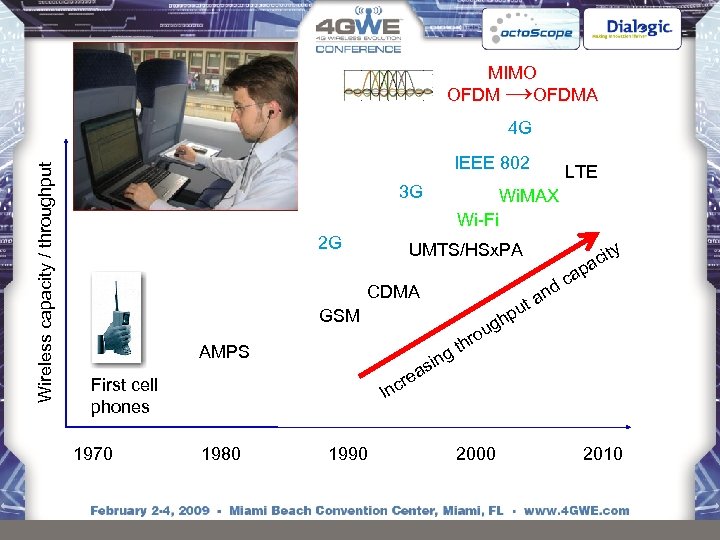 MIMO OFDM →OFDMA Wireless capacity / throughput 4 G IEEE 802 3 G 2 G Wi. MAX Wi-Fi y UMTS/HSx. PA CDMA it ac p a d c n a ut p GSM h ug ro h t ng i as AMPS cre In First cell phones 1970 LTE 1980 1990 2000 2010
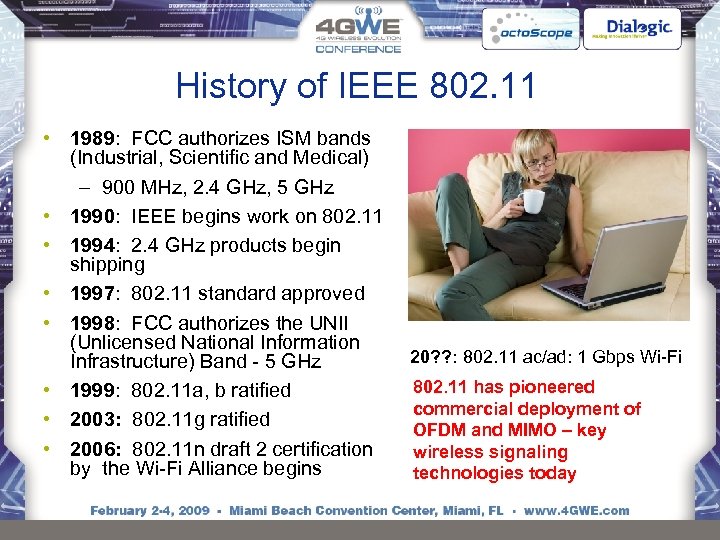 History of IEEE 802. 11 • 1989: FCC authorizes ISM bands (Industrial, Scientific and Medical) – 900 MHz, 2. 4 GHz, 5 GHz • 1990: IEEE begins work on 802. 11 • 1994: 2. 4 GHz products begin shipping • 1997: 802. 11 standard approved • 1998: FCC authorizes the UNII (Unlicensed National Information Infrastructure) Band - 5 GHz • 1999: 802. 11 a, b ratified • 2003: 802. 11 g ratified • 2006: 802. 11 n draft 2 certification by the Wi-Fi Alliance begins 20? ? : 802. 11 ac/ad: 1 Gbps Wi-Fi 802. 11 has pioneered commercial deployment of OFDM and MIMO – key wireless signaling technologies today
 History of 802. 16 • 1998: IEEE formed 802. 16 WG – Started with 10– 66 GHz band; later modified to work in 2– 11 GHz to enable NLOS (non-line of site) • 2004: IEEE 802. 16‐ 2004 d – Fixed operation standard ratified • 2005: 802. 16 -2005 e From OFDM to OFDMA orthogonal frequency division multiplexing orthogonal frequency division multiple access – Mobility and scalability in 2– 6 GHz • Latest: P 802. 16 Rev 2/D 8 draft • Future: 802. 16 m – next generation – SDD (system definition document) – SRD (system requirements document)
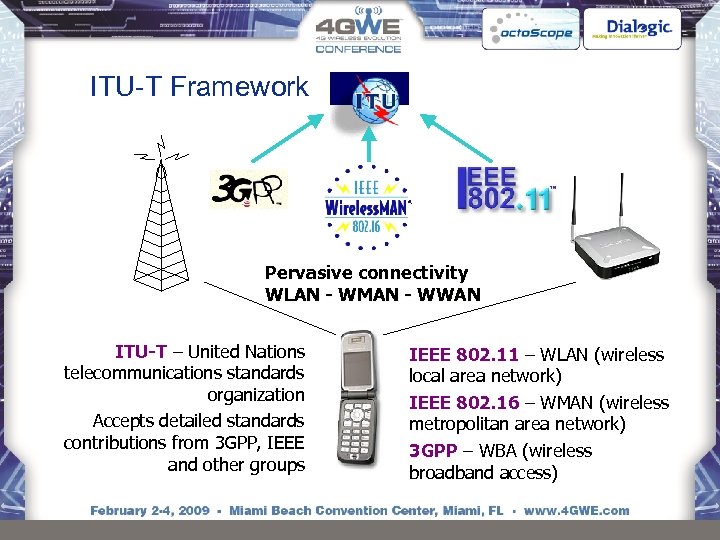 ITU-T Framework Pervasive connectivity WLAN - WMAN - WWAN ITU-T – United Nations telecommunications standards organization Accepts detailed standards contributions from 3 GPP, IEEE and other groups IEEE 802. 11 – WLAN (wireless local area network) IEEE 802. 16 – WMAN (wireless metropolitan area network) 3 GPP – WBA (wireless broadband access)
 • IMT-2000 ITU International Mobile Telecommunications – Global standard for third generation (3 G) wireless communications – Provides a framework for worldwide wireless access by linking the diverse systems of terrestrial and satellite based networks. – Data rate limit is approximately 30 Mbps – Detailed specifications contributed by 3 GPP, 3 GPP 2, ETSI and others • IMT-Advanced – New generation framework for mobile communication systems beyond IMT-2000 with deployment around 2010 to 2015 – Data rates to reach around 100 Mbps for high mobility and 1 Gbps for nomadic networks (i. e. WLANs) – IEEE 802. 16 m working to define the high mobility interface – IEEE 802. 11 ac and 802. 11 ad VHT (very high throughput) working to define the nomadic interface
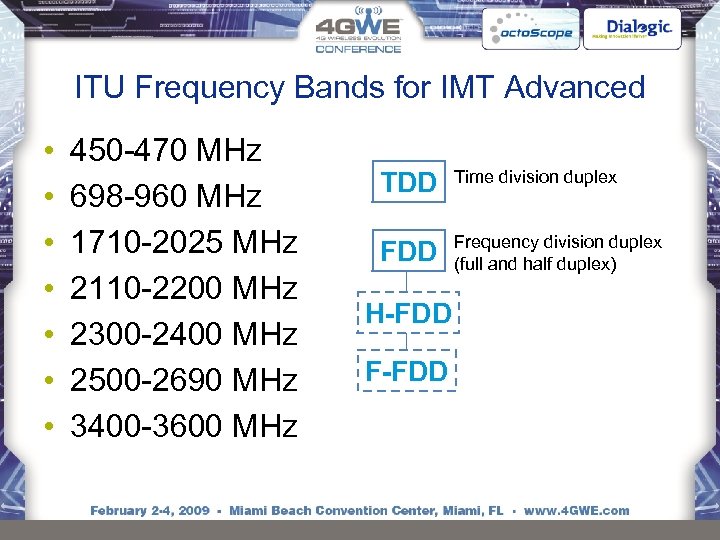 ITU Frequency Bands for IMT Advanced • • 450 -470 MHz 698 -960 MHz 1710 -2025 MHz 2110 -2200 MHz 2300 -2400 MHz 2500 -2690 MHz 3400 -3600 MHz TDD Time division duplex FDD Frequency division duplex (full and half duplex) H-FDD F-FDD
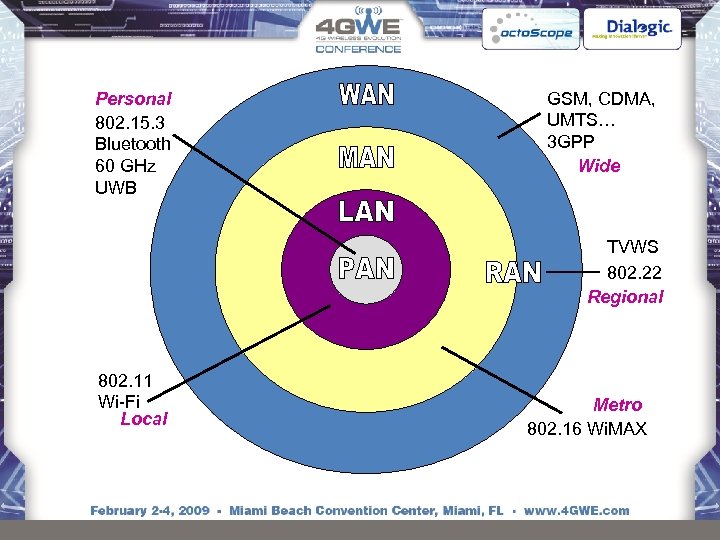 Personal 802. 15. 3 Bluetooth 60 GHz UWB GSM, CDMA, UMTS… 3 GPP Wide TVWS 802. 22 Regional 802. 11 Wi-Fi Local Metro 802. 16 Wi. MAX
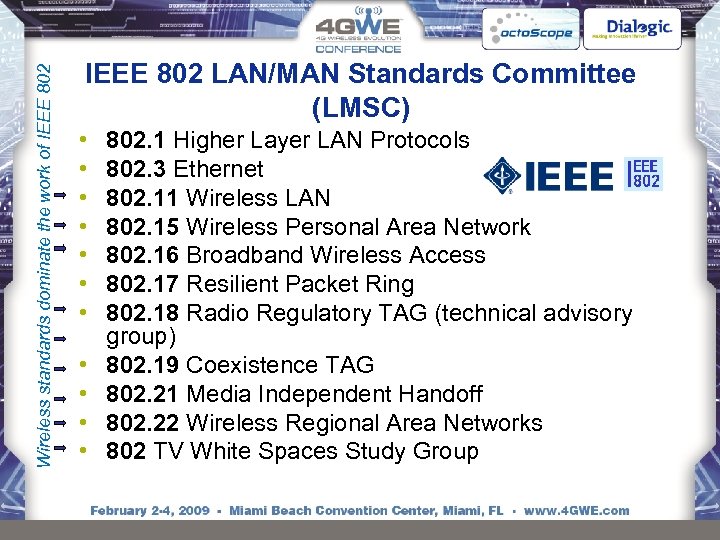 Wireless standards dominate the work of IEEE 802 LAN/MAN Standards Committee (LMSC) • • • 802. 1 Higher Layer LAN Protocols 802. 3 Ethernet 802. 11 Wireless LAN 802. 15 Wireless Personal Area Network 802. 16 Broadband Wireless Access 802. 17 Resilient Packet Ring 802. 18 Radio Regulatory TAG (technical advisory group) 802. 19 Coexistence TAG 802. 21 Media Independent Handoff 802. 22 Wireless Regional Area Networks 802 TV White Spaces Study Group
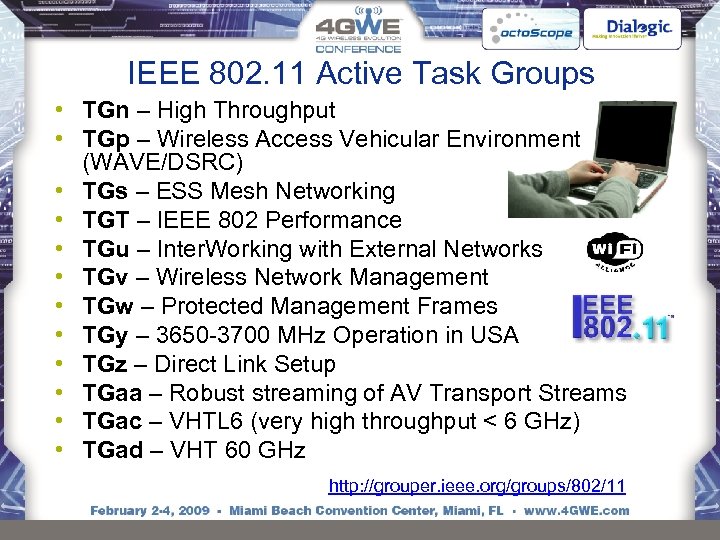 IEEE 802. 11 Active Task Groups • TGn – High Throughput • TGp – Wireless Access Vehicular Environment (WAVE/DSRC) • TGs – ESS Mesh Networking • TGT – IEEE 802 Performance • TGu – Inter. Working with External Networks • TGv – Wireless Network Management • TGw – Protected Management Frames • TGy – 3650 -3700 MHz Operation in USA • TGz – Direct Link Setup • TGaa – Robust streaming of AV Transport Streams • TGac – VHTL 6 (very high throughput < 6 GHz) • TGad – VHT 60 GHz http: //grouper. ieee. org/groups/802/11
 Draft 802. 11 n vs. Legacy Throughput Performance
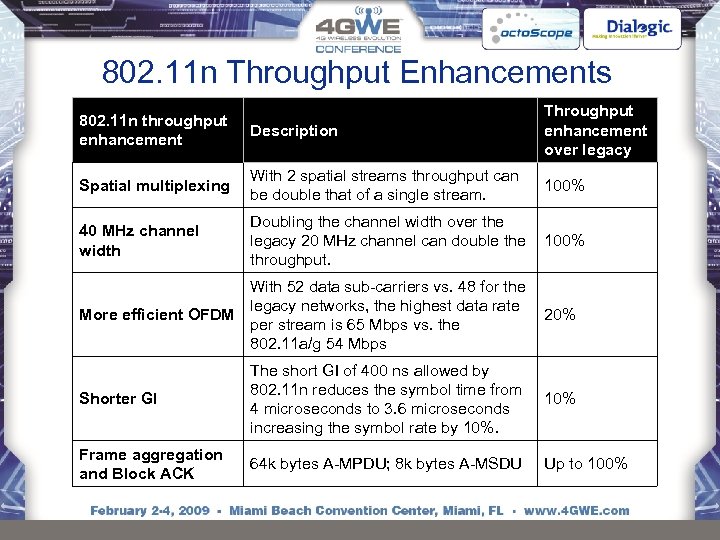 802. 11 n Throughput Enhancements 802. 11 n throughput enhancement Description Throughput enhancement over legacy Spatial multiplexing With 2 spatial streams throughput can be double that of a single stream. 100% 40 MHz channel width Doubling the channel width over the legacy 20 MHz channel can double the 100% throughput. With 52 data sub-carriers vs. 48 for the legacy networks, the highest data rate More efficient OFDM 20% per stream is 65 Mbps vs. the 802. 11 a/g 54 Mbps Shorter GI The short GI of 400 ns allowed by 802. 11 n reduces the symbol time from 4 microseconds to 3. 6 microseconds increasing the symbol rate by 10% Frame aggregation and Block ACK 64 k bytes A-MPDU; 8 k bytes A-MSDU Up to 100%
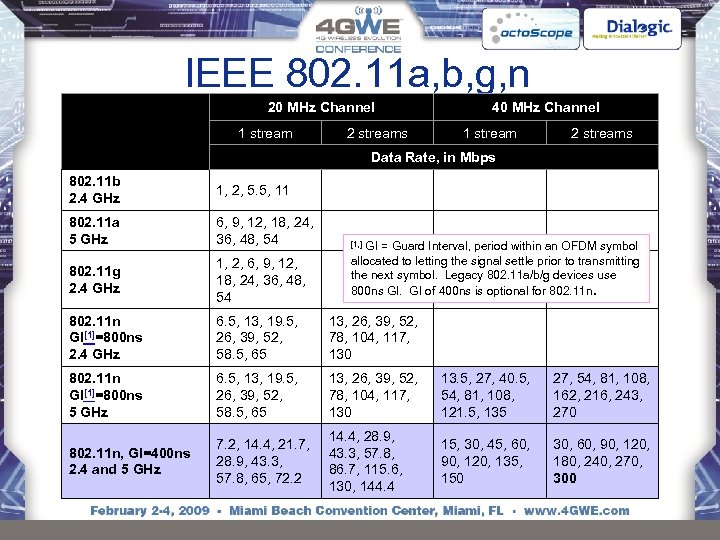 IEEE 802. 11 a, b, g, n 20 MHz Channel 1 stream 40 MHz Channel 2 streams 1 stream 2 streams Data Rate, in Mbps 802. 11 b 2. 4 GHz 1, 2, 5. 5, 11 802. 11 a 5 GHz 6, 9, 12, 18, 24, 36, 48, 54 802. 11 g 2. 4 GHz 1, 2, 6, 9, 12, 18, 24, 36, 48, 54 802. 11 n GI[1]=800 ns 2. 4 GHz 6. 5, 13, 19. 5, 26, 39, 52, 58. 5, 65 13, 26, 39, 52, 78, 104, 117, 130 802. 11 n GI[1]=800 ns 5 GHz 6. 5, 13, 19. 5, 26, 39, 52, 58. 5, 65 13, 26, 39, 52, 78, 104, 117, 130 13. 5, 27, 40. 5, 54, 81, 108, 121. 5, 135 27, 54, 81, 108, 162, 216, 243, 270 802. 11 n, GI=400 ns 2. 4 and 5 GHz 7. 2, 14. 4, 21. 7, 28. 9, 43. 3, 57. 8, 65, 72. 2 14. 4, 28. 9, 43. 3, 57. 8, 86. 7, 115. 6, 130, 144. 4 15, 30, 45, 60, 90, 120, 135, 150 30, 60, 90, 120, 180, 240, 270, 300 [1, ] GI = Guard Interval, period within an OFDM symbol allocated to letting the signal settle prior to transmitting the next symbol. Legacy 802. 11 a/b/g devices use 800 ns GI. GI of 400 ns is optional for 802. 11 n.
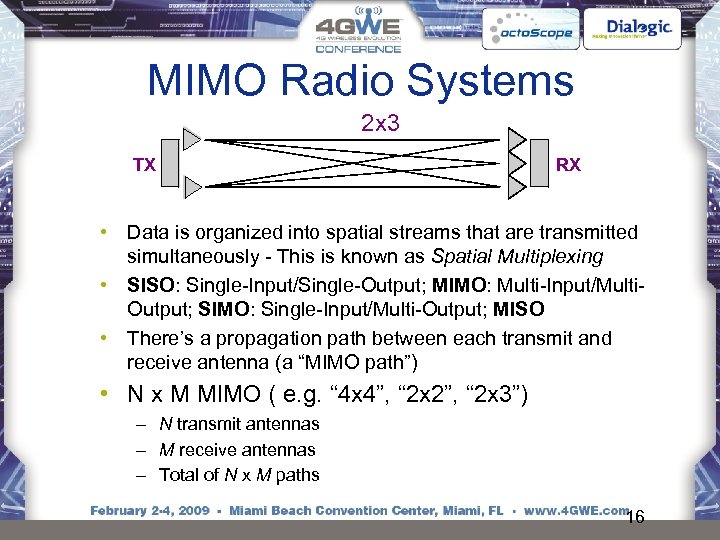 MIMO Radio Systems 2 x 3 TX RX • Data is organized into spatial streams that are transmitted simultaneously - This is known as Spatial Multiplexing • SISO: Single-Input/Single-Output; MIMO: Multi-Input/Multi. Output; SIMO: Single-Input/Multi-Output; MISO • There’s a propagation path between each transmit and receive antenna (a “MIMO path”) • N x M MIMO ( e. g. “ 4 x 4”, “ 2 x 2”, “ 2 x 3”) – N transmit antennas – M receive antennas – Total of N x M paths 16
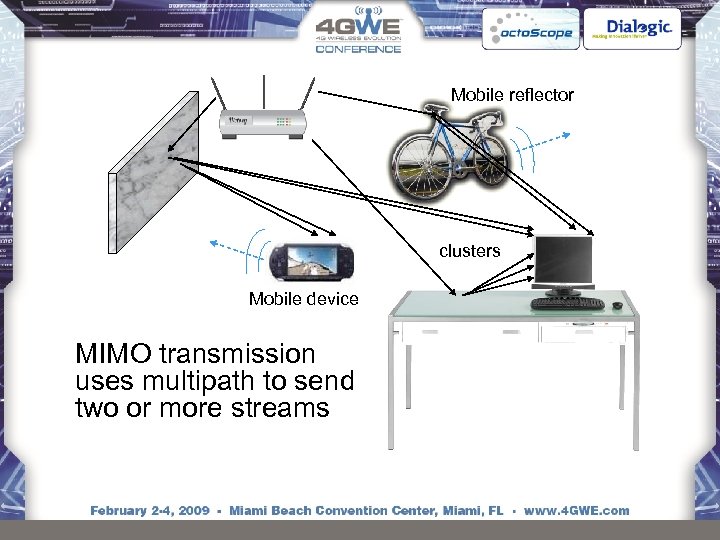 Mobile reflector clusters Mobile device MIMO transmission uses multipath to send two or more streams
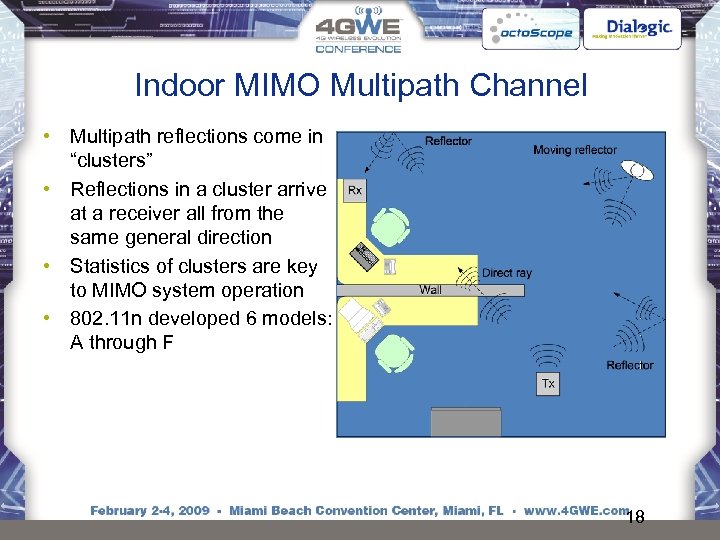 Indoor MIMO Multipath Channel • Multipath reflections come in “clusters” • Reflections in a cluster arrive at a receiver all from the same general direction • Statistics of clusters are key to MIMO system operation • 802. 11 n developed 6 models: A through F 18
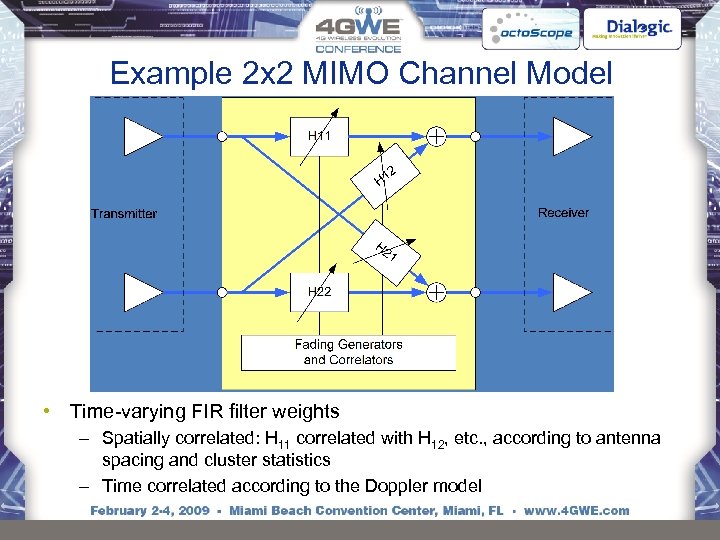 Example 2 x 2 MIMO Channel Model • Time-varying FIR filter weights – Spatially correlated: H 11 correlated with H 12, etc. , according to antenna spacing and cluster statistics – Time correlated according to the Doppler model
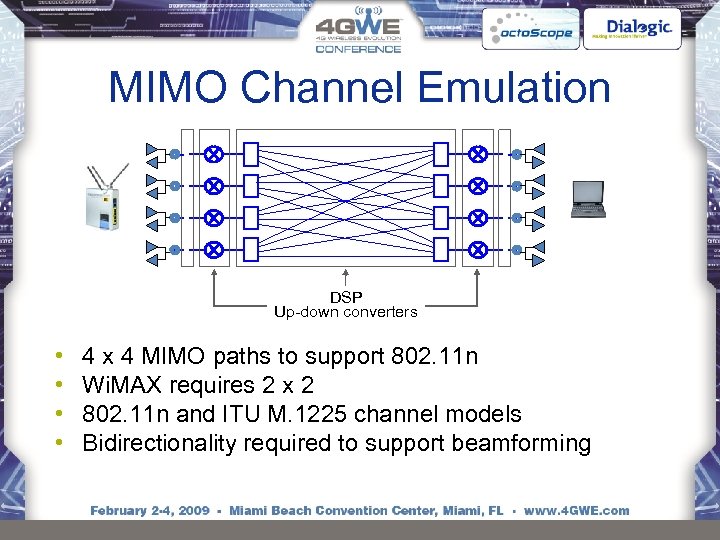 MIMO Channel Emulation DSP Up-down converters • • 4 x 4 MIMO paths to support 802. 11 n Wi. MAX requires 2 x 2 802. 11 n and ITU M. 1225 channel models Bidirectionality required to support beamforming
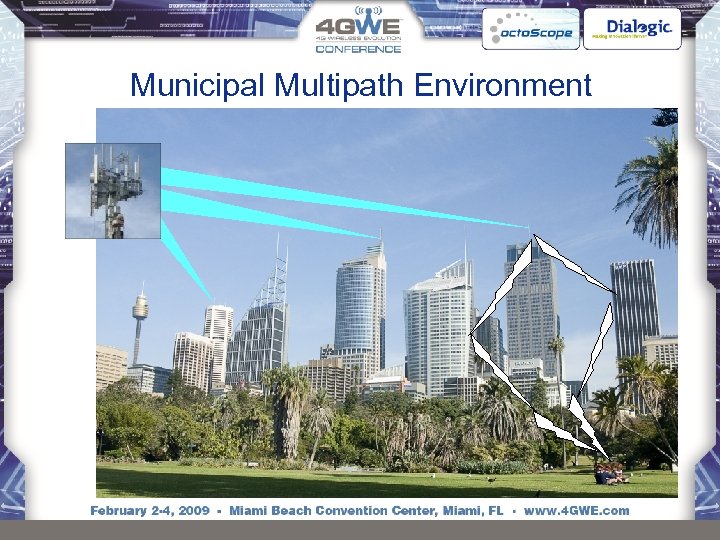 Municipal Multipath Environment
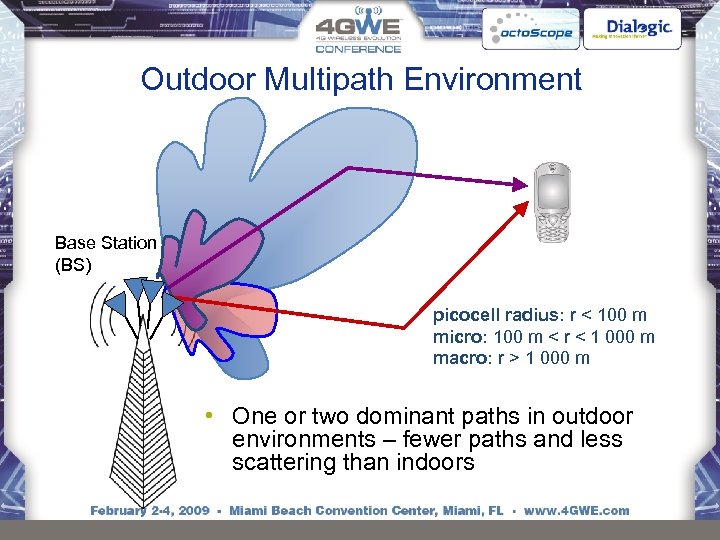 Outdoor Multipath Environment Base Station (BS) picocell radius: r < 100 m micro: 100 m < r < 1 000 m macro: r > 1 000 m • One or two dominant paths in outdoor environments – fewer paths and less scattering than indoors
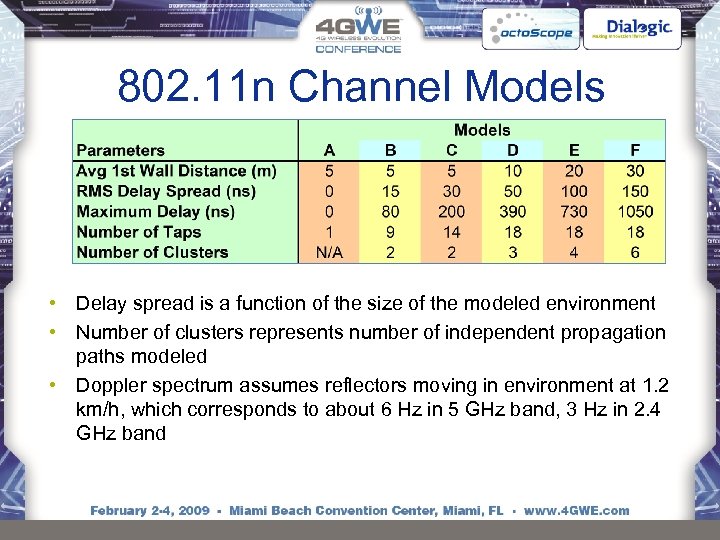 802. 11 n Channel Models • Delay spread is a function of the size of the modeled environment • Number of clusters represents number of independent propagation paths modeled • Doppler spectrum assumes reflectors moving in environment at 1. 2 km/h, which corresponds to about 6 Hz in 5 GHz band, 3 Hz in 2. 4 GHz band
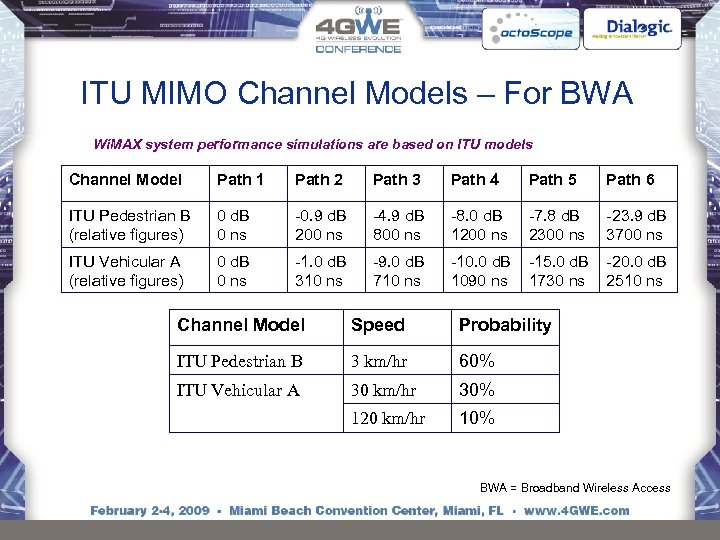 ITU MIMO Channel Models – For BWA Wi. MAX system performance simulations are based on ITU models Channel Model Path 1 Path 2 Path 3 Path 4 Path 5 Path 6 ITU Pedestrian B (relative figures) 0 d. B 0 ns -0. 9 d. B 200 ns -4. 9 d. B 800 ns -8. 0 d. B 1200 ns -7. 8 d. B 2300 ns -23. 9 d. B 3700 ns ITU Vehicular A (relative figures) 0 d. B 0 ns -1. 0 d. B 310 ns -9. 0 d. B 710 ns -10. 0 d. B 1090 ns -15. 0 d. B 1730 ns -20. 0 d. B 2510 ns Channel Model Speed Probability ITU Pedestrian B 3 km/hr 60% ITU Vehicular A 30 km/hr 30% 120 km/hr 10% BWA = Broadband Wireless Access
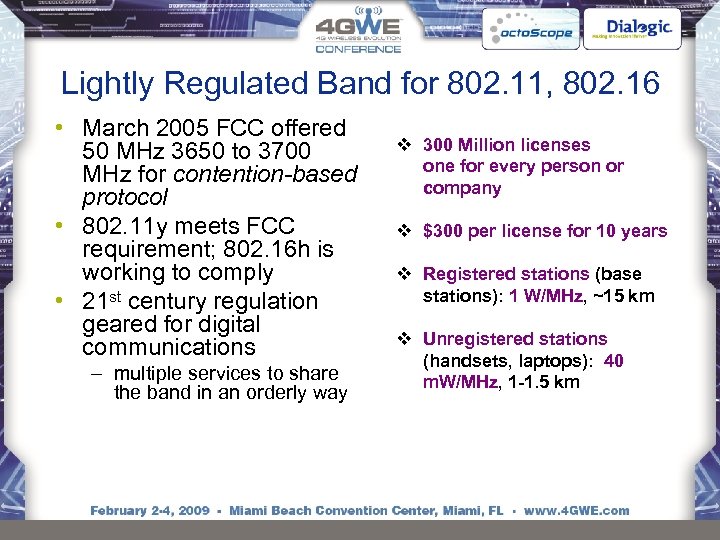 Lightly Regulated Band for 802. 11, 802. 16 • March 2005 FCC offered 50 MHz 3650 to 3700 MHz for contention-based protocol • 802. 11 y meets FCC requirement; 802. 16 h is working to comply • 21 st century regulation geared for digital communications – multiple services to share the band in an orderly way v 300 Million licenses one for every person or company v $300 per license for 10 years v Registered stations (base stations): 1 W/MHz, ~15 km v Unregistered stations (handsets, laptops): 40 m. W/MHz, 1 -1. 5 km
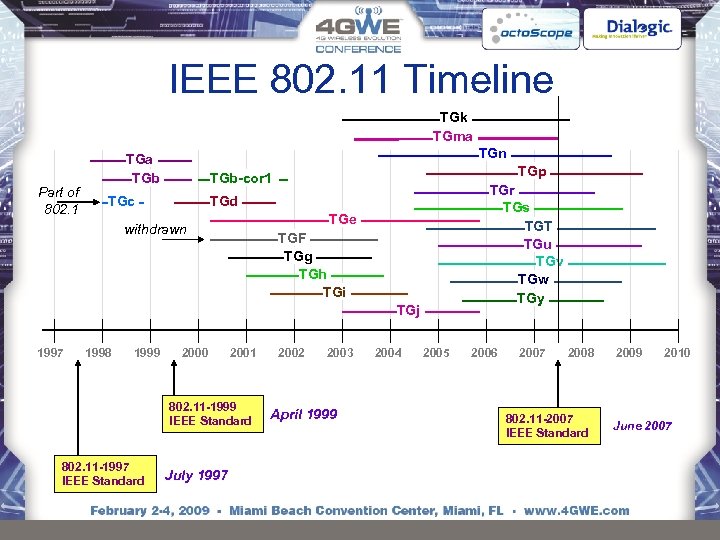 IEEE 802. 11 Timeline TGk TGma Part of 802. 1 TGn TGa TGb-cor 1 TGc TGd TGe withdrawn TGF TGg TGh TGi TGj 1997 1998 1999 2000 2001 802. 11 -1999 IEEE Standard 802. 11 -1997 IEEE Standard July 1997 2002 2003 April 1999 2004 2005 TGp TGr TGs TGT TGu TGv TGw TGy 2006 2007 2008 802. 11 -2007 IEEE Standard 2009 2010 June 2007
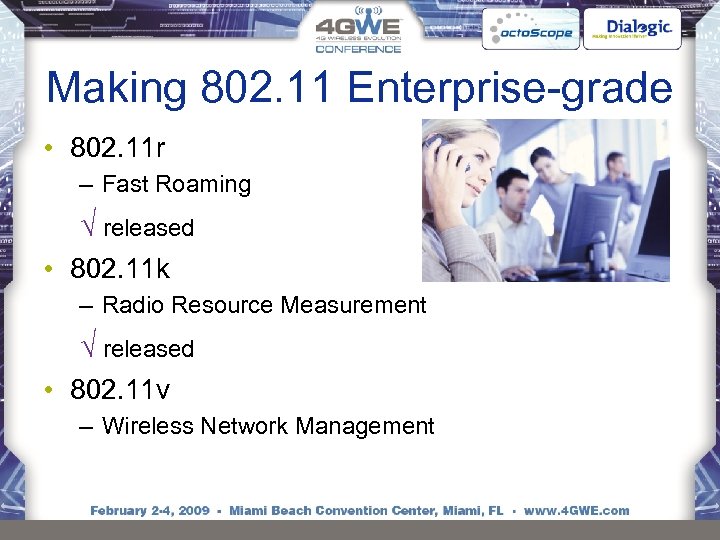 Making 802. 11 Enterprise-grade • 802. 11 r – Fast Roaming √ released • 802. 11 k – Radio Resource Measurement √ released • 802. 11 v – Wireless Network Management
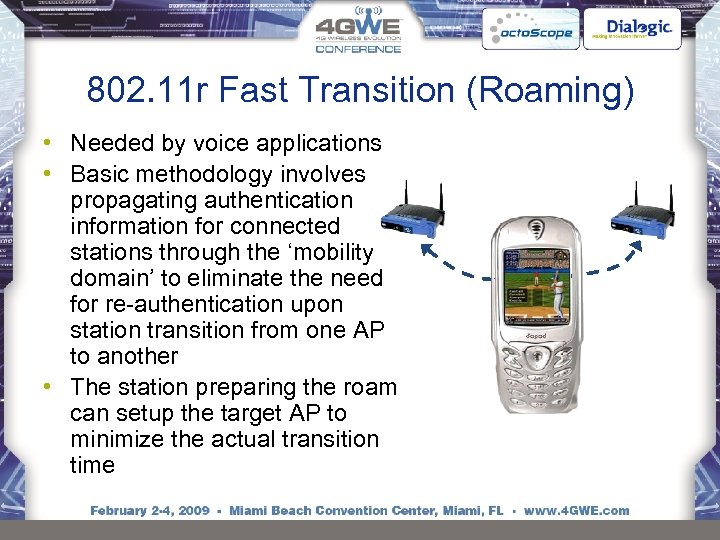 802. 11 r Fast Transition (Roaming) • Needed by voice applications • Basic methodology involves propagating authentication information for connected stations through the ‘mobility domain’ to eliminate the need for re-authentication upon station transition from one AP to another • The station preparing the roam can setup the target AP to minimize the actual transition time
 802. 11 k Radio Resource Measurement • Impetus for 802. 11 k came from the Enterprises that needed to manage their WLANs from a central point • 802. 11 k makes a centralized network management system by providing layer 2 mechanisms for – Discovering network topology – Monitoring WLAN devices, their receive power levels, PHY configuration and network activity • Can be used to assists 802. 11 r Fast Transition (roaming) protocol with handoff decisions based on the loading of the infrastructure, but 802. 11 v is more focused on load balancing
 802. 11 v Wireless Network Management • TGv’s charter is to build on the network measurement mechanisms defined by TGk and introduce network management functions to provide Enterprises with centralized network management and load balancing capabilities. • Major goals: manageability, improved power efficiency and interference avoidance • Defines a protocol for requesting and reporting location capability – Location information may be CIVIC (street address) or GEO (longitude, latitude coordinates) • For the handset, TGv may enable awareness of AP e 911 capabilities while the handset is in sleep mode; this work has common ground with TGu
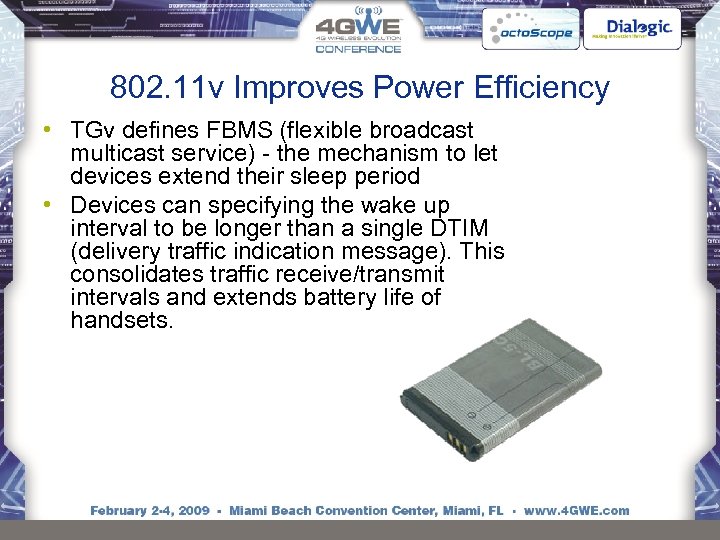 802. 11 v Improves Power Efficiency • TGv defines FBMS (flexible broadcast multicast service) - the mechanism to let devices extend their sleep period • Devices can specifying the wake up interval to be longer than a single DTIM (delivery traffic indication message). This consolidates traffic receive/transmit intervals and extends battery life of handsets.
 Making Wi-Fi Carrier-grade? • 802. 11 u - Inter. Working with External Networks – Main goal is to enable Interworking with external networks, including other 802 based networks such as 802. 16 and 802. 3 and 3 GPP based IMS networks – Manage network discovery, emergency call support (e 911), roaming, location and availability – The network discovery capabilities give a station looking to connect information about networks in range, service providers, subscription status with service providers • 802. 11 u makes 802. 11 networks more like cellular networks where such information is provided by the infrastructure
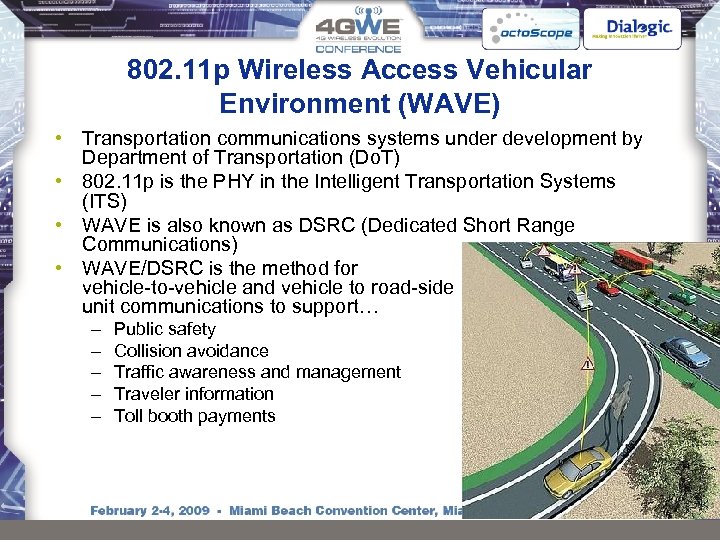 802. 11 p Wireless Access Vehicular Environment (WAVE) • Transportation communications systems under development by Department of Transportation (Do. T) • 802. 11 p is the PHY in the Intelligent Transportation Systems (ITS) • WAVE is also known as DSRC (Dedicated Short Range Communications) • WAVE/DSRC is the method for vehicle-to-vehicle and vehicle to road-side unit communications to support… – – – Public safety Collision avoidance Traffic awareness and management Traveler information Toll booth payments
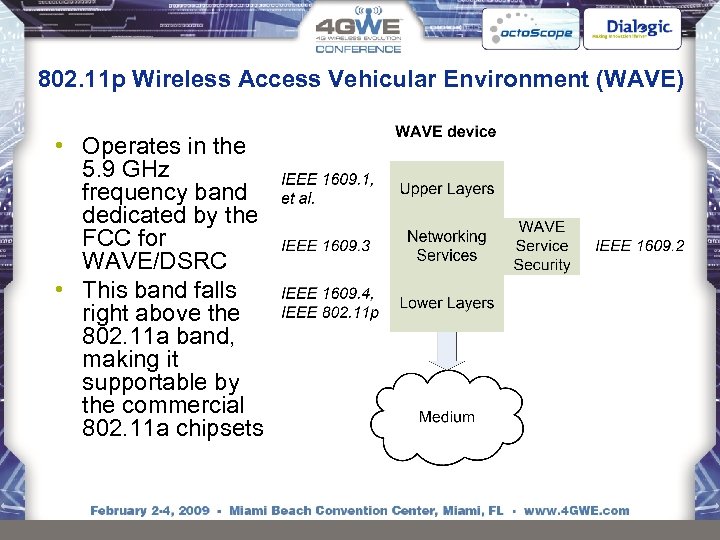 802. 11 p Wireless Access Vehicular Environment (WAVE) • Operates in the 5. 9 GHz frequency band dedicated by the FCC for WAVE/DSRC • This band falls right above the 802. 11 a band, making it supportable by the commercial 802. 11 a chipsets
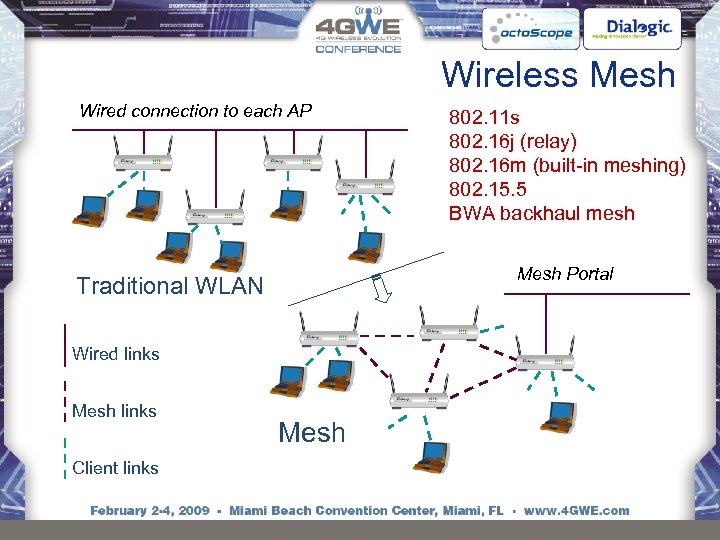 Wireless Mesh Wired connection to each AP Mesh Portal Traditional WLAN Wired links Mesh links Client links 802. 11 s 802. 16 j (relay) 802. 16 m (built-in meshing) 802. 15. 5 BWA backhaul mesh Mesh
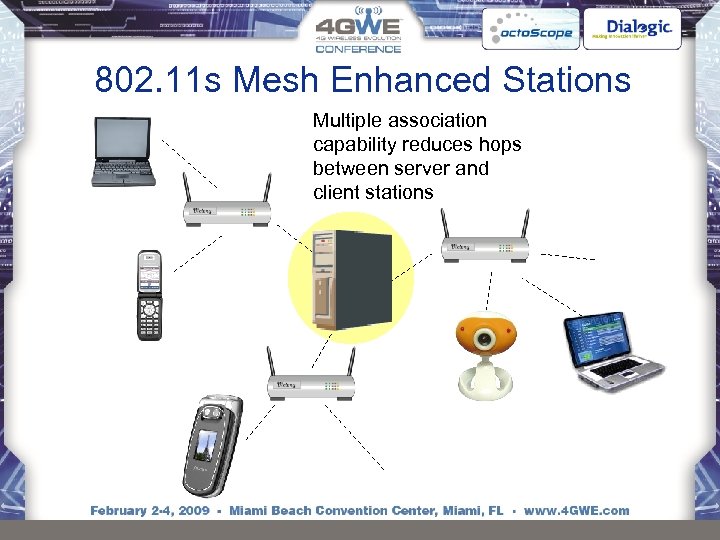
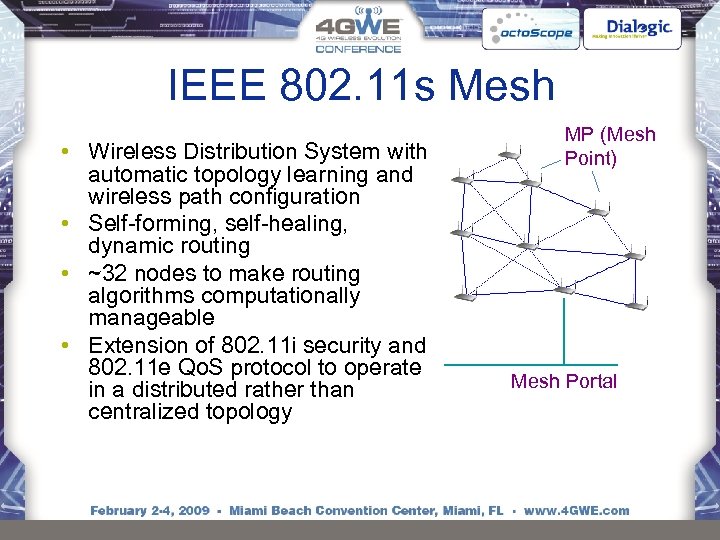 IEEE 802. 11 s Mesh • Wireless Distribution System with automatic topology learning and wireless path configuration • Self-forming, self-healing, dynamic routing • ~32 nodes to make routing algorithms computationally manageable • Extension of 802. 11 i security and 802. 11 e Qo. S protocol to operate in a distributed rather than centralized topology MP (Mesh Point) Mesh Portal
 802. 11 s Mesh Enhanced Stations Multiple association capability reduces hops between server and client stations
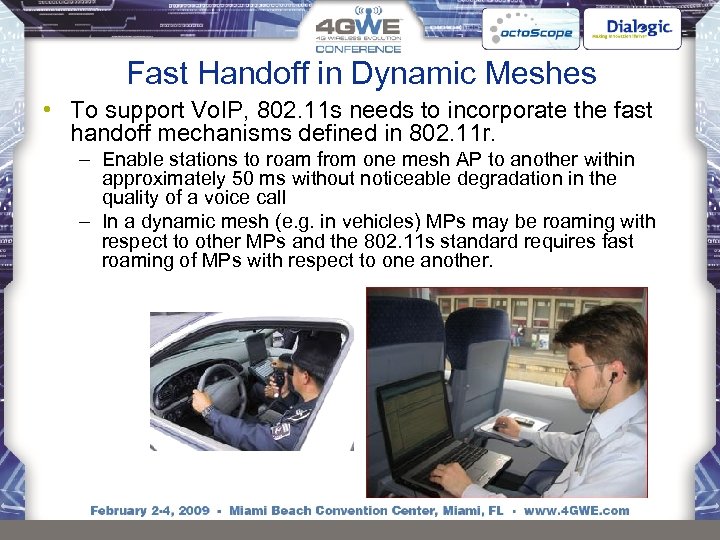 Fast Handoff in Dynamic Meshes • To support Vo. IP, 802. 11 s needs to incorporate the fast handoff mechanisms defined in 802. 11 r. – Enable stations to roam from one mesh AP to another within approximately 50 ms without noticeable degradation in the quality of a voice call – In a dynamic mesh (e. g. in vehicles) MPs may be roaming with respect to other MPs and the 802. 11 s standard requires fast roaming of MPs with respect to one another.
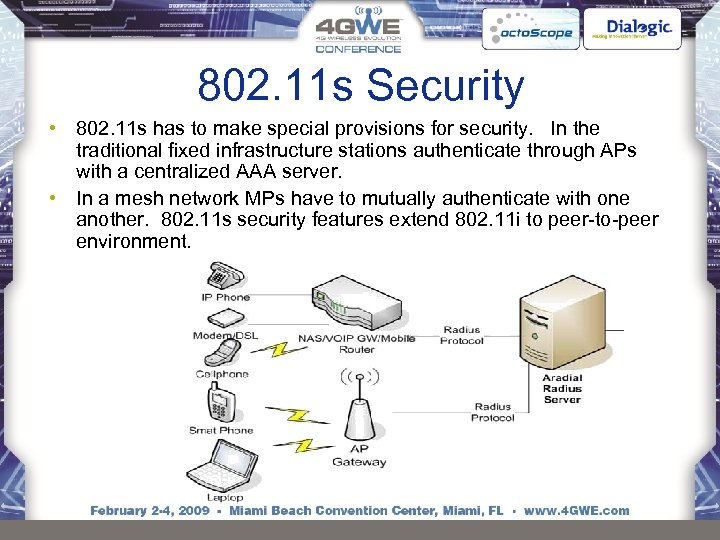 802. 11 s Security • 802. 11 s has to make special provisions for security. In the traditional fixed infrastructure stations authenticate through APs with a centralized AAA server. • In a mesh network MPs have to mutually authenticate with one another. 802. 11 s security features extend 802. 11 i to peer-to-peer environment.
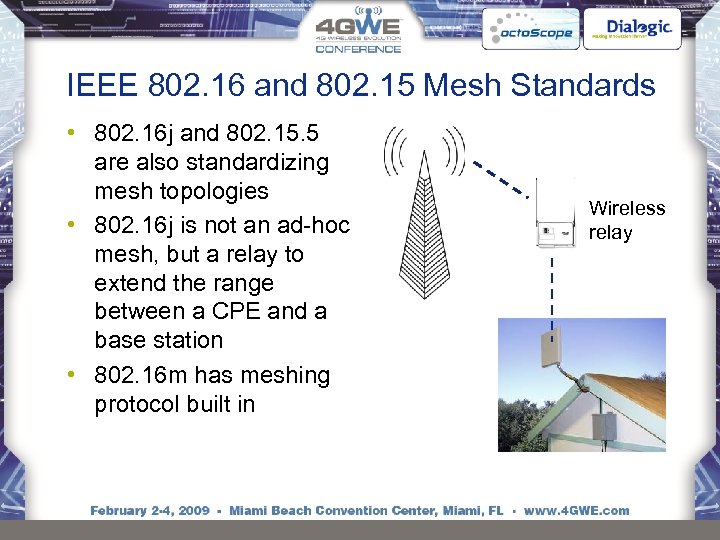 IEEE 802. 16 and 802. 15 Mesh Standards • 802. 16 j and 802. 15. 5 are also standardizing mesh topologies • 802. 16 j is not an ad-hoc mesh, but a relay to extend the range between a CPE and a base station • 802. 16 m has meshing protocol built in Wireless relay
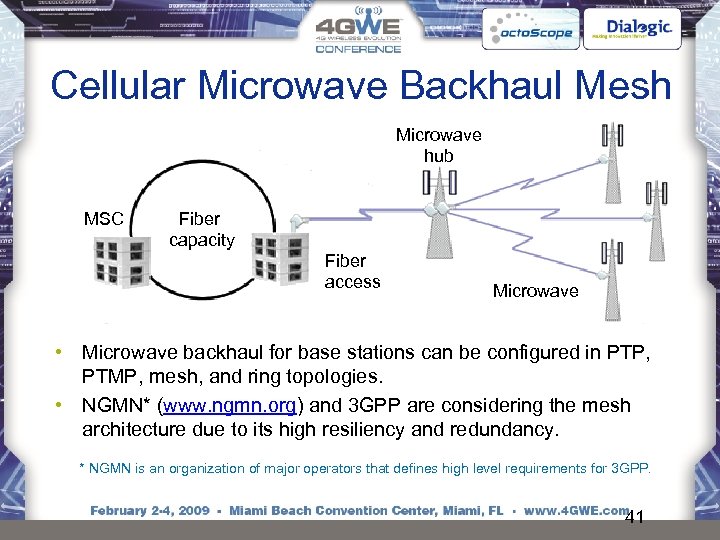 Cellular Microwave Backhaul Mesh Microwave hub MSC Fiber capacity Fiber access Microwave • Microwave backhaul for base stations can be configured in PTP, PTMP, mesh, and ring topologies. • NGMN* (www. ngmn. org) and 3 GPP are considering the mesh architecture due to its high resiliency and redundancy. * NGMN is an organization of major operators that defines high level requirements for 3 GPP. 41
 IEEE 802. 16 Active Task Groups • 802. 16 h, License-Exempt Task Group – Working with 802. 11 TGy and 802. 19 Coexistence TAG • 802. 16 j, Mobile Multihop Relay – Extended reach between BS (base station) and CPE (customer premises equipment) • 802. 16 m, IMT Advanced Air Interface • Maintenance – Developing 802. 16 Rev 2 – Working with the Wi. MAX Forum http: //grouper. ieee. org/groups/802/16
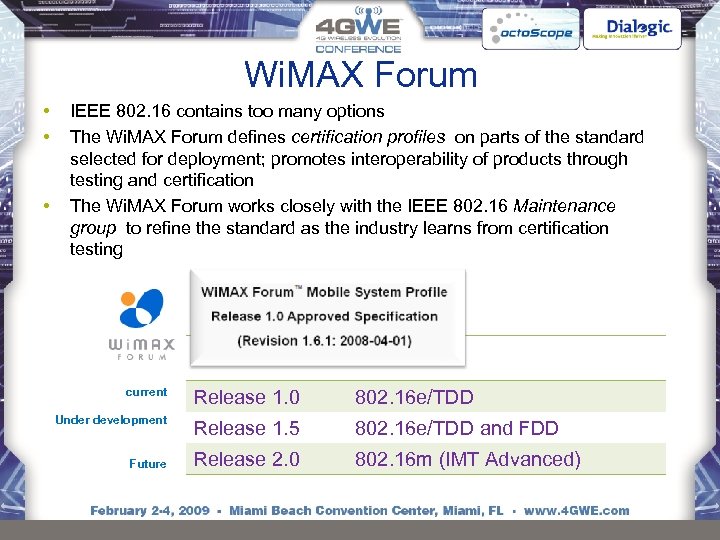 Wi. MAX Forum • • • IEEE 802. 16 contains too many options The Wi. MAX Forum defines certification profiles on parts of the standard selected for deployment; promotes interoperability of products through testing and certification The Wi. MAX Forum works closely with the IEEE 802. 16 Maintenance group to refine the standard as the industry learns from certification testing current Release 1. 0 802. 16 e/TDD Under development Release 1. 5 802. 16 e/TDD and FDD Release 2. 0 802. 16 m (IMT Advanced) Future
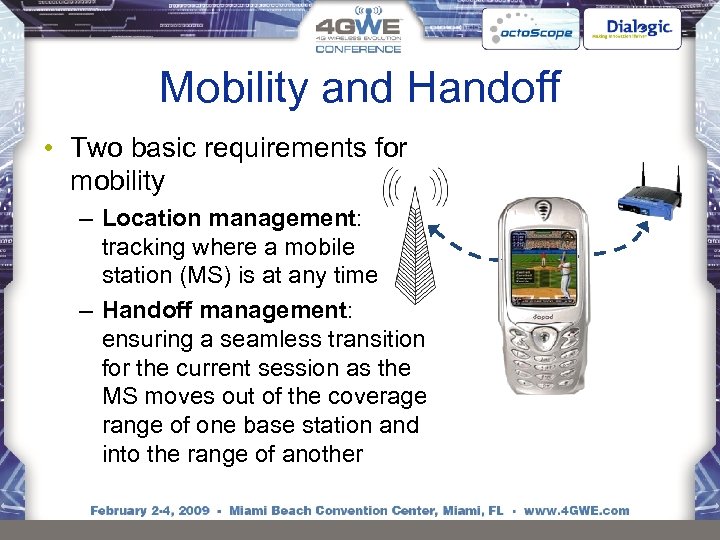 Mobility and Handoff • Two basic requirements for mobility – Location management: tracking where a mobile station (MS) is at any time – Handoff management: ensuring a seamless transition for the current session as the MS moves out of the coverage range of one base station and into the range of another
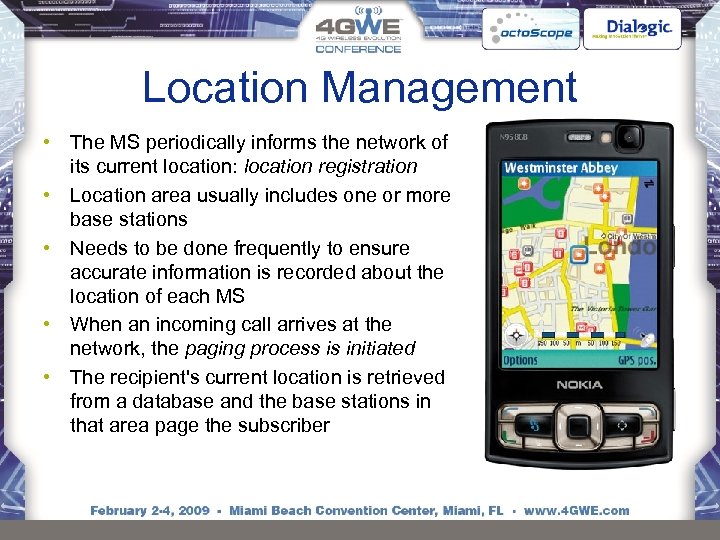 Location Management • The MS periodically informs the network of its current location: location registration • Location area usually includes one or more base stations • Needs to be done frequently to ensure accurate information is recorded about the location of each MS • When an incoming call arrives at the network, the paging process is initiated • The recipient's current location is retrieved from a database and the base stations in that area page the subscriber
 Handoff • Wi. MAX requires handoff latency be less than 50 ms with an associated packet loss of less than 1 percent for speeds up to 120 kmph • The MS makes the decisions while the BS makes recommendations on target BS’s for the handoff • Either the SINR (Signal to Interference plus Noise Ratio) or RSS (receive signal strength) can be used as criteria
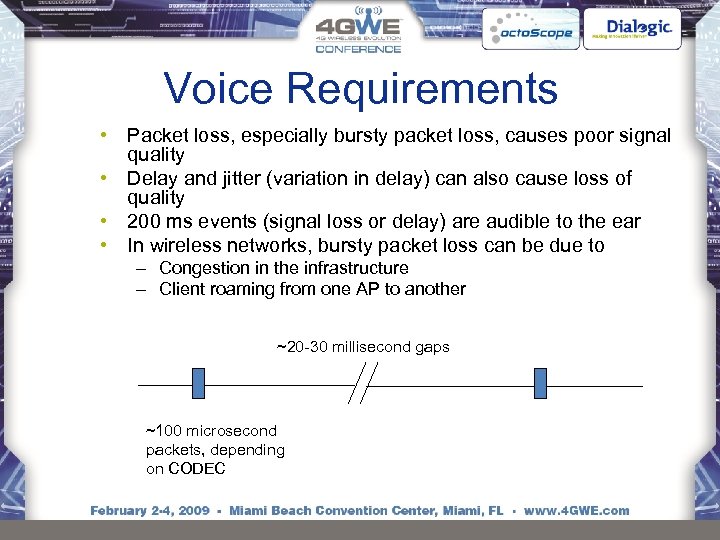 Voice Requirements • Packet loss, especially bursty packet loss, causes poor signal quality • Delay and jitter (variation in delay) can also cause loss of quality • 200 ms events (signal loss or delay) are audible to the ear • In wireless networks, bursty packet loss can be due to – Congestion in the infrastructure – Client roaming from one AP to another ~20 -30 millisecond gaps ~100 microsecond packets, depending on CODEC
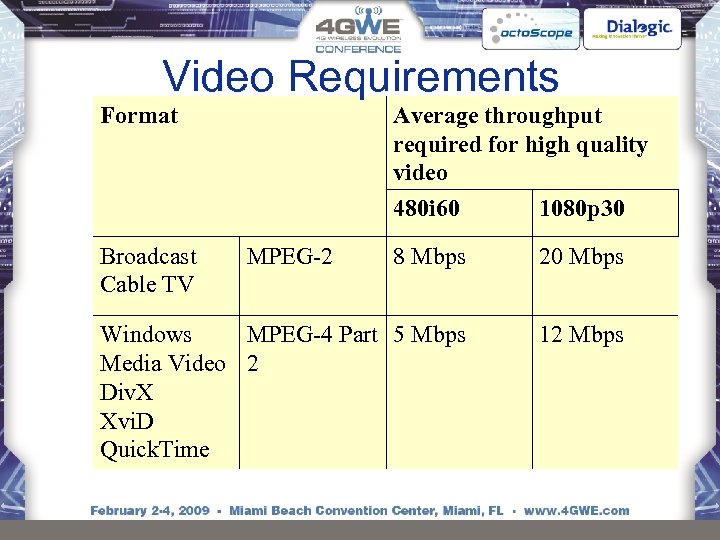 Video Requirements Format Broadcast Cable TV Average throughput required for high quality video 480 i 60 1080 p 30 MPEG-2 8 Mbps 20 Mbps Windows MPEG-4 Part 5 Mbps Media Video 2 Div. X Xvi. D Quick. Time 12 Mbps
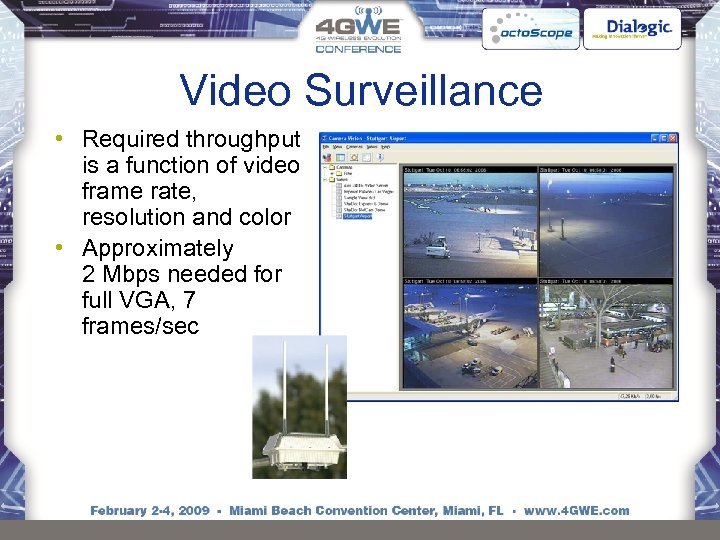 Video Surveillance • Required throughput is a function of video frame rate, resolution and color • Approximately 2 Mbps needed for full VGA, 7 frames/sec
 802 Wireless • 802. 11 – – – Faster (802. 11 n, ac/ad) More power efficient (sleep modes 802. 11 n, u, v) Location aware (802. 11 u, v) Vo. IP and Video capable Manageable • 802. 16 – Scalable, supports mobility – 802. 16 m has built in meshing and femtocell support • White spaces – Major new disruptive market – Currently no industry standard other than FCC
 Agenda 10: 30 – 12: 00 noon Our G-enealogy – History and Evolution of Mobile Radio Lunch 1: 00 – 2: 45 The IEEE’s Wireless Ethernet Keeps Going and Growing 4 G Tutorial: Vive la Différence? Break 3: 00 – 3: 45 Mobile Broadband - New Applications and New Business Models Break 4: 00 – 4: 45 Tutorial: White Spaces and Beyond
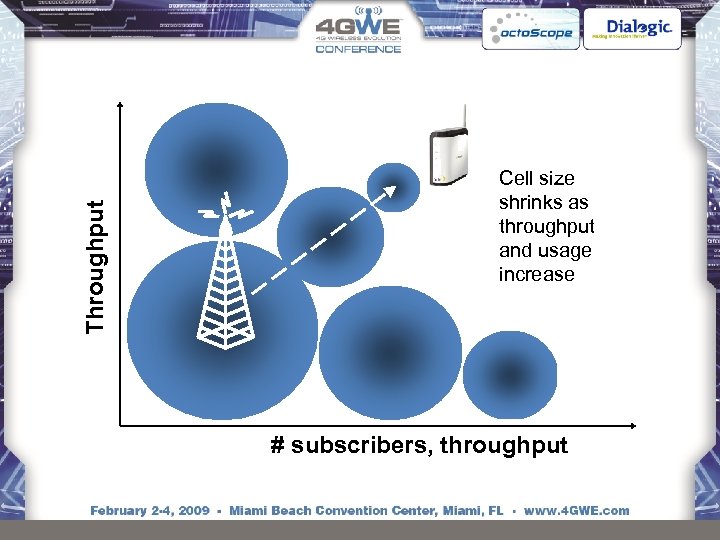
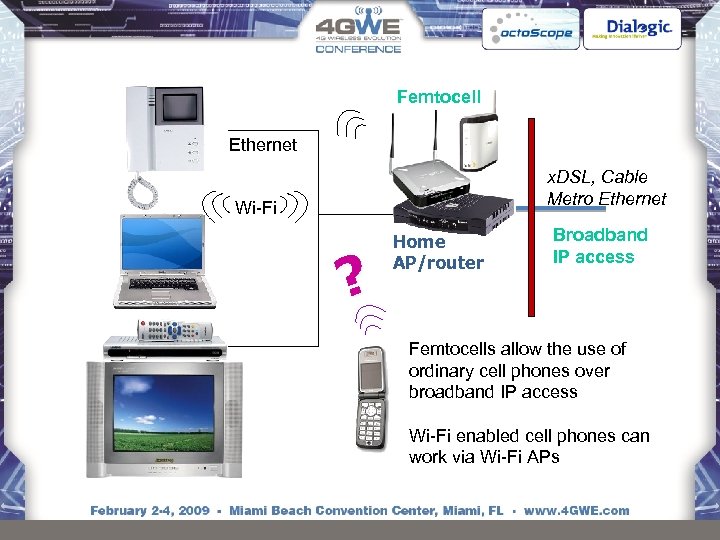
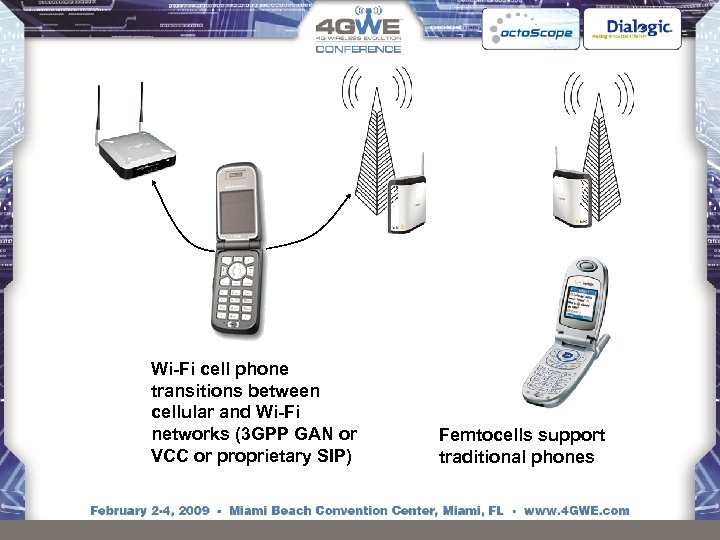
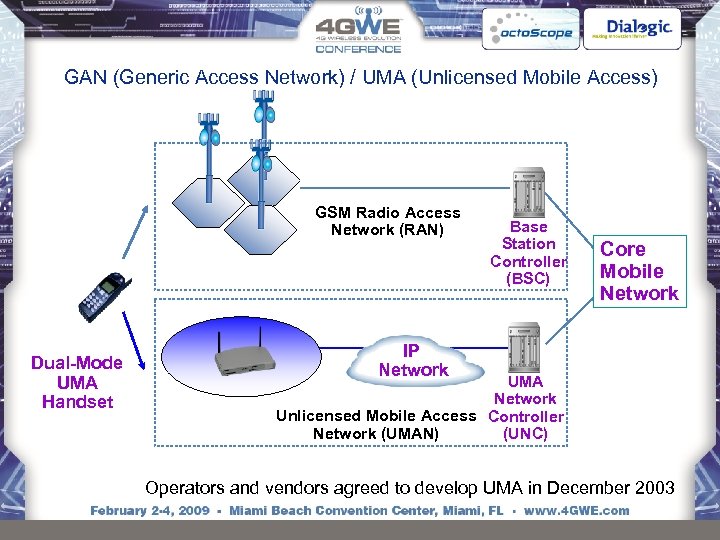
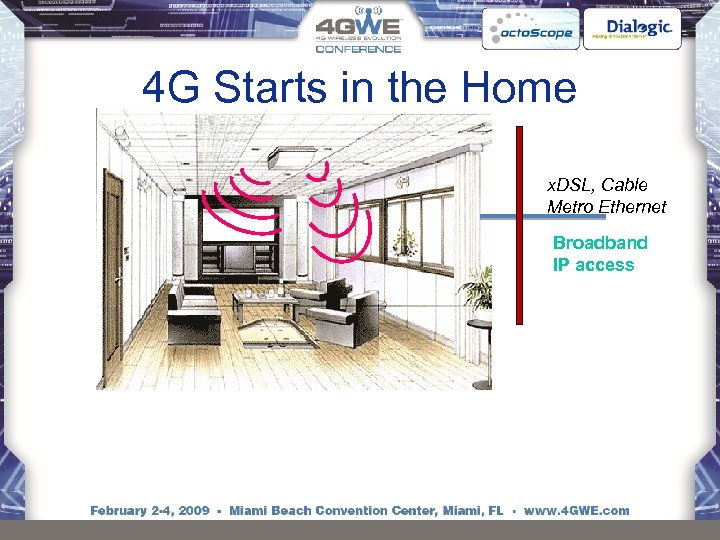 4 G Starts in the Home x. DSL, Cable Metro Ethernet Broadband IP access
 Throughput Cell size shrinks as throughput and usage increase # subscribers, throughput
 Femtocell Ethernet x. DSL, Cable Metro Ethernet Wi-Fi ? Home AP/router Broadband IP access Femtocells allow the use of ordinary cell phones over broadband IP access Wi-Fi enabled cell phones can work via Wi-Fi APs
 Wi-Fi cell phone transitions between cellular and Wi-Fi networks (3 GPP GAN or VCC or proprietary SIP) Femtocells support traditional phones
 GAN (Generic Access Network) / UMA (Unlicensed Mobile Access) GSM Radio Access Network (RAN) Dual-Mode UMA Handset Base Station Controller (BSC) Core Mobile Network IP Network UMA Network Unlicensed Mobile Access Controller Network (UMAN) (UNC) Operators and vendors agreed to develop UMA in December 2003
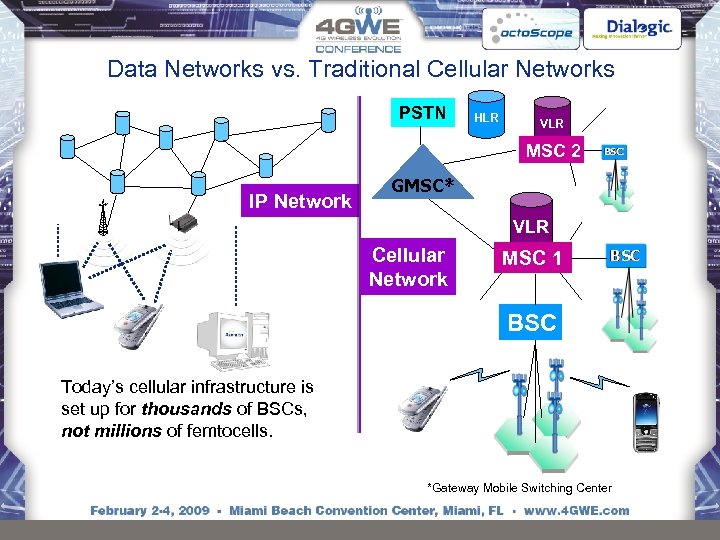 Data Networks vs. Traditional Cellular Networks PSTN HLR VLR MSC 2 IP Network GMSC* VLR Cellular Network MSC 1 BSC Today’s cellular infrastructure is set up for thousands of BSCs, not millions of femtocells. *Gateway Mobile Switching Center
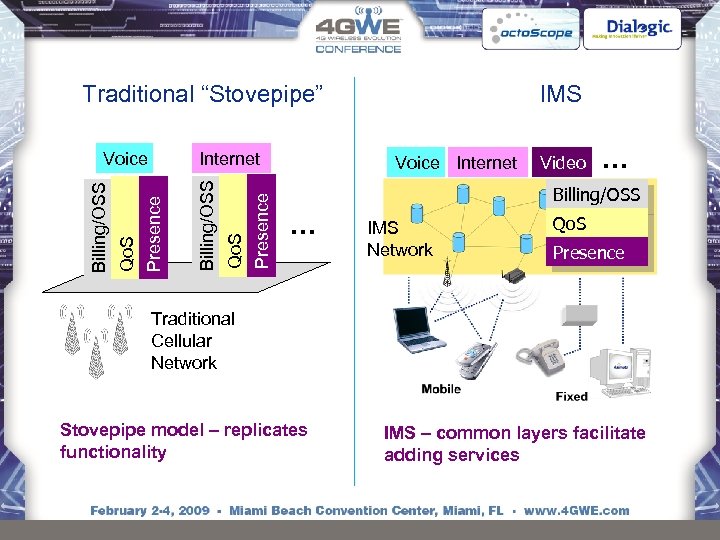 Traditional “Stovepipe” Presence Qo. S Billing/OSS Internet Presence Qo. S Billing/OSS Voice IMS Voice Internet Video … Billing/OSS … IMS Network Qo. S Presence Traditional Cellular Network Stovepipe model – replicates functionality IMS – common layers facilitate adding services
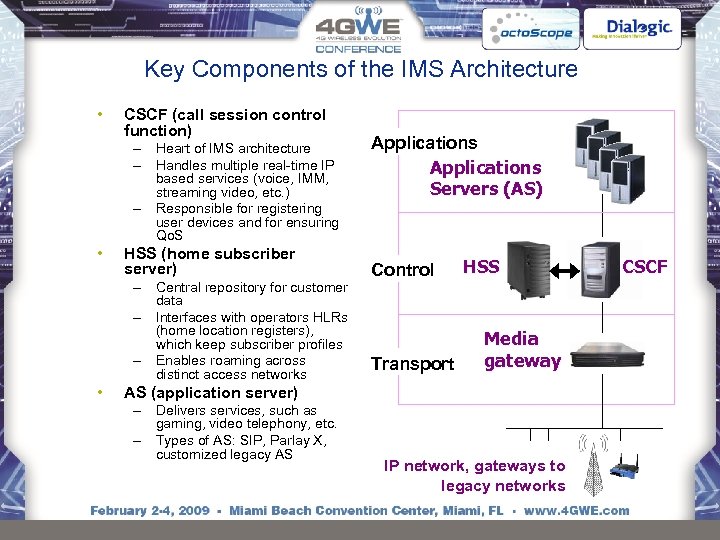 Key Components of the IMS Architecture • CSCF (call session control function) – Heart of IMS architecture – Handles multiple real-time IP based services (voice, IMM, streaming video, etc. ) – Responsible for registering user devices and for ensuring Qo. S • HSS (home subscriber server) – Central repository for customer data – Interfaces with operators HLRs (home location registers), which keep subscriber profiles – Enables roaming across distinct access networks • Applications Servers (AS) Control Transport HSS Media gateway AS (application server) – Delivers services, such as gaming, video telephony, etc. – Types of AS: SIP, Parlay X, customized legacy AS IP network, gateways to legacy networks CSCF
 LTE Architecture – IMS Based • • • LTE specifies IP multimedia subsystem (IMS), optimizing the architecture for services. IMS is being used in wired infrastructure to enable Vo. IP and other applications; LTE expands on this capability to deliver seamless services. Hotspot-like initial deployments, primarily in urban areas will leverage HSPA for full coverage Most LTE devices will be multi-mode, supporting HSPA and other interfaces LTE femtocells will be integrated in the architecture from the onset to increase capacity and indoor coverage.
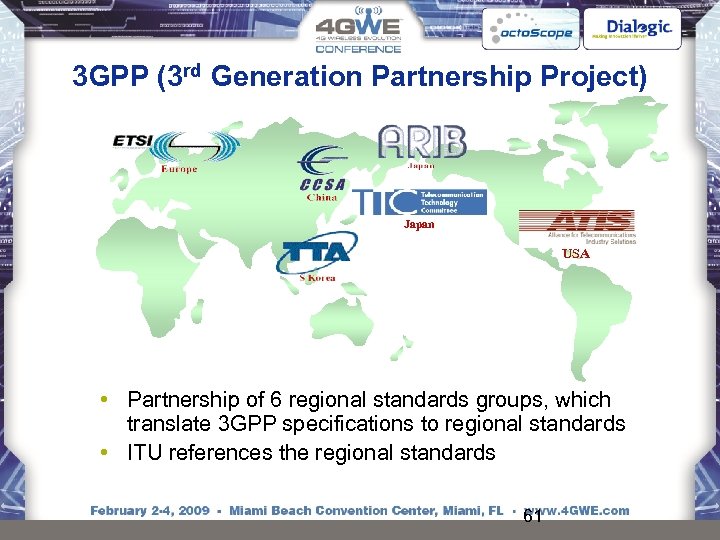 3 GPP (3 rd Generation Partnership Project) Japan USA • Partnership of 6 regional standards groups, which translate 3 GPP specifications to regional standards • ITU references the regional standards 61
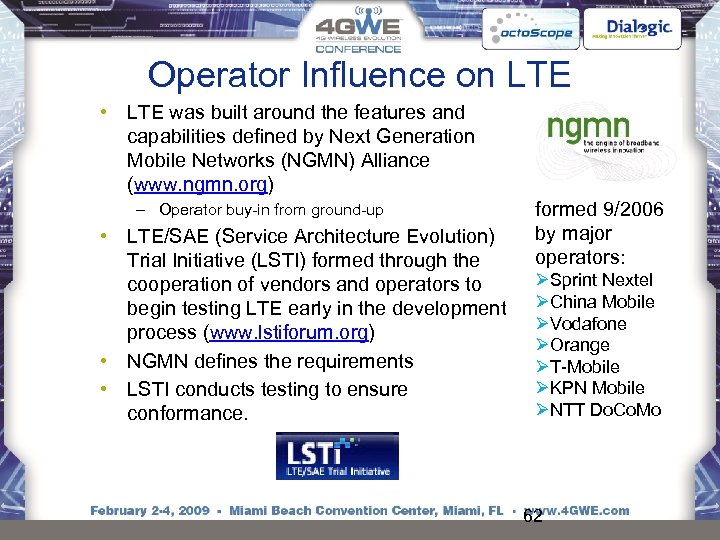 Operator Influence on LTE • LTE was built around the features and capabilities defined by Next Generation Mobile Networks (NGMN) Alliance (www. ngmn. org) – Operator buy-in from ground-up • LTE/SAE (Service Architecture Evolution) Trial Initiative (LSTI) formed through the cooperation of vendors and operators to begin testing LTE early in the development process (www. lstiforum. org) • NGMN defines the requirements • LSTI conducts testing to ensure conformance. formed 9/2006 by major operators: ØSprint Nextel ØChina Mobile ØVodafone ØOrange ØT-Mobile ØKPN Mobile ØNTT Do. Co. Mo 62
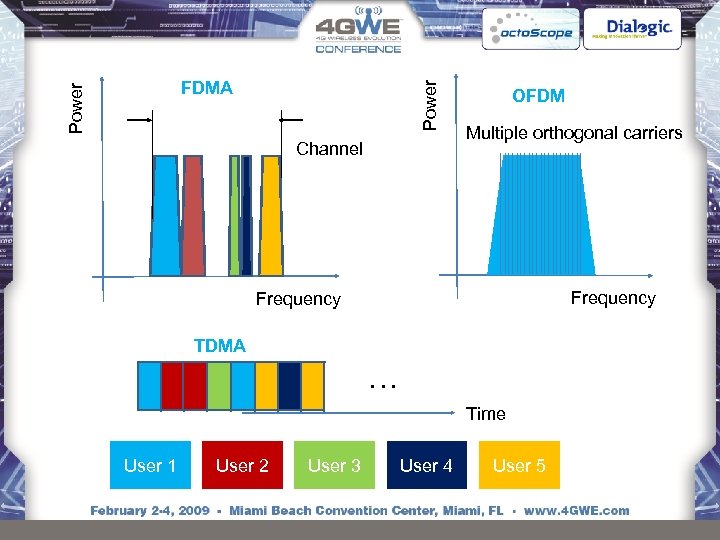
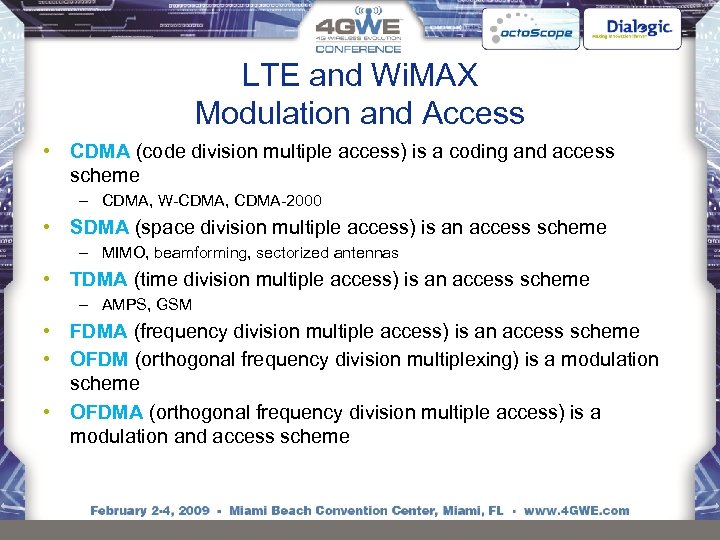 LTE and Wi. MAX Modulation and Access • CDMA (code division multiple access) is a coding and access scheme – CDMA, W-CDMA, CDMA-2000 • SDMA (space division multiple access) is an access scheme – MIMO, beamforming, sectorized antennas • TDMA (time division multiple access) is an access scheme – AMPS, GSM • FDMA (frequency division multiple access) is an access scheme • OFDM (orthogonal frequency division multiplexing) is a modulation scheme • OFDMA (orthogonal frequency division multiple access) is a modulation and access scheme
 Power FDMA Channel OFDM Multiple orthogonal carriers Frequency TDMA … Time User 1 User 2 User 3 User 4 User 5
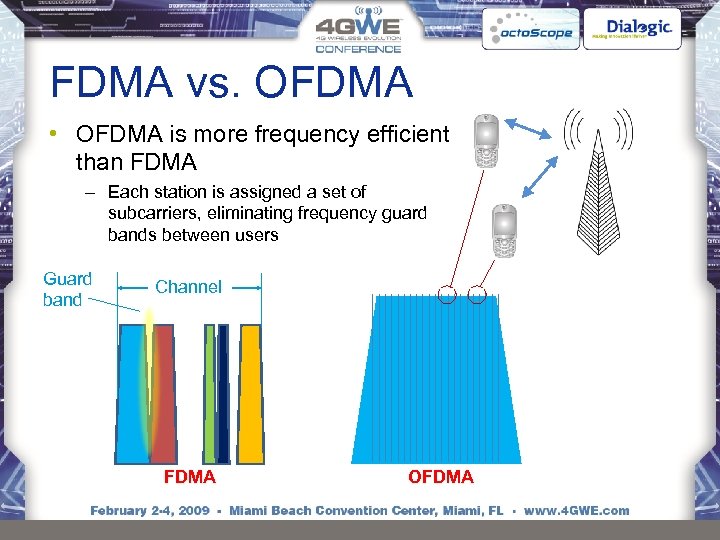 FDMA vs. OFDMA • OFDMA is more frequency efficient than FDMA – Each station is assigned a set of subcarriers, eliminating frequency guard bands between users Guard band Channel FDMA OFDMA
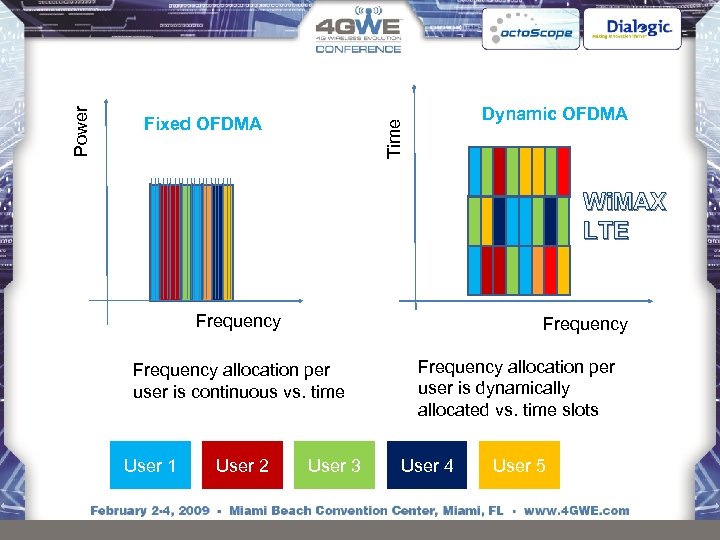 Dynamic OFDMA Time Power Fixed OFDMA Wi. MAX LTE Frequency allocation per user is continuous vs. time User 1 User 2 User 3 Frequency allocation per user is dynamically allocated vs. time slots User 4 User 5
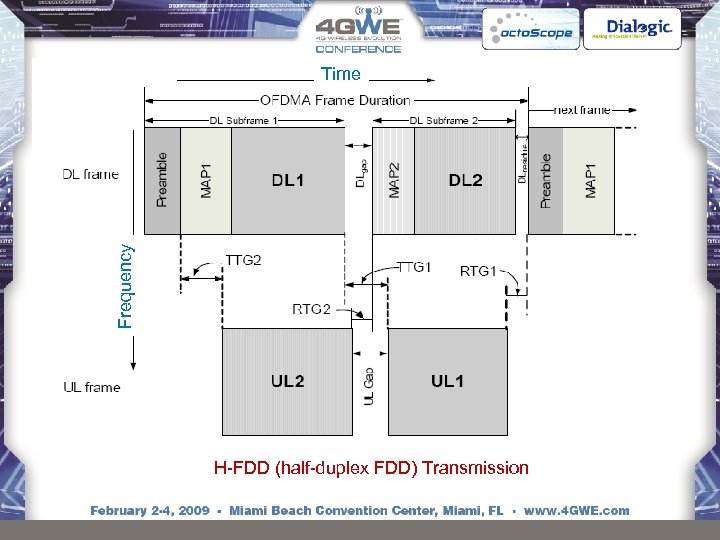
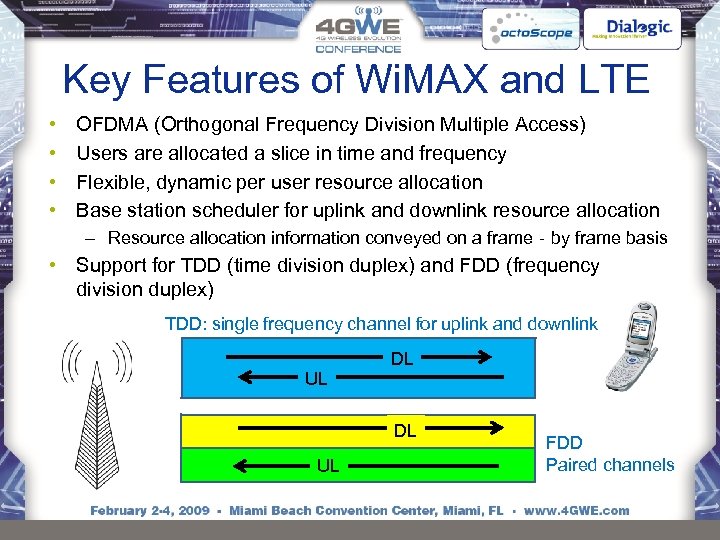 Key Features of Wi. MAX and LTE • • OFDMA (Orthogonal Frequency Division Multiple Access) Users are allocated a slice in time and frequency Flexible, dynamic per user resource allocation Base station scheduler for uplink and downlink resource allocation – Resource allocation information conveyed on a frame‐by frame basis • Support for TDD (time division duplex) and FDD (frequency division duplex) TDD: single frequency channel for uplink and downlink DL UL FDD Paired channels
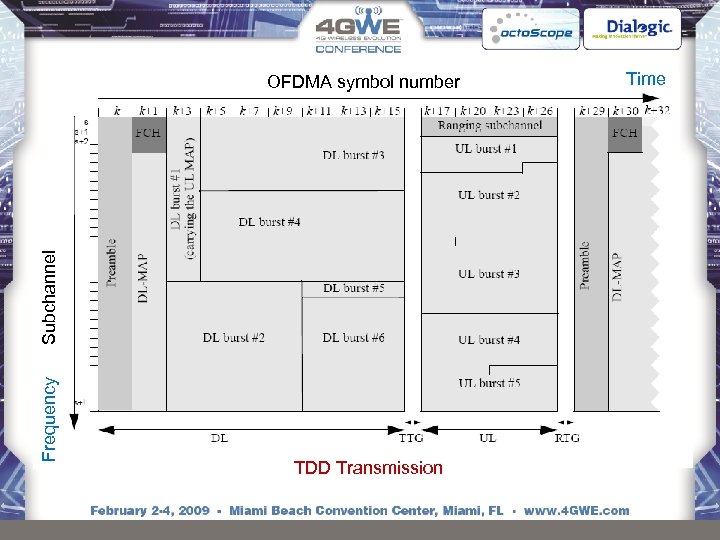 Frequency Subchannel OFDMA symbol number TDD Transmission Time
 Frequency Time H-FDD (half-duplex FDD) Transmission
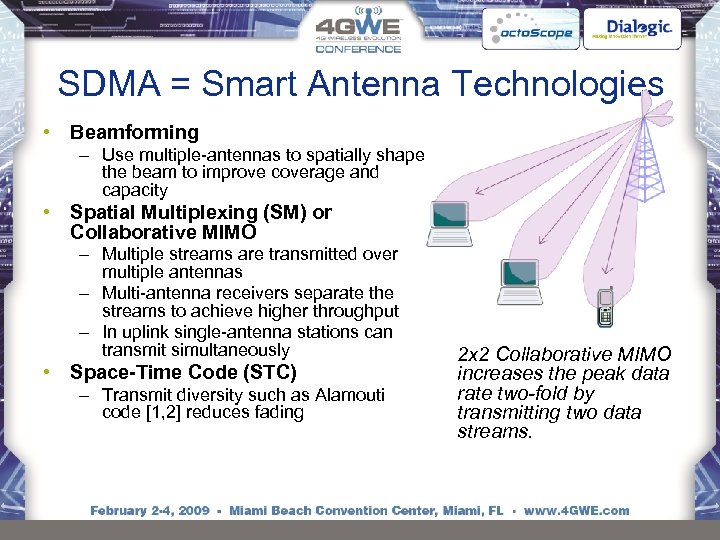 SDMA = Smart Antenna Technologies • Beamforming – Use multiple-antennas to spatially shape the beam to improve coverage and capacity • Spatial Multiplexing (SM) or Collaborative MIMO – Multiple streams are transmitted over multiple antennas – Multi-antenna receivers separate the streams to achieve higher throughput – In uplink single-antenna stations can transmit simultaneously • Space-Time Code (STC) – Transmit diversity such as Alamouti code [1, 2] reduces fading 2 x 2 Collaborative MIMO increases the peak data rate two-fold by transmitting two data streams.
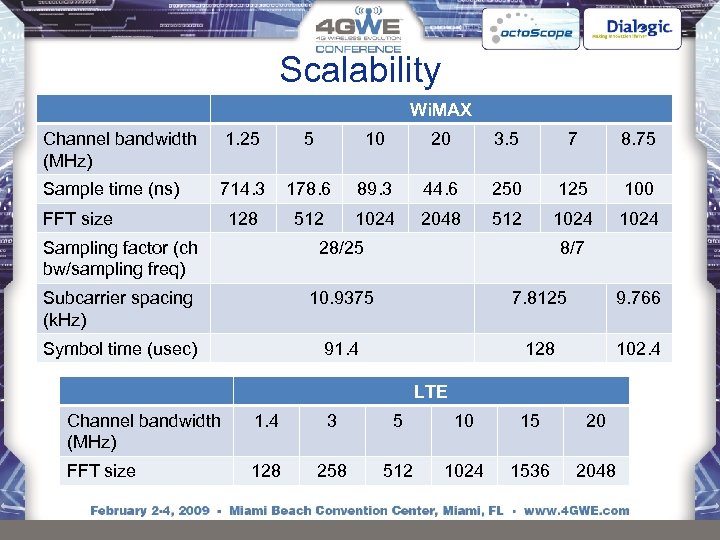 Scalability Wi. MAX Channel bandwidth (MHz) 1. 25 5 10 20 3. 5 7 8. 75 Sample time (ns) 714. 3 178. 6 89. 3 44. 6 250 125 100 128 512 1024 2048 512 1024 FFT size Sampling factor (ch bw/sampling freq) 28/25 8/7 Subcarrier spacing (k. Hz) 10. 9375 7. 8125 9. 766 Symbol time (usec) 91. 4 128 102. 4 LTE Channel bandwidth (MHz) 1. 4 3 5 10 15 20 FFT size 128 258 512 1024 1536 2048
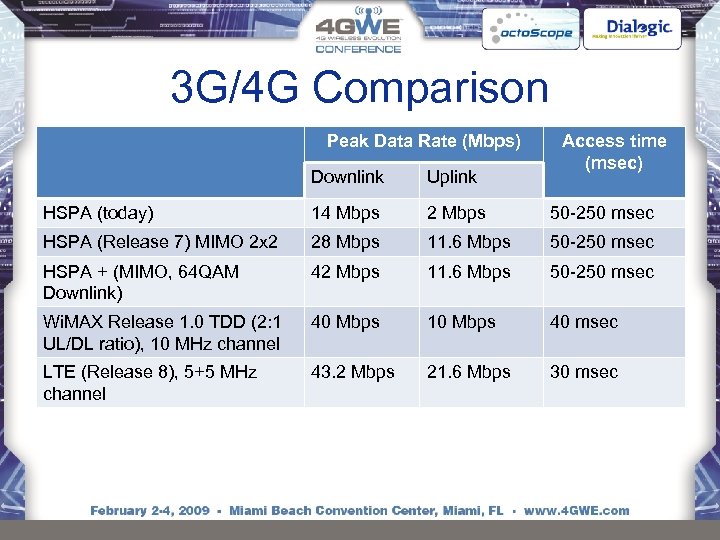 3 G/4 G Comparison Peak Data Rate (Mbps) Access time (msec) Downlink Uplink HSPA (today) 14 Mbps 2 Mbps 50 -250 msec HSPA (Release 7) MIMO 2 x 2 28 Mbps 11. 6 Mbps 50 -250 msec HSPA + (MIMO, 64 QAM Downlink) 42 Mbps 11. 6 Mbps 50 -250 msec Wi. MAX Release 1. 0 TDD (2: 1 UL/DL ratio), 10 MHz channel 40 Mbps 10 Mbps 40 msec LTE (Release 8), 5+5 MHz channel 43. 2 Mbps 21. 6 Mbps 30 msec
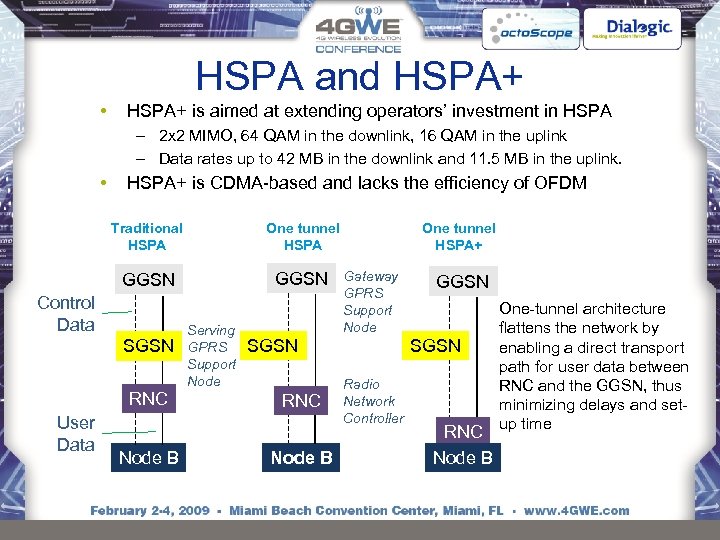 HSPA and HSPA+ • HSPA+ is aimed at extending operators’ investment in HSPA – 2 x 2 MIMO, 64 QAM in the downlink, 16 QAM in the uplink – Data rates up to 42 MB in the downlink and 11. 5 MB in the uplink. • HSPA+ is CDMA-based and lacks the efficiency of OFDM Traditional HSPA One tunnel HSPA+ GGSN Control Data SGSN RNC User Data Node B Serving GPRS Support Node Gateway GPRS Support Node SGSN RNC Node B Radio Network Controller RNC Node B One-tunnel architecture flattens the network by enabling a direct transport path for user data between RNC and the GGSN, thus minimizing delays and setup time
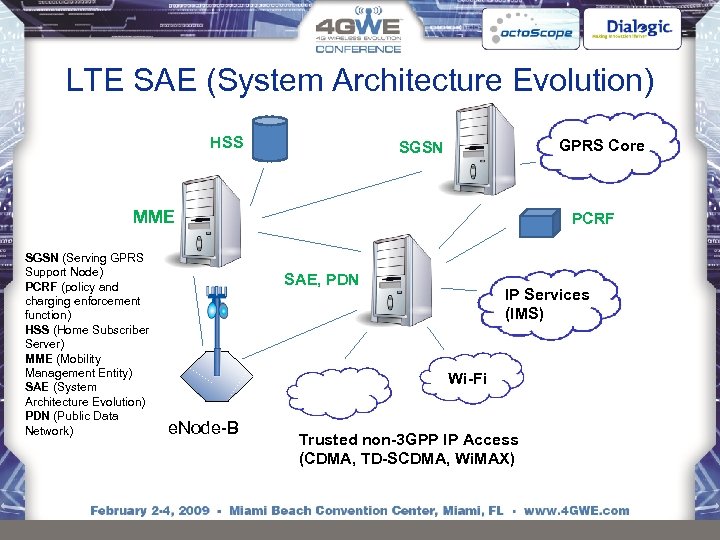 LTE SAE (System Architecture Evolution) HSS GPRS Core SGSN MME SGSN (Serving GPRS Support Node) PCRF (policy and charging enforcement function) HSS (Home Subscriber Server) MME (Mobility Management Entity) SAE (System Architecture Evolution) PDN (Public Data Network) PCRF SAE, PDN IP Services (IMS) Wi-Fi e. Node-B Trusted non-3 GPP IP Access (CDMA, TD-SCDMA, Wi. MAX)
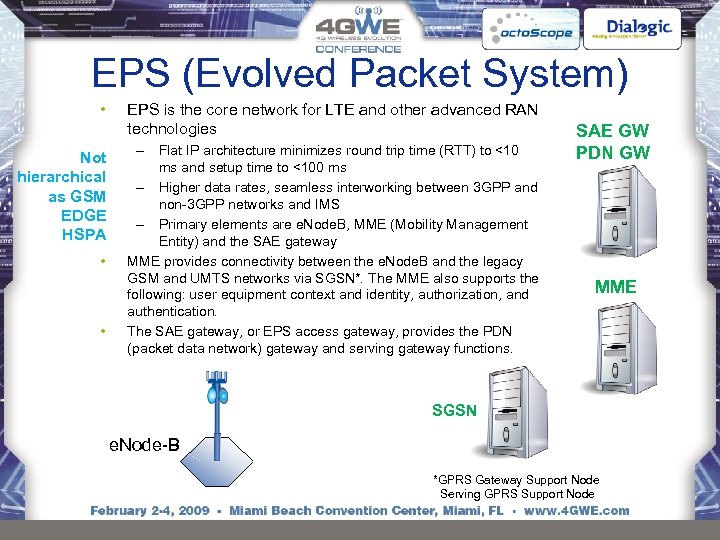 EPS (Evolved Packet System) • EPS is the core network for LTE and other advanced RAN technologies Not hierarchical as GSM EDGE HSPA • • – Flat IP architecture minimizes round trip time (RTT) to <10 ms and setup time to <100 ms – Higher data rates, seamless interworking between 3 GPP and non-3 GPP networks and IMS – Primary elements are e. Node. B, MME (Mobility Management Entity) and the SAE gateway MME provides connectivity between the e. Node. B and the legacy GSM and UMTS networks via SGSN*. The MME also supports the following: user equipment context and identity, authorization, and authentication. The SAE gateway, or EPS access gateway, provides the PDN (packet data network) gateway and serving gateway functions. SAE GW PDN GW MME SGSN e. Node-B *GPRS Gateway Support Node Serving GPRS Support Node
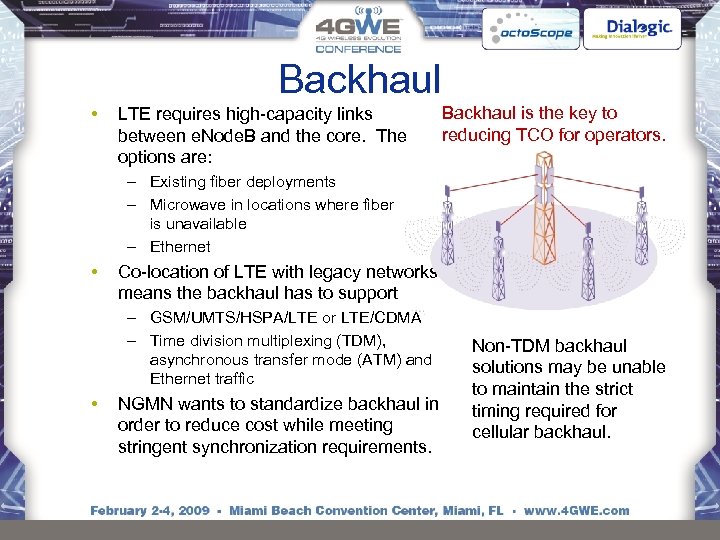 Backhaul • LTE requires high-capacity links between e. Node. B and the core. The options are: Backhaul is the key to reducing TCO for operators. – Existing fiber deployments – Microwave in locations where fiber is unavailable – Ethernet • Co-location of LTE with legacy networks means the backhaul has to support – GSM/UMTS/HSPA/LTE or LTE/CDMA – Time division multiplexing (TDM), asynchronous transfer mode (ATM) and Ethernet traffic • NGMN wants to standardize backhaul in order to reduce cost while meeting stringent synchronization requirements. Non-TDM backhaul solutions may be unable to maintain the strict timing required for cellular backhaul.
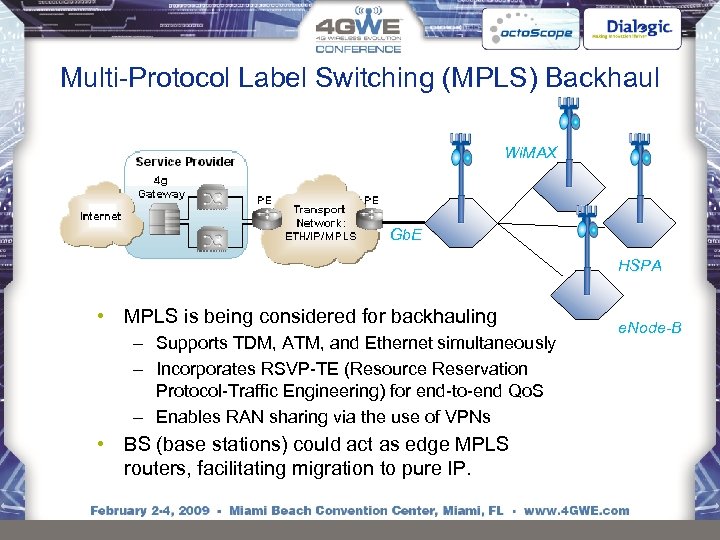 Multi-Protocol Label Switching (MPLS) Backhaul Wi. MAX Gb. E HSPA • MPLS is being considered for backhauling – Supports TDM, ATM, and Ethernet simultaneously – Incorporates RSVP-TE (Resource Reservation Protocol-Traffic Engineering) for end-to-end Qo. S – Enables RAN sharing via the use of VPNs • BS (base stations) could act as edge MPLS routers, facilitating migration to pure IP. e. Node-B
 Wi. MAX vs. LTE • Commonalities – IP-based – OFDMA and MIMO – Similar data rates and channel widths • Differences – Carriers are able to set requirements for LTE through organizations like NGMN and LSTI, but cannot do this as easily at the IEEE based 802. 16 – LTE backhaul is designed to support legacy services while Wi. MAX is better suited to greenfield deployments
 Commercial Issues LTE • Deployments likely slower than projected But • Eventual migration path for GSM/3 GSM, i. e. for > 80% share • Will be lowest cost & dominant in 2020 Wi. MAX • 2 -3 year lead, likely maintained for years • Dedicated spectrum in many countries But • Likely < 15% share by 2020 & thus more costly
 Agenda 10: 30 – 12: 00 noon Our G-enealogy – History and Evolution of Mobile Radio Lunch 1: 00 – 2: 45 3: 00 – 3: 45 The IEEE’s Wireless Ethernet Keeps Going and Growing 4 G Tutorial: Vive la Différence? Break Mobile Broadband - New Applications and New Business Models Break 4: 00 – 4: 45 Tutorial: White Spaces and Beyond
 www. octoscope. com Brough Turner, Chief Strategy Officer, Dialogic brough. turner@dialogic. com Blog: http: //blogs. nmss. com/communications/ broughturner@gmail. com Skype: brough
 Additional Reference Material
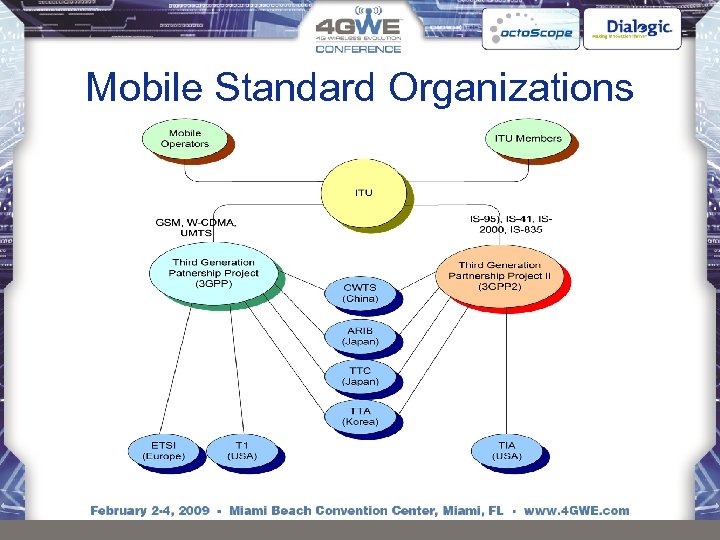 Mobile Standard Organizations
 Partnership Projects and Forums • ITU IMT-2000: http: //www. itu. int/home/imt. html • Mobile Partnership Projects – 3 GPP : http: //www. 3 gpp. org – 3 GPP 2 : http: //www. 3 gpp 2. org • Mobile marketing alliances and forums – – – – GSM Association: http: //www. gsmworld. com/index. shtml UMTS Forum : http: //www. umts-forum. org CDMA Development Group: http: //www. cdg. org/index. asp Next Generation Mobile Networks Alliance: http: //www. ngmn. org/ Global Mobile Suppliers Association: http: //www. gsacom. com CTIA: http: //www. ctia. org/ 3 G Americas: http: //www. uwcc. org
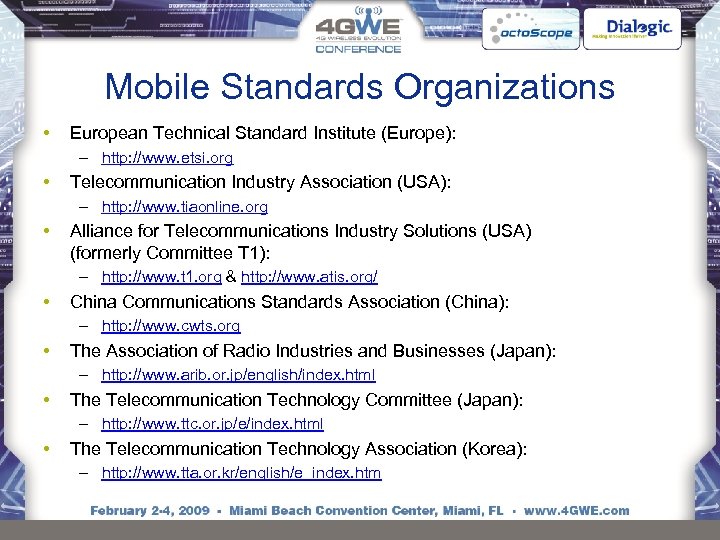 Mobile Standards Organizations • European Technical Standard Institute (Europe): – http: //www. etsi. org • Telecommunication Industry Association (USA): – http: //www. tiaonline. org • Alliance for Telecommunications Industry Solutions (USA) (formerly Committee T 1): – http: //www. t 1. org & http: //www. atis. org/ • China Communications Standards Association (China): – http: //www. cwts. org • The Association of Radio Industries and Businesses (Japan): – http: //www. arib. or. jp/english/index. html • The Telecommunication Technology Committee (Japan): – http: //www. ttc. or. jp/e/index. html • The Telecommunication Technology Association (Korea): – http: //www. tta. or. kr/english/e_index. htm
 Other Industry Consortia • OMA, Open Mobile Alliance: http: //www. openmobilealliance. org/ – Consolidates Open Mobile Architecture, WAP Forum, Location Interoperability Forum, Sync. ML, MMS Interoperability Group, Wireless Village • Lists of wireless organizations compiled by others: – http: //www. wipconnector. com/resources. php – http: //focus. ti. com/general/docs/wtbugencontent. tsp? templa te. Id=6123&content. Id=4602 – http: //www. wlana. org/pdf/wlan_standards_orgs. pdf
 Wireless MAN, LAN and PAN Links • Wireless. MAN – Broadband Access (Wi. MAX) – IEEE 802. 16: http: //www. ieee 802. org/16/ – Wi. MAX Forum: http: //www. wimaxforum. org/home/ • Wireless LAN (Wi. Fi) – IEEE 802. 11: http: //www. ieee 802. org/11/ – Wi. Fi Alliance: http: //www. wi-fi. org/ – Wireless LAN Association: http: //www. wlana. org/ • Wireless WPAN (Bluetooth) – IEEE 802. 15: http: //www. ieee 802. org/15/ – Bluetooth SIG: https: //www. bluetooth. org/ and http: //www. bluetooth. com/
 Market & Subscriber Statistics Free: • http: //en. wikipedia. org/wiki/List_of_mobile_network_operators – – http: //en. wikipedia. org/wiki/List_of_mobile_network_operators_of_Europe http: //en. wikipedia. org/wiki/List_of_mobile_network_operators_of_the_Americas http: //en. wikipedia. org/wiki/List_of_mobile_network_operators_of_the_Asia_Pacific_region http: //en. wikipedia. org/wiki/List_of_mobile_network_operators_of_the_Middle_East_and_Africa • http: //www. gsmworld. com/roaming/gsminfo/index. shtml • http: //www. cdg. org/worldwide/cdma_world_subscriber. asp • http: //www. gsacom. com/news/statistics. php 4 Nominal cost: • http: //www. itu. int/ITU-D/ict/publications/world. html
 www. octoscope. com Brough Turner, Chief Strategy Officer, Dialogic brough. turner@dialogic. com Blog: http: //blogs. nmss. com/communications/ broughturner@gmail. com Skype: brough
 Additional Content
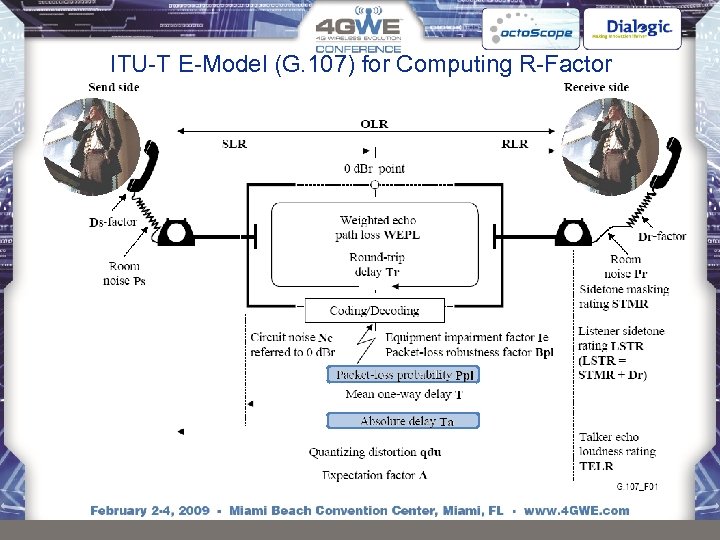
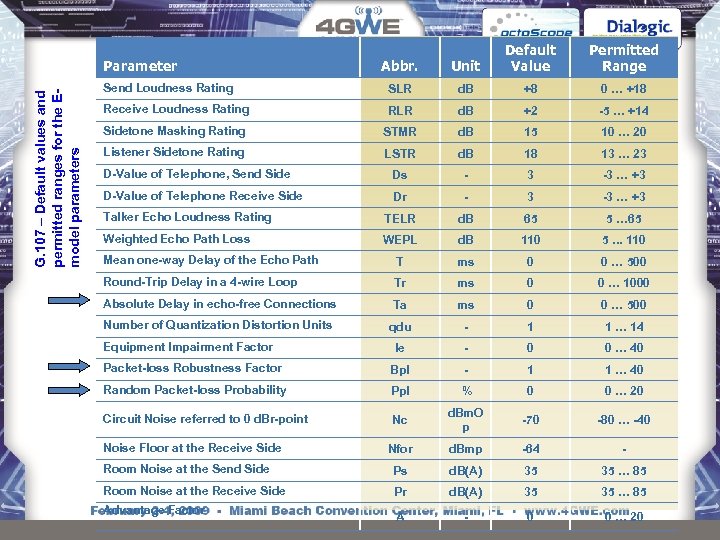
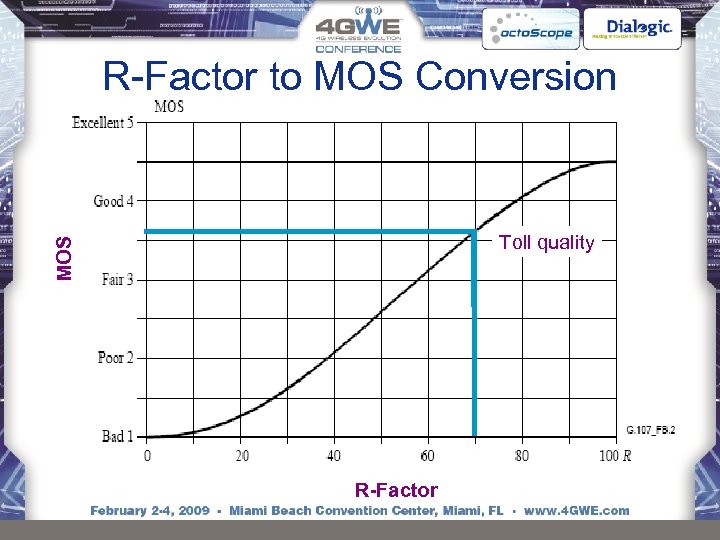
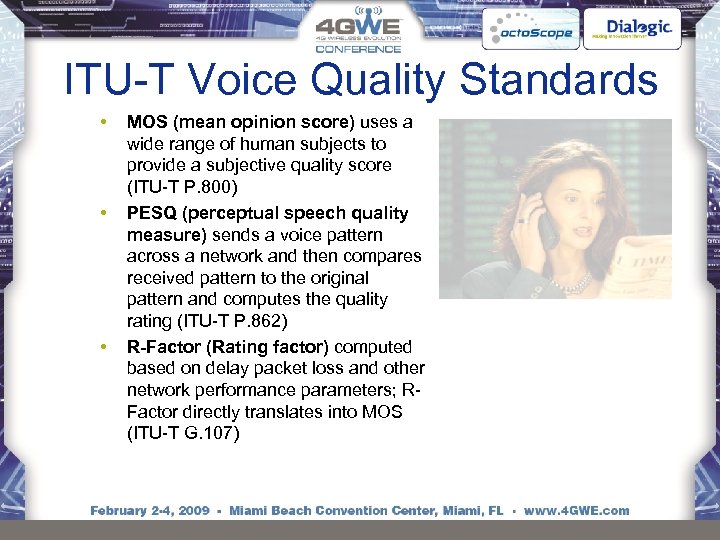 ITU-T Voice Quality Standards • • • MOS (mean opinion score) uses a wide range of human subjects to provide a subjective quality score (ITU-T P. 800) PESQ (perceptual speech quality measure) sends a voice pattern across a network and then compares received pattern to the original pattern and computes the quality rating (ITU-T P. 862) R-Factor (Rating factor) computed based on delay packet loss and other network performance parameters; RFactor directly translates into MOS (ITU-T G. 107)
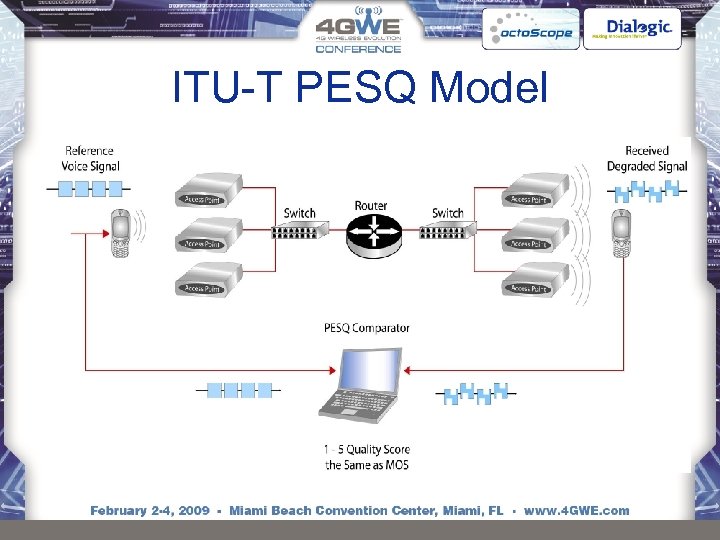 ITU-T PESQ Model
 ITU-T E-Model (G. 107) for Computing R-Factor
 Abbr. Unit Default Value Send Loudness Rating SLR d. B +8 0 … +18 Receive Loudness Rating RLR d. B +2 -5 … +14 Sidetone Masking Rating STMR d. B 15 10 … 20 Listener Sidetone Rating LSTR d. B 18 13 … 23 D-Value of Telephone, Send Side Ds - 3 -3 … +3 D-Value of Telephone Receive Side Dr - 3 -3 … +3 Talker Echo Loudness Rating TELR d. B 65 5 … 65 Weighted Echo Path Loss WEPL d. B 110 5. . . 110 Mean one-way Delay of the Echo Path T ms 0 0 … 500 Round-Trip Delay in a 4 -wire Loop Tr ms 0 0 … 1000 Absolute Delay in echo-free Connections Ta ms 0 0 … 500 Number of Quantization Distortion Units qdu - 1 1 … 14 Ie - 0 0 … 40 Packet-loss Robustness Factor Bpl - 1 1 … 40 Random Packet-loss Probability Ppl % 0 0 … 20 Circuit Noise referred to 0 d. Br-point Nc d. Bm. O p -70 -80 … -40 Nfor d. Bmp -64 - Room Noise at the Send Side Ps d. B(A) 35 35 … 85 Room Noise at the Receive Side Pr d. B(A) 35 35 … 85 A - 0 0 … 20 G. 107 – Default values and permitted ranges for the Emodel parameters Parameter Equipment Impairment Factor Noise Floor at the Receive Side Advantage Factor Permitted Range
 R-Factor to MOS Conversion MOS Toll quality R-Factor
 Video Metrics • Media Delivery Index (MDI) defined in RFC 4445 describes media capacity of a network composed of the Media Loss Rate (MLR) and Delay Factor (DF) – MLR is a media-weighted metric that expresses the number of expected IEEE Std 802. 11 packets dropped from a video stream – DF represents the amount of time required to drain the endstation buffer at the bit rate of the media stream • MLR = (Packets Expected - Packets Received) / Interval in Seconds • DF is calculated as follows: – VB = |Bytes Received - Bytes Drained| – DF = (max(VB) – min(VB)) / Video Bit rate in Bytes – Where VB = video buffer