


 Скачать презентацию Wireless Technologies Helping Chronic Care Management Ofer Atzmon
184a12367604bc65560a5fdbb8c0f51d.ppt
- Количество слайдов: 18
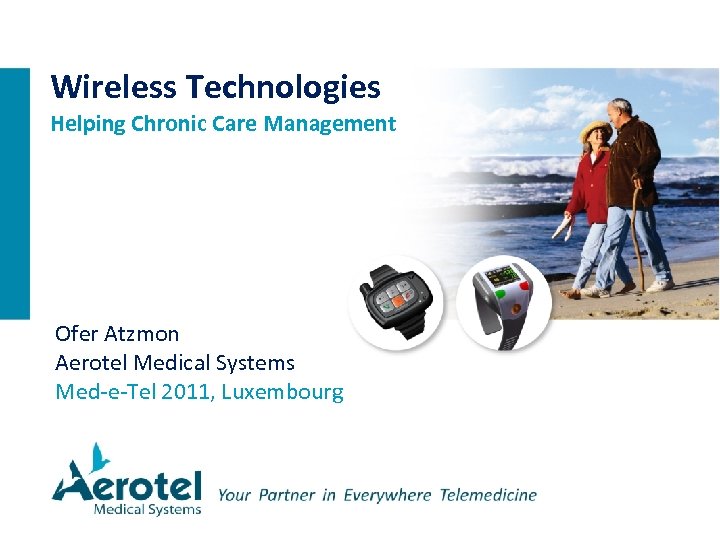 Wireless Technologies Helping Chronic Care Management Ofer Atzmon Aerotel Medical Systems Med-e-Tel 2011, Luxembourg
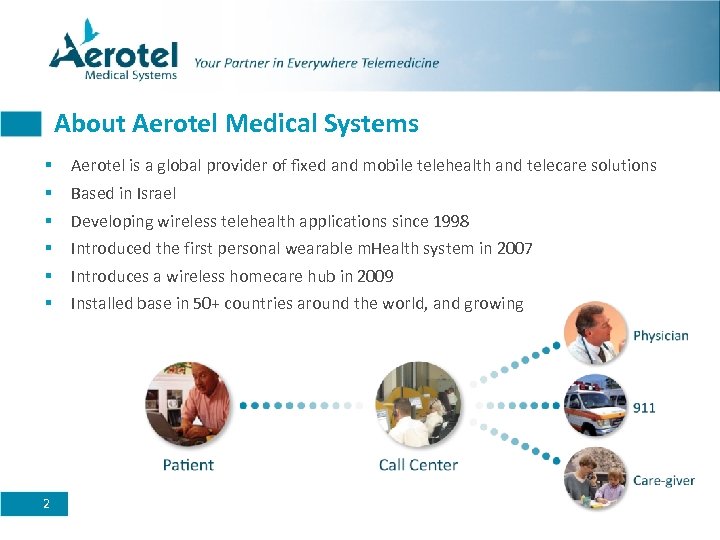 About Aerotel Medical Systems § § § 2 Aerotel is a global provider of fixed and mobile telehealth and telecare solutions Based in Israel Developing wireless telehealth applications since 1998 Introduced the first personal wearable m. Health system in 2007 Introduces a wireless homecare hub in 2009 Installed base in 50+ countries around the world, and growing
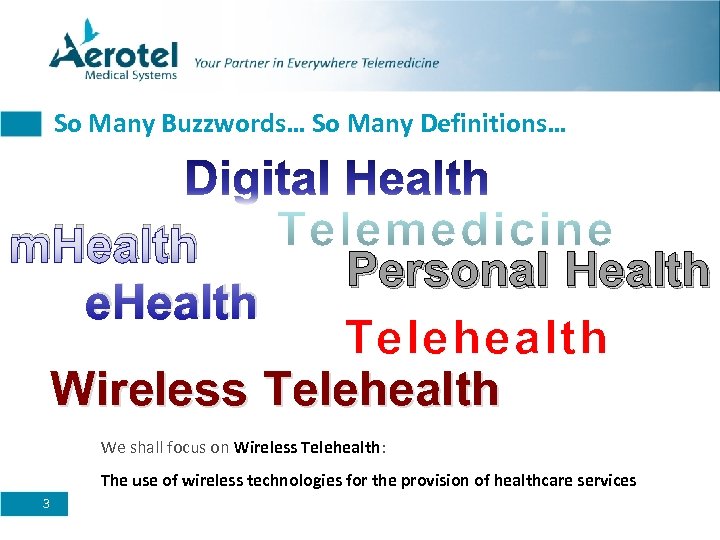 So Many Buzzwords… So Many Definitions… m. Health e. Health Personal Health Telehealth Wireless Telehealth We shall focus on Wireless Telehealth: The use of wireless technologies for the provision of healthcare services 3
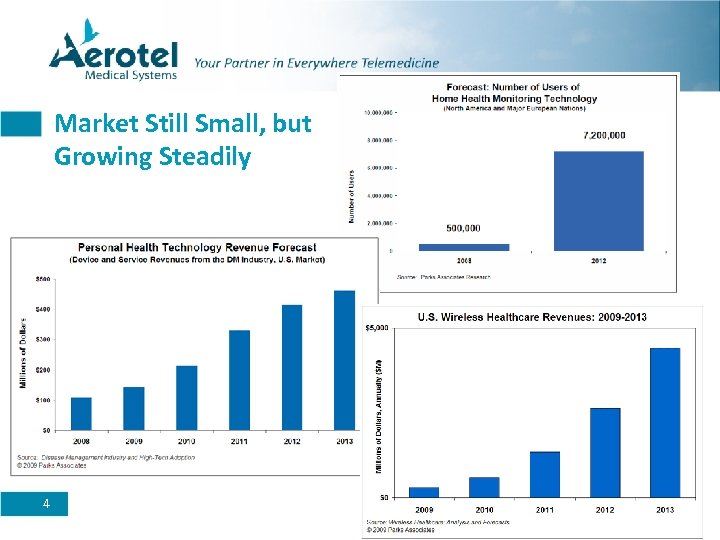 Market Still Small, but Growing Steadily 4
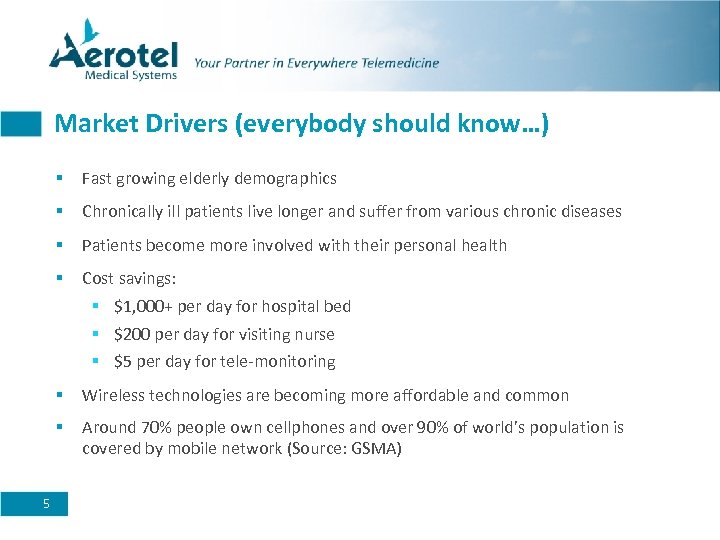 Market Drivers (everybody should know…) § Fast growing elderly demographics § Chronically ill patients live longer and suffer from various chronic diseases § Patients become more involved with their personal health § Cost savings: § $1, 000+ per day for hospital bed § $200 per day for visiting nurse § $5 per day for tele-monitoring § § 5 Wireless technologies are becoming more affordable and common Around 70% people own cellphones and over 90% of world’s population is covered by mobile network (Source: GSMA)
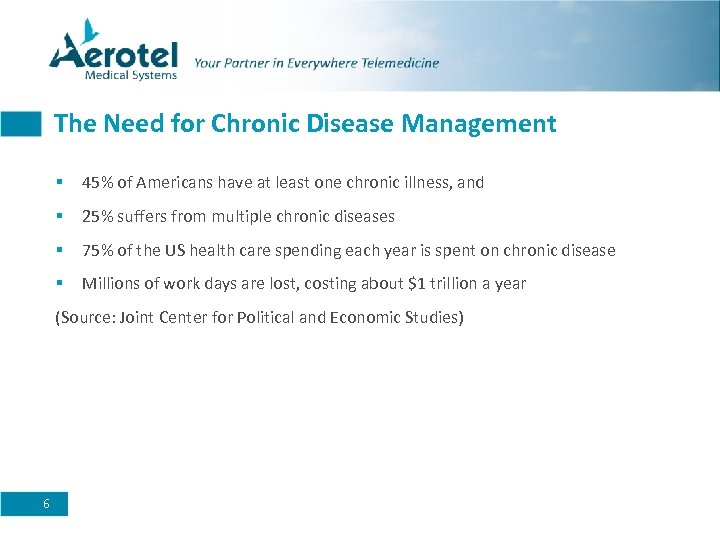 The Need for Chronic Disease Management § 45% of Americans have at least one chronic illness, and § 25% suffers from multiple chronic diseases § 75% of the US health care spending each year is spent on chronic disease § Millions of work days are lost, costing about $1 trillion a year (Source: Joint Center for Political and Economic Studies) 6
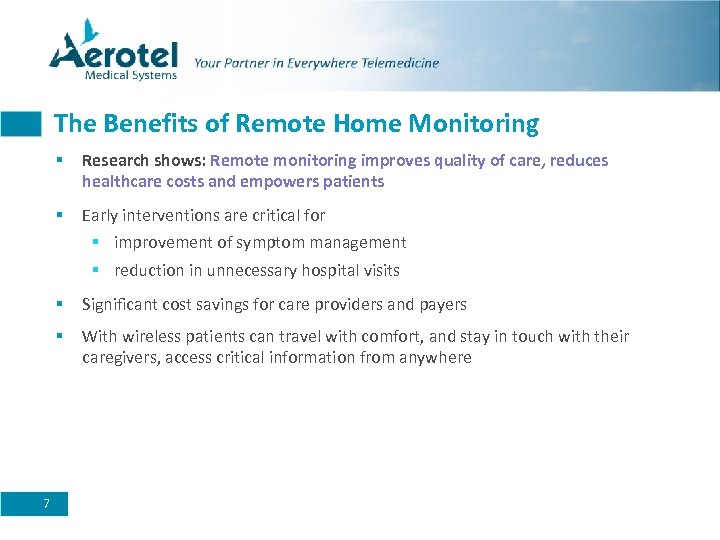 The Benefits of Remote Home Monitoring § Research shows: Remote monitoring improves quality of care, reduces healthcare costs and empowers patients § Early interventions are critical for § improvement of symptom management § reduction in unnecessary hospital visits § § 7 Significant cost savings for care providers and payers With wireless patients can travel with comfort, and stay in touch with their caregivers, access critical information from anywhere
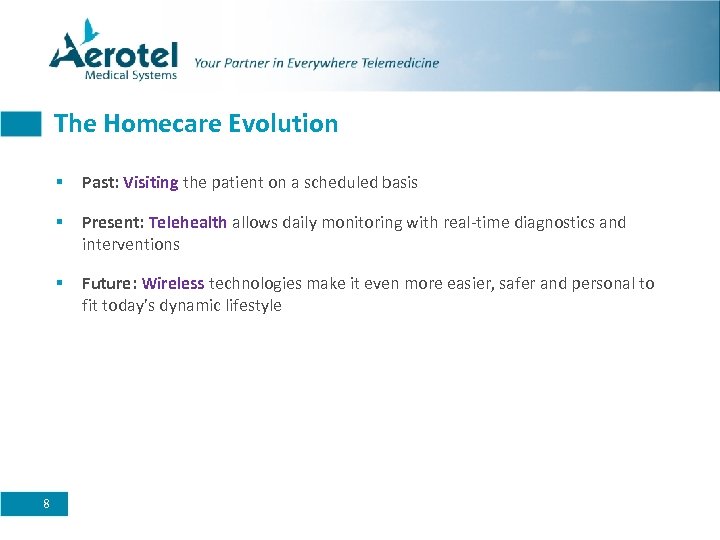 The Homecare Evolution § § Present: Telehealth allows daily monitoring with real-time diagnostics and interventions § 8 Past: Visiting the patient on a scheduled basis Future: Wireless technologies make it even more easier, safer and personal to fit today’s dynamic lifestyle
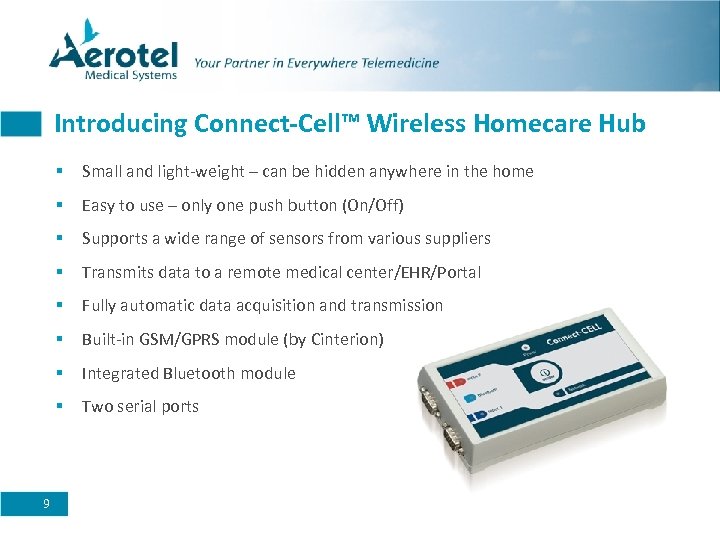 Introducing Connect-Cell™ Wireless Homecare Hub § § Easy to use – only one push button (On/Off) § Supports a wide range of sensors from various suppliers § Transmits data to a remote medical center/EHR/Portal § Fully automatic data acquisition and transmission § Built-in GSM/GPRS module (by Cinterion) § Integrated Bluetooth module § 9 Small and light-weight – can be hidden anywhere in the home Two serial ports
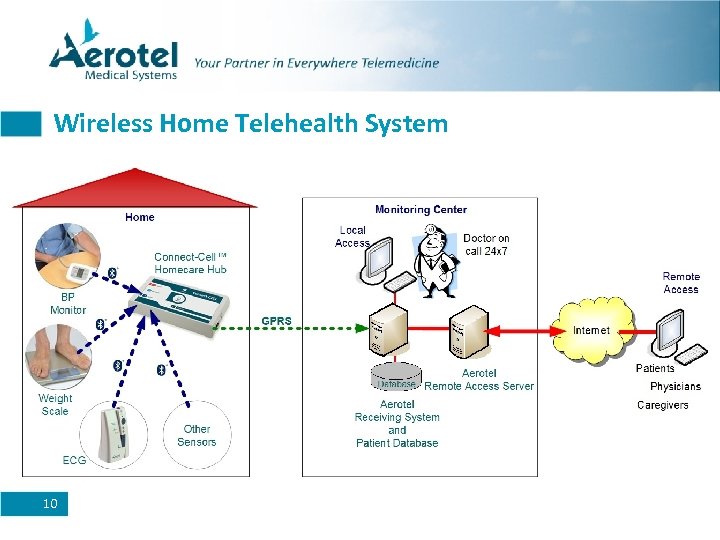 Wireless Home Telehealth System 10
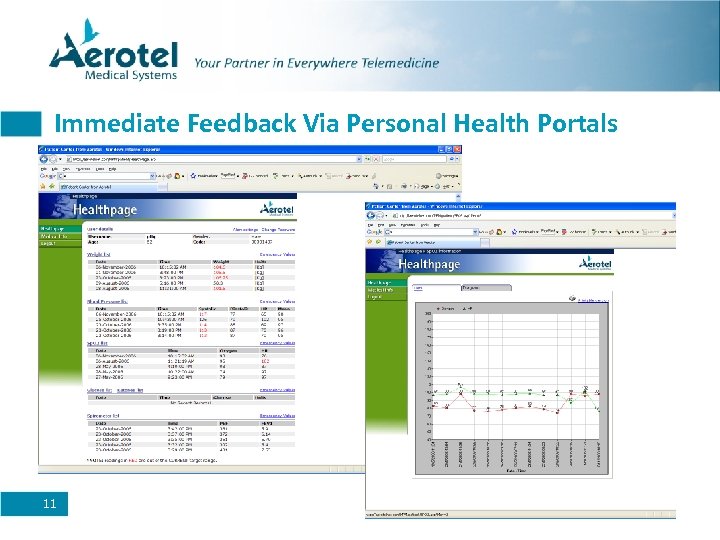 Immediate Feedback Via Personal Health Portals 11
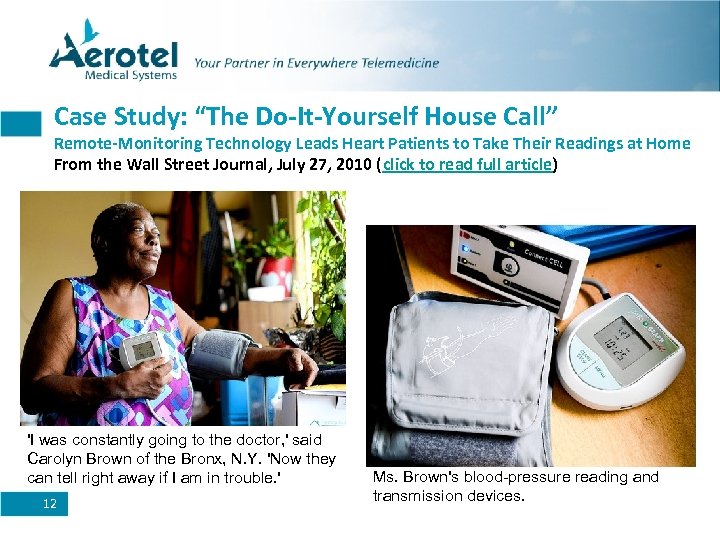 Case Study: “The Do-It-Yourself House Call” Remote-Monitoring Technology Leads Heart Patients to Take Their Readings at Home From the Wall Street Journal, July 27, 2010 (click to read full article) 'I was constantly going to the doctor, ' said Carolyn Brown of the Bronx, N. Y. 'Now they can tell right away if I am in trouble. ' 12 Ms. Brown's blood-pressure reading and transmission devices.
 “The Do-It-Yourself House Call” – Service Description § Service by the New York City Health and Hospitals Corp. ; covered by insurers § Monitoring provided by AMC (NY); Technology provided by Aerotel. § Provided to post heart attack patients § Home system includes: a scale, blood-pressure cuff and glucose monitor § Collects the data daily via the hub § Nurse case managers follow up with the patients if any of the vital signs seem worrisome § Patients get immediate reassurance when there’s nothing wrong with them § They do not have to go see a doctor unnecessarily 13
 “The Do-It-Yourself House Call” – the Benefits § Detect changes and intervene before the patient has to be hospitalized. § Instead of constantly going to the doctor, the monitoring service can detect immediately if the patient has a problem § Faster evaluation of suspected heart failures § Peace of mind for patients and caregivers § 30% reduction in hospitalization for heart-failure patients, a study showed § Significant cost savings: $6, 300 for a Medicaid heart patient's typical hospital stay vs. a $626 worth wireless monitoring system (which is typically rented). § The system actually pays for itself! 14
 How Can This Solution become More Widely Used § Reducing costs of technology § Making the technology transparent for end-users § Standardizing data-exchange protocols (e. g. Continua) § Protecting data privacy § Concentrated effort of various stakeholders (vendors, payers, wireless carriers, healthcare providers)…. 15
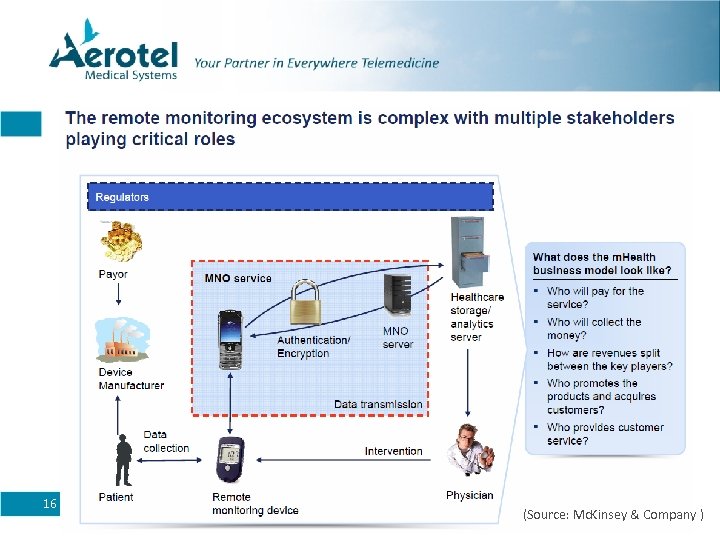 16 (Source: Mc. Kinsey & Company )
 Lessons Learned § Wireless monitoring systems involve many stakeholders § Each stakeholder needs to see a clear benefit – but not at the expense of another stakeholder § Only when all stakeholders coordinate their efforts, and all see clear benefits will such solutions prevail § Solutions provides could act as the “mediators” to orchestrate the efforts of all the players 17
 Thank you for your attention Please come visit our stand at Med-e-Tel Ofer Atzmon VP Business Development and Marketing ofer@aerotel. com www. aerotel. com +972 -52 -2451771