


 Скачать презентацию Wireless LAN Network Communication System www assignmentpoint com
a38507b6d017a51168b63786d2f9624a.ppt
- Количество слайдов: 68
 Wireless LAN Network Communication System www. assignmentpoint. com 1
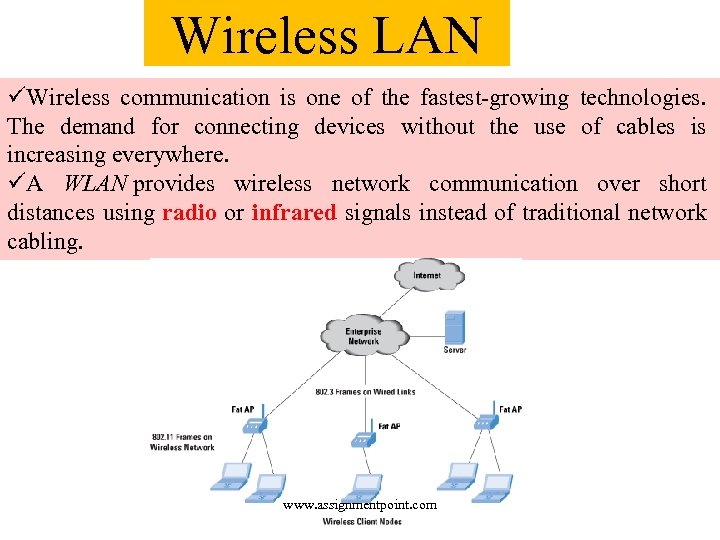 Wireless LAN üWireless communication is one of the fastest-growing technologies. The demand for connecting devices without the use of cables is increasing everywhere. üA WLAN provides wireless network communication over short distances using radio or infrared signals instead of traditional network cabling. www. assignmentpoint. com
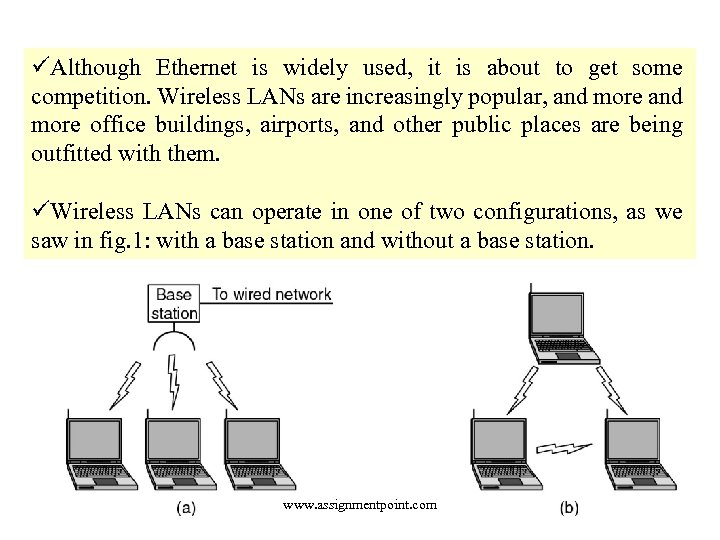 üAlthough Ethernet is widely used, it is about to get some competition. Wireless LANs are increasingly popular, and more office buildings, airports, and other public places are being outfitted with them. üWireless LANs can operate in one of two configurations, as we saw in fig. 1: with a base station and without a base station. www. assignmentpoint. com
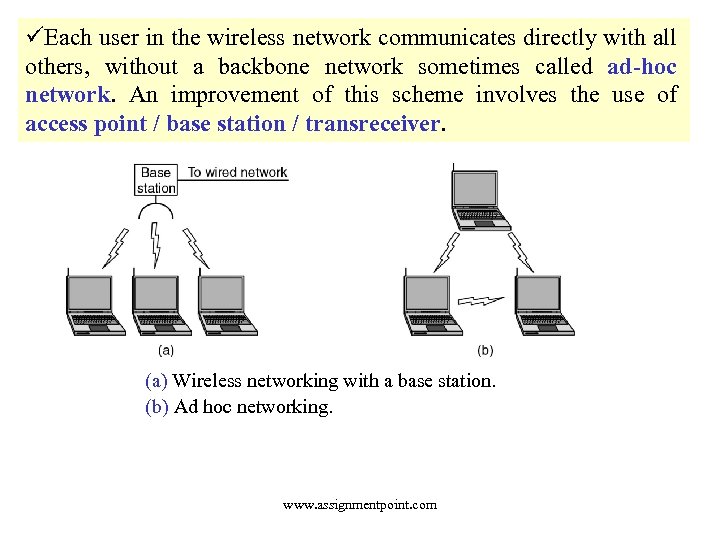 üEach user in the wireless network communicates directly with all others, without a backbone network sometimes called ad-hoc network. An improvement of this scheme involves the use of access point / base station / transreceiver. (a) Wireless networking with a base station. (b) Ad hoc networking. www. assignmentpoint. com
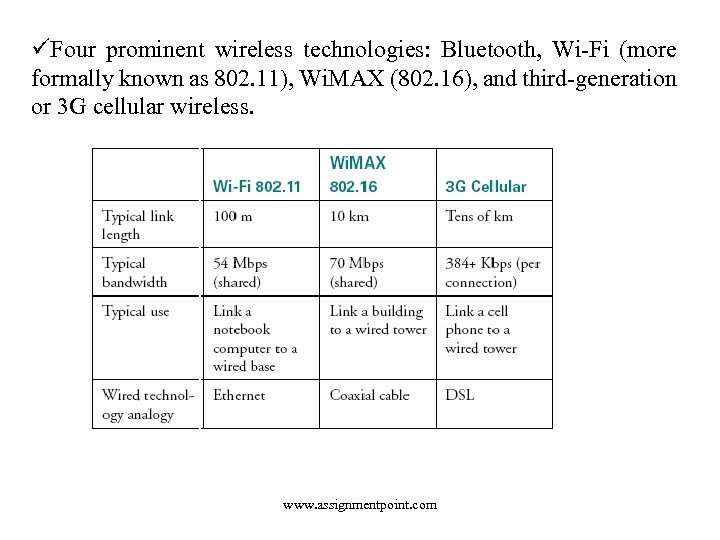 üFour prominent wireless technologies: Bluetooth, Wi-Fi (more formally known as 802. 11), Wi. MAX (802. 16), and third-generation or 3 G cellular wireless. www. assignmentpoint. com
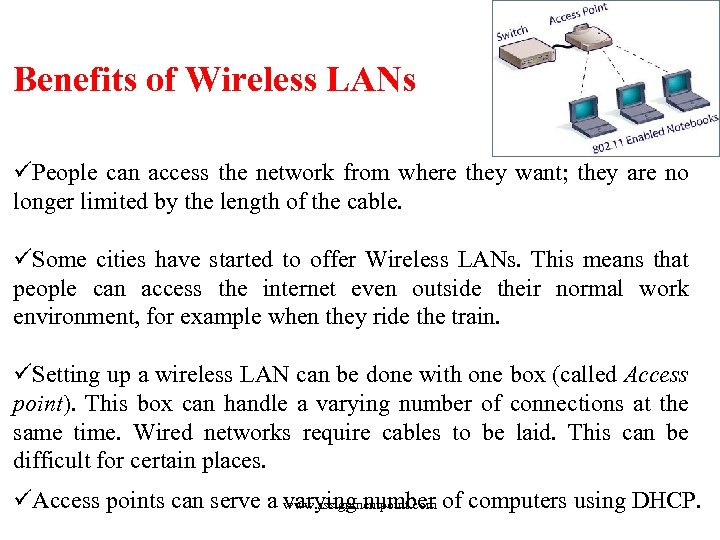 Benefits of Wireless LANs üPeople can access the network from where they want; they are no longer limited by the length of the cable. üSome cities have started to offer Wireless LANs. This means that people can access the internet even outside their normal work environment, for example when they ride the train. üSetting up a wireless LAN can be done with one box (called Access point). This box can handle a varying number of connections at the same time. Wired networks require cables to be laid. This can be difficult for certain places. üAccess points can serve a varying number of computers using DHCP. www. assignmentpoint. com
 Major Problems with Wireless network www. assignmentpoint. com
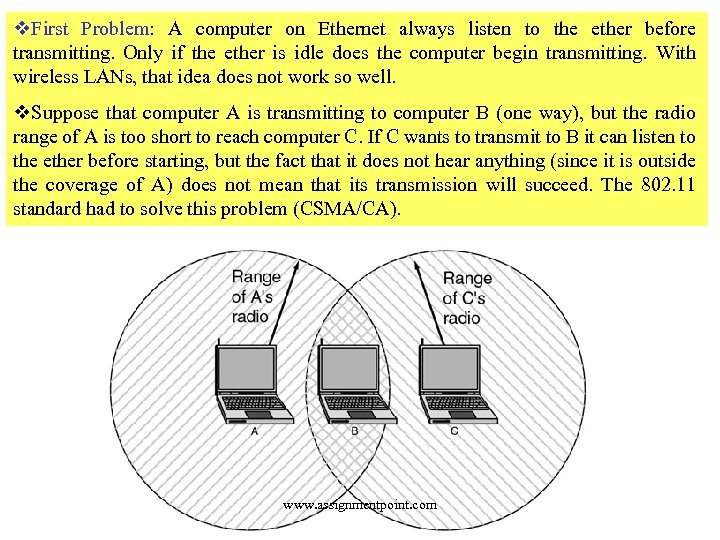 v. First Problem: A computer on Ethernet always listen to the ether before transmitting. Only if the ether is idle does the computer begin transmitting. With wireless LANs, that idea does not work so well. v. Suppose that computer A is transmitting to computer B (one way), but the radio range of A is too short to reach computer C. If C wants to transmit to B it can listen to the ether before starting, but the fact that it does not hear anything (since it is outside the coverage of A) does not mean that its transmission will succeed. The 802. 11 standard had to solve this problem (CSMA/CA). www. assignmentpoint. com
 v. Second Problem: Multipath propagation (Multipath fading) due to presence of reflecting and refracting and scatterers hence cause multiple versions of the signal arrive at the receiver. With small variation of distance and time cause wide variation of received signal called small scale fading experienced in a dense city. v. Third Problem: Handoff is necessary like mobile communications v. Fourth Problem: Some times software is not aware of mobility. For example many word processors have a list of printers that users can choose to print a file. When the computer on which the word processor runs is taken into a new environment, the built-in list of printer becomes invalid. www. assignmentpoint. com
 Wireless LAN Technologies Wireless LAN technologies can be classified into four types: infrared, spread-spectrum, narrowband RF, and home RF and Bluetooth. www. assignmentpoint. com
 Infrared LANs üEach signal-covering cell in an infrared LAN is limited to one room. Coverage is small, since the infrared rays cannot penetrate through wall and other opaque obstacles. üThree alternative transmission techniques are used for infrared data transmission: direct beam (point-to-point connection), omnidirectional configuration consists of a single BS that is normally used on ceilings, and diffused configuration (the transmitter directs the signal to a diffused reflecting ceiling. The signal is reflected in all directions from the ceiling. The receiver then pick up the transmitted signal) www. assignmentpoint. com
 Narrowband RF LANs use very narrow bandwidth. Adjacent cells use different frequency bands. The transmissions are encrypted to prevent attacks. Spread Spectrum LANs The idea behind spread spectrum is to spread the signal over a wider frequency band than normal in such a way as to minimize the impact of interference from other devices. Frequency hopping is a spread spectrum technique that involves transmitting the signal over a random sequence of frequencies, that is, first transmitting at one frequency, then a second, then a third, and so on. www. assignmentpoint. com
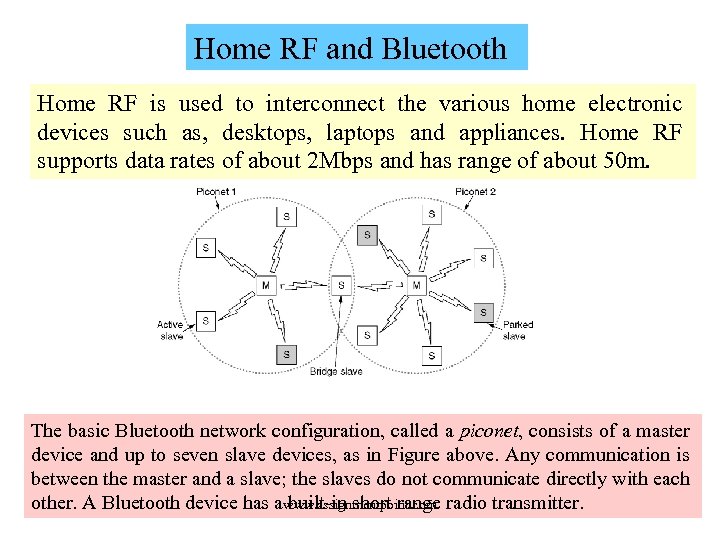 Home RF and Bluetooth Home RF is used to interconnect the various home electronic devices such as, desktops, laptops and appliances. Home RF supports data rates of about 2 Mbps and has range of about 50 m. The basic Bluetooth network configuration, called a piconet, consists of a master device and up to seven slave devices, as in Figure above. Any communication is between the master and a slave; the slaves do not communicate directly with each other. A Bluetooth device has a built-in short range radio transmitter. www. assignmentpoint. com
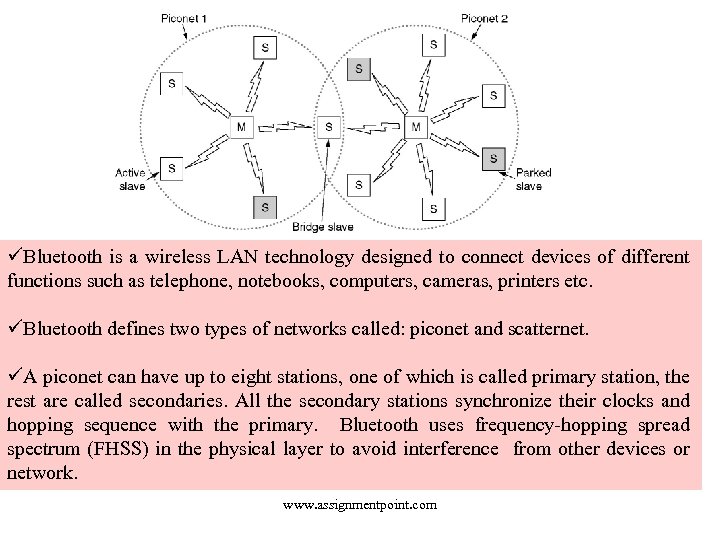 üBluetooth is a wireless LAN technology designed to connect devices of different functions such as telephone, notebooks, computers, cameras, printers etc. üBluetooth defines two types of networks called: piconet and scatternet. üA piconet can have up to eight stations, one of which is called primary station, the rest are called secondaries. All the secondary stations synchronize their clocks and hopping sequence with the primary. Bluetooth uses frequency-hopping spread spectrum (FHSS) in the physical layer to avoid interference from other devices or network. www. assignmentpoint. com
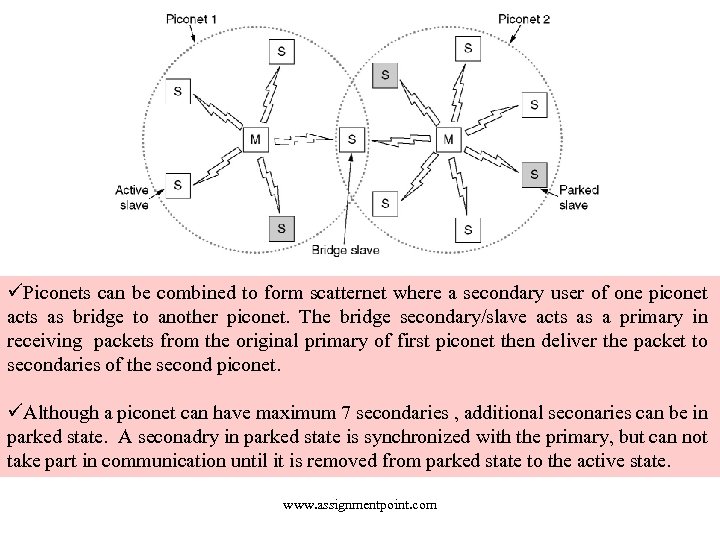 üPiconets can be combined to form scatternet where a secondary user of one piconet acts as bridge to another piconet. The bridge secondary/slave acts as a primary in receiving packets from the original primary of first piconet then deliver the packet to secondaries of the second piconet. üAlthough a piconet can have maximum 7 secondaries , additional seconaries can be in parked state. A seconadry in parked state is synchronized with the primary, but can not take part in communication until it is removed from parked state to the active state. www. assignmentpoint. com
 Two types of links can be created between primary and seconary: üA synchronous connection-oriented (SCO) link is used when avoiding latency (delay in data delivery) is more important han integrity (error free delivery). In this case physical link is created primary and secondary by reserving specific slots at regular intervals. The basic nit of connection is s two slots, one for each direction. If a packet is damaged it is never retransmitted. üAn asynchronous connecionless link (ACL) is used when data integrity is more important than avoiding latency. In this type link if payload encapsulated in the frame is lost/ corrupted, it is retransmitted. www. assignmentpoint. com
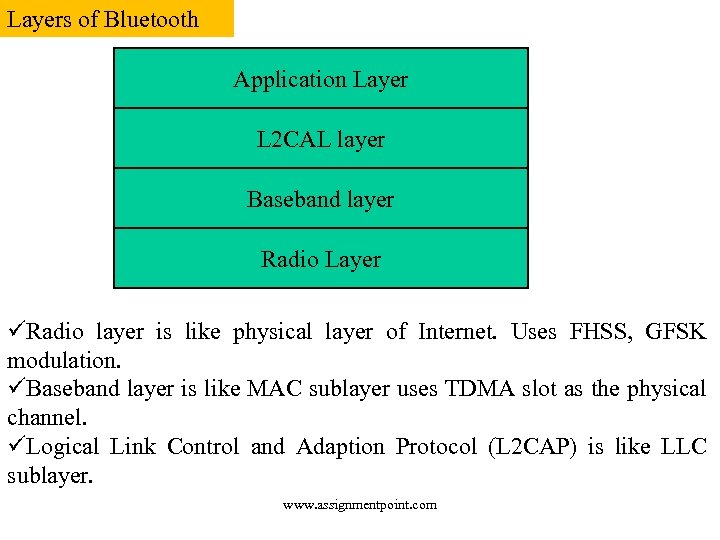 Layers of Bluetooth Application Layer L 2 CAL layer Baseband layer Radio Layer üRadio layer is like physical layer of Internet. Uses FHSS, GFSK modulation. üBaseband layer is like MAC sublayer uses TDMA slot as the physical channel. üLogical Link Control and Adaption Protocol (L 2 CAP) is like LLC sublayer. www. assignmentpoint. com
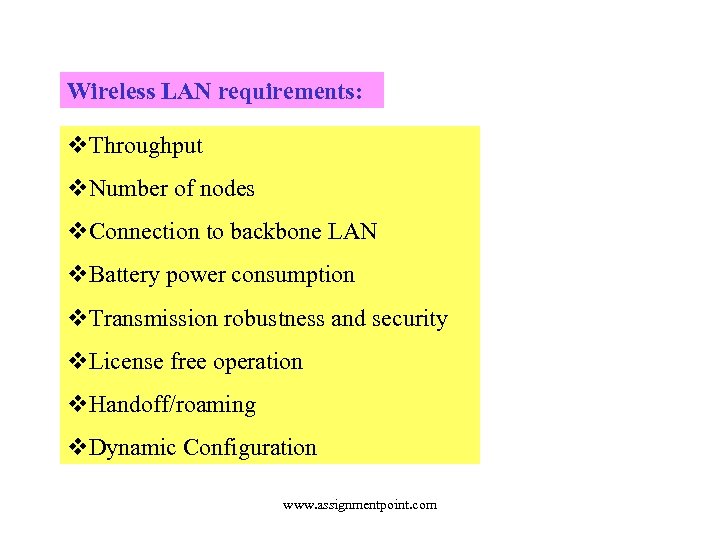 Wireless LAN requirements: v. Throughput v. Number of nodes v. Connection to backbone LAN v. Battery power consumption v. Transmission robustness and security v. License free operation v. Handoff/roaming v. Dynamic Configuration www. assignmentpoint. com
 IEEE 802 Activities The Institute of Electrical and Electronics Engineers (IEEE, read I-Triple-E) is a Professional association headquartered in New York City that is dedicated to advancing technological innovation and excellence. It has more than 400, 000 members in more than 160 countries, about 51. 4% of whom reside in the USA. www. assignmentpoint. com
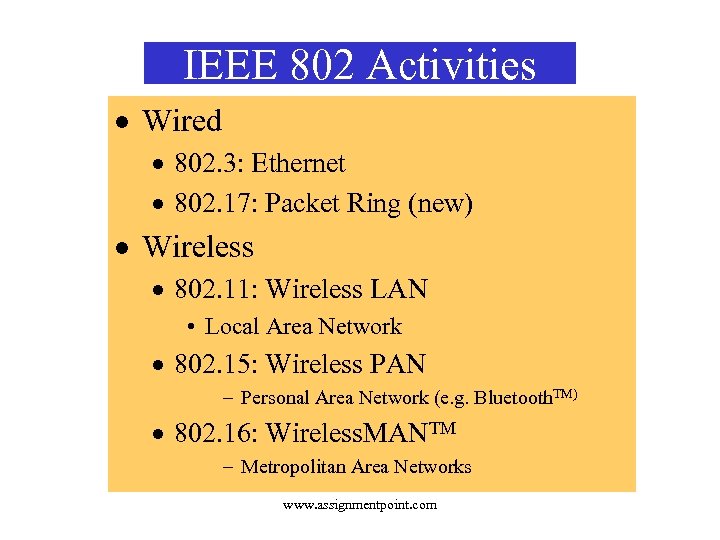 IEEE 802 Activities · Wired · 802. 3: Ethernet · 802. 17: Packet Ring (new) · Wireless · 802. 11: Wireless LAN • Local Area Network · 802. 15: Wireless PAN – Personal Area Network (e. g. Bluetooth. TM) · 802. 16: Wireless. MANTM – Metropolitan Area Networks www. assignmentpoint. com
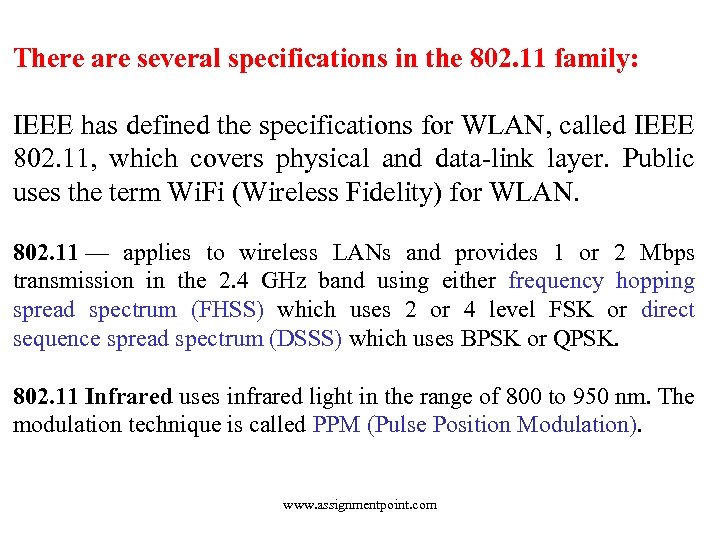 There are several specifications in the 802. 11 family: IEEE has defined the specifications for WLAN, called IEEE 802. 11, which covers physical and data-link layer. Public uses the term Wi. Fi (Wireless Fidelity) for WLAN. 802. 11 — applies to wireless LANs and provides 1 or 2 Mbps transmission in the 2. 4 GHz band using either frequency hopping spread spectrum (FHSS) which uses 2 or 4 level FSK or direct sequence spread spectrum (DSSS) which uses BPSK or QPSK. 802. 11 Infrared uses infrared light in the range of 800 to 950 nm. The modulation technique is called PPM (Pulse Position Modulation). www. assignmentpoint. com
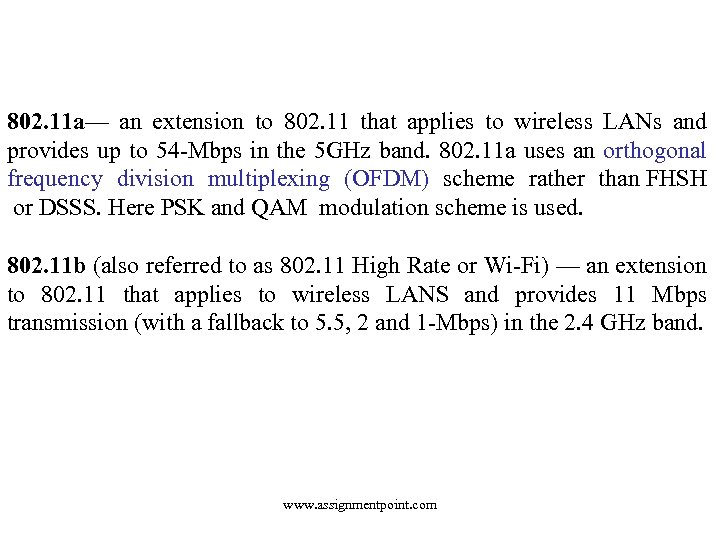 802. 11 a— an extension to 802. 11 that applies to wireless LANs and provides up to 54 -Mbps in the 5 GHz band. 802. 11 a uses an orthogonal frequency division multiplexing (OFDM) scheme rather than FHSH or DSSS. Here PSK and QAM modulation scheme is used. 802. 11 b (also referred to as 802. 11 High Rate or Wi-Fi) — an extension to 802. 11 that applies to wireless LANS and provides 11 Mbps transmission (with a fallback to 5. 5, 2 and 1 -Mbps) in the 2. 4 GHz band. www. assignmentpoint. com
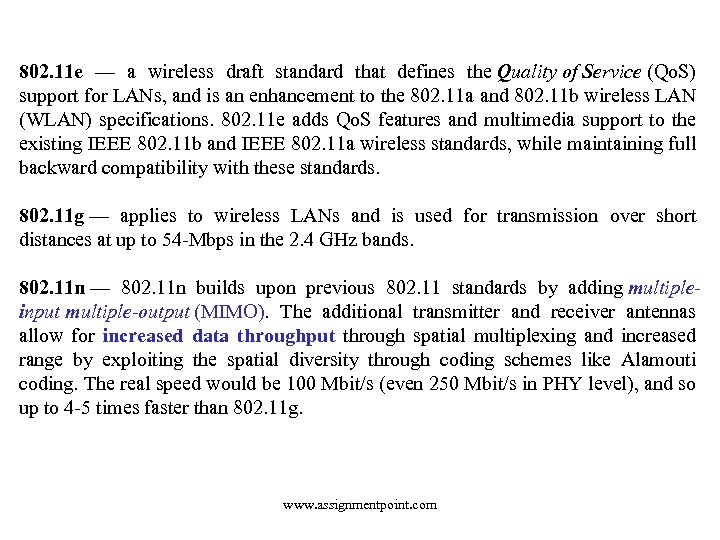 802. 11 e — a wireless draft standard that defines the Quality of Service (Qo. S) support for LANs, and is an enhancement to the 802. 11 a and 802. 11 b wireless LAN (WLAN) specifications. 802. 11 e adds Qo. S features and multimedia support to the existing IEEE 802. 11 b and IEEE 802. 11 a wireless standards, while maintaining full backward compatibility with these standards. 802. 11 g — applies to wireless LANs and is used for transmission over short distances at up to 54 -Mbps in the 2. 4 GHz bands. 802. 11 n — 802. 11 n builds upon previous 802. 11 standards by adding multipleinput multiple-output (MIMO). The additional transmitter and receiver antennas allow for increased data throughput through spatial multiplexing and increased range by exploiting the spatial diversity through coding schemes like Alamouti coding. The real speed would be 100 Mbit/s (even 250 Mbit/s in PHY level), and so up to 4 -5 times faster than 802. 11 g. www. assignmentpoint. com
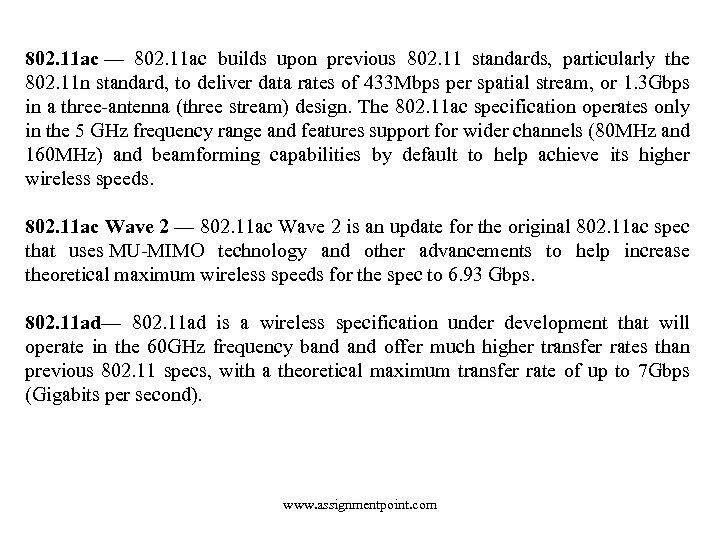 802. 11 ac — 802. 11 ac builds upon previous 802. 11 standards, particularly the 802. 11 n standard, to deliver data rates of 433 Mbps per spatial stream, or 1. 3 Gbps in a three-antenna (three stream) design. The 802. 11 ac specification operates only in the 5 GHz frequency range and features support for wider channels (80 MHz and 160 MHz) and beamforming capabilities by default to help achieve its higher wireless speeds. 802. 11 ac Wave 2 — 802. 11 ac Wave 2 is an update for the original 802. 11 ac spec that uses MU-MIMO technology and other advancements to help increase theoretical maximum wireless speeds for the spec to 6. 93 Gbps. 802. 11 ad— 802. 11 ad is a wireless specification under development that will operate in the 60 GHz frequency band offer much higher transfer rates than previous 802. 11 specs, with a theoretical maximum transfer rate of up to 7 Gbps (Gigabits per second). www. assignmentpoint. com
 802. 11 r - 802. 11 r, also called Fast Basic Service Set (BSS) Transition, supports Vo. Wi-Fi handoff between access points to enable Vo. IP roaming on a Wi-Fi network with 802. 1 X authentication. 802. 1 X — Not to be confused with 802. 11 x (which is the term used to describe the family of 802. 11 standards) 802. 1 X is an IEEE standard for port-based Network Access Control that allows network administrators to restricted use of IEEE 802 LAN service access points to secure communication between authenticated and authorized devices. www. assignmentpoint. com
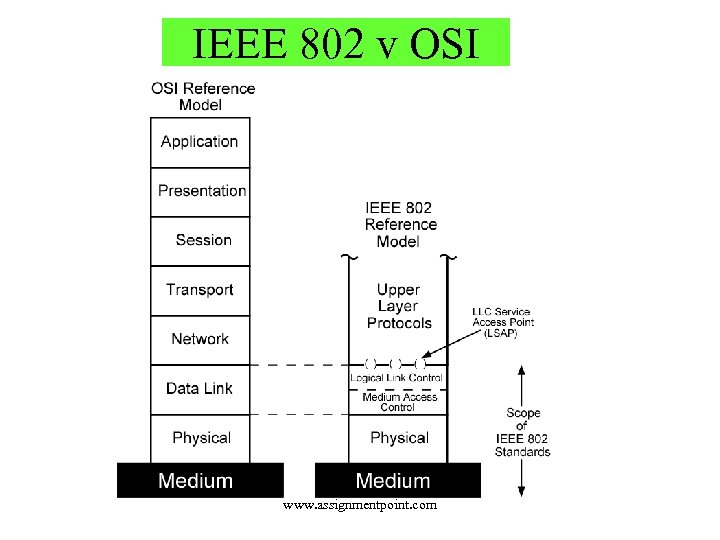
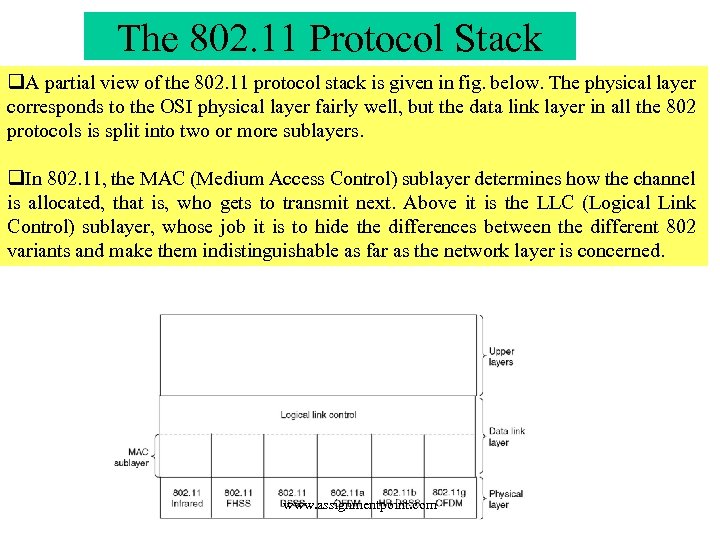 The 802. 11 Protocol Stack q. A partial view of the 802. 11 protocol stack is given in fig. below. The physical layer corresponds to the OSI physical layer fairly well, but the data link layer in all the 802 protocols is split into two or more sublayers. q. In 802. 11, the MAC (Medium Access Control) sublayer determines how the channel is allocated, that is, who gets to transmit next. Above it is the LLC (Logical Link Control) sublayer, whose job it is to hide the differences between the different 802 variants and make them indistinguishable as far as the network layer is concerned. www. assignmentpoint. com
 IEEE 802 v OSI www. assignmentpoint. com
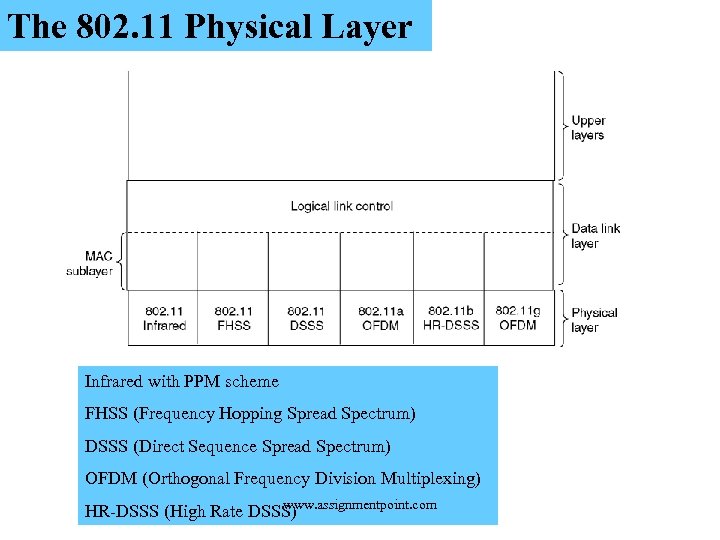 The 802. 11 Physical Layer Infrared with PPM scheme FHSS (Frequency Hopping Spread Spectrum) DSSS (Direct Sequence Spread Spectrum) OFDM (Orthogonal Frequency Division Multiplexing) www. assignmentpoint. com HR-DSSS (High Rate DSSS)
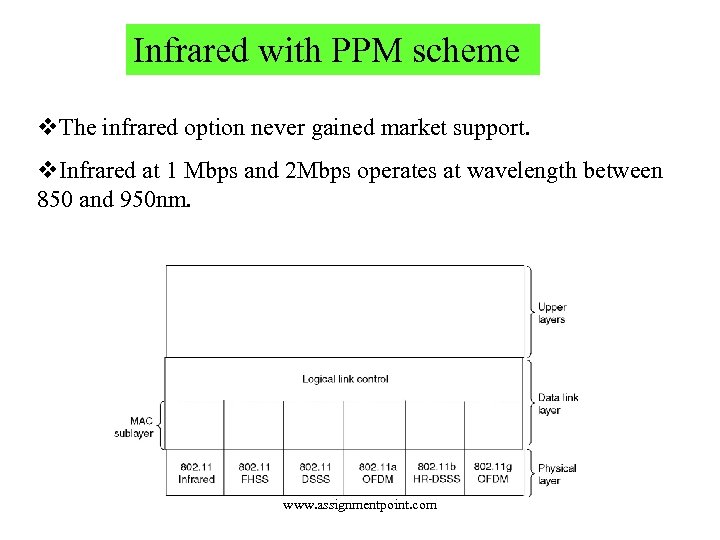 Infrared with PPM scheme v. The infrared option never gained market support. v. Infrared at 1 Mbps and 2 Mbps operates at wavelength between 850 and 950 nm. www. assignmentpoint. com
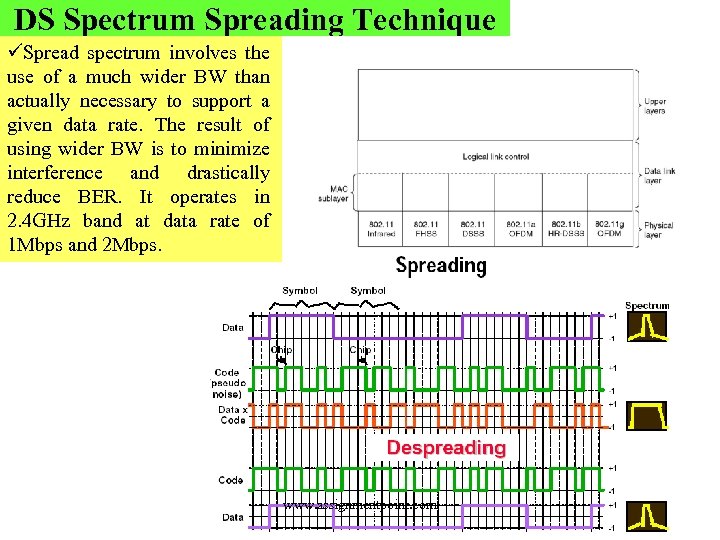 DS Spectrum Spreading Technique üSpread spectrum involves the use of a much wider BW than actually necessary to support a given data rate. The result of using wider BW is to minimize interference and drastically reduce BER. It operates in 2. 4 GHz band at data rate of 1 Mbps and 2 Mbps. www. assignmentpoint. com
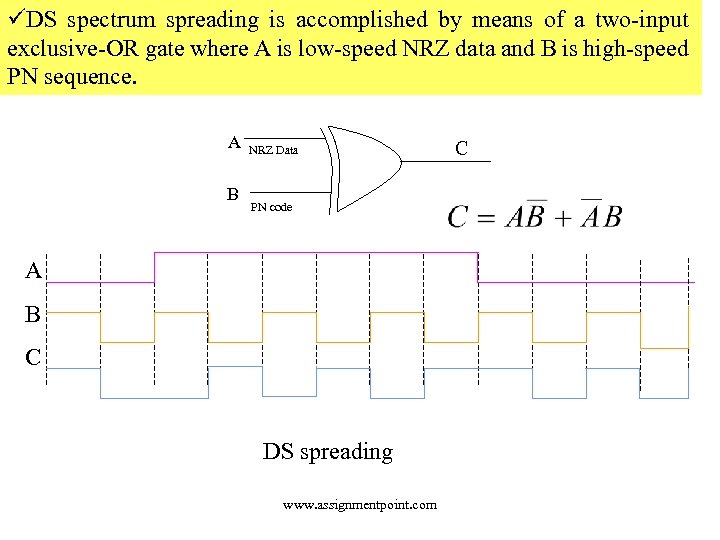 üDS spectrum spreading is accomplished by means of a two-input exclusive-OR gate where A is low-speed NRZ data and B is high-speed PN sequence. A B NRZ Data PN code A B C DS spreading www. assignmentpoint. com C
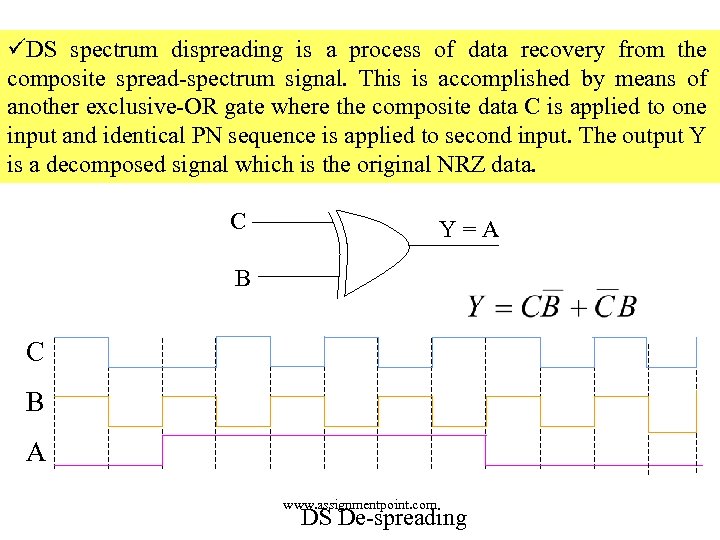 üDS spectrum dispreading is a process of data recovery from the composite spread-spectrum signal. This is accomplished by means of another exclusive-OR gate where the composite data C is applied to one input and identical PN sequence is applied to second input. The output Y is a decomposed signal which is the original NRZ data. C Y = A B C B A www. assignmentpoint. com DS De-spreading
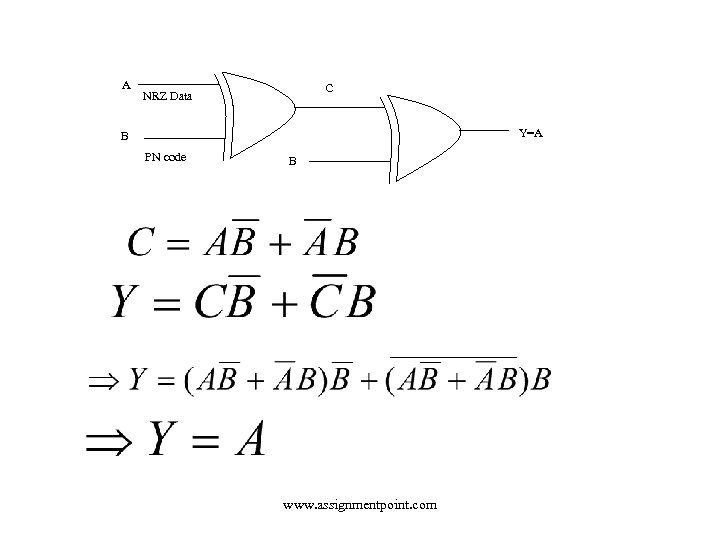 A C NRZ Data Y=A B PN code B www. assignmentpoint. com
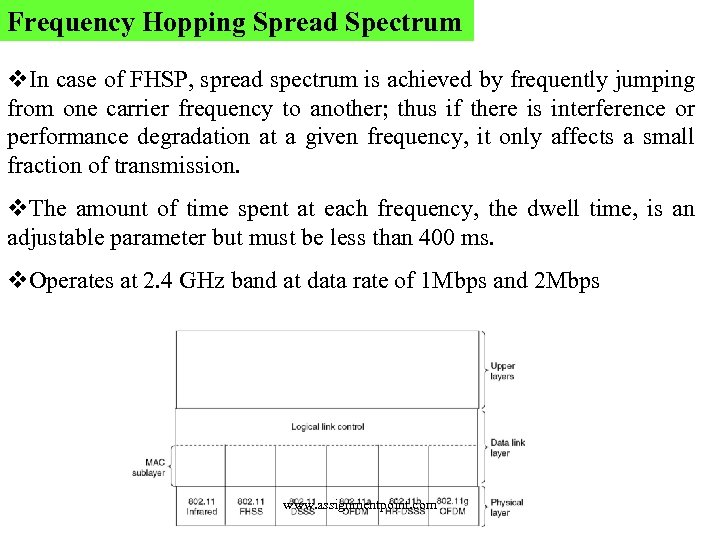 Frequency Hopping Spread Spectrum v. In case of FHSP, spread spectrum is achieved by frequently jumping from one carrier frequency to another; thus if there is interference or performance degradation at a given frequency, it only affects a small fraction of transmission. v. The amount of time spent at each frequency, the dwell time, is an adjustable parameter but must be less than 400 ms. v. Operates at 2. 4 GHz band at data rate of 1 Mbps and 2 Mbps www. assignmentpoint. com
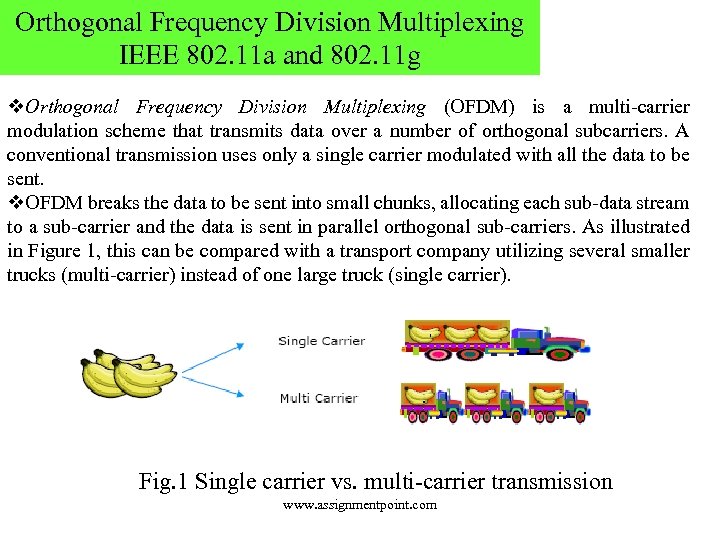 Orthogonal Frequency Division Multiplexing IEEE 802. 11 a and 802. 11 g v. Orthogonal Frequency Division Multiplexing (OFDM) is a multi-carrier modulation scheme that transmits data over a number of orthogonal subcarriers. A conventional transmission uses only a single carrier modulated with all the data to be sent. v. OFDM breaks the data to be sent into small chunks, allocating each sub-data stream to a sub-carrier and the data is sent in parallel orthogonal sub-carriers. As illustrated in Figure 1, this can be compared with a transport company utilizing several smaller trucks (multi-carrier) instead of one large truck (single carrier). Fig. 1 Single carrier vs. multi-carrier transmission www. assignmentpoint. com
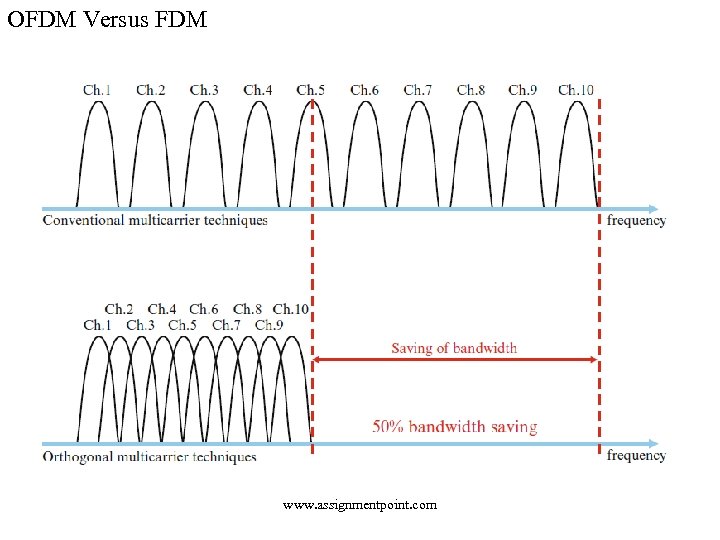 OFDM Versus FDM www. assignmentpoint. com
 OFDM offers many advantages over single-carrier modulations: 1. It elongates the symbol period so that the signal is more robust against intersymbol interference caused by channel dispersions and multipath interference. 2. It divides the entire frequency band into narrow bands so that it is less sensitive to wide-band impulse noise and fast channel fades. 3. Splitting the channel into narrowband channels enables significant simplification of equalizer design in multipath environments. www. assignmentpoint. com
 4. Different modulation formats and data rates can be used on different subcarriers depending on the noise level of individual subbands (the symbol periods are kept the same). In serial transmission, certain types of noise (such as timevarying tone interference) may cause an entire system to fail; the parallel OFDM system can avoid this problem by adaptively reducing the data rate of the affected subbands or dropping them. 5. OFDM can be implemented digitally using an inverse discrete Fourier transform and discrete Fourier transform (IDFT/DFT) pair (via the efficient fast algorithm IFFT/FFT pair), which greatly reduces the system complexity. www. assignmentpoint. com
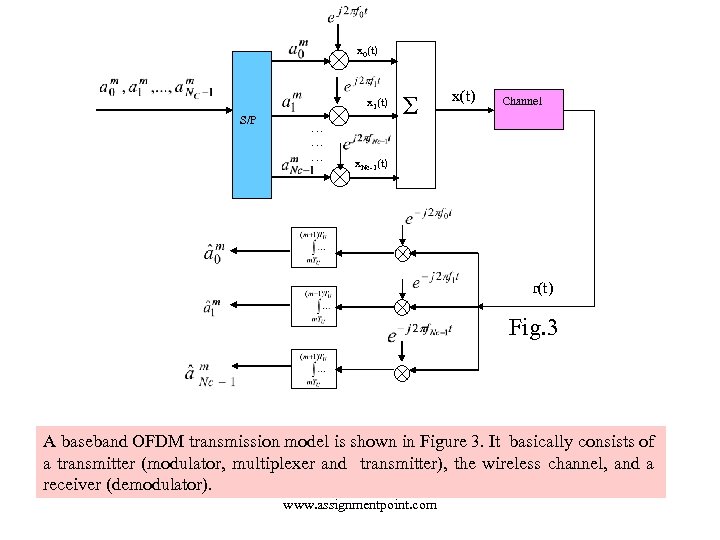 x 0(t) x 1(t) S/P … … … Σ x(t) Channel x. Nc-1(t) r(t) Fig. 3 A baseband OFDM transmission model is shown in Figure 3. It basically consists of a transmitter (modulator, multiplexer and transmitter), the wireless channel, and a receiver (demodulator). www. assignmentpoint. com
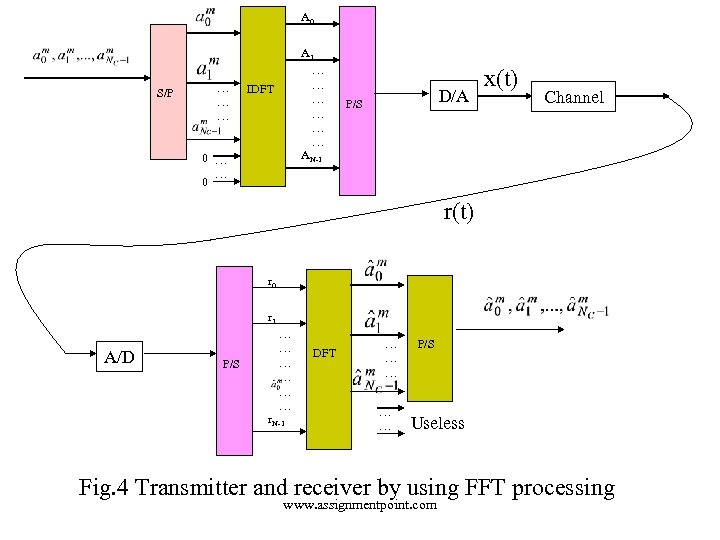 A 0 S/P … … … A 1 … … … AN-1 IDFT 0 … … 0 D/A P/S x(t) Channel r(t) r 0 r 1 A/D P/S … … … r. N-1 DFT … … … P/S Useless Fig. 4 Transmitter and receiver by using FFT processing www. assignmentpoint. com
 Data Link Layer of IEEE 802. 11 The Data Link layer of IEEE 802. 11 has two parts: LLC and MAC sublayer. This layer provides several key functionalities: reliable data delivery, media access control and security features. www. assignmentpoint. com
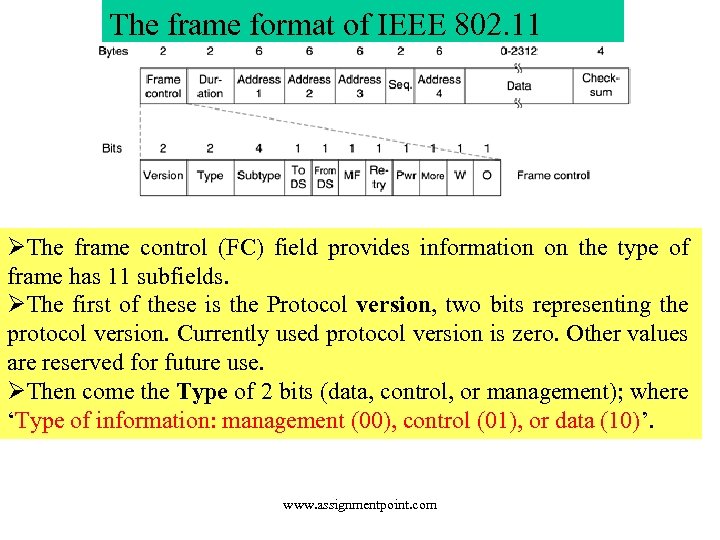 The frame format of IEEE 802. 11 ØThe frame control (FC) field provides information on the type of frame has 11 subfields. ØThe first of these is the Protocol version, two bits representing the protocol version. Currently used protocol version is zero. Other values are reserved for future use. ØThen come the Type of 2 bits (data, control, or management); where ‘Type of information: management (00), control (01), or data (10)’. www. assignmentpoint. com
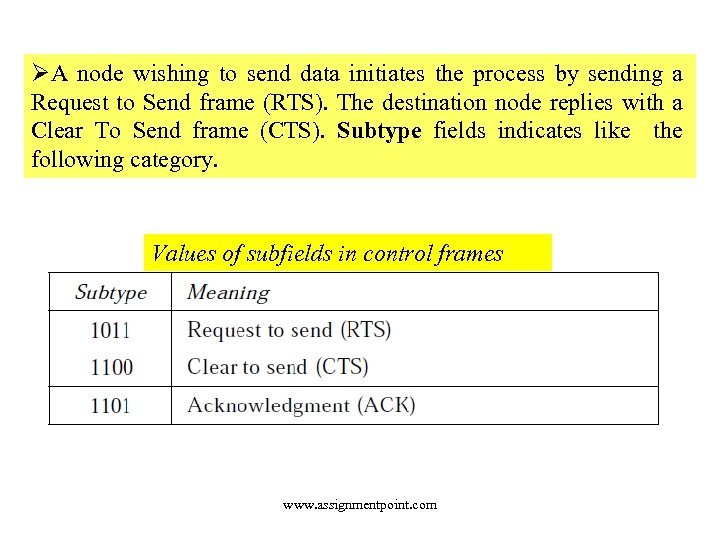 ØA node wishing to send data initiates the process by sending a Request to Send frame (RTS). The destination node replies with a Clear To Send frame (CTS). Subtype fields indicates like the following category. Values of subfields in control frames www. assignmentpoint. com
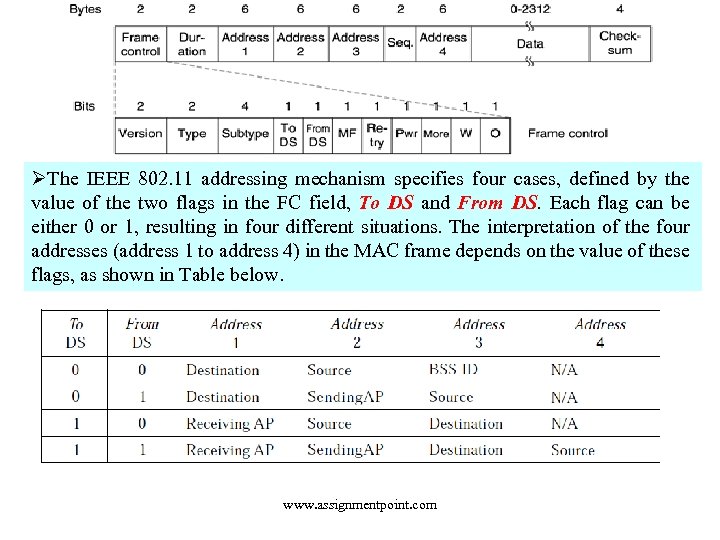 ØThe IEEE 802. 11 addressing mechanism specifies four cases, defined by the value of the two flags in the FC field, To DS and From DS. Each flag can be either 0 or 1, resulting in four different situations. The interpretation of the four addresses (address 1 to address 4) in the MAC frame depends on the value of these flags, as shown in Table below. www. assignmentpoint. com
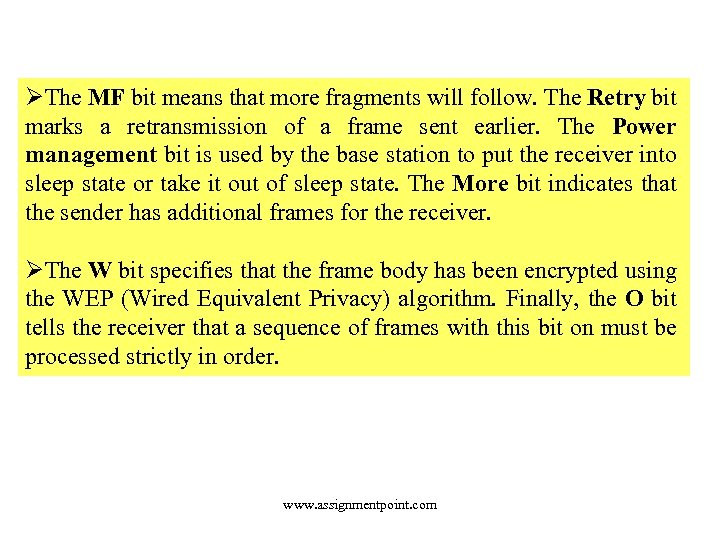 ØThe MF bit means that more fragments will follow. The Retry bit marks a retransmission of a frame sent earlier. The Power management bit is used by the base station to put the receiver into sleep state or take it out of sleep state. The More bit indicates that the sender has additional frames for the receiver. ØThe W bit specifies that the frame body has been encrypted using the WEP (Wired Equivalent Privacy) algorithm. Finally, the O bit tells the receiver that a sequence of frames with this bit on must be processed strictly in order. www. assignmentpoint. com
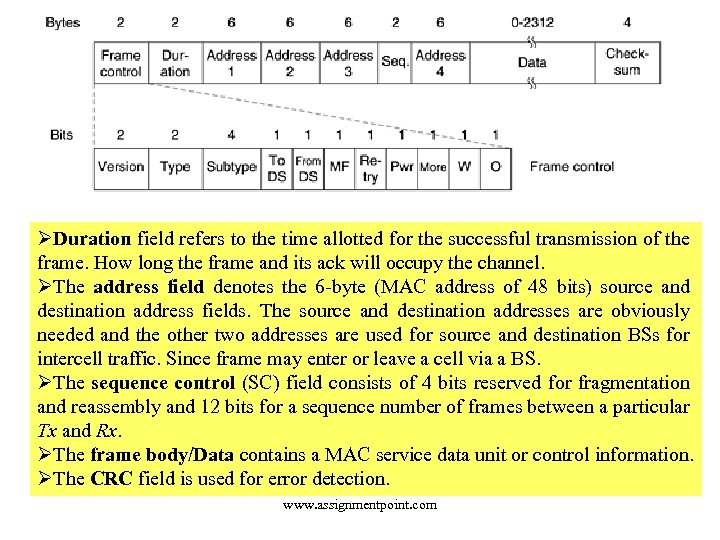 ØDuration field refers to the time allotted for the successful transmission of the frame. How long the frame and its ack will occupy the channel. ØThe address field denotes the 6 -byte (MAC address of 48 bits) source and destination address fields. The source and destination addresses are obviously needed and the other two addresses are used for source and destination BSs for intercell traffic. Since frame may enter or leave a cell via a BS. ØThe sequence control (SC) field consists of 4 bits reserved for fragmentation and reassembly and 12 bits for a sequence number of frames between a particular Tx and Rx. ØThe frame body/Data contains a MAC service data unit or control information. ØThe CRC field is used for error detection. www. assignmentpoint. com
 IEEE 802. 11 at MAC sublayer uses CSMA/CA as the access method. üStandard 802. 11 typically uses the carrier Sense Multiple Access with collision avoidance (CSMA/CA) method. üWith this method, each user listens for traffic coming from other users (a node can sense a traffic channel like combination of carrier and TS) and transmits data if the channel is idle. üIf the channel is busy, the user waits until the channel becomes idle. The user then transmits data after a random back-off time. www. assignmentpoint. com
 Carrier Sense Multiple Access/ Collision Avoidance (CSMA/CA) ØThe wireless LAN system cannot detect collisions because the power of the transmitting device is much stronger than the receiver’s power. ØIn this situation collision detection is not practical, it makes sense to try to devise a system that can help prevent collisions. Thus the CA is CSMA/CA refers to ‘collision avoidance’. ØWhen a device detects that the transmission media is idle, the device must wait for a specific time before it can contend for access to the media. This specific time is called interframe spacing (IFS) time. ØThe IFS time can also be used for prioritizing transmissions. If a device is given a smaller IFS , then it has more chances of gaining access to the transmission media. www. assignmentpoint. com
 ØIf the sender does not receive an ACK then the device assumes that a collision has occurred. Sender usually uses binary exponential backoff. www. assignmentpoint. com
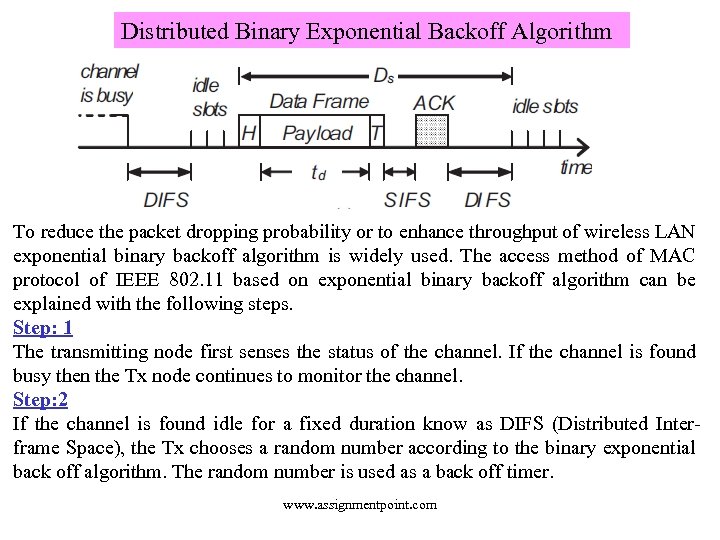 Distributed Binary Exponential Backoff Algorithm To reduce the packet dropping probability or to enhance throughput of wireless LAN exponential binary backoff algorithm is widely used. The access method of MAC protocol of IEEE 802. 11 based on exponential binary backoff algorithm can be explained with the following steps. Step: 1 The transmitting node first senses the status of the channel. If the channel is found busy then the Tx node continues to monitor the channel. Step: 2 If the channel is found idle for a fixed duration know as DIFS (Distributed Interframe Space), the Tx chooses a random number according to the binary exponential back off algorithm. The random number is used as a back off timer. www. assignmentpoint. com
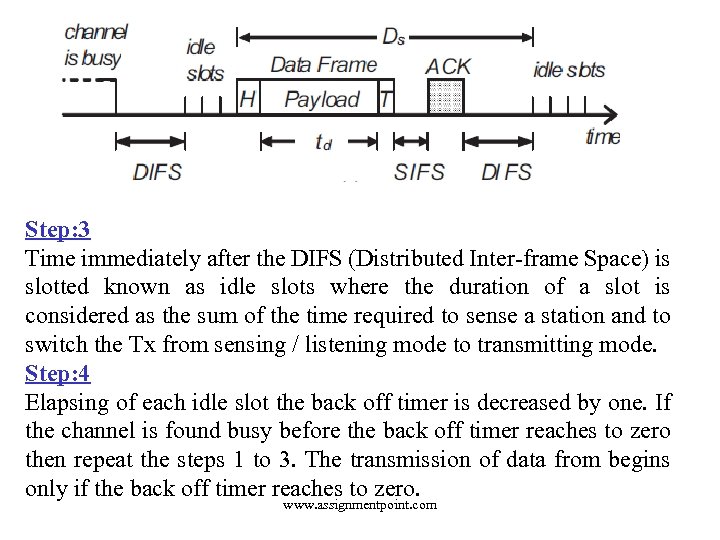 Step: 3 Time immediately after the DIFS (Distributed Inter-frame Space) is slotted known as idle slots where the duration of a slot is considered as the sum of the time required to sense a station and to switch the Tx from sensing / listening mode to transmitting mode. Step: 4 Elapsing of each idle slot the back off timer is decreased by one. If the channel is found busy before the back off timer reaches to zero then repeat the steps 1 to 3. The transmission of data from begins only if the back off timer reaches to zero. www. assignmentpoint. com
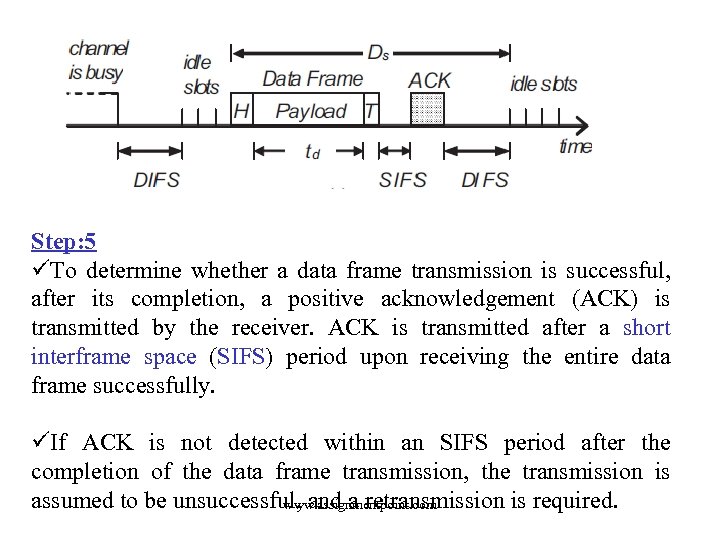 Step: 5 üTo determine whether a data frame transmission is successful, after its completion, a positive acknowledgement (ACK) is transmitted by the receiver. ACK is transmitted after a short interframe space (SIFS) period upon receiving the entire data frame successfully. üIf ACK is not detected within an SIFS period after the completion of the data frame transmission, the transmission is assumed to be unsuccessful, and a retransmission is required. www. assignmentpoint. com
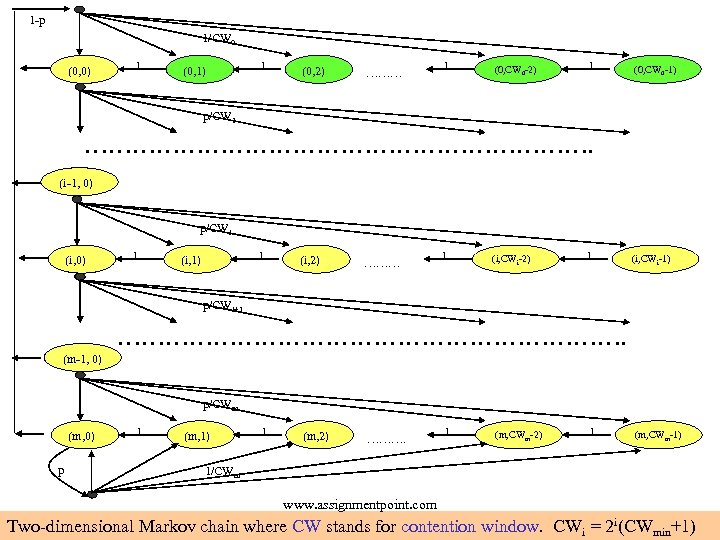
 Bianchi Model üThe main contribution of Bianchi’s model is the analytical calculation of saturation throughput in a closed-form expression. The model also calculates the probability of a packet transmission failure due to collision. üBianchi uses a two-dimensional Markov chain of m + 1 backoff stages in which each stage represents the backoff time counter of a node, see Figure below. üA transition takes place upon collision and successful transmission. If collision takes place probability state moves to to a “higher” stage e. g. , from stage i-1 to stage i. When a successful transmission occurs then state goes to the lowest stage i. e. , stage 0. üEach state of this bidimensional Markov process is represented by {s(t), b(t)}, where b(t) is the stochastic process representing the backoff time counter for a given station and s(t) is the stochastic process representing the backoff stage (0, 1, · · · , m) of the station at time t. www. assignmentpoint. com
 1 -p 1/CW 0 (0, 0) 1 (0, 1) 1 (0, 2) ……… 1 (0, CW 0 -2) 1 (0, CW 0 -1) p/CW 1 ……………………………. (i-1, 0) p/CWi (i, 0) 1 1 (i, 1) (i, 2) ……… 1 (i, CWi-2) 1 (i, CWi-1) p/CWi+1 ……………………………. (m-1, 0) p/CWm (m, 0) p 1 (m, 1) 1 (m, 2) ………. 1 (m, CWm-2) 1 (m, CWm-1) 1/CWm www. assignmentpoint. com Two-dimensional Markov chain where CW stands for contention window. CWi = 2 i(CWmin+1)
 Carrier Sense Multiple Access/ Collision Detection (CSMA/CD) ØA collision detection mechanism compares the amount of energy on the media after a packet is transmitted. If the value is greater than the energy used by the transmitting device, then a collision has occurred. If there is no difference the two measured values, then a collision has not occurred. www. assignmentpoint. com
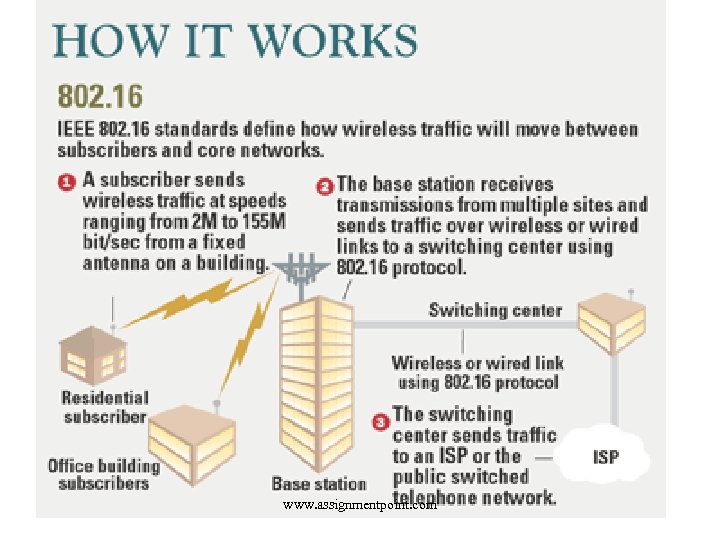
 IEEE 802. 16 üIEEE 802. 11 is a standard for a wireless LAN; 802. 16 is a standard for wireless WAN or MAN. It is broadband wireless system called Wi. MAX (Worldwide Interoperability for Microwave Access). ü 802. 11 provides connectionless communication where as 802. 16 provides connection oriented service. üThe IEEE 802. 16 group was formed in 1998 to develop an airinterface standard for Broadband Wireless Access (BWA) and to support the development and deployment of wireless metropolitan area networks üA later version of IEEE 802. 16 created two new standards called IEEE 802. 16 d for fixed Wi. MAX and IEEE 802. 16 e for mobile www. assignmentpoint. com Wi. MAX.
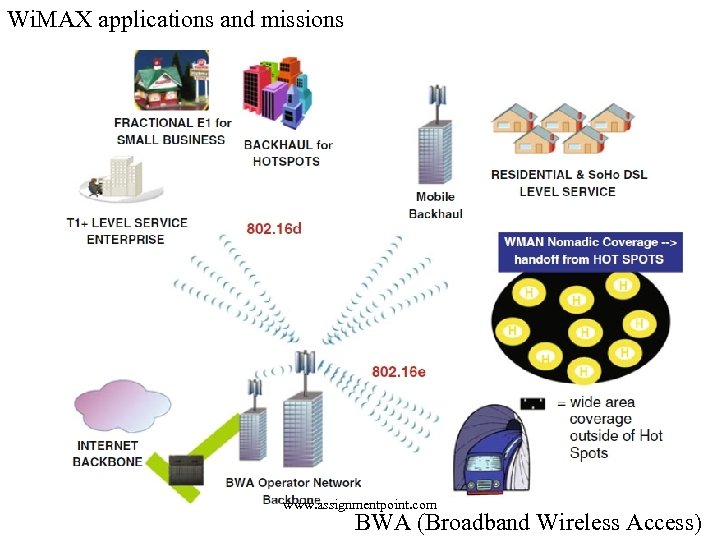 Wi. MAX applications and missions www. assignmentpoint. com BWA (Broadband Wireless Access)
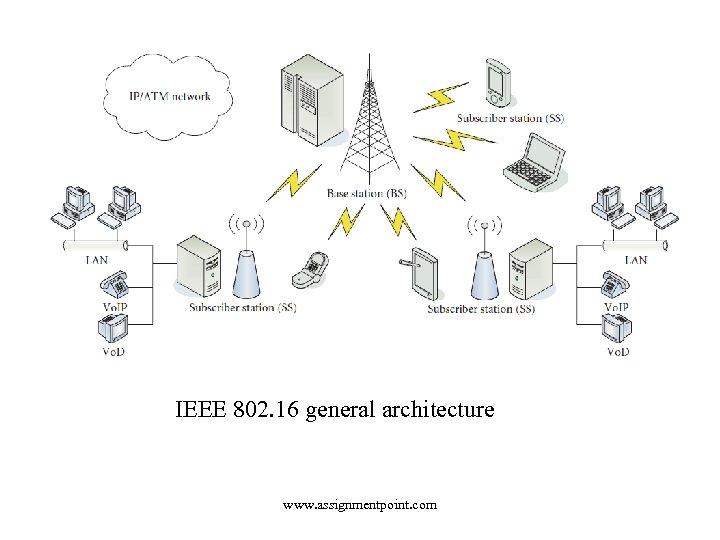 IEEE 802. 16 general architecture www. assignmentpoint. com
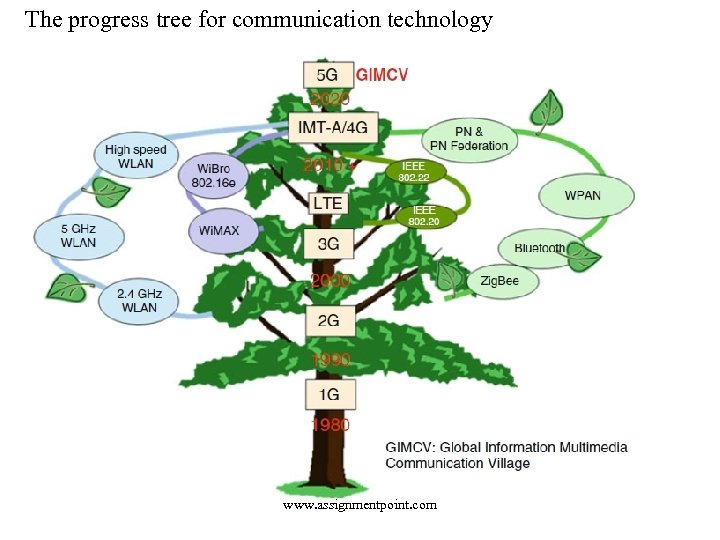 The progress tree for communication technology www. assignmentpoint. com
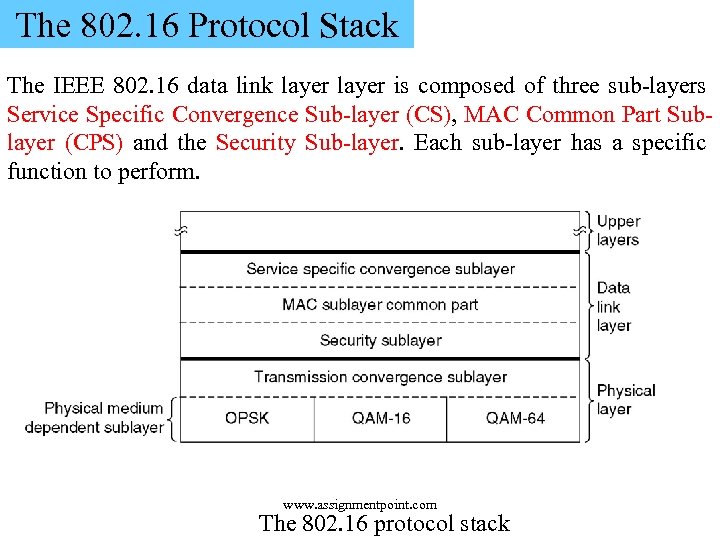 The 802. 16 Protocol Stack The IEEE 802. 16 data link layer is composed of three sub-layers Service Specific Convergence Sub-layer (CS), MAC Common Part Sublayer (CPS) and the Security Sub-layer. Each sub-layer has a specific function to perform. www. assignmentpoint. com The 802. 16 protocol stack
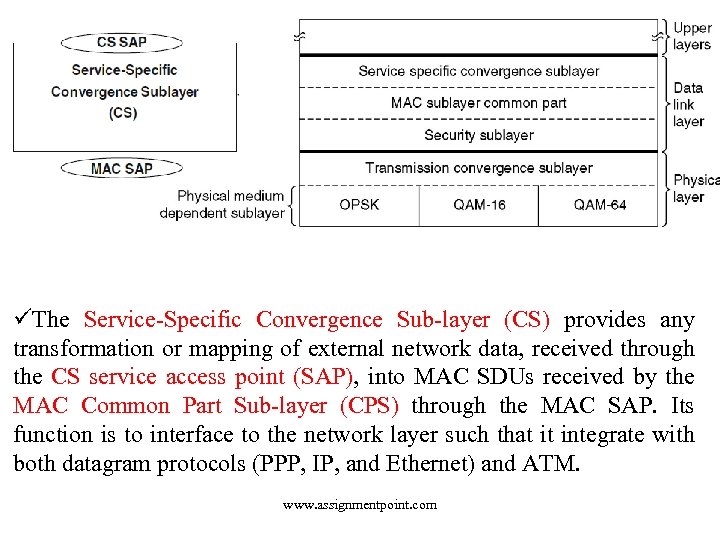 üThe Service-Specific Convergence Sub-layer (CS) provides any transformation or mapping of external network data, received through the CS service access point (SAP), into MAC SDUs received by the MAC Common Part Sub-layer (CPS) through the MAC SAP. Its function is to interface to the network layer such that it integrate with both datagram protocols (PPP, IP, and Ethernet) and ATM. www. assignmentpoint. com
 üA complication here is that 802. 16 was designed to integrate seamlessly with both datagram protocols (e. g. , PPP, IP, and Ethernet) and ATM. The problem is that packet protocols are connectionless and ATM is connection oriented. This means that every ATM connection has to map onto an 802. 16 connection, in principle a straightforward matter. But onto which 802. 16 connection should an incoming IP packet be mapped? That problem is dealt with in this sublayer. üThe core part of the IEEE 802. 16 MAC is the MAC CPS, as it provides the core MAC functionality of system access bandwidth allocation, connection establishment, and connection maintenance. üThe MAC also contains a separate security Sublayer providing authentication, secure key exchange, and encryption. www. assignmentpoint. com
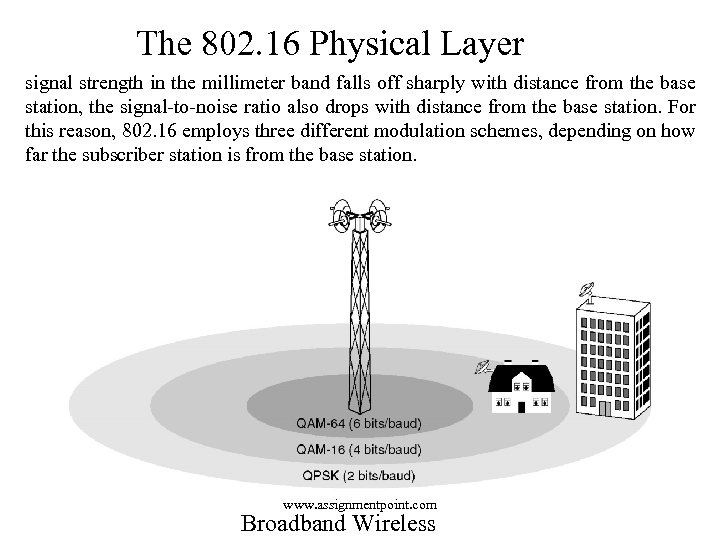 The 802. 16 Physical Layer signal strength in the millimeter band falls off sharply with distance from the base station, the signal-to-noise ratio also drops with distance from the base station. For this reason, 802. 16 employs three different modulation schemes, depending on how far the subscriber station is from the base station. www. assignmentpoint. com Broadband Wireless
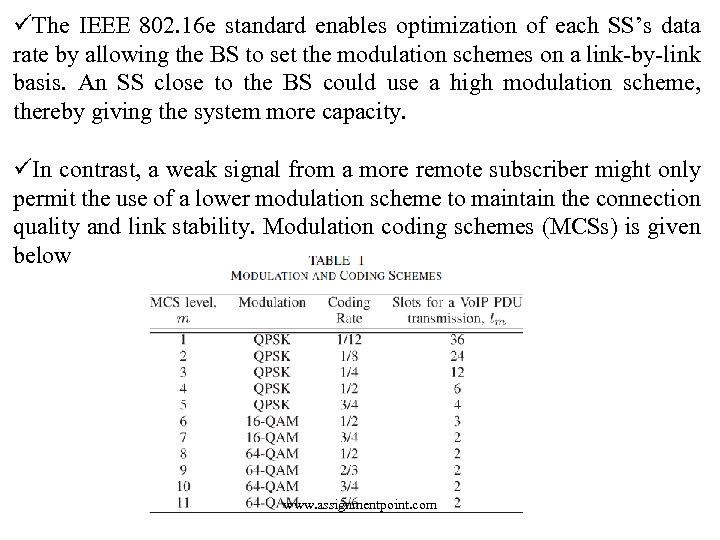 üThe IEEE 802. 16 e standard enables optimization of each SS’s data rate by allowing the BS to set the modulation schemes on a link-by-link basis. An SS close to the BS could use a high modulation scheme, thereby giving the system more capacity. üIn contrast, a weak signal from a more remote subscriber might only permit the use of a lower modulation scheme to maintain the connection quality and link stability. Modulation coding schemes (MCSs) is given below www. assignmentpoint. com
 Broadband Wireless www. assignmentpoint. com
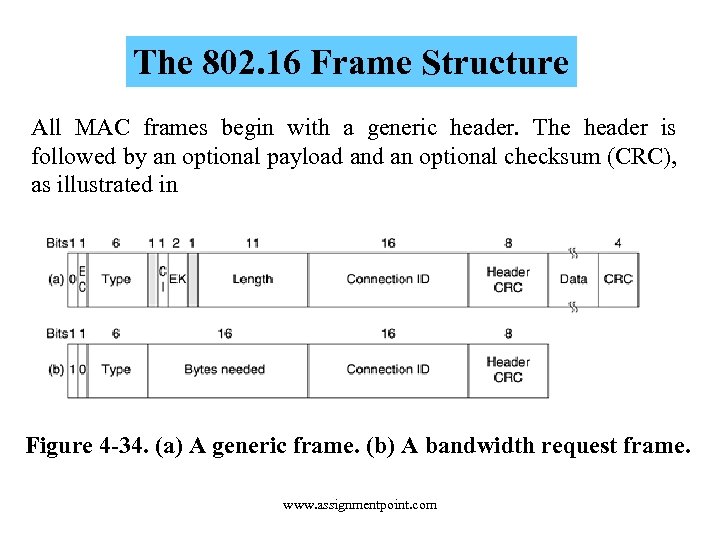 The 802. 16 Frame Structure All MAC frames begin with a generic header. The header is followed by an optional payload an optional checksum (CRC), as illustrated in Figure 4 -34. (a) A generic frame. (b) A bandwidth request frame. www. assignmentpoint. com
 §The EC bit tells whether the payload is encrypted. §The Type field identifies the frame type, mostly telling whether packing and fragmentation are present. §The CI field indicates the presence or absence of the final checksum. §The EK field tells which of the encryption keys is being used (if any). The Length field gives the complete length of the frame, including the header. The Connection identifier tells which connection this frame belongs to. §Finally, the Header. CRC field is a checksum over the header only, using the polynomial x 8 + x 2 + x + 1 www. assignmentpoint. com
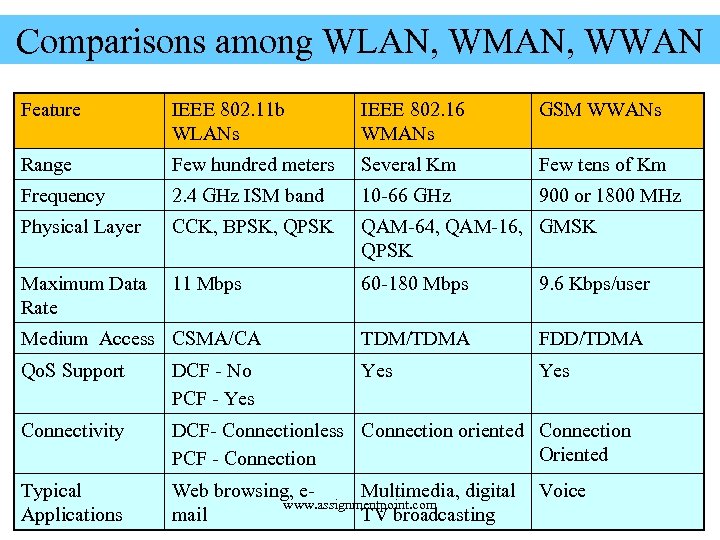 Comparisons among WLAN, WMAN, WWAN Feature IEEE 802. 11 b WLANs IEEE 802. 16 WMANs GSM WWANs Range Few hundred meters Several Km Few tens of Km Frequency 2. 4 GHz ISM band 10 -66 GHz 900 or 1800 MHz Physical Layer CCK, BPSK, QPSK QAM-64, QAM-16, GMSK QPSK Maximum Data 11 Mbps Rate 60 -180 Mbps 9. 6 Kbps/user Medium Access CSMA/CA TDM/TDMA FDD/TDMA Qo. S Support DCF - No PCF - Yes Yes Connectivity DCF- Connectionless Connection oriented Connection Oriented PCF - Connection Typical Applications Web browsing, e. Multimedia, digital Voice www. assignmentpoint. com mail TV broadcasting