 Скачать презентацию Wireless Embedded Inter-Networking Foundations of Ubiquitous Sensor Networks
8688228c52e8623c2706df1b0ac66fd3.ppt
- Количество слайдов: 81



Wireless Embedded Inter-Networking Foundations of Ubiquitous Sensor Networks Tiny. OS 2. 0 Programing – An IPv 6 Kernel Approach David E. Culler University of California, Berkeley June 2008 WEI L 4 - Tiny. OS Prog 1
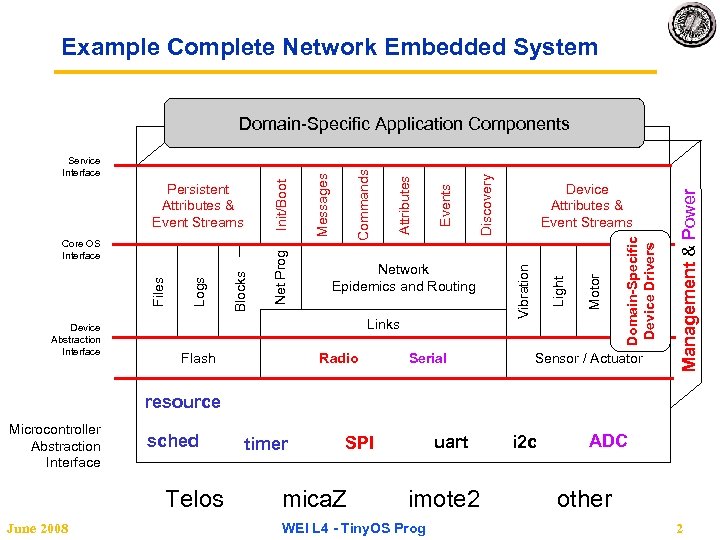
Example Complete Network Embedded System Flash Radio Serial Motor Light Vibration Links Sensor / Actuator Management & Power Discovery Events Attributes Init/Boot Net Prog Network Epidemics and Routing Device Attributes & Event Streams Domain-Specific Device Drivers Device Abstraction Interface Logs Files Core OS Interface Messages Persistent Attributes & Event Streams Blocks Service Interface Commands Domain-Specific Application Components resource Microcontroller Abstraction Interface sched Telos June 2008 timer uart SPI mica. Z imote 2 WEI L 4 - Tiny. OS Prog i 2 c ADC other 2
Outline • • • Key Tiny. OS Concepts Tiny. OS Abstraction Architecture A Simple Event-Driven Example Execution Model Critical system elements – Timers, Sensors, Communication • Service Architecture June 2008 WEI L 4 - Tiny. OS Prog 3
Tiny. OS 2. 0 • Primary Reference: http: //www. tinyos. net/tinyos 2. x/doc/ • http: //www. tinyos. net/tinyos-2. x/doc/html/tutorial/ • http: //nescc. sourceforge. net/papers/nesc-ref. pdf June 2008 WEI L 4 - Tiny. OS Prog 4
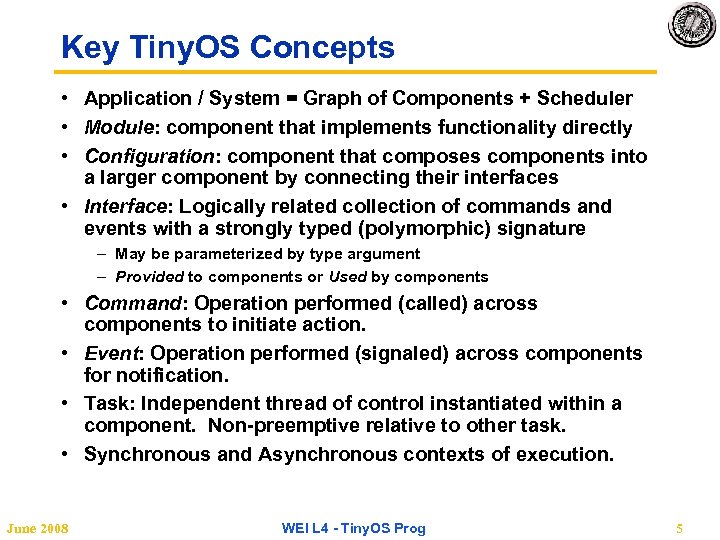
Key Tiny. OS Concepts • Application / System = Graph of Components + Scheduler • Module: component that implements functionality directly • Configuration: component that composes components into a larger component by connecting their interfaces • Interface: Logically related collection of commands and events with a strongly typed (polymorphic) signature – May be parameterized by type argument – Provided to components or Used by components • Command: Operation performed (called) across components to initiate action. • Event: Operation performed (signaled) across components for notification. • Task: Independent thread of control instantiated within a component. Non-preemptive relative to other task. • Synchronous and Asynchronous contexts of execution. June 2008 WEI L 4 - Tiny. OS Prog 5
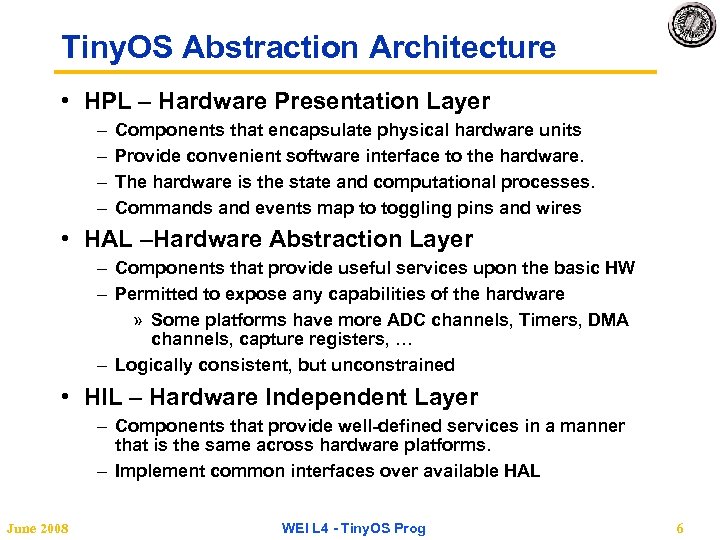
Tiny. OS Abstraction Architecture • HPL – Hardware Presentation Layer – – Components that encapsulate physical hardware units Provide convenient software interface to the hardware. The hardware is the state and computational processes. Commands and events map to toggling pins and wires • HAL –Hardware Abstraction Layer – Components that provide useful services upon the basic HW – Permitted to expose any capabilities of the hardware » Some platforms have more ADC channels, Timers, DMA channels, capture registers, … – Logically consistent, but unconstrained • HIL – Hardware Independent Layer – Components that provide well-defined services in a manner that is the same across hardware platforms. – Implement common interfaces over available HAL June 2008 WEI L 4 - Tiny. OS Prog 6
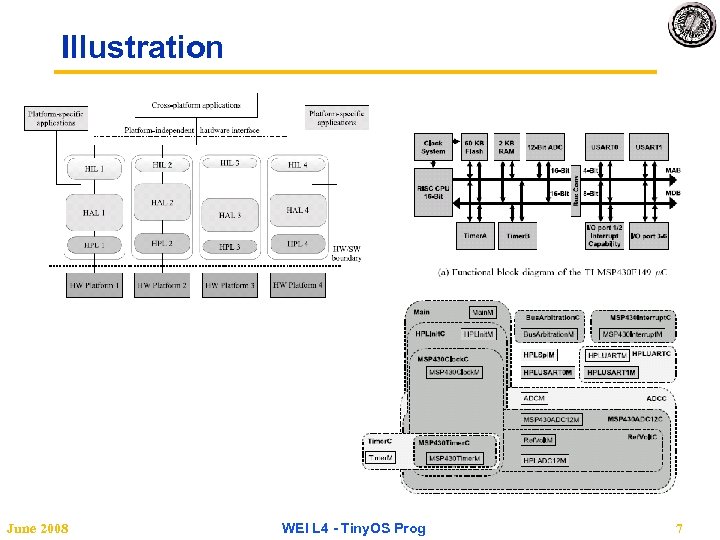
Illustration June 2008 WEI L 4 - Tiny. OS Prog 7
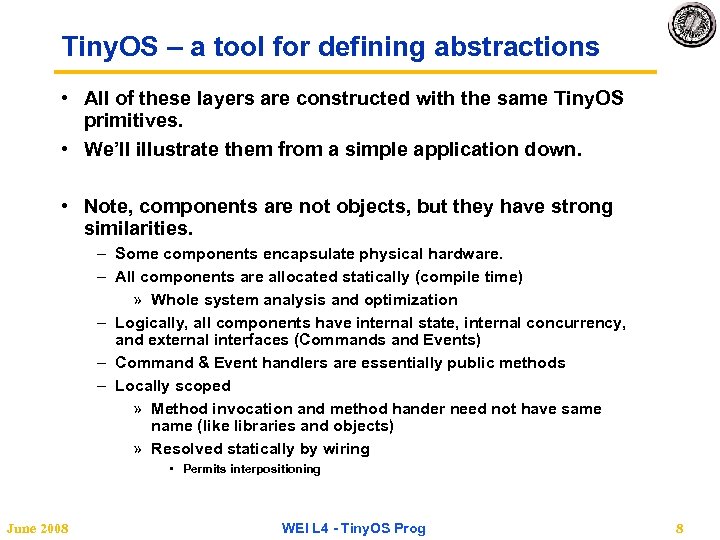
Tiny. OS – a tool for defining abstractions • All of these layers are constructed with the same Tiny. OS primitives. • We’ll illustrate them from a simple application down. • Note, components are not objects, but they have strong similarities. – Some components encapsulate physical hardware. – All components are allocated statically (compile time) » Whole system analysis and optimization – Logically, all components have internal state, internal concurrency, and external interfaces (Commands and Events) – Command & Event handlers are essentially public methods – Locally scoped » Method invocation and method hander need not have same name (like libraries and objects) » Resolved statically by wiring • Permits interpositioning June 2008 WEI L 4 - Tiny. OS Prog 8
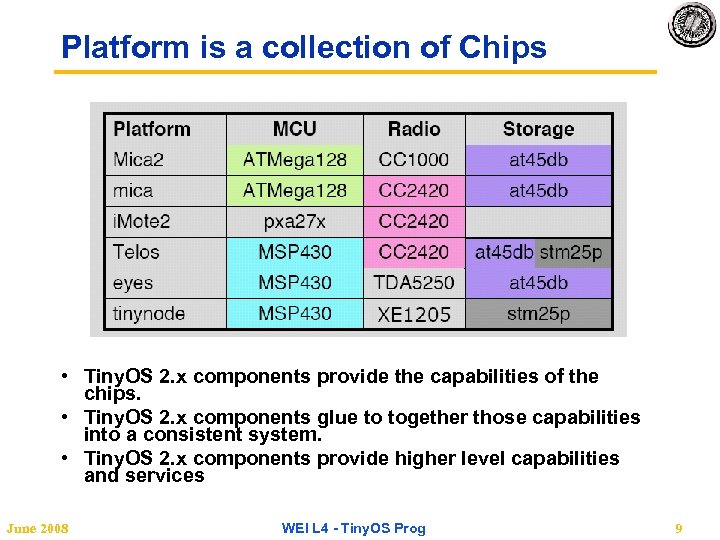
Platform is a collection of Chips • Tiny. OS 2. x components provide the capabilities of the chips. • Tiny. OS 2. x components glue to together those capabilities into a consistent system. • Tiny. OS 2. x components provide higher level capabilities and services June 2008 WEI L 4 - Tiny. OS Prog 9
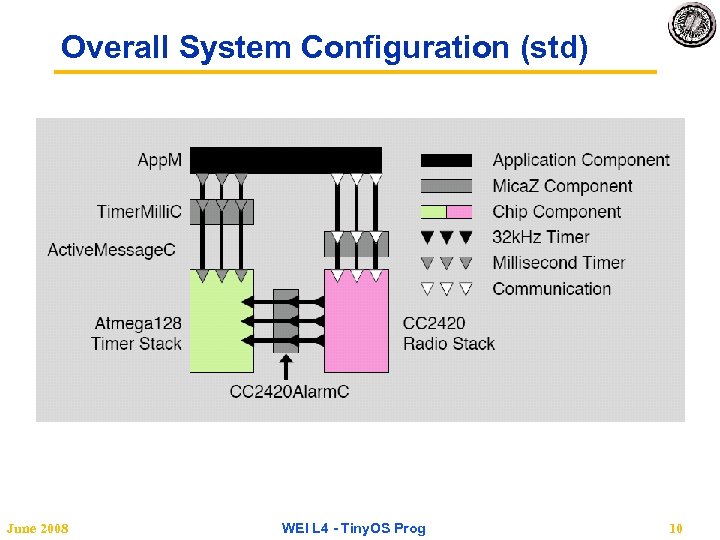
Overall System Configuration (std) June 2008 WEI L 4 - Tiny. OS Prog 10
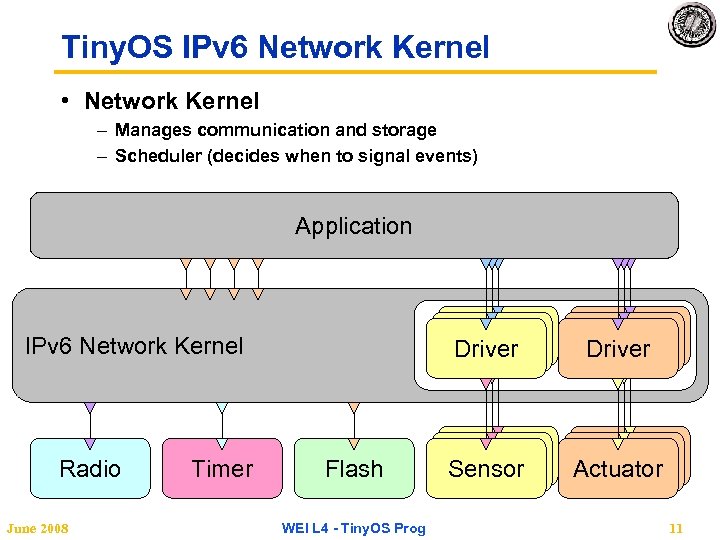
Tiny. OS IPv 6 Network Kernel • Network Kernel – Manages communication and storage – Scheduler (decides when to signal events) Application Driver IPv 6 Network Kernel Radio June 2008 Timer Flash WEI L 4 - Tiny. OS Prog Driver Sensors Sensor Actuator 11
Illustration of Tiny. OS Programming Concepts June 2008 WEI L 4 - Tiny. OS Prog 12
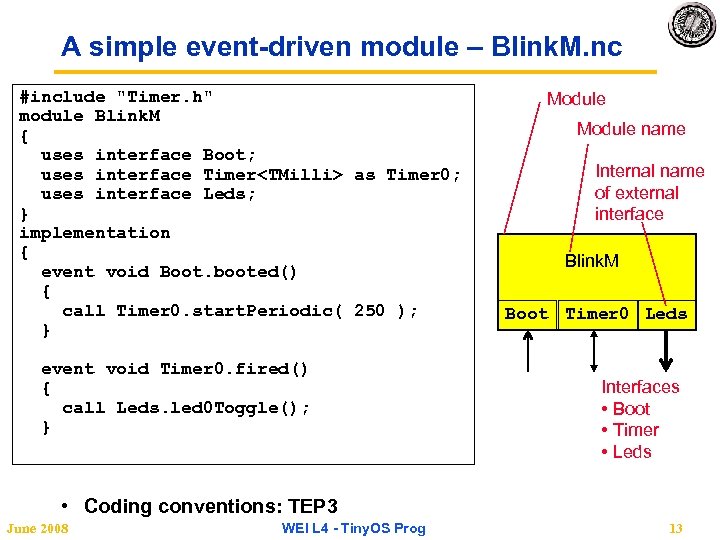
A simple event-driven module – Blink. M. nc #include "Timer. h" module Blink. M { uses interface Boot; uses interface Timer<TMilli> as Timer 0; uses interface Leds; } implementation { event void Boot. booted() { call Timer 0. start. Periodic( 250 ); } event void Timer 0. fired() { call Leds. led 0 Toggle(); } Module name Internal name of external interface Blink. M Boot Timer 0 Leds Interfaces • Boot • Timer • Leds • Coding conventions: TEP 3 June 2008 WEI L 4 - Tiny. OS Prog 13
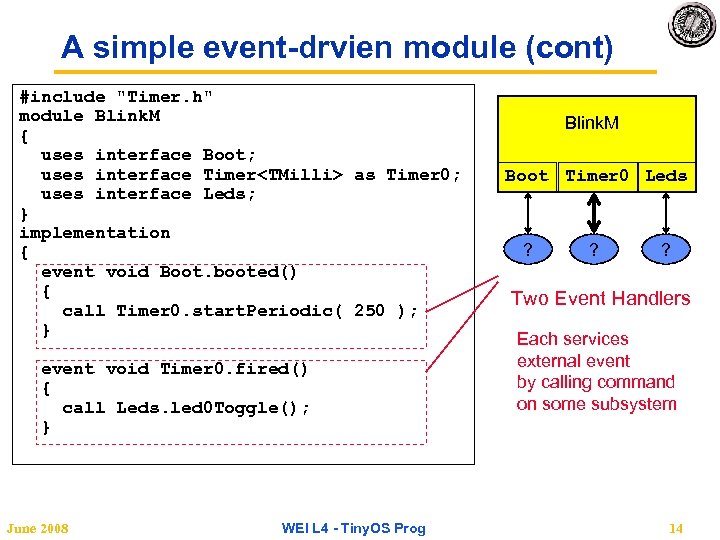
A simple event-drvien module (cont) #include "Timer. h" module Blink. M { uses interface Boot; uses interface Timer<TMilli> as Timer 0; uses interface Leds; } implementation { event void Boot. booted() { call Timer 0. start. Periodic( 250 ); } event void Timer 0. fired() { call Leds. led 0 Toggle(); } June 2008 WEI L 4 - Tiny. OS Prog Blink. M Boot Timer 0 Leds ? ? ? Two Event Handlers Each services external event by calling command on some subsystem 14
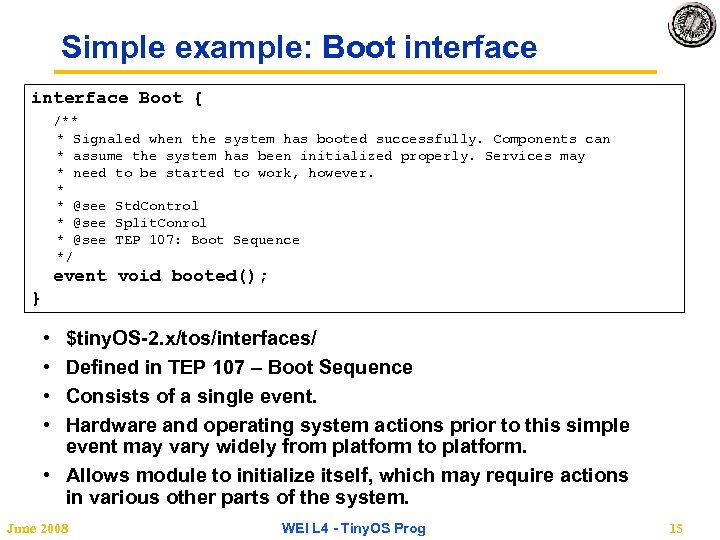
Simple example: Boot interface Boot { /** * Signaled when the system has booted successfully. Components can * assume the system has been initialized properly. Services may * need to be started to work, however. * * @see Std. Control * @see Split. Conrol * @see TEP 107: Boot Sequence */ event void booted(); } • • $tiny. OS-2. x/tos/interfaces/ Defined in TEP 107 – Boot Sequence Consists of a single event. Hardware and operating system actions prior to this simple event may vary widely from platform to platform. • Allows module to initialize itself, which may require actions in various other parts of the system. June 2008 WEI L 4 - Tiny. OS Prog 15
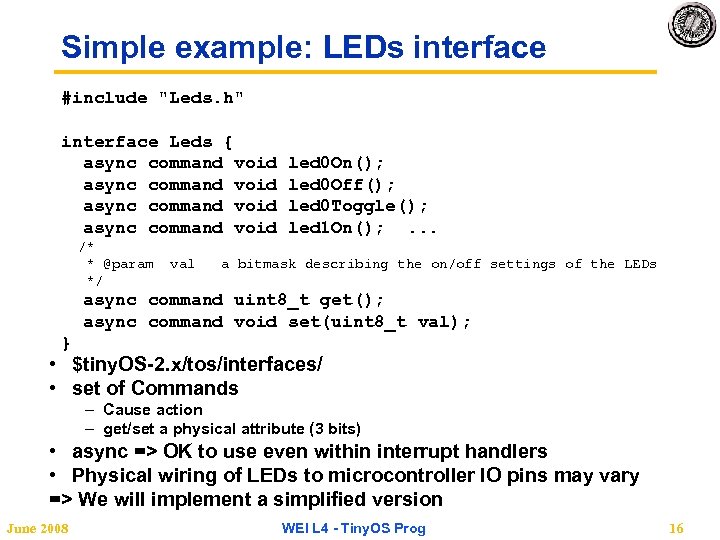
Simple example: LEDs interface #include "Leds. h" interface Leds { async command void /* * @param */ val led 0 On(); led 0 Off(); led 0 Toggle(); led 1 On(); . . . a bitmask describing the on/off settings of the LEDs async command uint 8_t get(); async command void set(uint 8_t val); } • $tiny. OS-2. x/tos/interfaces/ • set of Commands – Cause action – get/set a physical attribute (3 bits) • async => OK to use even within interrupt handlers • Physical wiring of LEDs to microcontroller IO pins may vary => We will implement a simplified version June 2008 WEI L 4 - Tiny. OS Prog 16
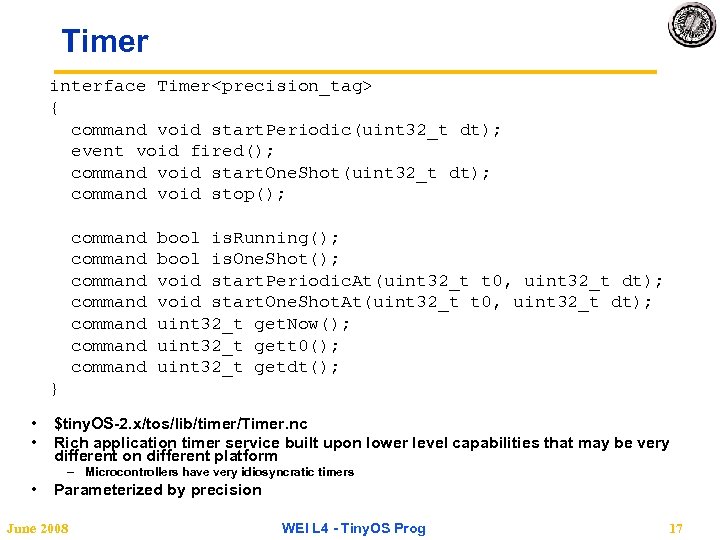
Timer interface Timer<precision_tag> { command void start. Periodic(uint 32_t dt); event void fired(); command void start. One. Shot(uint 32_t dt); command void stop(); command command bool is. Running(); bool is. One. Shot(); void start. Periodic. At(uint 32_t t 0, uint 32_t dt); void start. One. Shot. At(uint 32_t t 0, uint 32_t dt); uint 32_t get. Now(); uint 32_t gett 0(); uint 32_t getdt(); } • • $tiny. OS-2. x/tos/lib/timer/Timer. nc Rich application timer service built upon lower level capabilities that may be very different on different platform – Microcontrollers have very idiosyncratic timers • Parameterized by precision June 2008 WEI L 4 - Tiny. OS Prog 17
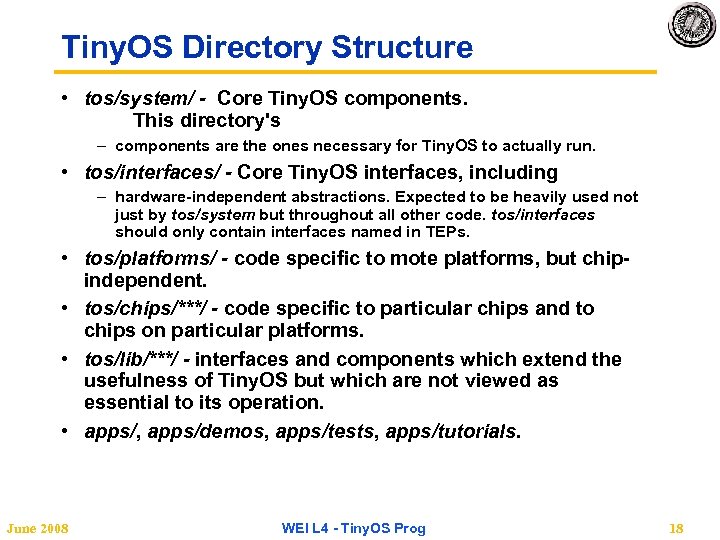
Tiny. OS Directory Structure • tos/system/ - Core Tiny. OS components. This directory's – components are the ones necessary for Tiny. OS to actually run. • tos/interfaces/ - Core Tiny. OS interfaces, including – hardware-independent abstractions. Expected to be heavily used not just by tos/system but throughout all other code. tos/interfaces should only contain interfaces named in TEPs. • tos/platforms/ - code specific to mote platforms, but chipindependent. • tos/chips/***/ - code specific to particular chips and to chips on particular platforms. • tos/lib/***/ - interfaces and components which extend the usefulness of Tiny. OS but which are not viewed as essential to its operation. • apps/, apps/demos, apps/tests, apps/tutorials. June 2008 WEI L 4 - Tiny. OS Prog 18
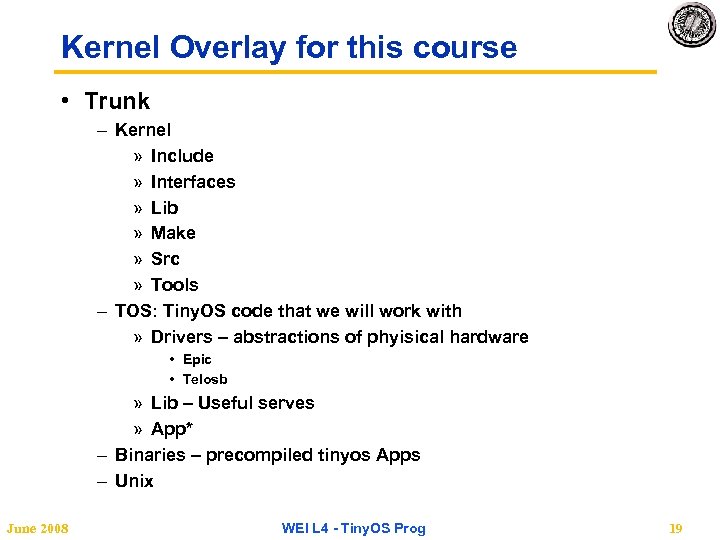
Kernel Overlay for this course • Trunk – Kernel » Include » Interfaces » Lib » Make » Src » Tools – TOS: Tiny. OS code that we will work with » Drivers – abstractions of phyisical hardware • Epic • Telosb » Lib – Useful serves » App* – Binaries – precompiled tinyos Apps – Unix June 2008 WEI L 4 - Tiny. OS Prog 19
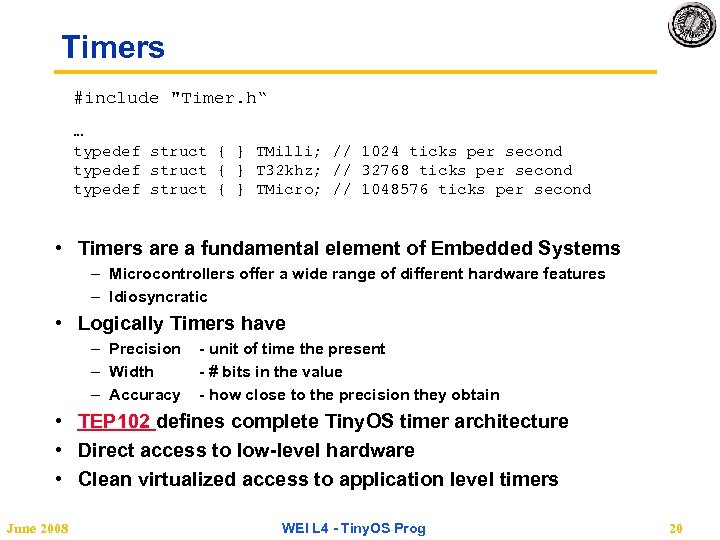
Timers #include "Timer. h“ … typedef struct { } TMilli; // 1024 ticks per second typedef struct { } T 32 khz; // 32768 ticks per second typedef struct { } TMicro; // 1048576 ticks per second • Timers are a fundamental element of Embedded Systems – Microcontrollers offer a wide range of different hardware features – Idiosyncratic • Logically Timers have – Precision – Width – Accuracy - unit of time the present - # bits in the value - how close to the precision they obtain • TEP 102 defines complete Tiny. OS timer architecture • Direct access to low-level hardware • Clean virtualized access to application level timers June 2008 WEI L 4 - Tiny. OS Prog 20
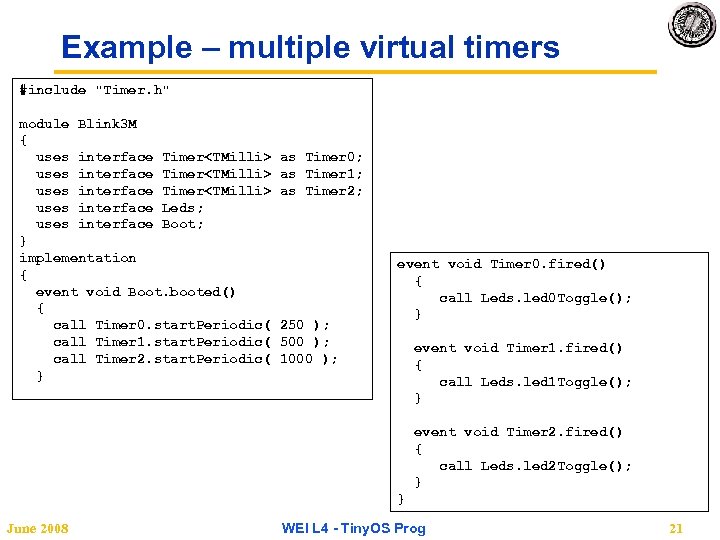
Example – multiple virtual timers #include "Timer. h" module Blink 3 M { uses interface Timer<TMilli> uses interface Leds; uses interface Boot; } implementation { event void Boot. booted() { call Timer 0. start. Periodic( call Timer 1. start. Periodic( call Timer 2. start. Periodic( } as Timer 0; as Timer 1; as Timer 2; 250 ); 500 ); 1000 ); event void Timer 0. fired() { call Leds. led 0 Toggle(); } event void Timer 1. fired() { call Leds. led 1 Toggle(); } event void Timer 2. fired() { call Leds. led 2 Toggle(); } } June 2008 WEI L 4 - Tiny. OS Prog 21
Composition • Our event-driven component, Blink, may be built directly on the hardware – For a particular microcontroller on a particular platform • or on a simple layer for a variety of platforms • or on a full-function kernel • Or it may run in a simulator on a PC, • Or… • As long as it is wired to components that provide the interfaces that this component uses. • And it can be used in a large system or application June 2008 WEI L 4 - Tiny. OS Prog 22
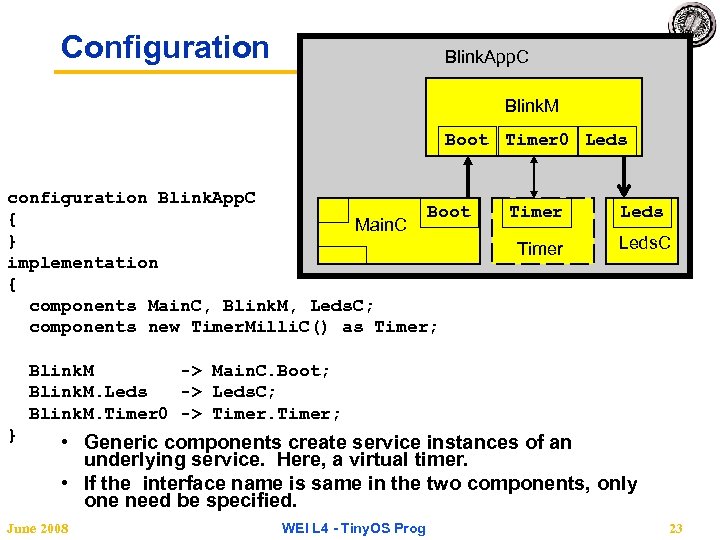
Configuration Blink. App. C Blink. M Boot Timer 0 Leds configuration Blink. App. C Boot { Main. C } implementation { components Main. C, Blink. M, Leds. C; components new Timer. Milli. C() as Timer; Timer Leds. C Blink. M -> Main. C. Boot; Blink. M. Leds -> Leds. C; Blink. M. Timer 0 -> Timer; } • Generic components create service instances of an underlying service. Here, a virtual timer. • If the interface name is same in the two components, only one need be specified. June 2008 WEI L 4 - Tiny. OS Prog 23
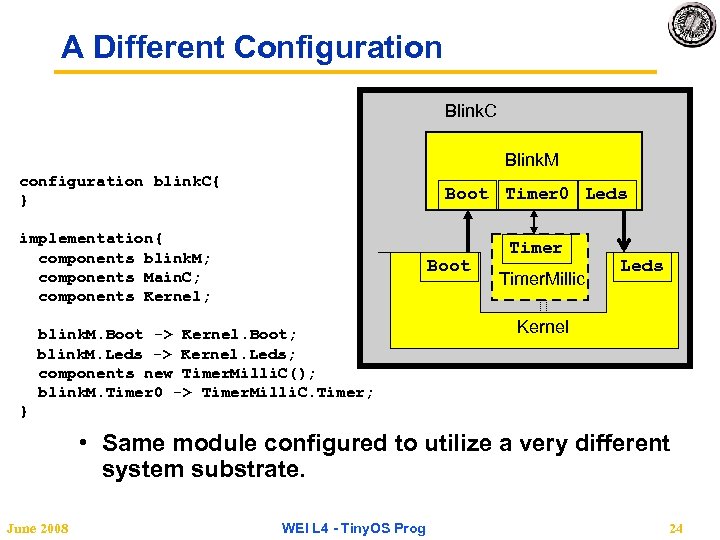
A Different Configuration Blink. C Blink. M configuration blink. C{ } Boot Timer 0 Leds implementation{ components blink. M; components Main. C; components Kernel; Boot blink. M. Boot -> Kernel. Boot; blink. M. Leds -> Kernel. Leds; components new Timer. Milli. C(); blink. M. Timer 0 -> Timer. Milli. C. Timer; Timer. Millic Leds Kernel } • Same module configured to utilize a very different system substrate. June 2008 WEI L 4 - Tiny. OS Prog 24
Execution Behavior • Timer interrupt is mapped to a Tiny. OS event. – Handled in a safe context • Performs simple operations. • When activity stops, entire system sleeps – In the lowest possible sleep state • Never wait, never spin. Automated, wholesystem power management. June 2008 WEI L 4 - Tiny. OS Prog 25
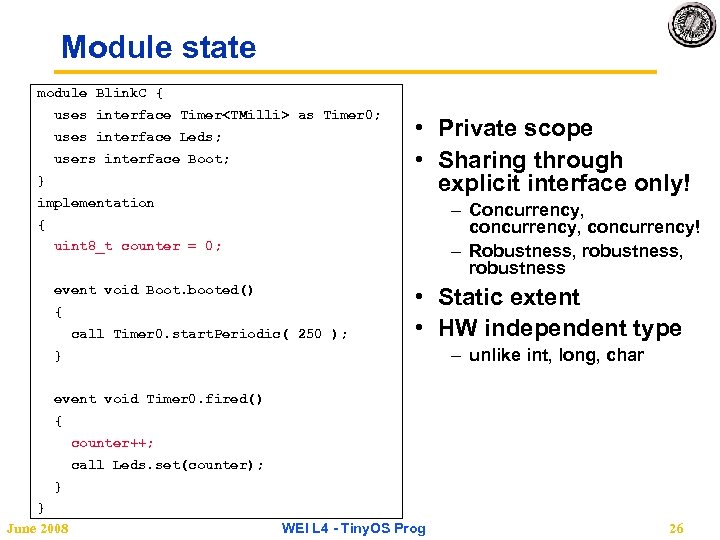
Module state module Blink. C { uses interface Timer<TMilli> as Timer 0; uses interface Leds; users interface Boot; } implementation • Private scope • Sharing through explicit interface only! – Concurrency, concurrency! – Robustness, robustness { uint 8_t counter = 0; event void Boot. booted() { call Timer 0. start. Periodic( 250 ); • Static extent • HW independent type – unlike int, long, char } event void Timer 0. fired() { counter++; call Leds. set(counter); } } June 2008 WEI L 4 - Tiny. OS Prog 26
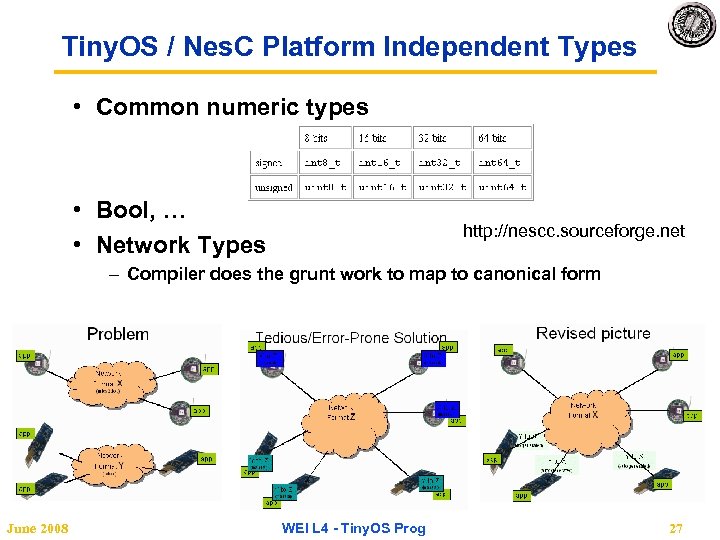
Tiny. OS / Nes. C Platform Independent Types • Common numeric types • Bool, … • Network Types http: //nescc. sourceforge. net – Compiler does the grunt work to map to canonical form June 2008 WEI L 4 - Tiny. OS Prog 27
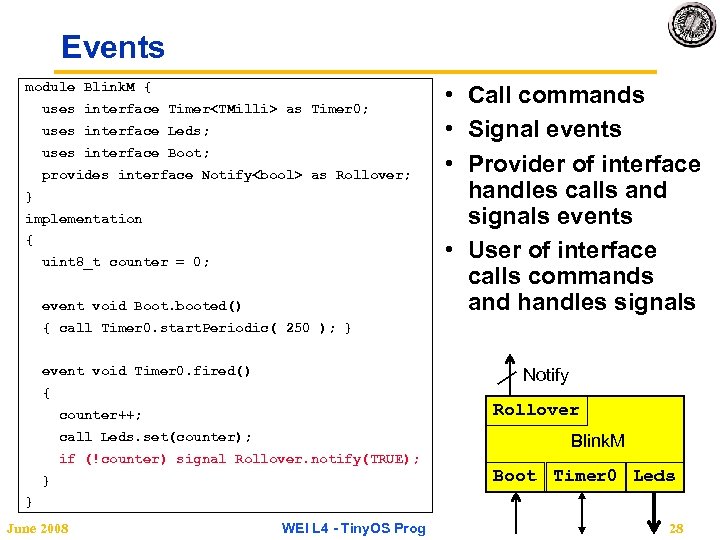
Events module Blink. M { uses interface Timer<TMilli> as Timer 0; uses interface Leds; uses interface Boot; provides interface Notify<bool> as Rollover; } implementation { uint 8_t counter = 0; event void Boot. booted() • Call commands • Signal events • Provider of interface handles calls and signals events • User of interface calls commands and handles signals { call Timer 0. start. Periodic( 250 ); } event void Timer 0. fired() Notify { Rollover counter++; call Leds. set(counter); Blink. M if (!counter) signal Rollover. notify(TRUE); } Boot Timer 0 Leds } June 2008 WEI L 4 - Tiny. OS Prog 28
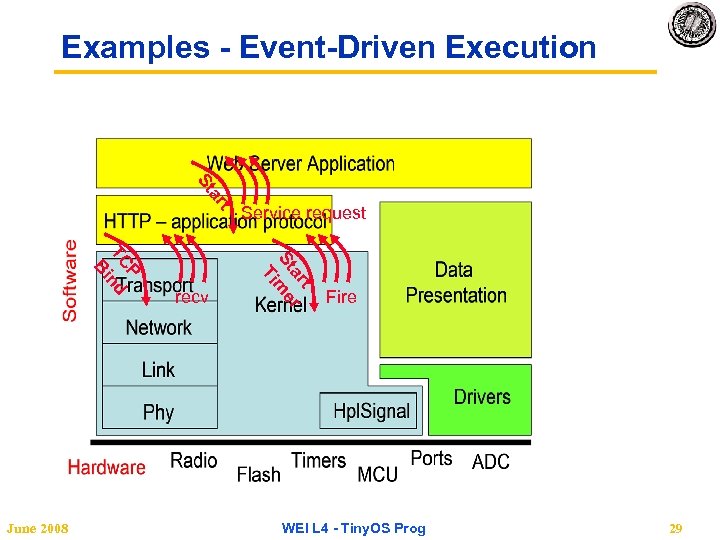
Examples - Event-Driven Execution t ar St t ar r St me Ti P TC nd Bi June 2008 Service request recv Fire WEI L 4 - Tiny. OS Prog 29
Split-Phase Operations • For potentially long latency operations – Don’t want to spin-wait, polling for completion – Don’t want blocking call - hangs till completion – Don’t want to sprinkle the code with explicit sleeps and yields • Instead, – Want to service other concurrent activities will waiting – Want to go sleep if there are none, and wake up upon completion • Split-phase operation – Call command to initiate action – Subsystem will signal event when complete • The classic concurrent I/O problem, but also want energy efficiency. – Parallelism, or sleep. – Event-driven execution is fast and low power! June 2008 WEI L 4 - Tiny. OS Prog 30
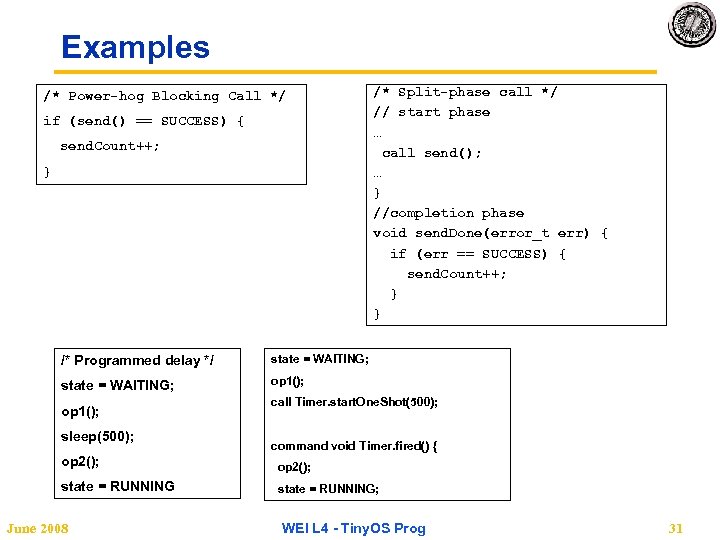
Examples /* Power-hog Blocking Call */ if (send() == SUCCESS) { send. Count++; } /* Programmed delay */ state = WAITING; /* Split-phase call */ // start phase … call send(); … } //completion phase void send. Done(error_t err) { if (err == SUCCESS) { send. Count++; } } op 1(); sleep(500); call Timer. start. One. Shot(500); command void Timer. fired() { op 2(); state = RUNNING; June 2008 WEI L 4 - Tiny. OS Prog 31
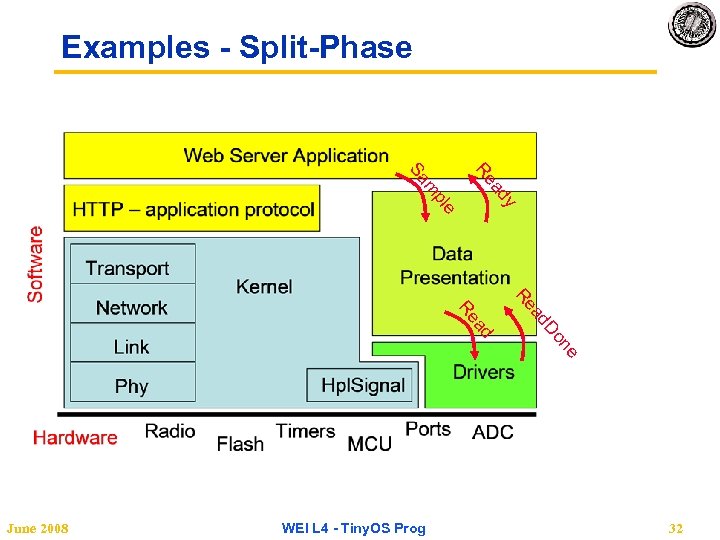
Examples - Split-Phase ne Do ad Re WEI L 4 - Tiny. OS Prog y ad Re e pl m Sa June 2008 32
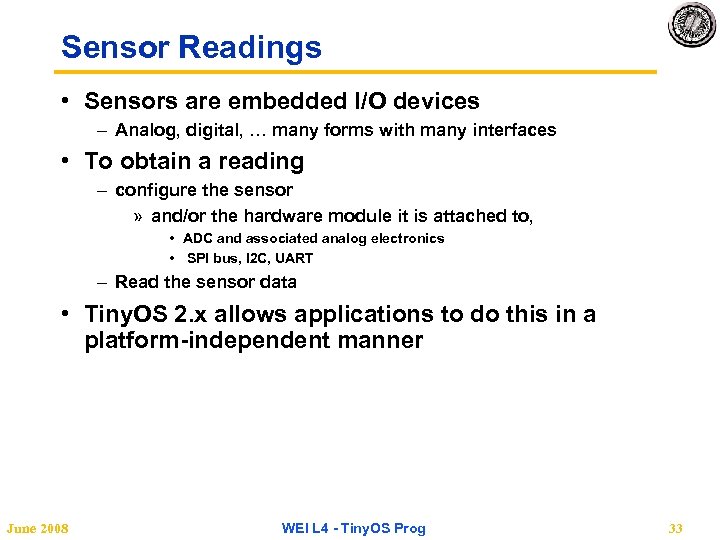
Sensor Readings • Sensors are embedded I/O devices – Analog, digital, … many forms with many interfaces • To obtain a reading – configure the sensor » and/or the hardware module it is attached to, • ADC and associated analog electronics • SPI bus, I 2 C, UART – Read the sensor data • Tiny. OS 2. x allows applications to do this in a platform-independent manner June 2008 WEI L 4 - Tiny. OS Prog 33
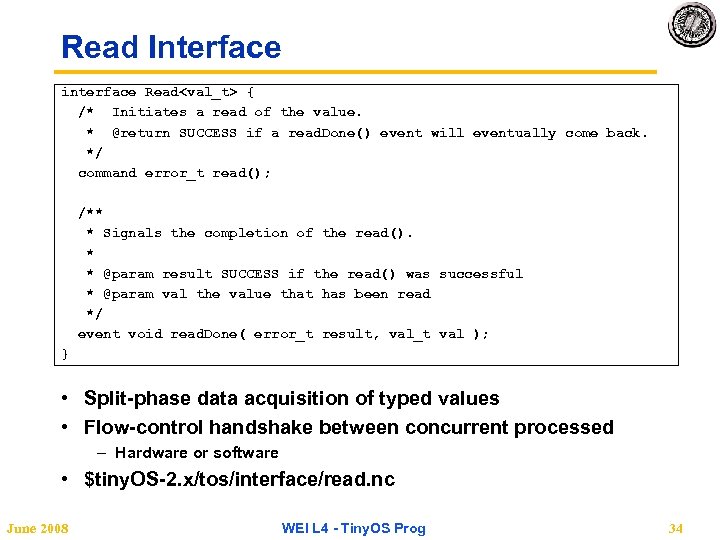
Read Interface interface Read<val_t> { /* Initiates a read of the value. * @return SUCCESS if a read. Done() event will eventually come back. */ command error_t read(); /** * Signals the completion of the read(). * * @param result SUCCESS if the read() was successful * @param val the value that has been read */ event void read. Done( error_t result, val_t val ); } • Split-phase data acquisition of typed values • Flow-control handshake between concurrent processed – Hardware or software • $tiny. OS-2. x/tos/interface/read. nc June 2008 WEI L 4 - Tiny. OS Prog 34
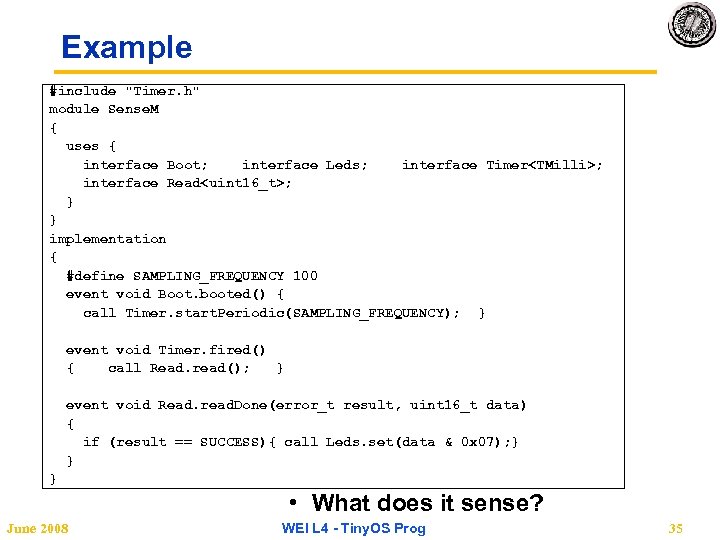
Example #include "Timer. h" module Sense. M { uses { interface Boot; interface Leds; interface Timer<TMilli>; interface Read<uint 16_t>; } } implementation { #define SAMPLING_FREQUENCY 100 event void Boot. booted() { call Timer. start. Periodic(SAMPLING_FREQUENCY); } event void Timer. fired() { call Read. read(); } event void Read. read. Done(error_t result, uint 16_t data) { if (result == SUCCESS){ call Leds. set(data & 0 x 07); } } } • What does it sense? June 2008 WEI L 4 - Tiny. OS Prog 35
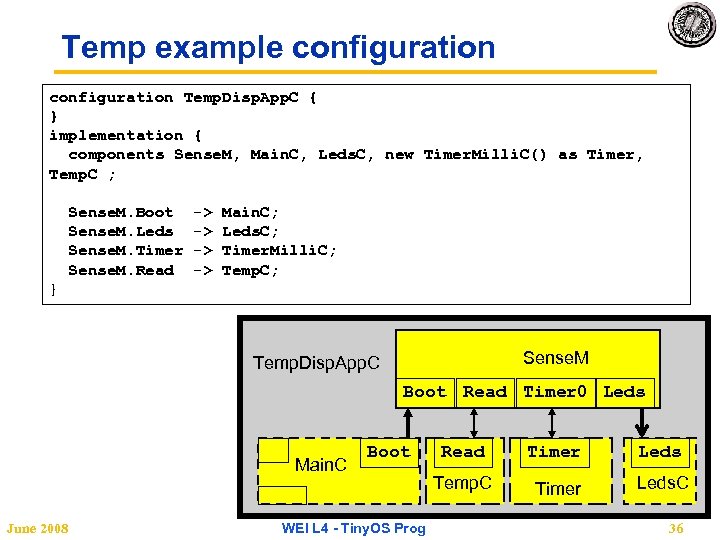
Temp example configuration Temp. Disp. App. C { } implementation { components Sense. M, Main. C, Leds. C, new Timer. Milli. C() as Timer, Temp. C ; Sense. M. Boot Sense. M. Leds Sense. M. Timer Sense. M. Read -> -> Main. C; Leds. C; Timer. Milli. C; Temp. C; } Sense. M Temp. Disp. App. C Boot Read Timer 0 Leds Main. C June 2008 Boot WEI L 4 - Tiny. OS Prog Read Timer Leds Temp. C Timer Leds. C 36
Concurrency • Commands and event glue together concurrent activities • Hardware units operate on parallel – Commands used to initiate activity – Events used to signal completion, etc. • System software components are very similar – But they don’t have dedicated hardware to keep working on the command. – Tasks are used for that • Decouple execution and leave room for juggling – Use lots of little tasks to keep things flowing • Preempted by async events (interrupts) – Not other tasks June 2008 WEI L 4 - Tiny. OS Prog 37
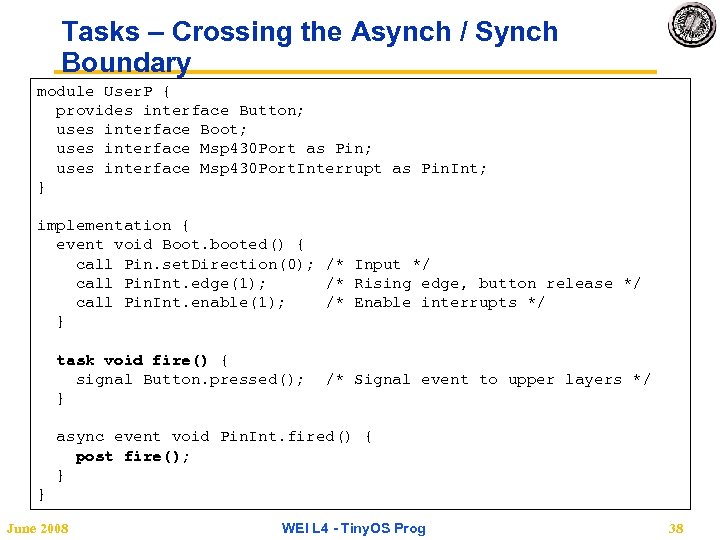
Tasks – Crossing the Asynch / Synch Boundary module User. P { provides interface Button; uses interface Boot; uses interface Msp 430 Port as Pin; uses interface Msp 430 Port. Interrupt as Pin. Int; } implementation { event void Boot. booted() { call Pin. set. Direction(0); /* Input */ call Pin. Int. edge(1); /* Rising edge, button release */ call Pin. Int. enable(1); /* Enable interrupts */ } task void fire() { signal Button. pressed(); } /* Signal event to upper layers */ async event void Pin. Int. fired() { post fire(); } } June 2008 WEI L 4 - Tiny. OS Prog 38
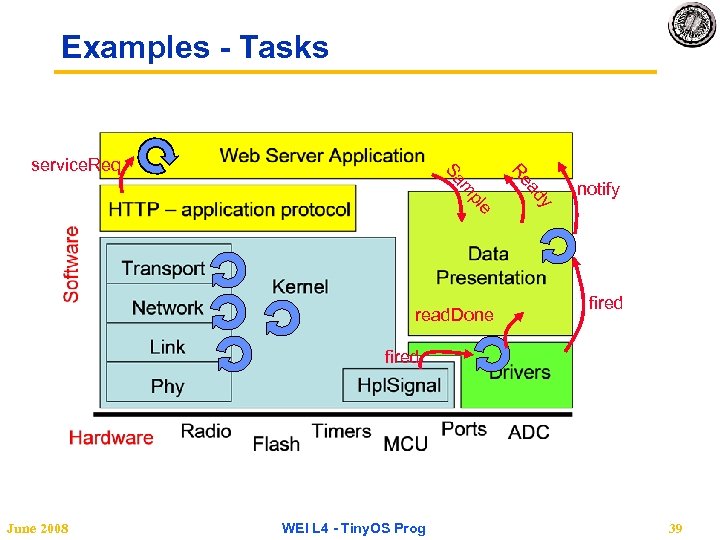
Examples - Tasks notify y ad read. Done Re e pl m Sa service. Req fired June 2008 WEI L 4 - Tiny. OS Prog 39
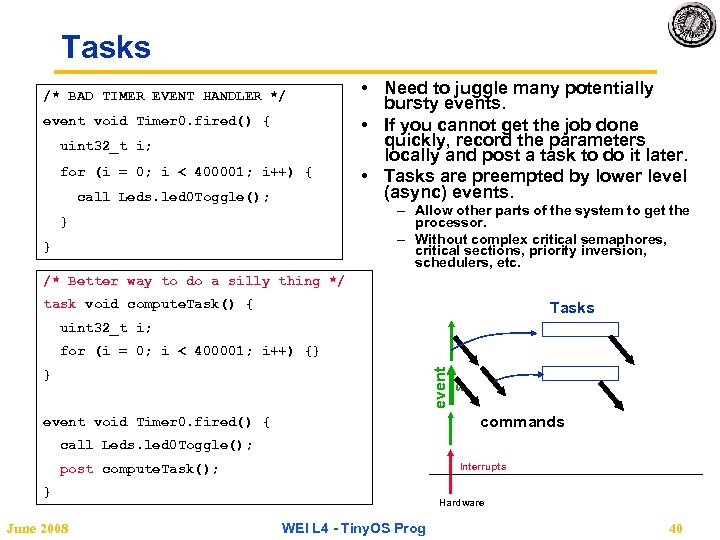
Tasks /* BAD TIMER EVENT HANDLER */ event void Timer 0. fired() { uint 32_t i; for (i = 0; i < 400001; i++) { call Leds. led 0 Toggle(); • Need to juggle many potentially bursty events. • If you cannot get the job done quickly, record the parameters locally and post a task to do it later. • Tasks are preempted by lower level (async) events. – Allow other parts of the system to get the processor. – Without complex critical semaphores, critical sections, priority inversion, schedulers, etc. } } /* Better way to do a silly thing */ task void compute. Task() { Tasks uint 32_t i; event s for (i = 0; i < 400001; i++) {} } commands event void Timer 0. fired() { call Leds. led 0 Toggle(); Interrupts post compute. Task(); } June 2008 Hardware WEI L 4 - Tiny. OS Prog 40
Uses of tasks (? ? ? ) • • June 2008 High speed sampling Filtering Queueing Smoothing Detection Classification … WEI L 4 - Tiny. OS Prog 41
Networking • Traditional Tiny. OS communication is based on active messages – Send a structure to <node, handler. Id> – Receive is just a network event that signals the hander with a message • Earliest Tiny. OS (0. 3) was essentially moving Active Messages and the Threaded Abstract Machine (TAM) from the MPP domain to emdedded devices. – Parallel Machine communication is internal! – Sensor networks are networks, not distributed computers – They connect to OTHER NETWORKS • Active Messages covered in Appendix – But I don’t use them any more June 2008 WEI L 4 - Tiny. OS Prog 42
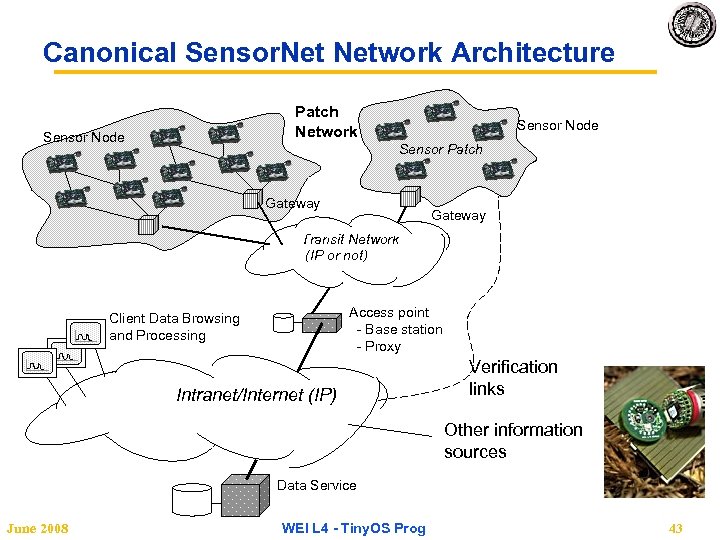
Canonical Sensor. Network Architecture Patch Network Sensor Node Sensor Patch Gateway Transit Network (IP or not) Access point - Base station - Proxy Client Data Browsing and Processing Intranet/Internet (IP) Verification links Other information sources Data Service June 2008 WEI L 4 - Tiny. OS Prog 43
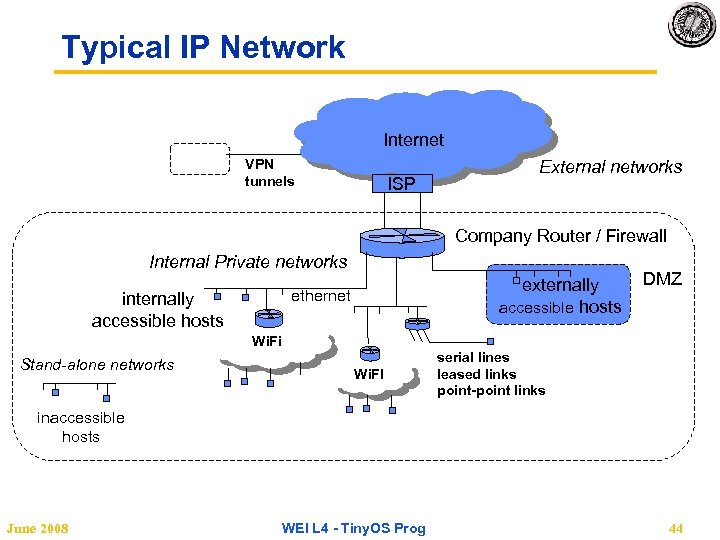
Typical IP Network Internet VPN tunnels ISP External networks Company Router / Firewall Internal Private networks externally accessible hosts ethernet internally accessible hosts DMZ Wi. Fi Stand-alone networks Wi. FI serial lines leased links point-point links inaccessible hosts June 2008 WEI L 4 - Tiny. OS Prog 44
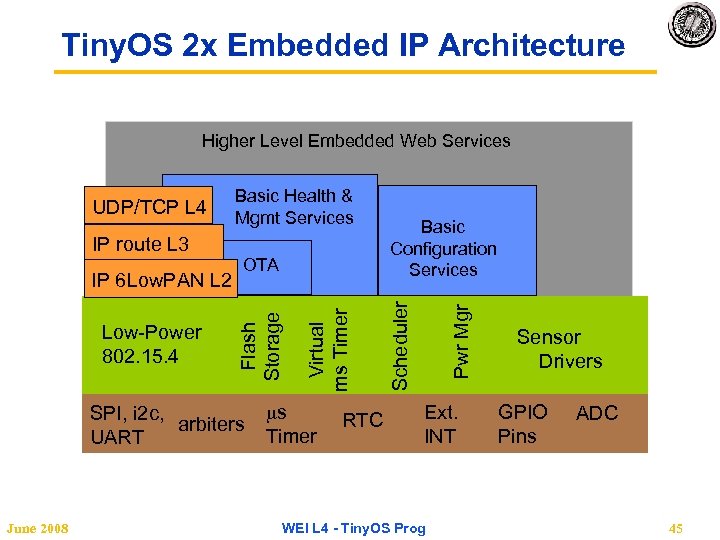
Tiny. OS 2 x Embedded IP Architecture Higher Level Embedded Web Services SPI, i 2 c, arbiters UART June 2008 s Timer RTC Pwr Mgr Low-Power 802. 15. 4 Basic Configuration Services Scheduler IP 6 Low. PAN L 2 OTA Virtual ms Timer IP route L 3 Basic Health & Mgmt Services Flash Storage UDP/TCP L 4 Ext. INT WEI L 4 - Tiny. OS Prog Sensor Drivers GPIO Pins ADC 45
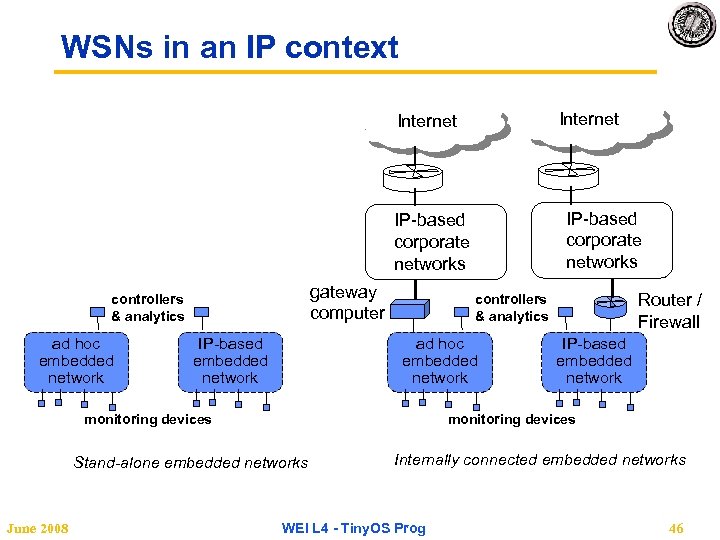
WSNs in an IP context Internet IP-based corporate networks gateway computer controllers & analytics ad hoc embedded network IP-based embedded network ad hoc embedded network monitoring devices IP-based embedded network monitoring devices Stand-alone embedded networks June 2008 Router / Firewall controllers & analytics Internally connected embedded networks WEI L 4 - Tiny. OS Prog 46
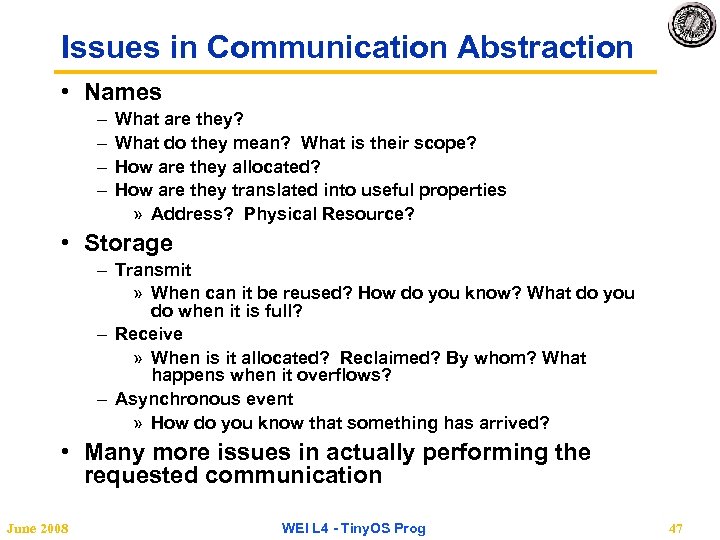
Issues in Communication Abstraction • Names – – What are they? What do they mean? What is their scope? How are they allocated? How are they translated into useful properties » Address? Physical Resource? • Storage – Transmit » When can it be reused? How do you know? What do you do when it is full? – Receive » When is it allocated? Reclaimed? By whom? What happens when it overflows? – Asynchronous event » How do you know that something has arrived? • Many more issues in actually performing the requested communication June 2008 WEI L 4 - Tiny. OS Prog 47
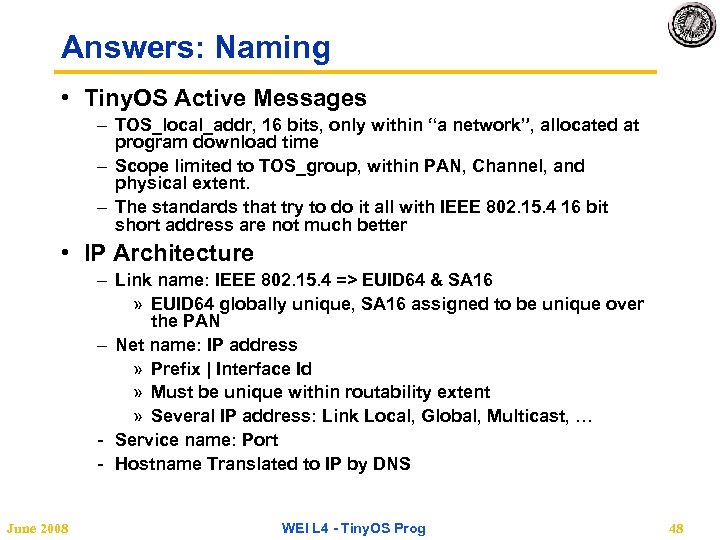
Answers: Naming • Tiny. OS Active Messages – TOS_local_addr, 16 bits, only within “a network”, allocated at program download time – Scope limited to TOS_group, within PAN, Channel, and physical extent. – The standards that try to do it all with IEEE 802. 15. 4 16 bit short address are not much better • IP Architecture – Link name: IEEE 802. 15. 4 => EUID 64 & SA 16 » EUID 64 globally unique, SA 16 assigned to be unique over the PAN – Net name: IP address » Prefix | Interface Id » Must be unique within routability extent » Several IP address: Link Local, Global, Multicast, … - Service name: Port - Hostname Translated to IP by DNS June 2008 WEI L 4 - Tiny. OS Prog 48
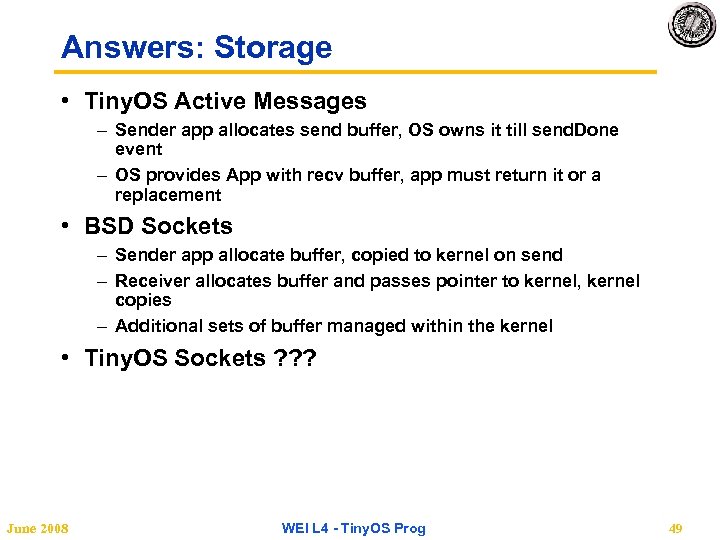
Answers: Storage • Tiny. OS Active Messages – Sender app allocates send buffer, OS owns it till send. Done event – OS provides App with recv buffer, app must return it or a replacement • BSD Sockets – Sender app allocate buffer, copied to kernel on send – Receiver allocates buffer and passes pointer to kernel, kernel copies – Additional sets of buffer managed within the kernel • Tiny. OS Sockets ? ? ? June 2008 WEI L 4 - Tiny. OS Prog 49
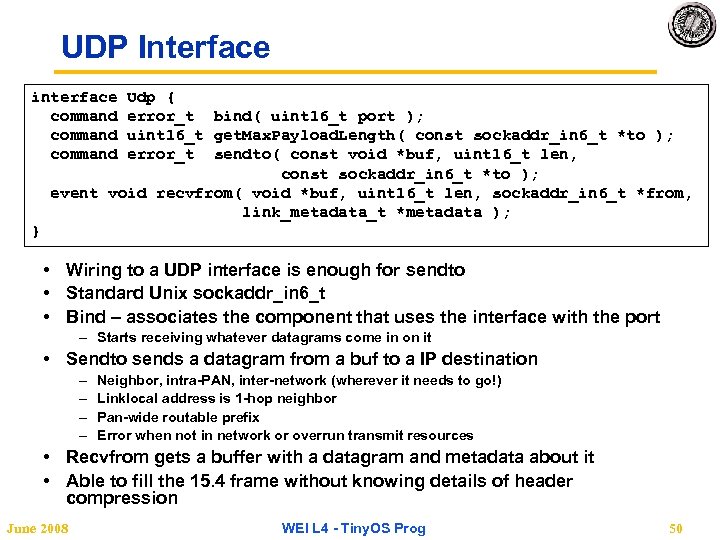
UDP Interface interface command Udp { error_t bind( uint 16_t port ); uint 16_t get. Max. Payload. Length( const sockaddr_in 6_t *to ); error_t sendto( const void *buf, uint 16_t len, const sockaddr_in 6_t *to ); event void recvfrom( void *buf, uint 16_t len, sockaddr_in 6_t *from, link_metadata_t *metadata ); } • Wiring to a UDP interface is enough for sendto • Standard Unix sockaddr_in 6_t • Bind – associates the component that uses the interface with the port – Starts receiving whatever datagrams come in on it • Sendto sends a datagram from a buf to a IP destination – – Neighbor, intra-PAN, inter-network (wherever it needs to go!) Linklocal address is 1 -hop neighbor Pan-wide routable prefix Error when not in network or overrun transmit resources • Recvfrom gets a buffer with a datagram and metadata about it • Able to fill the 15. 4 frame without knowing details of header compression June 2008 WEI L 4 - Tiny. OS Prog 50
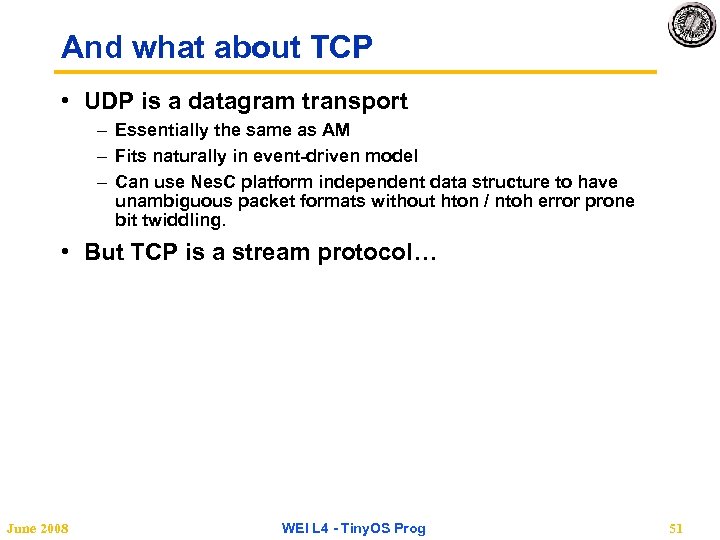
And what about TCP • UDP is a datagram transport – Essentially the same as AM – Fits naturally in event-driven model – Can use Nes. C platform independent data structure to have unambiguous packet formats without hton / ntoh error prone bit twiddling. • But TCP is a stream protocol… June 2008 WEI L 4 - Tiny. OS Prog 51
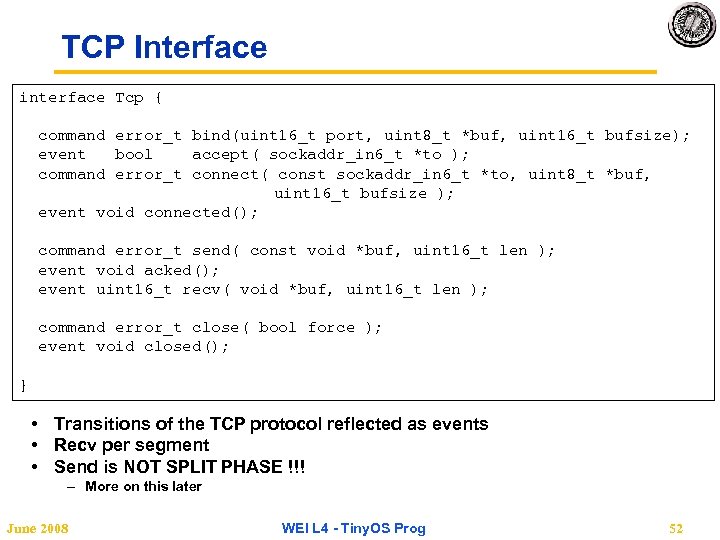
TCP Interface interface Tcp { command error_t bind(uint 16_t port, uint 8_t *buf, uint 16_t bufsize); event bool accept( sockaddr_in 6_t *to ); command error_t connect( const sockaddr_in 6_t *to, uint 8_t *buf, uint 16_t bufsize ); event void connected(); command error_t send( const void *buf, uint 16_t len ); event void acked(); event uint 16_t recv( void *buf, uint 16_t len ); command error_t close( bool force ); event void closed(); } • Transitions of the TCP protocol reflected as events • Recv per segment • Send is NOT SPLIT PHASE !!! – More on this later June 2008 WEI L 4 - Tiny. OS Prog 52
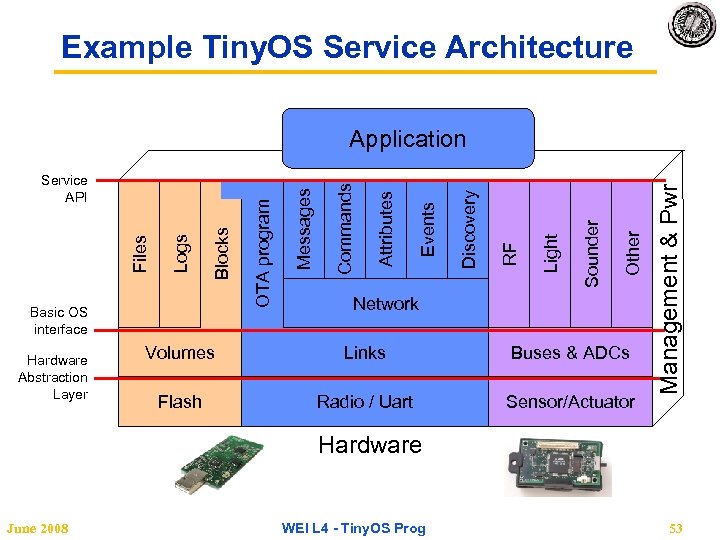
Example Tiny. OS Service Architecture Hardware Abstraction Layer Other Sounder Light RF Discovery Events Attributes Commands Network Volumes Links Buses & ADCs Flash Radio / Uart Sensor/Actuator Management & Pwr Basic OS interface Messages Blocks Logs Files Service API OTA program Application Hardware June 2008 WEI L 4 - Tiny. OS Prog 53
Permanent Data Storage • Tiny. OS 2. x provides three basic storage abstractions: – small objects, – circular logs, and – large objects. • also provides interfaces the underlying storage services and components that provide these interfaces. • Flash devices – ST Microelectronics M 25 Pxx family of flash memories used in the Telos family of motes (tos/chips/stm 25 p) – Atmel AT 45 DB family of flash memories used in the Mica 2/Mica. Z motes (tos/chips/at 45 b) – Special pxa 271 p 30 versions for the Intel Mote 2 contributed by Arch Rock. (tos/platforms/intelmote 2) • TEP 103 June 2008 WEI L 4 - Tiny. OS Prog 54
Storage Interfaces and Components • Interfaces – – – – Block. Read Block. Write Mount Config. Storage Log. Read Log. Write Storage. h Components – Config. Storage. C - Configuration Data » calibration, identity, location, sensing configuration, . . – Log. Storage. C » data – Block. Storage. C » Code, … June 2008 WEI L 4 - Tiny. OS Prog 55
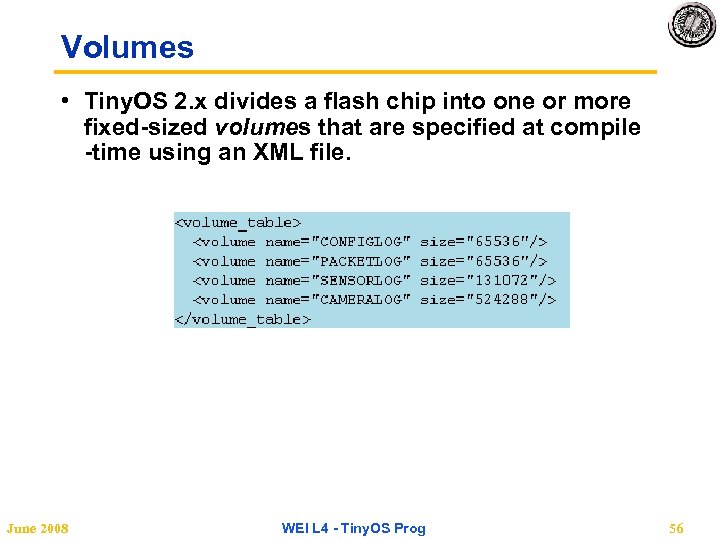
Volumes • Tiny. OS 2. x divides a flash chip into one or more fixed-sized volumes that are specified at compile -time using an XML file. June 2008 WEI L 4 - Tiny. OS Prog 56
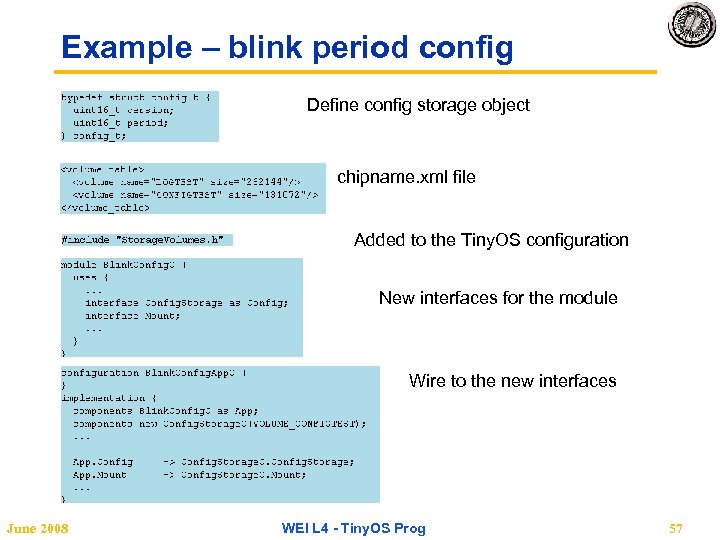
Example – blink period config Define config storage object chipname. xml file Added to the Tiny. OS configuration New interfaces for the module Wire to the new interfaces June 2008 WEI L 4 - Tiny. OS Prog 57
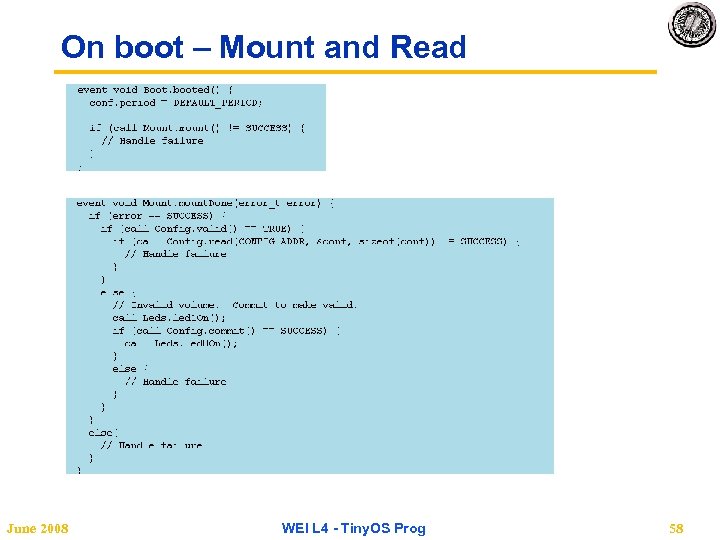
On boot – Mount and Read June 2008 WEI L 4 - Tiny. OS Prog 58
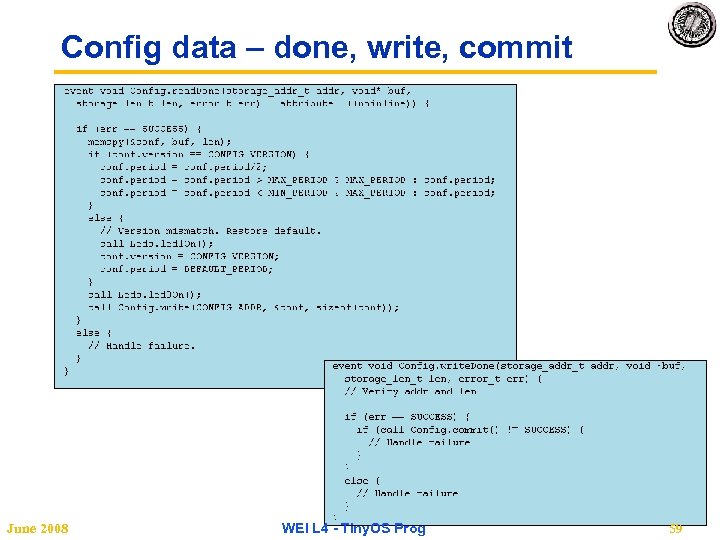
Config data – done, write, commit June 2008 WEI L 4 - Tiny. OS Prog 59
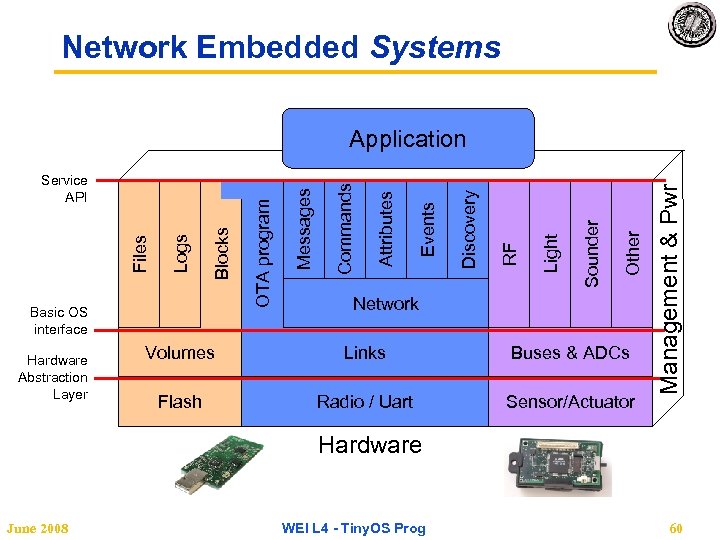
Network Embedded Systems Hardware Abstraction Layer Other Sounder Light RF Discovery Events Attributes Commands Network Volumes Links Buses & ADCs Flash Radio / Uart Sensor/Actuator Management & Pwr Basic OS interface Messages Blocks Logs Files Service API OTA program Application Hardware June 2008 WEI L 4 - Tiny. OS Prog 60
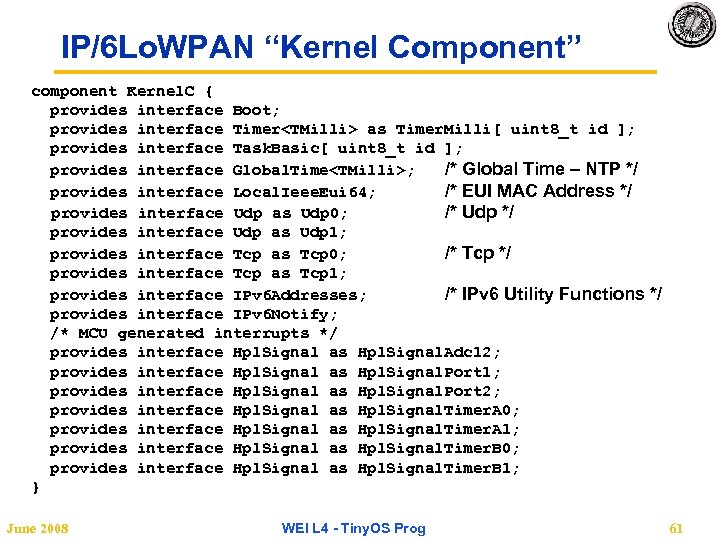
IP/6 Lo. WPAN “Kernel Component” component Kernel. C { provides interface Boot; provides interface Timer<TMilli> as Timer. Milli[ uint 8_t id ]; provides interface Task. Basic[ uint 8_t id ]; provides interface Global. Time<TMilli>; /* Global Time – NTP */ provides interface Local. Ieee. Eui 64; /* EUI MAC Address */ provides interface Udp as Udp 0; /* Udp */ provides interface Udp as Udp 1; provides interface Tcp as Tcp 0; /* Tcp */ provides interface Tcp as Tcp 1; provides interface IPv 6 Addresses; /* IPv 6 Utility Functions */ provides interface IPv 6 Notify; /* MCU generated interrupts */ provides interface Hpl. Signal as Hpl. Signal. Adc 12; provides interface Hpl. Signal as Hpl. Signal. Port 1; provides interface Hpl. Signal as Hpl. Signal. Port 2; provides interface Hpl. Signal as Hpl. Signal. Timer. A 0; provides interface Hpl. Signal as Hpl. Signal. Timer. A 1; provides interface Hpl. Signal as Hpl. Signal. Timer. B 0; provides interface Hpl. Signal as Hpl. Signal. Timer. B 1; } June 2008 WEI L 4 - Tiny. OS Prog 61
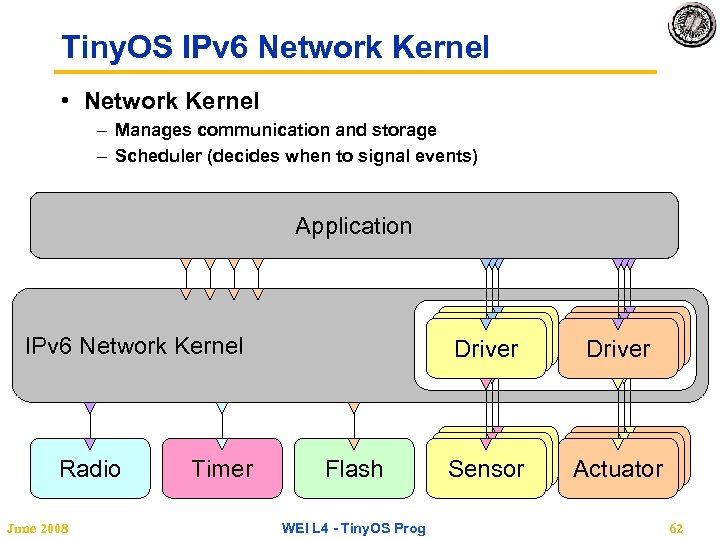
Tiny. OS IPv 6 Network Kernel • Network Kernel – Manages communication and storage – Scheduler (decides when to signal events) Application Driver IPv 6 Network Kernel Radio June 2008 Timer Flash WEI L 4 - Tiny. OS Prog Driver Sensors Sensor Actuator 62
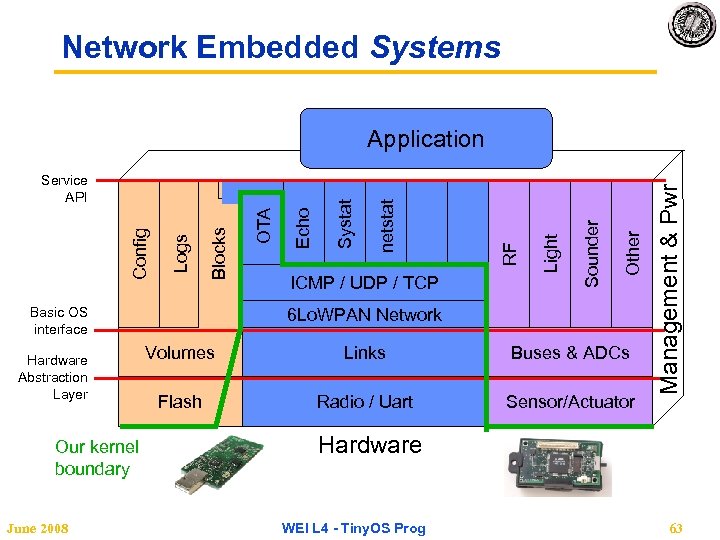
Network Embedded Systems Our kernel boundary June 2008 Volumes Links Buses & ADCs Flash Radio / Uart Sensor/Actuator Management & Pwr Other Sounder Light RF netstat Echo ICMP / UDP / TCP 6 Lo. WPAN Network Basic OS interface Hardware Abstraction Layer OTA Blocks Logs Config Service API Systat Application Hardware WEI L 4 - Tiny. OS Prog 63
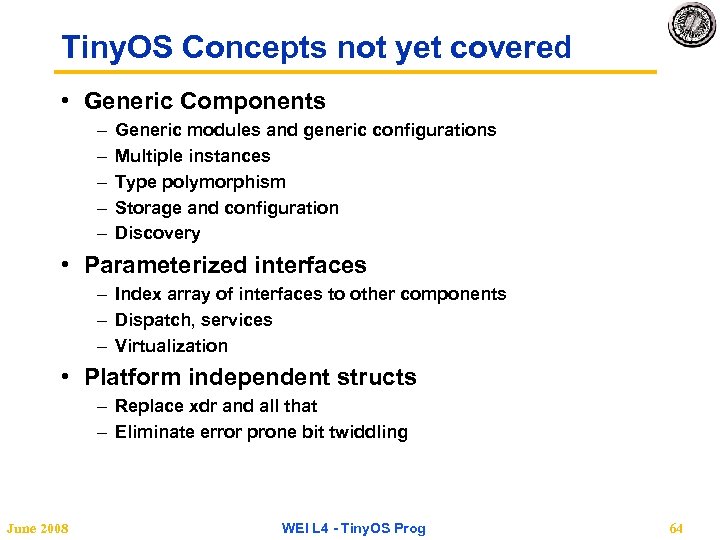
Tiny. OS Concepts not yet covered • Generic Components – – – Generic modules and generic configurations Multiple instances Type polymorphism Storage and configuration Discovery • Parameterized interfaces – Index array of interfaces to other components – Dispatch, services – Virtualization • Platform independent structs – Replace xdr and all that – Eliminate error prone bit twiddling June 2008 WEI L 4 - Tiny. OS Prog 64
Discussion June 2008 WEI L 4 - Tiny. OS Prog 65
Traditional Tiny. OS Active Messages June 2008 WEI L 4 - Tiny. OS Prog 66
Sensor NETWORK • We have a flexible, low-power, event-driven sensor / actuator platform. • Let’s add the network • Send / Receive of information • Dispatching incoming data to computation processes that will handle it. – Automate in a systematic fashion • Parsing the packet – Define the structure, let the compiler do the work. – Handler knows what it should be receiving June 2008 WEI L 4 - Tiny. OS Prog 67
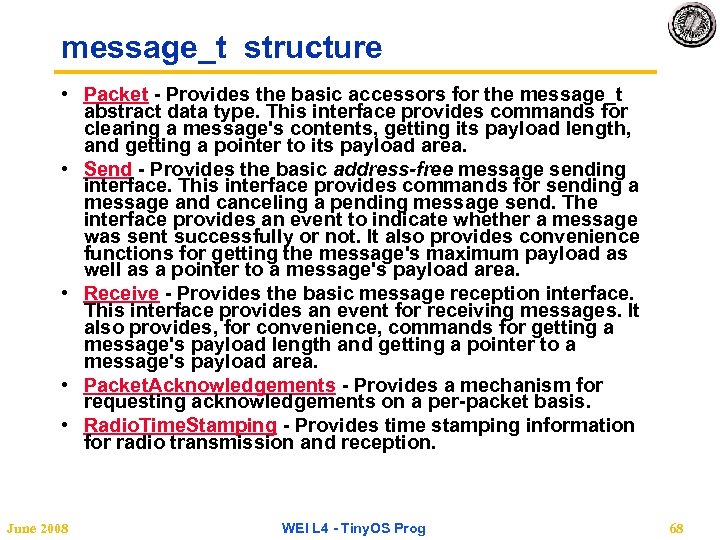
message_t structure • Packet - Provides the basic accessors for the message_t abstract data type. This interface provides commands for clearing a message's contents, getting its payload length, and getting a pointer to its payload area. • Send - Provides the basic address-free message sending interface. This interface provides commands for sending a message and canceling a pending message send. The interface provides an event to indicate whether a message was sent successfully or not. It also provides convenience functions for getting the message's maximum payload as well as a pointer to a message's payload area. • Receive - Provides the basic message reception interface. This interface provides an event for receiving messages. It also provides, for convenience, commands for getting a message's payload length and getting a pointer to a message's payload area. • Packet. Acknowledgements - Provides a mechanism for requesting acknowledgements on a per-packet basis. • Radio. Time. Stamping - Provides time stamping information for radio transmission and reception. June 2008 WEI L 4 - Tiny. OS Prog 68
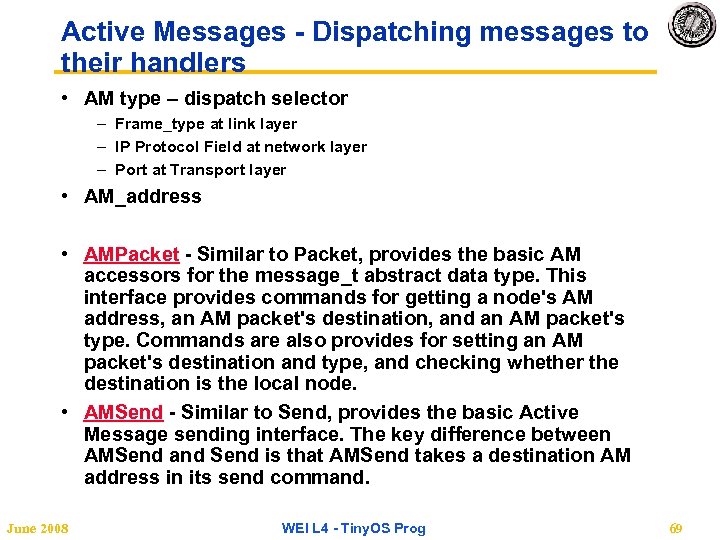
Active Messages - Dispatching messages to their handlers • AM type – dispatch selector – Frame_type at link layer – IP Protocol Field at network layer – Port at Transport layer • AM_address • AMPacket - Similar to Packet, provides the basic AM accessors for the message_t abstract data type. This interface provides commands for getting a node's AM address, an AM packet's destination, and an AM packet's type. Commands are also provides for setting an AM packet's destination and type, and checking whether the destination is the local node. • AMSend - Similar to Send, provides the basic Active Message sending interface. The key difference between AMSend and Send is that AMSend takes a destination AM address in its send command. June 2008 WEI L 4 - Tiny. OS Prog 69
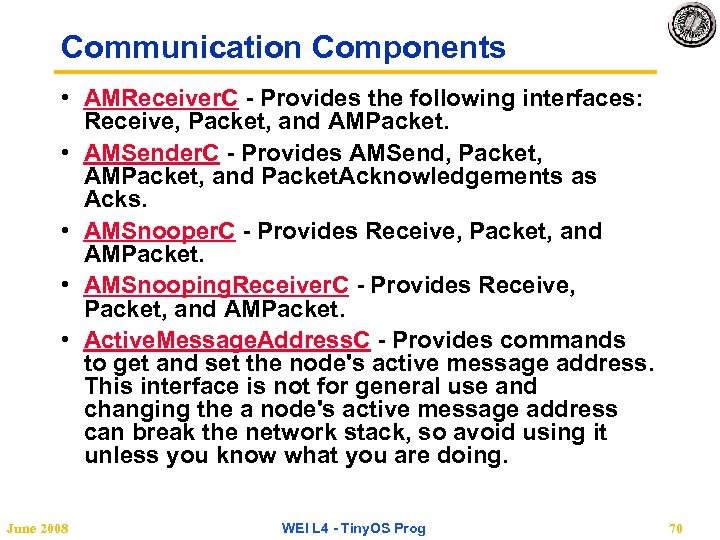
Communication Components • AMReceiver. C - Provides the following interfaces: Receive, Packet, and AMPacket. • AMSender. C - Provides AMSend, Packet, AMPacket, and Packet. Acknowledgements as Acks. • AMSnooper. C - Provides Receive, Packet, and AMPacket. • AMSnooping. Receiver. C - Provides Receive, Packet, and AMPacket. • Active. Message. Address. C - Provides commands to get and set the node's active message address. This interface is not for general use and changing the a node's active message address can break the network stack, so avoid using it unless you know what you are doing. June 2008 WEI L 4 - Tiny. OS Prog 70
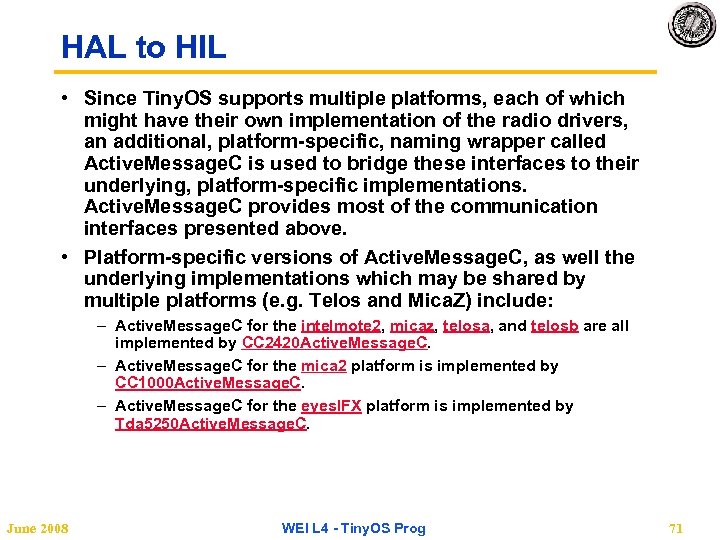
HAL to HIL • Since Tiny. OS supports multiple platforms, each of which might have their own implementation of the radio drivers, an additional, platform-specific, naming wrapper called Active. Message. C is used to bridge these interfaces to their underlying, platform-specific implementations. Active. Message. C provides most of the communication interfaces presented above. • Platform-specific versions of Active. Message. C, as well the underlying implementations which may be shared by multiple platforms (e. g. Telos and Mica. Z) include: – Active. Message. C for the intelmote 2, micaz, telosa, and telosb are all implemented by CC 2420 Active. Message. C. – Active. Message. C for the mica 2 platform is implemented by CC 1000 Active. Message. C. – Active. Message. C for the eyes. IFX platform is implemented by Tda 5250 Active. Message. C. June 2008 WEI L 4 - Tiny. OS Prog 71
![tos/types/message. h. typedef nx_struct message_t { nx_uint 8_t header[sizeof(message_header_t)]; nx_uint 8_t data[TOSH_DATA_LENGTH]; nx_uint 8_t](https://present5.com/presentation/8688228c52e8623c2706df1b0ac66fd3/image-72.jpg "tos/types/message. h. typedef nx_struct message_t { nx_uint 8_t header[sizeof(message_header_t)]; nx_uint 8_t data[TOSH_DATA_LENGTH]; nx_uint 8_t")
tos/types/message. h. typedef nx_struct message_t { nx_uint 8_t header[sizeof(message_header_t)]; nx_uint 8_t data[TOSH_DATA_LENGTH]; nx_uint 8_t footer[sizeof(message_header_t)]; nx_uint 8_t metadata[sizeof(message_metadata_t)]; } message_t; • Link level concept used throughout the Tiny. OS research community and industry. • How does this move forward to IP/WSN? June 2008 WEI L 4 - Tiny. OS Prog 72
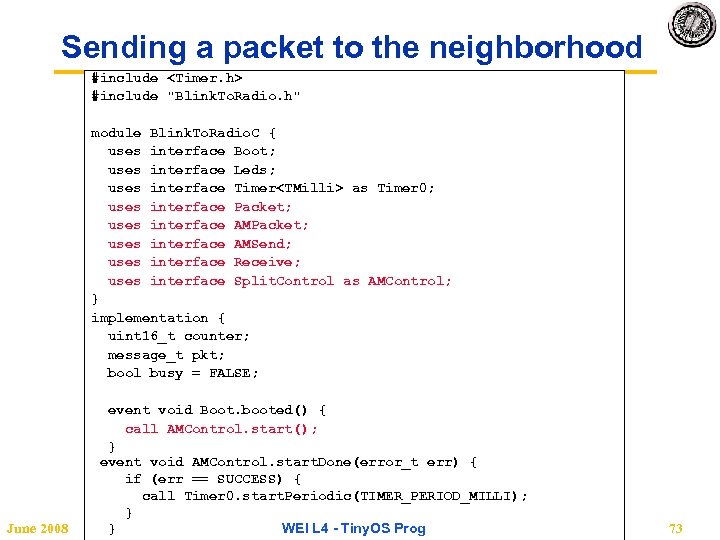
Sending a packet to the neighborhood #include <Timer. h> #include "Blink. To. Radio. h" module Blink. To. Radio. C { uses interface Boot; uses interface Leds; uses interface Timer<TMilli> as Timer 0; uses interface Packet; uses interface AMSend; uses interface Receive; uses interface Split. Control as AMControl; } implementation { uint 16_t counter; message_t pkt; bool busy = FALSE; June 2008 event void Boot. booted() { call AMControl. start(); } event void AMControl. start. Done(error_t err) { if (err == SUCCESS) { call Timer 0. start. Periodic(TIMER_PERIOD_MILLI); } WEI L 4 - Tiny. OS Prog } 73
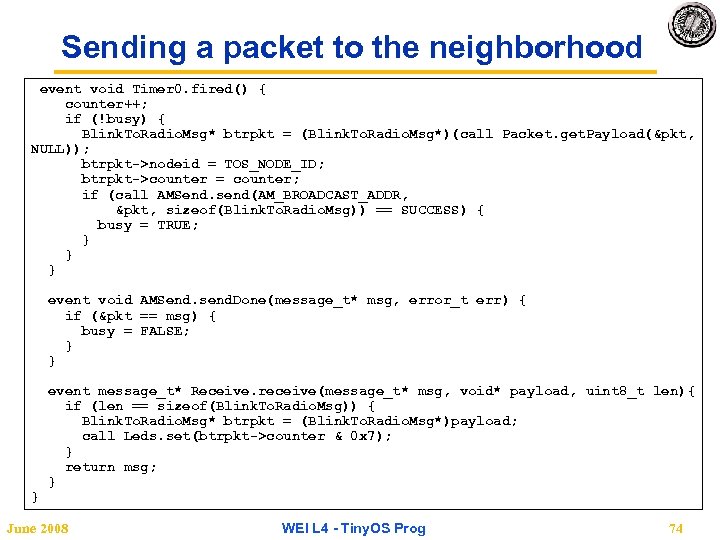
Sending a packet to the neighborhood event void Timer 0. fired() { counter++; if (!busy) { Blink. To. Radio. Msg* btrpkt = (Blink. To. Radio. Msg*)(call Packet. get. Payload(&pkt, NULL)); btrpkt->nodeid = TOS_NODE_ID; btrpkt->counter = counter; if (call AMSend. send(AM_BROADCAST_ADDR, &pkt, sizeof(Blink. To. Radio. Msg)) == SUCCESS) { busy = TRUE; } } } event void AMSend. send. Done(message_t* msg, error_t err) { if (&pkt == msg) { busy = FALSE; } } } event message_t* Receive. receive(message_t* msg, void* payload, uint 8_t len){ if (len == sizeof(Blink. To. Radio. Msg)) { Blink. To. Radio. Msg* btrpkt = (Blink. To. Radio. Msg*)payload; call Leds. set(btrpkt->counter & 0 x 7); } return msg; } June 2008 WEI L 4 - Tiny. OS Prog 74
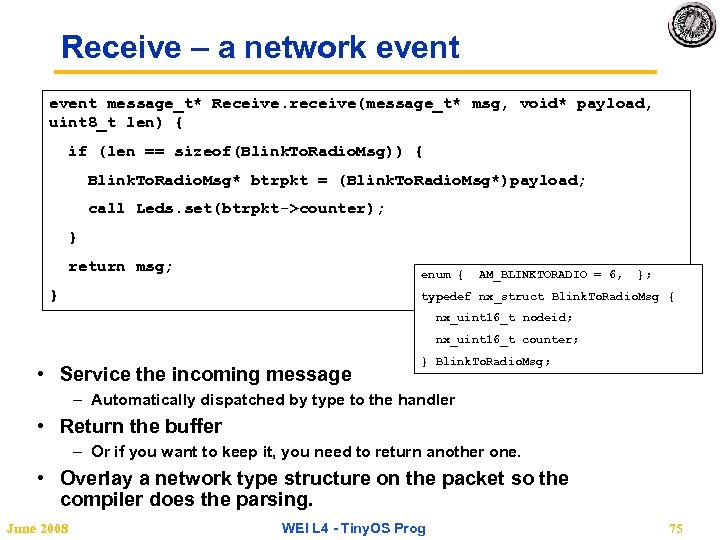
Receive – a network event message_t* Receive. receive(message_t* msg, void* payload, uint 8_t len) { if (len == sizeof(Blink. To. Radio. Msg)) { Blink. To. Radio. Msg* btrpkt = (Blink. To. Radio. Msg*)payload; call Leds. set(btrpkt->counter); } return msg; enum { } AM_BLINKTORADIO = 6, }; typedef nx_struct Blink. To. Radio. Msg { nx_uint 16_t nodeid; nx_uint 16_t counter; • Service the incoming message } Blink. To. Radio. Msg; – Automatically dispatched by type to the handler • Return the buffer – Or if you want to keep it, you need to return another one. • Overlay a network type structure on the packet so the compiler does the parsing. June 2008 WEI L 4 - Tiny. OS Prog 75
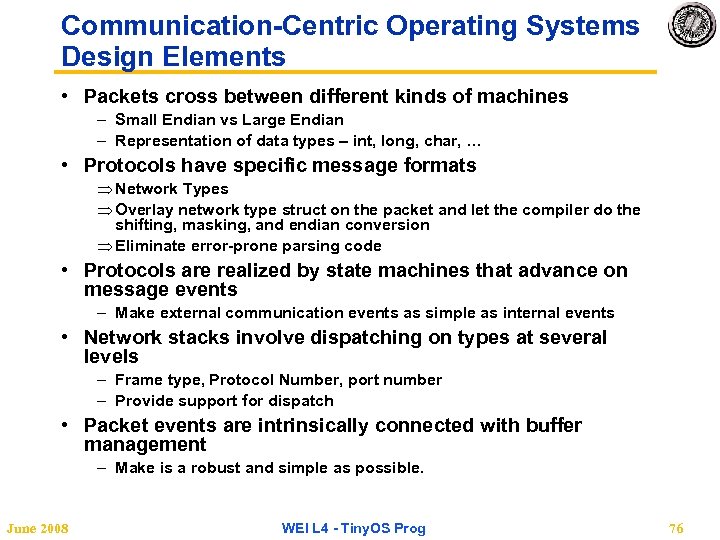
Communication-Centric Operating Systems Design Elements • Packets cross between different kinds of machines – Small Endian vs Large Endian – Representation of data types – int, long, char, … • Protocols have specific message formats Þ Network Types Þ Overlay network type struct on the packet and let the compiler do the shifting, masking, and endian conversion Þ Eliminate error-prone parsing code • Protocols are realized by state machines that advance on message events – Make external communication events as simple as internal events • Network stacks involve dispatching on types at several levels – Frame type, Protocol Number, port number – Provide support for dispatch • Packet events are intrinsically connected with buffer management – Make is a robust and simple as possible. June 2008 WEI L 4 - Tiny. OS Prog 76
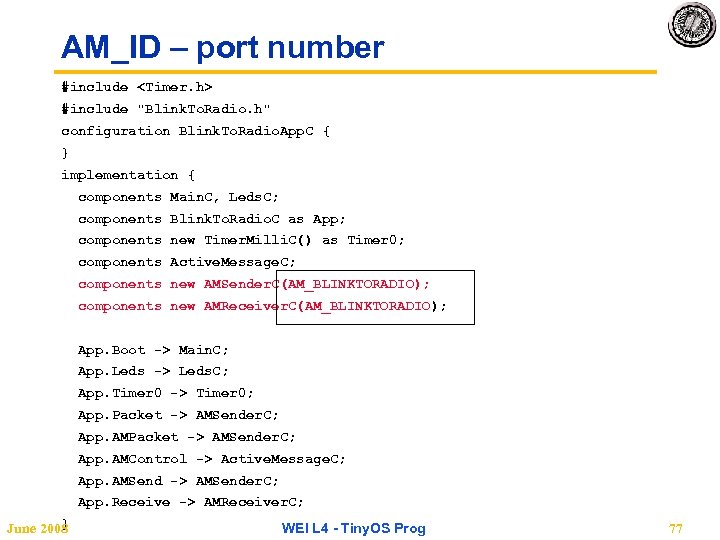
AM_ID – port number #include <Timer. h> #include "Blink. To. Radio. h" configuration Blink. To. Radio. App. C { } implementation { components Main. C, Leds. C; components Blink. To. Radio. C as App; components new Timer. Milli. C() as Timer 0; components Active. Message. C; components new AMSender. C(AM_BLINKTORADIO); components new AMReceiver. C(AM_BLINKTORADIO); App. Boot -> Main. C; App. Leds -> Leds. C; App. Timer 0 -> Timer 0; App. Packet -> AMSender. C; App. AMControl -> Active. Message. C; App. AMSend -> AMSender. C; App. Receive -> AMReceiver. C; } June 2008 WEI L 4 - Tiny. OS Prog 77
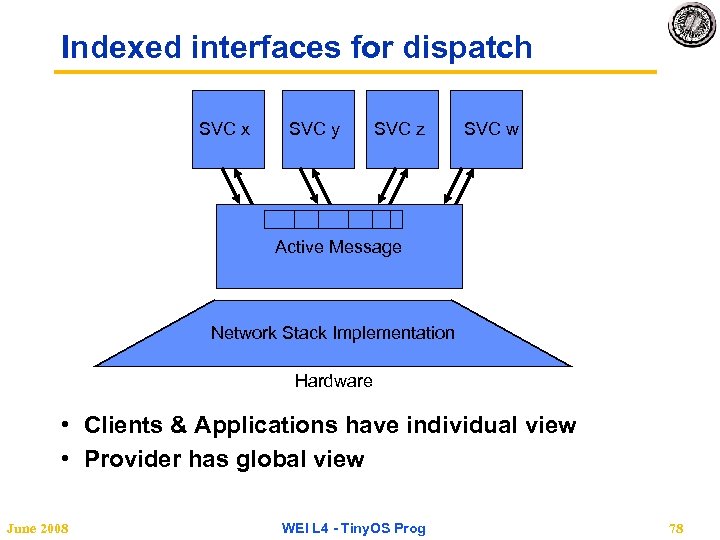
Indexed interfaces for dispatch SVC x SVC y SVC z SVC w Active Message Network Stack Implementation Hardware • Clients & Applications have individual view • Provider has global view June 2008 WEI L 4 - Tiny. OS Prog 78
Active Messages • Concept – message carries unique identifier of handler that is to process it – Directly off the link – Compile time formation and parsing » It is a Structure – Bounded storage » Consume the receive buffer immediately • Has been the central networking abstraction in all version of Tiny. OS – Used for all the multihop routing protocols, … • Link frame derived from SW usage • TCP/UDP / IP / 6 Lo. WPAN will cause first serious re-examination of Message_T June 2008 WEI L 4 - Tiny. OS Prog 79
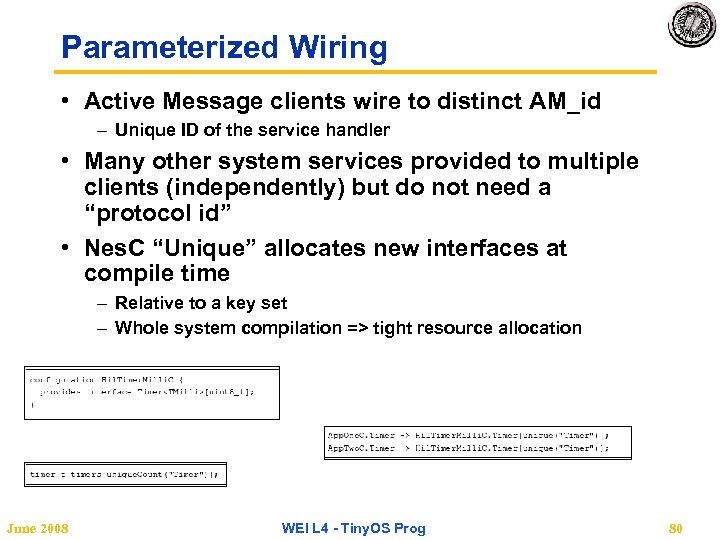
Parameterized Wiring • Active Message clients wire to distinct AM_id – Unique ID of the service handler • Many other system services provided to multiple clients (independently) but do not need a “protocol id” • Nes. C “Unique” allocates new interfaces at compile time – Relative to a key set – Whole system compilation => tight resource allocation June 2008 WEI L 4 - Tiny. OS Prog 80
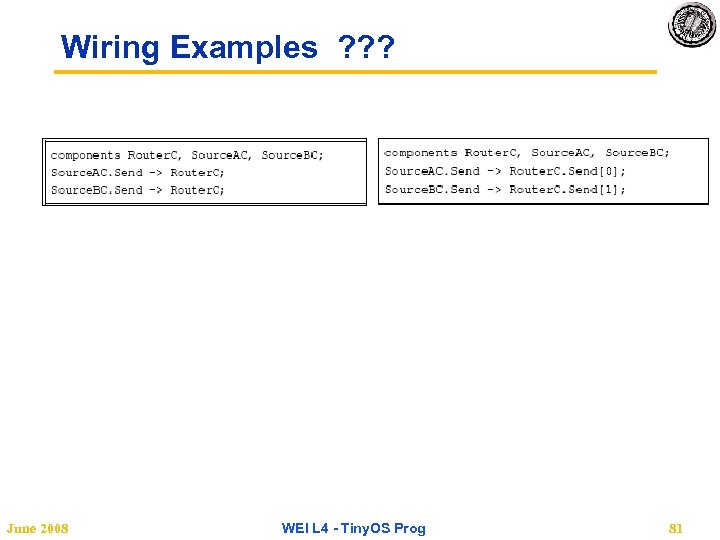
Wiring Examples ? ? ? June 2008 WEI L 4 - Tiny. OS Prog 81
Скачать презентацию Wireless Embedded Inter-Networking Foundations of Ubiquitous Sensor Networks
8688228c52e8623c2706df1b0ac66fd3.ppt