


 Скачать презентацию Wireless ATM Miae Woo Outline
ad733a11f28a164baec2897618ab154a.ppt
- Количество слайдов: 43
 Wireless ATM Miae Woo
 Outline • • Background Concept of WATM Reference model, Protocol Stack of WATM Development Scenarios Research Projects for WATM MAC WATM LM 2
 Background • Information Super Highway w Access to all types of information and media w Based on ATM/B-ISDN Technology • Rapid increase of mobile telecom. service w Full capacity of the second generation mobile systems w New solution with more capacity and better performance • Compatibility with the fixed telecom. infra structure w Cost-effectiveness 3
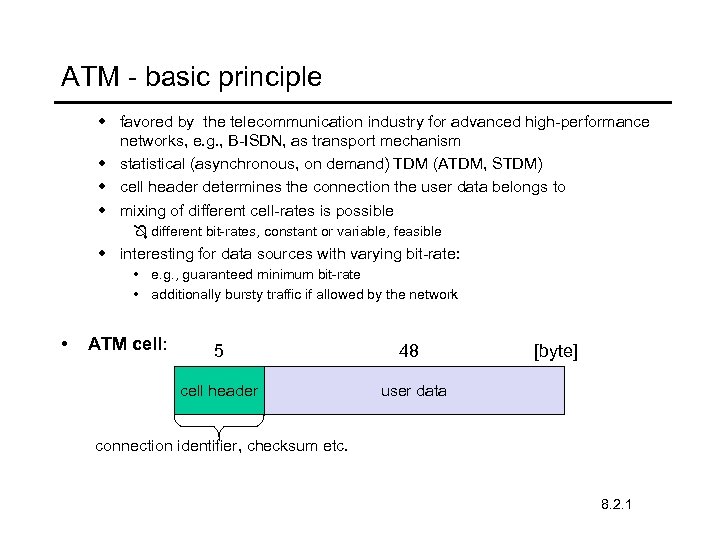 ATM - basic principle w favored by the telecommunication industry for advanced high-performance networks, e. g. , B-ISDN, as transport mechanism w statistical (asynchronous, on demand) TDM (ATDM, STDM) w cell header determines the connection the user data belongs to w mixing of different cell-rates is possible Ô different bit-rates, constant or variable, feasible w interesting for data sources with varying bit-rate: • e. g. , guaranteed minimum bit-rate • additionally bursty traffic if allowed by the network • ATM cell: 5 cell header 48 [byte] user data connection identifier, checksum etc. 8. 2. 1
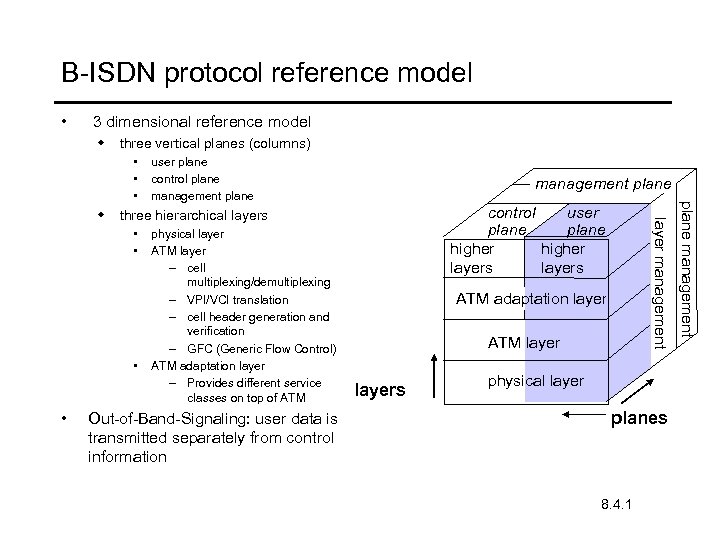 B-ISDN protocol reference model • 3 dimensional reference model w three vertical planes (columns) user plane control plane management plane • • physical layer ATM layer – cell multiplexing/demultiplexing – VPI/VCI translation – cell header generation and verification – GFC (Generic Flow Control) ATM adaptation layer – Provides different service classes on top of ATM Out-of-Band-Signaling: user data is transmitted separately from control information layer management control user plane higher layers w three hierarchical layers ATM adaptation layer ATM layers physical layer planes 8. 4. 1 plane management • • •
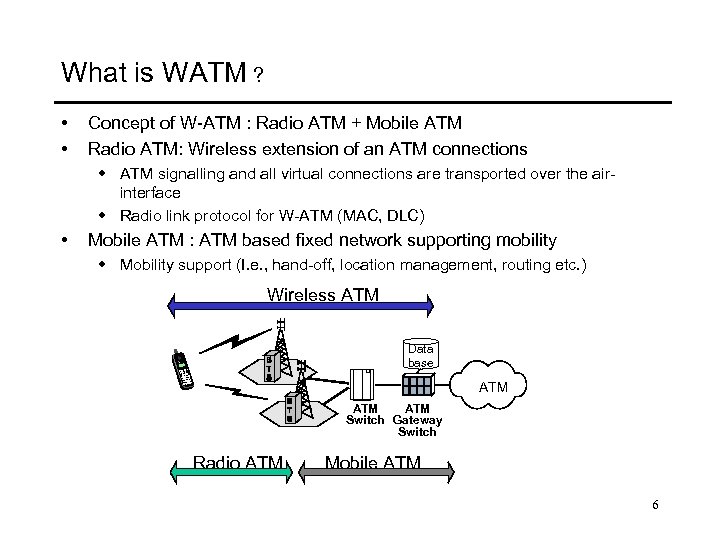 What is WATM ? • • Concept of W-ATM : Radio ATM + Mobile ATM Radio ATM: Wireless extension of an ATM connections w ATM signalling and all virtual connections are transported over the airinterface w Radio link protocol for W-ATM (MAC, DLC) • Mobile ATM : ATM based fixed network supporting mobility w Mobility support (I. e. , hand-off, location management, routing etc. ) Wireless ATM Data base ATM ATM Switch Gateway Switch Radio ATM Mobile ATM 6
 Meaning of WATM • • 3 rd-generation of Mobile communication w Multimedia-capable integrated wireless network Wireless extensions to ATM networks w Support of untethered network members 7
 System Design Goal of WATM • • Flexible multiservice capability including voice, data and multimedia Compatibility with ATM & B-ISDN Guaranteed Qo. S for various service types Low terminal cost, power consumption and complexity Radio bandwidth efficiency Efficient, scalable and cost-effective network architecture Compliance with regulatory constraints 8
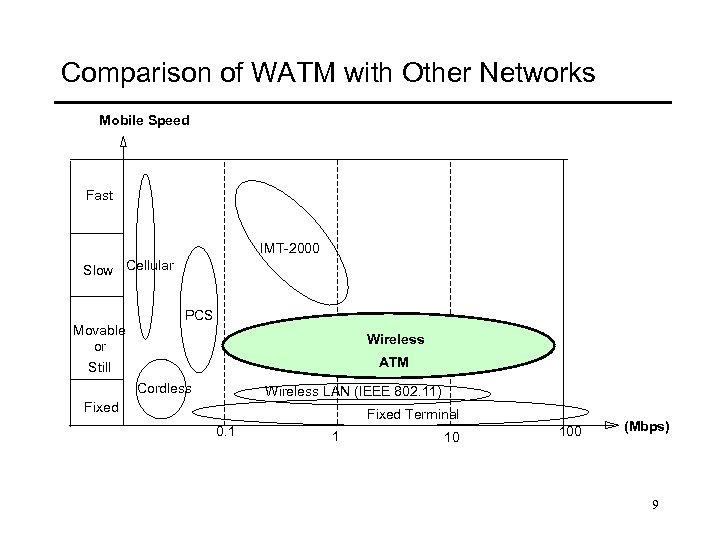 Comparison of WATM with Other Networks Mobile Speed Fast IMT-2000 Slow Cellular Movable or PCS Wireless ATM Still Cordless Wireless LAN (IEEE 802. 11) Fixed Terminal 0. 1 1 10 100 (Mbps) 9
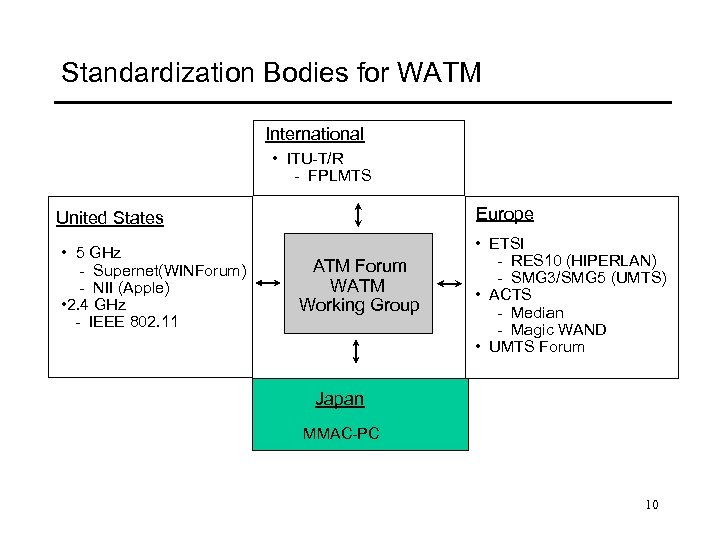 Standardization Bodies for WATM International • ITU-T/R - FPLMTS Europe United States • 5 GHz - Supernet(WINForum) - NII (Apple) • 2. 4 GHz - IEEE 802. 11 ATM Forum WATM Working Group • ETSI - RES 10 (HIPERLAN) - SMG 3/SMG 5 (UMTS) • ACTS - Median - Magic WAND • UMTS Forum Japan MMAC-PC 10
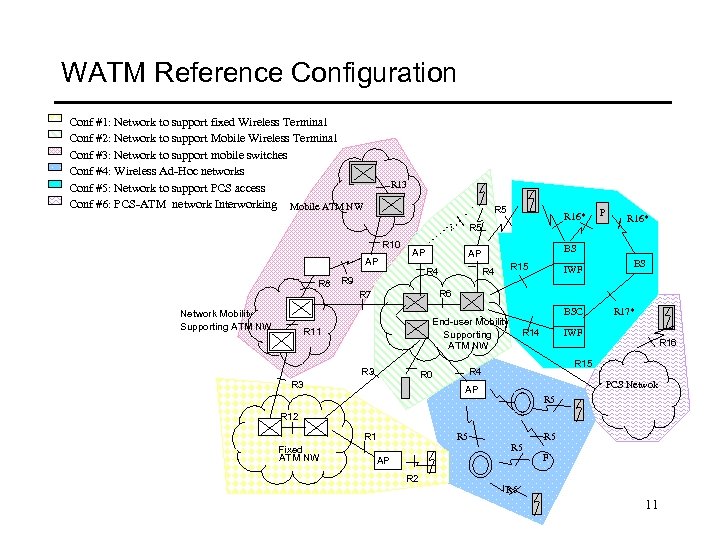 WATM Reference Configuration Conf #1: Network to support fixed Wireless Terminal Conf #2: Network to support Mobile Wireless Terminal Conf #3: Network to support mobile switches Conf #4: Wireless Ad-Hoc networks Conf #5: Network to support PCS access Conf #6: PCS-ATM network Interworking Mobile ATM NW R 13 R 5 R 16* R 5 R 10 AP AP AP R 8 R 9 R 15 R 4 IWF BS R 6 R 7 Network Mobility Supporting ATM NW R 16* BS AP R 4 P BSC End-user Mobility Supporting ATM NW R 11 R 3 IWF R 16 R 15 R 4 R 0 R 3 R 14 R 17* PCS Netwok AP R 5 R 12 R 1 Fixed ATM NW R 5 AP R 2 R 5 F R 5 11
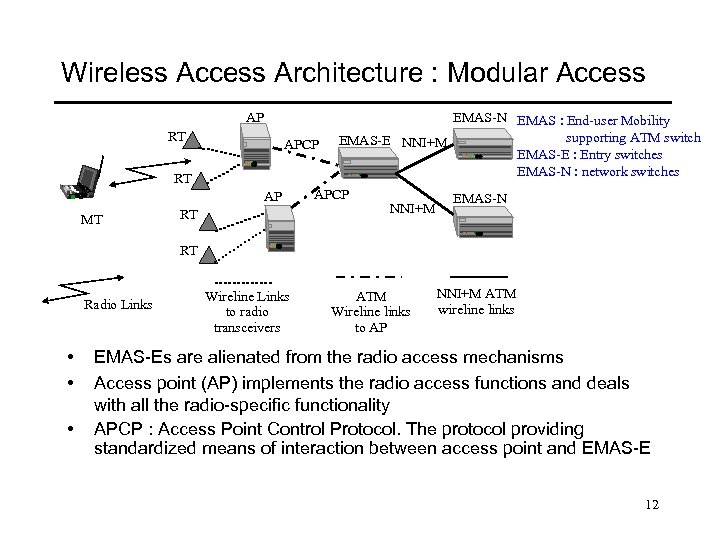 Wireless Access Architecture : Modular Access AP RT APCP RT AP MT RT EMAS-N EMAS : End-user Mobility supporting ATM switch EMAS-E NNI+M EMAS-E : Entry switches EMAS-N : network switches APCP NNI+M EMAS-N RT Radio Links • • • Wireline Links to radio transceivers ATM Wireline links to AP NNI+M ATM wireline links EMAS-Es are alienated from the radio access mechanisms Access point (AP) implements the radio access functions and deals with all the radio-specific functionality APCP : Access Point Control Protocol. The protocol providing standardized means of interaction between access point and EMAS-E 12
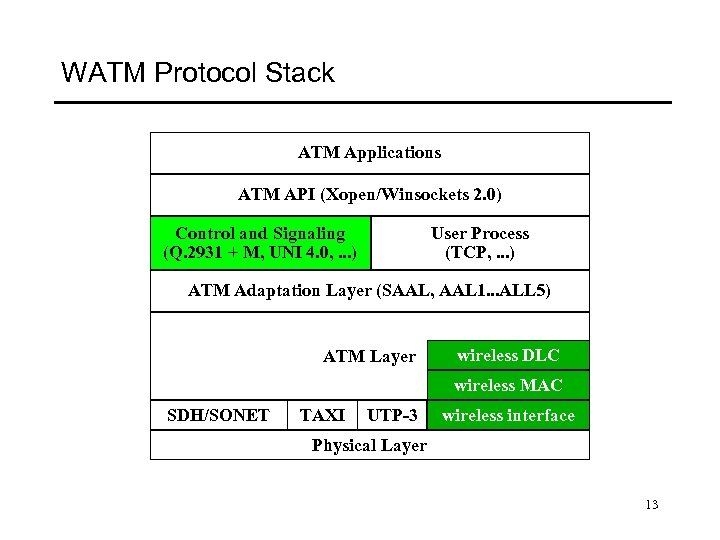 WATM Protocol Stack ATM Applications ATM API (Xopen/Winsockets 2. 0) Control and Signaling (Q. 2931 + M, UNI 4. 0, . . . ) User Process (TCP, . . . ) ATM Adaptation Layer (SAAL, AAL 1. . . ALL 5) ATM Layer wireless DLC wireless MAC SDH/SONET TAXI UTP-3 wireless interface Physical Layer 13
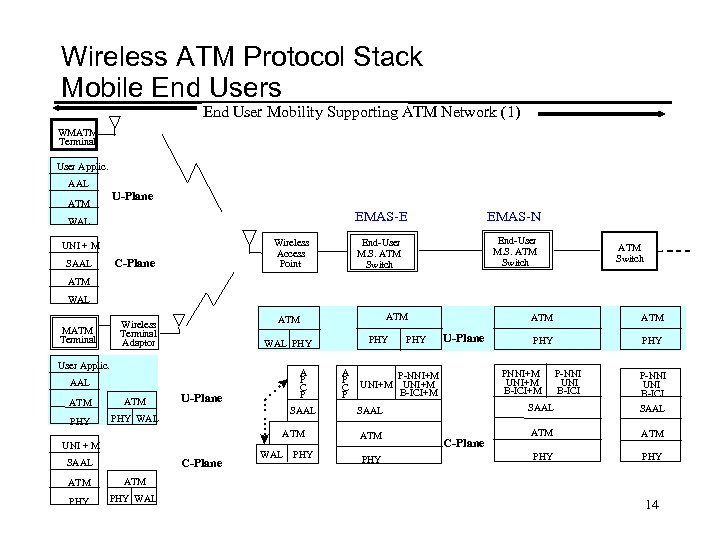 Wireless ATM Protocol Stack Mobile End Users Mobile End-Users Networks (1) End User Mobility Supporting ATM Network (1) WMATM Terminal User Applic. AAL U-Plane ATM EMAS-E Wireless Access Point UNI + M C-Plane SAAL EMAS-N End-User M. S. ATM Switch WAL End-User M. S. ATM Switch ATM WAL MATM Terminal A P C P AAL ATM PHY U-Plane PHY WAL SAAL ATM UNI + M C-Plane SAAL ATM PHY WAL PHY A P C P PHY UNI+M ATM U-Plane P-NNI+M UNI+M B-ICI+M PHY PHY PNNI+M UNI+M B-ICI+M P-NNI UNI B-ICI SAAL ATM C-Plane SAAL ATM PHY WAL PHY User Applic. ATM ATM Wireless Terminal Adaptor 14
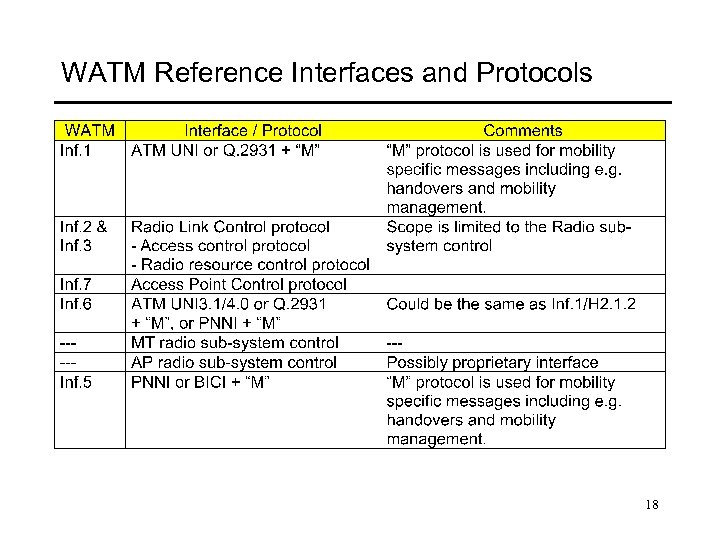
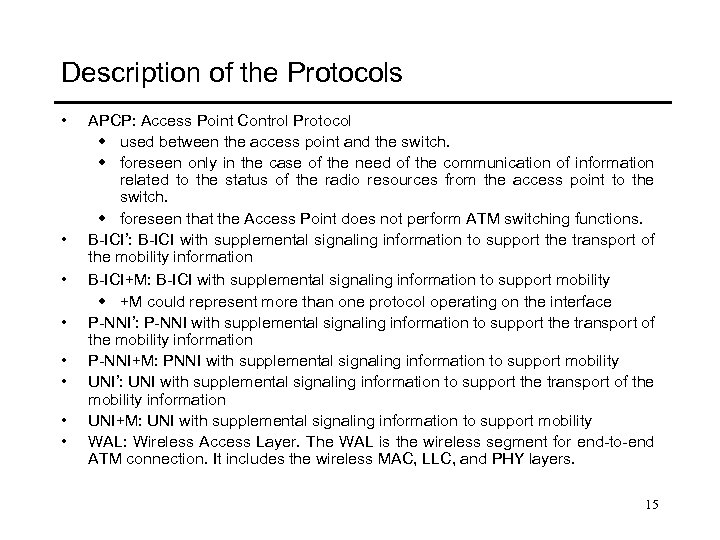 Description of the Protocols • • APCP: Access Point Control Protocol w used between the access point and the switch. w foreseen only in the case of the need of the communication of information related to the status of the radio resources from the access point to the switch. w foreseen that the Access Point does not perform ATM switching functions. B-ICI’: B-ICI with supplemental signaling information to support the transport of the mobility information B-ICI+M: B-ICI with supplemental signaling information to support mobility w +M could represent more than one protocol operating on the interface P-NNI’: P-NNI with supplemental signaling information to support the transport of the mobility information P-NNI+M: PNNI with supplemental signaling information to support mobility UNI’: UNI with supplemental signaling information to support the transport of the mobility information UNI+M: UNI with supplemental signaling information to support mobility WAL: Wireless Access Layer. The WAL is the wireless segment for end-to-end ATM connection. It includes the wireless MAC, LLC, and PHY layers. 15
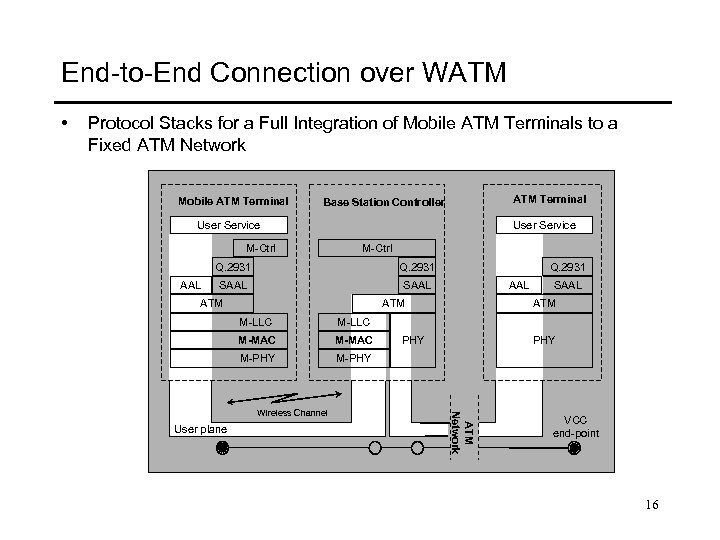 End-to-End Connection over WATM • Protocol Stacks for a Full Integration of Mobile ATM Terminals to a Fixed ATM Network Mobile ATM Terminal Base Station Controller User Service M-Ctrl Q. 2931 AAL Q. 2931 SAAL ATM M-LLC M-MAC M-PHY SAAL ATM M-LLC M-MAC M-PHY PHY ATM Network Wireless Channel User plane Q. 2931 VCC end-point 16
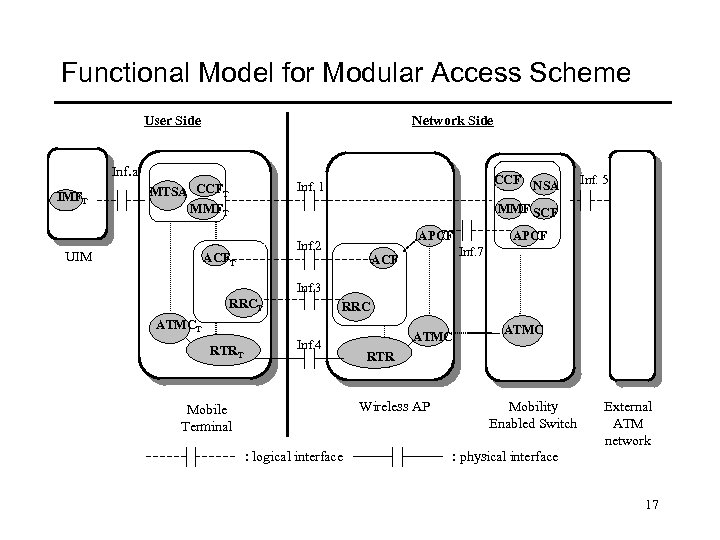 Functional Model for Modular Access Scheme User Side Network Side Inf. a IMFT UIM CCF NSA Inf. 1 MTSA CCFT MMFT Inf. 5 MMF SCF APCF Inf. 2 ACFT APCF Inf. 7 ACF Inf. 3 RRCT RRC ATMCT RTRT Inf. 4 ATMC RTR Wireless AP Mobile Terminal : logical interface ATMC Mobility Enabled Switch External ATM network : physical interface 17
 WATM Reference Interfaces and Protocols 18
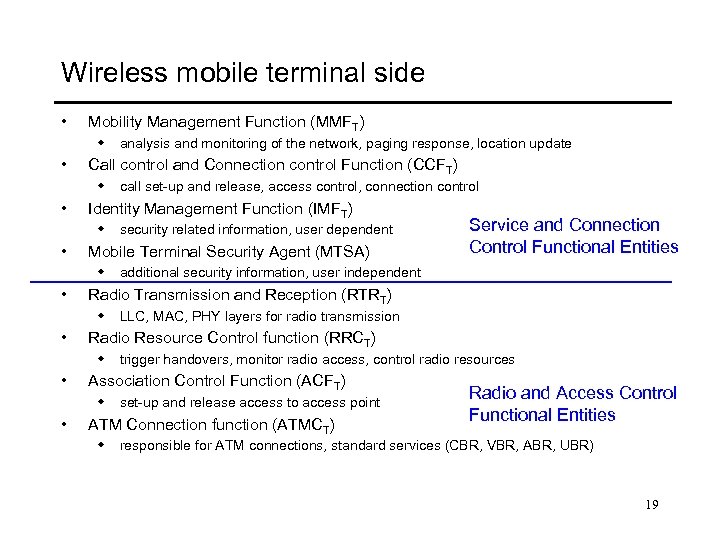 Wireless mobile terminal side • Mobility Management Function (MMFT) w analysis and monitoring of the network, paging response, location update • Call control and Connection control Function (CCFT) w call set-up and release, access control, connection control • Identity Management Function (IMFT) w security related information, user dependent • Mobile Terminal Security Agent (MTSA) Service and Connection Control Functional Entities w additional security information, user independent • Radio Transmission and Reception (RTRT) w LLC, MAC, PHY layers for radio transmission • Radio Resource Control function (RRCT) w trigger handovers, monitor radio access, control radio resources • Association Control Function (ACFT) w set-up and release access to access point • ATM Connection function (ATMCT) Radio and Access Control Functional Entities w responsible for ATM connections, standard services (CBR, VBR, ABR, UBR) 19
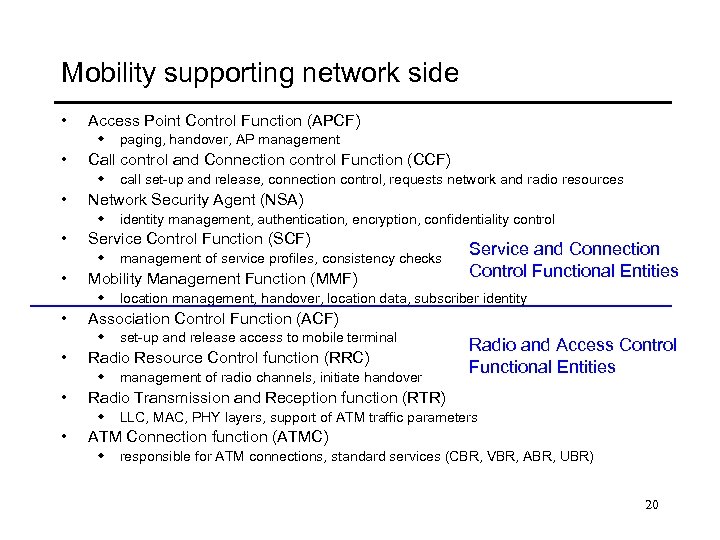 Mobility supporting network side • Access Point Control Function (APCF) w paging, handover, AP management • Call control and Connection control Function (CCF) w call set-up and release, connection control, requests network and radio resources • Network Security Agent (NSA) w identity management, authentication, encryption, confidentiality control • Service Control Function (SCF) w management of service profiles, consistency checks • Mobility Management Function (MMF) Service and Connection Control Functional Entities w location management, handover, location data, subscriber identity • Association Control Function (ACF) w set-up and release access to mobile terminal • Radio Resource Control function (RRC) w management of radio channels, initiate handover • Radio and Access Control Functional Entities Radio Transmission and Reception function (RTR) w LLC, MAC, PHY layers, support of ATM traffic parameters • ATM Connection function (ATMC) w responsible for ATM connections, standard services (CBR, VBR, ABR, UBR) 20
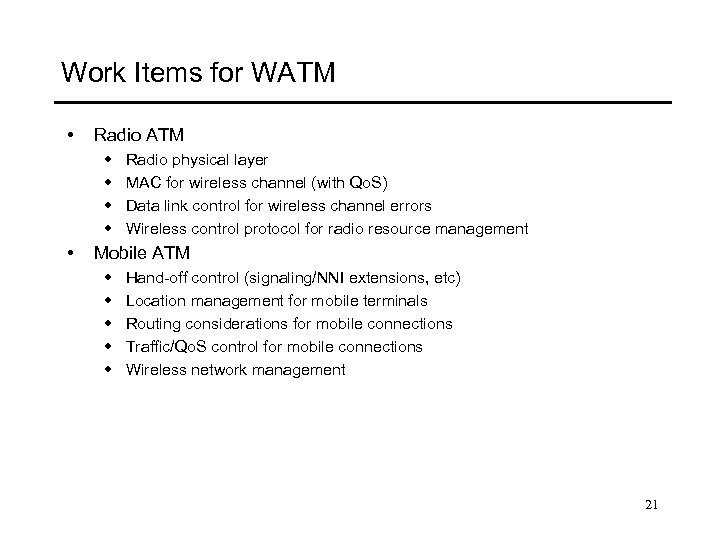 Work Items for WATM • Radio ATM w w • Radio physical layer MAC for wireless channel (with Qo. S) Data link control for wireless channel errors Wireless control protocol for radio resource management Mobile ATM w w w Hand-off control (signaling/NNI extensions, etc) Location management for mobile terminals Routing considerations for mobile connections Traffic/Qo. S control for mobile connections Wireless network management 21
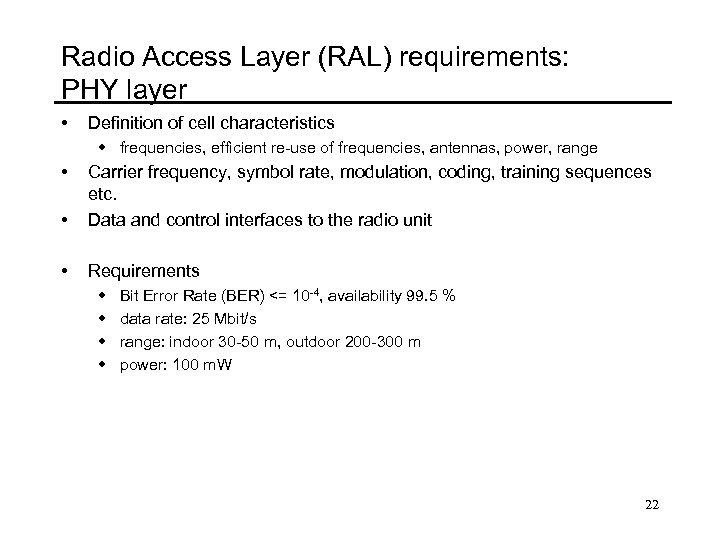 Radio Access Layer (RAL) requirements: PHY layer • Definition of cell characteristics w frequencies, efficient re-use of frequencies, antennas, power, range • • Carrier frequency, symbol rate, modulation, coding, training sequences etc. Data and control interfaces to the radio unit • Requirements w w Bit Error Rate (BER) <= 10 -4, availability 99. 5 % data rate: 25 Mbit/s range: indoor 30 -50 m, outdoor 200 -300 m power: 100 m. W 22
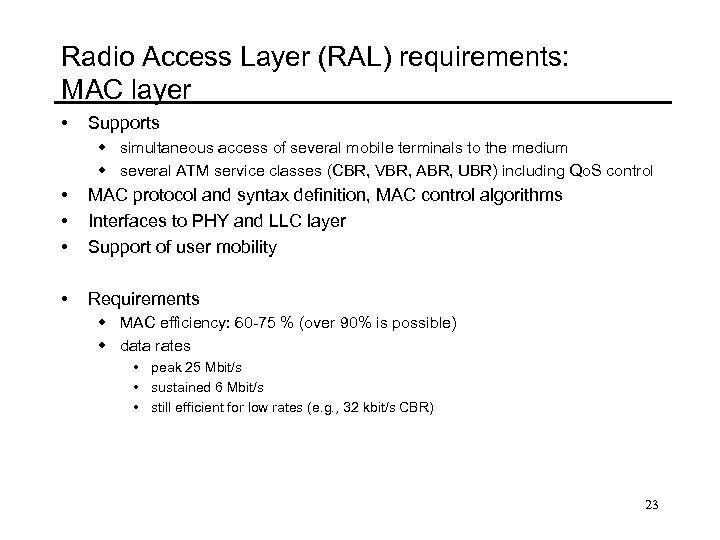 Radio Access Layer (RAL) requirements: MAC layer • Supports w simultaneous access of several mobile terminals to the medium w several ATM service classes (CBR, VBR, ABR, UBR) including Qo. S control • • • MAC protocol and syntax definition, MAC control algorithms Interfaces to PHY and LLC layer Support of user mobility • Requirements w MAC efficiency: 60 -75 % (over 90% is possible) w data rates • peak 25 Mbit/s • sustained 6 Mbit/s • still efficient for low rates (e. g. , 32 kbit/s CBR) 23
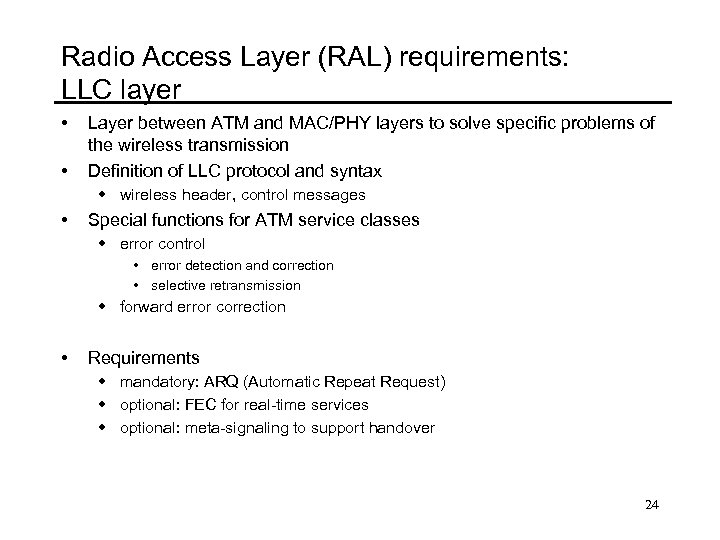 Radio Access Layer (RAL) requirements: LLC layer • • Layer between ATM and MAC/PHY layers to solve specific problems of the wireless transmission Definition of LLC protocol and syntax w wireless header, control messages • Special functions for ATM service classes w error control • error detection and correction • selective retransmission w forward error correction • Requirements w mandatory: ARQ (Automatic Repeat Request) w optional: FEC for real-time services w optional: meta-signaling to support handover 24
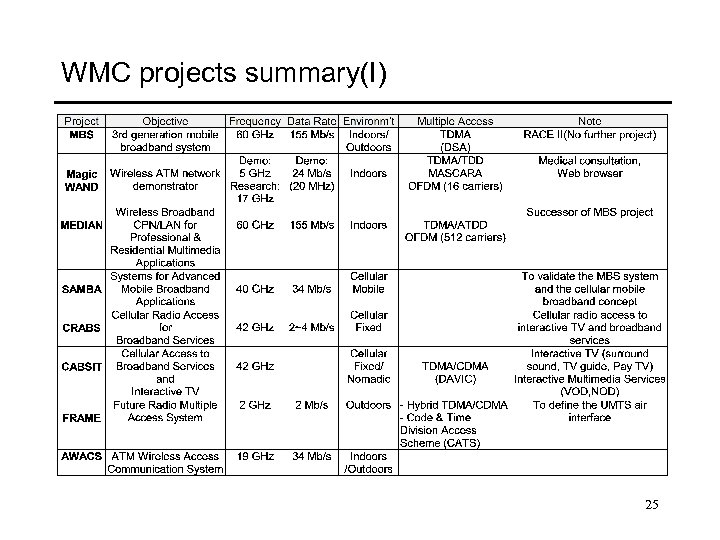 WMC projects summary(I) 25
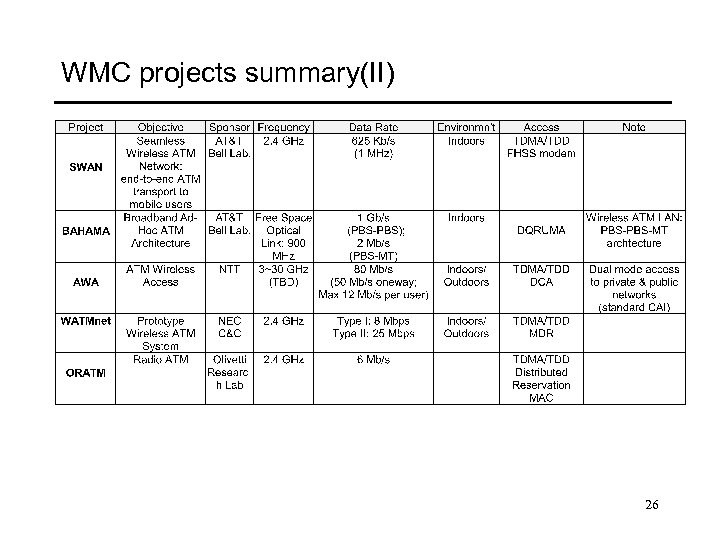 WMC projects summary(II) 26
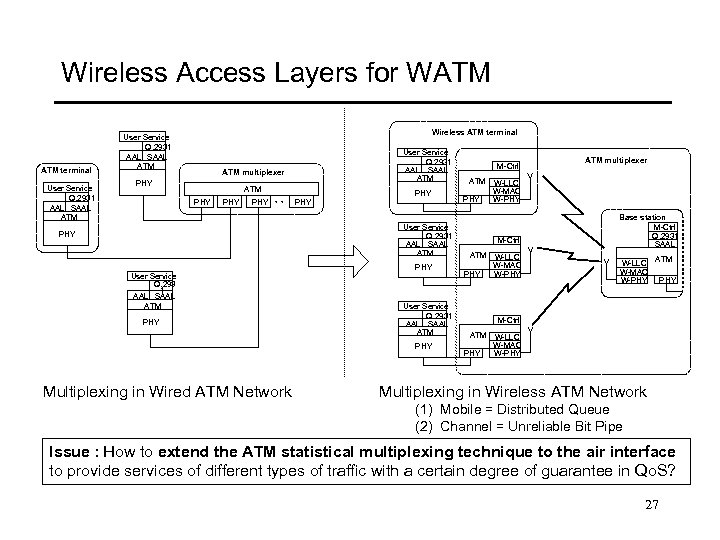 Wireless Access Layers for WATM terminal User Service Q. 2931 AAL SAAL ATM Wireless ATM terminal User Service Q. 2931 AAL SAAL ATM ATM multiplexer PHY ATM PHY PHY PHY User Service Q. 2931 AAL SAAL ATM PHY User Service Q. 2931 AAL SAAL ATM PHY Multiplexing in Wired ATM Network M-Ctrl ATM PHY W-LLC W-MAC W-PHY M-Ctrl ATM PHY ATM multiplexer W-LLC W-MAC W-PHY Base station M-Ctrl Q. 2931 SAAL W-LLC W-MAC W-PHY ATM PHY M-Ctrl ATM PHY W-LLC W-MAC W-PHY Multiplexing in Wireless ATM Network (1) Mobile = Distributed Queue (2) Channel = Unreliable Bit Pipe Issue : How to extend the ATM statistical multiplexing technique to the air interface to provide services of different types of traffic with a certain degree of guarantee in Qo. S? 27
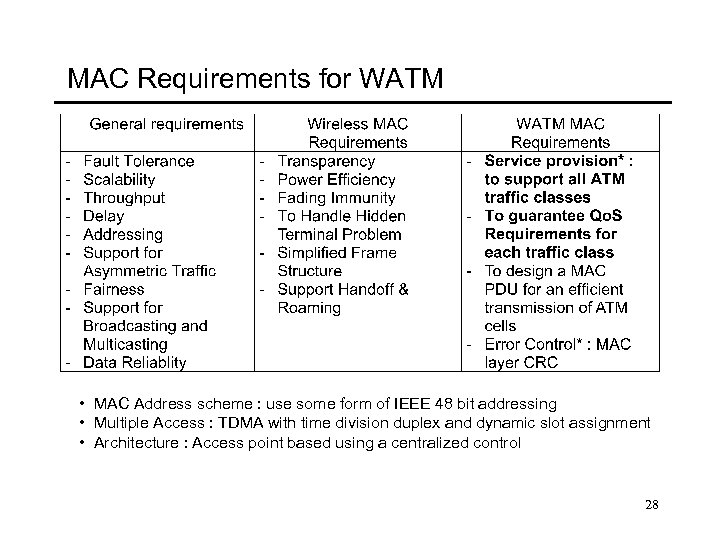 MAC Requirements for WATM • MAC Address scheme : use some form of IEEE 48 bit addressing • Multiple Access : TDMA with time division duplex and dynamic slot assignment • Architecture : Access point based using a centralized control 28
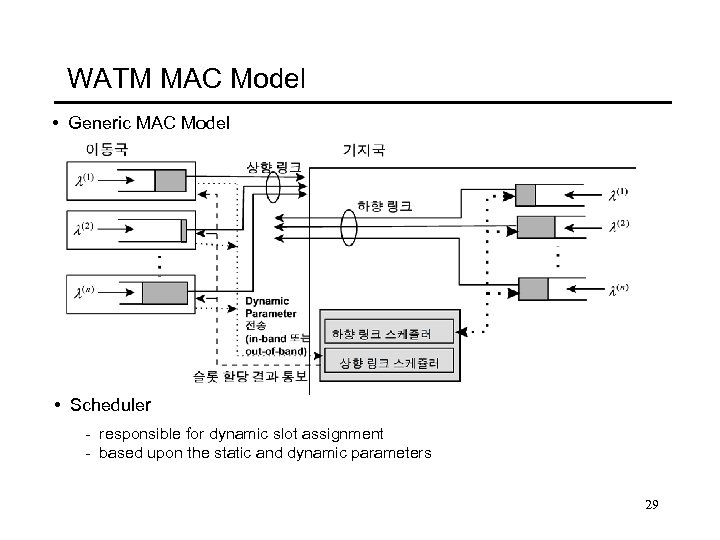 WATM MAC Model • Generic MAC Model • Scheduler - responsible for dynamic slot assignment - based upon the static and dynamic parameters 29
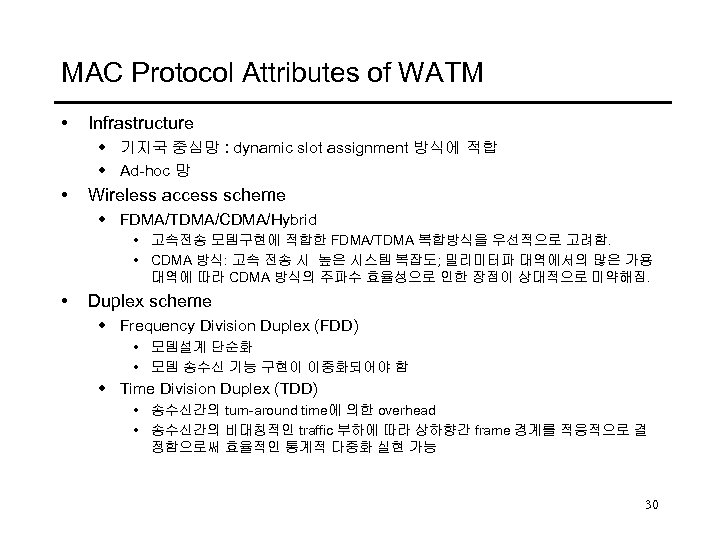 MAC Protocol Attributes of WATM • Infrastructure w 기지국 중심망 : dynamic slot assignment 방식에 적합 w Ad-hoc 망 • Wireless access scheme w FDMA/TDMA/CDMA/Hybrid • 고속전송 모뎀구현에 적합한 FDMA/TDMA 복합방식을 우선적으로 고려함. • CDMA 방식: 고속 전송 시 높은 시스템 복잡도; 밀리미터파 대역에서의 많은 가용 대역에 따라 CDMA 방식의 주파수 효율성으로 인한 장점이 상대적으로 미약해짐. • Duplex scheme w Frequency Division Duplex (FDD) • 모뎀설계 단순화 • 모뎀 송수신 기능 구현이 이중화되어야 함 w Time Division Duplex (TDD) • 송수신간의 turn-around time에 의한 overhead • 송수신간의 비대칭적인 traffic 부하에 따라 상하향간 frame 경계를 적응적으로 결 정함으로써 효율적인 통계적 다중화 실현 가능 30
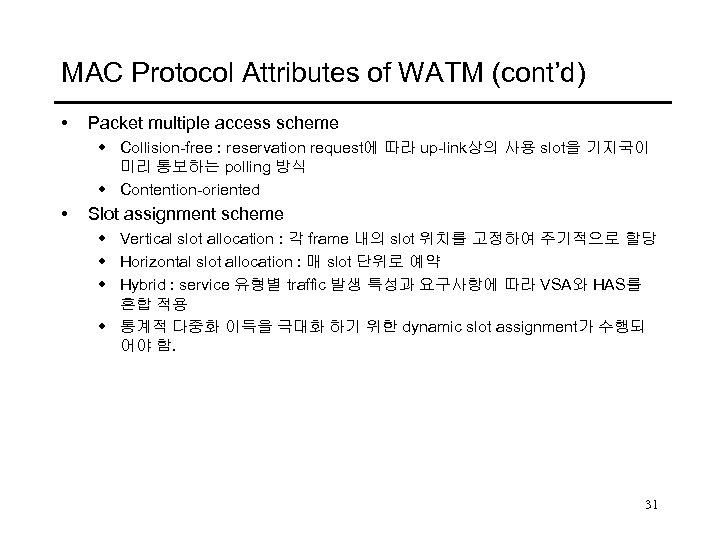 MAC Protocol Attributes of WATM (cont’d) • Packet multiple access scheme w Collision-free : reservation request에 따라 up-link상의 사용 slot을 기지국이 미리 통보하는 polling 방식 w Contention-oriented • Slot assignment scheme w Vertical slot allocation : 각 frame 내의 slot 위치를 고정하여 주기적으로 할당 w Horizontal slot allocation : 매 slot 단위로 예약 w Hybrid : service 유형별 traffic 발생 특성과 요구사항에 따라 VSA와 HAS를 혼합 적용 w 통계적 다중화 이득을 극대화 하기 위한 dynamic slot assignment가 수행되 어야 함. 31
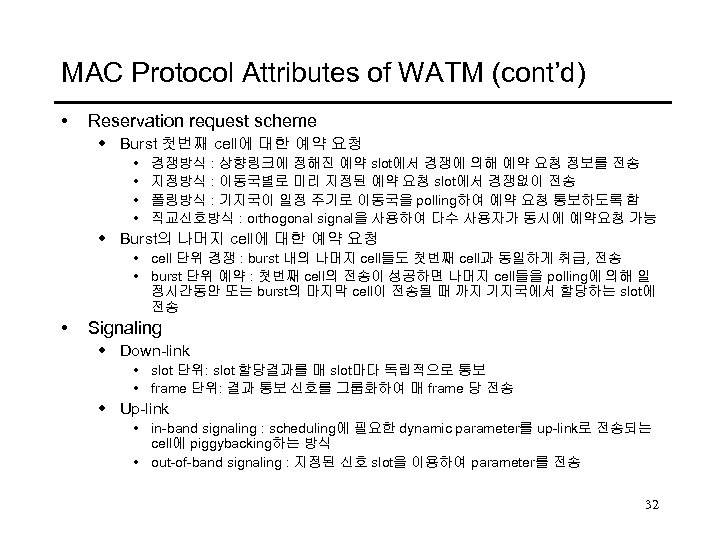 MAC Protocol Attributes of WATM (cont’d) • Reservation request scheme w Burst 첫번째 cell에 대한 예약 요청 • • 경쟁방식 : 상향링크에 정해진 예약 slot에서 경쟁에 의해 예약 요청 정보를 전송 지정방식 : 이동국별로 미리 지정된 예약 요청 slot에서 경쟁없이 전송 폴링방식 : 기지국이 일정 주기로 이동국을 polling하여 예약 요청 통보하도록 함 직교신호방식 : orthogonal signal을 사용하여 다수 사용자가 동시에 예약요청 가능 w Burst의 나머지 cell에 대한 예약 요청 • cell 단위 경쟁 : burst 내의 나머지 cell들도 첫번째 cell과 동일하게 취급, 전송 • burst 단위 예약 : 첫번째 cell의 전송이 성공하면 나머지 cell들을 polling에 의해 일 정시간동안 또는 burst의 마지막 cell이 전송될 때 까지 기지국에서 할당하는 slot에 전송 • Signaling w Down-link • slot 단위: slot 할당결과를 매 slot마다 독립적으로 통보 • frame 단위: 결과 통보 신호를 그룹화하여 매 frame 당 전송 w Up-link • in-band signaling : scheduling에 필요한 dynamic parameter를 up-link로 전송되는 cell에 piggybacking하는 방식 • out-of-band signaling : 지정된 신호 slot을 이용하여 parameter를 전송 32
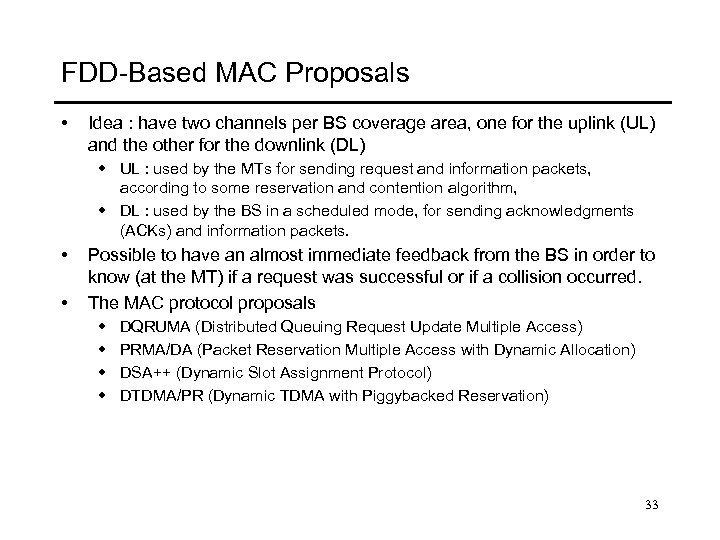 FDD-Based MAC Proposals • Idea : have two channels per BS coverage area, one for the uplink (UL) and the other for the downlink (DL) w UL : used by the MTs for sending request and information packets, according to some reservation and contention algorithm, w DL : used by the BS in a scheduled mode, for sending acknowledgments (ACKs) and information packets. • • Possible to have an almost immediate feedback from the BS in order to know (at the MT) if a request was successful or if a collision occurred. The MAC protocol proposals w w DQRUMA (Distributed Queuing Request Update Multiple Access) PRMA/DA (Packet Reservation Multiple Access with Dynamic Allocation) DSA++ (Dynamic Slot Assignment Protocol) DTDMA/PR (Dynamic TDMA with Piggybacked Reservation) 33
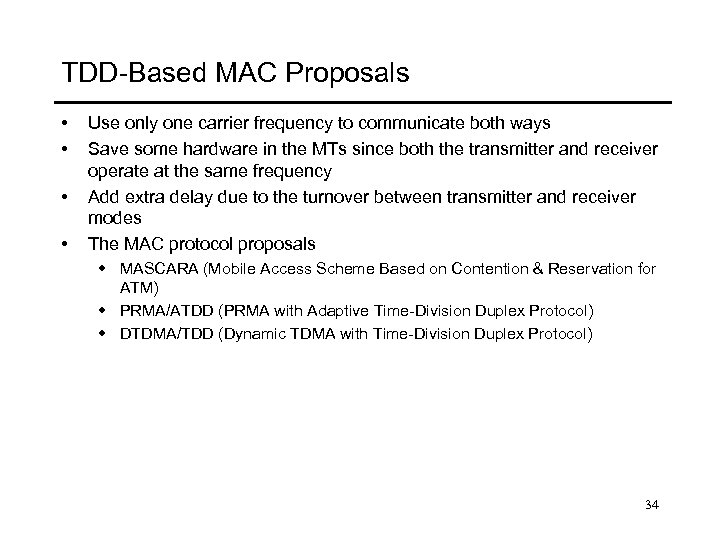 TDD-Based MAC Proposals • • Use only one carrier frequency to communicate both ways Save some hardware in the MTs since both the transmitter and receiver operate at the same frequency Add extra delay due to the turnover between transmitter and receiver modes The MAC protocol proposals w MASCARA (Mobile Access Scheme Based on Contention & Reservation for ATM) w PRMA/ATDD (PRMA with Adaptive Time-Division Duplex Protocol) w DTDMA/TDD (Dynamic TDMA with Time-Division Duplex Protocol) 34
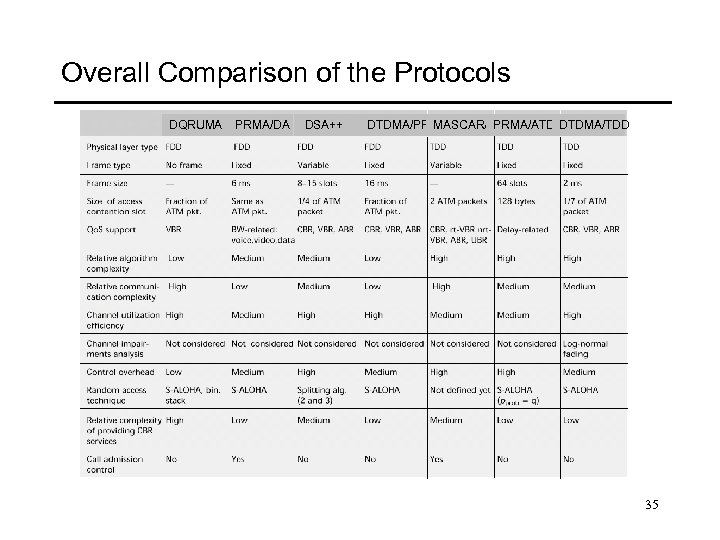 Overall Comparison of the Protocols DQRUMA PRMA/DA DSA++ DTDMA/PR MASCARAPRMA/ATDD DTDMA/TDD 35
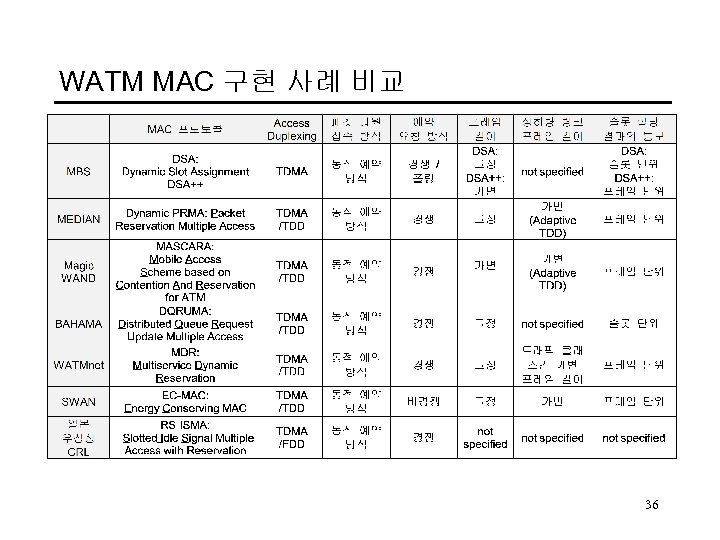 WATM MAC 구현 사례 비교 36
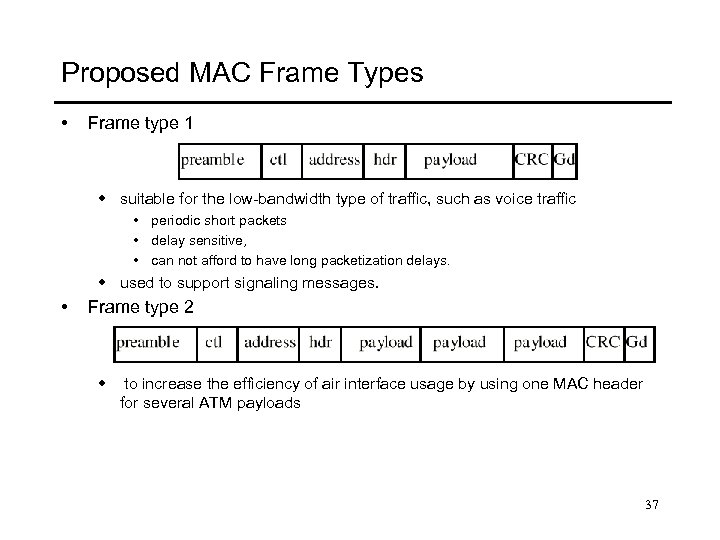 Proposed MAC Frame Types • Frame type 1 w suitable for the low-bandwidth type of traffic, such as voice traffic • periodic short packets • delay sensitive, • can not afford to have long packetization delays. w used to support signaling messages. • Frame type 2 w to increase the efficiency of air interface usage by using one MAC header for several ATM payloads 37
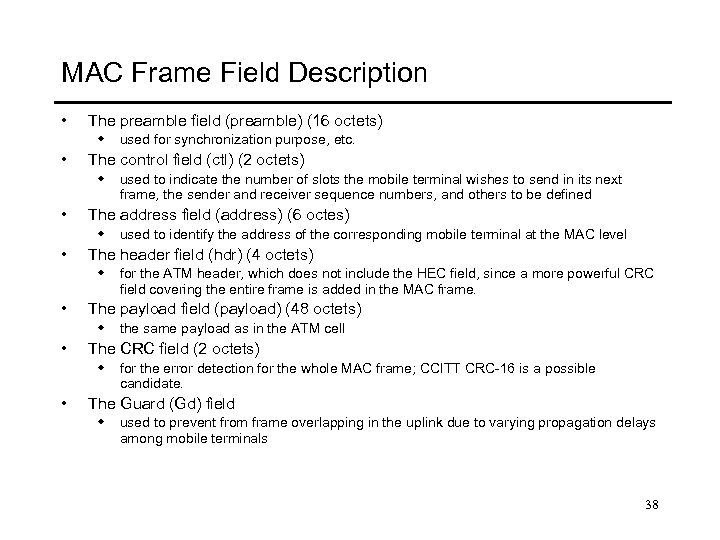 MAC Frame Field Description • The preamble field (preamble) (16 octets) w used for synchronization purpose, etc. • The control field (ctl) (2 octets) w used to indicate the number of slots the mobile terminal wishes to send in its next frame, the sender and receiver sequence numbers, and others to be defined • The address field (address) (6 octes) w used to identify the address of the corresponding mobile terminal at the MAC level • The header field (hdr) (4 octets) w for the ATM header, which does not include the HEC field, since a more powerful CRC field covering the entire frame is added in the MAC frame. • The payload field (payload) (48 octets) w the same payload as in the ATM cell • The CRC field (2 octets) w for the error detection for the whole MAC frame; CCITT CRC-16 is a possible candidate. • The Guard (Gd) field w used to prevent from frame overlapping in the uplink due to varying propagation delays among mobile terminals 38
 Location Management • • LM enables the network to communicate with MTs by managing the information about the location of the terminal LM = Mobile tracking + Mobile locating w Mobile Tracking • Network elements updating procedure about the location of mobile entities • Mobile registration + updating w Mobile Locating • The procedure by which a network node determines the location of the mobile for the delivery of incoming calls • May be executed explicitly prior to call setup or may be an integral part of the call setup procedure • Use the information acquired during the tracking phase 39
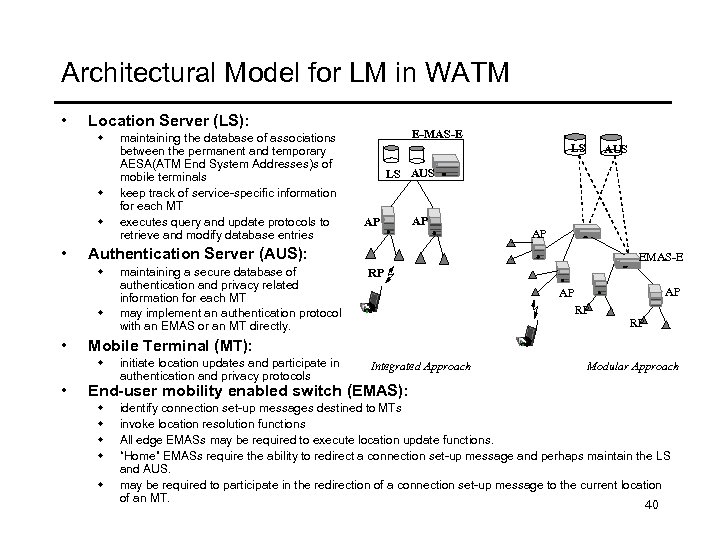 Architectural Model for LM in WATM • Location Server (LS): w w w • w LS AUS AP AP AP maintaining a secure database of authentication and privacy related information for each MT may implement an authentication protocol with an EMAS or an MT directly. EMAS-E RP AP AP RP RP Mobile Terminal (MT): w • E-MAS-E Authentication Server (AUS): w • maintaining the database of associations between the permanent and temporary AESA(ATM End System Addresses)s of mobile terminals keep track of service-specific information for each MT executes query and update protocols to retrieve and modify database entries initiate location updates and participate in authentication and privacy protocols Integrated Approach Modular Approach End-user mobility enabled switch (EMAS): w w w identify connection set-up messages destined to MTs invoke location resolution functions All edge EMASs may be required to execute location update functions. “Home” EMASs require the ability to redirect a connection set-up message and perhaps maintain the LS and AUS. may be required to participate in the redirection of a connection set-up message to the current location of an MT. 40
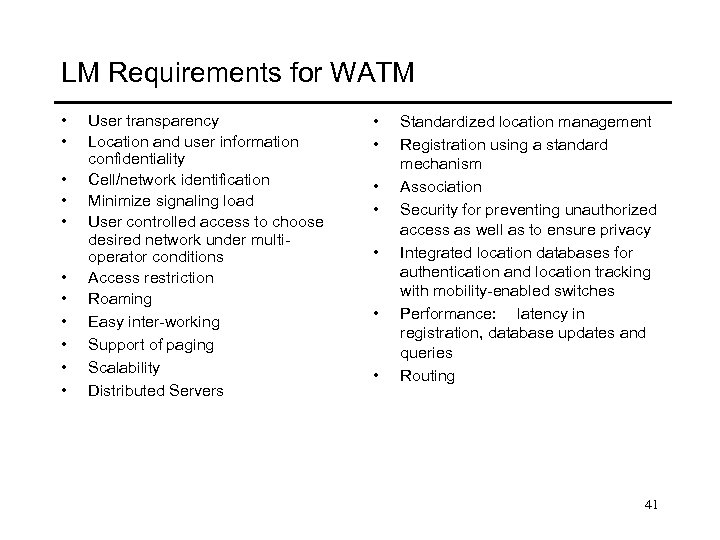 LM Requirements for WATM • • • User transparency Location and user information confidentiality Cell/network identification Minimize signaling load User controlled access to choose desired network under multioperator conditions Access restriction Roaming Easy inter-working Support of paging Scalability Distributed Servers • • Standardized location management Registration using a standard mechanism Association Security for preventing unauthorized access as well as to ensure privacy Integrated location databases for authentication and location tracking with mobility-enabled switches Performance: latency in registration, database updates and queries Routing 41
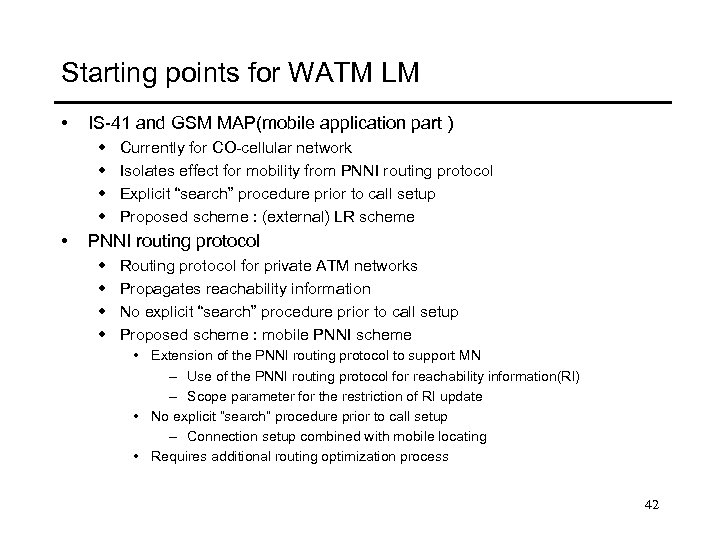 Starting points for WATM LM • IS-41 and GSM MAP(mobile application part ) w w • Currently for CO-cellular network Isolates effect for mobility from PNNI routing protocol Explicit “search” procedure prior to call setup Proposed scheme : (external) LR scheme PNNI routing protocol w w Routing protocol for private ATM networks Propagates reachability information No explicit “search” procedure prior to call setup Proposed scheme : mobile PNNI scheme • Extension of the PNNI routing protocol to support MN – Use of the PNNI routing protocol for reachability information(RI) – Scope parameter for the restriction of RI update • No explicit “search” procedure prior to call setup – Connection setup combined with mobile locating • Requires additional routing optimization process 42
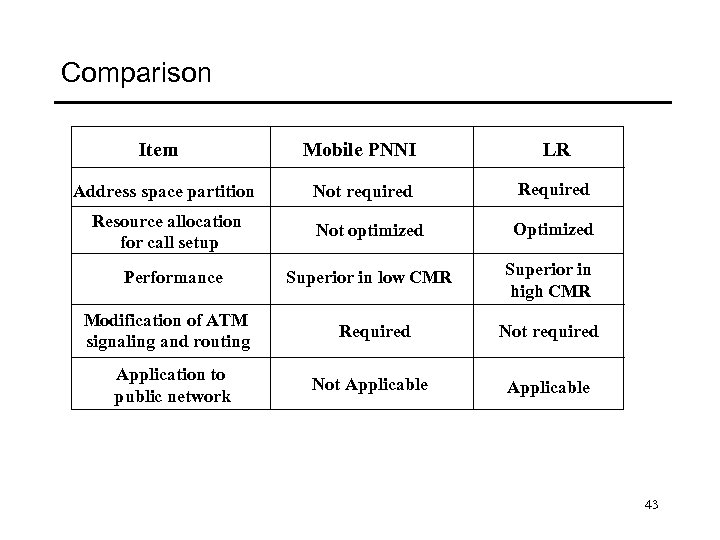 Comparison Item Address space partition Resource allocation for call setup Performance Modification of ATM signaling and routing Application to public network Mobile PNNI LR Not required Required Not optimized Optimized Superior in low CMR Superior in high CMR Required Not required Not Applicable 43