Скачать презентацию Wireless Application Protocol Evolution of Wireless Networks
bc9287c742c2fe6b655fe8297f01e2e9.ppt
- Количество слайдов: 62
 Wireless Application Protocol Evolution of Wireless Networks
 Evolution of Wireless Systems l l The worldwide success of cellular telephone has lead to the development of newer wireless systems and standards for other types of communications besides mobile voice. For example – Cellular networks to facilitate high speed data traffic – Replace fiber optics and copper lines between fixed points several kms apart. – Replacement of wires within homes, offices etc (evolution of Bluetooth)
 Cellular Networks
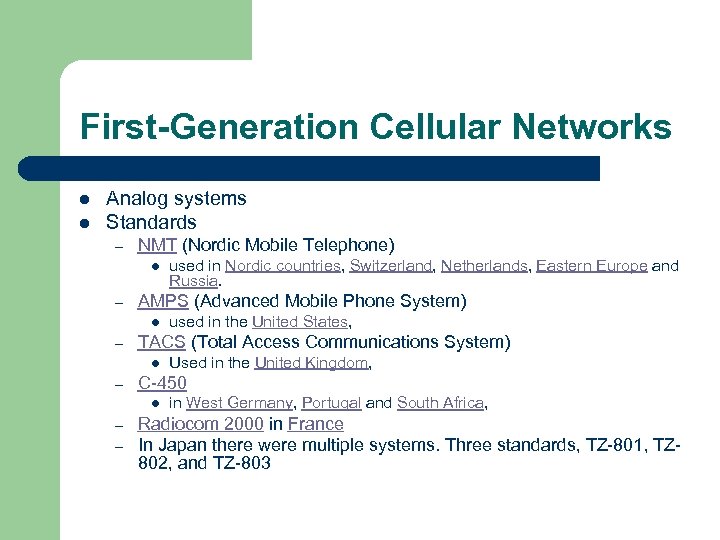 First-Generation Cellular Networks l l Analog systems Standards – NMT (Nordic Mobile Telephone) l – AMPS (Advanced Mobile Phone System) l – – Used in the United Kingdom, C-450 l – used in the United States, TACS (Total Access Communications System) l – used in Nordic countries, Switzerland, Netherlands, Eastern Europe and Russia. in West Germany, Portugal and South Africa, Radiocom 2000 in France In Japan there were multiple systems. Three standards, TZ-801, TZ 802, and TZ-803
 NMT l First fully-automatic cellular phone system – l Two standards NMT-450 and NMT-900 – l Corresponds to frequency and the later has higher bands. Cell size range from 2 km to 30 km. – l Started in 1970, in service 1981 Use smaller size in urban areas for better quality and larger in less-populated areas. Automatic switching (dialing) and handover.
 NMT Contd. l No spec. for voice traffic encryption – l l Buy a scanner, tune to the desired channel and intercept. NMT also supported a simple data transfer mode called DMS (Data and Messaging Service) or NMTText Using DMS, also text messaging was possible between two NMT handsets before SMS service started in GSM but this feature was never commercially available except in Russian and Polish NMT networks. NMT Suspended – In Finland Telia. Sonera's NMT on December 31, 2002.
 AMPS l l 1 G cellular phone used in US, which uses FDMA Operates in 800 MHz band – Total of 832 channels; l l l Require large bandwidth for large base population. No protection against eavesdropper – l 416 in 824– 849 MHz for transmissions from mobile to the base 416 in 869– 894 MHz for transmissions from base to the mobile. Each channel is 30 KHz wide ESN (Electronic Serial Number) was cloned in 1990 s to make free calls from different cells. Replaced with D-AMPS, GSM and CDMA for better security and capacity
 TACS l l A variant of AMPS developed by Motorola. It has been used in some European countries (including the UK & Ireland), as well as Japan and Hong Kong. ETACS was an extended version of TACS with more channels. The last ETACS service operated by Vodafone was discontinued on 31 May 2001
 Cellular Network
 Second-Generation Cellular Networks l l Digital system i. e. voice is digitized Unlike 1 G that relies on FDMA/FDD, 2 G use digital modulation formats and TDMA/FDD, CDMA/FDD multiple access techniques Can be divided into two standards; TDMA and CDMA The main 2 G standards are – – GSM (TDMA-based), originally from Europe but used worldwide IS-136 aka D-AMPS, TDMA-based, used in the Americas IS-95 aka cdma. One, CDMA-based, used in the Americas and parts of Asia PDC (TDMA-based), used exclusively in Japan
 2 G Contd. l Using digital signals between the handsets and the towers increases system capacity in two key ways: l Digital voice data can be compressed and multiplexed much more effectively than analog voice encodings through the use of various CODECs, allowing more calls to be packed into the same amount of radio bandwidth. The digital systems were designed to emit less radio power from the handsets. This meant that cells could be smaller, so more cells could be placed in the same amount of space. This was also made possible by cell towers and related equipment getting less expensive. l
 2 G Advantages l l The lower powered radio signals require less battery power, so phones last much longer between charges, and batteries can be smaller. The digital voice encoding allowed digital error checking which could increase sound quality by reducing dynamic and lowering the noise floor. Going all-digital allowed for the introduction of digital data services, such as SMS and email. Better security, harder to be scanned
 GSM l l l 2. 27 billion subscribers across more than 212 countries, 81% of the global mobile market Its provides international roaming very common 8 -slots TDMA with 200 KHz radio channel, with frame duration of 4. 615 ms The channel data rate is 270. 833 kbit/s Operates in four different bands – Mostly 900 MHz or 1800 MHz – US and Canada use 850 MHz and 1900 MHz – 25 MHz bandwidth of each subdivided into 124 channels – E. g. in 900 MHz, uplink 890 -915 MHz, downlink 935 -960 MHz
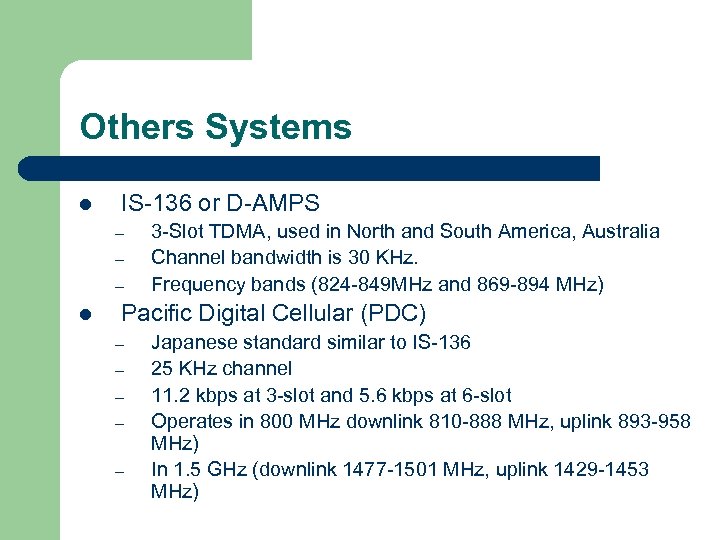 Others Systems l IS-136 or D-AMPS – – – l 3 -Slot TDMA, used in North and South America, Australia Channel bandwidth is 30 KHz. Frequency bands (824 -849 MHz and 869 -894 MHz) Pacific Digital Cellular (PDC) – – – Japanese standard similar to IS-136 25 KHz channel 11. 2 kbps at 3 -slot and 5. 6 kbps at 6 -slot Operates in 800 MHz downlink 810 -888 MHz, uplink 893 -958 MHz) In 1. 5 GHz (downlink 1477 -1501 MHz, uplink 1429 -1453 MHz)
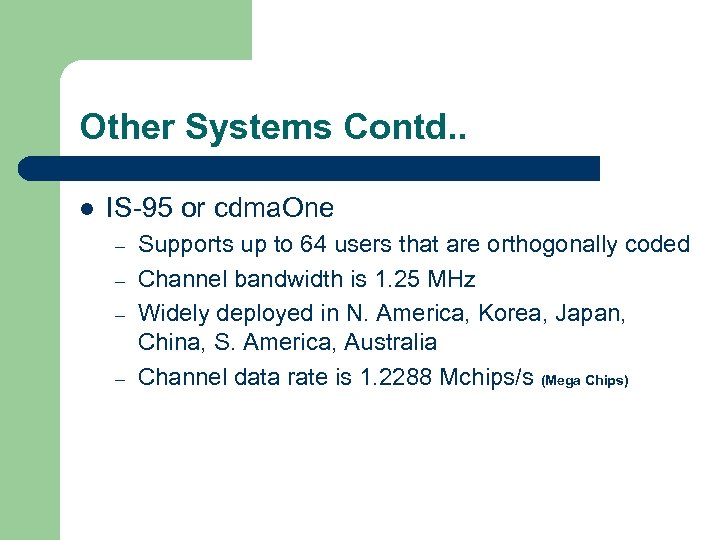 Other Systems Contd. . l IS-95 or cdma. One – – Supports up to 64 users that are orthogonally coded Channel bandwidth is 1. 25 MHz Widely deployed in N. America, Korea, Japan, China, S. America, Australia Channel data rate is 1. 2288 Mchips/s (Mega Chips)
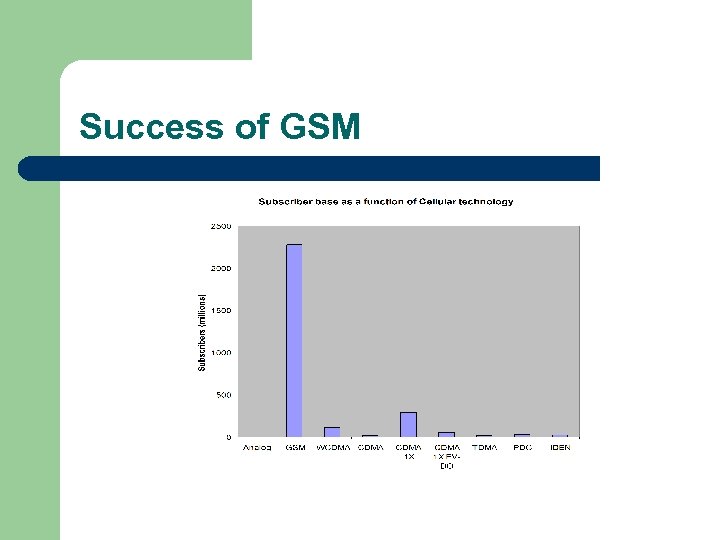 Success of GSM
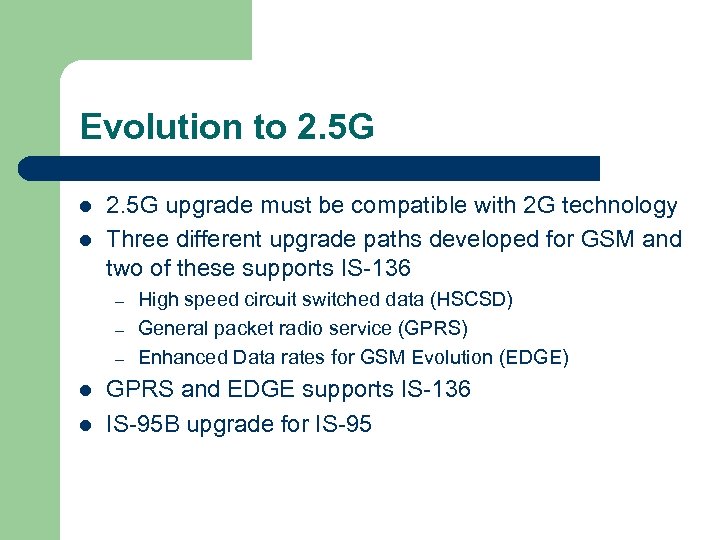 Evolution to 2. 5 G l l 2. 5 G upgrade must be compatible with 2 G technology Three different upgrade paths developed for GSM and two of these supports IS-136 – – – l l High speed circuit switched data (HSCSD) General packet radio service (GPRS) Enhanced Data rates for GSM Evolution (EDGE) GPRS and EDGE supports IS-136 IS-95 B upgrade for IS-95
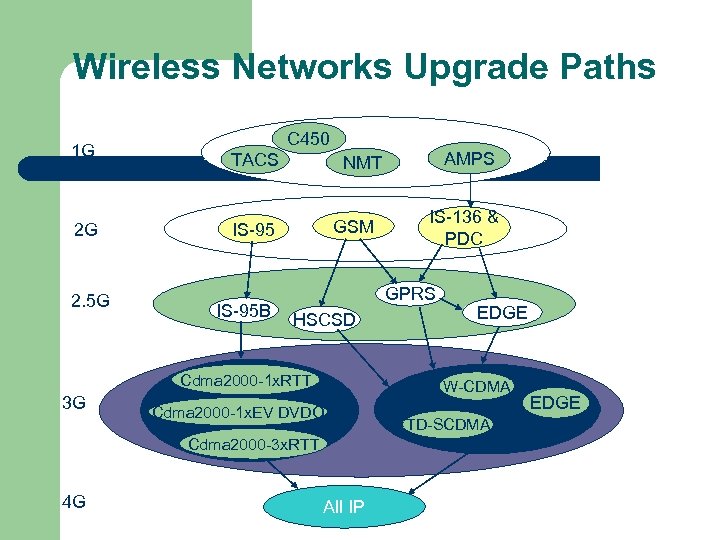 Wireless Networks Upgrade Paths 1 G 2 G 2. 5 G C 450 TACS GSM IS-95 B HSCSD EDGE W-CDMA Cdma 2000 -1 x. EV DVDO Cdma 2000 -3 x. RTT 4 G IS-136 & PDC GPRS Cdma 2000 -1 x. RTT 3 G AMPS NMT All IP TD-SCDMA EDGE
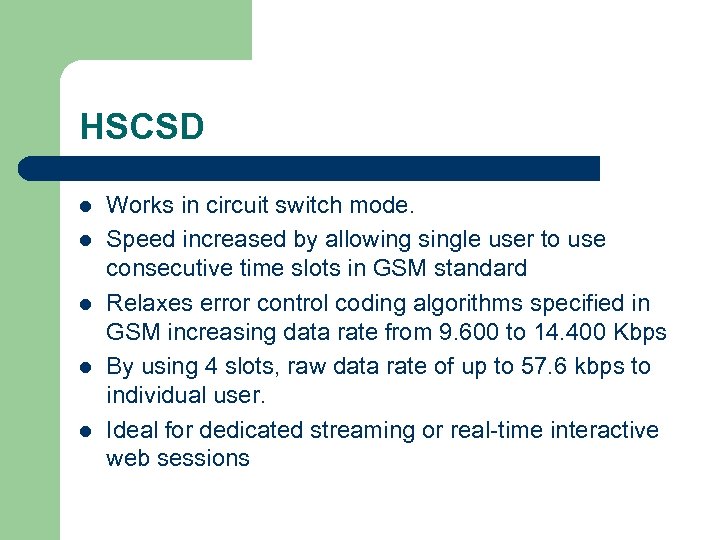 HSCSD l l l Works in circuit switch mode. Speed increased by allowing single user to use consecutive time slots in GSM standard Relaxes error control coding algorithms specified in GSM increasing data rate from 9. 600 to 14. 400 Kbps By using 4 slots, raw data rate of up to 57. 6 kbps to individual user. Ideal for dedicated streaming or real-time interactive web sessions
 GPRS l l l Packet-based data networks. Well-suited for non real-time traffic like email, faxes, web browsing Unlike HSCSD, GPRS allows multi-user channel sharing of individual radio channel and time slots and supports many more users. GPRS units are automatically instructed to tune to dedicated GPRS channels and particular time slots for always-on access. When all 8 slots are dedicated, data rate reaches to 171. 2 kbps (8 x 21. 4 kbps of raw un-coded data)
 EDGE (2. 75 G) l l l l More advanced upgrade to 2 G that requires addition of new hardware and software Developed as a path to become eventual 3 G high speed data access New modulation 8 -PSK in addition to GSM standard GMSK. Allows nine different formats known as Multiple modulation and Coding Scheme (MCS) Each MCS state may either use GMSK (low rate) or 8 -PSK (high rate). A family of MCS for each GSM slot and users can adaptively determine best MCS setting User start first with max error protection and max data rate until the link has unacceptable outage or delay By combining different channels (multi-carrier trans), EDGE
 IS-95 B or cdma. One l l l IS-95/CDMA has a single upgrade path IS-95 B for eventual 3 G operation. Dedicate multiple orthogonal user channels for specific users. IS-95 A support 64 users with data rate 14, 400 Kbps Medium data rate service by allowing user to command up to 8 Walsh codes. The raw data rate reaches to 8 x 14, 400 = 115. 2 kbps Supports hard handoff procedure – Allow units to search different radio channels without instruction from switch. User can rapidly tune to different BS.
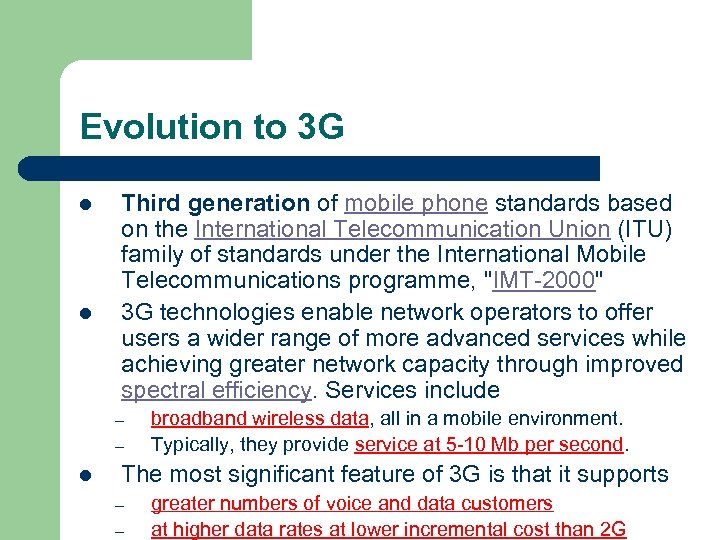 Evolution to 3 G l l Third generation of mobile phone standards based on the International Telecommunication Union (ITU) family of standards under the International Mobile Telecommunications programme, "IMT-2000" 3 G technologies enable network operators to offer users a wider range of more advanced services while achieving greater network capacity through improved spectral efficiency. Services include – – l broadband wireless data, all in a mobile environment. Typically, they provide service at 5 -10 Mb per second. The most significant feature of 3 G is that it supports – – greater numbers of voice and data customers at higher data rates at lower incremental cost than 2 G
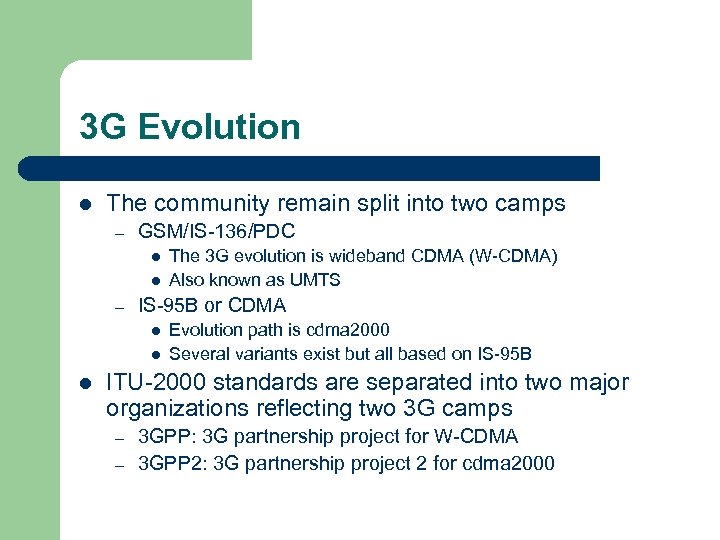 3 G Evolution l The community remain split into two camps – GSM/IS-136/PDC l l – IS-95 B or CDMA l l l The 3 G evolution is wideband CDMA (W-CDMA) Also known as UMTS Evolution path is cdma 2000 Several variants exist but all based on IS-95 B ITU-2000 standards are separated into two major organizations reflecting two 3 G camps – – 3 GPP: 3 G partnership project for W-CDMA 3 GPP 2: 3 G partnership project 2 for cdma 2000
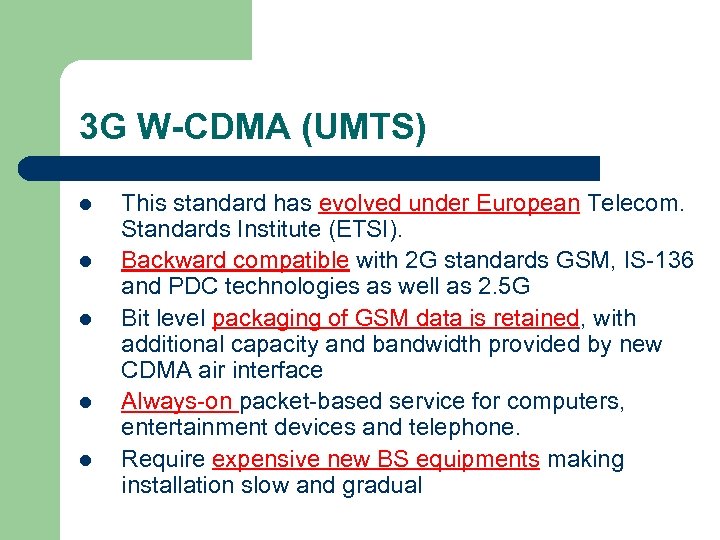 3 G W-CDMA (UMTS) l l l This standard has evolved under European Telecom. Standards Institute (ETSI). Backward compatible with 2 G standards GSM, IS-136 and PDC technologies as well as 2. 5 G Bit level packaging of GSM data is retained, with additional capacity and bandwidth provided by new CDMA air interface Always-on packet-based service for computers, entertainment devices and telephone. Require expensive new BS equipments making installation slow and gradual
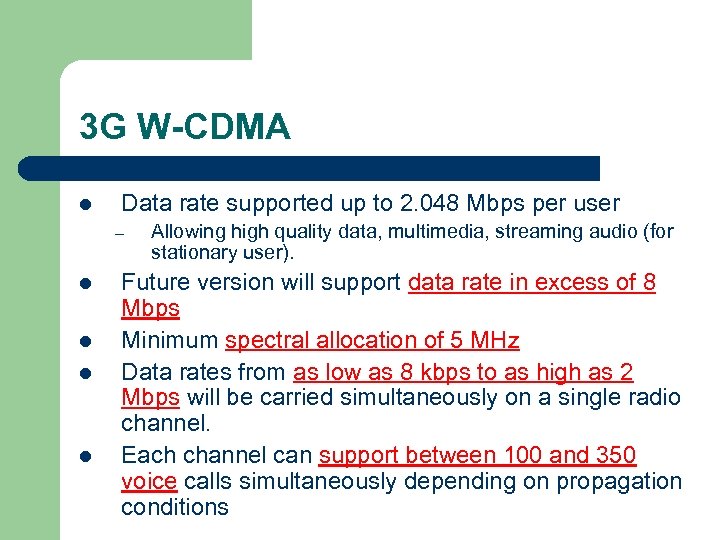 3 G W-CDMA l Data rate supported up to 2. 048 Mbps per user – l l Allowing high quality data, multimedia, streaming audio (for stationary user). Future version will support data rate in excess of 8 Mbps Minimum spectral allocation of 5 MHz Data rates from as low as 8 kbps to as high as 2 Mbps will be carried simultaneously on a single radio channel. Each channel can support between 100 and 350 voice calls simultaneously depending on propagation conditions
 3 G cdma 2000 l l l Provides seamless and evolutionary upgrade path for 2 G and 2. 5 G CDMA technology. Centers on original 1. 25 MHz radio channel CDMA operators may seamlessly and selectively upgrade without changing entire BS equipment The first 3 G CDMA standard cdma 2000 1 x. RTT usingle channel (1 x => multi-carrier) Cdma 2000 1 x – – supports data rate up to 307 kbps in packet mode Can support up to twice as many users as 2 G CDMA
 cdma 2000 – l No additional equipment needed, simply software and new channel cards at BS Cdma 2000 1 x. EV Evolution by Qualcomm – – Proprietary high data rate packet standard to be overlaid on existing CDMA 1 x. EC-DO dedicates the channel strictly to data user and support 2. 4 Mbps per channel.
 cdma 2000 l Cdma 2000 3 x. RTT – – – l The ultimate 3 G solution relies upon multicarrier that gang adjacent channels together into 3. 75 MHz. Three non-adjacent channels may be operated simultaneously and in parallel. Data rate in excess of 2 Mbps similar when compared to WCDMA Advocates of cdma 2000 claim their standard much more seamless and less expensive upgrade path when compared to W-CDMA.
 Limitations of 3 G l l l Difficulty of CDMA to provide higher data rates Need for continuously increasing data rate and bandwidth to meet the multimedia requirements Limitation of spectrum and it’s allocation Inability to roam between different services To provide a seamless transport end-to-end mechanism To introduce a better system with reduced cost
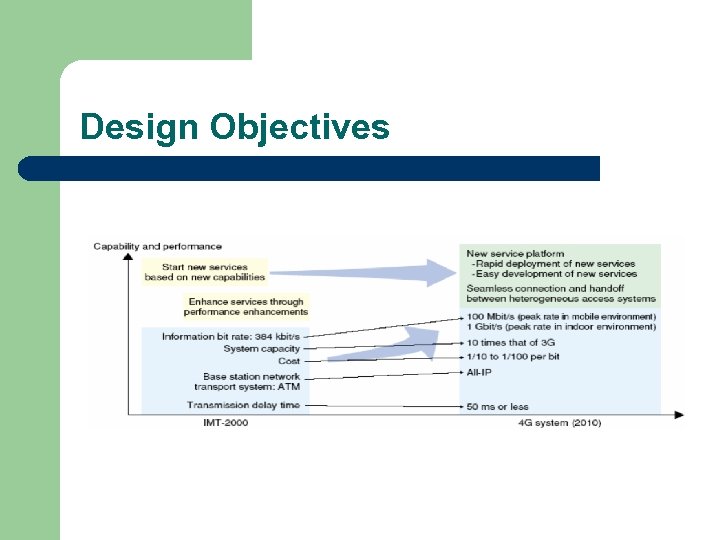
 4 G l l Provide a comprehensive IP solution where voice, data and streamed multimedia can be given to users on an "Anytime, Anywhere" basis, and at higher data rates than previous generations. No formal definition but certain objectives – – Fully IP-based integrated system Provides 100 Mbit/s and 1 Gbit/s speeds both indoors and outdoors, with premium quality and high security.
 4 G Objectives l l l l A spectrally efficient system (in bits/s/Hz and bit/s/Hz/site). A nominal data rate of 100 Mbit/s at higher relative speeds and 1 Gbit/s while client and station are in relatively fixed positions High network capacity: more simultaneous users per cell Smooth handoff across heterogeneous networks, Seamless connectivity and global roaming across multiple networks High quality of service for next generation multimedia support (real time audio, high speed data, HDTV video content, mobile TV, etc) Interoperability with existing wireless standards An all IP, packet switched network
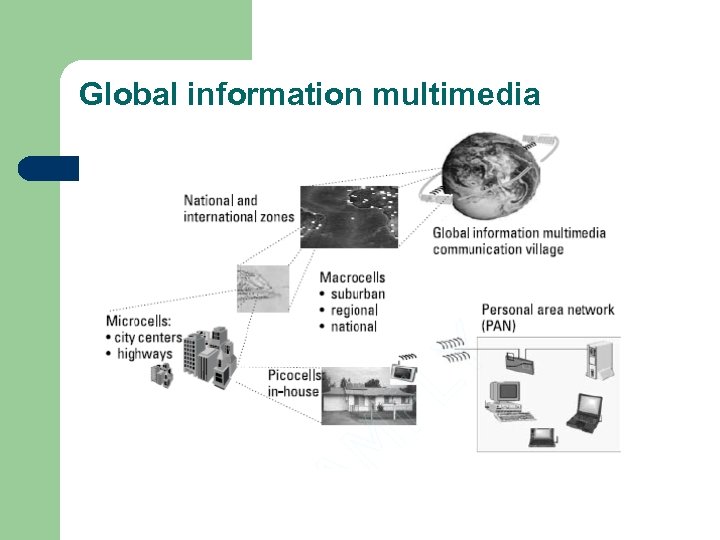 Global information multimedia communication village
 Convergence of High Speed Internet & Mobility a Major Driver of Future Wireless l l The Wireless Industry has grown at enormous pace over the past decade. Over 2. 5 billion subscribers to cellular services are enjoying the benefits of staying connected while on the move. With the growth in Internet, a wide range of services are accessed by users through a wired infrastructure. The introduction of mobile Internet brought about by the convergence of Mobile & Internet technologies is the future objective.
 4 G Concept “The user has freedom and flexibility to select any desired service with reasonable Qo. S and affordable price, anytime, anywhere. ”
 Design Objectives
 Heterogeneous Networks
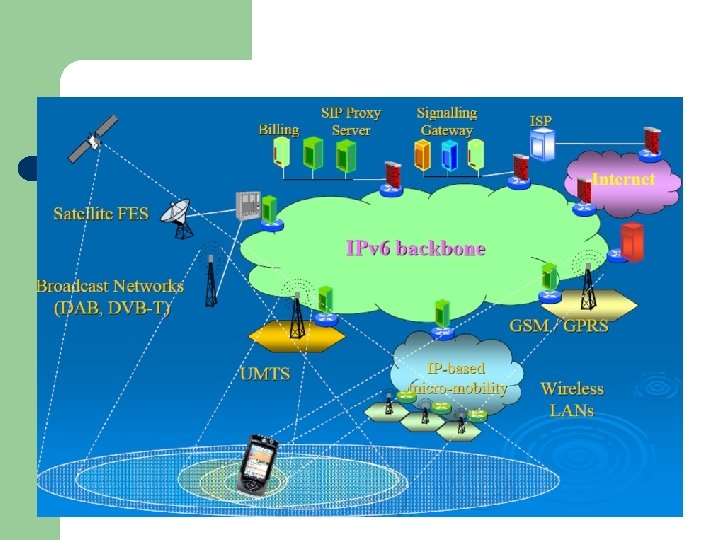
 Next Generation will also have specifically needs to resolve it’s own multiple issues l l l l Heterogeneous networks Access, handover Location coordination, resource coordination Adding new users Qo. S, wireless security and authentication Network failure backup Pricing and billing
 Quality of Service (Qo. S) l l Traffic generated by the different services will not only increase traffic loads on the networks, but will also require different quality of service (Qo. S) requirements (e. g. , cell loss rate, delay, and jitter) for different streams (e. g. , video, voice, data). Providing Qo. S guarantees in 4 G networks is a nontrivial issue where both Qo. S signalling across different networks and service differentiation between mobile flows will have to be addressed.
 Quality of Service l l One of the most difficult problems that are to be solved, when it comes to IP mobility, is how to insure the constant Qo. S level during the handover. Depending on whether the new access router is in the same or some other sub network, we recognize the horizontal and vertical handover.
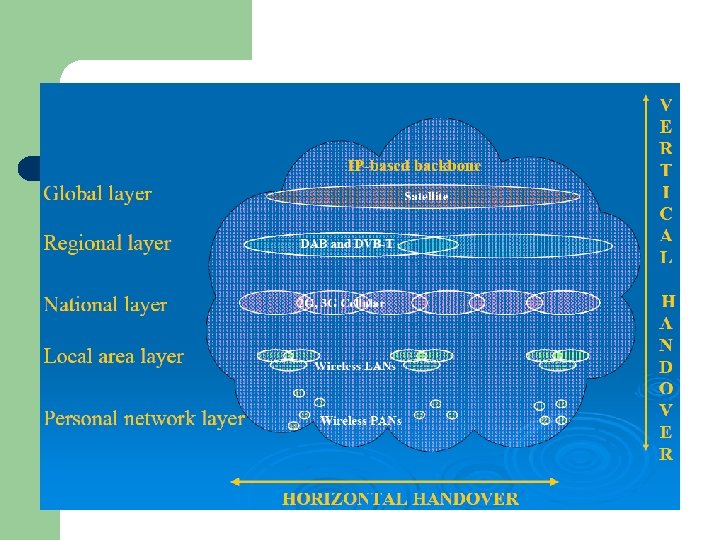 Hierarchical layer for 4 G
 Quality of Service l l However, the mobile terminal can not receive IP packets while the process of handover is finished. This time is called the handover latency. Handover latency has a great influence on the flow of multimedia applications in real-time. Mobile IPv 6 have been proposed to reduce the handover latency and the number of lost packets. The field “Traffic Class” and “Flow Label” in IPv 6 header enables the routers to secure the special Qo. S for specific packet series with marked priority.
 MULTIMEDIA – Video Services l l 4 G wireless systems are expected to deliver efficient multimedia services at very high data rates. Basically there are two types of video services: bursting and streaming video services. Streaming: is performed when a user requires realtime video services, in which the server delivers data continuously at a playback rate. Bursting: is basically file downloading using a buffer and this is done at the highest data rate taking advantage of the whole available bandwidth.
 Security l l Security in wireless networks mainly involves authentication, confidentiality, integrity, and authorization for the access of network connectivity and Qo. S resources for the mobile nodes flow. The heterogeneity of wireless networks complicates the security issue. Dynamic reconfigurable, adaptive, and lightweight security mechanisms should be developed. AAA (Authentication Authorization Auditing) protocols provide a framework for such suffered especially for control plane functions and installing security policies in the mobile node such as encryption, decryption and filtering.
 Convergence of Cellular Mobile Networks and WLANs Benefits for l Operators – – – l Higher bandwidths. Lower cost of networks and equipment. The use of licence-exempt spectrum. Higher capacity and Qo. S enhancement. Higher revenue. Users – – Access to broadband multimedia services with lower cost and where mostly needed. Inter-network roaming.
 Applications l l l Virtual Presence: This means that 4 G provides user services at all times, even if the user is off-site. Virtual navigation: 4 G provides users with virtual navigation through which a user can access a database of the streets, buildings etc. Tele-geoprocessing applications: This is a combination of GIS (Geographical Information System) and GPS (Global Positioning System) in which a user can get the location by querying.
 Applications l l Tele-Medicine and Education: 4 G will support remote health monitoring of patients. For people who are interested in life long education, 4 G provides a good opportunity. Crisis management: Natural disasters can cause break down in communication systems. In today’s world it might take days or 7 weeks to restore the system. But in 4 G it is expected to restore such crisis issues in a few hours.
 Multiple Operators and Billing System l l l In today’s communication market, an operator usually charges customers with a simple billing and accounting scheme. A flat rate based on subscribed services, call durations, and transferred data volume is usually enough in many situations. With the increase of service varieties in 4 G systems, more comprehensive billing and accounting systems are needed.
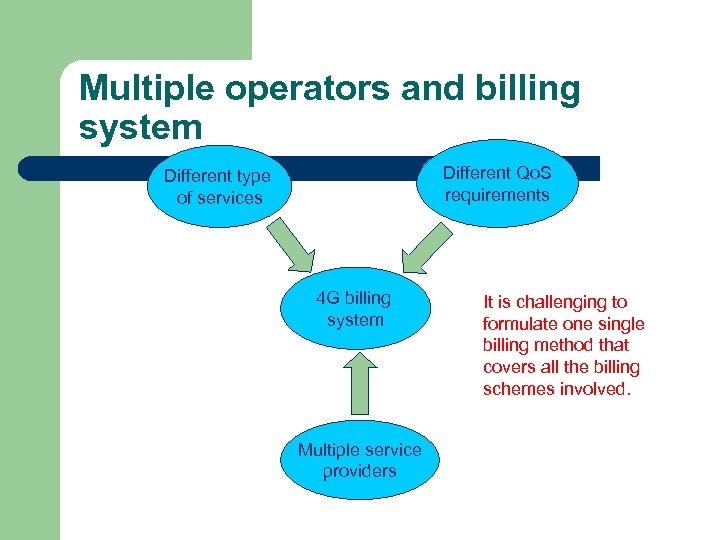 Multiple operators and billing system Different Qo. S requirements Different type of services 4 G billing system Multiple service providers It is challenging to formulate one single billing method that covers all the billing schemes involved.
 3 G TD-SCDMA l l l l In china, more than 8 millions GSM subscribers were added in just 1 month. china’s desire to craft its own wireless vision. Chinese CATT and Siemens jointly submitted IMT 2000 3 G standard based on Time Division Synchronous Code Division Multiple Access Relies on existing GSM infrastructure 1. 6 MHz channel and smart antennas to yield more spectral efficiency. 5 ms frames divided into 7 slots allocated to single data only user or several slow users TD-SCDMA allows easy upgrade to GSM.