


 Скачать презентацию WINTER Current state of regulation Template related to
569ee10ed5951e67799b06e71965173f.ppt
- Количество слайдов: 24
 WINTER Current state of regulation Template related to radon and the monitoring program in the Russian Federation Saint-Petersburg Research Institute of Radiation Hygiene after Professor P. V. Ramzaev Dmitrii Kononenko, researcher
 Responsible Authorities Federal Service for Surveillance on Consumer Rights Protection and Human Well-being (Rospotrebnadzor) Federal Biomedical Agency (FMBA)
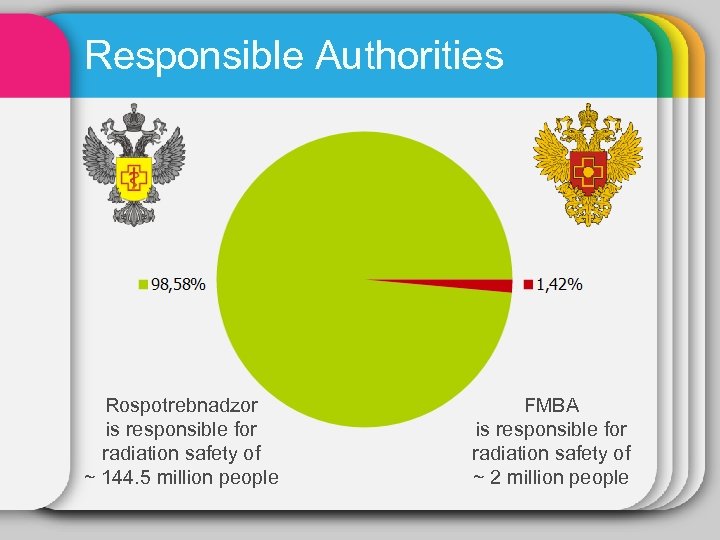 Responsible Authorities Rospotrebnadzor is responsible for radiation safety of ~ 144. 5 million people FMBA is responsible for radiation safety of ~ 2 million people
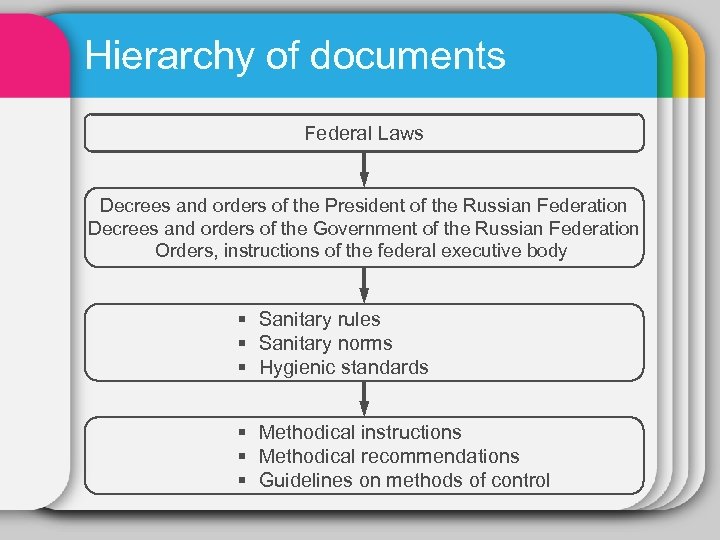 Hierarchy of documents Federal Laws Decrees and orders of the President of the Russian Federation Decrees and orders of the Government of the Russian Federation Orders, instructions of the federal executive body § Sanitary rules § Sanitary norms § Hygienic standards § Methodical instructions § Methodical recommendations § Guidelines on methods of control
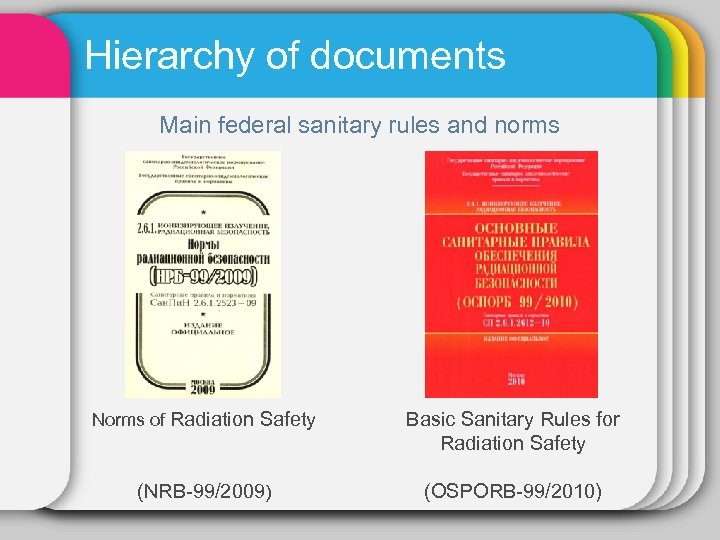 Hierarchy of documents Main federal sanitary rules and norms Norms of Radiation Safety Basic Sanitary Rules for Radiation Safety (NRB-99/2009) (OSPORB-99/2010)
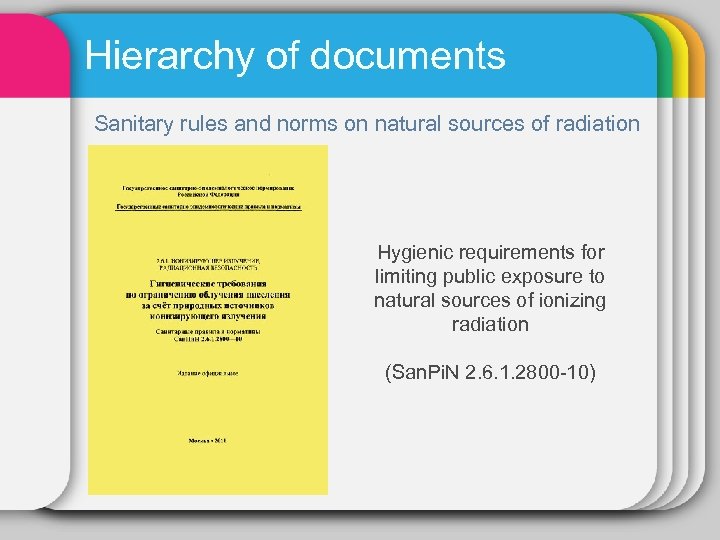 Hierarchy of documents Sanitary rules and norms on natural sources of radiation Hygienic requirements for limiting public exposure to natural sources of ionizing radiation (San. Pi. N 2. 6. 1. 2800 -10)
 Changes in regulation In 2014 -2016 there were no major changes in the regulation related to radon. New sanitary rules: § “Hygienic requirements for the placement, arrangement, equipment and operation of radon laboratories, radon therapy departments” (SP 2. 6. 1. 3247 -15) Draft methodical recommendations: § “Organization and conducting of radiation survey for justification of radon mitigation actions in dwellings and public buildings” (2019) § “Development of regional programs to reduce public exposure levels in the regions of the Russian Federation due to natural sources of ionizing radiation” (2018)
 Changes in regulation Draft methodical recommendations: § “Organization and conducting of radiation monitoring in radon laboratories and radon therapy departments (radon clinics)” (2017 -2018) Projects of methodical recommendations: § “Risk assessment for the population from residential exposure to radon and its progeny” (2018 -2019)
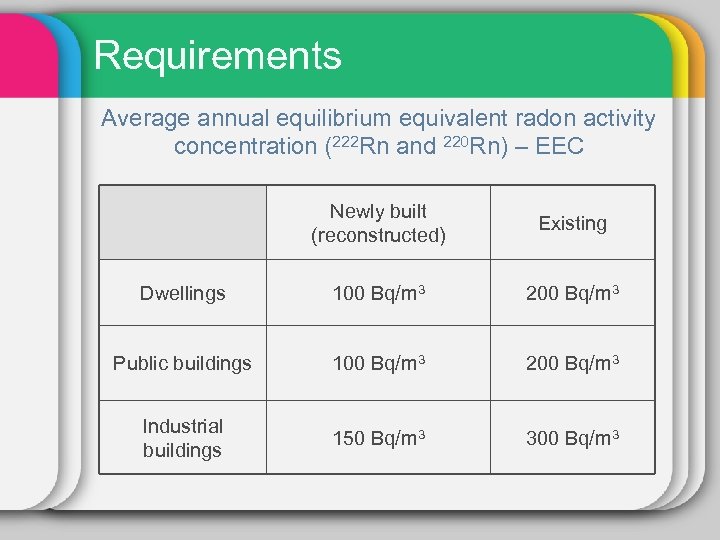 Requirements Average annual equilibrium equivalent radon activity concentration (222 Rn and 220 Rn) – EEC Newly built (reconstructed) Existing Dwellings 100 Bq/m 3 200 Bq/m 3 Public buildings 100 Bq/m 3 200 Bq/m 3 Industrial buildings 150 Bq/m 3 300 Bq/m 3
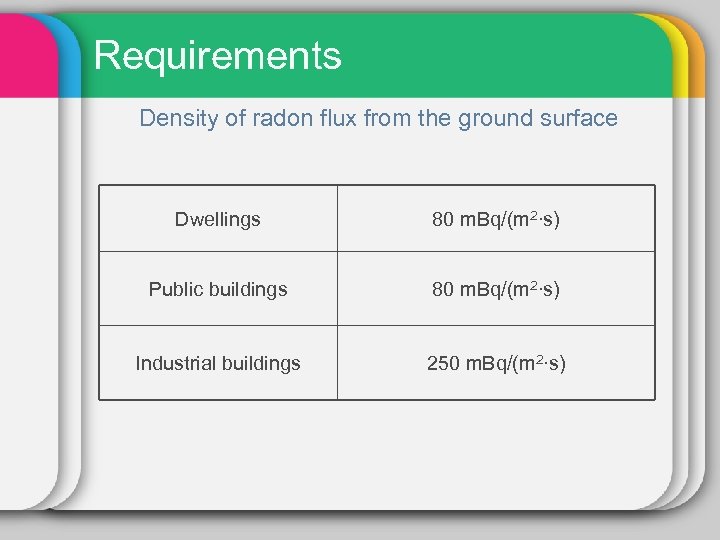 Requirements Density of radon flux from the ground surface Dwellings 80 m. Bq/(m 2∙s) Public buildings 80 m. Bq/(m 2∙s) Industrial buildings 250 m. Bq/(m 2∙s)
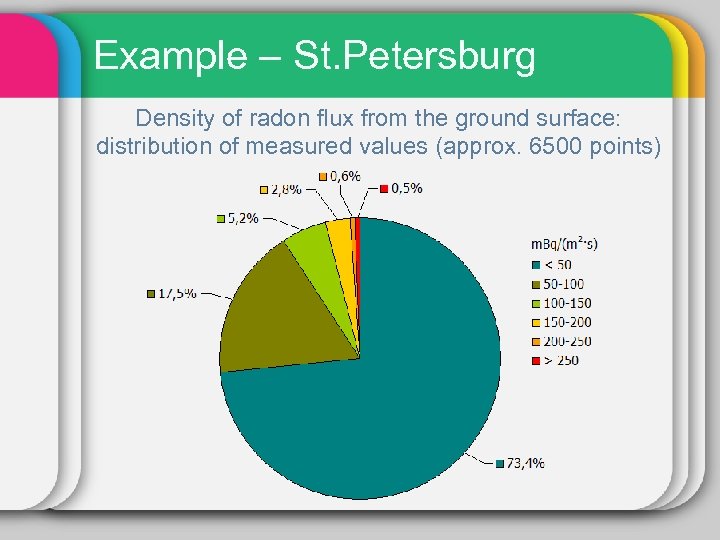 Example – St. Petersburg Density of radon flux from the ground surface: distribution of measured values (approx. 6500 points)
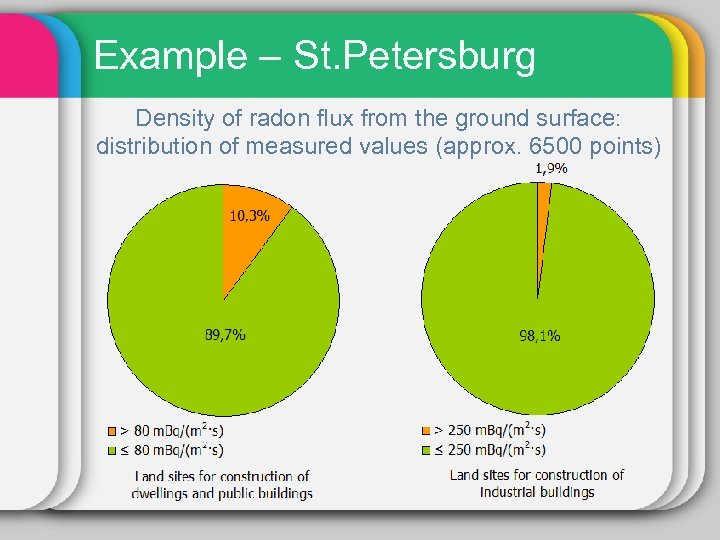 Example – St. Petersburg Density of radon flux from the ground surface: distribution of measured values (approx. 6500 points)
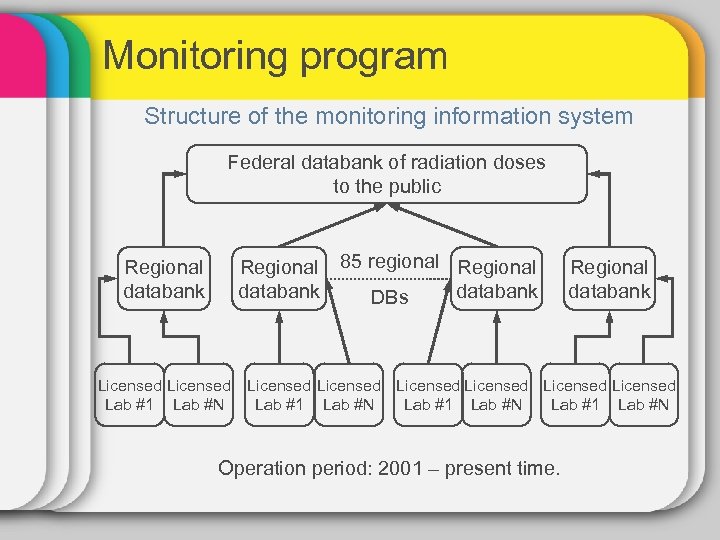 Monitoring program Structure of the monitoring information system Federal databank of radiation doses to the public Regional databank Licensed Lab #1 Lab #N 85 regional Regional databank DBs Regional databank Licensed Licensed Lab #1 Lab #N Operation period: 2001 – present time.
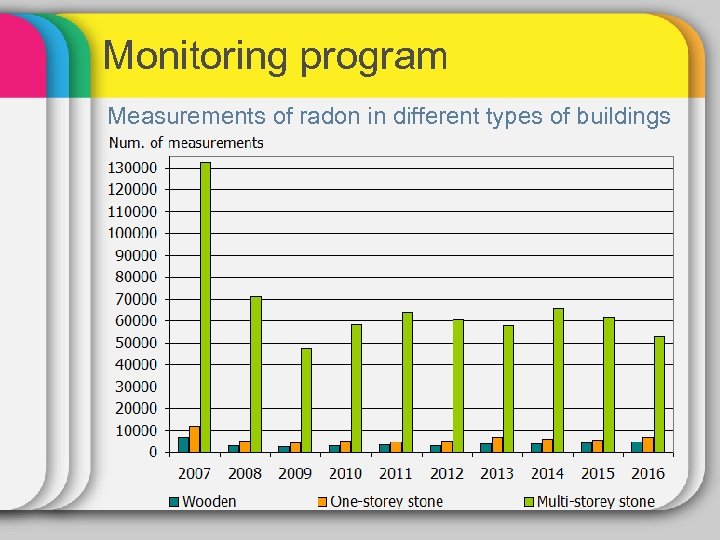 Monitoring program Measurements of radon in different types of buildings
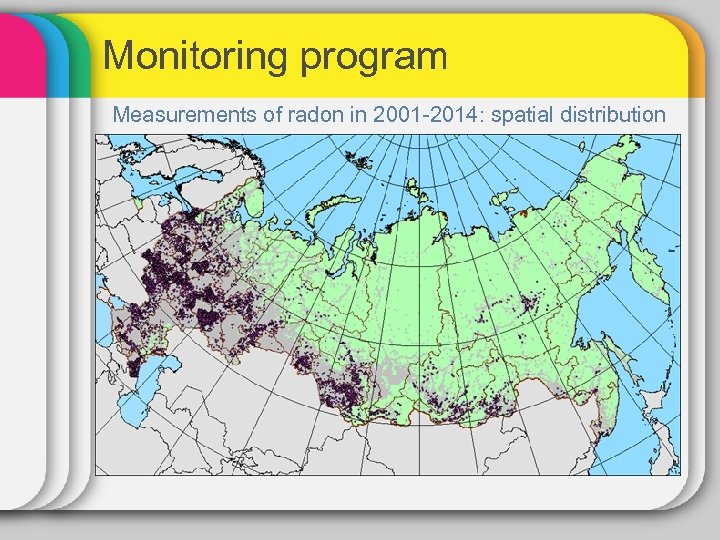 Monitoring program Measurements of radon in 2001 -2014: spatial distribution
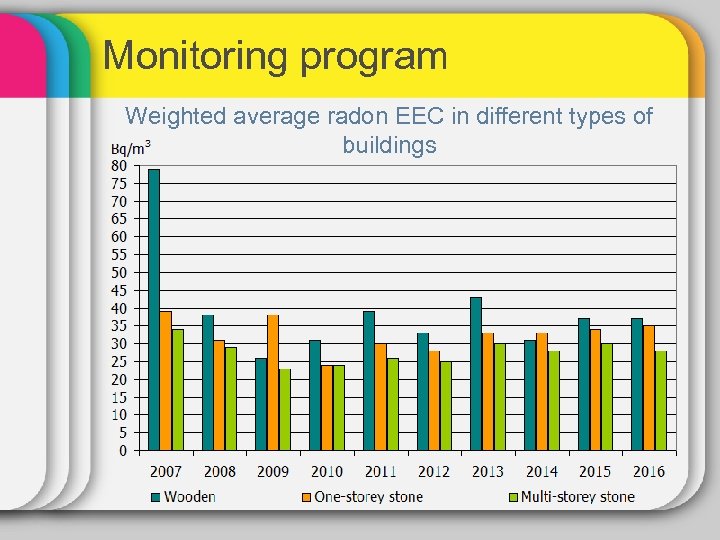 Monitoring program Weighted average radon EEC in different types of buildings
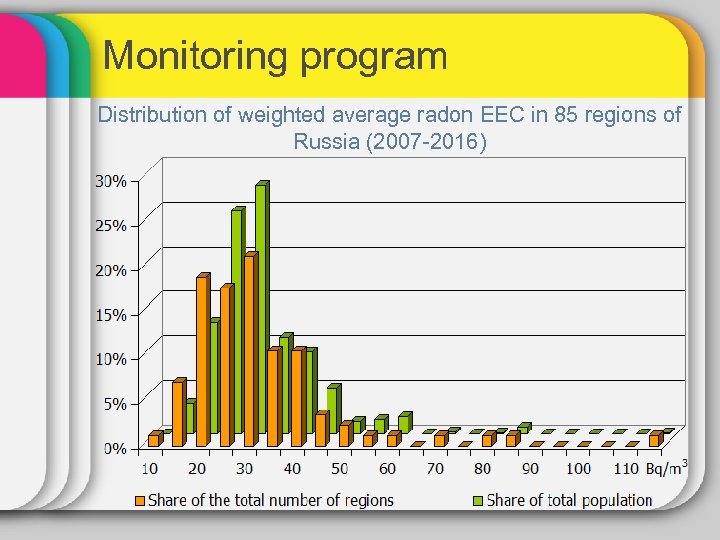 Monitoring program Distribution of weighted average radon EEC in 85 regions of Russia (2007 -2016)
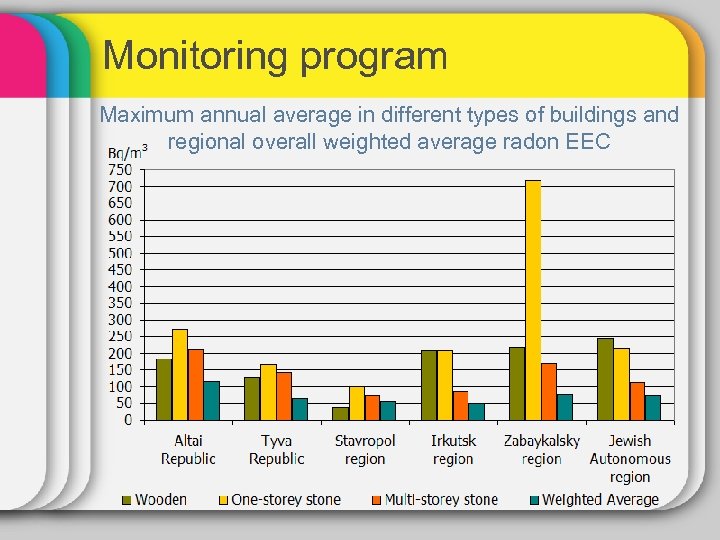 Monitoring program Maximum annual average in different types of buildings and regional overall weighted average radon EEC
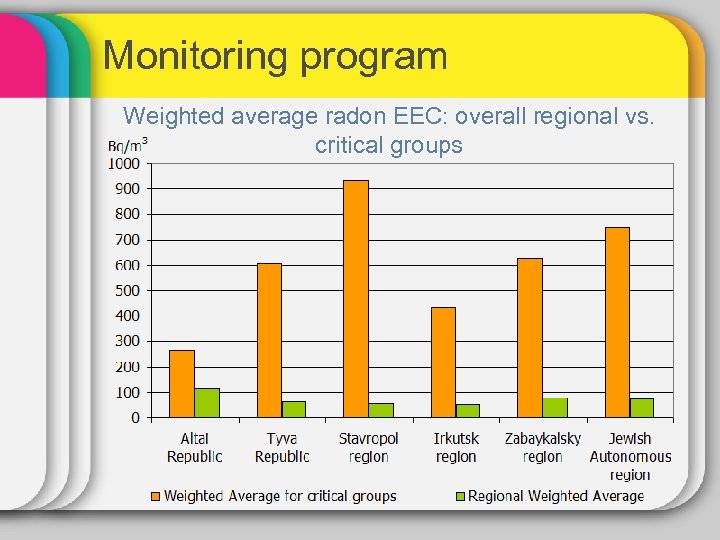 Monitoring program Weighted average radon EEC: overall regional vs. critical groups
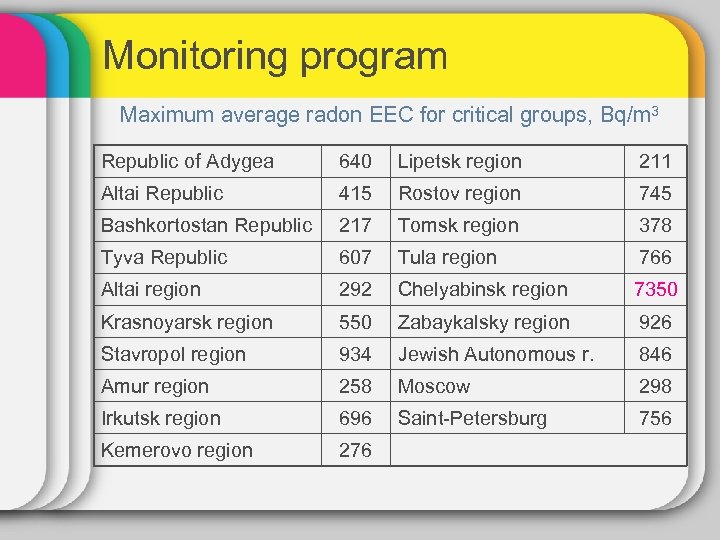 Monitoring program Maximum average radon EEC for critical groups, Bq/m 3 Republic of Adygea 640 Lipetsk region 211 Altai Republic 415 Rostov region 745 Bashkortostan Republic 217 Tomsk region 378 Tyva Republic 607 Tula region 766 Altai region 292 Chelyabinsk region 7350 Krasnoyarsk region 550 Zabaykalsky region 926 Stavropol region 934 Jewish Autonomous r. 846 Amur region 258 Moscow 298 Irkutsk region 696 Saint-Petersburg 756 Kemerovo region 276
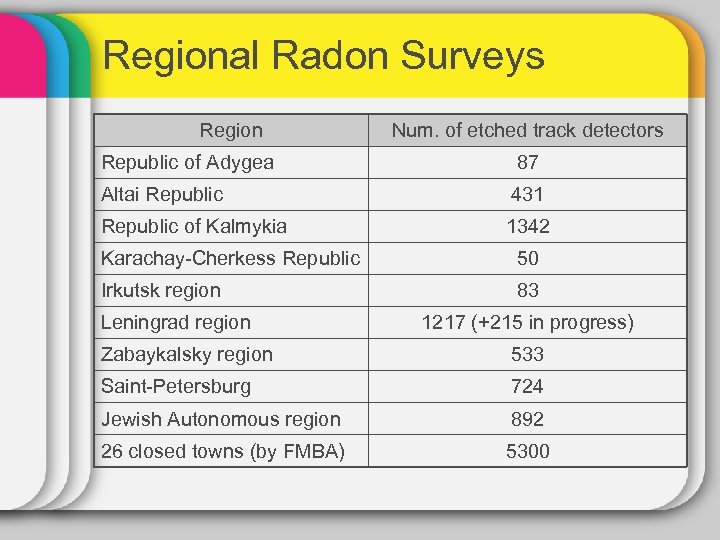 Regional Radon Surveys Region Num. of etched track detectors Republic of Adygea 87 Altai Republic 431 Republic of Kalmykia 1342 Karachay-Cherkess Republic 50 Irkutsk region 83 Leningrad region 1217 (+215 in progress) Zabaykalsky region 533 Saint-Petersburg 724 Jewish Autonomous region 892 26 closed towns (by FMBA) 5300
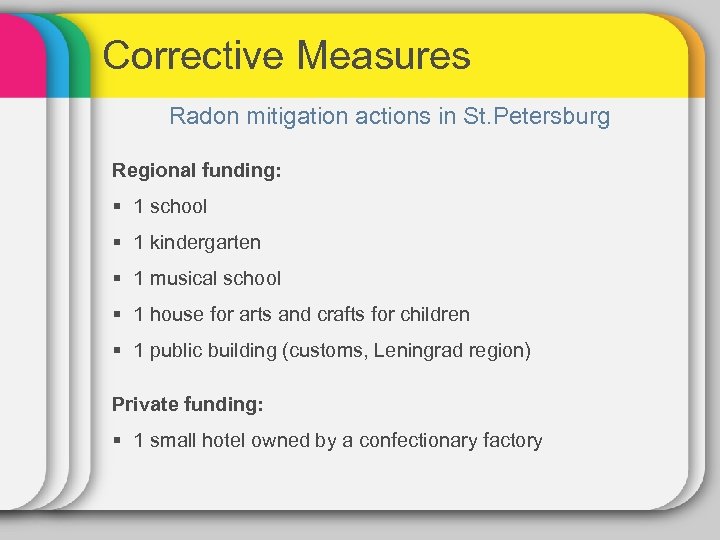 Corrective Measures Radon mitigation actions in St. Petersburg Regional funding: § 1 school § 1 kindergarten § 1 musical school § 1 house for arts and crafts for children § 1 public building (customs, Leningrad region) Private funding: § 1 small hotel owned by a confectionary factory
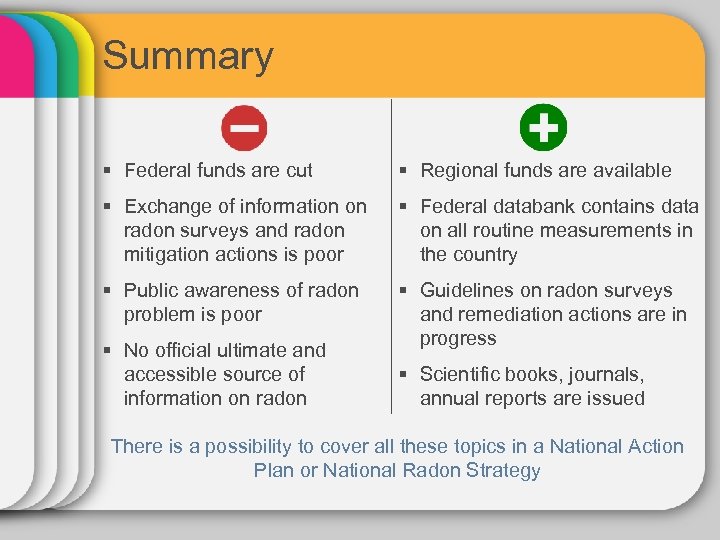 Summary § Federal funds are cut § Regional funds are available § Exchange of information on radon surveys and radon mitigation actions is poor § Federal databank contains data on all routine measurements in the country § Public awareness of radon problem is poor § Guidelines on radon surveys and remediation actions are in progress § No official ultimate and accessible source of information on radon § Scientific books, journals, annual reports are issued There is a possibility to cover all these topics in a National Action Plan or National Radon Strategy
 THANK YOU FOR ATTENTION! e-mail: d. kononenko@niirg. ru