


 Скачать презентацию winner in literature 2015 ХУДОЖЕСТВЕННО-ДОКУМЕНТАЛЬНЫЙ ЦИКЛ РОМАНОВ ГОЛОСА
Reliability Validity.pptx
- Количество слайдов: 38
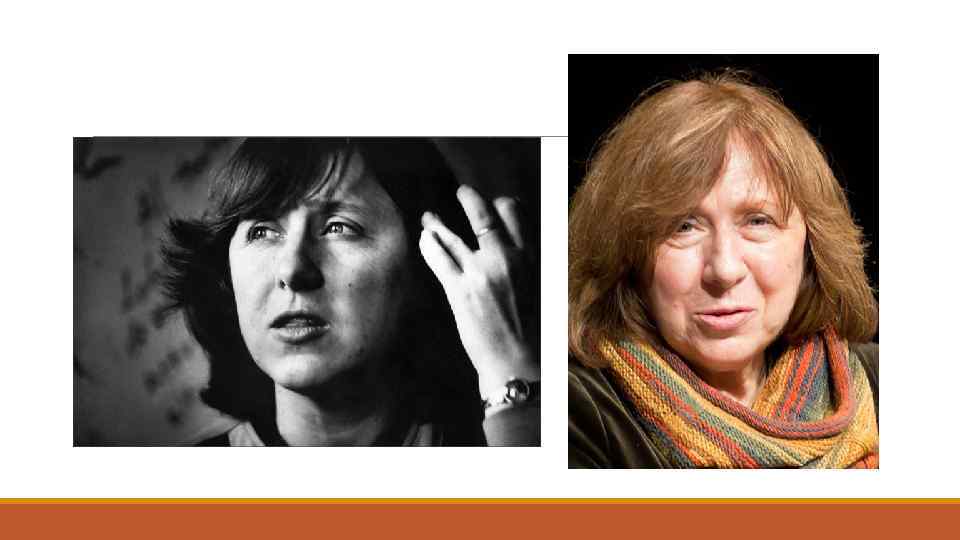
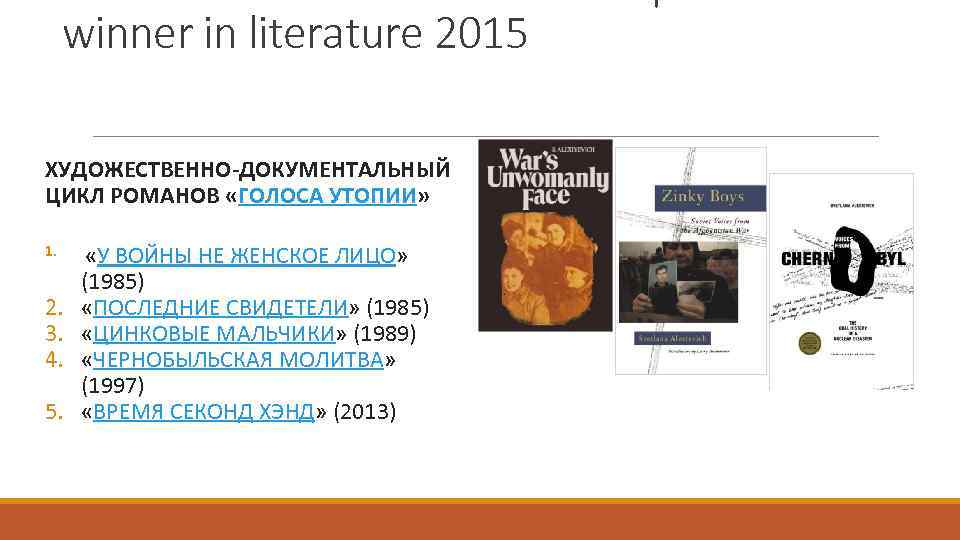 winner in literature 2015 ХУДОЖЕСТВЕННО-ДОКУМЕНТАЛЬНЫЙ ЦИКЛ РОМАНОВ «ГОЛОСА УТОПИИ» 1. 2. 3. 4. 5. «У ВОЙНЫ НЕ ЖЕНСКОЕ ЛИЦО» (1985) «ПОСЛЕДНИЕ СВИДЕТЕЛИ» (1985) «ЦИНКОВЫЕ МАЛЬЧИКИ» (1989) «ЧЕРНОБЫЛЬСКАЯ МОЛИТВА» (1997) «ВРЕМЯ СЕКОНД ХЭНД» (2013)
 Oral histories "I'm writing a history of human feelings, " Alexievich says. "What people thought, understood and remembered during the event. What they believed in or mistrusted, what illusions, hopes and fears they experienced. This is impossible to imagine or invent, at any rate in such multitude of real details. "
 У войны неженское лицо «Мама, что такое – папа? » …Удивленно и растерянно встретила меня Александра Семеновна Масаковская, в войну рядовая, повар: "Мы не стреляли. Я не стреляла. Кашу солдатам варила. За это дали медаль. Я о ней и не вспоминаю: разве я воевала? Кашу варила, солдатский суп. Тягала котлы, баки. Тяжелые-тяжелые… Командир, помню, говорил: «Я бы пострелял эти баки… Как ты рожать после войны будешь? » И однажды взял все баки — пострелял. Пришлось в каком-то поселке искать баки поменьше. Придут солдатики с передовой, отдых им дадут. Бедненькие, все грязные, измученные, ноги, руки — все обмороженное. Особенно боялись морозов узбеки, таджики. У них же солнце всегда, тепло, а тут тридцать — сорок градусов мороза. Не может отогреться, кормишь его. Он сам ложки не поднесет ко рту".
 Цинковые мальчики …На автобусной станции в полупустом зале ожидания сидел офицер с дорожным чемоданом, рядом с ним худой мальчишка, подстриженный под солдатскую нулёвку, копал вилкой в ящике с засохшим фикусом. Бесхитростно подсели к ним деревенские женщины, выспросили: куда, зачем, кто? Офицер сопровождал домой солдата, сошедшего с ума: «С Кабула копает, что попадёт в руки, тем и копает: лопатой, вилкой, палкой, авторучкой» . Мальчишка поднял голову: «Прятаться надо… Я вырою щель… У меня быстро получается… Мы называли их братскими могилами… Большую щель для всех вас выкопаю…» Первый раз я увидела зрачки величиной с глаз…
 Алексиевич: О чем говорят вокруг меня? О чем пишут? Об интернациональном долге, о геополитике, о наших державных интересах, о южных границах. Глухо ходят слухи о похоронках в панельных домах и сельских хатах с мирными геранями на окнах, о цинковых гробах, не вмещающихся в «пенальных» размерах «хрущевок» . Матери, ещё недавно в отчаянии бившиеся над слепыми железными ящиками, выступают в коллективах, в школах, призывая других мальчиков «выполнить долг перед Родиной» . Цензура внимательно следит, чтобы в военных очерках не упоминалось о гибели наших солдат, нас заставляют верить, что «ограниченный контингент советских войск» помогает братскому народу строить дороги, развозить удобрение по кишлакам, а советские военврачи принимают роды у афганских женщин. И многие верят. Вернувшиеся солдаты приносят в школы гитары, чтобы спеть о том, о чем надо кричать…
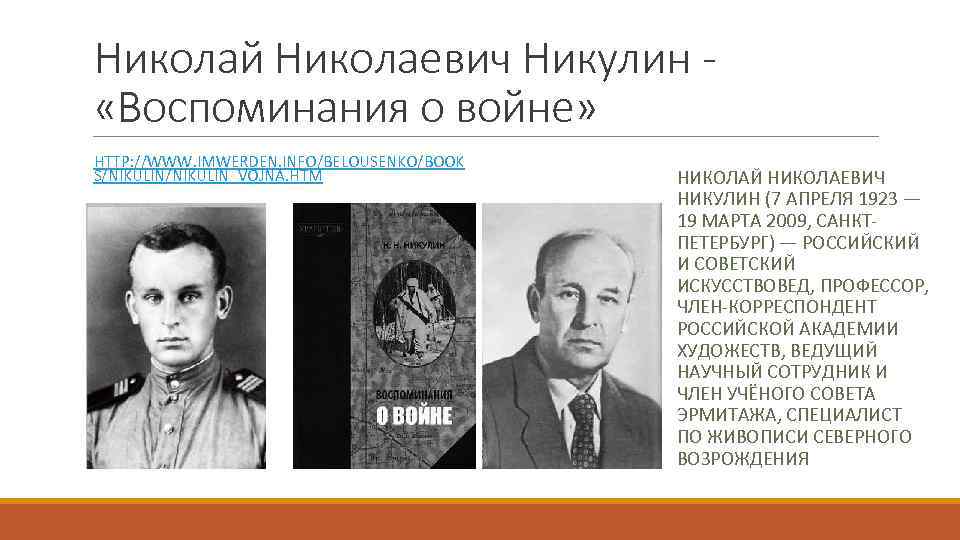 Николай Николаевич Никулин «Воспоминания о войне» HTTP: //WWW. IMWERDEN. INFO/BELOUSENKO/BOOK S/NIKULIN_VOJNA. HTM НИКОЛАЙ НИКОЛАЕВИЧ НИКУЛИН (7 АПРЕЛЯ 1923 — 19 МАРТА 2009, САНКТПЕТЕРБУРГ) — РОССИЙСКИЙ И СОВЕТСКИЙ ИСКУССТВОВЕД, ПРОФЕССОР, ЧЛЕН-КОРРЕСПОНДЕНТ РОССИЙСКОЙ АКАДЕМИИ ХУДОЖЕСТВ, ВЕДУЩИЙ НАУЧНЫЙ СОТРУДНИК И ЧЛЕН УЧЁНОГО СОВЕТА ЭРМИТАЖА, СПЕЦИАЛИСТ ПО ЖИВОПИСИ СЕВЕРНОГО ВОЗРОЖДЕНИЯ
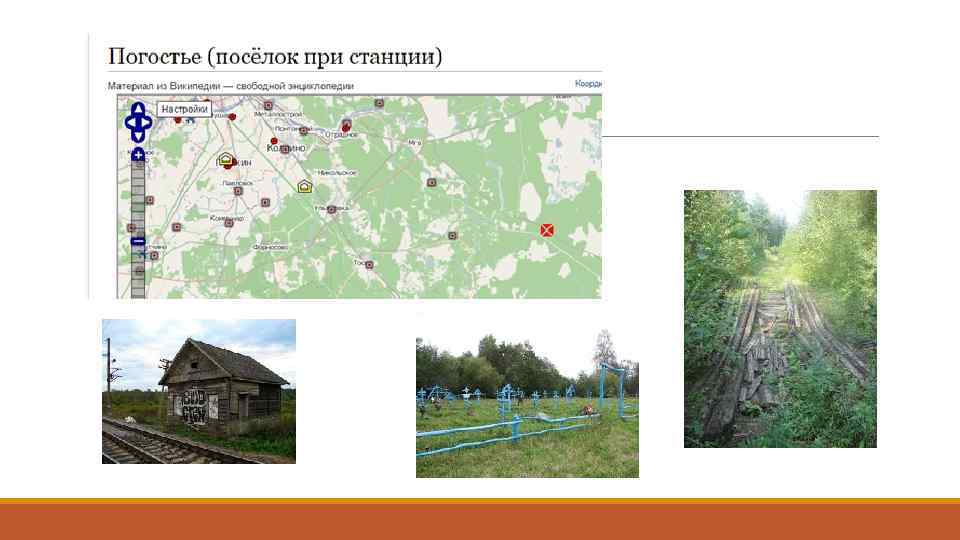
 Погостье Черепа и трудодни В годы войны для погребения погибших при воинских частях были созданы похоронные команды. После войны захоронением останков занималось в основном местное население. При этом изданные в Москве положения и инструкции на местах иногда исполнялись своеобразно. "Пришла нам в деревню разнарядка собрать останки. Глава сельсовета сказал, что будет считать по черепам. Ну, мы пошли и понабрали мешок черепов. Все ж на поверхности лежало", - рассказывает Михаил Смирнов из деревни Погостье. "Сколько голов принесли, столько трудодней и засчитали. А за каждый трудодень либо выходной, либо продуктами, либо копеечка капнула. Они все равно уже мертвые, а нам семью было кормить", - продолжает он. Лес в отличие от полей почти не разминировали, поэтому еще долго после войны местные жители ходили в чащу только по большой необходимости. "Когда совсем голодно было, собирались человек по десять и шли в лес искать еду у убитых. У немцев вот был консервированный хлеб. Очень вкусный. И у наших в вещмешках иногда что-то было. Может и нехорошо это, а как выжить было? "- вспоминает Александр Носков, работавший на железной дороге близ Погостья. "Весь лес в снарядах да гранатах был, - рассказывает он. - Это я уже постарше был. А мальчишками-то в войнушку настоящими пистолетами да обрезами играли. И гранату я в школу приносил". Погибшие солдаты еще долго помогали тем, кто выжил. С убитых снимали ватники и шинели, чтобы сшить себе одежду. Найденное оружие, ордена и медали прятали на чердаках или продавали. Позже, когда появился спрос на немецкие каски и знаки отличия, стали вытаскивать и их. А вот останки прежних хозяев всех этих вещей продолжали лежать в лесах. "Каждый год находим такие братские захоронения. Бойцы лежат с личными вещами, с медальонами. Начинаем проверять по базе данных, а они якобы захоронены. Только на мемориалах в десятках километров отсюда", - говорит Александр Коноплев, руководитель Всероссийского информационнопоискового центра "Отечество".
 Research Strategies and Designs
 Scientific Method This involves… q q q q q isolating the problem -- why this research is important and worth doing literature review concepts operationalization forming research questions and hypothesis/hypotheses building a research design collecting the data analyzing the data collected making generalizations writing report presenting and or publishing results
 Qualitative and Quantitative methods of research (Hard and Soft methods) q Quantitative – we can estivate numerical parameters, such as quantity, number, share q Experiments (classical and quasi) q Surveys (standardized questionnaires) q Secondary data analysis q Structured observation q Hall-tests q Ghost purchaser q We can get a deeper understanding of what is happening q Interviews q Focus groups q Participant observation
 Mixed methods, triangulation q Combination of qualitative and quantitative methods q Pilot study with quantitative methods q Research for Lenergo power company q. What kind of associations people have with Lenenergo brand (appeared to be very positive) q Interviews: negative impression of permanent organizational restructuring q Interviews with former clients of Gallup SPb research company
 One or several measurements q Cross-sections q. Longitudes q Panels q. Buying Chinese products (e. g. smartphones) q Attrition problem q Floating panels
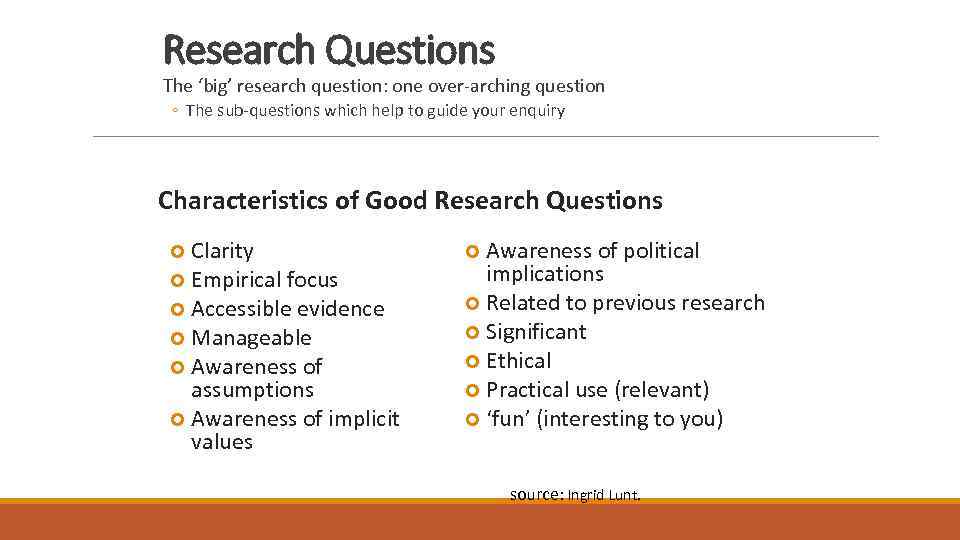 Research Questions The ‘big’ research question: one over-arching question ◦ The sub-questions which help to guide your enquiry Characteristics of Good Research Questions Clarity Empirical focus Accessible evidence Manageable Awareness of assumptions Awareness of implicit values Awareness of political implications Related to previous research Significant Ethical Practical use (relevant) ‘fun’ (interesting to you) source: Ingrid Lunt.
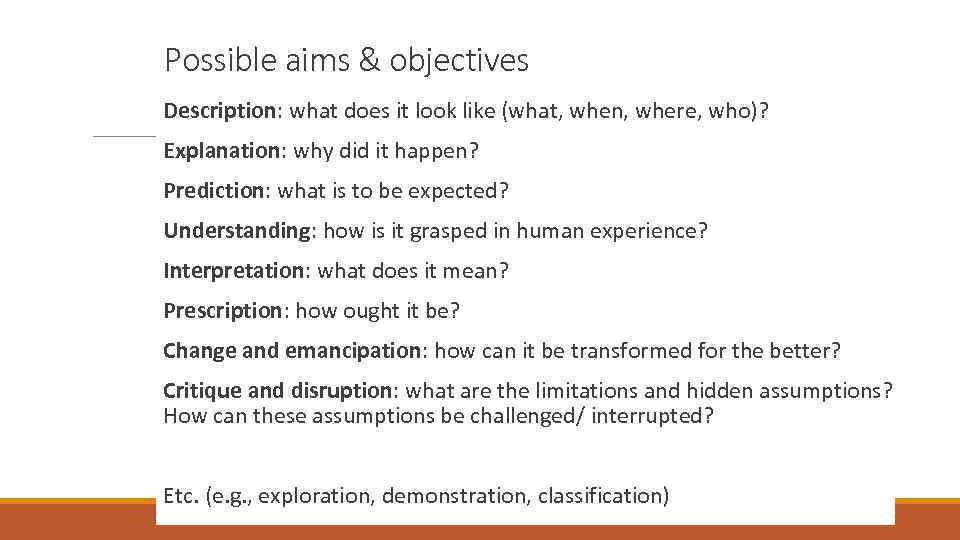 Possible aims & objectives Description: what does it look like (what, when, where, who)? Explanation: why did it happen? Prediction: what is to be expected? Understanding: how is it grasped in human experience? Interpretation: what does it mean? Prescription: how ought it be? Change and emancipation: how can it be transformed for the better? Critique and disruption: what are the limitations and hidden assumptions? How can these assumptions be challenged/ interrupted? Etc. (e. g. , exploration, demonstration, classification)
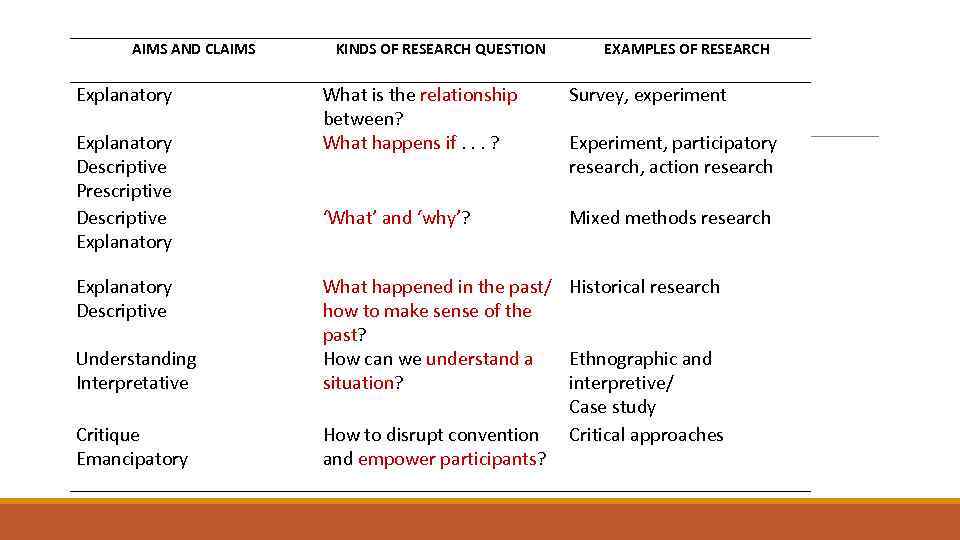 AIMS AND CLAIMS Explanatory Descriptive Prescriptive Descriptive Explanatory Descriptive Understanding Interpretative Critique Emancipatory KINDS OF RESEARCH QUESTION EXAMPLES OF RESEARCH What is the relationship between? What happens if. . . ? Survey, experiment ‘What’ and ‘why’? Mixed methods research Experiment, participatory research, action research What happened in the past/ Historical research how to make sense of the past? How can we understand a Ethnographic and situation? interpretive/ Case study How to disrupt convention Critical approaches and empower participants?
 Reliability q Retest q Different forms (versions of test) – ЕГЭ q Split test
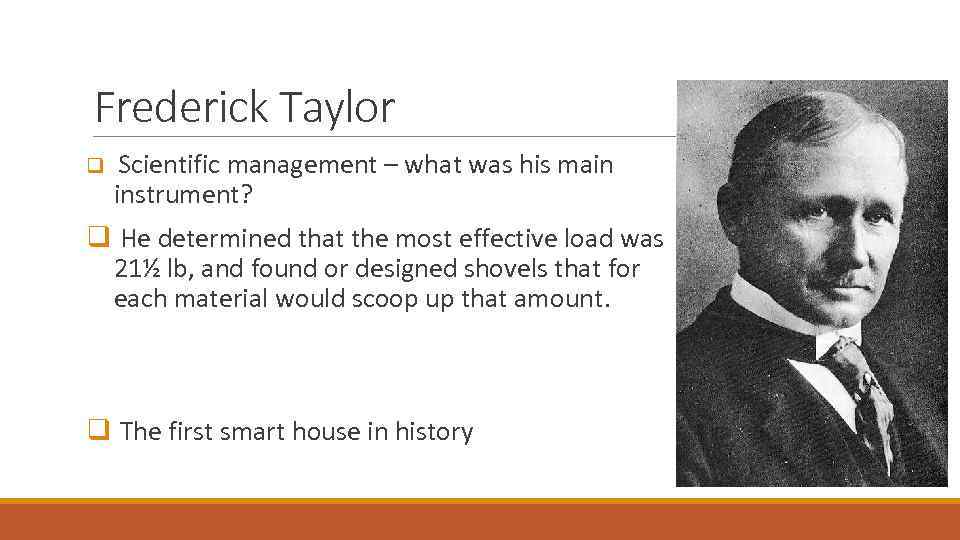 Frederick Taylor q Scientific management – what was his main instrument? q He determined that the most effective load was 21½ lb, and found or designed shovels that for each material would scoop up that amount. q The first smart house in history
 Four principles of the scientific management Managers should: First. They develop a science for each element of a man’s work, which replaces the old rule-of thumb method. Second. They scientifically select and then train, teach, and develop the workman, whereas in the past he chose his own work and trained himself as best he could. Third. They heartily cooperate with the men so as to insure all of the work being done in accordance with the principles of the science which has been developed. Fourth. There is an almost equal division of the work and the responsibility between the management and the workmen. The management take over all work for which they are better fitted than the workmen, while in the past almost all of the work and the greater part of the responsibility were thrown upon the men.
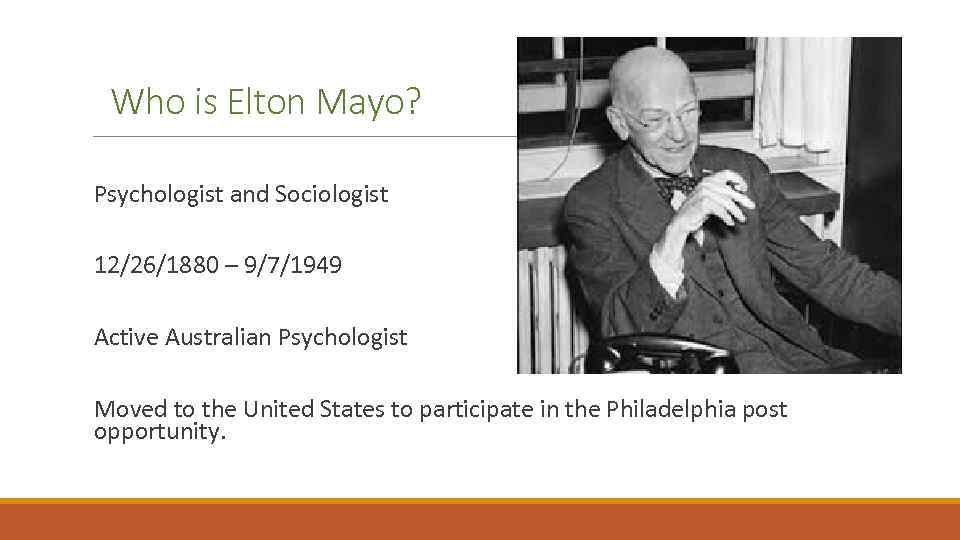 Who is Elton Mayo? Psychologist and Sociologist 12/26/1880 – 9/7/1949 Active Australian Psychologist Moved to the United States to participate in the Philadelphia post opportunity.
 Mayo’s Journey Adelaide University of Queensland Pennsylvania University Harvard Business School Retirement British Government Advisor
 Hawthorne Experiment (in fact quasiexperiment before/after) 1924 -1927 Funded by General Electric Conducted by The National Research Council (NRC) of the National Academy of Sciences with engineers from MIT Measured Light Intensity vs. Worker Output Result : ◦ Higher worker productivity and satisfaction at … all light levels Conclusions: ◦ Light intensity has no conclusive effect on output ◦ Productivity has a psychological component Concept of “Hawthorne Effect” was created


 Relay Assembly Test Experiments – Sociometry – Global reform 1927 -1929 Manipulated factors of production to measure effect on output: ◦ Pay Incentives ◦ Length of Work Day & Work Week ◦ Use of Rest Periods ◦ Company Sponsored Meals Results: ◦ Higher output and greater employee satisfaction Conclusions: ◦ Positive effects even with negative influences – workers’ output will increase as a response to attention ◦ Strong social bonds were created within the test group. Workers are influenced by need for recognition, security and sense of belonging
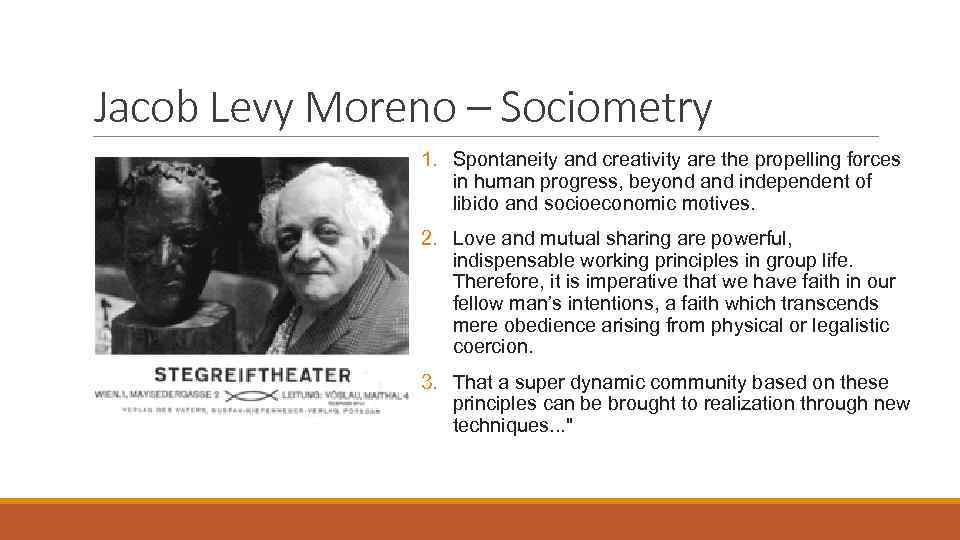 Jacob Levy Moreno – Sociometry 1. Spontaneity and creativity are the propelling forces in human progress, beyond and independent of libido and socioeconomic motives. 2. Love and mutual sharing are powerful, indispensable working principles in group life. Therefore, it is imperative that we have faith in our fellow man’s intentions, a faith which transcends mere obedience arising from physical or legalistic coercion. 3. That a super dynamic community based on these principles can be brought to realization through new techniques. . . "
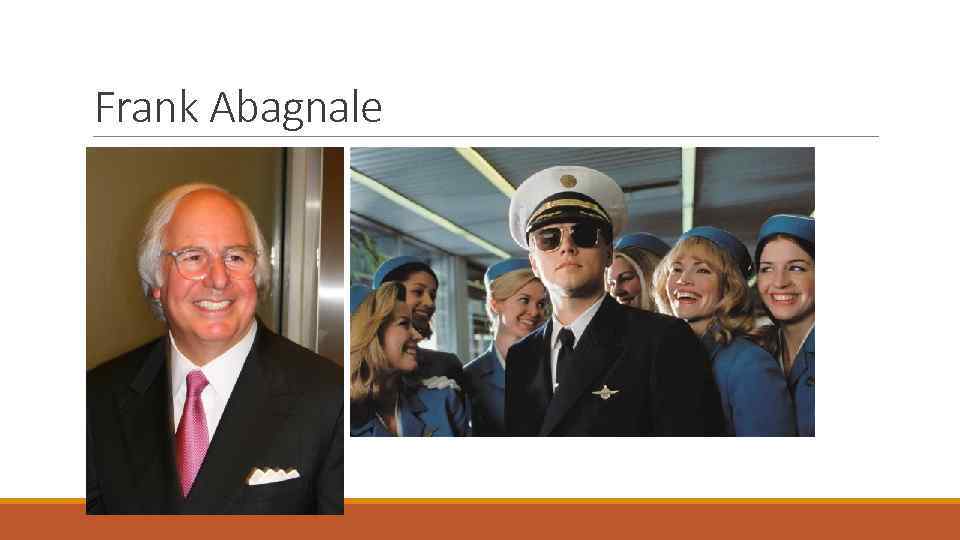 Frank Abagnale
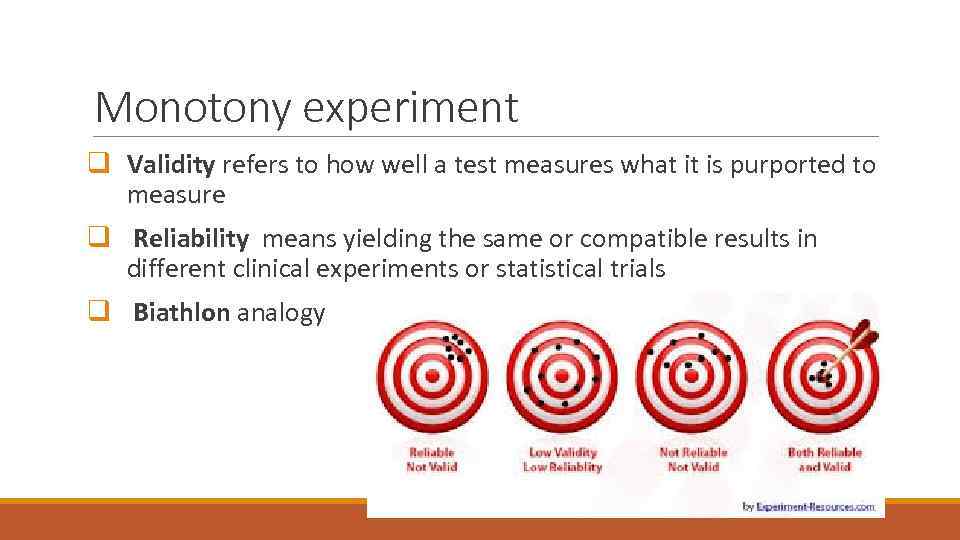 Monotony experiment q Validity refers to how well a test measures what it is purported to measure q Reliability means yielding the same or compatible results in different clinical experiments or statistical trials q Biathlon analogy
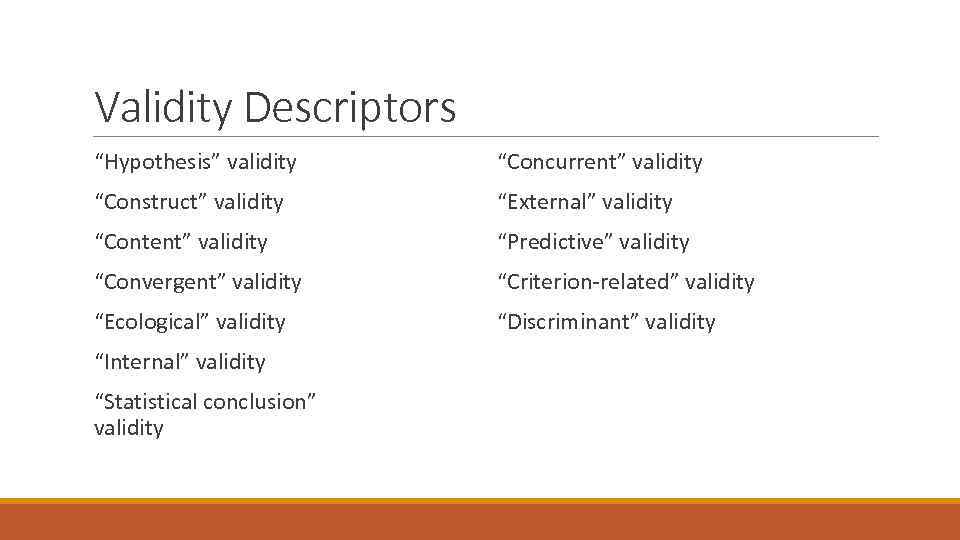 Validity Descriptors “Hypothesis” validity “Concurrent” validity “Construct” validity “External” validity “Content” validity “Predictive” validity “Convergent” validity “Criterion-related” validity “Ecological” validity “Discriminant” validity “Internal” validity “Statistical conclusion” validity
 Issues in Qualitative Research Generalisability Validity Reliability Dependability, consistency, understanding and comprehensiveness, honesty, credibility, generating theory ‘checkability’, empathy, richness, authenticity, Fuzzy Generalisations uniqueness, explanatory depth, scope, subjectivity, strength of and descriptive potential, Falsification confirmability, feeling, capturing ◦ Using extreme uniqueness, idiographic “neutrality”, applicability, (most/least likely to fit statements, fidelity to transferability theory), atypical, and participants’ accounts critical cases Enriching Often concerns:
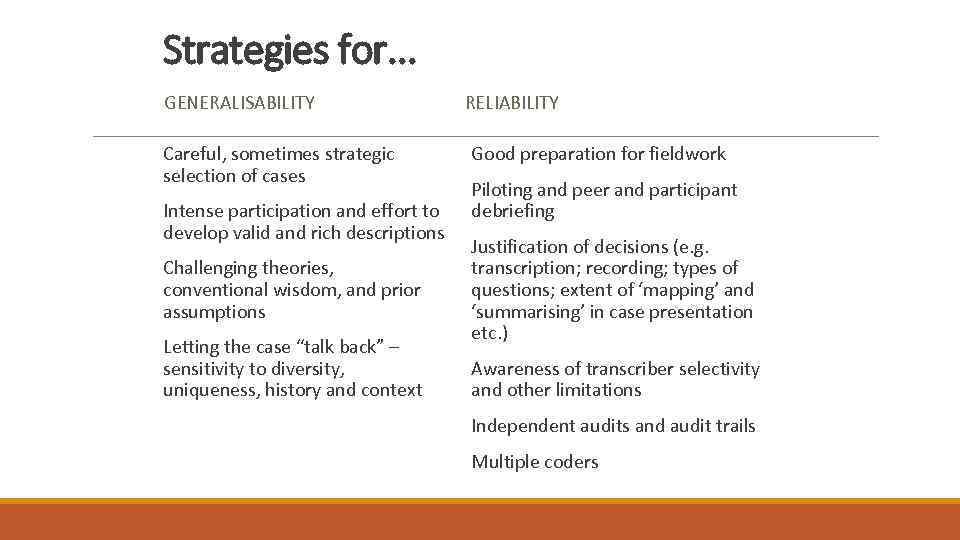 Strategies for. . . GENERALISABILITY Careful, sometimes strategic selection of cases RELIABILITY Good preparation for fieldwork Piloting and peer and participant Intense participation and effort to debriefing develop valid and rich descriptions Justification of decisions (e. g. Challenging theories, transcription; recording; types of conventional wisdom, and prior questions; extent of ‘mapping’ and assumptions ‘summarising’ in case presentation etc. ) Letting the case “talk back” – sensitivity to diversity, Awareness of transcriber selectivity uniqueness, history and context and other limitations Independent audits and audit trails Multiple coders
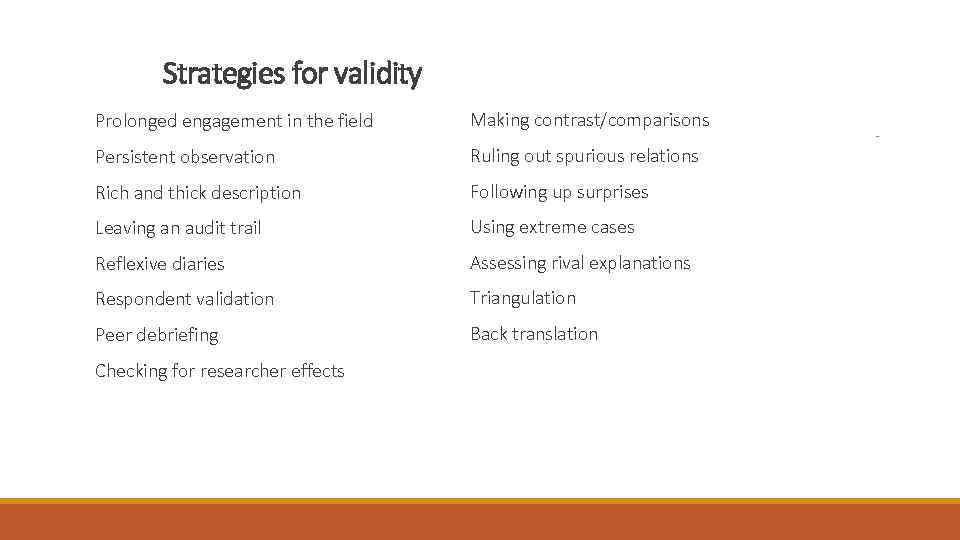 Strategies for validity Prolonged engagement in the field Making contrast/comparisons Persistent observation Ruling out spurious relations Rich and thick description Following up surprises Leaving an audit trail Using extreme cases Reflexive diaries Assessing rival explanations Respondent validation Triangulation Peer debriefing Back translation Checking for researcher effects
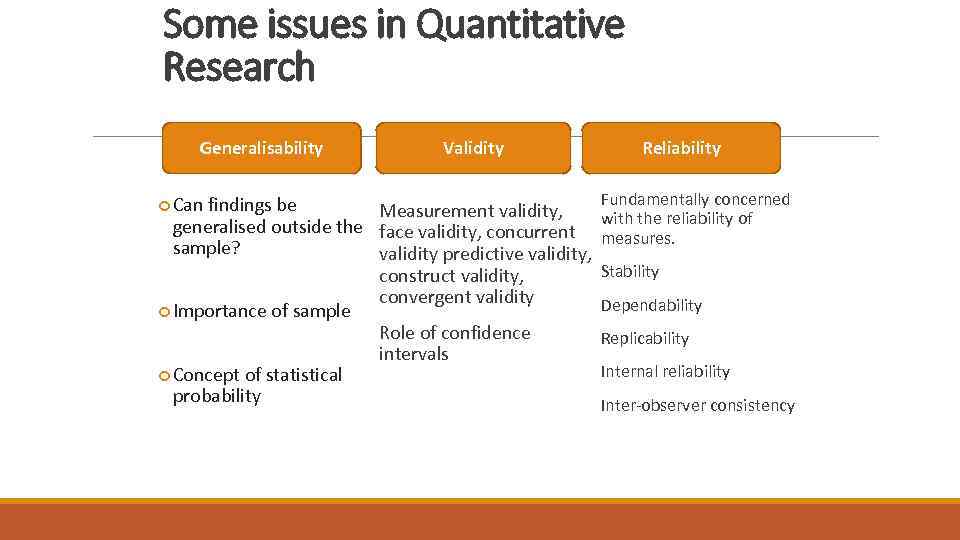 Some issues in Quantitative Research Generalisability Can findings be Validity Reliability Fundamentally concerned Measurement validity, generalised outside the face validity, concurrent with the reliability of measures. sample? validity predictive validity, Stability construct validity, convergent validity Dependability Importance of sample Role of confidence Replicability intervals Internal reliability Concept of statistical probability Inter-observer consistency
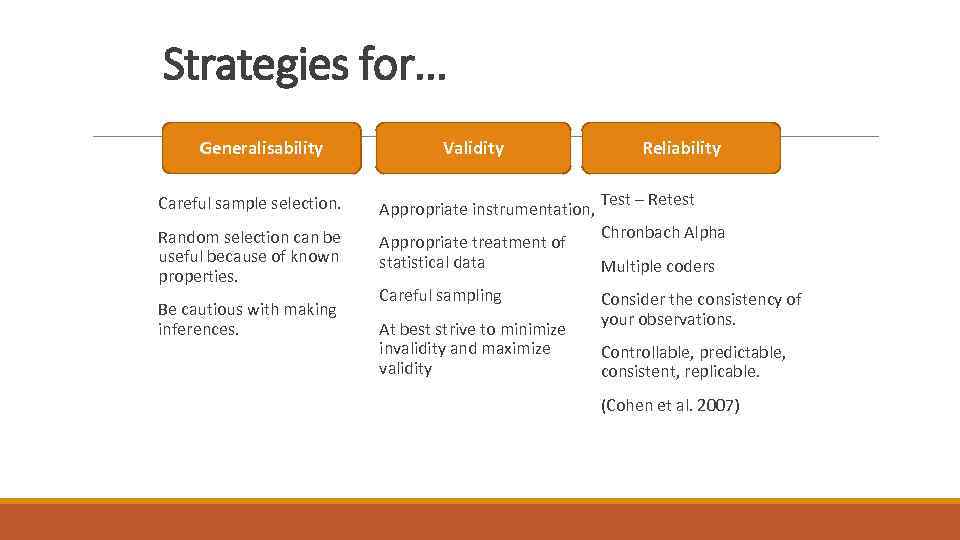 Strategies for. . . Generalisability Careful sample selection. Random selection can be useful because of known properties. Be cautious with making inferences. Validity Reliability Test – Retest Appropriate instrumentation, Chronbach Alpha Appropriate treatment of statistical data Multiple coders Careful sampling At best strive to minimize invalidity and maximize validity Consider the consistency of your observations. Controllable, predictable, consistent, replicable. (Cohen et al. 2007)

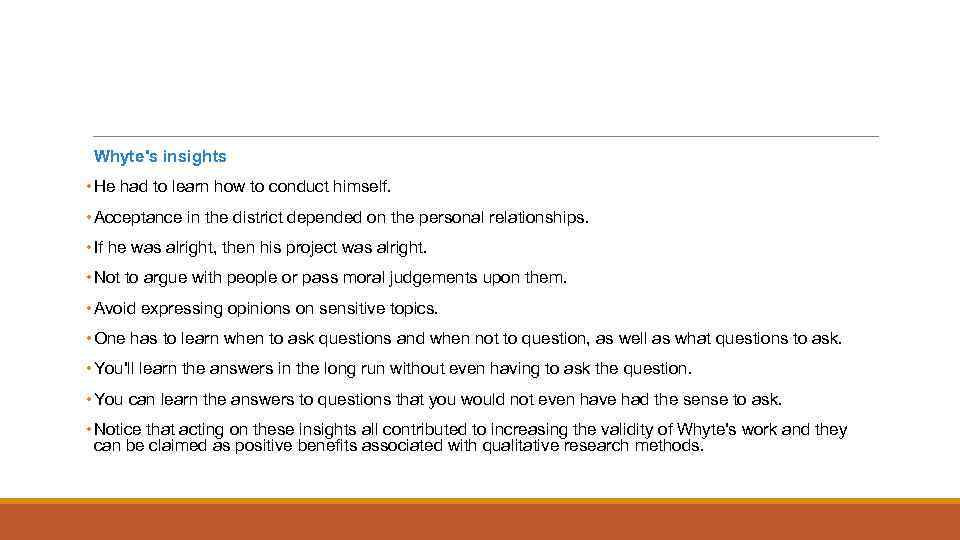 Whyte's insights • He had to learn how to conduct himself. • Acceptance in the district depended on the personal relationships. • If he was alright, then his project was alright. • Not to argue with people or pass moral judgements upon them. • Avoid expressing opinions on sensitive topics. • One has to learn when to ask questions and when not to question, as well as what questions to ask. • You'll learn the answers in the long run without even having to ask the question. • You can learn the answers to questions that you would not even have had the sense to ask. • Notice that acting on these insights all contributed to increasing the validity of Whyte's work and they can be claimed as positive benefits associated with qualitative research methods.
 Participant and nonparticipant (direct) observation q Nonparticipant observation is studying a social process without becoming a part of it in any way.