 Скачать презентацию Winner Determination in Combinatorial Exchanges Tuomas Sandholm Associate
f3340439821ed190c1fc24b87f9521d2.ppt
- Количество слайдов: 19



Winner Determination in Combinatorial Exchanges Tuomas Sandholm Associate Professor Computer Science Department Carnegie Mellon University and Founder, Chairman, and Chief Technology Officer Combine. Net, Inc.
Outline • Combine. Net company overview • Performance on real-world combinatorial procurement auctions • Exchange formulation & problem hardness • Exchange instance generator • Experiments with different solution technologies & instance types • Factors affecting problem difficulty • Discussion of the expected FCC exchange model
Combine. Net, Inc. • Leading vendor of markets with expressive competition • Technology development started 1997 • Company founded April 2000 • 55 full-time employees and 9 professors – Tuomas Sandholm, Subhash Suri, Egon Balas, Craig Boutilier, John Coyle, Holger Hoos, George Nemhauser, David Parkes, Rakesh Vohra • 1 patent issued and 13 pending – – – Bidding languages Market designs Algorithms Preference elicitation Methods around basic combinatorial bidding that make it practical … • Headquartered in Pittsburgh, with offices in London, San Francisco, Atlanta, Brussels
Combine. Net event summary (latest 2 years) • ~100 combinatorial procurement auctions fielded – – – Transportation: truckload, less than truckload, ocean freight, air freight Direct sourcing: materials, packaging, production Indirect sourcing: facilities, maintenance and repair operations, utilities Services: temporary labor … • Total transaction volume: $6 B – Individual auctions range from $8 M to $730 M • Total savings: $1. 02 B
Combine. Net applied technologies • Operations research – – LP relaxation techniques Branch and bound, Branch and cut Multiple (efficient) formulations … • Artificial intelligence – Search techniques – Constraint propagation – … • Software engineering – Modularity supports application of most appropriate solving techniques and refinements, some of which depend on problem instance – C++ is effective (fast) implementation language, STL is indispensable – XML is effective (extensible) input/output metalanguage • Off-the-shelf XML parsers are too slow and heavy for large (100 s of MB) inputs, so we built our own – …
Largest expressive competition problem we have encountered • Transportation services procurement auction • ~ 3000 trucking lanes to be bought, multiple units of each • ~ 120, 000 bids, no package bids • ~ 130, 000 side constraints • CPLEX did not solve in 48 hours • Our technology clears this optimally & proves optimality in 4½ minutes – Significant algorithm design & software engineering effort 1997 -2003
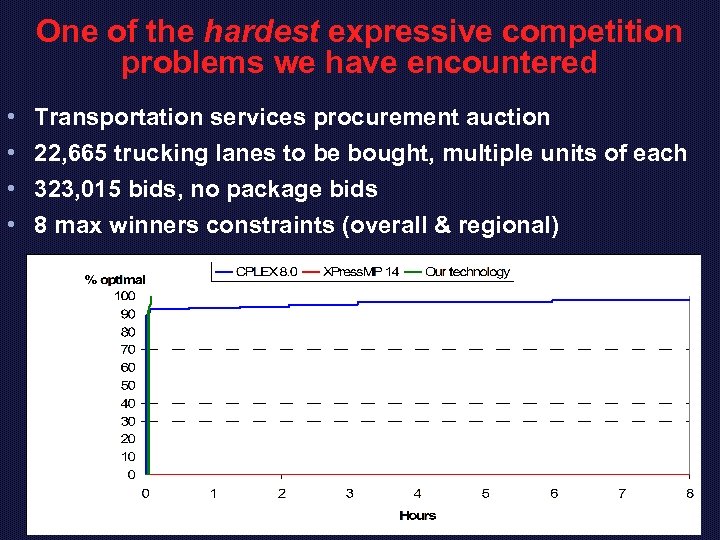
One of the hardest expressive competition problems we have encountered • • Transportation services procurement auction 22, 665 trucking lanes to be bought, multiple units of each 323, 015 bids, no package bids 8 max winners constraints (overall & regional)
Combinatorial exchanges
Combinatorial exchanges are a key effort at Combine. Net • Combine. Net has ~40 engineers, almost half of whom work on winner determination technology • The main backend hosted product, Clear. Box, does combinatorial auctions, reverse auctions, and exchanges – With hundreds of types of side constraints – With multiple attributes and a fully expressive language for taking them into account • $1. 84 M NIST ATP grant for a 3 -year effort for speeding up combinatorial exchanges – One year completed • Fastest engine (by 1 -2 orders of magnitude) for clearing combinatorial exchanges
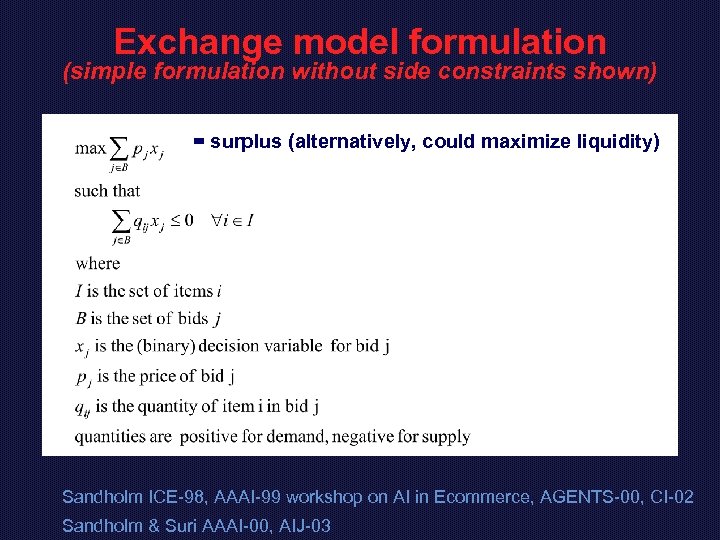
Exchange model formulation (simple formulation without side constraints shown) = surplus (alternatively, could maximize liquidity) Sandholm ICE-98, AAAI-99 workshop on AI in Ecommerce, AGENTS-00, CI-02 Sandholm & Suri AAAI-00, AIJ-03
![Exchange problem hardness [Sandholm, Suri, Gilpin & Levine AAMAS-02] • Thrm. NP-complete • Thrm.](https://present5.com/presentation/f3340439821ed190c1fc24b87f9521d2/image-11.jpg "Exchange problem hardness [Sandholm, Suri, Gilpin & Levine AAMAS-02] • Thrm. NP-complete • Thrm.")
Exchange problem hardness [Sandholm, Suri, Gilpin & Levine AAMAS-02] • Thrm. NP-complete • Thrm. Inapproximable to a ratio better than #bids 1 -e • Thrm. Without free disposal, even finding a feasible (non-zero trade) solution is NP-complete
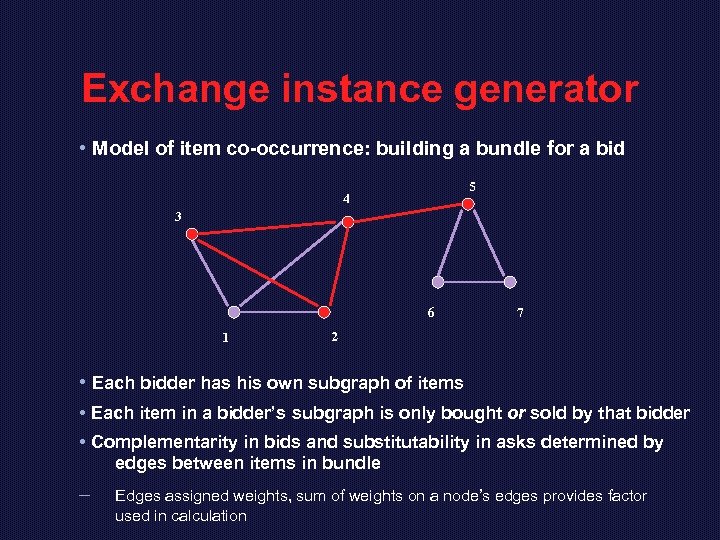
Exchange instance generator • Model of item co-occurrence: building a bundle for a bid 5 4 3 6 1 7 2 • Each bidder has his own subgraph of items • Each item in a bidder’s subgraph is only bought or sold by that bidder • Complementarity in bids and substitutability in asks determined by edges between items in bundle – Edges assigned weights, sum of weights on a node’s edges provides factor used in calculation
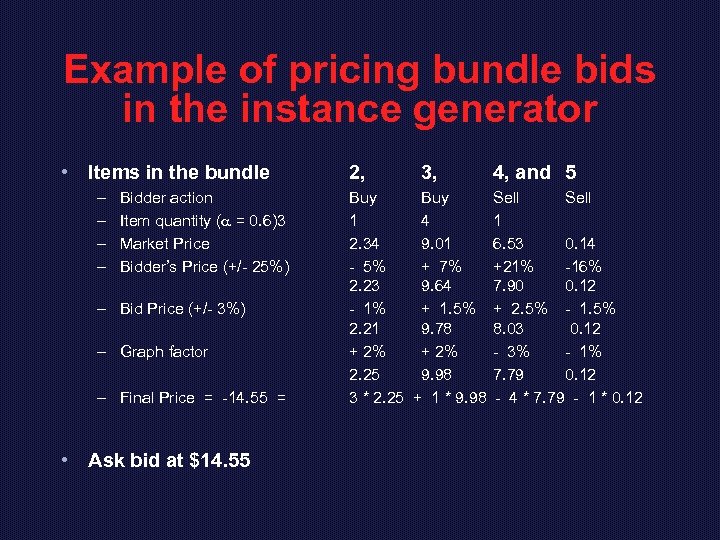
Example of pricing bundle bids in the instance generator • Items in the bundle – – Bidder action Item quantity (a = 0. 6)3 Market Price Bidder’s Price (+/- 25%) – Bid Price (+/- 3%) – Graph factor – Final Price = -14. 55 = • Ask bid at $14. 55 2, 3, Buy 1 4 2. 34 9. 01 - 5% + 7% 2. 23 9. 64 - 1% + 1. 5% 2. 21 9. 78 + 2% 2. 25 9. 98 3 * 2. 25 + 1 * 9. 98 4, and 5 Sell 1 6. 53 0. 14 +21% -16% 7. 90 0. 12 + 2. 5% - 1. 5% 8. 03 0. 12 - 3% - 1% 7. 79 0. 12 - 4 * 7. 79 - 1 * 0. 12
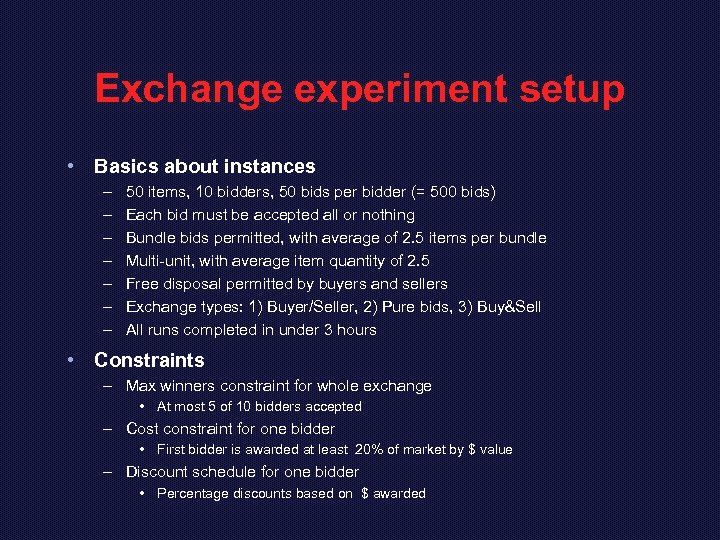
Exchange experiment setup • Basics about instances – – – – 50 items, 10 bidders, 50 bids per bidder (= 500 bids) Each bid must be accepted all or nothing Bundle bids permitted, with average of 2. 5 items per bundle Multi-unit, with average item quantity of 2. 5 Free disposal permitted by buyers and sellers Exchange types: 1) Buyer/Seller, 2) Pure bids, 3) Buy&Sell All runs completed in under 3 hours • Constraints – Max winners constraint for whole exchange • At most 5 of 10 bidders accepted – Cost constraint for one bidder • First bidder is awarded at least 20% of market by $ value – Discount schedule for one bidder • Percentage discounts based on $ awarded
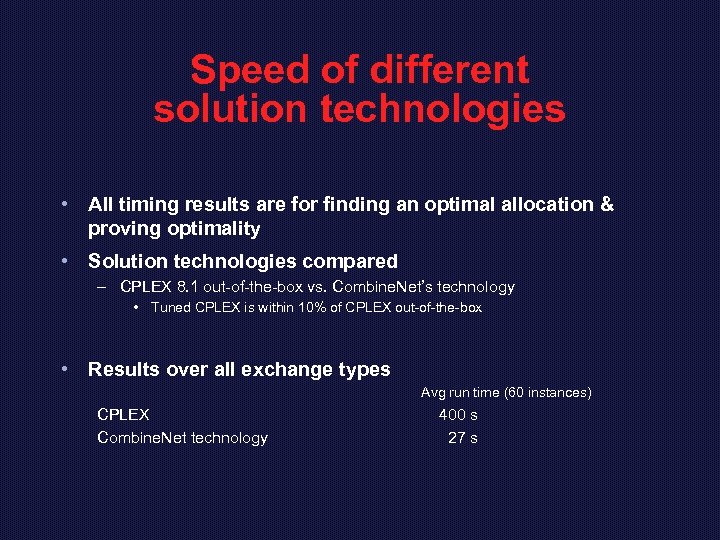
Speed of different solution technologies • All timing results are for finding an optimal allocation & proving optimality • Solution technologies compared – CPLEX 8. 1 out-of-the-box vs. Combine. Net’s technology • Tuned CPLEX is within 10% of CPLEX out-of-the-box • Results over all exchange types Avg run time (60 instances) CPLEX Combine. Net technology 400 s 27 s
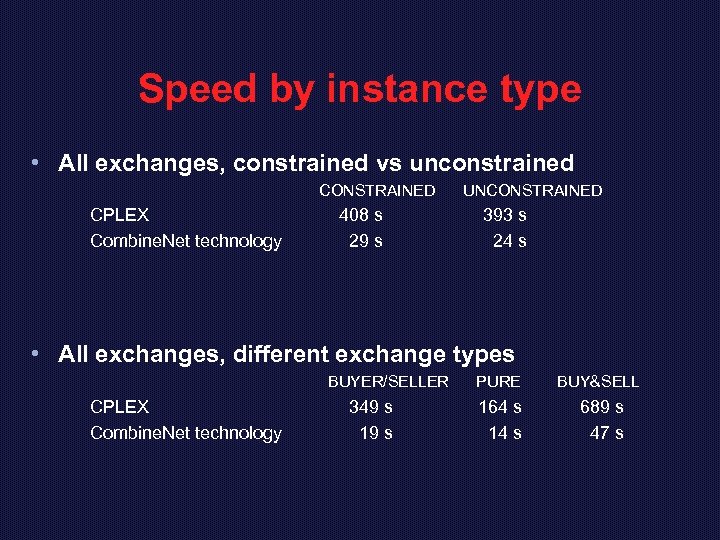
Speed by instance type • All exchanges, constrained vs unconstrained CONSTRAINED CPLEX Combine. Net technology 408 s 29 s UNCONSTRAINED 393 s 24 s • All exchanges, different exchange types BUYER/SELLER CPLEX Combine. Net technology 349 s 19 s PURE BUY&SELL 164 s 14 s 689 s 47 s
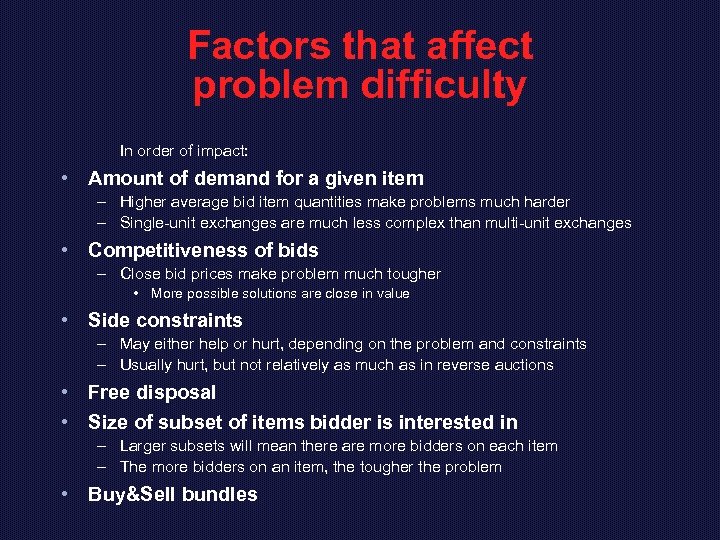
Factors that affect problem difficulty In order of impact: • Amount of demand for a given item – Higher average bid item quantities make problems much harder – Single-unit exchanges are much less complex than multi-unit exchanges • Competitiveness of bids – Close bid prices make problem much tougher • More possible solutions are close in value • Side constraints – May either help or hurt, depending on the problem and constraints – Usually hurt, but not relatively as much as in reverse auctions • Free disposal • Size of subset of items bidder is interested in – Larger subsets will mean there are more bidders on each item – The more bidders on an item, the tougher the problem • Buy&Sell bundles
Conclusions • Combinatorial markets of different types have become a reality and Combine. Net has a lot of experience designing, building, fielding & hosting them • Combinatorial exchanges are very complex to clear – NP-complete, inapproximable – Orders of magnitude more complex than combinatorial auctions or reverse auctions of the same size • Combine. Net technology is the fastest for the problem by 12 orders of magnitude • Optimal clearing scales to reasonable problem sizes • Complexity depends on certain features of the instances, as presented
Expected FCC exchange model • General points – Each license for a frequency range in a region is an item – There are # ranges (~35) X # regions (500? ) items • Aspects that decrease complexity – – Each item has a single unit only There is a single seller for each item (though multiple buyers possible) There is a definite structure to bids, by region and frequency range Small sellers and large buyers provide asymmetry • Aspects that increase complexity – Substitutability of frequency ranges may explode the size of bids – Large bundles are likely for the buyers – Potentially several large buyers for each item
Скачать презентацию Winner Determination in Combinatorial Exchanges Tuomas Sandholm Associate
f3340439821ed190c1fc24b87f9521d2.ppt