


 Скачать презентацию Wine Flavor 101 January 11 2013 Overview of
13fda58b4f4675bd31668c4dd779ac95.ppt
- Количество слайдов: 41
 Wine Flavor 101 January 11, 2013 Overview of the Biology of Brettanomyces: A New Look at an Old Problem Linda F. Bisson Department of Viticulture and Enology University of California
 Brettanomyces The Old Problem. . .
 Historical Background q Brettanomyces is a budding yeast found widely distributed in nature q Discovered in beer in 1904 (Claussen), in wine (Krumbholz & Tauschanoff, 1930) and again in 1940 (Custers) q Results in a variety of aromas – English Character or Lambic Beers – Spoilage/Regional Character in Wines
 Historical Background q Brettanomyces produces a wide array of aromatic compounds q Brettanomyces cellar contamination was widespread q Brettanomyces characters became synonymous with “terroir” and regional signature q Brettanomyces characters can compete with varietal characters for dominance of wine profile
 Taxonomy q Anamorphic/non-sexual form: Brettanomyces Teleomorphic/sexual form: Dekkera q Several species are found: B. bruxellensis, B. anomala, B. custerianus q Characteristic traits: – Ascomycete yeast – Reproduce by budding – Observation of sporulation is rare – Pseudohyphae formed – Fermentation end products: acetic acid and CO 2 dominate – Fermentation more rapid in presence of air: Custer’s effect
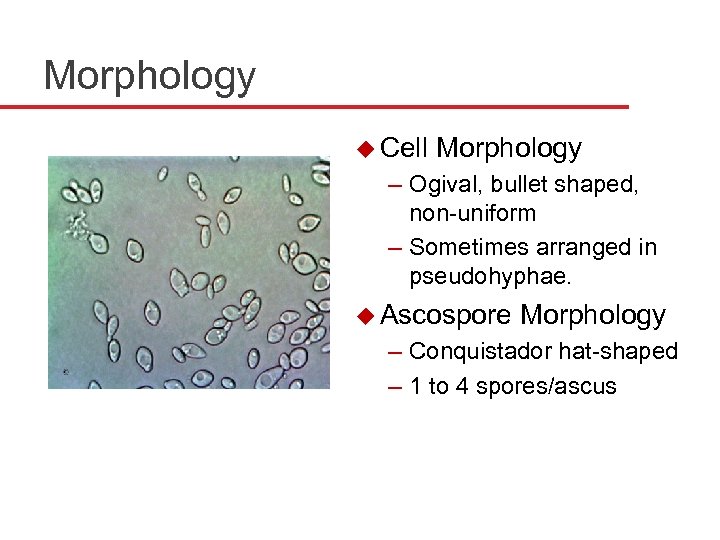 Morphology Cell Morphology – Ogival, bullet shaped, non-uniform – Sometimes arranged in pseudohyphae. Ascospore Morphology – Conquistador hat-shaped – 1 to 4 spores/ascus
 Brettanomyces Genomics q Chromosomal number varies by strain q Chromosome configuration not well preserved q Not a simple haploid or diploid – Hybrid between two strains with similar but different genomes? – Diploid progenitor that lost the ability to engage in sexual reproduction (genome renewal) q Accumulation of allelic differences and polymorphisms – Hyper-mutagenic? – Defective in repair?
 Metabolism of Brettanomyces q Can use numerous sugars, ethanol, other carbon compounds, and even amino acids as carbon sources q Can survive in very nutrient poor condition q Can survive and metabolize in extreme environments and is found in VNC states q Produces diverse metabolic end products from grape components: » Volatile Phenols » Tetrahydropyrazines
 Brettanomyces Characteristics q Highly metabolically versatile q Capable of ethanol production from sugars anaerobically q Produce acetic acid from sugars aerobically q Can produce viable petite (non-fermenting) off-spring
 Brettanomyces and Oxygen q Oxygen stimulates growth, acetic acid formation and glycolysis q Oxidation of acetaldehyde to acetic acid is favored over reduction to alcohol q Leads to depletion of NAD+ q Requires co-substrates or oxygen for acetic acid production q Redox state of cytoplasm has a strong impact on metabolites produced
 Brettanomyces vs. Saccharomyces q Saccharomyces: grows 5 times faster q Brettanomyces has slightly higher ethanol yields (1015%) q Saccharomyces produces more glycerol (6 fold higher) q Brettanomyces produces more biomass (20 to 30% more) q Brettanomyces more tolerant of large changes in p. H and temperature q Brettanomyces has a more energy-efficient metabolism: can do more with less
 Brettanomyces vs. Saccharomyces q Saccharomyces – Whole genome duplication – Domestication events – Reversible adaptation q Brettanomyces – Intensified local adaptive evolution – Terminal, non-reversible adaptation
 Brettanomyces vs. Saccharomyces Whole genome duplication (Saccharomyces: buy all the gear I need and carry it with me) vs. Intensified local adaptive evolution (Brettanomyces: live off the land) q Both strategies allow successful adaptation to challenging environments and enable switching between metabolic modes. q The WGD is more confining of subsequent strain integrity; strains are more similar than in the case of intensified local adaptive evolution
 What Does This Mean for Winemakers and Consumers? q Significant diversity in compounds produced by Brettanomyces strains q Regional specificity of compounds produced due to highly adapted local populations
 Spoilage Organism or Agent of Regional Character? q Brettanomyces makes a host of aromatic compounds q Compounds made differ by strain q Compounds made differ by winery q Compounds made differ by vineyard
 Brettanomyces Role as a Spoilage Organism
 Brettanomyces Spoilage Characters q Vinyl phenols q Ethyl phenols q Isovaleric Acid q Biogenic amines – Putrescine – Cadaverine – Spermidine q Acetic acid q Host of other compounds
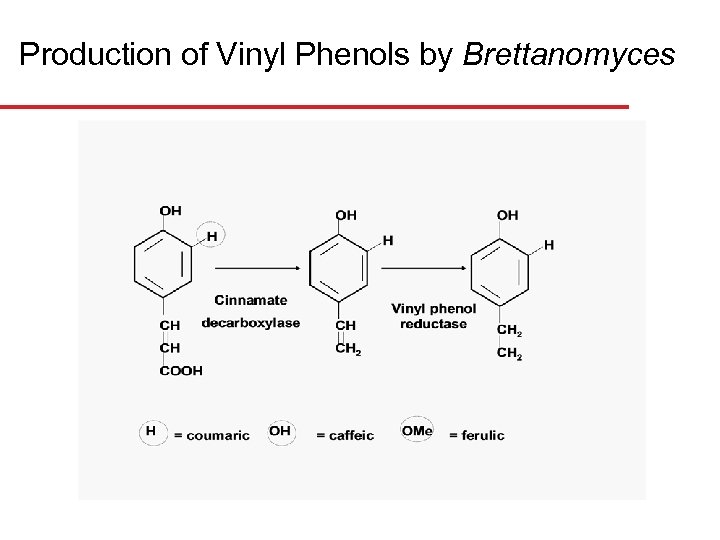 Production of Vinyl Phenols by Brettanomyces
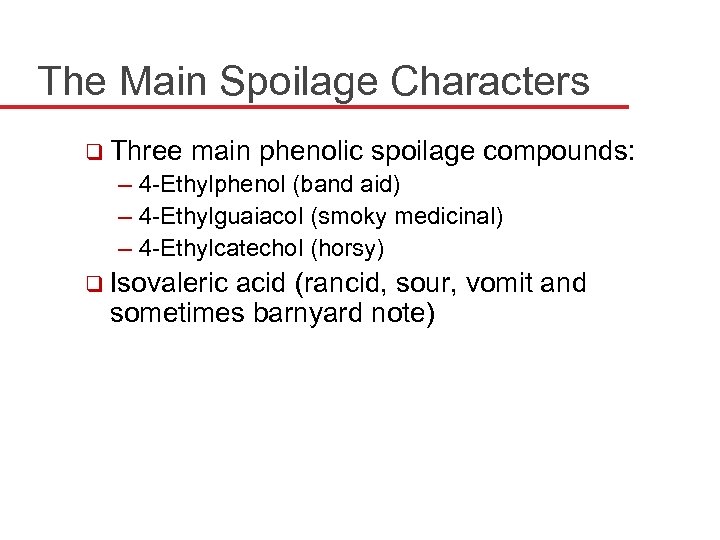 The Main Spoilage Characters q Three main phenolic spoilage compounds: – 4 -Ethylphenol (band aid) – 4 -Ethylguaiacol (smoky medicinal) – 4 -Ethylcatechol (horsy) q Isovaleric acid (rancid, sour, vomit and sometimes barnyard note)
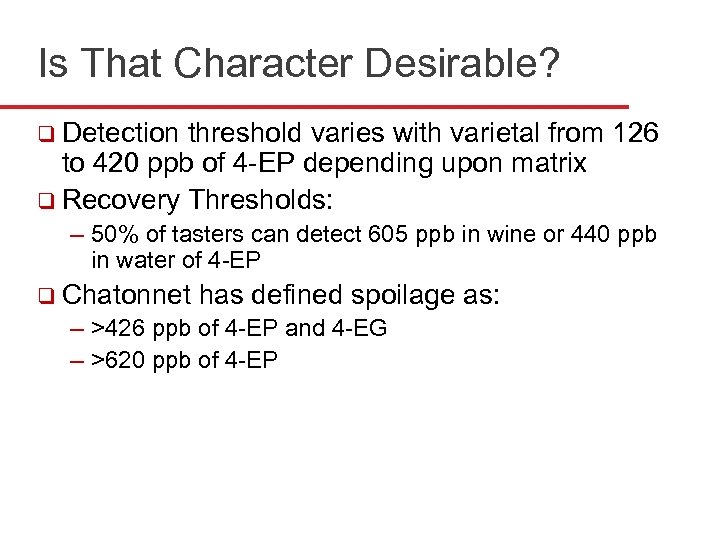 Is That Character Desirable? q Detection threshold varies with varietal from 126 to 420 ppb of 4 -EP depending upon matrix q Recovery Thresholds: – 50% of tasters can detect 605 ppb in wine or 440 ppb in water of 4 -EP q Chatonnet has defined spoilage as: – >426 ppb of 4 -EP and 4 -EG – >620 ppb of 4 -EP
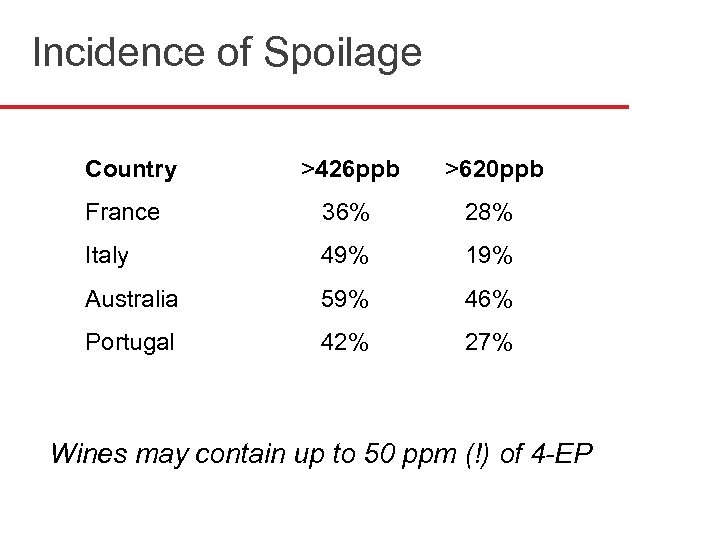 Incidence of Spoilage Country >426 ppb >620 ppb France 36% 28% Italy 49% 19% Australia 59% 46% Portugal 42% 27% Wines may contain up to 50 ppm (!) of 4 -EP
 Vinyl Phenol Formation q Detoxification? q Co-Substrate?
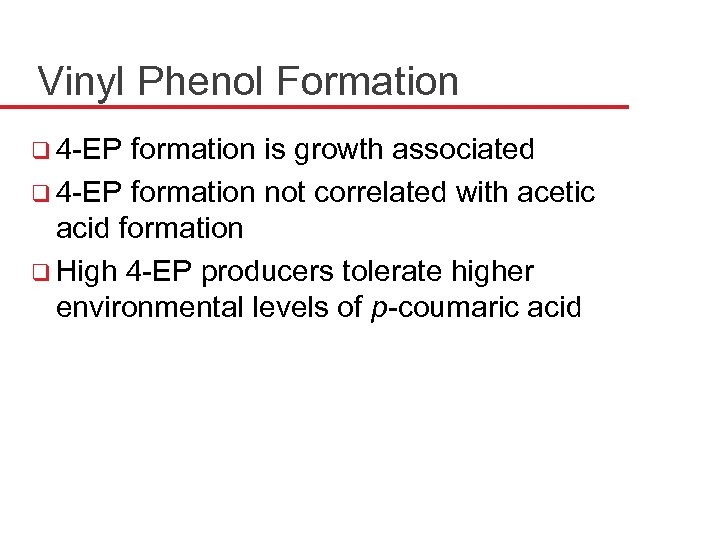 Vinyl Phenol Formation q 4 -EP formation is growth associated q 4 -EP formation not correlated with acetic acid formation q High 4 -EP producers tolerate higher environmental levels of p-coumaric acid
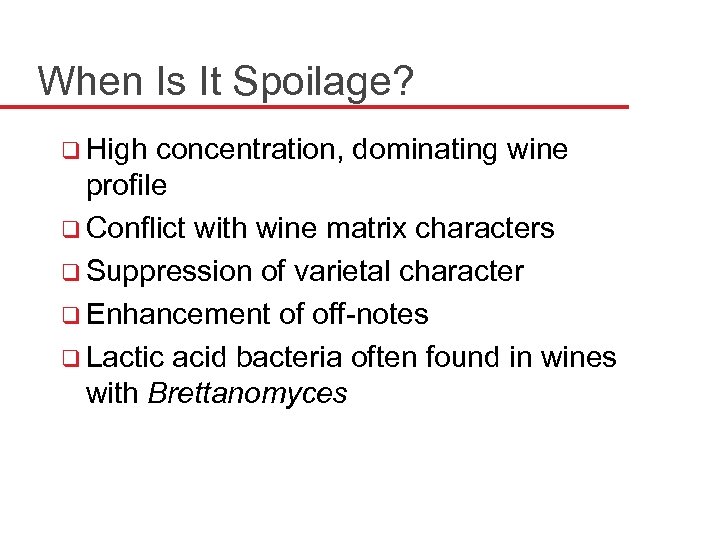 When Is It Spoilage? q High concentration, dominating wine profile q Conflict with wine matrix characters q Suppression of varietal character q Enhancement of off-notes q Lactic acid bacteria often found in wines with Brettanomyces
 The Wirz Strain Trial q Take a large collection of 35 Brettanomyces strains: 17 Strains from CA, 1 from NY, 1 from MO, 4 from France, 2 from Germany, 2 from New Zealand, 2 from Chile, 2 from Malta, 2 from Belgium, 1 from Canada, 1 from Thailand q Perform descriptive analysis with trained panelists following growth in Cabernet Sauvignon wine q 14 panelists participated
 The Main Aromas Found: q Band-Aid (4 -Ethyl Phenol) q Earthy (Geosmin) q Horsy q Leather q Putrid q Soy q Tobacco
 The Standards 8 aroma standards were selected by the panelists: – Soy (Soy Sauce) – Band-Aid (4 -Ethyl Phenol) – Horsy (Horse Sweat-soaked Towel) – Putrid (Burnt Fava Beans) – Tobacco (Shredded Cigarette) – Leather (Leather Shoelace) – Earthy (Geosmin)
 ANOVA Analysis of Variance (ANOVA) showed that the variance in the data for 5 of the 7 attributes could be explained by the wines: – Band-Aid, horsey, earthy, putrid, soy. (p<0. 06) – Leather and tobacco judge interaction was too high
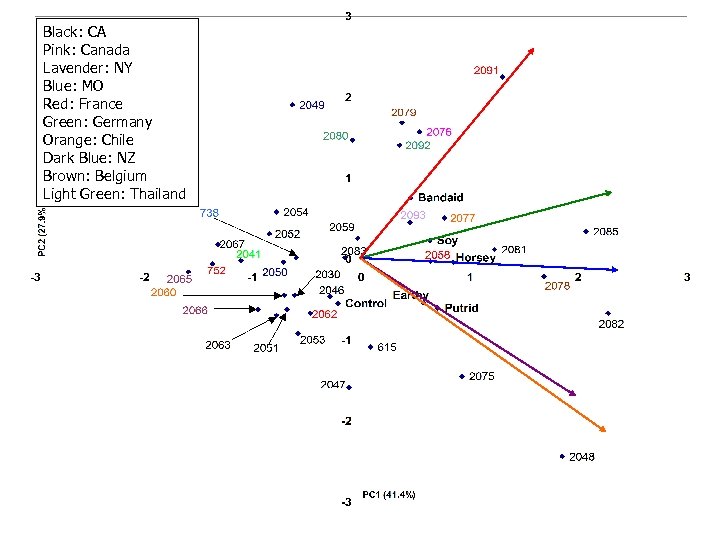 Black: CA Pink: Canada Lavender: NY Blue: MO Red: France Green: Germany Orange: Chile Dark Blue: NZ Brown: Belgium Light Green: Thailand
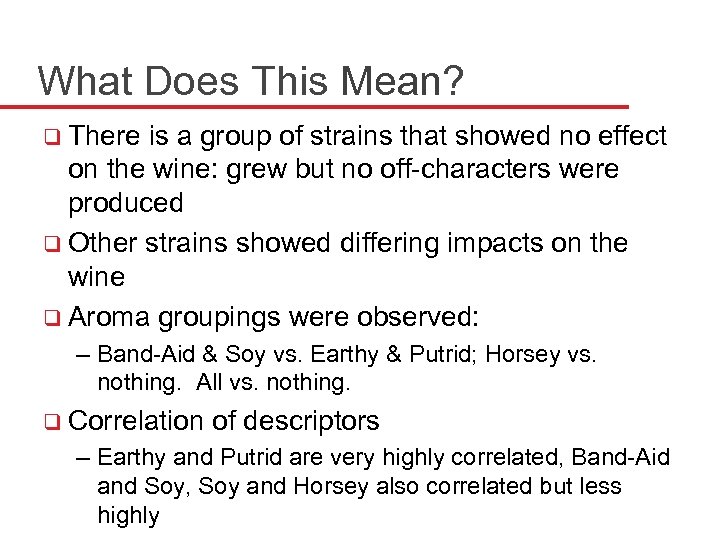 What Does This Mean? q There is a group of strains that showed no effect on the wine: grew but no off-characters were produced q Other strains showed differing impacts on the wine q Aroma groupings were observed: – Band-Aid & Soy vs. Earthy & Putrid; Horsey vs. nothing. All vs. nothing. q Correlation of descriptors – Earthy and Putrid are very highly correlated, Band-Aid and Soy, Soy and Horsey also correlated but less highly
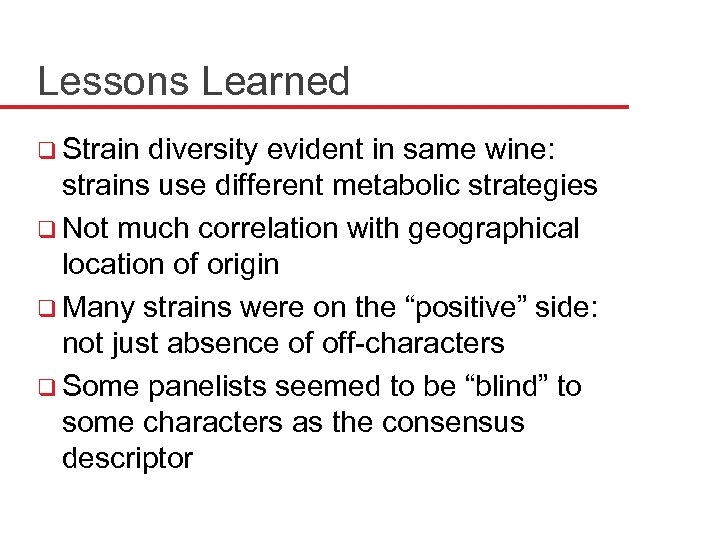 Lessons Learned q Strain diversity evident in same wine: strains use different metabolic strategies q Not much correlation with geographical location of origin q Many strains were on the “positive” side: not just absence of off-characters q Some panelists seemed to be “blind” to some characters as the consensus descriptor
 Subsequent Studies q Lucy Joseph: GC-Olfactory q Brad Kitson: Role of specific precursors in wine q Beth Albino: Survey of strains, precursors and diversity of aromatic impressions: Birth of the Brett Aroma Wheel q Lucy Joseph: Metabolomic analyses, refinement of Brett Aroma Wheel
 Brettanomyces The New Look
 Brettanomyces Aroma Impact q The sensory analysis demonstrated that different strains impact the same wine in different ways q Some of the Brettanomyces-infected wines were “preferred” over the control in judge comments q Judges disagreed on the nature of the positive descriptors q New goal: better understanding of the positive impacts of Brettanomyces on wines
 Brettanomyces and Regional Character q Local Brettanomyces strains contribute to the expected aromatic profile of wines when allowed to bloom during aging q Some people, cultures, population segments are attracted to those characters q Many more people are attracted to the positive Brettanomyces characters if the vinyl phenols and isovaleric acid contributions are minimized
 Brettanomyces Characters q Are described differently by different people q Strongly trigger complex memory responses q See the perception phenomenon of “filling in the aroma gap” q Show strong matrix effects q Can add to complexity
 The Brett Aroma Impact Wheel q Not a typical descriptive analysis q Wanted the consensus terms but also breadth of descriptors
 The Search for a Neutral/ Positive Strain q Neutral Strains: may be useful in making wines stable against further Brettanomyces infection via consumption of residual nutrients q Positive Strains: may impart some of the spicy, complex characters Brettanomyces is known for minus the negatives q Better understanding of metabolism may lead to a better understanding of the negative impacts of wine and allow better prediction of which wines to use for this “style”
 The Search for a Neutral/ Positive Strain q Variations in vinyl phenol production q Not consistently stable q Strong matrix influence that is not well understood q Bottom Line: Brettanomyces cannot be trusted metabolically, but if historical winery experience is positive and there is no subsequent adaptive pressure, the positive influence may recur
 Today’s Program: AM q The Brettanomyces Signature Spoilage Characters – Spiked Cabernet Wine q Influence of Matrix: – Characters in different wines » Smoky Red Fruit Grenache » Gamy Pinot noir » Barbera
 Today’s Program: PM q Brettanomyces Aroma Impact Wheel – Tasting of Merlot Wine with Different Strains – Tasting of Brett “suppressed and salvaged” wine q Brettanomyces in Commercial Wines: – Winemaker Panel – Tasting of Commercially wines with Brett contributions: selected by use of Aroma Impact Wheel descriptors