 Скачать презентацию Windows 2000 Security Architecture Peter Brundrett Program Manager
90cd2fa6a14d7901636d4d66cd8f05c2.ppt
- Количество слайдов: 38



Windows 2000 Security Architecture Peter Brundrett Program Manager Windows 2000 Security Microsoft Corporation
Topics n n n n n Single Sign-on Kerberos v 5 integration Active Directory security Delegation of authentication Public key infrastructure Encrypting file system Network security Security policy Secure Windows
Platform Security Requirements n n n n Single enterprise logon Strong authentication Authorization Secure communications Mandatory policy Auditing Interoperability Extensible architecture Goal: Deliver Windows 2000 as the most secure high volume OS
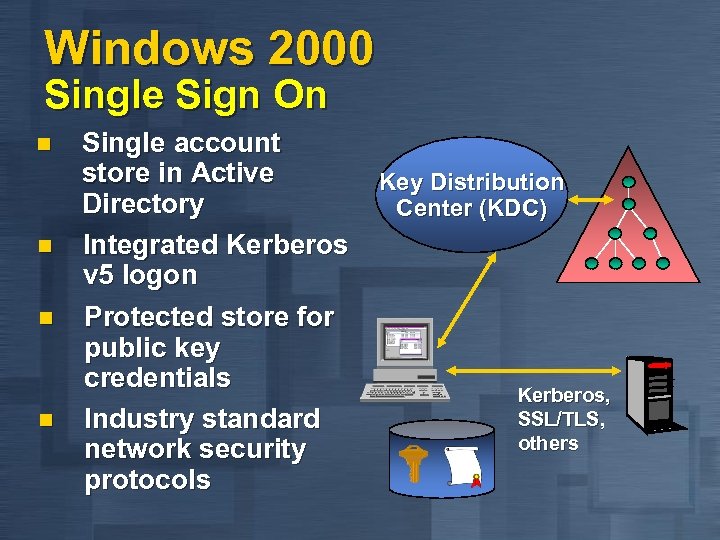
Windows 2000 Single Sign On n n Single account store in Active Key Distribution Directory Center (KDC) Integrated Kerberos v 5 logon Protected store for public key credentials Kerberos, SSL/TLS, Industry standard others network security protocols
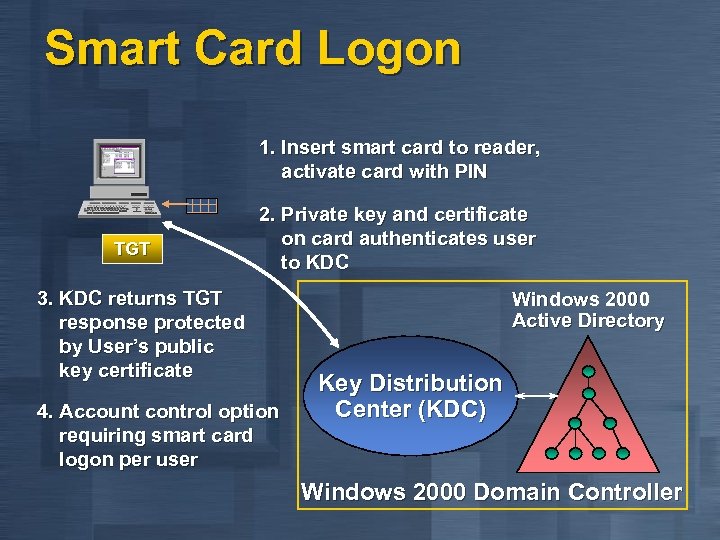
Smart Card Logon 1. Insert smart card to reader, activate card with PIN TGT 2. Private key and certificate on card authenticates user to KDC 3. KDC returns TGT response protected by User’s public key certificate 4. Account control option requiring smart card logon per user Windows 2000 Active Directory Key Distribution Center (KDC) Windows 2000 Domain Controller
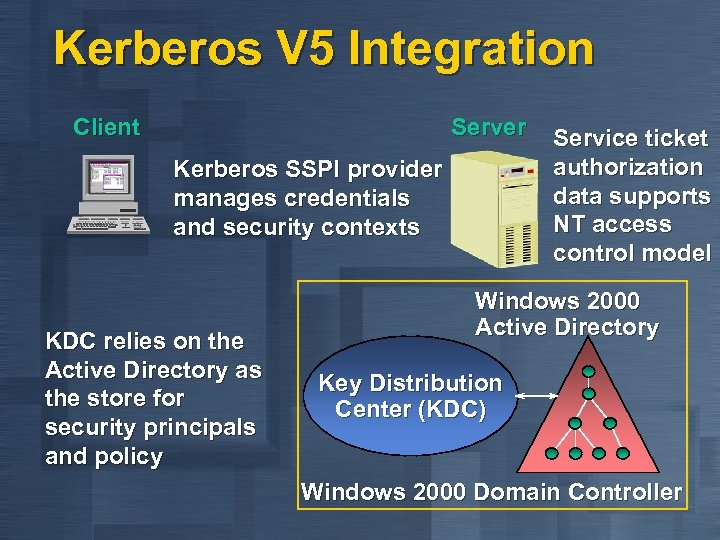
Kerberos V 5 Integration Client Server Service ticket authorization Kerberos SSPI provider data supports manages credentials NT access and security contexts control model KDC relies on the Active Directory as the store for security principals and policy Windows 2000 Active Directory Key Distribution Center (KDC) Windows 2000 Domain Controller
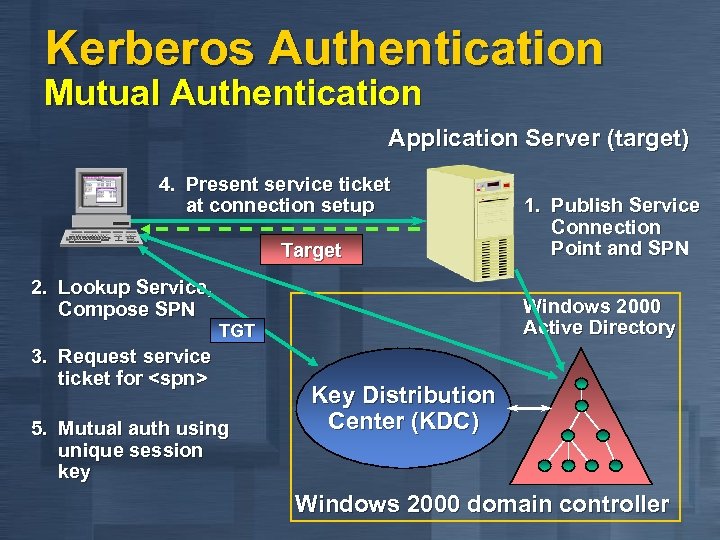
Kerberos Authentication Mutual Authentication Application Server (target) 4. Present service ticket at connection setup Target 2. Lookup Service, Compose SPN Windows 2000 Active Directory TGT 3. Request service ticket for <spn> 5. Mutual auth using unique session key 1. Publish Service Connection Point and SPN Key Distribution Center (KDC) Windows 2000 domain controller
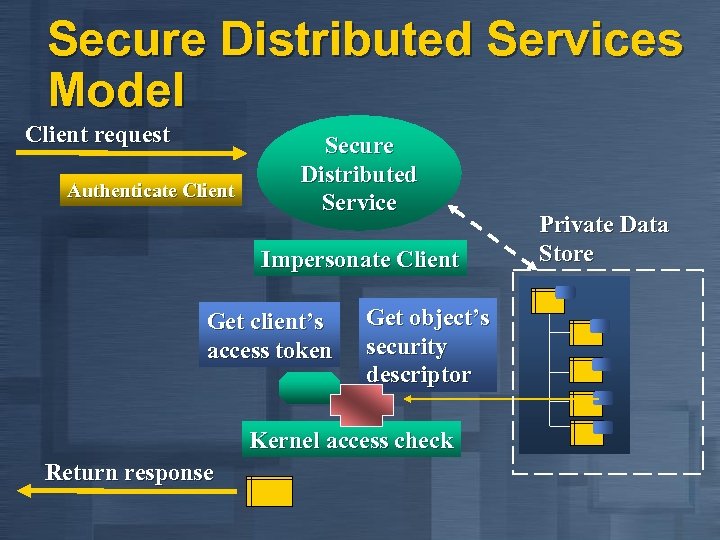
Secure Distributed Services Model Client request Authenticate Client Secure Distributed Service Impersonate Client Get client’s access token Get object’s security descriptor Kernel access check Return response Private Data Store
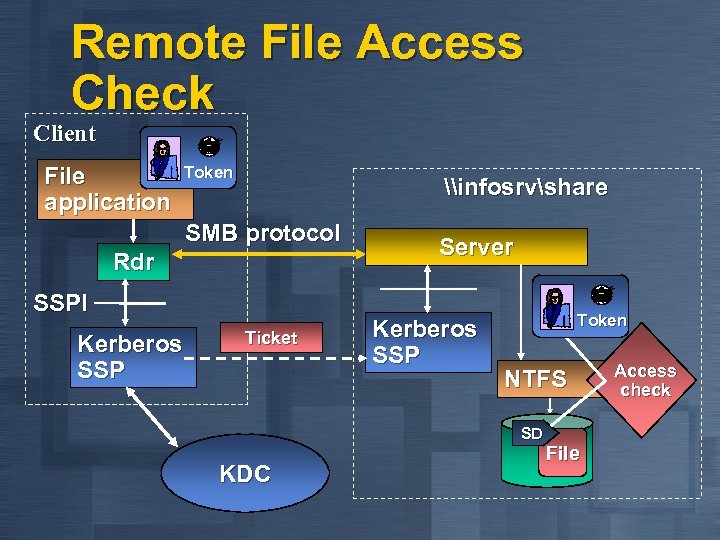
Remote File Access Check Client File application Token \infosrvshare SMB protocol Rdr SSPI Kerberos SSP Ticket Server Kerberos SSP Token NTFS SD KDC File Access check
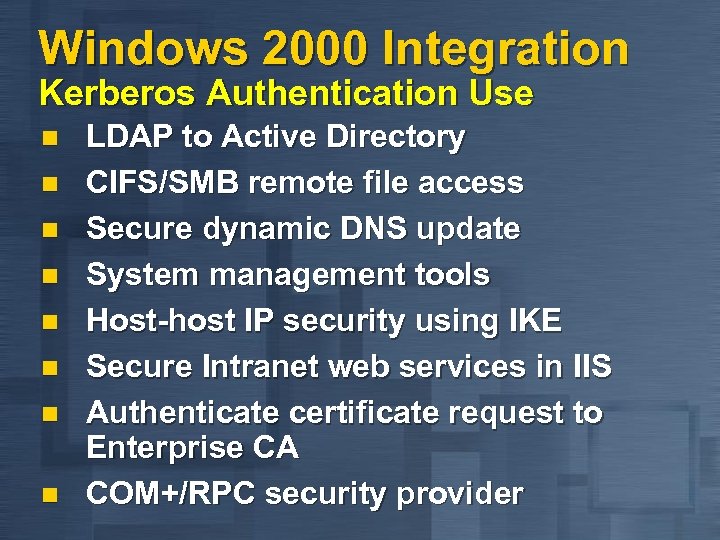
Windows 2000 Integration Kerberos Authentication Use n n n n LDAP to Active Directory CIFS/SMB remote file access Secure dynamic DNS update System management tools Host-host IP security using IKE Secure Intranet web services in IIS Authenticate certificate request to Enterprise CA COM+/RPC security provider
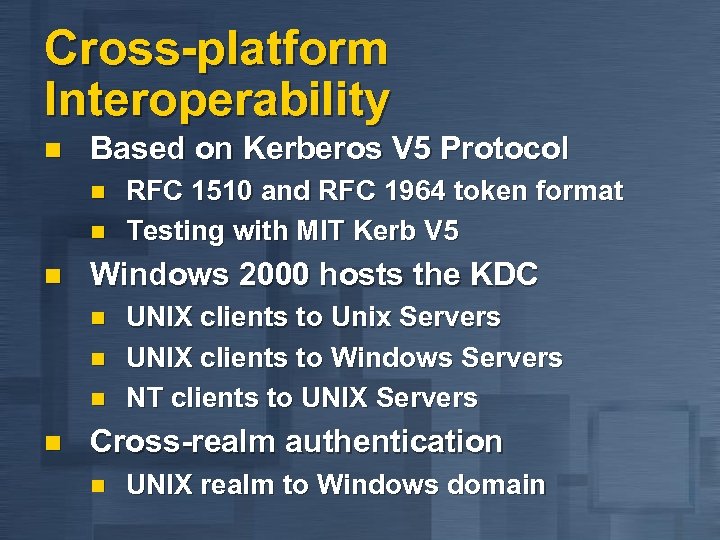
Cross-platform Interoperability n Based on Kerberos V 5 Protocol n n n Windows 2000 hosts the KDC n n RFC 1510 and RFC 1964 token format Testing with MIT Kerb V 5 UNIX clients to Unix Servers UNIX clients to Windows Servers NT clients to UNIX Servers Cross-realm authentication n UNIX realm to Windows domain
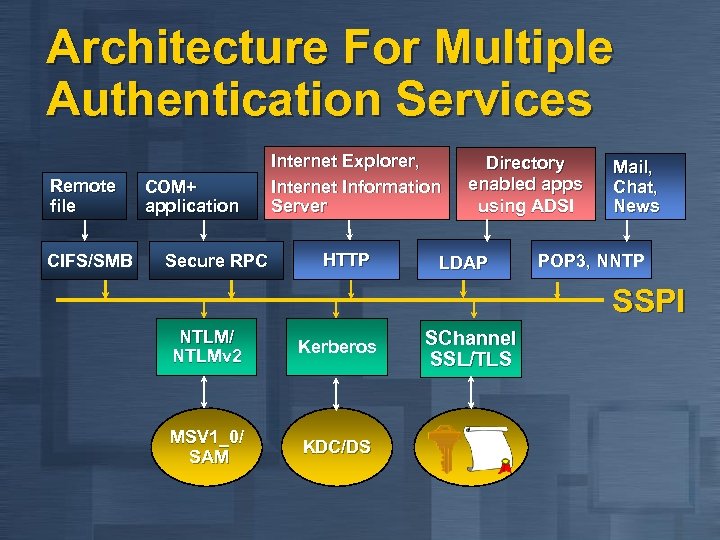
Architecture For Multiple Authentication Services Remote file CIFS/SMB COM+ application Secure RPC Internet Explorer, Internet Information Server HTTP Directory enabled apps using ADSI LDAP Mail, Chat, News POP 3, NNTP SSPI NTLM/ NTLMv 2 Kerberos MSV 1_0/ SAM KDC/DS SChannel SSL/TLS
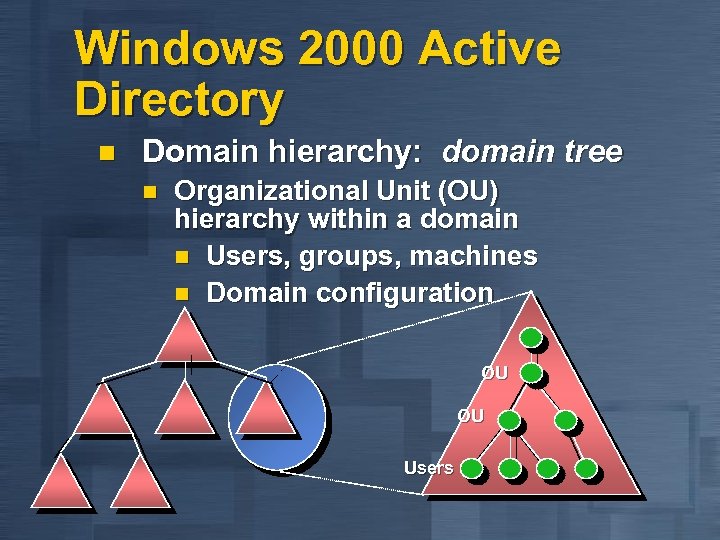
Windows 2000 Active Directory n Domain hierarchy: domain tree n Organizational Unit (OU) hierarchy within a domain n Users, groups, machines n Domain configuration OU OU Users
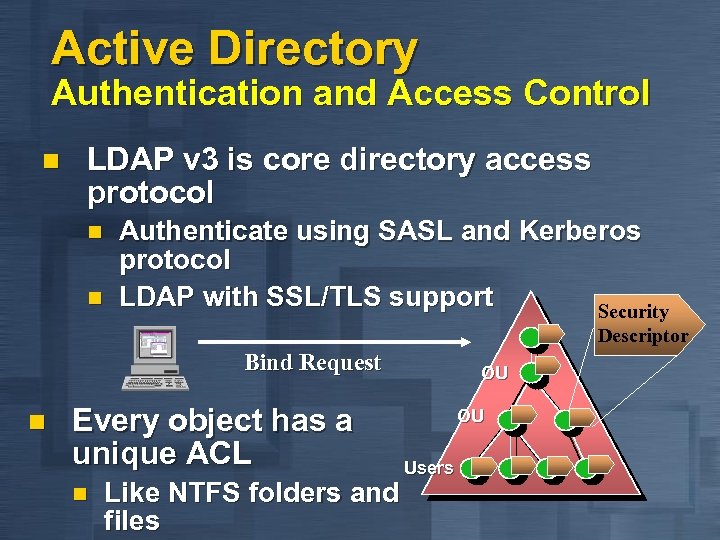
Active Directory Authentication and Access Control n LDAP v 3 is core directory access protocol n n Authenticate using SASL and Kerberos protocol LDAP with SSL/TLS support Security Descriptor Bind Request n Every object has a unique ACL n OU OU Users Like NTFS folders and files
Active Directory Security administration n Delegation of administration n Fine-grain access control n n Grant permissions at organizational unit (OU) level Who creates OUs, users, groups, etc. Grant or deny permissions on perproperty level, or a group of properties n Read property n Write property Per-property auditing
Secure Applications n Connection Authentication n Secure Communication n n Message privacy and integrity Impersonation and Delegation n n Establish Credentials Mutual authentication of client and server Assuming client’s identity Authorization and Auditing n Using security descriptors
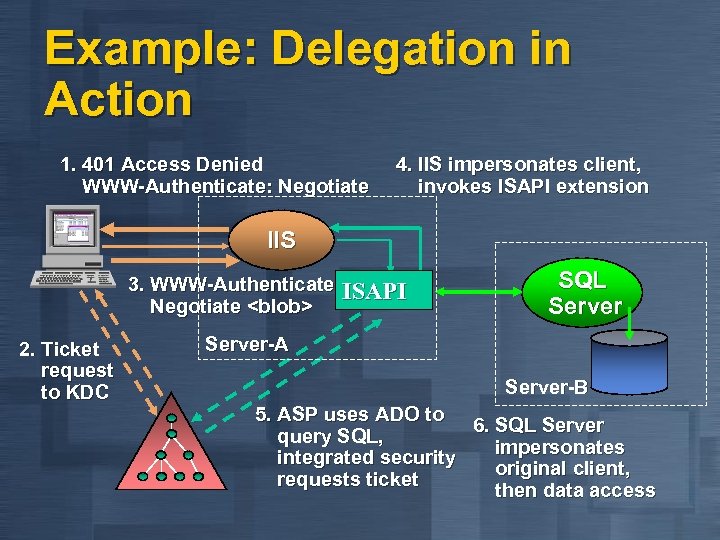
Example: Delegation in Action 1. 401 Access Denied WWW-Authenticate: Negotiate 4. IIS impersonates client, invokes ISAPI extension IIS 3. WWW-Authenticate: ISAPI Negotiate <blob> 2. Ticket request to KDC SQL Server-A Server-B 5. ASP uses ADO to query SQL, integrated security requests ticket 6. SQL Server impersonates original client, then data access
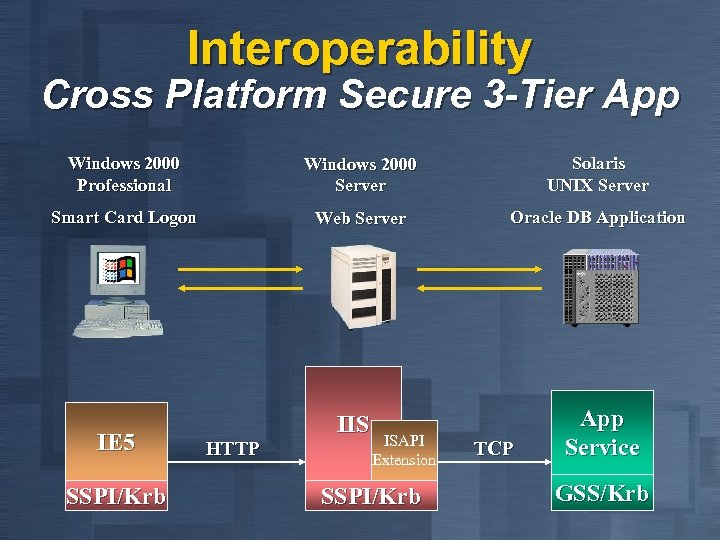
Interoperability Cross Platform Secure 3 -Tier App Windows 2000 Professional Windows 2000 Server Solaris UNIX Server Smart Card Logon Web Server Oracle DB Application IE 5 SSPI/Krb HTTP IIS ISAPI Extension SSPI/Krb TCP App Service GSS/Krb
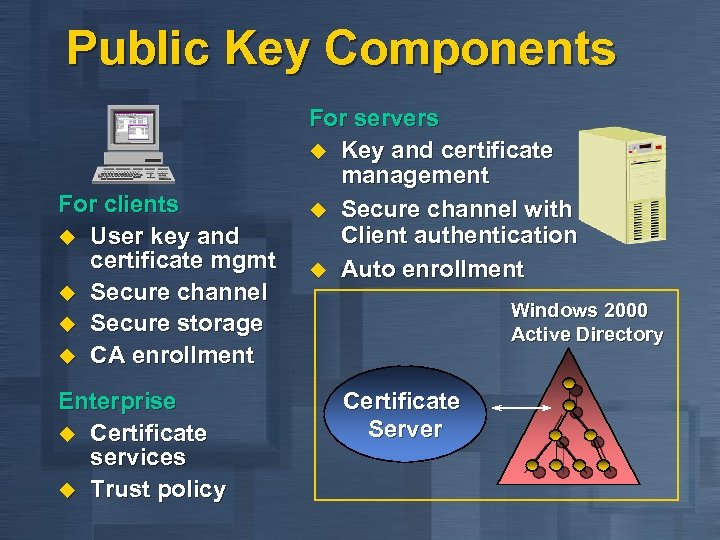
Public Key Components For clients u User key and certificate mgmt u Secure channel u Secure storage u CA enrollment Enterprise u Certificate services u Trust policy For servers u Key and certificate management u Secure channel with Client authentication u Auto enrollment Windows 2000 Active Directory Certificate Server
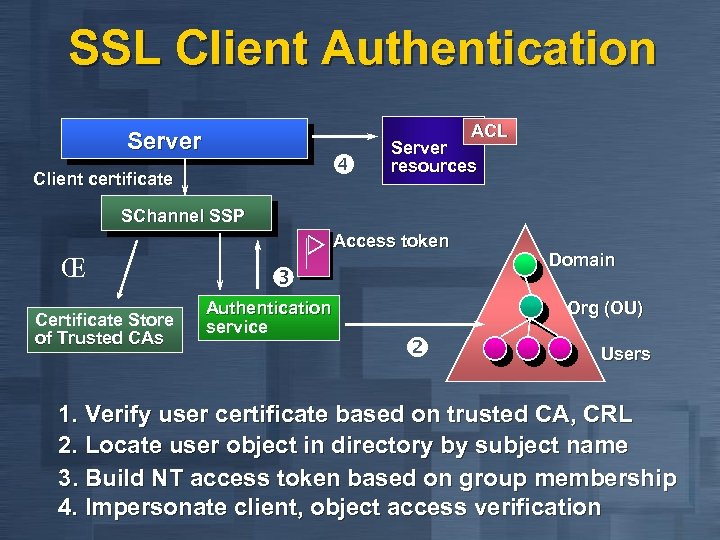
SSL Client Authentication ACL Server Client certificate Server resources SChannel SSP Access token ΠCertificate Store of Trusted CAs Authentication service Domain Org (OU) Users 1. Verify user certificate based on trusted CA, CRL 2. Locate user object in directory by subject name 3. Build NT access token based on group membership 4. Impersonate client, object access verification
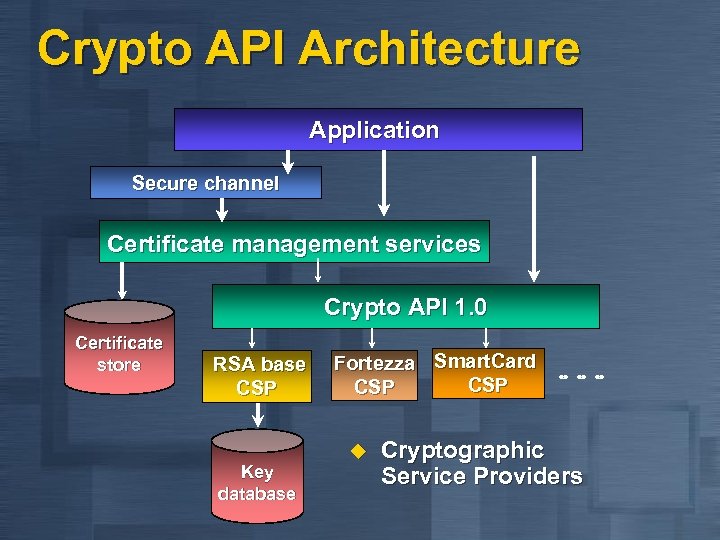
Crypto API Architecture Application Secure channel Certificate management services Crypto API 1. 0 Certificate store RSA base CSP Key database Fortezza Smart. Card CSP u Cryptographic Service Providers
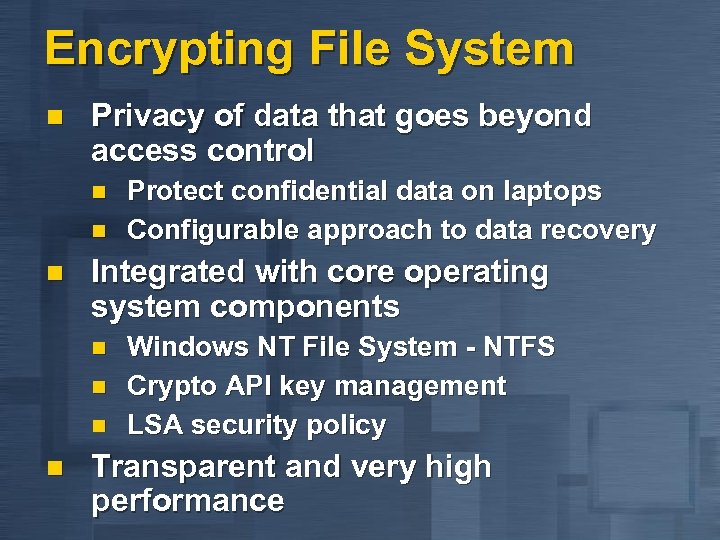
Encrypting File System n Privacy of data that goes beyond access control n n n Integrated with core operating system components n n Protect confidential data on laptops Configurable approach to data recovery Windows NT File System - NTFS Crypto API key management LSA security policy Transparent and very high performance
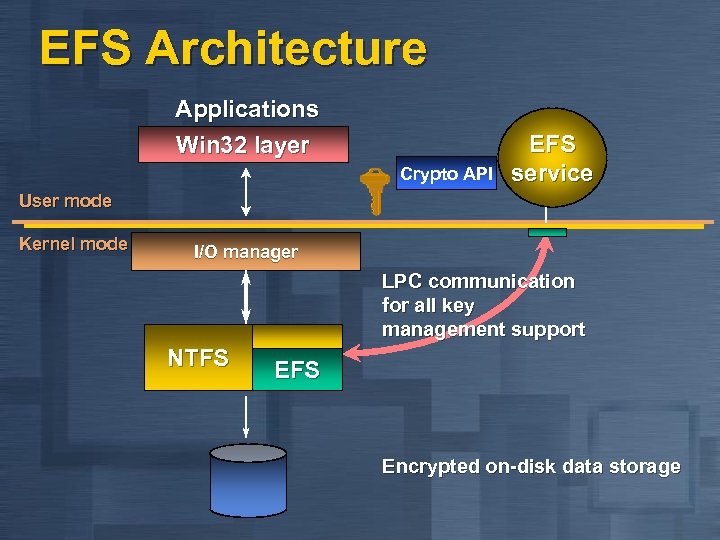
EFS Architecture Applications Win 32 layer Crypto API EFS service User mode Kernel mode I/O manager LPC communication for all key management support NTFS Encrypted on-disk data storage
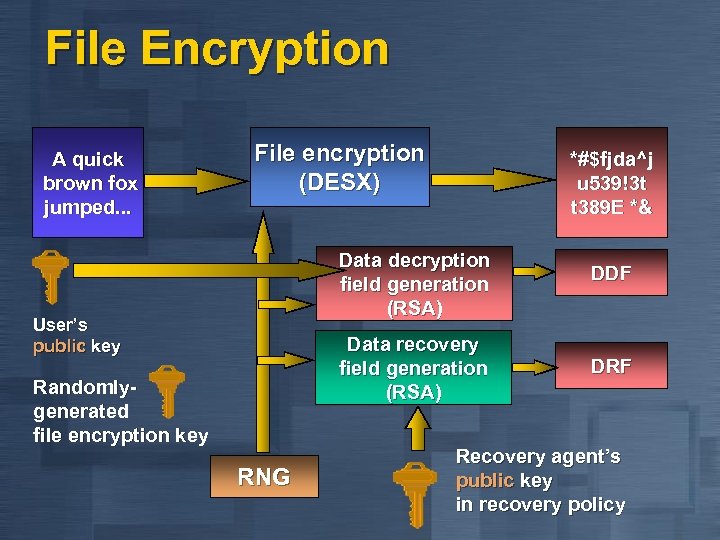
File Encryption A quick brown fox jumped. . . File encryption (DESX) *#$fjda^j u 539!3 t t 389 E *& Data decryption field generation (RSA) User’s public key Data recovery field generation (RSA) Randomlygenerated file encryption key RNG DDF DRF Recovery agent’s public key in recovery policy
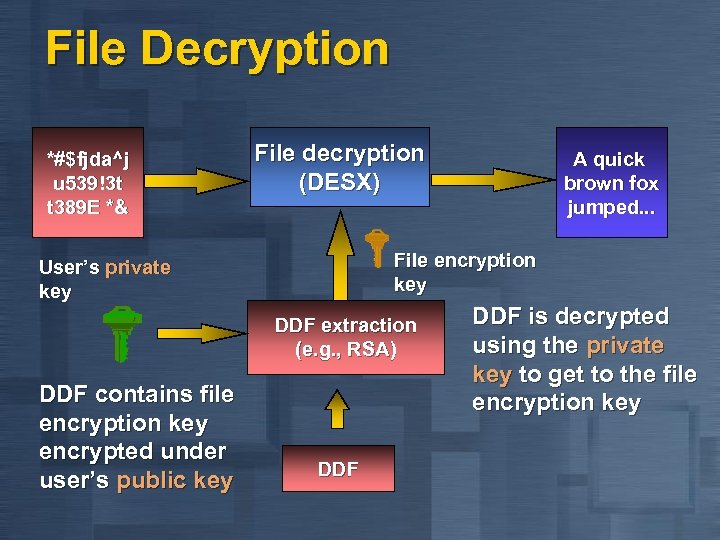
File Decryption *#$fjda^j u 539!3 t t 389 E *& File decryption (DESX) File encryption key User’s private key DDF extraction (e. g. , RSA) DDF contains file encryption key encrypted under user’s public key A quick brown fox jumped. . . DDF is decrypted using the private key to get to the file encryption key
Secure Networking n n n Internet Protocol Security (IPSec) Extended Authentication Protocol/PPP n Token and Smart. Card support Remote Authentication Dial In User Service (RADIUS) Kerberos security package Public key (SSL/TLS) security package
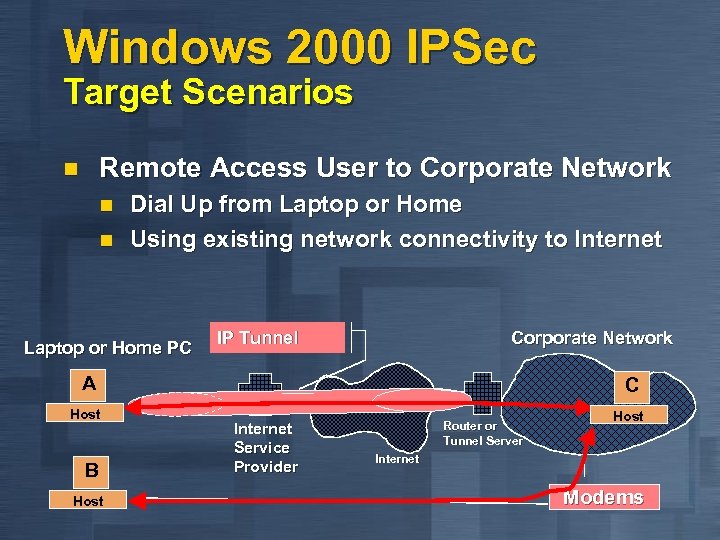
Windows 2000 IPSec Target Scenarios Remote Access User to Corporate Network n n n Dial Up from Laptop or Home Using existing network connectivity to Internet Laptop or Home PC IP Tunnel Corporate Network A Host B Host C Internet Service Provider Router or Tunnel Server Host Internet Modems
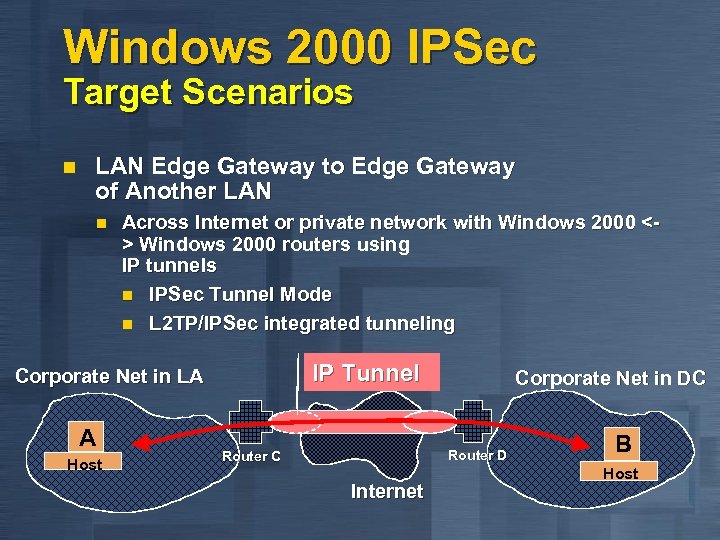
Windows 2000 IPSec Target Scenarios n LAN Edge Gateway to Edge Gateway of Another LAN n Across Internet or private network with Windows 2000 <> Windows 2000 routers using IP tunnels n IPSec Tunnel Mode n L 2 TP/IPSec integrated tunneling IP Tunnel Corporate Net in LA A Host Corporate Net in DC Router D Router C Internet B Host
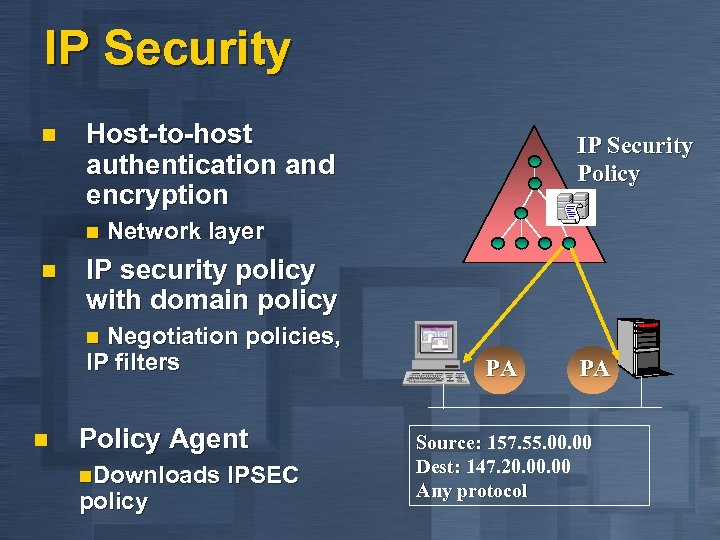
IP Security n Host-to-host authentication and encryption IP Security Policy n Network layer n IP security policy with domain policy n Negotiation policies, IP filters n Policy Agent n. Downloads IPSEC policy PA PA Source: 157. 55. 00 Dest: 147. 20. 00 Any protocol
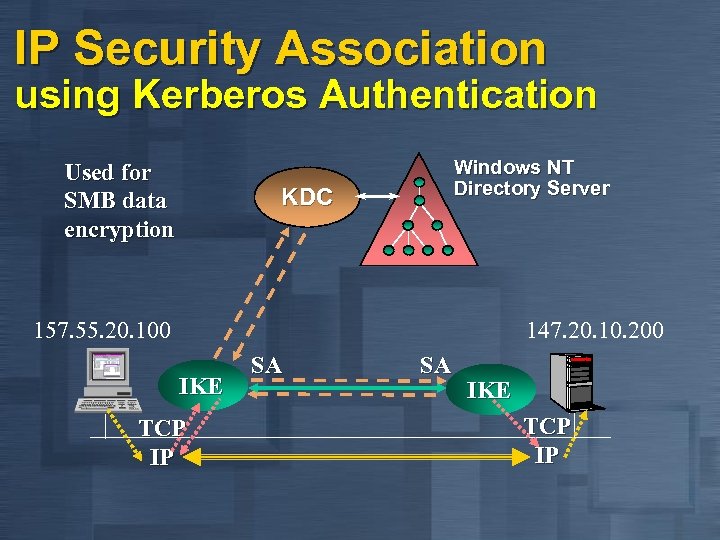
IP Security Association using Kerberos Authentication Used for SMB data encryption Windows NT Directory Server KDC 157. 55. 20. 100 147. 20. 10. 200 IKE TCP IP SA SA IKE TCP IP
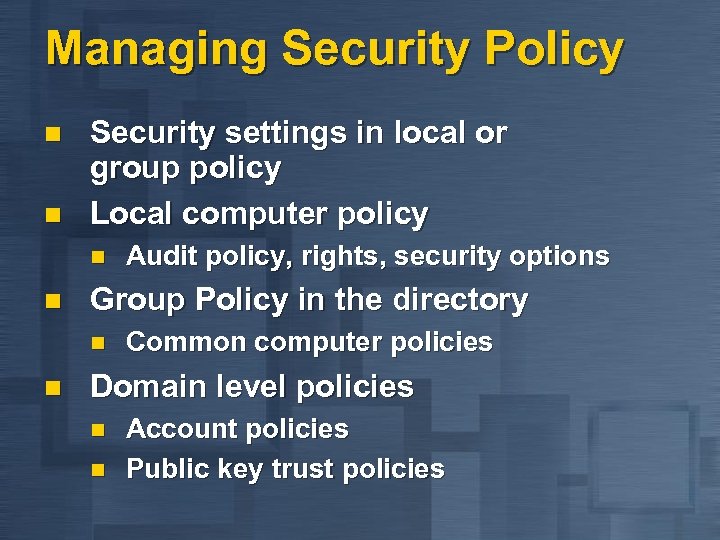
Managing Security Policy n n Security settings in local or group policy Local computer policy n n Group Policy in the directory n n Audit policy, rights, security options Common computer policies Domain level policies n n Account policies Public key trust policies
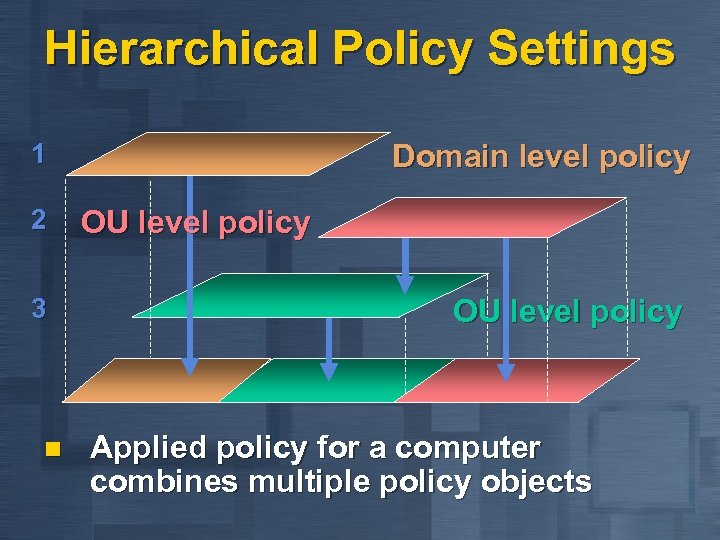
Hierarchical Policy Settings 1 2 3 n Domain level policy OU level policy Applied policy for a computer combines multiple policy objects
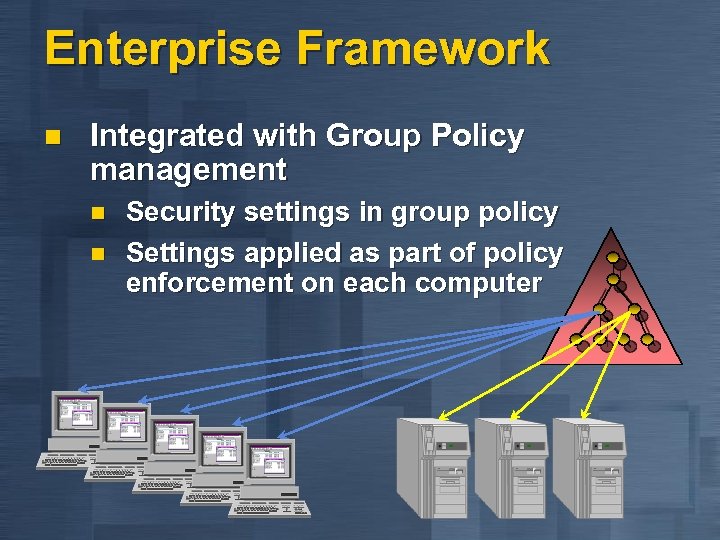
Enterprise Framework n Integrated with Group Policy management n n Security settings in group policy Settings applied as part of policy enforcement on each computer
Secure Windows n Goals n n Clean install of Windows 2000 n n Secure out-of-the-box Definition of secure system settings Backward compatible user experience Upgrade can apply security configuration Who can do what? n n Administrators, Power Users, Users Group membership defines access
Administrators vs. Users n Administrators n n Full control of the operating system Install system components, drivers Upgrade or repair the system Users n n n Cannot compromise system integrity Read-only access to system resources Interactive and network logon rights Can shutdown desktop system Legacy application issues
Security Features Summary n Single sign on with standard protocols n n Public key certificate management n n Enterprise services for PKI rollout Distributed security for applications n n Kerberos V 5 and X. 509 V 3 certificates Authentication, authorization, auditing Active Directory integration n Scalable, extensible user account directory
For More Information n White papers n n Windows 2000 Resource Kit n n n http: //www. microsoft. com/windows 2000/library Active Directory Security Services Deployment Guide Detail technical material Microsoft Security Advisor n http: //www. microsoft. com/security
 Скачать презентацию Windows 2000 Security Architecture Peter Brundrett Program Manager
90cd2fa6a14d7901636d4d66cd8f05c2.ppt