 Скачать презентацию Willkommen in Shanghai Bienvenue à Shanghai 这是上海 This
Chapter 1-3.ppt
- Количество слайдов: 80




Willkommen in Shanghai Bienvenue à Shanghai 这是上海 This is shanghai

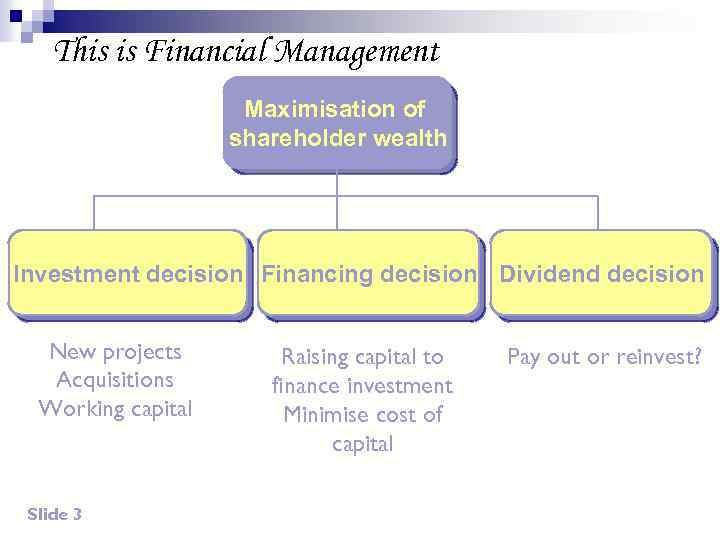
This is Financial Management Maximisation of shareholder wealth Investment decision Financing decision Dividend decision New projects Acquisitions Working capital Slide 3 Raising capital to finance investment Minimise cost of capital Pay out or reinvest?

Chapter 1 Financial objectives
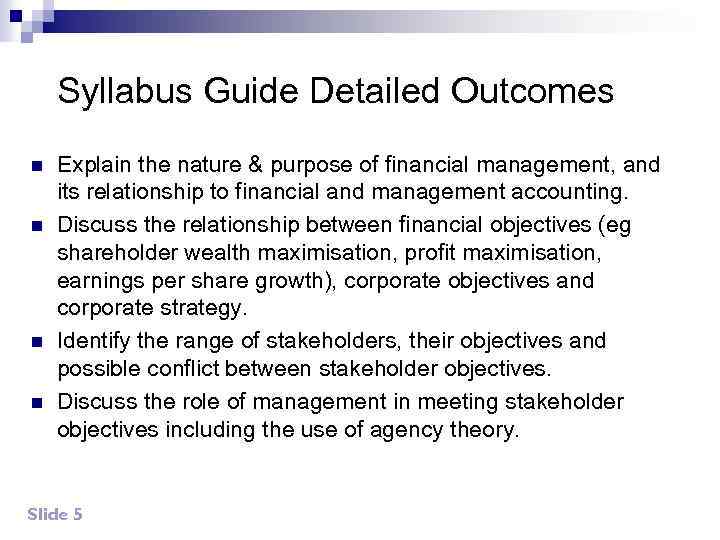
Syllabus Guide Detailed Outcomes n n Explain the nature & purpose of financial management, and its relationship to financial and management accounting. Discuss the relationship between financial objectives (eg shareholder wealth maximisation, profit maximisation, earnings per share growth), corporate objectives and corporate strategy. Identify the range of stakeholders, their objectives and possible conflict between stakeholder objectives. Discuss the role of management in meeting stakeholder objectives including the use of agency theory. Slide 5
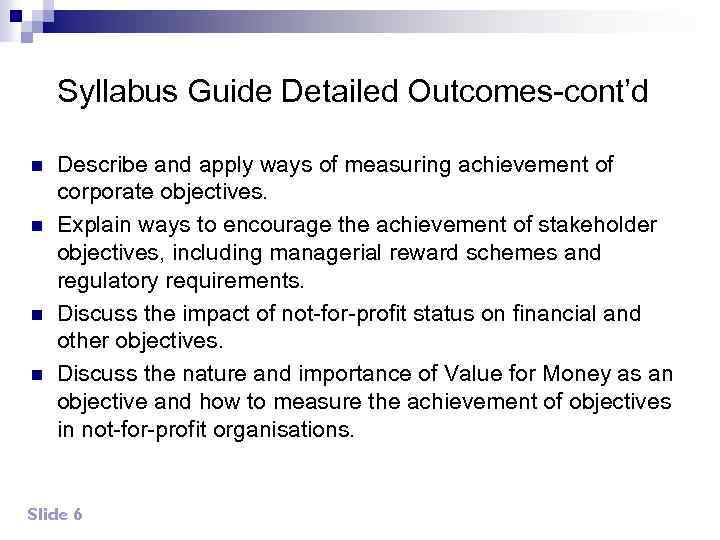
Syllabus Guide Detailed Outcomes-cont’d n n Describe and apply ways of measuring achievement of corporate objectives. Explain ways to encourage the achievement of stakeholder objectives, including managerial reward schemes and regulatory requirements. Discuss the impact of not-for-profit status on financial and other objectives. Discuss the nature and importance of Value for Money as an objective and how to measure the achievement of objectives in not-for-profit organisations. Slide 6
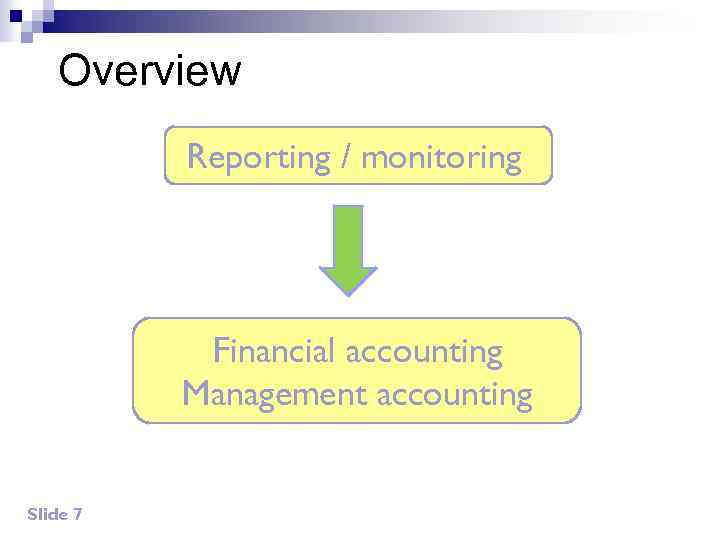
Overview Reporting / monitoring Financial accounting Management accounting Slide 7
Financial objectives Profit maximisation is often assumed to be the main objective of a business. n However, shareholders sometimes express disappointment in a company’s performance even when profits are rising; - this suggests that profit is not sufficient as a business objective. n Slide 8

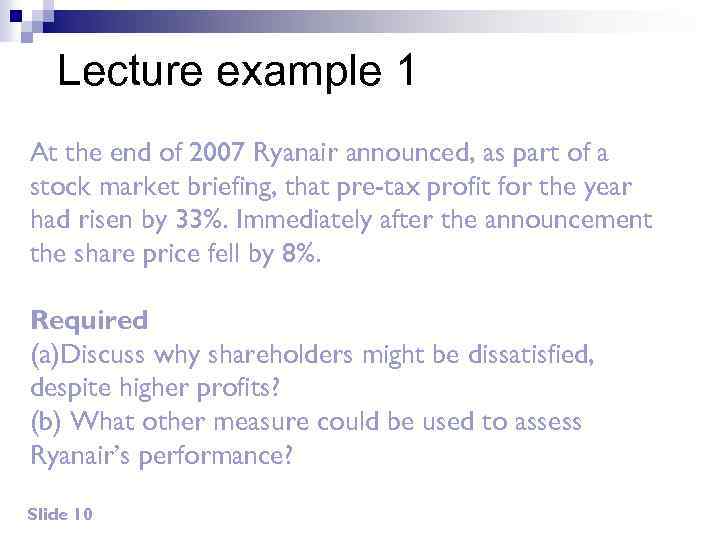
Lecture example 1 At the end of 2007 Ryanair announced, as part of a stock market briefing, that pre-tax profit for the year had risen by 33%. Immediately after the announcement the share price fell by 8%. Required (a)Discuss why shareholders might be dissatisfied, despite higher profits? (b) What other measure could be used to assess Ryanair’s performance? Slide 10
Answer to Lecture Example 1 a Profits are historic, shareholders care about the future n Investment decisions require new finance , shareholders care about debt levels n Profits are not cash flows, shareholders often want to see what returns they will be getting as dividends n Also profit can be manipulated by depreciation policy and by short-termism n Slide 11

Answer to Lecture Example 1 b n The share price is generally felt to capture shareholders feelings about future cash flows and risk Slide 12
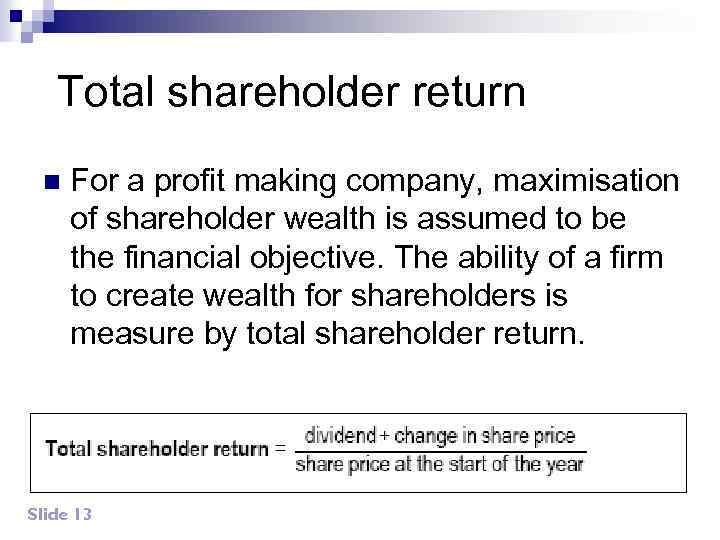
Total shareholder return n For a profit making company, maximisation of shareholder wealth is assumed to be the financial objective. The ability of a firm to create wealth for shareholders is measure by total shareholder return. Slide 13
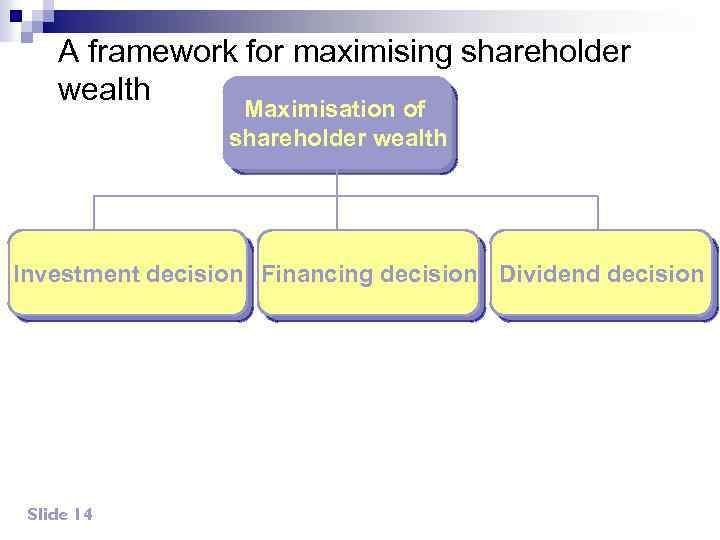
A framework for maximising shareholder wealth Maximisation of shareholder wealth Investment decision Financing decision Dividend decision Slide 14
Investment decisions n n Investment decisions (in projects, takeovers or working capital) need to be analysed to ensure that they are beneficial to the investor; this is covered in later chapters. Investments can help a firm to achieve key corporate objectives such as market share, quality etc; these will be monitored by the management accounting department. Investments also help a firm to achieve key financial objectives such as improving earnings per share. Slide 15
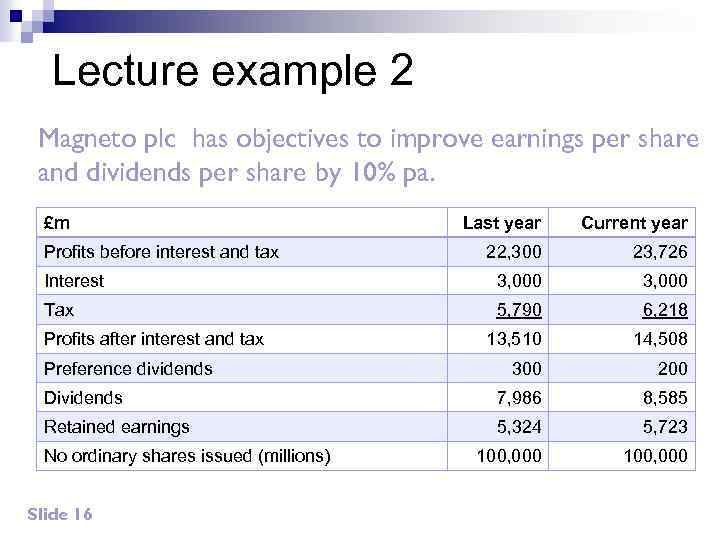
Lecture example 2 Magneto plc has objectives to improve earnings per share and dividends per share by 10% pa. £m Last year Current year 22, 300 23, 726 Interest 3, 000 Tax 5, 790 6, 218 13, 510 14, 508 300 200 Dividends 7, 986 8, 585 Retained earnings 5, 324 5, 723 100, 000 Profits before interest and tax Profits after interest and tax Preference dividends No ordinary shares issued (millions) Slide 16
Lecture Example 2 – cont’d Required Evaluate whether Magneto has achieved its earnings & dividend per share objectives Slide 17
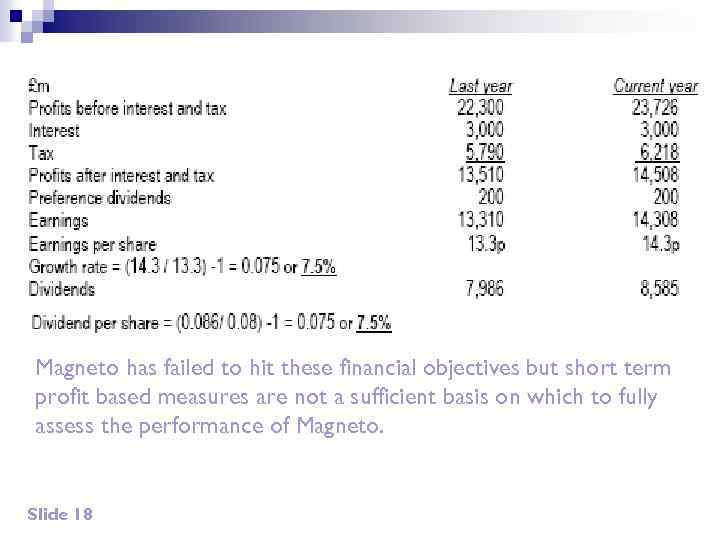
Answer to Lecture Example 2 Magneto has failed to hit these financial objectives but short term profit based measures are not a sufficient basis on which to fully assess the performance of Magneto. Slide 18
Financing decision n Financing decisions mainly focus on how much debt a firm should use, and aim to minimise the cost of capital. This is covered in later chapters Slide 19
Dividend decision n The dividend decision is determined by how much a firm has decided to spend on investments and how much of the finance needed for this it has decided to raise externally, and is a good example of the interrelationship between these 3 decisions. The dividend decision is covered in chapter 13. Slide 20
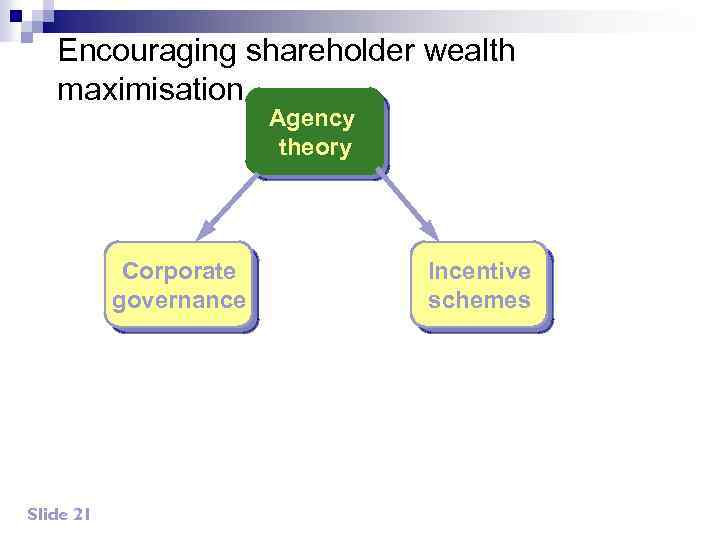
Encouraging shareholder wealth maximisation Agency theory Corporate governance Slide 21 Incentive schemes
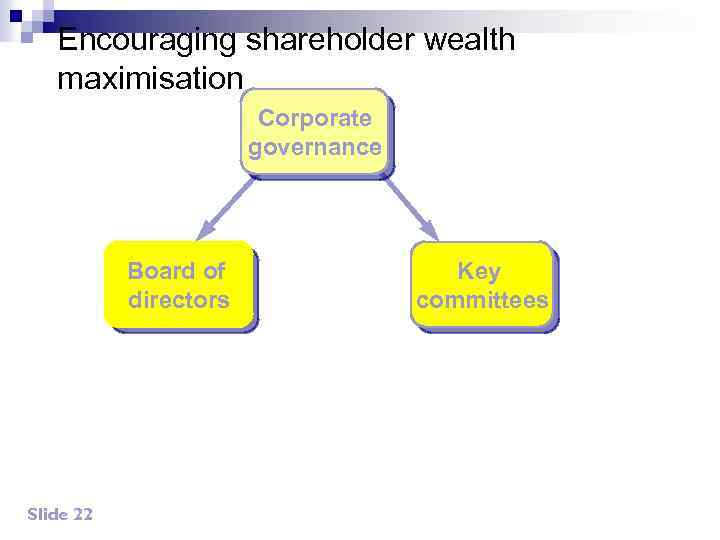
Encouraging shareholder wealth maximisation Corporate governance Board of directors Slide 22 Key committees
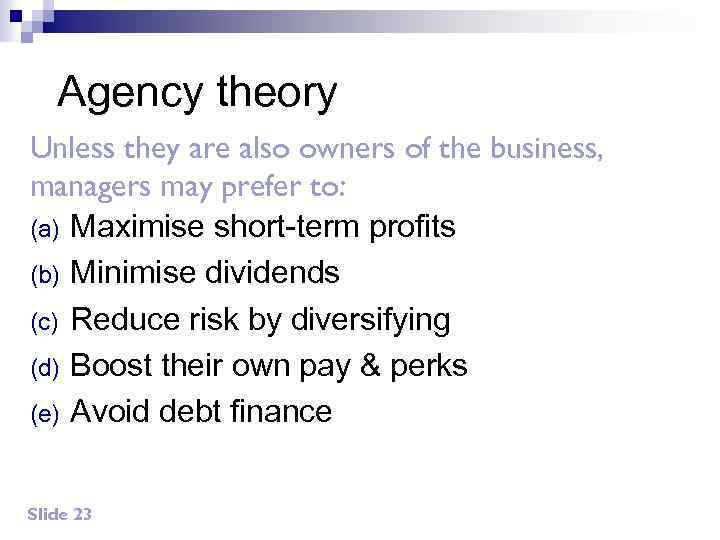
Agency theory Unless they are also owners of the business, managers may prefer to: (a) Maximise short-term profits (b) Minimise dividends (c) Reduce risk by diversifying (d) Boost their own pay & perks (e) Avoid debt finance Slide 23
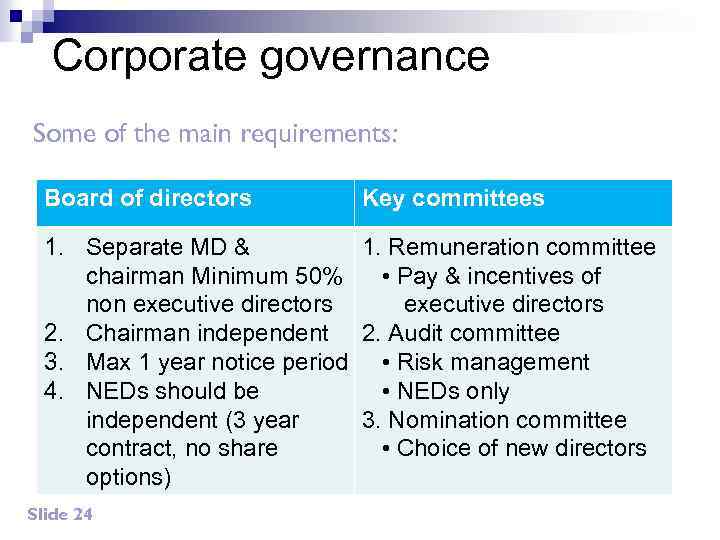
Corporate governance Some of the main requirements: Board of directors Key committees 1. Separate MD & 1. Remuneration committee chairman Minimum 50% • Pay & incentives of non executive directors 2. Chairman independent 2. Audit committee 3. Max 1 year notice period • Risk management 4. NEDs should be • NEDs only independent (3 year 3. Nomination committee contract, no share • Choice of new directors options) Slide 24

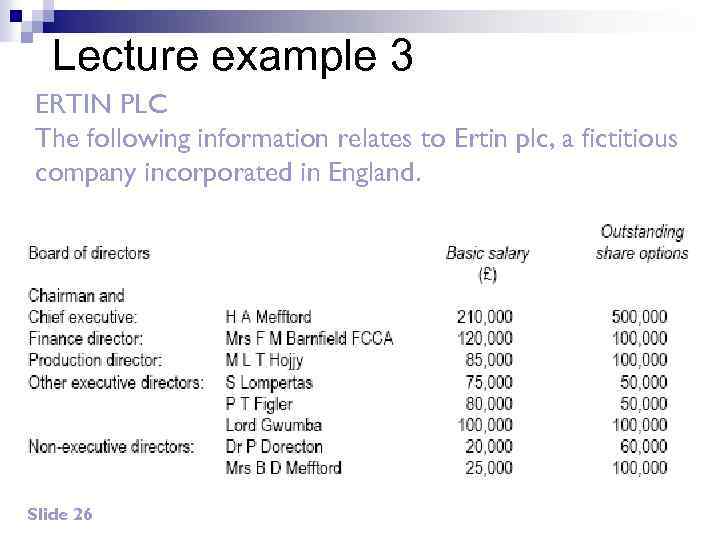
Lecture example 3 ERTIN PLC The following information relates to Ertin plc, a fictitious company incorporated in England. Slide 26
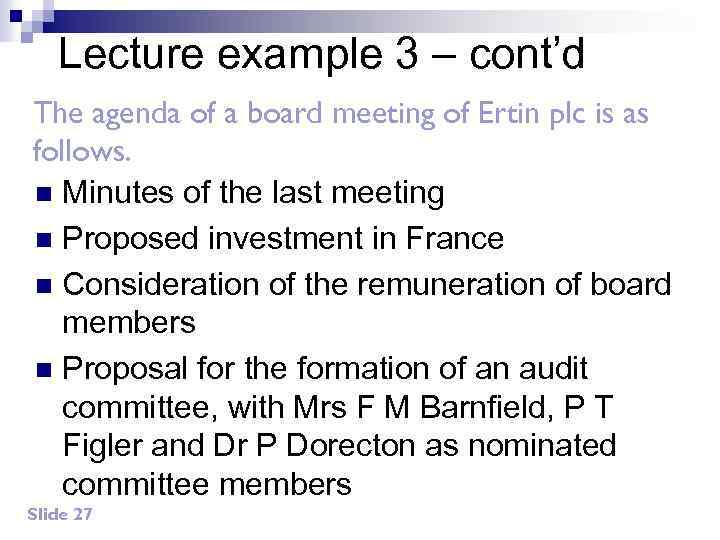
Lecture example 3 – cont’d The agenda of a board meeting of Ertin plc is as follows. n Minutes of the last meeting n Proposed investment in France n Consideration of the remuneration of board members n Proposal for the formation of an audit committee, with Mrs F M Barnfield, P T Figler and Dr P Dorecton as nominated committee members Slide 27
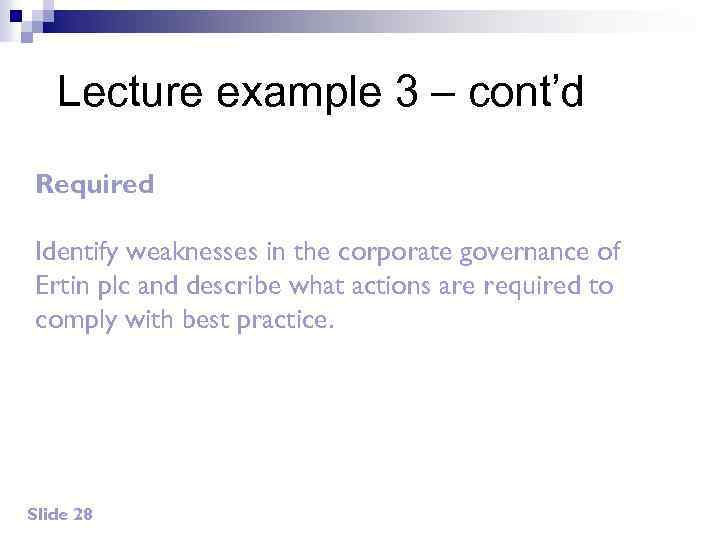
Lecture example 3 – cont’d Required Identify weaknesses in the corporate governance of Ertin plc and describe what actions are required to comply with best practice. Slide 28
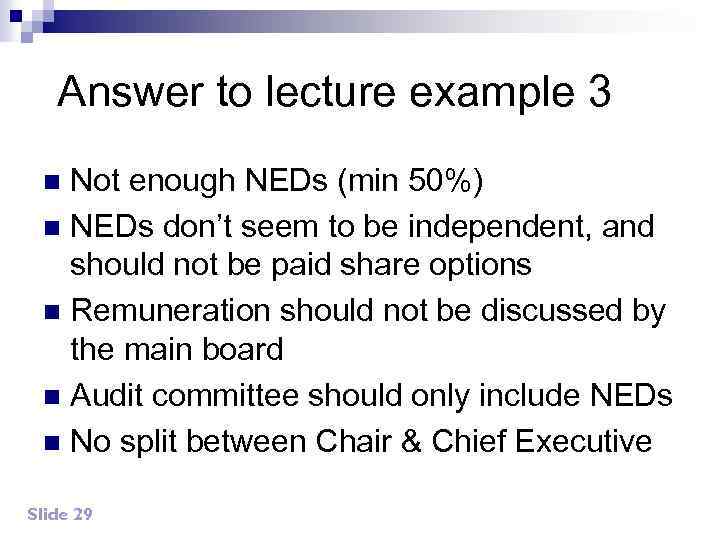
Answer to lecture example 3 Not enough NEDs (min 50%) n NEDs don’t seem to be independent, and should not be paid share options n Remuneration should not be discussed by the main board n Audit committee should only include NEDs n No split between Chair & Chief Executive n Slide 29
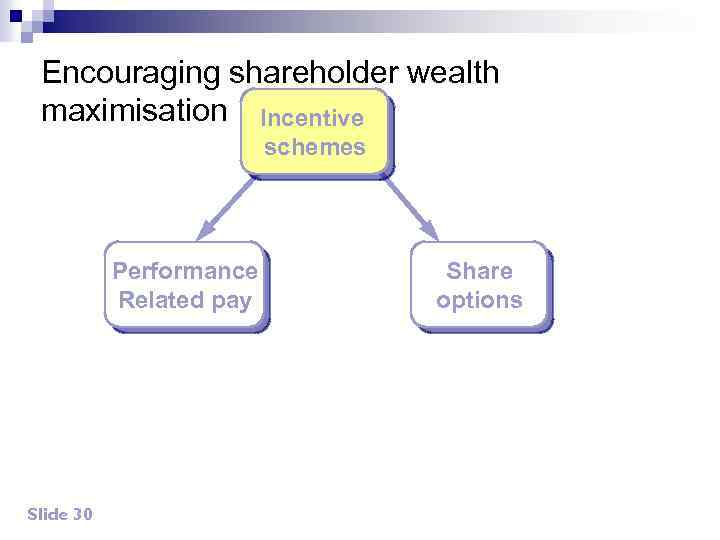
Encouraging shareholder wealth maximisation Incentive schemes Performance Related pay Slide 30 Share options
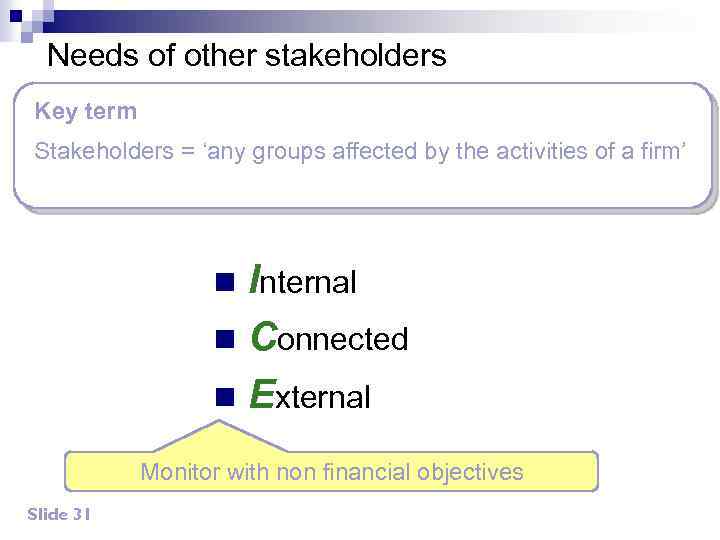
Needs of other stakeholders Key term Stakeholders = ‘any groups affected by the activities of a firm’ n Internal Connected n External n Monitor with non financial objectives Slide 31
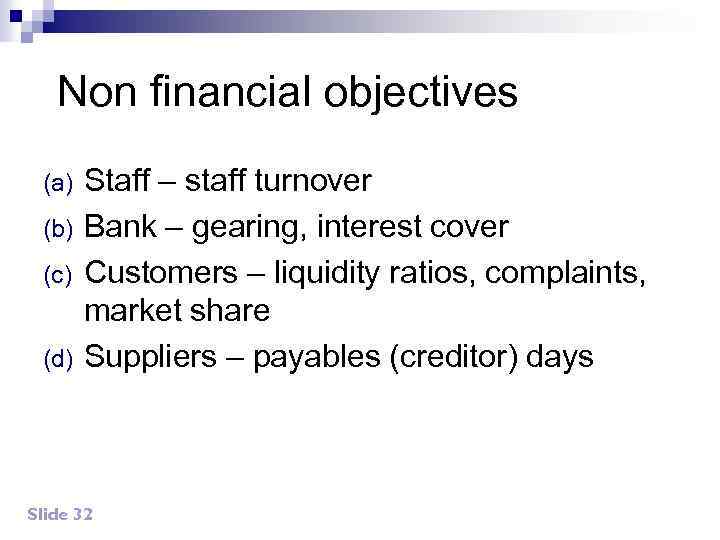
Non financial objectives (a) (b) (c) (d) Staff – staff turnover Bank – gearing, interest cover Customers – liquidity ratios, complaints, market share Suppliers – payables (creditor) days Slide 32
Measuring stakeholder objectives 4 categories of ratios n Profitability and return n Debt and gearing n Liquidity n Shareholders’ investment ratios Slide 33

Ratios Profitability ratios n Debt ratios n Liquidity ratios n Shareholder investor ratios n Slide 35
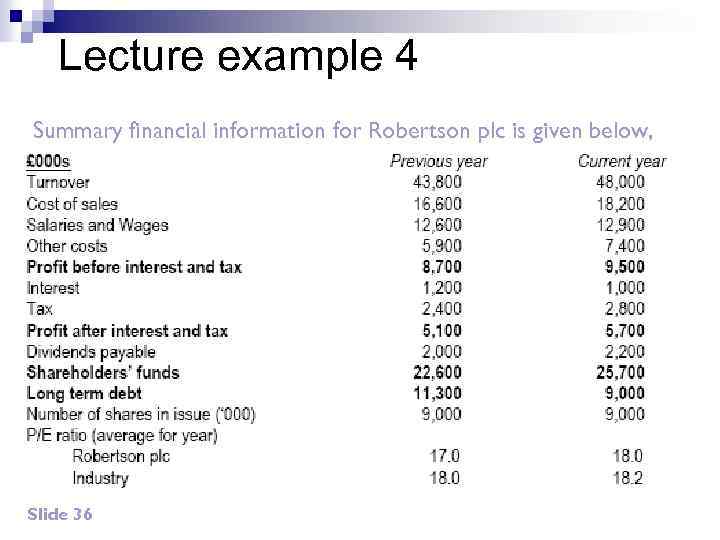
Lecture example 4 Summary financial information for Robertson plc is given below, covering the last two years. Slide 36
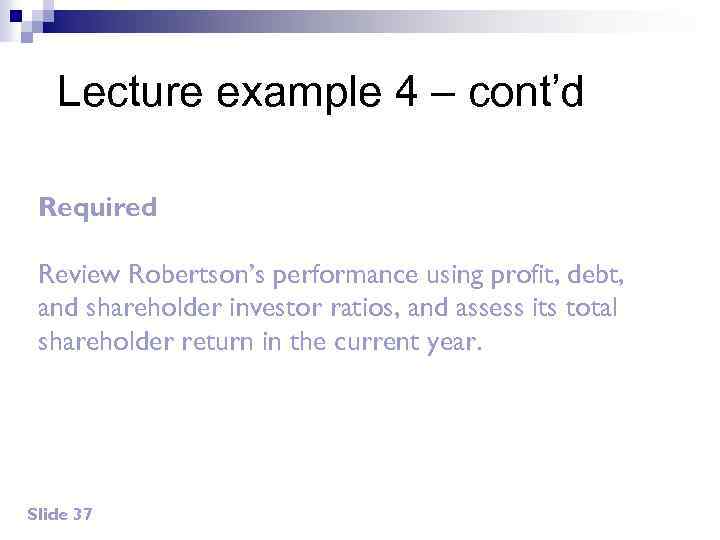
Lecture example 4 – cont’d Required Review Robertson’s performance using profit, debt, and shareholder investor ratios, and assess its total shareholder return in the current year. Slide 37
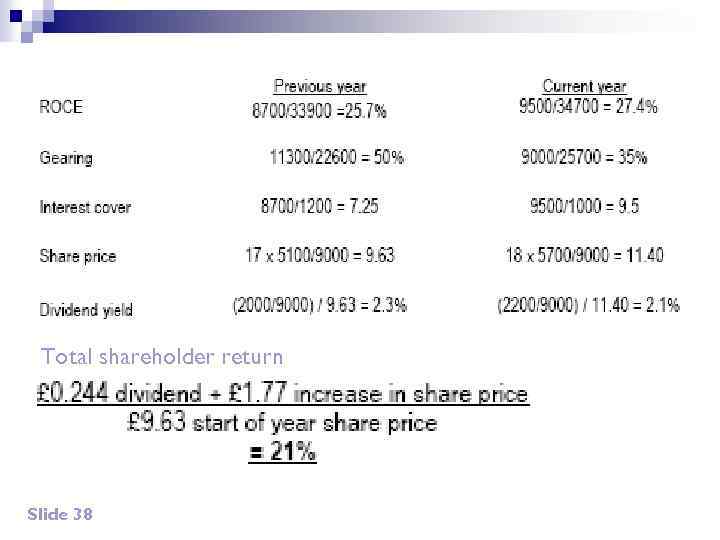
Answer to lecture example 4 Total shareholder return Slide 38
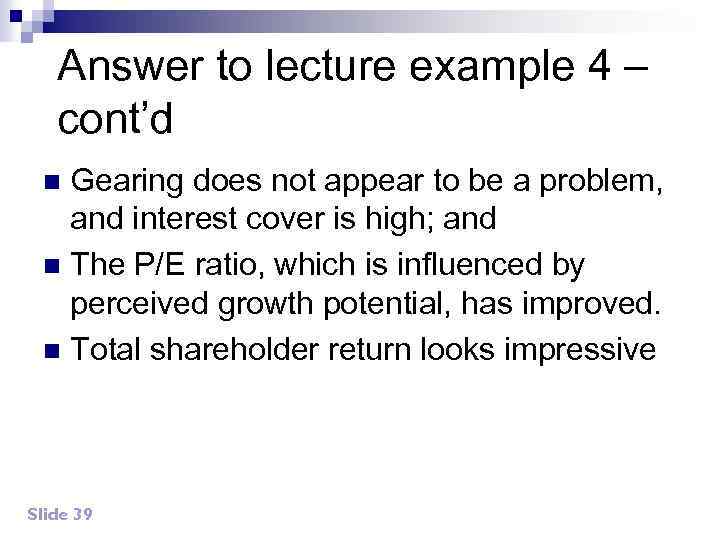
Answer to lecture example 4 – cont’d Gearing does not appear to be a problem, and interest cover is high; and n The P/E ratio, which is influenced by perceived growth potential, has improved. n Total shareholder return looks impressive n Slide 39
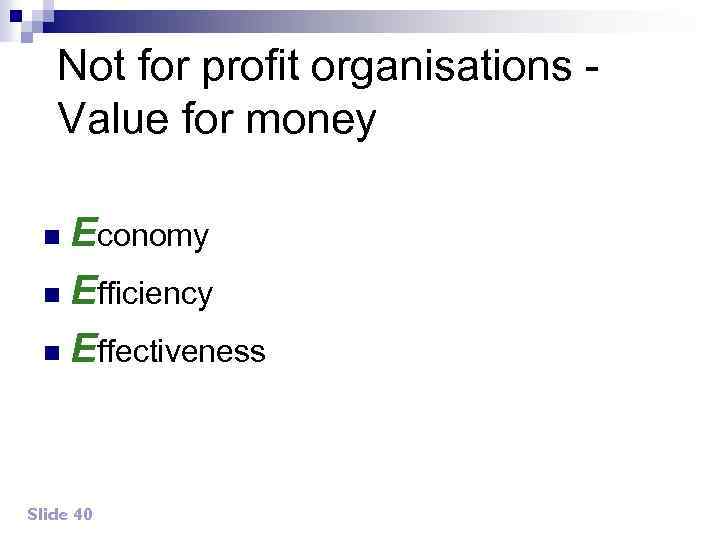
Not for profit organisations Value for money Economy n Efficiency n Effectiveness n Slide 40
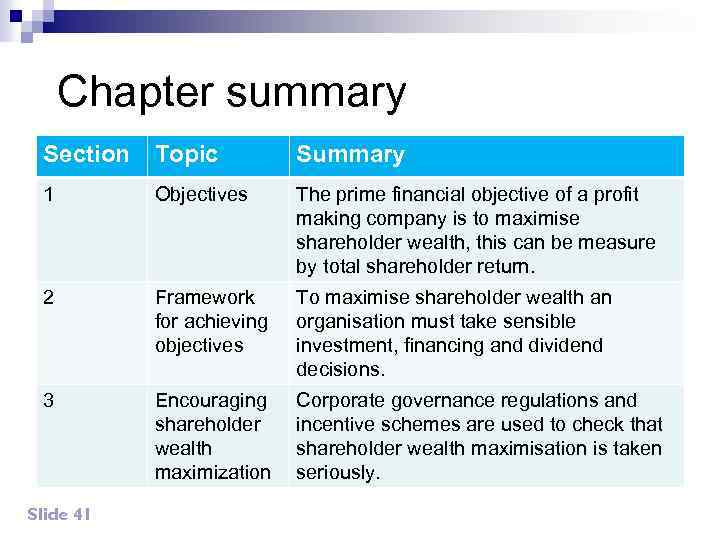
Chapter summary Section Topic Summary 1 Objectives The prime financial objective of a profit making company is to maximise shareholder wealth, this can be measure by total shareholder return. 2 Framework for achieving objectives To maximise shareholder wealth an organisation must take sensible investment, financing and dividend decisions. 3 Encouraging shareholder wealth maximization Corporate governance regulations and incentive schemes are used to check that shareholder wealth maximisation is taken seriously. Slide 41
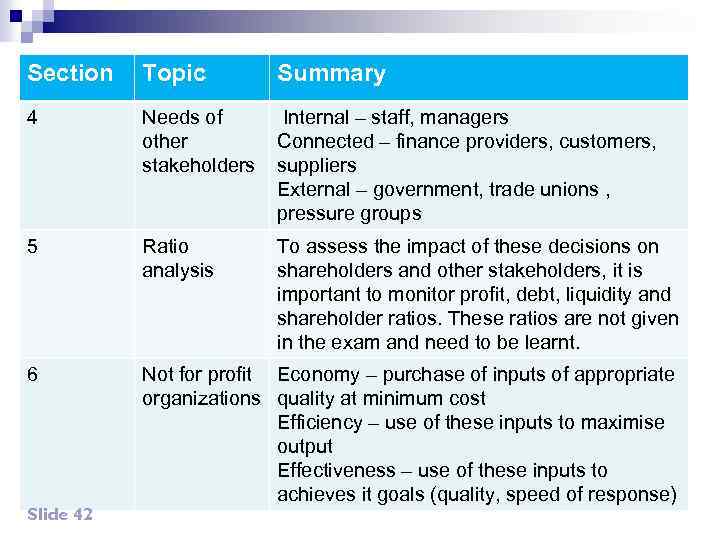
Section Topic Summary other stakeholders Connected – finance providers, customers, suppliers External – government, trade unions , pressure groups 5 Ratio analysis To assess the impact of these decisions on shareholders and other stakeholders, it is important to monitor profit, debt, liquidity and shareholder ratios. These ratios are not given in the exam and need to be learnt. 6 Not for profit Economy – purchase of inputs of appropriate organizations quality at minimum cost Efficiency – use of these inputs to maximise output Effectiveness – use of these inputs to achieves it goals (quality, speed of response) 4 Chapterof summary – cont’d Needs Internal – staff, managers Slide 42

Chapter 2 2 Economic environment for business “Self-Learning”
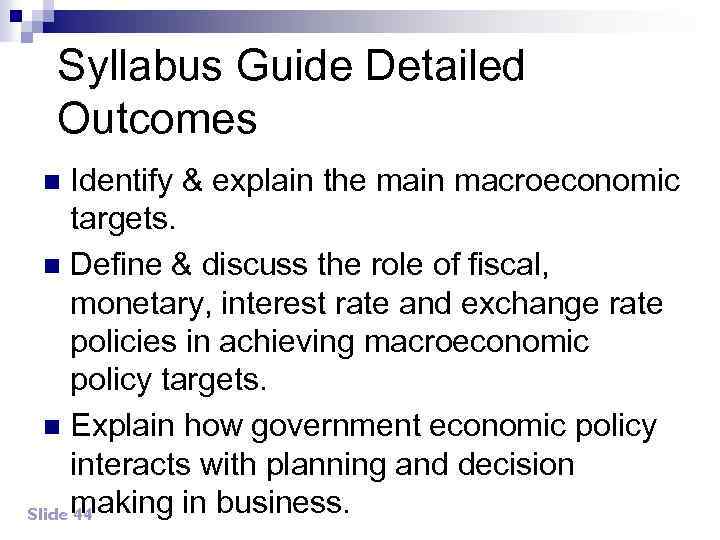
Syllabus Guide Detailed Outcomes Identify & explain the main macroeconomic targets. n Define & discuss the role of fiscal, monetary, interest rate and exchange rate policies in achieving macroeconomic policy targets. n Explain how government economic policy interacts with planning and decision Slide making in business. 44 n
Syllabus Guide Detailed Outcomes – cont’d n Explain the need for and the interaction with planning and decision-making in business of: (i) competition policy (ii) government assistance for business (iii) green policies (iv) corporate governance regulation. Slide 45
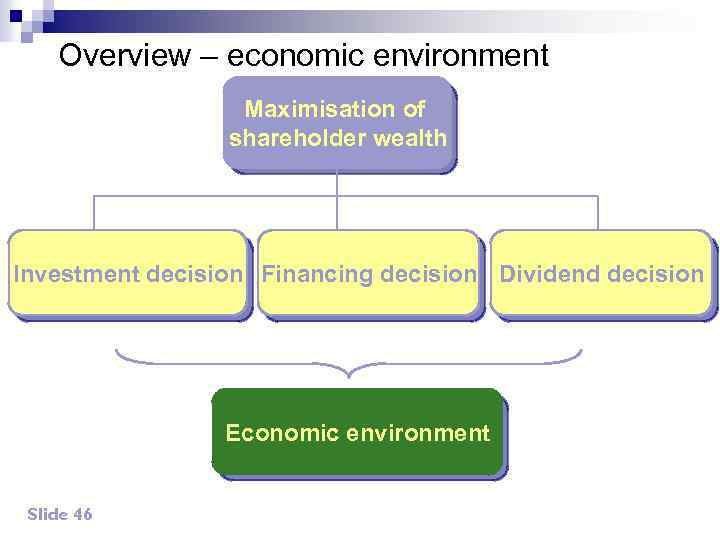
Overview – economic environment Maximisation of shareholder wealth Investment decision Financing decision Dividend decision Economic environment Slide 46
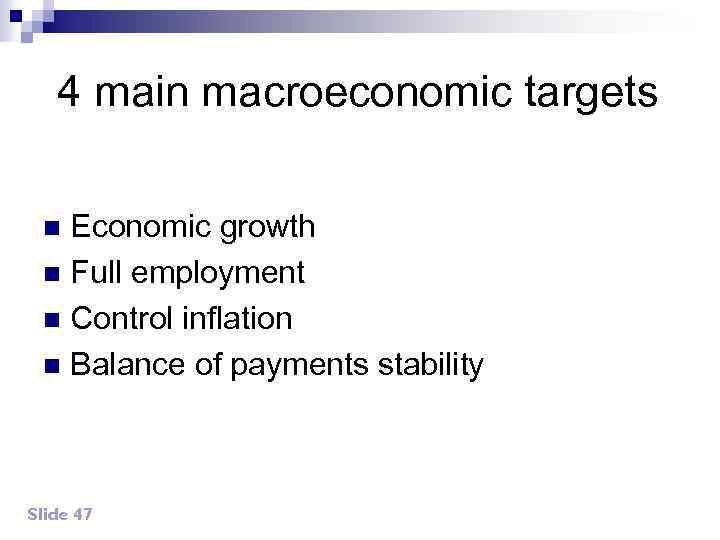
4 main macroeconomic targets Economic growth n Full employment n Control inflation n Balance of payments stability n Slide 47
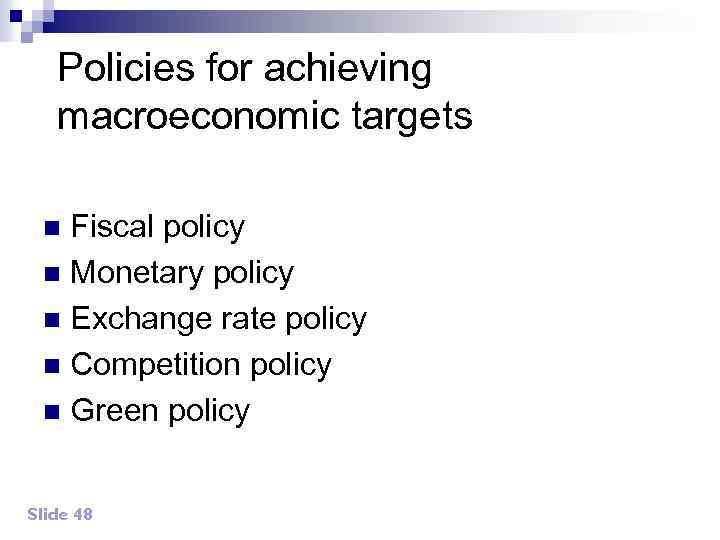
Policies for achieving macroeconomic targets Fiscal policy n Monetary policy n Exchange rate policy n Competition policy n Green policy n Slide 48
Lecture example 1 Target 1 : achieving economic growth /high employment Required Identify the impact on a business of the policy changes outlined in the table below. Slide 49
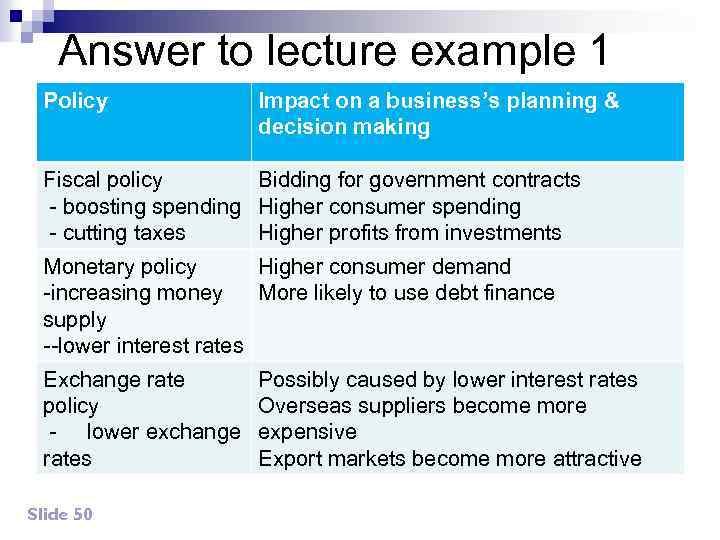
Answer to lecture example 1 Policy Impact on a business’s planning & decision making Fiscal policy Bidding for government contracts - boosting spending Higher consumer spending - cutting taxes Higher profits from investments Monetary policy Higher consumer demand -increasing money More likely to use debt finance supply --lower interest rates Exchange rate policy - lower exchange rates Slide 50 Possibly caused by lower interest rates Overseas suppliers become more expensive Export markets become more attractive
Lecture example 2 Target 2 : achieving low inflation Required Identify the impact on a business of the policy changes outlined in the table below. Slide 51
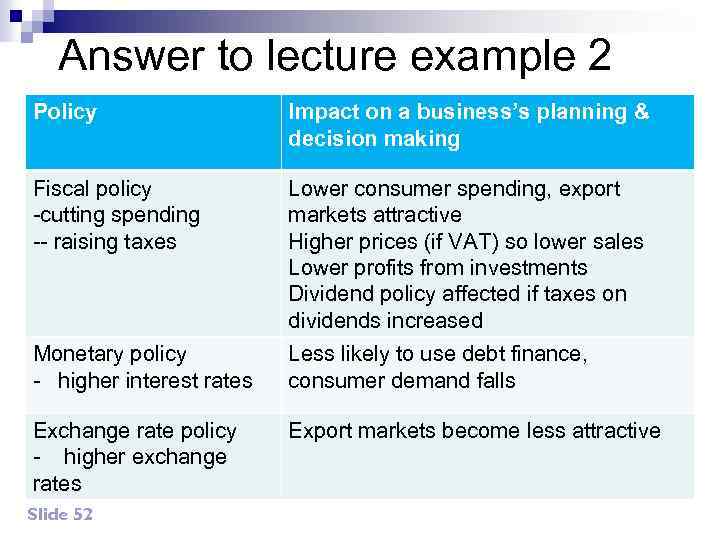
Answer to lecture example 2 Policy Impact on a business’s planning & decision making Fiscal policy -cutting spending -- raising taxes Lower consumer spending, export markets attractive Higher prices (if VAT) so lower sales Lower profits from investments Dividend policy affected if taxes on dividends increased Monetary policy - higher interest rates Less likely to use debt finance, consumer demand falls Exchange rate policy - higher exchange rates Export markets become less attractive Slide 52
Target 3 : achieving balance of payments stability n It is very difficult for a country to spend more on imports than it earns from exports for a sustained period of time. Where imports exceed exports this is often called a balance of payments deficit, and governments will often take action to correct this situation using the policies described below. Slide 53
Lecture example 3 Required Identify the impact on a business of the policy changes outlined in the table below. Slide 54
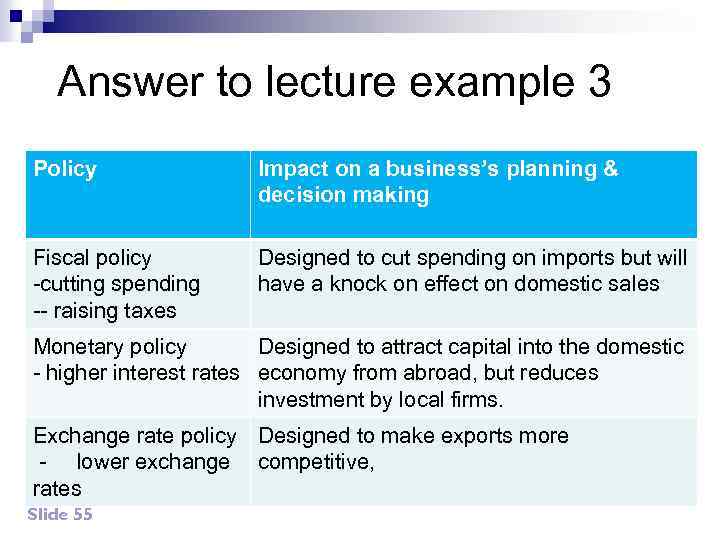
Answer to lecture example 3 Policy Impact on a business’s planning & decision making Fiscal policy -cutting spending -- raising taxes Designed to cut spending on imports but will have a knock on effect on domestic sales Monetary policy Designed to attract capital into the domestic - higher interest rates economy from abroad, but reduces investment by local firms. Exchange rate policy Designed to make exports more - lower exchange competitive, rates Slide 55
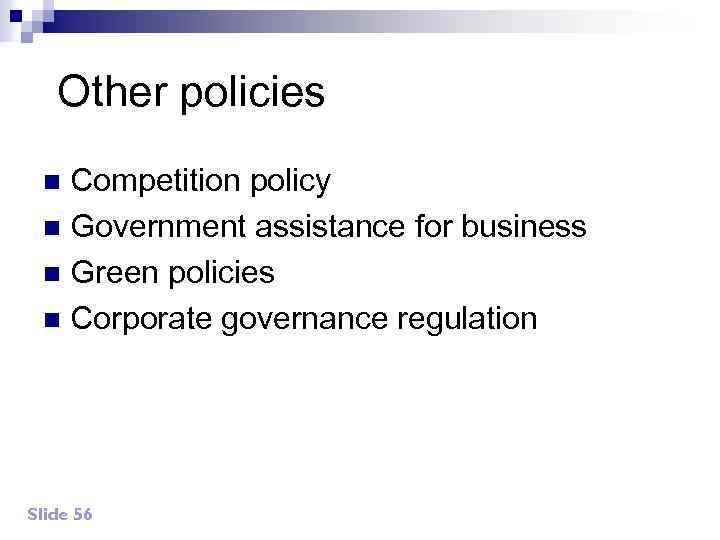
Other policies Competition policy n Government assistance for business n Green policies n Corporate governance regulation n Slide 56
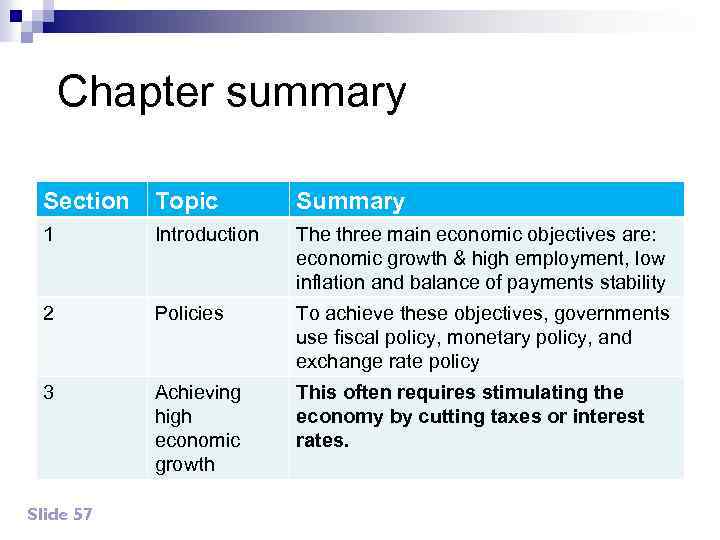
Chapter summary Section Topic Summary 1 Introduction The three main economic objectives are: economic growth & high employment, low inflation and balance of payments stability 2 Policies To achieve these objectives, governments use fiscal policy, monetary policy, and exchange rate policy 3 Achieving high economic growth This often requires stimulating the economy by cutting taxes or interest rates. Slide 57
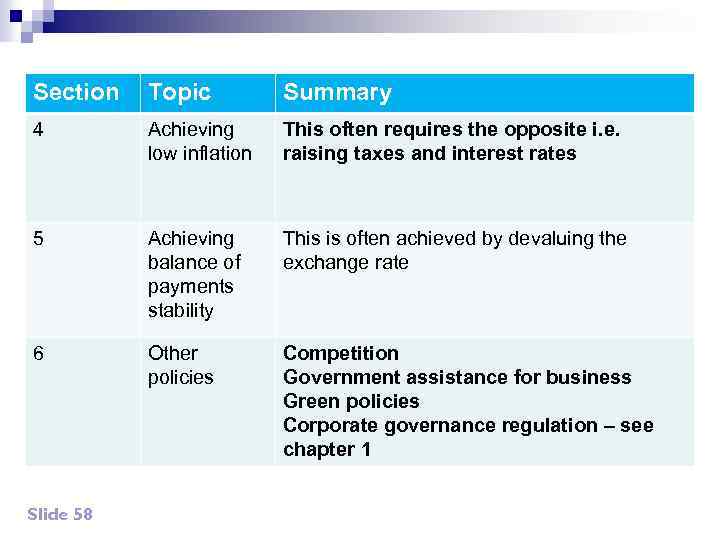
Topic Summary Chapter summary – cont’d Section 4 Achieving low inflation This often requires the opposite i. e. raising taxes and interest rates 5 Achieving balance of payments stability This is often achieved by devaluing the exchange rate 6 Other policies Competition Government assistance for business Green policies Corporate governance regulation – see chapter 1 Slide 58

Chapter 3 Financial markets and institutions “Self. Learning”
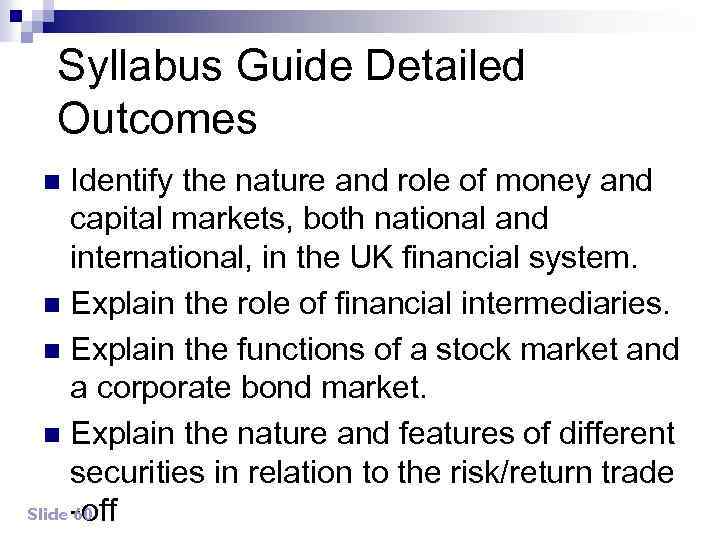
Syllabus Guide Detailed Outcomes Identify the nature and role of money and capital markets, both national and international, in the UK financial system. n Explain the role of financial intermediaries. n Explain the functions of a stock market and a corporate bond market. n Explain the nature and features of different securities in relation to the risk/return trade Slide -off 60 n
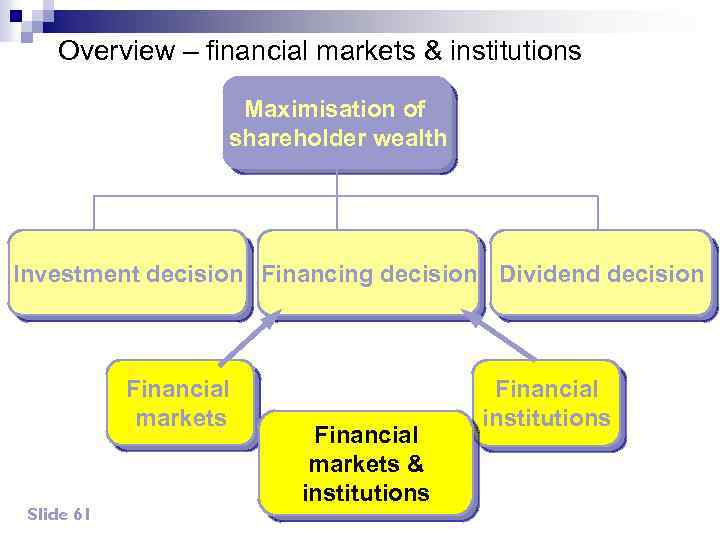
Overview – financial markets & institutions Maximisation of shareholder wealth Investment decision Financing decision Dividend decision Financial markets Slide 61 Financial markets & institutions Financial institutions
Introduction n When a firm is making its financing decision it has the choice of obtaining finance directly from investors through the financial markets or indirectly through financial institutions that they have deposited their money with; these financial institutions act as financial intermediaries. Slide 62
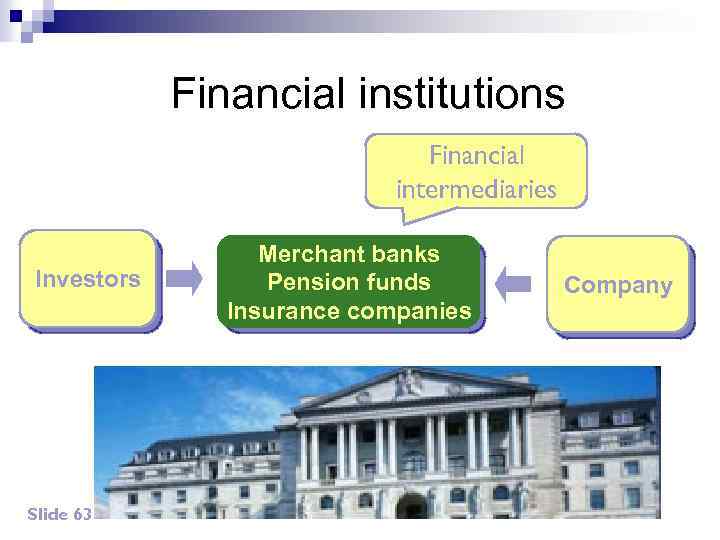
Financial institutions Financial intermediaries Investors Slide 63 Merchant banks Pension funds Insurance companies Company
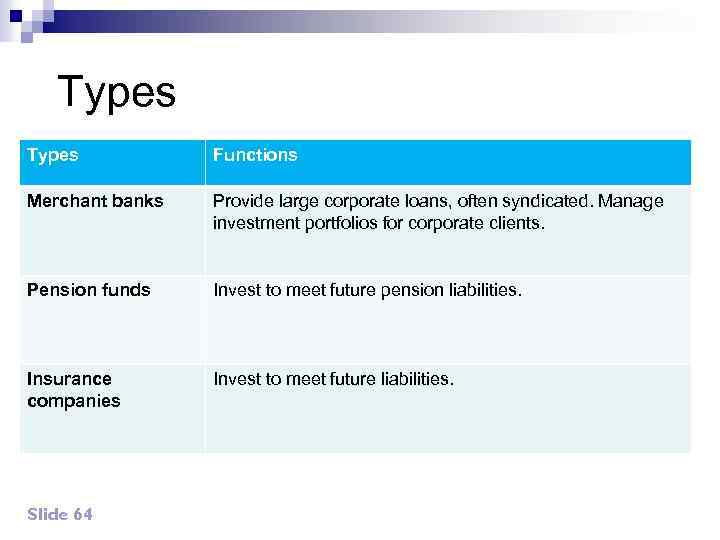
Types Functions Merchant banks Provide large corporate loans, often syndicated. Manage investment portfolios for corporate clients. Pension funds Invest to meet future pension liabilities. Insurance companies Invest to meet future liabilities. Slide 64
n These financial institutions dominate share ownership, and also the provision of debt finance; because they are investing their clients money they are referred to as financial intermediaries. Slide 65
Financial intermediaries Maturity transformation n Aggregation of funds n Pooling losses n Slide 66
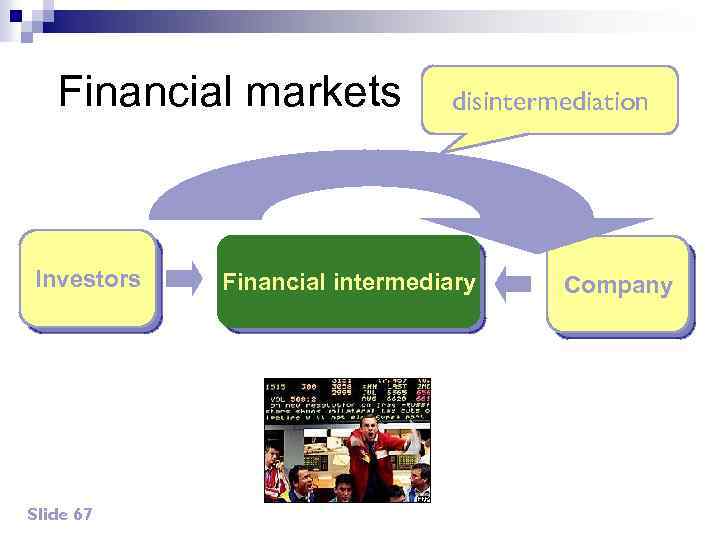
Financial markets Investors Slide 67 disintermediation Financial intermediary Company
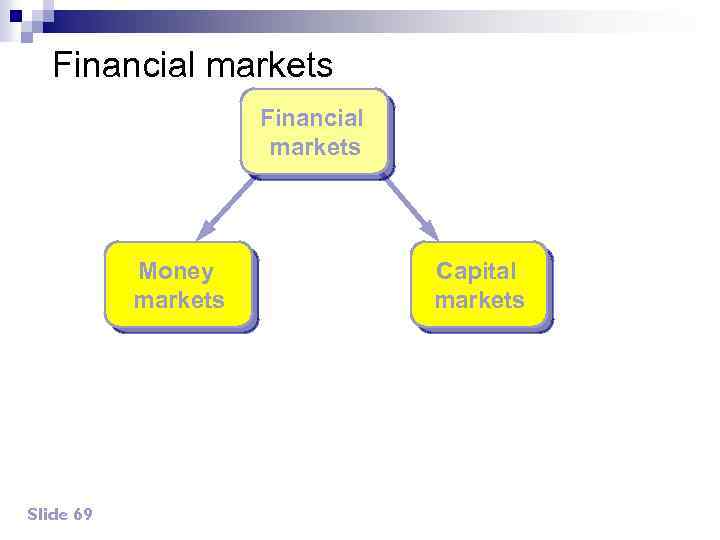
Financial markets A financial market brings a firm into direct contact with its investors. The trend to borrowing directly from investors is sometimes called disintermediation. n Financial markets are split into those that provide short-term finance (money markets) and those that provide long-term finance (capital markets). n Slide 68
Financial markets Money markets Slide 69 Capital markets
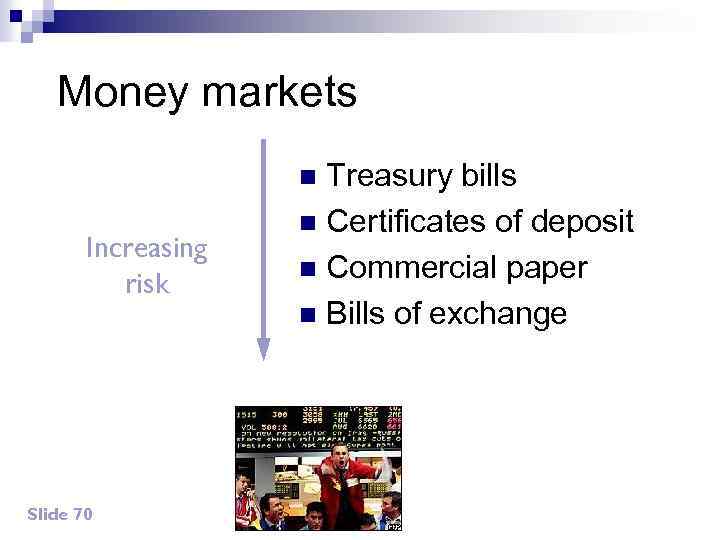
Money markets Treasury bills n Certificates of deposit n Commercial paper n Bills of exchange n Increasing risk Slide 70
n Higher risk investments require a higher return to be paid. Commercial paper and bills of exchange are discussed in more detail later in the course. Slide 71
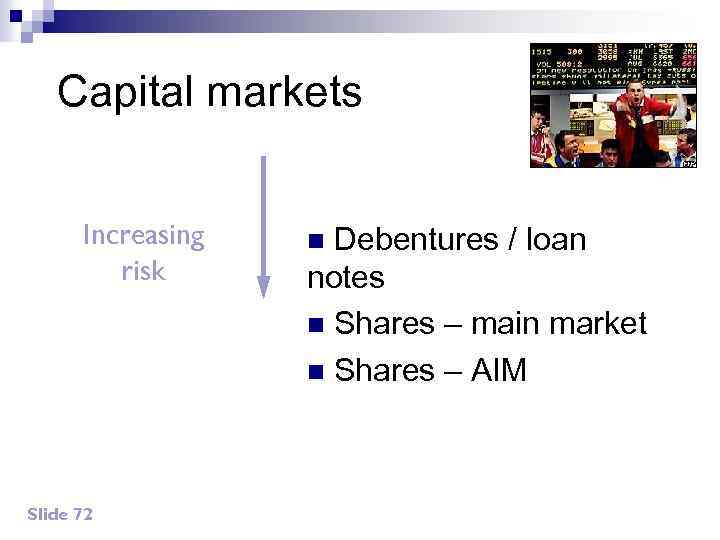
Capital markets Increasing risk Slide 72 Debentures / loan notes n Shares – main market n Shares – AIM n
n Higher risk investments require a higher return to be paid, so shares will give a higher return (and therefore cost more) than debentures. Debentures & shares are covered in more detail later in the course. Slide 73
Lecture example 1 Required What advantages are there to a firm of: (a) (b) (c) a listing on the main Stock Market a listing on the Alternative Investment Market issuing debentures Slide 74
Answer to lecture example 1 (a) The main Stock Market (b) The Alternative Investment Market (c) Debentures are a liquid investment, so will often be cheaper than a bank loan. Slide 75
Euromarkets Cheap debt finance n Unsecured / no covenants n Foreign currency n Key term Eurobond = a bond denominated in a currency which often differs from that of the country of issue Slide 76
Eurobonds n In recent years a strong market has built up which allows large companies with excellent credit ratings to raise finance in a foreign currency. This market is organised by international commercial banks. The key features of Eurobonds are summarised below. This market is much bigger than the market for domestic bonds / debentures. Slide 77
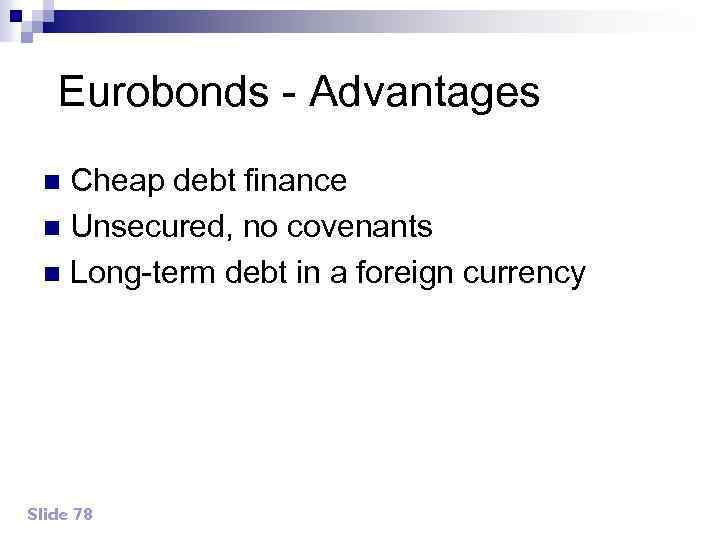
Eurobonds - Advantages Cheap debt finance n Unsecured, no covenants n Long-term debt in a foreign currency n Slide 78
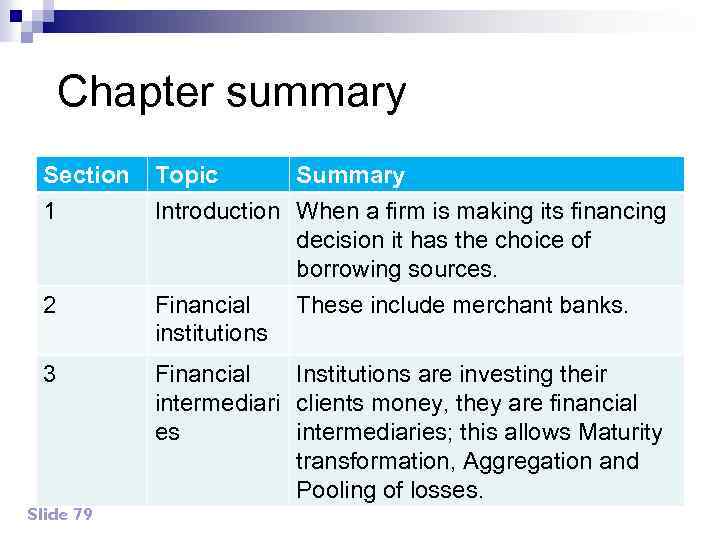
Chapter summary Section 1 2 3 Slide 79 Topic Summary Introduction When a firm is making its financing decision it has the choice of borrowing sources. Financial These include merchant banks. institutions Financial Institutions are investing their intermediari clients money, they are financial es intermediaries; this allows Maturity transformation, Aggregation and Pooling of losses.
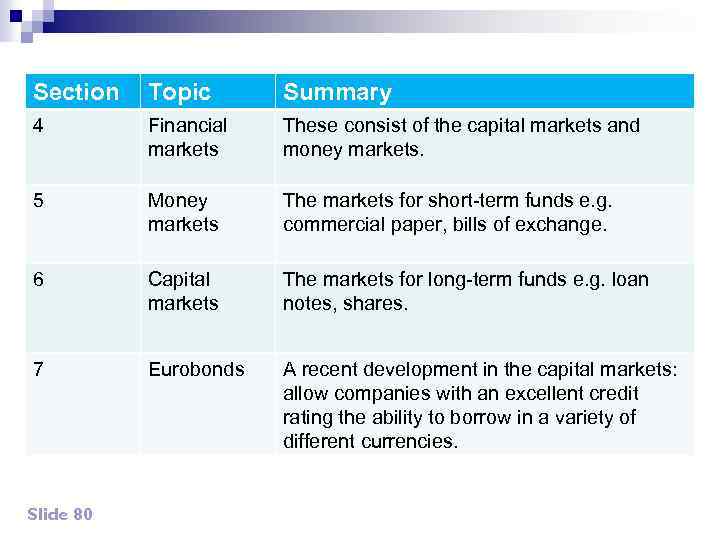
Topic Summary Chapter summary – cont’d Section 4 Financial markets These consist of the capital markets and money markets. 5 Money markets The markets for short-term funds e. g. commercial paper, bills of exchange. 6 Capital markets The markets for long-term funds e. g. loan notes, shares. 7 Eurobonds A recent development in the capital markets: allow companies with an excellent credit rating the ability to borrow in a variety of different currencies. Slide 80
Скачать презентацию Willkommen in Shanghai Bienvenue à Shanghai 这是上海 This
Chapter 1-3.ppt