


 Скачать презентацию William Stallings Data and Computer Communications 7 th
e12213763af1e25b0aaec764a3aaaf6a.ppt
- Количество слайдов: 37
 William Stallings Data and Computer Communications 7 th Edition Chapter 4 Transmission Media
 Overview • Characteristics and quality determined by: — Medium — Signal • Medium — Guided - wire — Unguided - wireless • For Guided Medium — The medium is more important • For Unguided — The bandwidth produced by the antenna is more important • Key concerns are data rate and distance
 Design Factors • Bandwidth — Higher bandwidth gives higher data rate • Transmission impairments — Attenuation • Interference — Issue especially in case of unguided medium • Number of receivers — Unicast (one sender, one receiver) — Multicast (multiple receivers can introduce more errors)
 Guided Transmission Media • Twisted Pair • Coaxial Cable • Optical Fiber
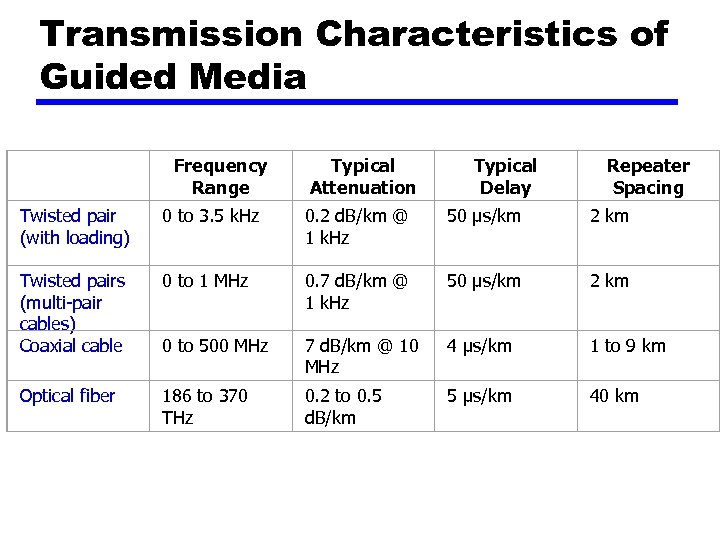 Transmission Characteristics of Guided Media Frequency Range Typical Attenuation Typical Delay Repeater Spacing Twisted pair (with loading) 0 to 3. 5 k. Hz 0. 2 d. B/km @ 1 k. Hz 50 µs/km 2 km Twisted pairs (multi-pair cables) Coaxial cable 0 to 1 MHz 0. 7 d. B/km @ 1 k. Hz 50 µs/km 2 km 0 to 500 MHz 7 d. B/km @ 10 MHz 4 µs/km 1 to 9 km Optical fiber 186 to 370 THz 0. 2 to 0. 5 d. B/km 5 µs/km 40 km
 Twisted Pair
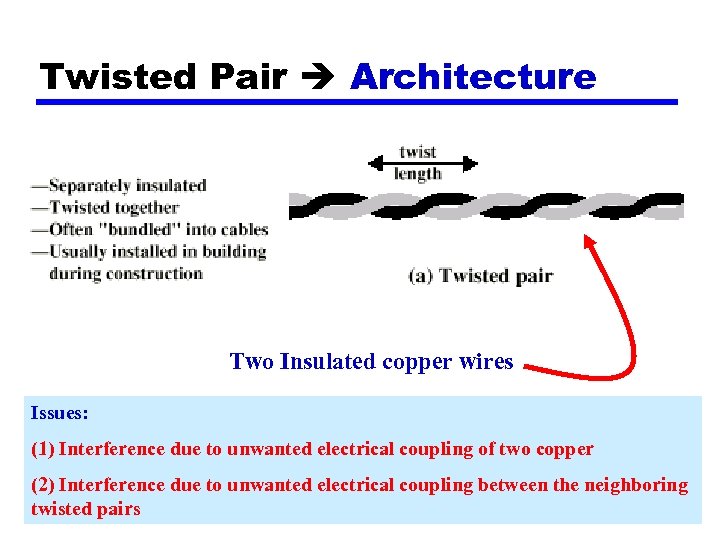 Twisted Pair Architecture Two Insulated copper wires Issues: (1) Interference due to unwanted electrical coupling of two copper (2) Interference due to unwanted electrical coupling between the neighboring twisted pairs
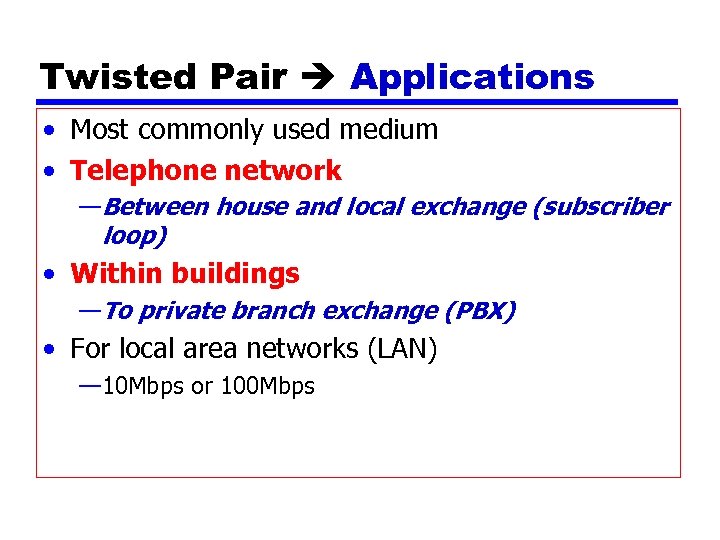 Twisted Pair Applications • Most commonly used medium • Telephone network —Between house and local exchange (subscriber loop) • Within buildings —To private branch exchange (PBX) • For local area networks (LAN) — 10 Mbps or 100 Mbps
 Twisted Pair - Pros and Cons • Advantages —Less expensive —Easy to work with • Disadvantages —Low data rate —Short range
 Twisted Pair (TP) Characteristics • Analog transmission — Amplifiers every 5 km to 6 km • Digital transmission — Use either analog or digital signals — repeater every 2 km or 3 km • TP is Limited — Distance — Bandwidth — Data rate • Susceptible to interference and noise — Easy coupling of electromagnetic fields
 Unshielded and Shielded TP • Unshielded Twisted Pair (UTP) —Ordinary telephone wire —Less expensive —Weak immunity against noise and interference —Suffers from external EM interference • Shielded Twisted Pair (STP) —An extra metallic sheath on each pair —Relatively more expensive —Provide better performance than UTP • Increased Data rate • Increased Bandwidth
 UTP Categories • Cat 3 — up to 16 MHz — Voice grade found in most offices — Twist length of 7. 5 cm to 10 cm • Cat 4 — up to 20 MHz • Cat 5 — up to 100 MHz — Commonly pre-installed in new office buildings — Twist length 0. 6 cm to 0. 85 cm • Cat 5 E (Enhanced) –see tables • Cat 6 • Cat 7
 Coaxial Cable
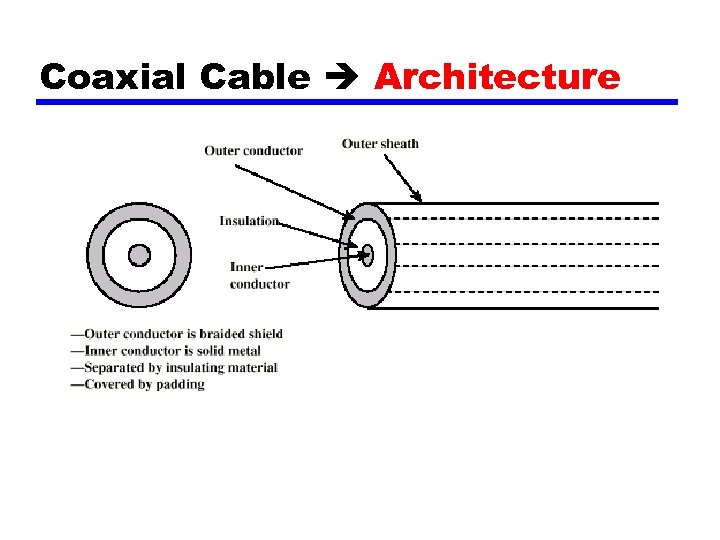 Coaxial Cable Architecture
 Coaxial Cable Applications • Television (TV) signals distribution —Ariel to TV —Cable TV • Long distance telephone transmission —Can carry 10, 000 voice calls simultaneously —Being replaced by fiber optic • Short distance computer systems links —Local area networks (LAN) —Metropolitan area network (MAN)
 Coaxial Cable Characteristics • Analog —Amplifiers every few km —Closer if higher frequency —Up to 500 MHz • Digital —Repeater every 1 km —Closer for higher data rates • Problem —Inter-modulation noise —Thermal noise
 Optical Fiber
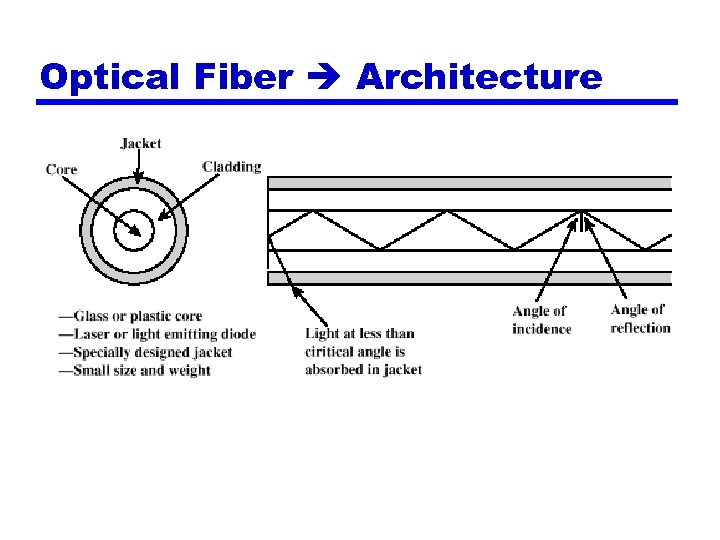 Optical Fiber Architecture
 Optical Fiber Benefits • Greater capacity —Data rates of hundreds of Gbps • Smaller size & weight —Made up of extremely thin fibers • Lower attenuation —Electromagnetic isolation • Greater repeater spacing — 10 s of km at least
 Optical Fiber - Transmission Characteristics • Operational range — 1014 to 1015 Hz • Light source —Light Emitting Diode (LED) • Cheaper • Wider operating temperature range • Last longer —Injection Laser Diode (ILD) • Operates on laser principle • More efficient • Greater data rate • Wavelength Division Multiplexing (WDM)
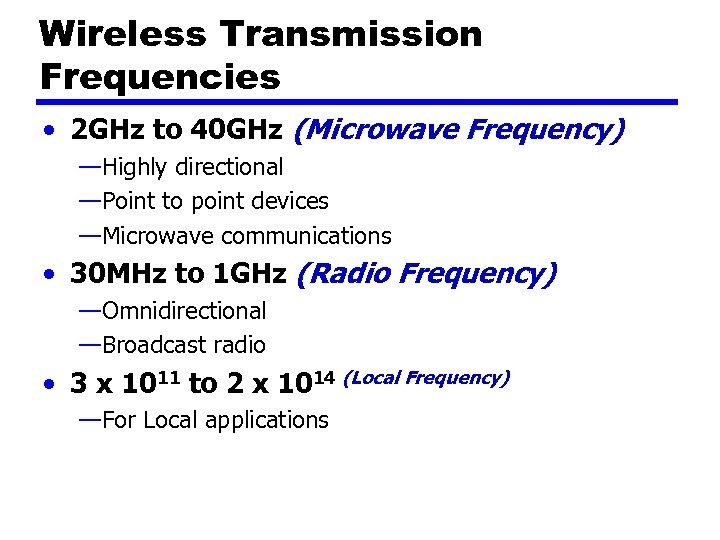 Wireless Transmission Frequencies • 2 GHz to 40 GHz (Microwave Frequency) —Highly directional —Point to point devices —Microwave communications • 30 MHz to 1 GHz (Radio Frequency) —Omnidirectional —Broadcast radio • 3 x 10¹¹ to 2 x 10¹⁴ (Local Frequency) —For Local applications
 Antennas • By definition — Is a electrical device • Transmission — Radio frequency energy from transmitter — Converted to electromagnetic energy — By antenna — Radiated into surrounding environment • Reception — Electromagnetic energy impinging on antenna — Converted to radio frequency electrical energy — Fed to receiver • Same antenna often used for both
 Radiation Pattern • Antenna might radiate power in all direction • Not same performance in all directions • How can we determine the performance of an antenna? —Solution is “Radiation Pattern” • Graphical representation of the radiated power • Isotropic antenna is an ideal antenna —Radiates in all directions equally —Use as a reference to characterize the power
 Antenna Gain • Measure of directionality of antenna • Power output in particular direction compared with that produced by isotropic antenna • Measured in decibels (d. B) • Gain could be +ve or -ve
 Terrestrial Microwave (TMW) 1. Parabolic antenna 2. Small beam 3. Line of sight 4. Use especially for P 2 P applications 5. Usually use for long distance communications
 Satellite Microwave (SM) 1. Satellite is relay station 2. Satellite • • • receives on one frequency amplifies or repeats signal transmits on another frequency 3. Requires geo-stationary orbit — Height of 35, 784 km 4. Applications • • • Television Long distance telephone Private business networks
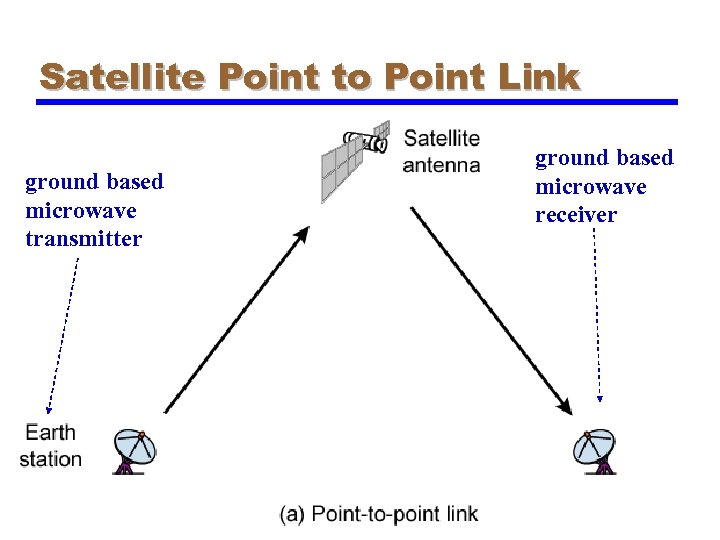 Satellite Point to Point Link ground based microwave transmitter ground based microwave receiver
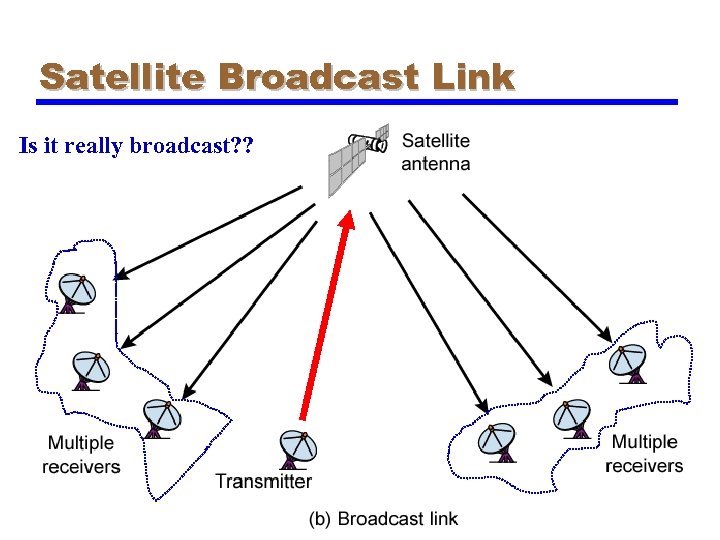 Satellite Broadcast Link Is it really broadcast? ?
 Broadcast Radio 1. Omnidirectional (travel in all directions) 2. Line of sight is over 3. Doesn’t need parabolic antenna 4. Example FM radio
 Wireless Propagation • Signal travels along three routes 1. Ground wave • • • Follows contour of earth Up to 2 MHz AM radio 2. Sky wave • • Signal reflected from ionize layer of upper atmosphere BBC world service, Voice of America 3. Line of sight • • • Above 30 Mhz Antennas must be physically aligned Atmosphere can reflect the microwave signal
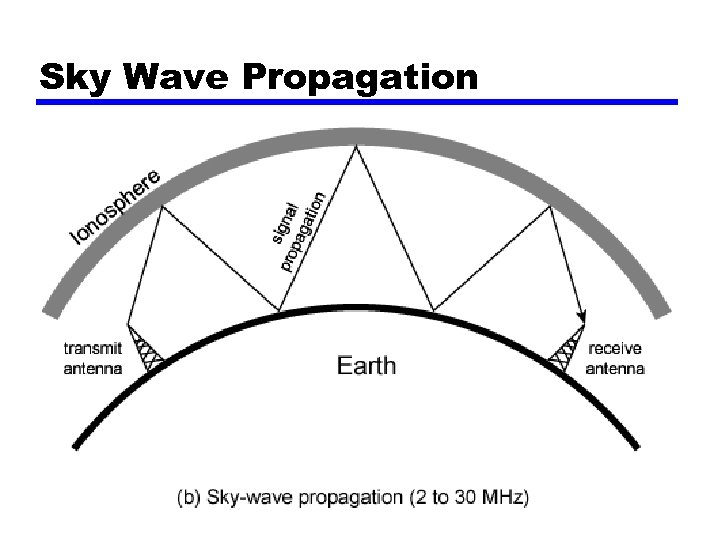 Sky Wave Propagation
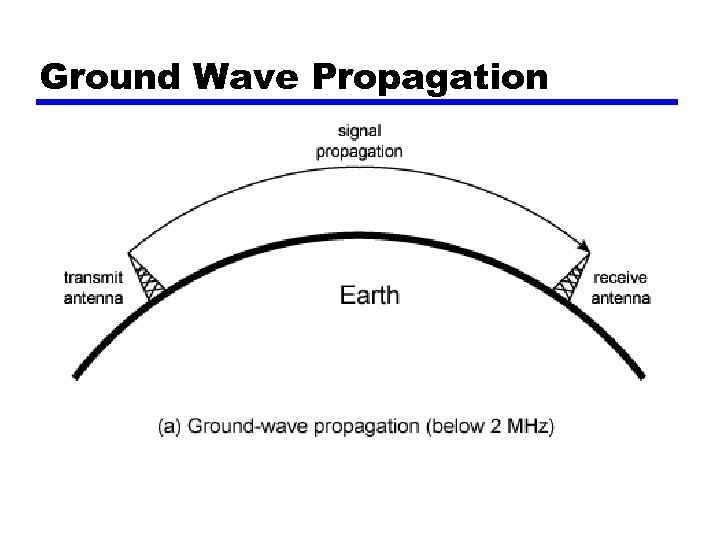 Ground Wave Propagation
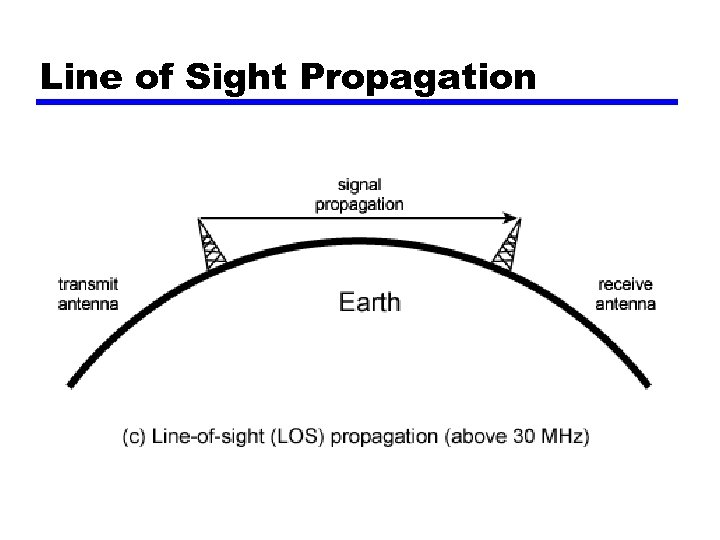 Line of Sight Propagation
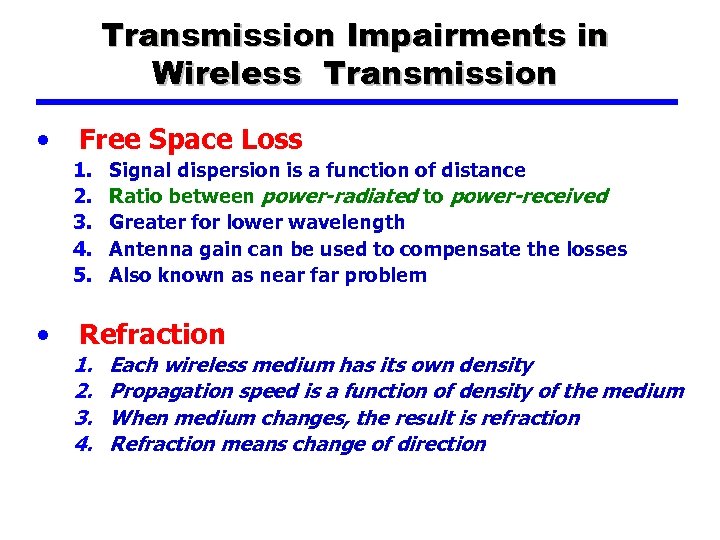 Transmission Impairments in Wireless Transmission • Free Space Loss 1. 2. 3. 4. 5. • Signal dispersion is a function of distance Ratio between power-radiated to power-received Greater for lower wavelength Antenna gain can be used to compensate the losses Also known as near far problem Refraction 1. 2. 3. 4. Each wireless medium has its own density Propagation speed is a function of density of the medium When medium changes, the result is refraction Refraction means change of direction
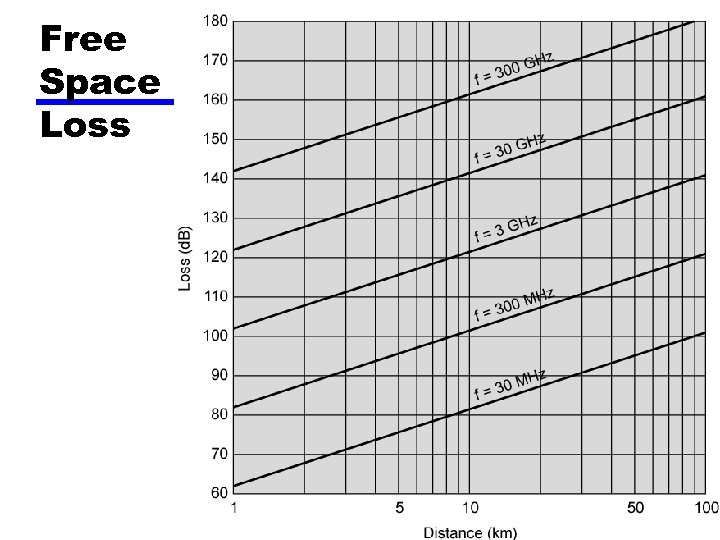 Free Space Loss
 Required Reading • Review Examples 4. 1 to 4. 4 • HW#2: Problems 4. 1 and 4. 2 —Due Date: Tuesday, September 25 (in class timing) — Need hard copy (typed or in hand writing) • Op. Net Lab 2 and 3 —(Due Date: Thursday, September 27 before 2: 30 Pm) — 3 Students (maximum) per group —One submission per group