 Скачать презентацию william shakespeare -by the pricking of my thumbs
58dc03269a60e72380a372a4631cf335.ppt
- Количество слайдов: 37



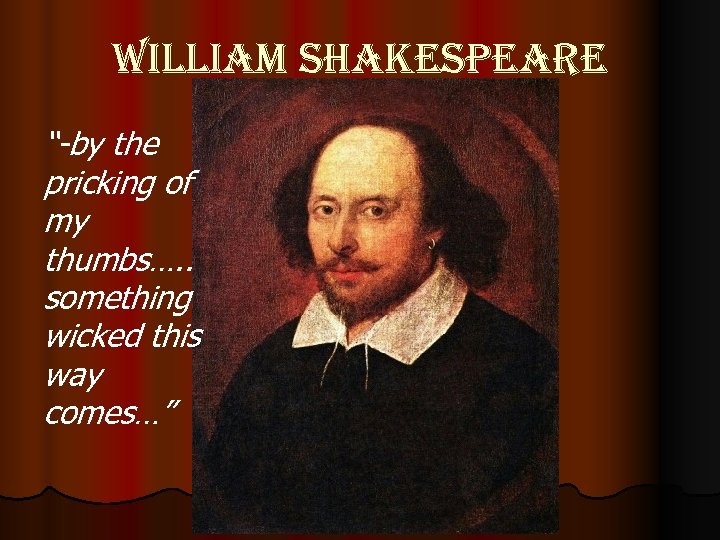
william shakespeare “-by the pricking of my thumbs…. . something wicked this way comes…”
date of birth? ? l 1564 – We don’t know his birthday l There is a record that he was baptized on April 26, 1564. l We can assume that he was probably born about 3 days earlier, but there is no proof of this.
family l Son of Mary Arden and John Shakespeare l Had 7 siblings – only one sister and four brothers survived to adulthood
family cont… l John was a glove-maker, Mayor of Stratford and a sheep dealer l Was fined for having too much dung on his front lawn l Mary Arden was a daughter of wealthy landowner – had a large dowry
Stratford-upon-Avon l Shakespeare was baptized in Holy Trinity Church, Stratford-upon-Avon l During his years in London, Shakespeare maintained his links with Stratford-upon. Avon. His wife and children continued to live there l By 1613, Shakespeare had apparently returned to live in Stratford-upon-Avon
Stratford-upon-Avon con’d l Buried in Holy Trinity Church in Stratford, where he had been baptized just fifty-two years earlier
l No education records exist of Shakespeare actually attending school l We can assume he went to the King’s New Grammar School, since all boys of Stratford went there to learn basic reading and math skills
marriage l Anne Hathaway – family friend (NOT the actor from Alice in Wonderland!) l Married in Nov. 1582 l Older woman – she was 26, he was 18 l They lived with his parents l Have 3 children: Susanna born in 1583, twins Hamnet and Judith 1592 l Hamnet dies at 11 years old
marriage cont… l Shotgun l Wedding: No announcement Customary to announce for 3 weeks that they were to be married l Allows for the opportunity to object in case someone has another identity, second family, or there is a possibility that they are related
the gap l 1585 – 1592: No one knows what happens l We do know he had another child with another woman out of wedlock l Do not have records of where Shakespeare was living or working – it is believed that he had left his family to pursue his craft l Finally, in 1592, Robert Green publishes a pamphlet criticizing Shakespeare, so we know he’s in London at this point
shakespeare’s theater Before the first public playhouses were built in London in the late 16 th century, players performed in the yards and upper rooms of the capital’s many inns l Open-air amphitheatres l Audiences were socially mixed, and women as well as men visited both the open-air and the indoor playhouses. Admission to the open-air amphitheatres cost one old penny, and they catered more for the citizenry. Admission to the indoor halls cost six old pennies, and they were frequented by the court and gentry. l
shakespeare’s theater con’d The playhouses were brightly decorated inside. Their stages had two doors for entrances and exits l Many of his plays were written for the Globe, rebuilt from the timbers of the Theatre on Bankside l Shakespeare, a player as well as a dramatist, belonged to a company of players. His company, the Lord Chamberlain’s Men (from 1603 the King’s Men) competed with others, notably the Admiral’s Men, for aud l
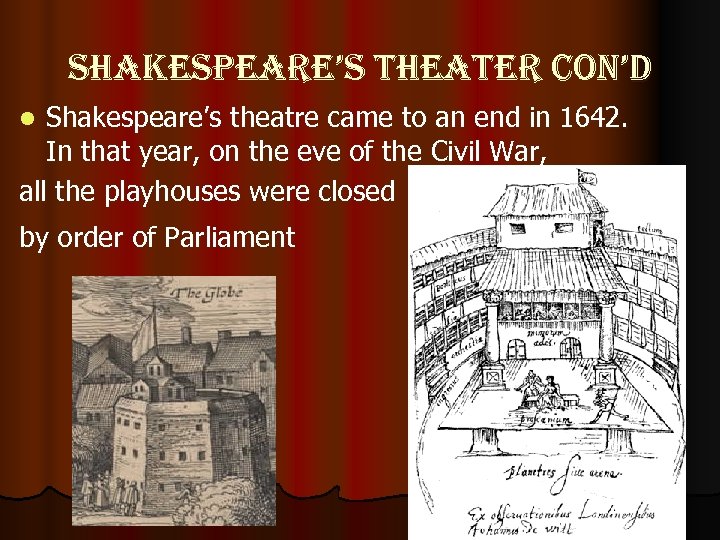
shakespeare’s theater con’d Shakespeare’s theatre came to an end in 1642. In that year, on the eve of the Civil War, all the playhouses were closed l by order of Parliament
lord chamberlain’s men l Acting Company that Shakespeare was a member of for most of his career l Was patronized by King James I. l Later changed to “The King’s Men”
death & his will l Shakespeare died on April 23, 1616 l Left his “second-best” bed to Anne Hathaway l Gave most of his estate to his daughter, Susanna l 25 March 1616, he signed his will. He was already a sick man, and on 25 April 1616
Death & His will Will is special because Shakespeare signed it. There are only 2 other known examples of his signature anywhere. The will is a standard legal document, written by a lawyer, with no touching last words for Shakespeare's family and friends l Shakespeare died a month after this will was written, having caught a fever at a 'merry party' thrown by fellow writer, Ben Jonson l
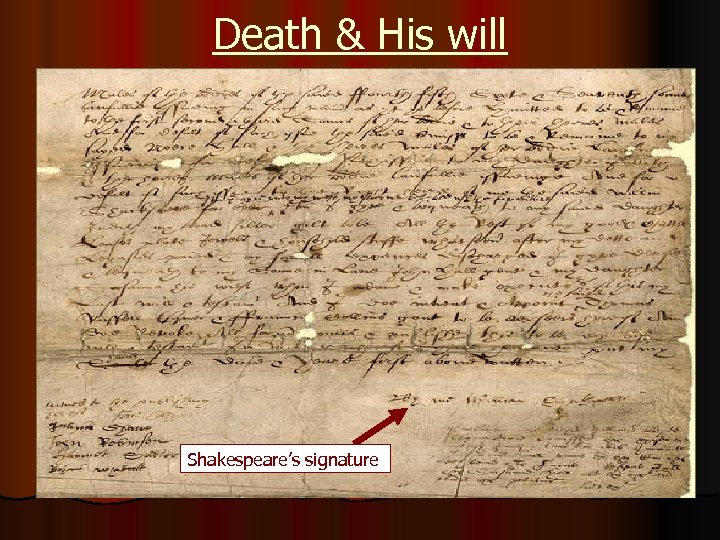
Death & His will Shakespeare’s signature
tombstone l Left a wish that he rest in peace and anyone who disturbed his remains would be cursed forever l “Good friend, for Jesus’ sake forbeare To digg the dust enclosed here! Blest be ye man that spares thes stones And curst be he that moves my bones. ”
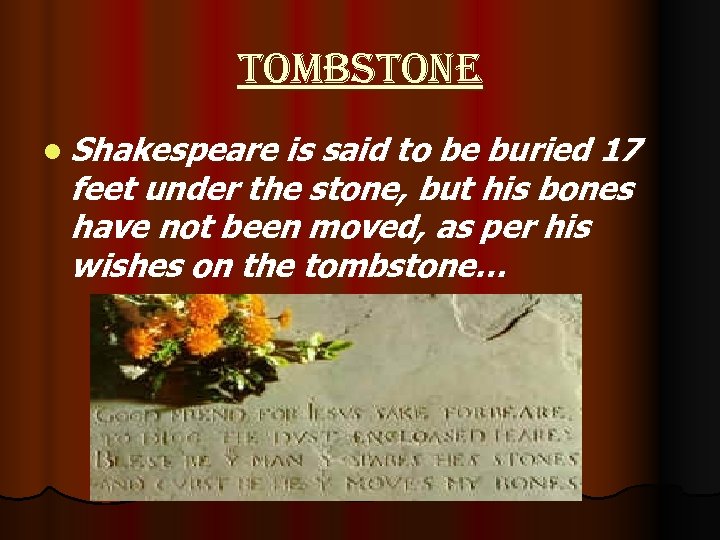
tombstone l Shakespeare is said to be buried 17 feet under the stone, but his bones have not been moved, as per his wishes on the tombstone…
the works l Wrote at least 38 plays, but only 36 were published. l Wrote 154 sonnets… What’s up w/ the sonnets? Authorized? Most famous? l Universal Themes: lust, greed, ambition, jealousy, cowardice, royalty, birthright, family feuds and unrequited love (not reciprocated/returned). l List of works
the evolution of romeo & juliet l Romeo and Juliet can be plausibly dated to 1595. Shakespeare must have written the play between 1591 and 1596 l Romeo and Juliet had certainly been performed by 1597 l Romeo and Juliet appeared in seven editions before 1642
The evolution of Romeo & Juliet con’d l There are no surviving records for any performances before the Restoration in 1660, but it is likely that Romeo and Juliet was first acted by the Lord Chamberlain’s Men at the Theatre and then at the Curtain. It has been suggested that Richard Burbage may have played Romeo, with the boy actor Robert Goffe as Juliet
The evolution of Romeo & Juliet l Sources: l Shakespeare may have known the story of Romeo and Juliet in several versions for some years before he wrote his play. Two sources were particularly important for its creation: l Arthur Brooke, The Tragicall Historye of Romeus and Iuliet l Geoffrey Chaucer, ‘Troilus and Criseyde’, in The Workes of Geffrey Chaucer
TERMS TO KNOW l Tragedy: a disastrous event; conflict between protagonist & antagonist/superior force having a terror/sorrowful ending; often occurs to the heroic, but flawed character l Dramatic Monologue: literary work, usually a poem, where a speaker’s character/personality is revealed; usually told to another character
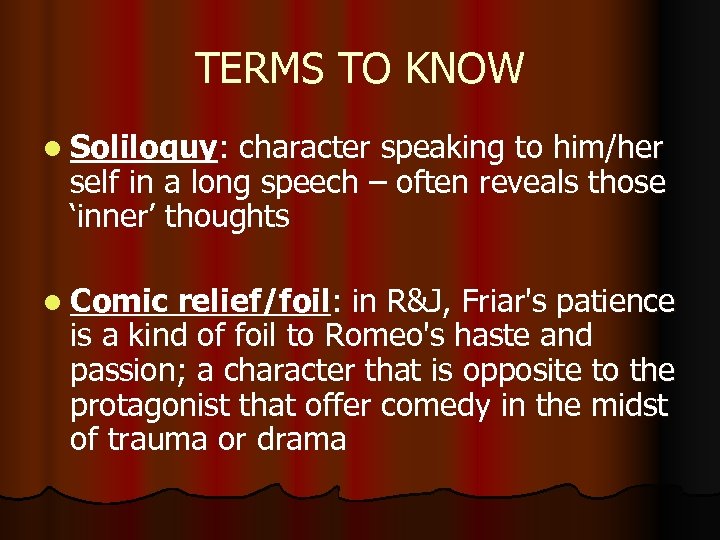
TERMS TO KNOW l Soliloquy: character speaking to him/her self in a long speech – often reveals those ‘inner’ thoughts l Comic relief/foil: in R&J, Friar's patience is a kind of foil to Romeo's haste and passion; a character that is opposite to the protagonist that offer comedy in the midst of trauma or drama
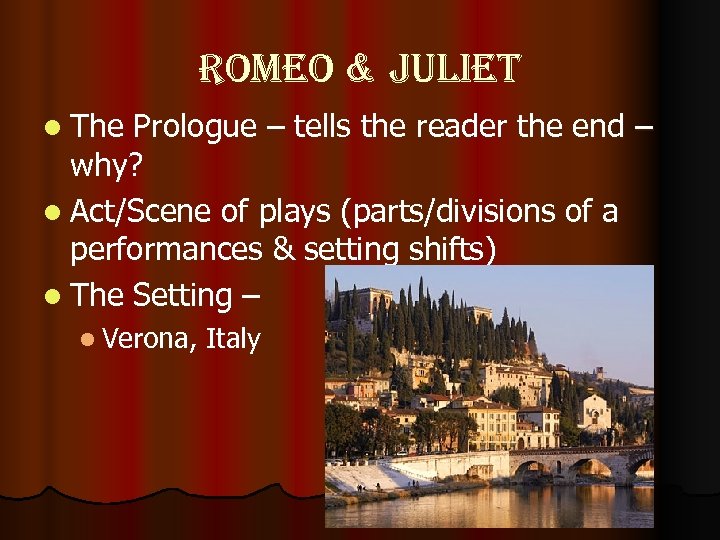
romeo & Juliet l The Prologue – tells the reader the end – why? l Act/Scene of plays (parts/divisions of a performances & setting shifts) l The Setting – l Verona, Italy
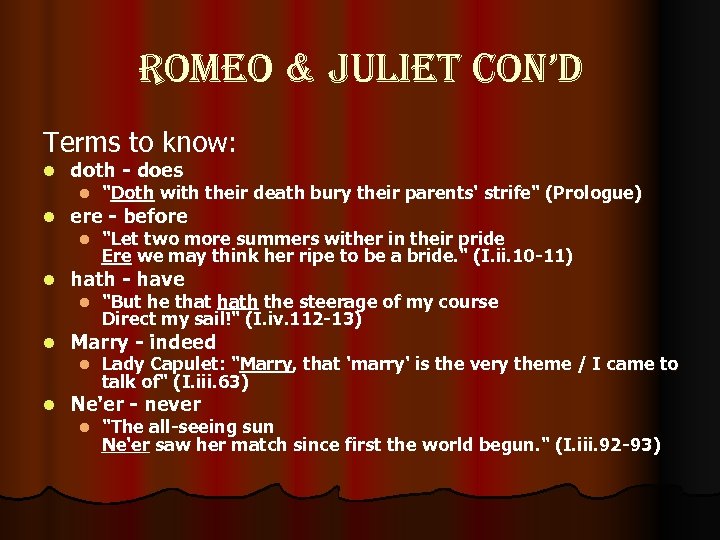
romeo & Juliet con’d Terms to know: l doth - does l l "Doth with their death bury their parents' strife" (Prologue) "Let two more summers wither in their pride Ere we may think her ripe to be a bride. " (I. ii. 10 -11) ere - before hath - have l l Marry - indeed l l "But he that hath the steerage of my course Direct my sail!" (I. iv. 112 -13) Lady Capulet: "Marry, that 'marry' is the very theme / I came to talk of" (I. iii. 63) Ne'er - never l "The all-seeing sun Ne'er saw her match since first the world begun. " (I. iii. 92 -93)
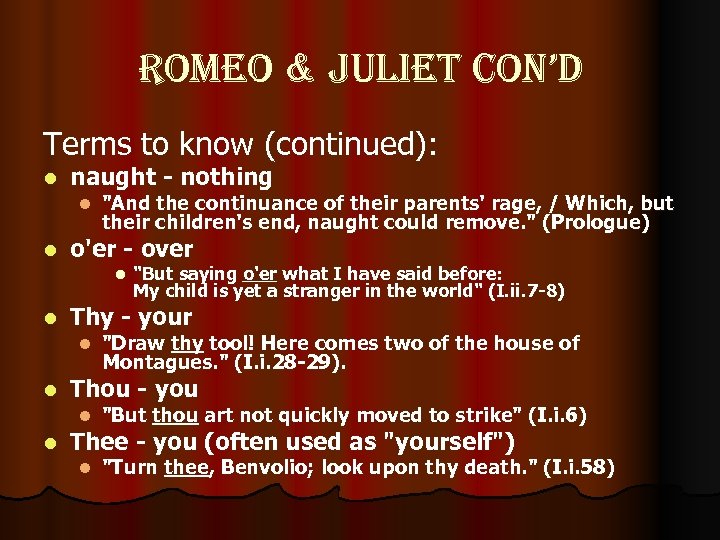
romeo & Juliet con’d Terms to know (continued): l naught - nothing l l "And the continuance of their parents' rage, / Which, but their children's end, naught could remove. " (Prologue) o'er - over l l Thy - your l l "Draw thy tool! Here comes two of the house of Montagues. " (I. i. 28 -29). Thou - you l l "But saying o'er what I have said before: My child is yet a stranger in the world" (I. ii. 7 -8) "But thou art not quickly moved to strike" (I. i. 6) Thee - you (often used as "yourself") l "Turn thee, Benvolio; look upon thy death. " (I. i. 58)
FAMOUS ROMEO & JULIET QUOTES! WATCH FOR THESE AS WE READ: l “O Romeo, Romeo! wherefore art thou Romeo? ” l “What ’s in a name? That which we call a rose/By any other name would smell as sweet. " l "O! she doth teach the torches to burn bright. " l " But soft! What light through yonder window breaks? It is the East and Juliet is the sun! Arise fair sun and kill the envious moon. It is the east. . . and I am the west. ”
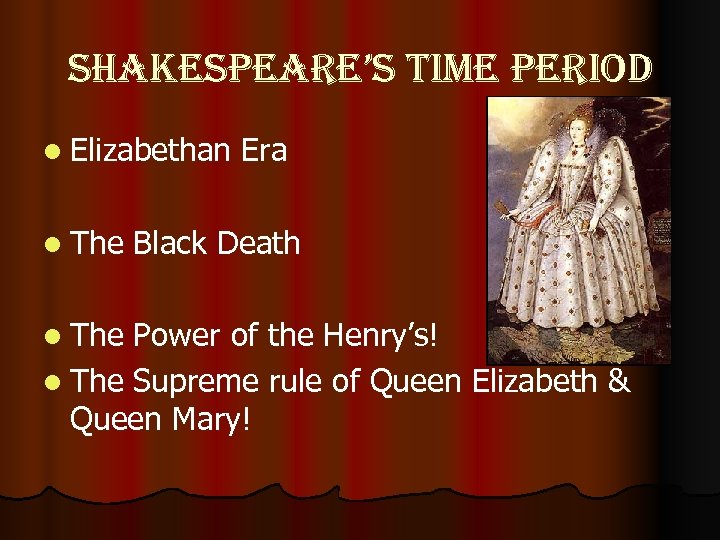
shakespeare’s time period l Elizabethan l The Era Black Death Power of the Henry’s! l The Supreme rule of Queen Elizabeth & Queen Mary!
shakespeare’s time period con’d l 16 th Century London l. It was the beginning of the modern era l. The century opened with the discovery of a new continent. l. The renaissance in Italy was peaking and spreading north, even arriving in backwaters like England.
shakespeare’s time period con’d l Life was largely prosperous for the average person l The economy was growing: the mechanisms of commerce, systems of international finance, ocean-going trading fleets, an entrepreneurial bourgeoisie, were all building a recognizably capitalist, money-based economy. l Geniuses were stepping all over each other on the street corners producing scientific innovation after innovation.
shakespeare’s time period con’d l Technological innovations like gunpowder were changing the nature of warfare and the military caste nature of society -- the cannon probably had a great deal to do with the rise of the centralized nation state as we know it. l The printing press created a media revolution. It brought ideas, partisan rhetoric, and how-to manuals to the people.
shakespeare’s time period con’d l. Most of all, it brought the Bible, in its original tongues and in the vernacular, to the masses. l. A spirit of inquiry, a desire to return to first principles, was blowing through the Church, which had been the unifying cultural foundation of Europe for a millenium
myths l Some scholars believe that Shakespeare wrote the King James Bible l Technically, there is no evidence that he was an actor, poet, or playwright. l Some people believe that he was a businessman who paid people to name him as the author of their works
Shakespeare’s Supernatural l Mythical allusions to gods and goddesses l Beliefs in the practices of herbal and chemical remedies l Existence of deceased family members’ apparitions l Destiny as a foreshadowing revenge for all woes.
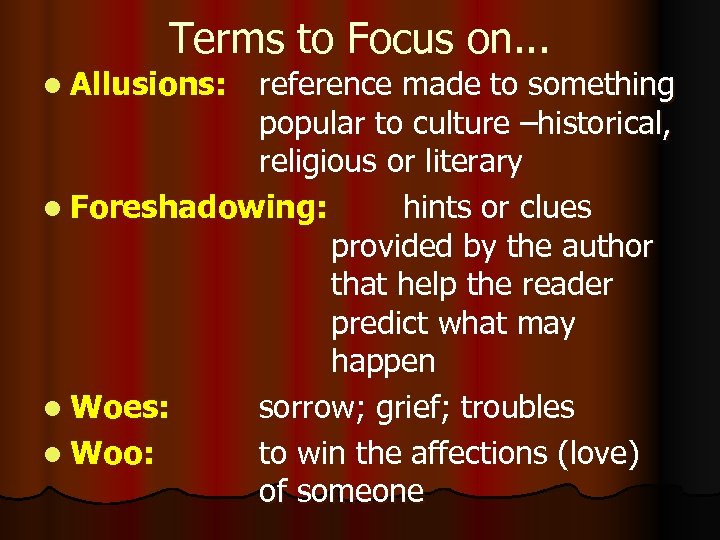
Terms to Focus on. . . l Allusions: reference made to something popular to culture –historical, religious or literary l Foreshadowing: hints or clues provided by the author that help the reader predict what may happen l Woes: sorrow; grief; troubles l Woo: to win the affections (love) of someone
Скачать презентацию william shakespeare -by the pricking of my thumbs
58dc03269a60e72380a372a4631cf335.ppt