 Скачать презентацию William Blake Poet Painter Printmaker William Blake
Blake 2.pptx
- Количество слайдов: 22




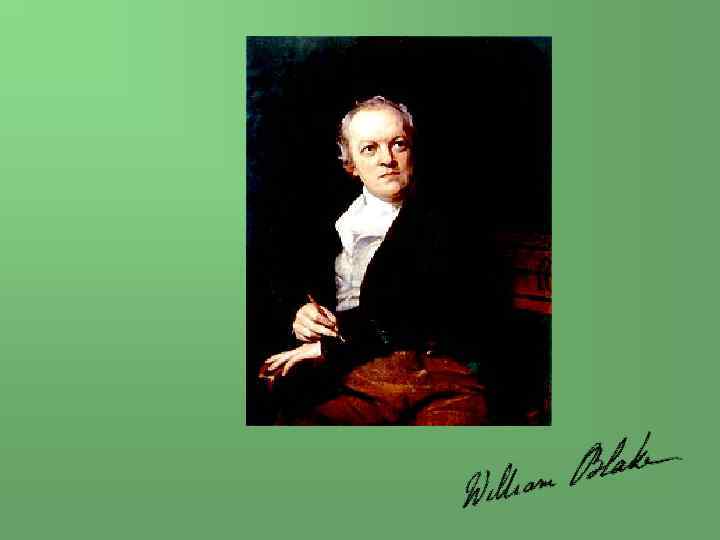
William Blake Poet, Painter, Printmaker
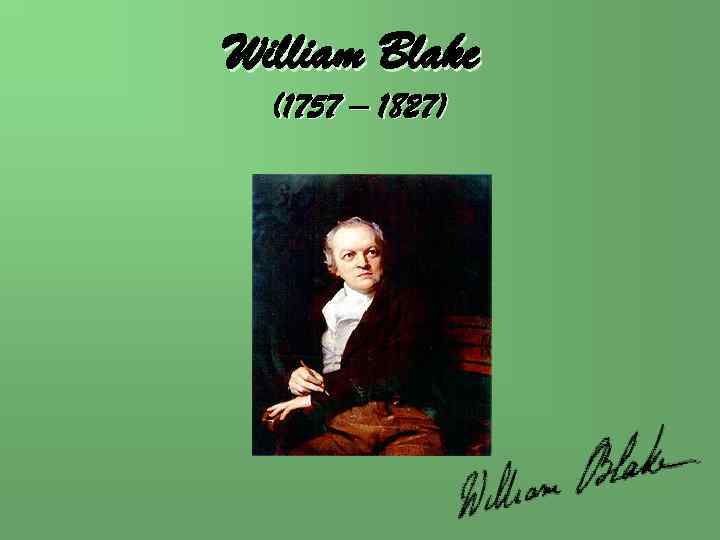
William Blake (1757 – 1827)
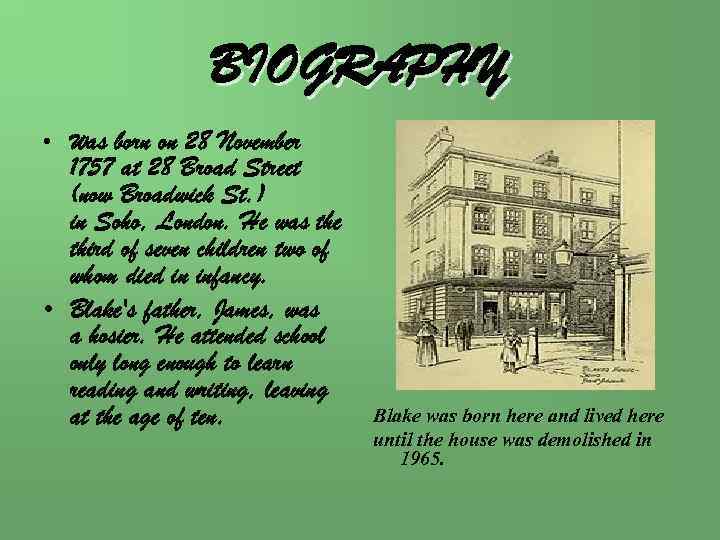
BIOGRAPHY • Was born on 28 November 1757 at 28 Broad Street (now Broadwick St. ) in Soho, London. He was the third of seven children two of whom died in infancy. • Blake's father, James, was a hosier. He attended school only long enough to learn reading and writing, leaving at the age of ten. Blake was born here and lived here until the house was demolished in 1965.
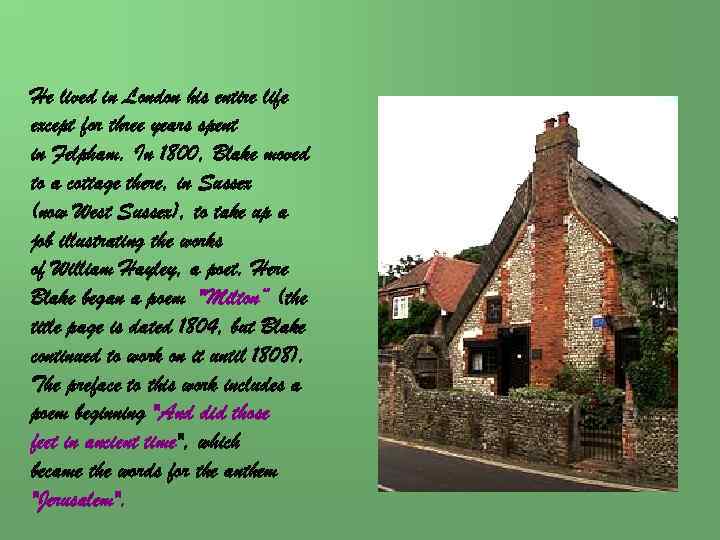
He lived in London his entire life except for three years spent in Felpham. In 1800, Blake moved to a cottage there, in Sussex (now West Sussex), to take up a job illustrating the works of William Hayley, a poet. Here Blake began a poem "Milton“ (the title page is dated 1804, but Blake continued to work on it until 1808). The preface to this work includes a poem beginning "And did those feet in ancient time", which became the words for the anthem "Jerusalem".
Education • On 4 August 1772, Blake was apprenticed to engraver. • At the end of the term, aged 21, he became a professional engraver. • On 8 October 1779, Blake became a student at the Royal Academy in Old Somerset House, near the Strand, Westminster, Central London. He studied there for 6 years.
Victorian Literature • • • Early romanticists: R. Burns, W. Scott, W. Blake Lakists: W. Wordsworth, S. Coleridge, R. Southey Later romantics: G. Byron, P. Shelley, J. Keats Victorian Poetry: A. Tennyson, R. Browning Early Victorian prose (Realistic Novel): Ch. Dickens, W. M. Thackeray, Bronte sisters, E. Gaskell.
Opinions about W. Blake "Blake is the Romantic writer who has exerted the most powerful influence on the twentieth century. " Edward Larrissy (“Blake and modern literature”) «Блейк и английская детская поэзия - вот что привело меня к детской литературе» . Самуил Яковлевич Маршак
Largely unrecognised during his lifetime, Blake is now considered a fundamental figure in the history of the poetry and visual arts of the Romantic Age. Considered mad by contemporaries for his views, Blake is held in high regard by later critics for his expressiveness and creativity, and for the philosophical and mystical undercurrents within his work. His paintings and poetry have been characterised as part of the Romantic movement and "Pre-Romantic", for its large appearance in the 18 th century.
The singularity of Blake's work makes him difficult to classify. • The 19 th-century scholar William Rossetti characterised him as a "glorious luminary", and "a man not forestalled by predecessors, nor to be classed with contemporaries, nor to be replaced by known or readily surmisable successors". •
During his lifetime Blake received no fame outside the narrow circle of admirers, but was "discovered" after his death by Pre. Raphaelites. Had a significant impact on Western culture of the XX century. The song "Jerusalem" on his poem is considered the unofficial anthem of the United Kingdom.
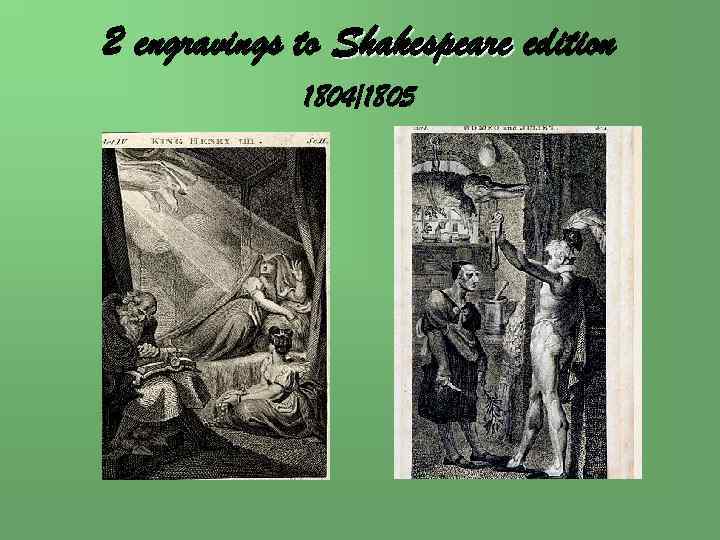
2 engravings to Shakespeare edition 1804/1805
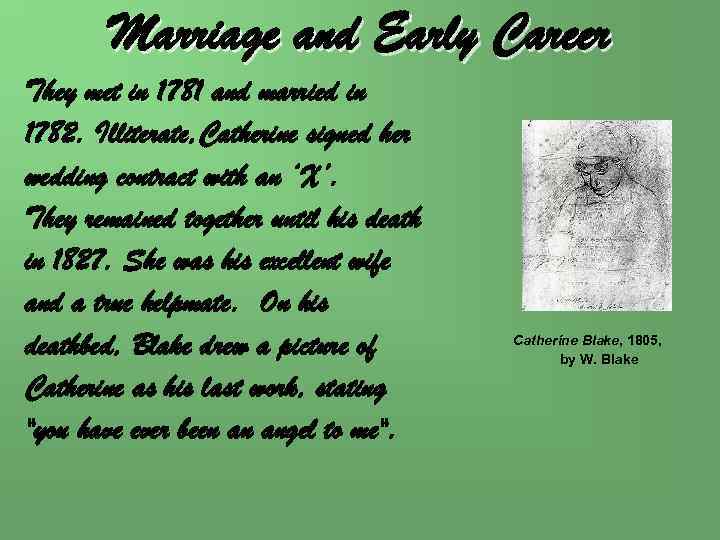
Marriage and Early Career They met in 1781 and married in 1782. Illiterate, Catherine signed her wedding contract with an ‘X’. They remained together until his death in 1827. She was his excellent wife and a true helpmate. On his Catherine Blake, 1805, deathbed, Blake drew a picture of by W. Blake Catherine as his last work, stating "you have ever been an angel to me".
Collection of Poems • 1783 – Poetical Sketches • 1789 - Songs of Innocence (19 engraved poems) • 1794 - Songs of Experience (26 engraved poems) And other works …
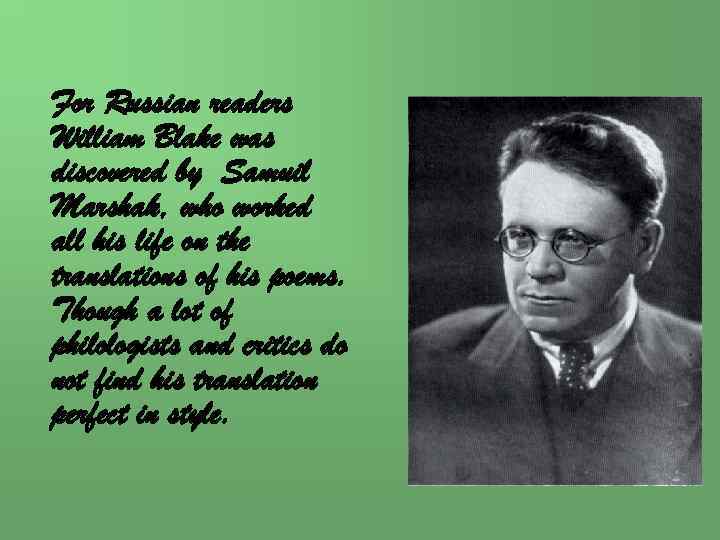
For Russian readers William Blake was discovered by Samuil Marshak, who worked all his life on the translations of his poems. Though a lot of philologists and critics do not find his translation perfect in style.
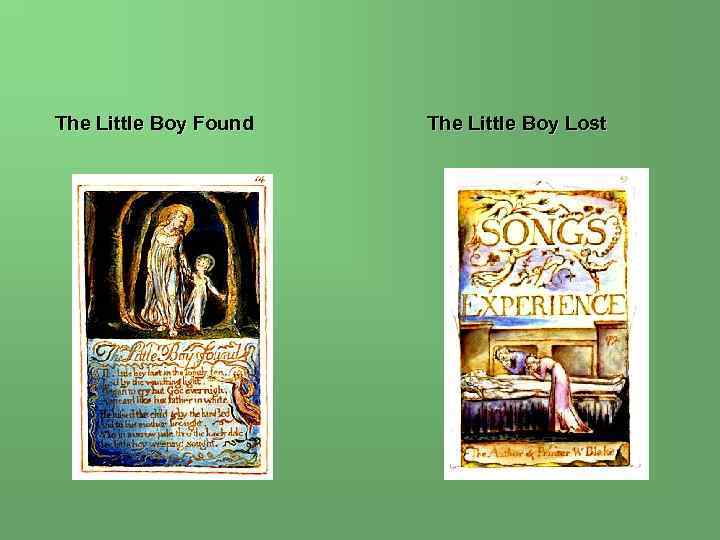
The Little Boy Found The Little Boy Lost
The Little Boy Found The little boy lost in the lonely fen, Led by the wand'ring light, Began to cry, but God ever nigh, Appeard like his father in white. He kissed the child & by the hand led And to his mother brought, Who in sorrow pale, thro' the lonely dale Her little boy weeping sought.
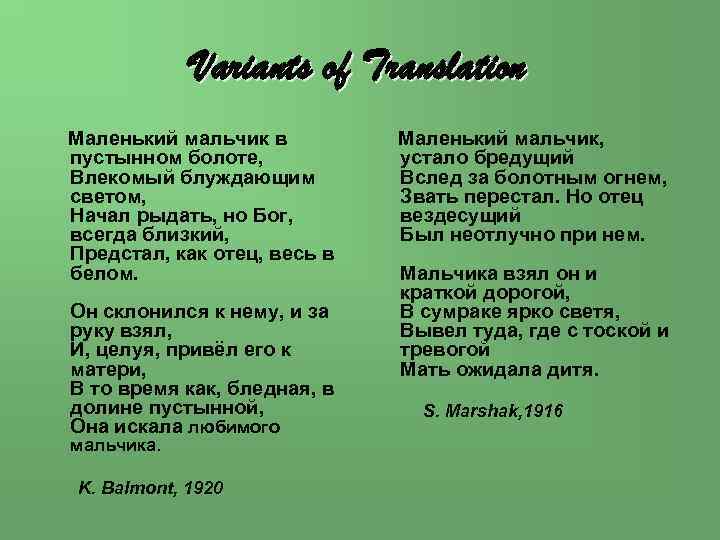
Variants of Translation Маленький мальчик в пустынном болоте, Влекомый блуждающим светом, Начал рыдать, но Бог, всегда близкий, Предстал, как отец, весь в белом. Он склонился к нему, и за руку взял, И, целуя, привёл его к матери, В то время как, бледная, в долине пустынной, Она искала любимого мальчика. K. Balmont, 1920 Маленький мальчик, устало бредущий Вслед за болотным огнем, Звать перестал. Но отец вездесущий Был неотлучно при нем. Мальчика взял он и краткой дорогой, В сумраке ярко светя, Вывел туда, где с тоской и тревогой Мать ожидала дитя. S. Marshak, 1916
Variants of Translation Во тьме ребёнок сбился с пути, Блуждая за огоньком. Заплакал чуть слышно, но рядом Всевышний — Окутан белым плащом. Как отец, Он за руку малыша К матери вёл за собой. Тоской сражена, искала она Дитя в долине ночной. S. Sukharev, 1997 Малыш за болотным брёл огоньком И в топь зашёл, наконец, Он звал, кричал, и пред ним предстал Господь, как родимый отец. Целуя, он за руку вёл малыша Туда, где бедная мать, Грустна и бледна, бродила одна, Надеясь сынка отыскать. D. Smirnov-Sadovsky, 2013
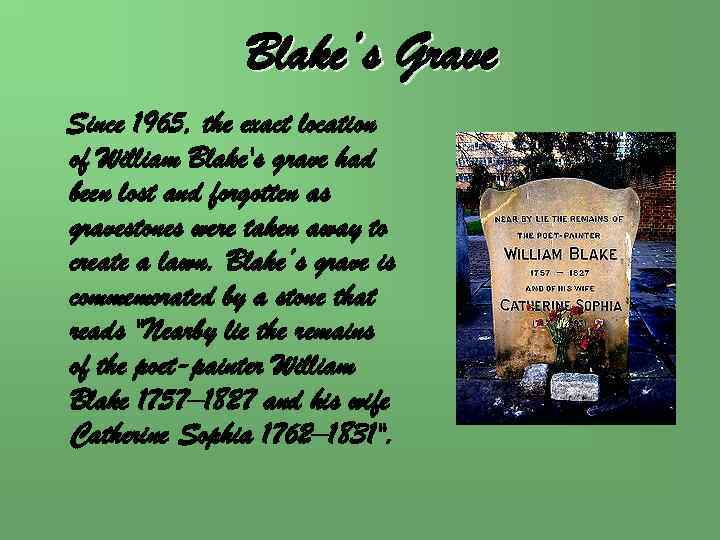
Blake’s Grave Since 1965, the exact location of William Blake's grave had been lost and forgotten as gravestones were taken away to create a lawn. Blake’s grave is commemorated by a stone that reads "Nearby lie the remains of the poet-painter William Blake 1757– 1827 and his wife Catherine Sophia 1762– 1831".
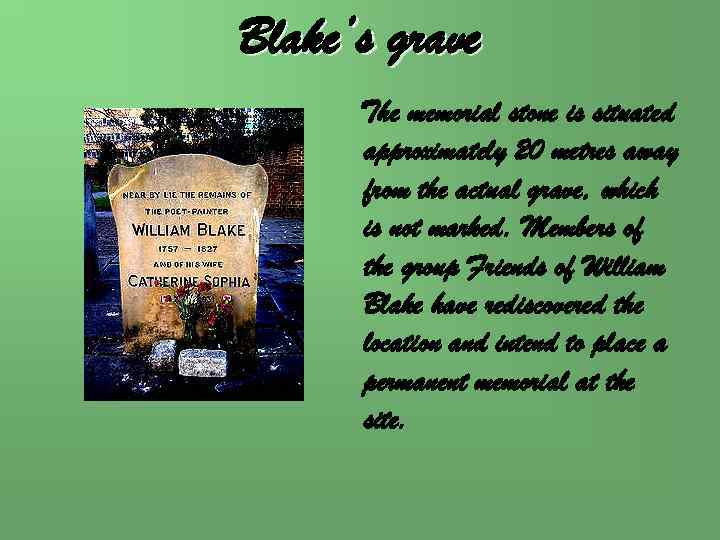
Blake’s grave The memorial stone is situated approximately 20 metres away from the actual grave, which is not marked. Members of the group Friends of William Blake have rediscovered the location and intend to place a permanent memorial at the site.
And in Conclusion … • Blake is recognised as a saint in the Ecclesia Gnostica Catholica. • The Blake Prize for Religious Art was established in his honour in Australia in 1949. • In 1957 a memorial to Blake and his wife was erected in Westminster Abbey.
 Скачать презентацию William Blake Poet Painter Printmaker William Blake
Blake 2.pptx