


 Скачать презентацию Will Privacy Security Concerns Impede HIT Initiatives
0cc4203a8b3fd689986b38b4e1d50ae7.ppt
- Количество слайдов: 32
 Will Privacy & Security Concerns Impede HIT Initiatives? HIPAA and HIT Summit March 28, 2007 Bill Braithwaite, MD, Ph. D Health Information Policy Consulting Washington, DC Copyright © 2007 by Braithwaite Consulting 1
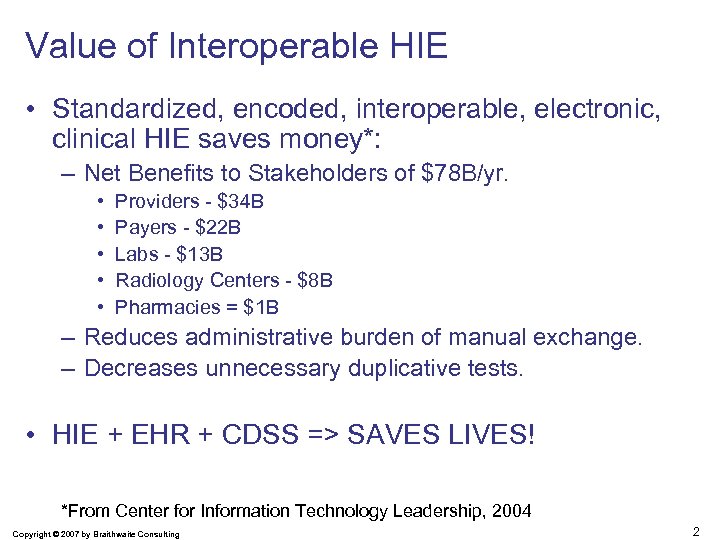 Value of Interoperable HIE • Standardized, encoded, interoperable, electronic, clinical HIE saves money*: – Net Benefits to Stakeholders of $78 B/yr. • • • Providers - $34 B Payers - $22 B Labs - $13 B Radiology Centers - $8 B Pharmacies = $1 B – Reduces administrative burden of manual exchange. – Decreases unnecessary duplicative tests. • HIE + EHR + CDSS => SAVES LIVES! *From Center for Information Technology Leadership, 2004 Copyright © 2007 by Braithwaite Consulting 2
 American Health Information Community (AHIC) • Formed in September 2005 under the auspices of FACA. • Provides recommendations to HHS on how to make health records digital and interoperable, and assure that the privacy and security of those records are protected, in a smooth, market-led way. – www. hhs. gov/healthit/ahic. html • 18 Commissioners – consumer groups, providers, payers, hospitals, vendors, government (50 -50 split) – Chaired by Secretary Leavitt and now with David Brailer as Vice-Chair. • Dissolution within two to five years with goal of creating selfsustaining, private sector replacement • First meeting October 7, 2005. • Recent meeting March 13, 2007. • Next meeting April 24, 2007. Copyright © 2007 by Braithwaite Consulting 3
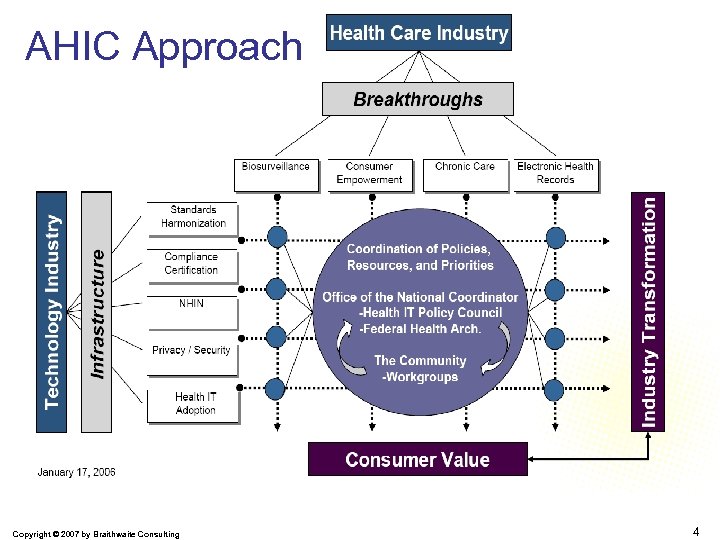 AHIC Approach Copyright © 2007 by Braithwaite Consulting 4
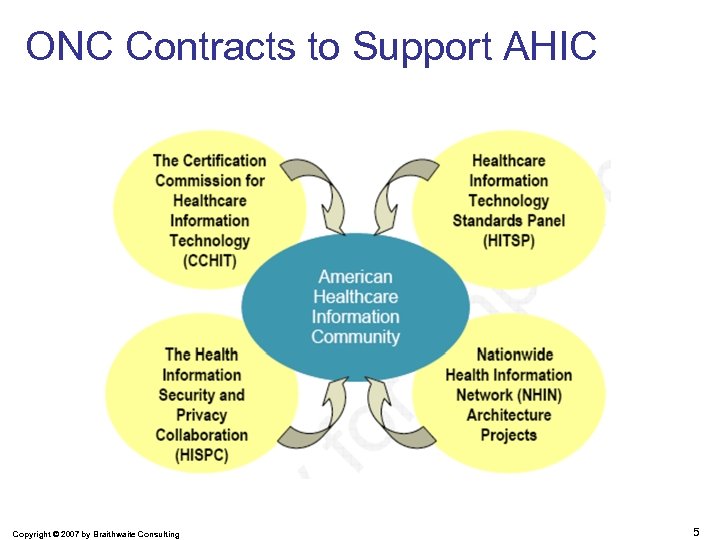 ONC Contracts to Support AHIC Copyright © 2007 by Braithwaite Consulting 5
 Privacy & Security Contract aka Health Information Security and Privacy Collaboration (HISPC) • Assess variations in organization-level business policies and state laws that affect health information exchange. • Identify and propose practical solutions, while preserving the privacy and security legal requirements. • Develop detailed plans to implement solutions. • Coordinate through NGA and subcontracts with 34 states or territorial governments. – Directly teaming in this manner is a critical element to the successful completion of this contract within the prescribed timeframe. • Contract to RTI International for 18 months, $11. 5 M. – Subcontracts for < $350 K. Copyright © 2007 by Braithwaite Consulting 6
 Health Information Security and Privacy Collaboration (HISPC) • 33 State and 1 Territory contracted (June-July) • 10 Regional Meetings (43 states participated) • Interim Reports – Assessment of Variation (November 2006) – Analysis of Solutions (January 2007) – Implementation Plans (February 2007) • National Meeting (March 2007) Copyright © 2007 by Braithwaite Consulting 7
 National Meeting (March 2007) • Day 1: 4 Tracks – Consent – Data Security and Quality – Legal and Regulatory Issues – Interpreting and Applying HIPAA • Day 2: 4 Tracks – Reducing Mistrust through Education and Outreach – Moving Forward in States at Different Points in the Process – Governance and Implementation – State Legislation and Business Policies Copyright © 2007 by Braithwaite Consulting 8
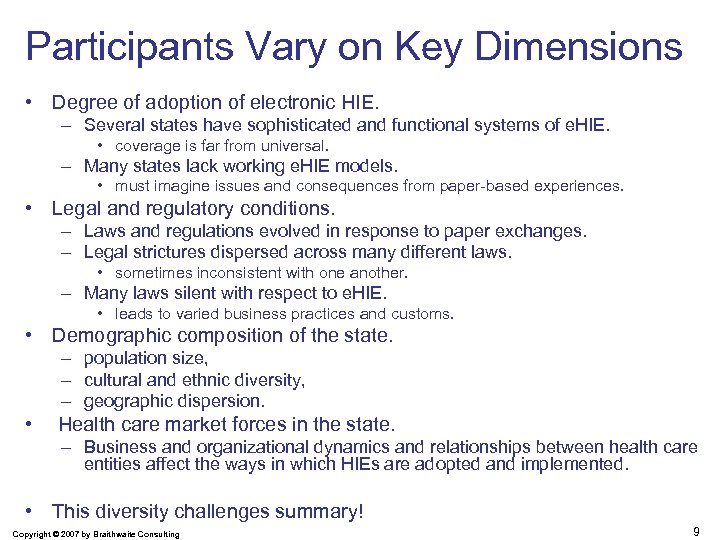 Participants Vary on Key Dimensions • Degree of adoption of electronic HIE. – Several states have sophisticated and functional systems of e. HIE. • coverage is far from universal. – Many states lack working e. HIE models. • must imagine issues and consequences from paper-based experiences. • Legal and regulatory conditions. – Laws and regulations evolved in response to paper exchanges. – Legal strictures dispersed across many different laws. • sometimes inconsistent with one another. – Many laws silent with respect to e. HIE. • leads to varied business practices and customs. • Demographic composition of the state. – population size, – cultural and ethnic diversity, – geographic dispersion. • Health care market forces in the state. – Business and organizational dynamics and relationships between health care entities affect the ways in which HIEs are adopted and implemented. • This diversity challenges summary! Copyright © 2007 by Braithwaite Consulting 9
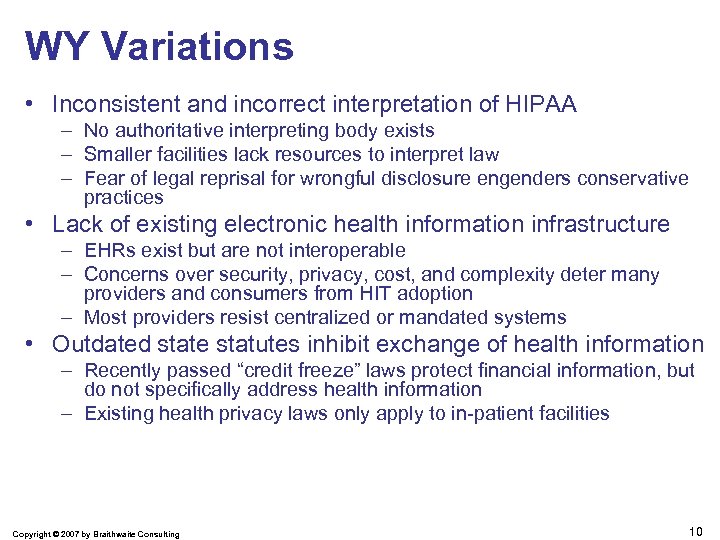 WY Variations • Inconsistent and incorrect interpretation of HIPAA – No authoritative interpreting body exists – Smaller facilities lack resources to interpret law – Fear of legal reprisal for wrongful disclosure engenders conservative practices • Lack of existing electronic health information infrastructure – EHRs exist but are not interoperable – Concerns over security, privacy, cost, and complexity deter many providers and consumers from HIT adoption – Most providers resist centralized or mandated systems • Outdated state statutes inhibit exchange of health information – Recently passed “credit freeze” laws protect financial information, but do not specifically address health information – Existing health privacy laws only apply to in-patient facilities Copyright © 2007 by Braithwaite Consulting 10
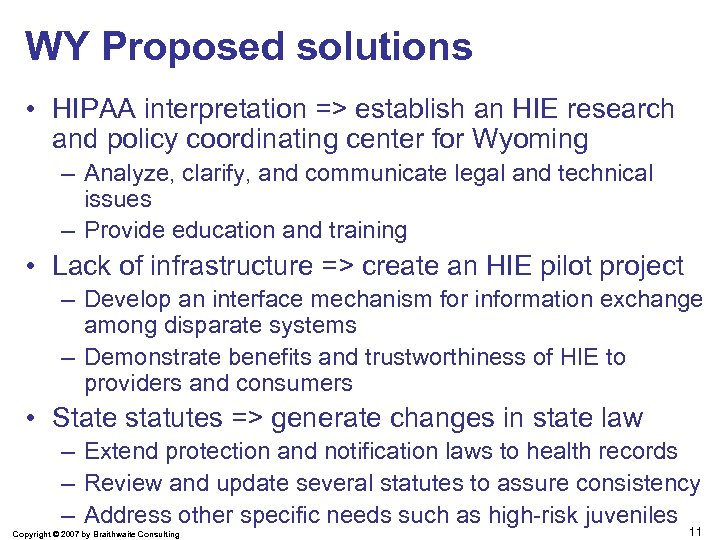 WY Proposed solutions • HIPAA interpretation => establish an HIE research and policy coordinating center for Wyoming – Analyze, clarify, and communicate legal and technical issues – Provide education and training • Lack of infrastructure => create an HIE pilot project – Develop an interface mechanism for information exchange among disparate systems – Demonstrate benefits and trustworthiness of HIE to providers and consumers • State statutes => generate changes in state law – Extend protection and notification laws to health records – Review and update several statutes to assure consistency – Address other specific needs such as high-risk juveniles Copyright © 2007 by Braithwaite Consulting 11
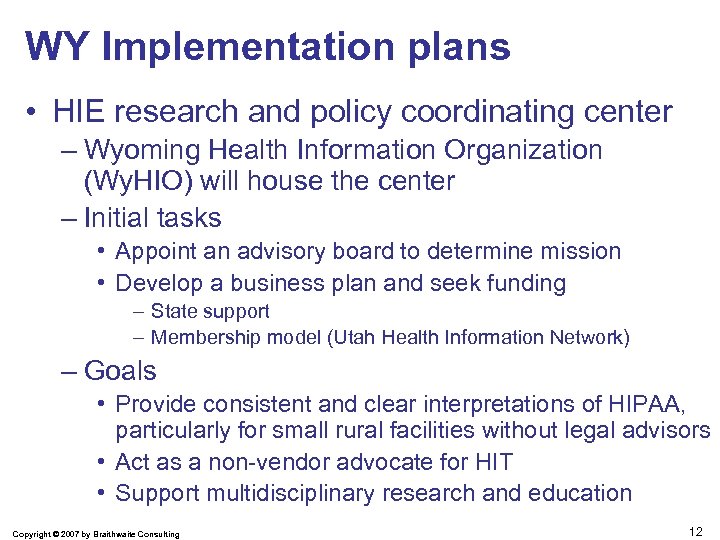 WY Implementation plans • HIE research and policy coordinating center – Wyoming Health Information Organization (Wy. HIO) will house the center – Initial tasks • Appoint an advisory board to determine mission • Develop a business plan and seek funding – State support – Membership model (Utah Health Information Network) – Goals • Provide consistent and clear interpretations of HIPAA, particularly for small rural facilities without legal advisors • Act as a non-vendor advocate for HIT • Support multidisciplinary research and education Copyright © 2007 by Braithwaite Consulting 12
 WY Implementation plans • HIE pilot project – Wy. HIO will also be responsible for this project – Initial tasks • Complete a preliminary network design and a basic application area (medications, trauma or secondary/specialty care) • Identify funding sources (a bill in 2007 Wyoming Legislature that proposed $4, 000 for a project died in committee) • Contract with a developer to create a prototype – Work with existing or developing EHR systems – Goal: demonstrate feasibility of non-centralized HIE and build trust among providers and consumers Copyright © 2007 by Braithwaite Consulting 13
 WY Implementation plans • State statutes – Work with legislator and attorney stakeholders to draft changes and/or enact new bills for 2008 Wyoming Legislature • Create a health information privacy law requiring notification of all consumers affected by a compromise of health records • Update Wyoming Hospital Records and Information Act and Wyoming Public Records Act to address inconsistencies with HIPAA and each other – Will require a study to evaluate laws and effects of change • Create a health information exchange act to define who is allowed to share information about juveniles, particularly in high-risk situations or matters of public health/safety Copyright © 2007 by Braithwaite Consulting 14
 NJ Barriers • Identification of the Patient – Master-Patient Index is one of 14 necessary foundation blocks for RHIO to interoperate – Solution in Health ID Cards with Bar Coding or Electronic Strip • Understanding and Resolving Legal and Policy Issues – Especially Consent Management and Sensitive Data Controls Copyright © 2007 by Braithwaite Consulting 15
![NJ Identification of the Patient • NJ State and Regional Master Patient Index [MPI]](https://present5.com/presentation/0cc4203a8b3fd689986b38b4e1d50ae7/image-16.jpg "NJ Identification of the Patient • NJ State and Regional Master Patient Index [MPI]") NJ Identification of the Patient • NJ State and Regional Master Patient Index [MPI] – Unique ID • Cross walked to legacy numbers – Assigned: • At birth • At hospital / ED admission • Upon patient request – Goal: reliably link each NJ patient with their health care record – Opt-out permitted • No longer part of EHR /RHIO • Payment may be delayed Copyright © 2007 by Braithwaite Consulting 16
NJ Identification of the Patient • NJ State and Regional Master Patient Index [MPI] – Unique ID • Cross walked to legacy numbers – Assigned: • At birth • At hospital / ED admission • Upon patient request – Goal: reliably link each NJ patient with their health care record – Opt-out permitted • No longer part of EHR /RHIO • Payment may be delayed Copyright © 2007 by Braithwaite Consulting 16
 MN Privacy Barriers to HIE • Patient consent required for nearly all disclosures of health records – including treatment – Patients need to give written consent – Consent generally expires within one year – Limited exceptions to consent • Medical emergency • Within “related” health care entities – Consents that do not expire • Disclosures to providers being consulted • Disclosures to payers for payment Copyright © 2007 by Braithwaite Consulting 17
 MN Privacy Barriers to HIE • Minnesota law places all liability for inappropriate disclosures on the disclosing provider: – A violation of patient consent requirements may be grounds for disciplinary action – A person who negligently or intentionally releases a health record is liable to the patient for compensatory damages, plus costs and fees • Providers are very cautious in disclosing data and respond to privacy/security concerns by not disclosing patient data Copyright © 2007 by Braithwaite Consulting 18
 MN Causes of Patient Consent Barriers • Undefined terms and ambiguous concepts that are used in Minnesota Statutes § 144. 335 - patient consent requirements • Difficulties in determining the appropriate application of consent requirements to new concepts in the electronic exchange of health information that do not have an analogous concept in a paper-based exchange • The need to update consent requirements to allow mechanisms that facilitate the electronic exchange of patients’ information while respecting the patients’ ability and wishes for controlling their information Copyright © 2007 by Braithwaite Consulting 19
 MN Generating Solutions • A workgroup of industry representatives and privacy advocates did not reach consensus on solutions: – Identified options – Documented advantages and disadvantages for each option – Connected related options • MDH developed criteria for evaluating options: – maintain or strengthen patients’ privacy or control over their health records – improve patient care – facilitate electronic, real time, automated exchange – not place an undue administrative burden on the health care industry – increase the clarity and uniform understanding of the statutory language and consent requirements Copyright © 2007 by Braithwaite Consulting 20
 MN Legislative Solutions • Statutory Modifications for Legislative Consideration – Clarify undefined terms and ambiguous concepts: • • “Health Record” “Medical Emergency” “Related Health Care Entity” “Current Treatment” – Apply consent requirements to new concepts: • “Record Locator Service” • “Identifying Information” Copyright © 2007 by Braithwaite Consulting 21
 MN Legislative Solutions (cont) • Statutory Modifications for Legislative Consideration – Update mechanisms that facilitate electronic exchange: • Create ability of a provider to rely on another provider’s representation of having obtained consent • Develop a legal framework for allocating liability between disclosing and requesting providers • Permit representation of consent to be transmitted electronically when requesting patient information – Recodify Minnesota’s patient consent statutes to make the requirements easier to understand for patients and health care providers Copyright © 2007 by Braithwaite Consulting 22
 HISPC Sources of Variation • Variation related to misunderstandings and differing applications of federal laws and regulations – HIPAA Privacy Rule • Patient Authorization/Consent • Variation in Determining “Minimum Necessary” – HIPAA Security Rule • Confusion regarding the different types of security required • Misunderstandings regarding what was currently technically available and scalable – CFR 42 part 2 • Variation in the treatment facilities’, physicians’, and integrated delivery systems’ understanding of 42 C. F. R. pt. 2, its relation to HIPAA, and the application of each regulation Copyright © 2007 by Braithwaite Consulting 23
 HISPC Sources of Variation (continued) • Variation related to state privacy laws – Scattered throughout many chapters of law – When found, they are often conflicting – Antiquated--written for a paper-based system • Trust in applied information security – Organizations of each other – Consumers/Patients trust of others • Cultural and business issues – Concern about liability for incidental or inappropriate disclosures – General resistance to change Copyright © 2007 by Braithwaite Consulting 24
 Major Categories of State Solutions • Governance — Most call for a permanent body to oversee and guide implementation of privacy and security solutions. • Business practices and policies solutions — Most call for standardization (using model forms, contracts, policies, and processes) of business practices for: – – consent and authorization, application of federal law, exchange of sensitive information, and exchange of data related to Medicaid, public health, and law enforcement agencies. Copyright © 2007 by Braithwaite Consulting 25
 Major Categories of State Solutions • Legal and regulatory solutions — Most call for amending state law and introducing new legislation where required. • Technological solutions — Most call for standardized approaches to: – – – patient identification systems; authorization, authentication, access, and audit; segmenting data within electronic medical records; terminology standards; and transmission security standards. • Education and outreach — All call for both consumer and provider education and outreach. Copyright © 2007 by Braithwaite Consulting 26
 HISPC Implementation Plans • Practical approaches and actionable steps for implementing solutions (due April 2007) – Actions – Governance and Leadership • Realignment of teams – Resources required • Funding • Staffing – Timelines • Nationwide Summary (due June 30, 2007) Copyright © 2007 by Braithwaite Consulting 27
 Summary of Results • Fear – – Violation of state or federal laws that are not understood. • Individuals are fearful of making ‘reasonable’ decisions. – Liability (personal and financial). • Leads to conservative approach to legal advice. Copyright © 2007 by Braithwaite Consulting 28
 Summary of Results (cont’d) • Uncertainty – – Low level of understanding across the range of patients and healthcare employees (including some lawyers). • Rights and responsibilities under complex set of laws and regulations. – Organizations interpret HIPAA “reasonable safeguards” guidelines inconsistently. • Enforcement actions are ‘reasonable’ but ‘unknown’. – Lack of standard set of technology to implement. • Variations in communications media create difficulties in information exchange. • Non-uniform implementation of encryption and other security technology in electronic methods of information exchange. Copyright © 2007 by Braithwaite Consulting 29
 Summary of Results (cont’d) • Doubt – – Trust – how do I know I can trust my data exchange partners? • Issues may be disappearing over time with community discussions. – Organization size and associated fiscal constraints. • Lack of investments in implementing technologies for information safeguards. • Doubt about ROI and/or its timing. Copyright © 2007 by Braithwaite Consulting 30
 Summary • Fear, Uncertainty, and Doubt will impede HIE and HIT Initiatives unless resolved. • States are starting to understand the issues. • States are formulating solutions: – Practice and Policy Solutions. – Legal and Regulatory Solutions. – Technology and Data Standards. – Education and Outreach. • Multi-state and National Level Recommendations are forthcoming. Copyright © 2007 by Braithwaite Consulting 31
 Thank you! William R. “Bill” Braithwaite, MD, Ph. D Washington, DC bill@braithwaites. com Copyright © 2007 by Braithwaite Consulting 32