


 Скачать презентацию Wiener Institut für Internationale Wirtschaftsvergleiche The Vienna Institute
f685b1d1d984332a9dbc65365a5d9536.ppt
- Количество слайдов: 39
 Wiener Institut für Internationale Wirtschaftsvergleiche The Vienna Institute for International Economic Studies www. wiiw. ac. at Employment Structures in the EU New Member States: The Impact of Output, Productivity and Structural Change EUKLEMS meeting, Helsinki, June 2005 Robert Stehrer Project ‚Industrial Restructuring and Implications for Labour Markets in the New EU Member States‘, commissioned by EU DG Employment, Social Affairs and Equal Opportunities, Contract No. VC/2003/0367
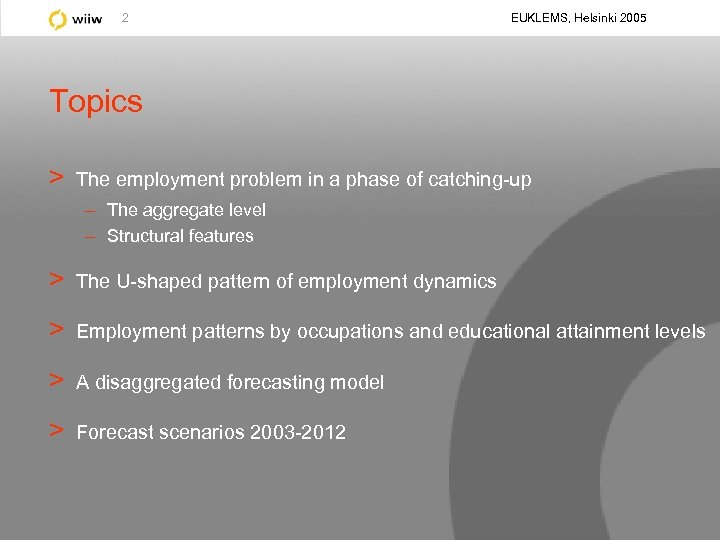 2 EUKLEMS, Helsinki 2005 Topics > The employment problem in a phase of catching-up – The aggregate level – Structural features > The U-shaped pattern of employment dynamics > Employment patterns by occupations and educational attainment levels > A disaggregated forecasting model > Forecast scenarios 2003 -2012
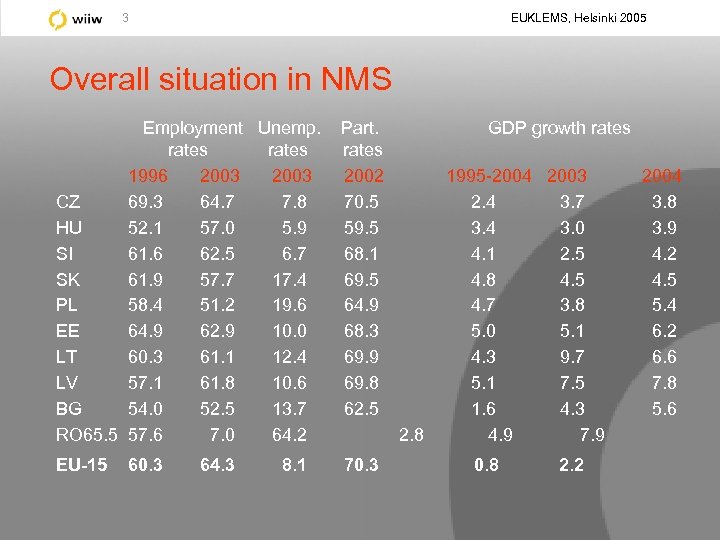 EUKLEMS, Helsinki 2005 3 Overall situation in NMS Employment Unemp. rates 1996 2003 CZ 69. 3 64. 7 7. 8 HU 52. 1 57. 0 5. 9 SI 61. 6 62. 5 6. 7 SK 61. 9 57. 7 17. 4 PL 58. 4 51. 2 19. 6 EE 64. 9 62. 9 10. 0 LT 60. 3 61. 1 12. 4 LV 57. 1 61. 8 10. 6 BG 54. 0 52. 5 13. 7 RO 65. 5 57. 6 7. 0 64. 2 Part. rates 2002 70. 5 59. 5 68. 1 69. 5 64. 9 68. 3 69. 9 69. 8 62. 5 EU-15 70. 3 64. 3 8. 1 GDP growth rates 2. 8 1995 -2004 2003 2. 4 3. 7 3. 4 3. 0 4. 1 2. 5 4. 8 4. 5 4. 7 3. 8 5. 0 5. 1 4. 3 9. 7 5. 1 7. 5 1. 6 4. 3 4. 9 7. 9 0. 8 2. 2 2004 3. 8 3. 9 4. 2 4. 5 5. 4 6. 2 6. 6 7. 8 5. 6
 4 The employment problem in a phase of catching-up (1) > The aggregate picture EUKLEMS, Helsinki 2005
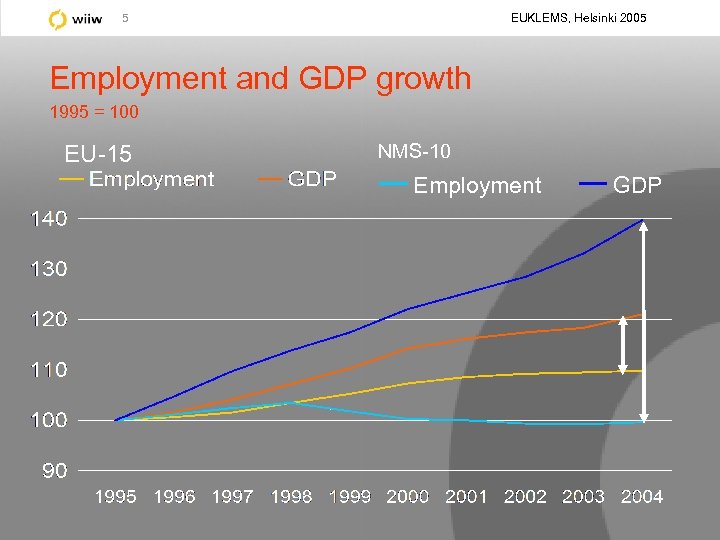 EUKLEMS, Helsinki 2005 5 Employment and GDP growth 1995 = 100 EU-15 NMS-10 Employment GDP
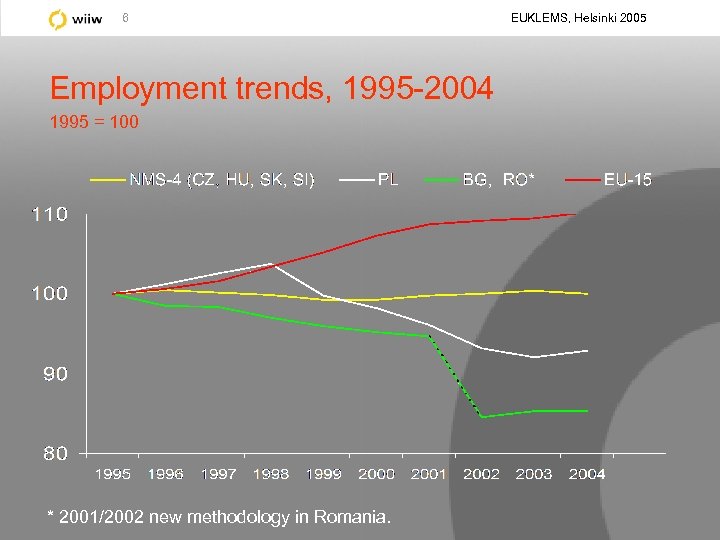 6 Employment trends, 1995 -2004 1995 = 100 * 2001/2002 new methodology in Romania. EUKLEMS, Helsinki 2005
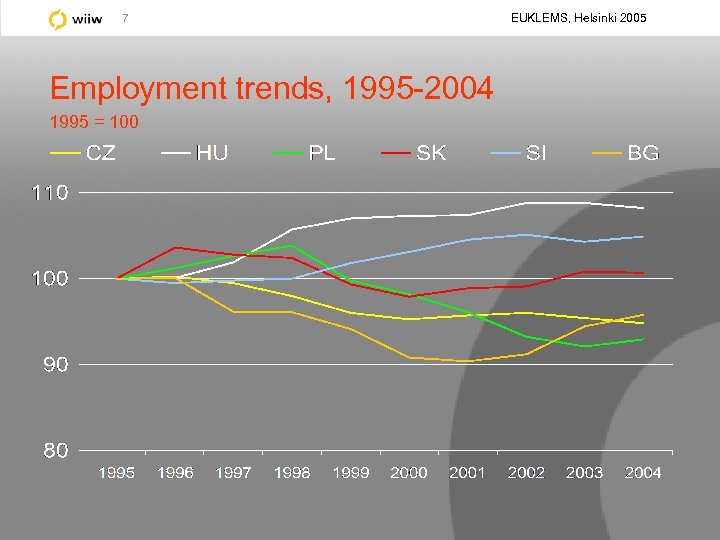 7 Employment trends, 1995 -2004 1995 = 100 EUKLEMS, Helsinki 2005
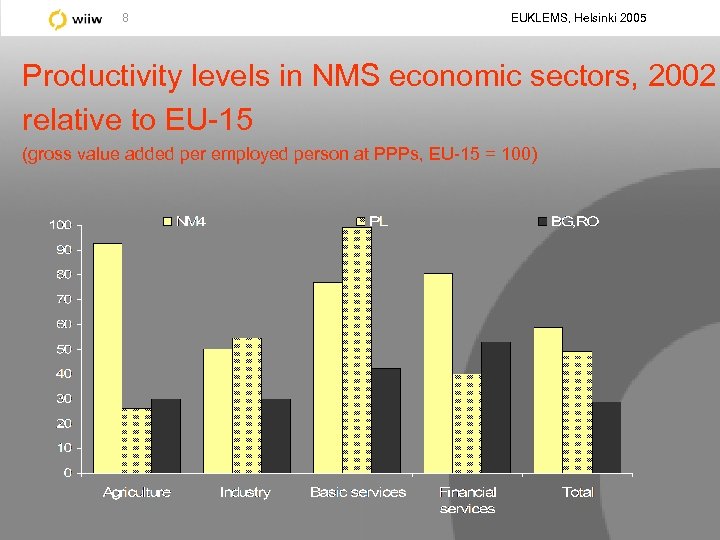 8 EUKLEMS, Helsinki 2005 Productivity levels in NMS economic sectors, 2002 relative to EU-15 (gross value added per employed person at PPPs, EU-15 = 100)
 9 The employment problem in a phase of catching-up (2) > Sectoral patterns EUKLEMS, Helsinki 2005
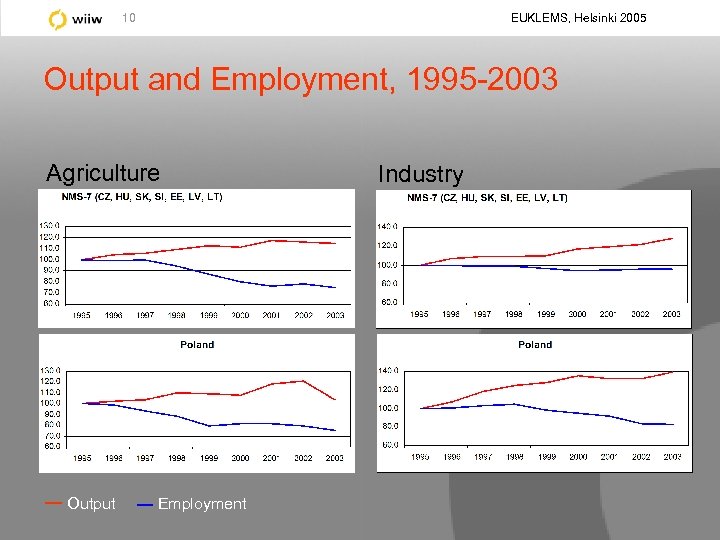 EUKLEMS, Helsinki 2005 10 Output and Employment, 1995 -2003 Agriculture Output Employment Industry
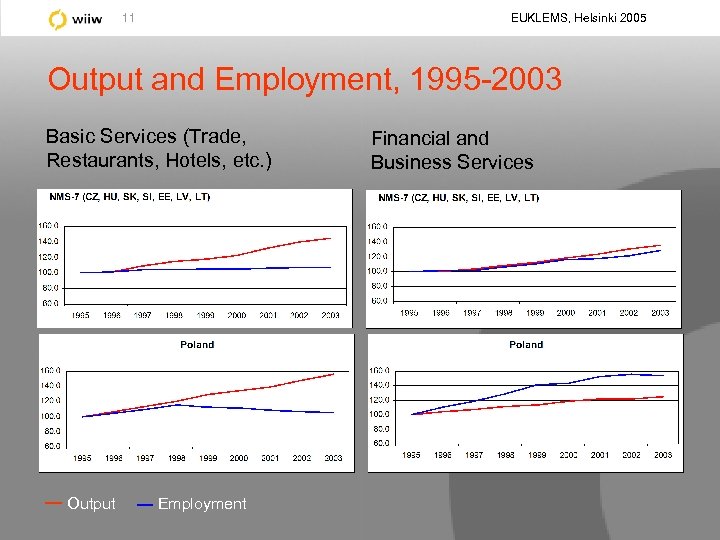 EUKLEMS, Helsinki 2005 11 Output and Employment, 1995 -2003 Basic Services (Trade, Restaurants, Hotels, etc. ) Output Employment Financial and Business Services
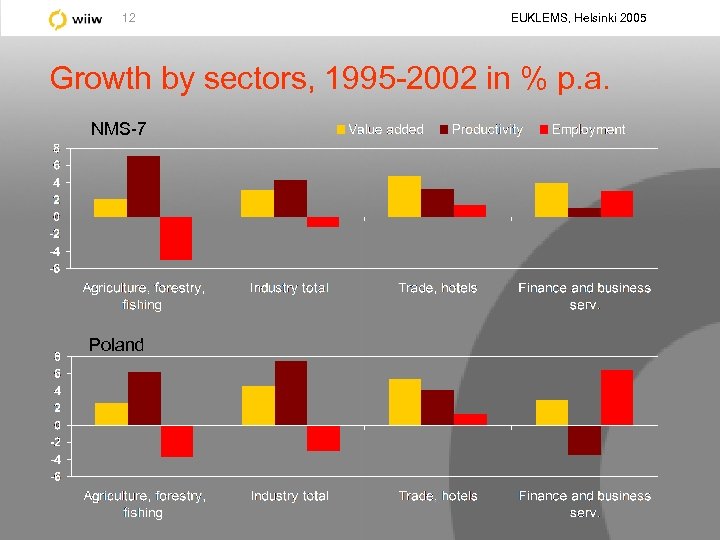 12 EUKLEMS, Helsinki 2005 Growth by sectors, 1995 -2002 in % p. a. NMS-7 Poland
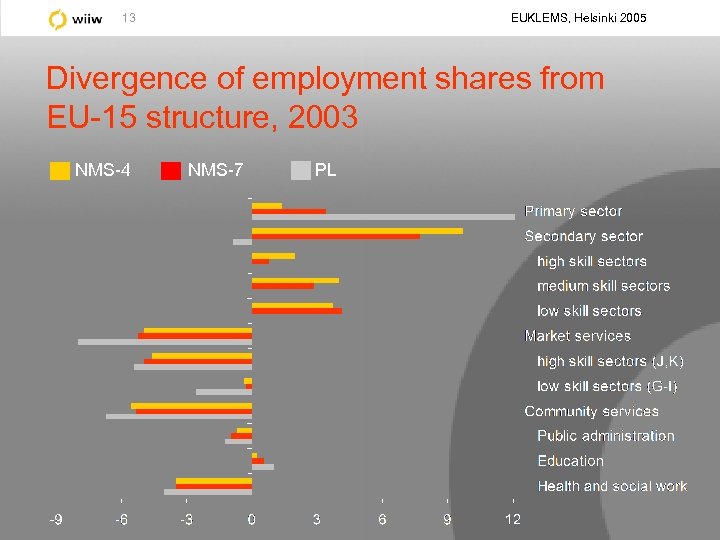 EUKLEMS, Helsinki 2005 13 Divergence of employment shares from EU-15 structure, 2003 NMS-4 NMS-7 PL
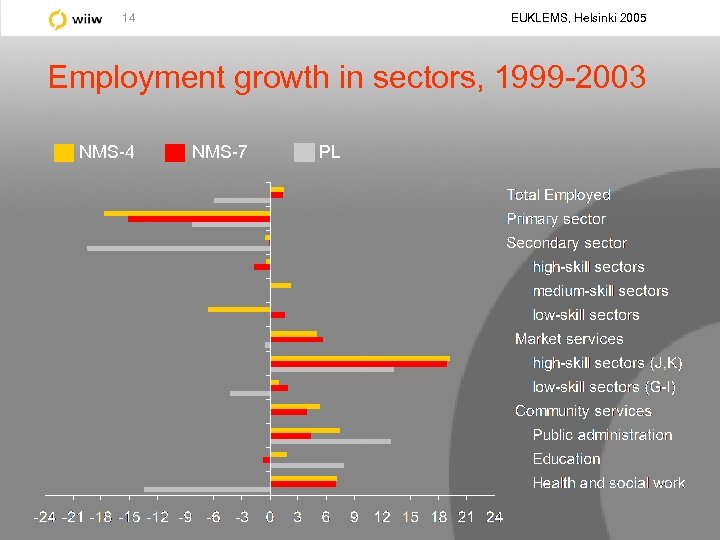 EUKLEMS, Helsinki 2005 14 Employment growth in sectors, 1999 -2003 NMS-4 NMS-7 PL
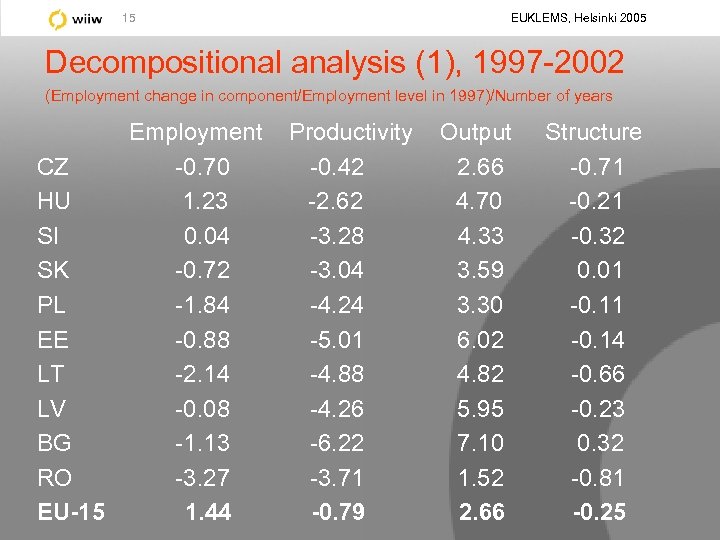 EUKLEMS, Helsinki 2005 15 Decompositional analysis (1), 1997 -2002 (Employment change in component/Employment level in 1997)/Number of years Employment CZ -0. 70 HU 1. 23 SI 0. 04 SK -0. 72 PL -1. 84 EE -0. 88 LT -2. 14 LV -0. 08 BG -1. 13 RO -3. 27 EU-15 1. 44 Productivity -0. 42 -2. 62 -3. 28 -3. 04 -4. 24 -5. 01 -4. 88 -4. 26 -6. 22 -3. 71 -0. 79 Output 2. 66 4. 70 4. 33 3. 59 3. 30 6. 02 4. 82 5. 95 7. 10 1. 52 2. 66 Structure -0. 71 -0. 21 -0. 32 0. 01 -0. 14 -0. 66 -0. 23 0. 32 -0. 81 -0. 25
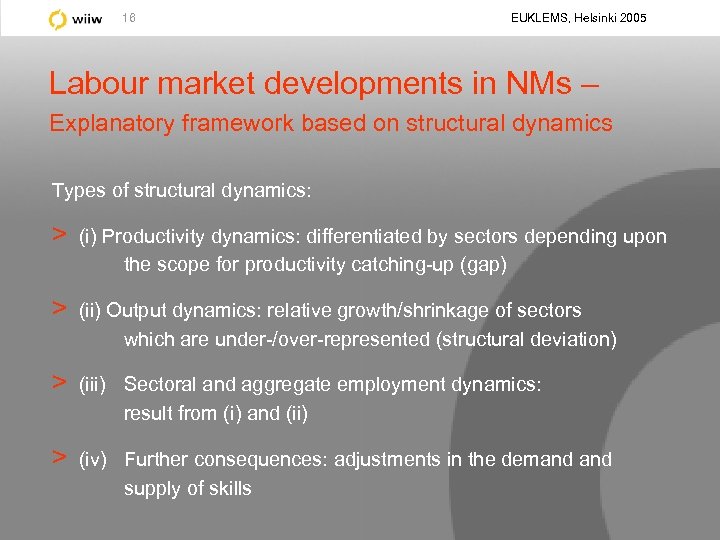 16 EUKLEMS, Helsinki 2005 Labour market developments in NMs – Explanatory framework based on structural dynamics Types of structural dynamics: > (i) Productivity dynamics: differentiated by sectors depending upon the scope for productivity catching-up (gap) > (ii) Output dynamics: relative growth/shrinkage of sectors which are under-/over-represented (structural deviation) > (iii) Sectoral and aggregate employment dynamics: result from (i) and (ii) > (iv) Further consequences: adjustments in the demand supply of skills
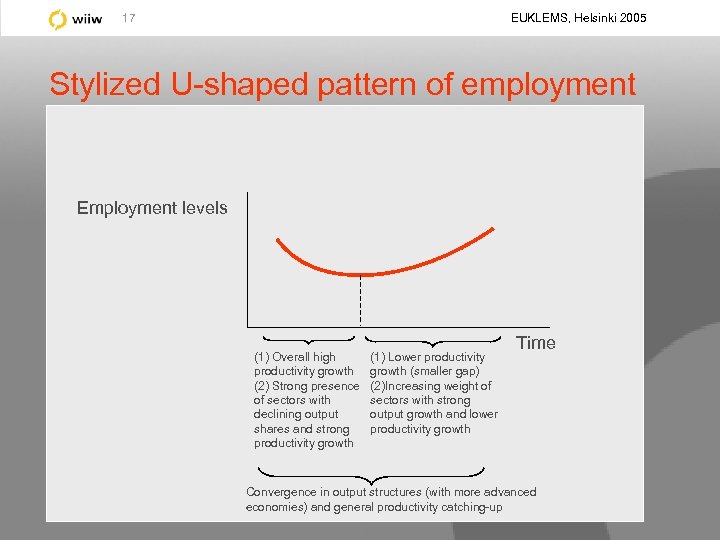 EUKLEMS, Helsinki 2005 17 Stylized U-shaped pattern of employment Employment levels (1) Overall high productivity growth (2) Strong presence of sectors with declining output shares and strong productivity growth (1) Lower productivity growth (smaller gap) (2)Increasing weight of sectors with strong output growth and lower productivity growth Time Convergence in output structures (with more advanced economies) and general productivity catching-up
 18 EUKLEMS, Helsinki 2005 Employment by occupations and educational attainment levels
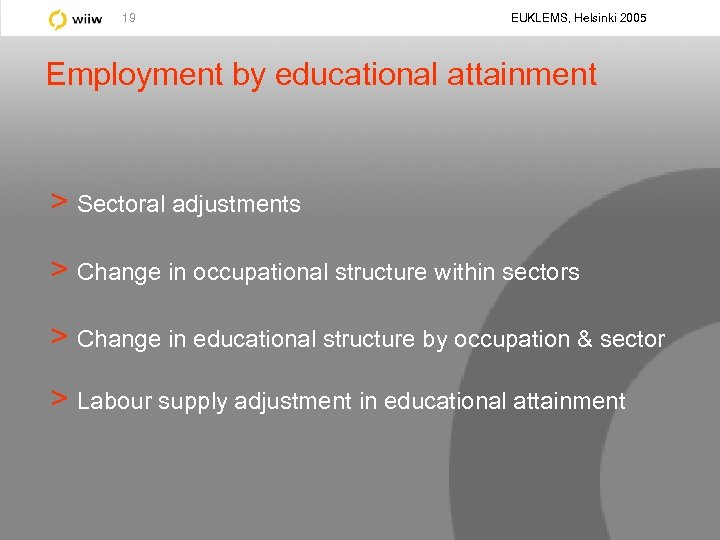 19 EUKLEMS, Helsinki 2005 Employment by educational attainment > Sectoral adjustments > Change in occupational structure within sectors > Change in educational structure by occupation & sector > Labour supply adjustment in educational attainment
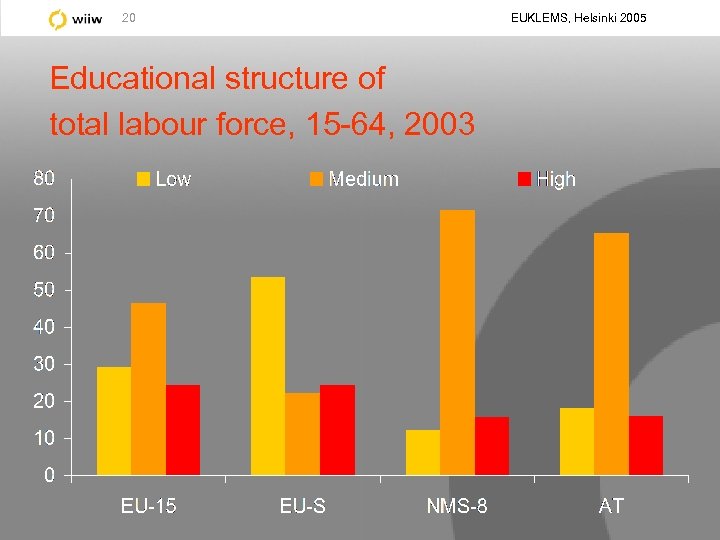 20 Educational structure of total labour force, 15 -64, 2003 EUKLEMS, Helsinki 2005
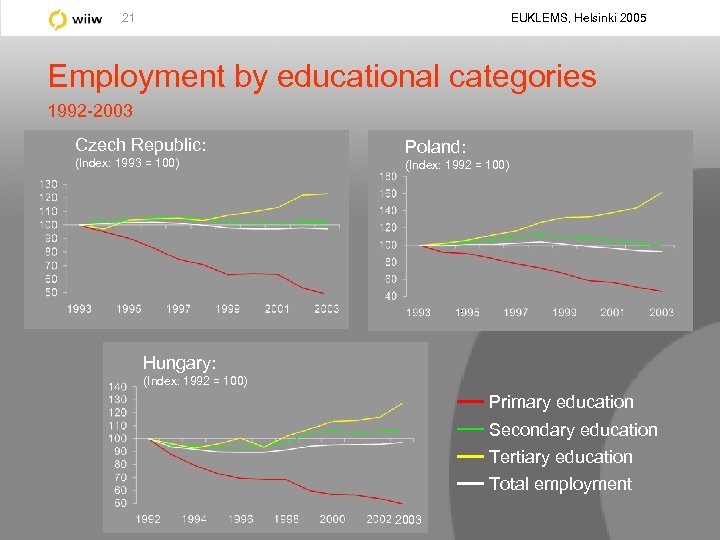 EUKLEMS, Helsinki 2005 21 Employment by educational categories 1992 -2003 Czech Republic: (Index: 1993 = 100) Poland: (Index: 1992 = 100) Hungary: (Index: 1992 = 100) Primary education Secondary education Tertiary education Total employment 2003
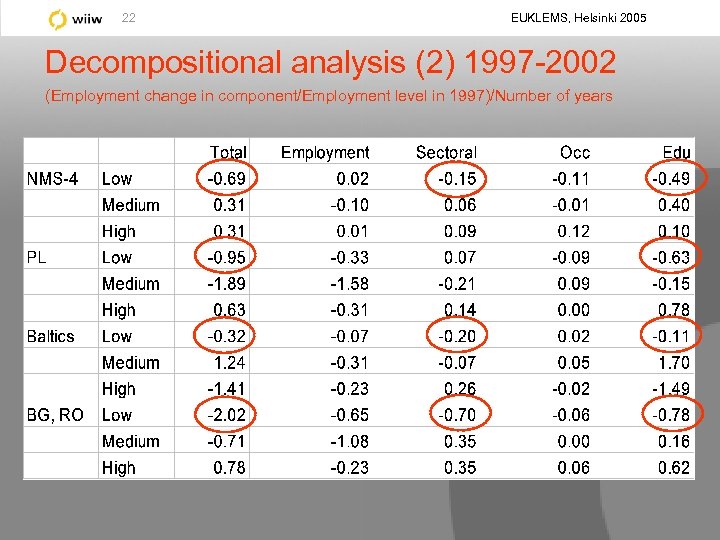 22 EUKLEMS, Helsinki 2005 Decompositional analysis (2) 1997 -2002 (Employment change in component/Employment level in 1997)/Number of years
 23 EUKLEMS, Helsinki 2005 Comparison to EU-15 > BCHS jobs are overrepresented in sectors (especially Agriculture) > Medium educated are overrepresented in all sectors > Medium educated are overrepresented in occupational categories > supply side plays an important role
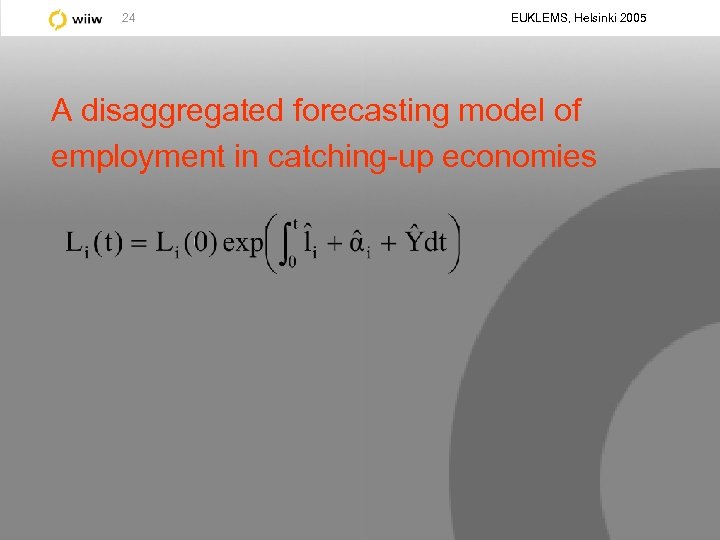 24 EUKLEMS, Helsinki 2005 A disaggregated forecasting model of employment in catching-up economies
 25 EUKLEMS, Helsinki 2005 Labour demand > Overall GDP growth > Sectoral labour productivity dynamics: – > Catching-up towards EU-15 Structural change: – – > Convergence in output shares towards EU-15 average Convergence in occupational structures within sector Speed of convergence depends on initial gap and estimated parameters
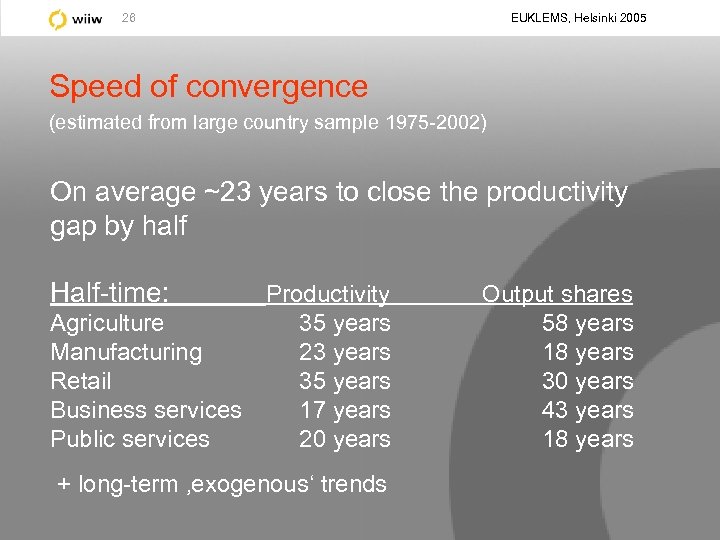 EUKLEMS, Helsinki 2005 26 Speed of convergence (estimated from large country sample 1975 -2002) On average ~23 years to close the productivity gap by half Half-time: Productivity Agriculture 35 years Manufacturing 23 years Retail 35 years Business services 17 years Public services 20 years + long-term ‚exogenous‘ trends Output shares 58 years 18 years 30 years 43 years 18 years
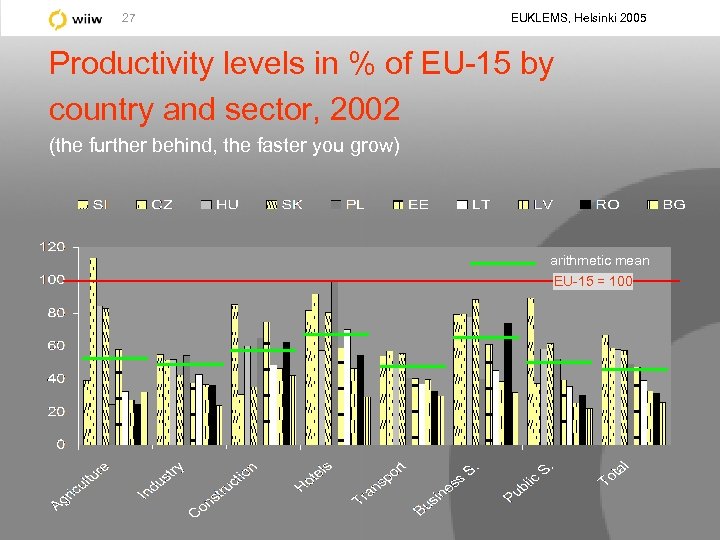 27 EUKLEMS, Helsinki 2005 Productivity levels in % of EU-15 by country and sector, 2002 (the further behind, the faster you grow) arithmetic mean EU-15 = 100
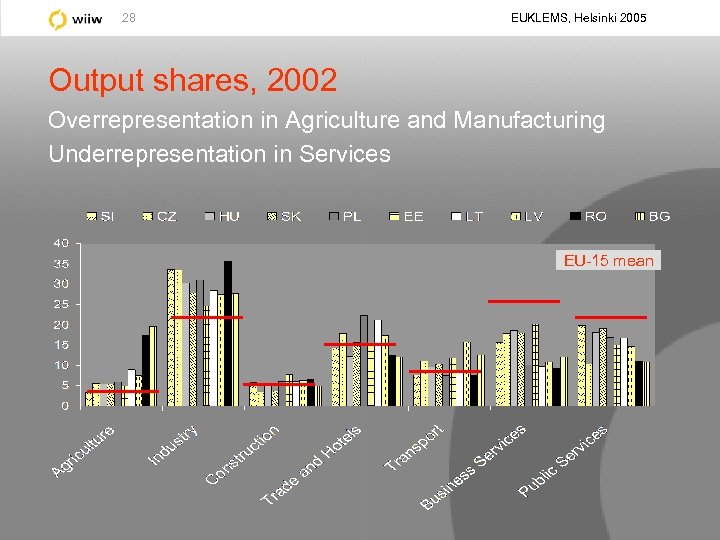 28 EUKLEMS, Helsinki 2005 Output shares, 2002 Overrepresentation in Agriculture and Manufacturing Underrepresentation in Services EU-15 mean
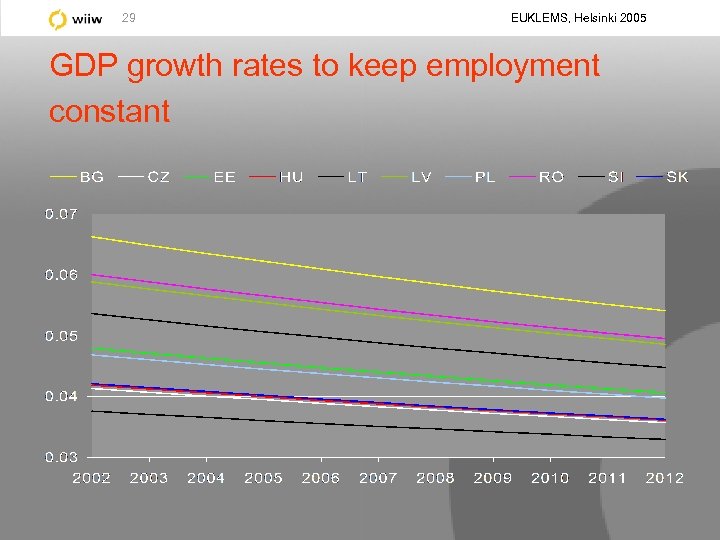 29 EUKLEMS, Helsinki 2005 GDP growth rates to keep employment constant
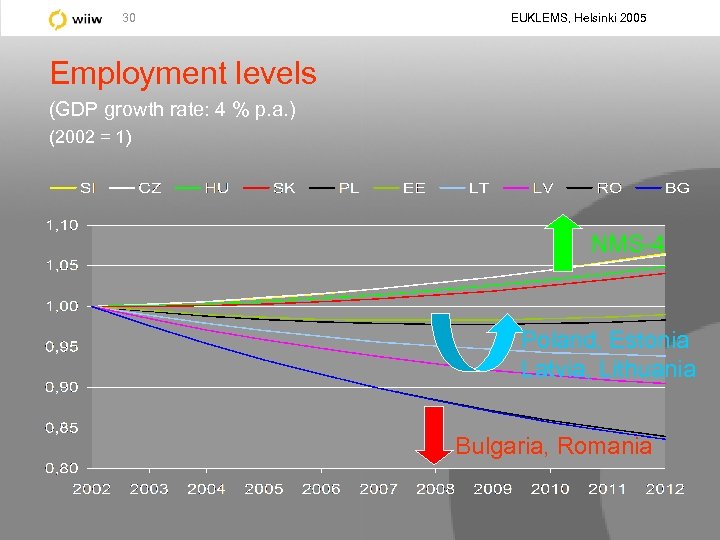 30 EUKLEMS, Helsinki 2005 Employment levels (GDP growth rate: 4 % p. a. ) (2002 = 1) NMS-4 Poland, Estonia Latvia, Lithuania Bulgaria, Romania
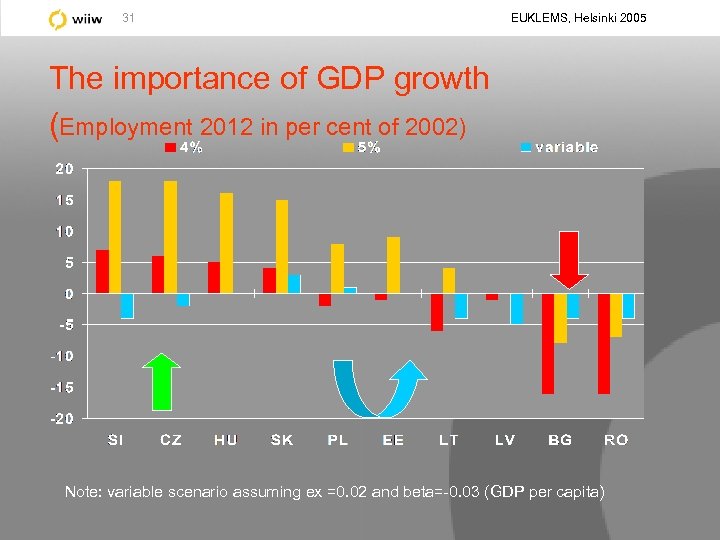 31 EUKLEMS, Helsinki 2005 The importance of GDP growth (Employment 2012 in per cent of 2002) Note: variable scenario assuming ex =0. 02 and beta=-0. 03 (GDP per capita)
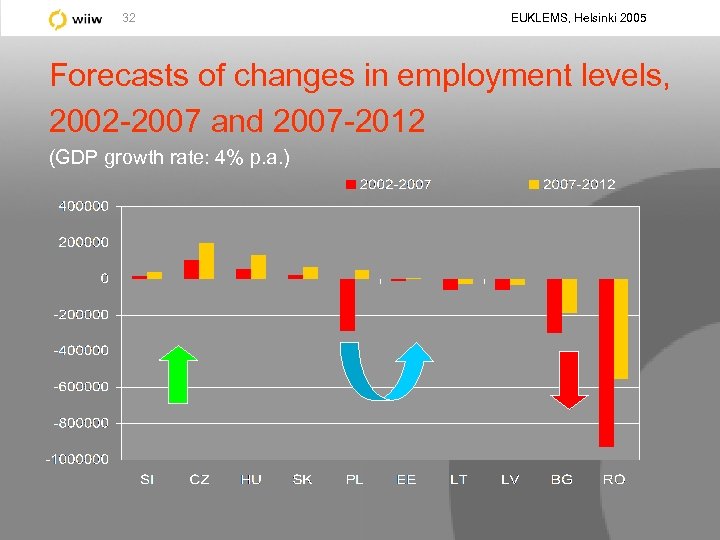 32 EUKLEMS, Helsinki 2005 Forecasts of changes in employment levels, 2002 -2007 and 2007 -2012 (GDP growth rate: 4% p. a. )
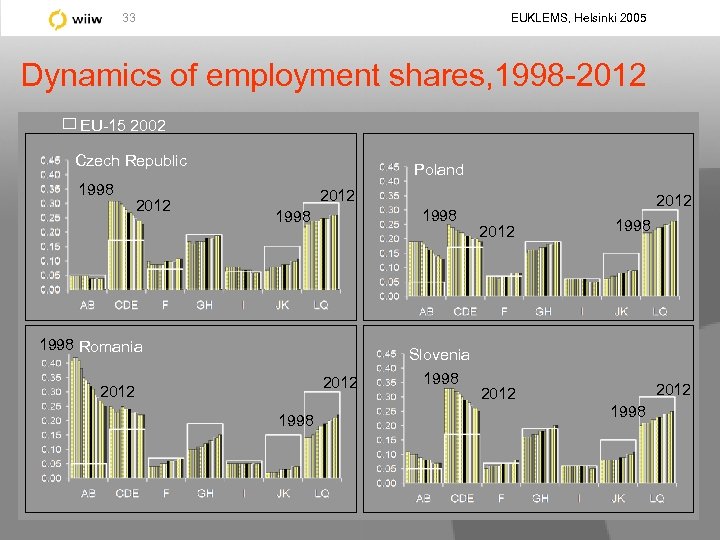 EUKLEMS, Helsinki 2005 33 Dynamics of employment shares, 1998 -2012 EU-15 2002 Czech Republic 1998 2012 Poland 2012 1998 Romania 2012 1998 Slovenia 1998 2012 1998
 34 EUKLEMS, Helsinki 2005 Occupation and Education Change in demand for occupations and educations: > Convergence in occupational structures by sectors to EU-15 mean > Assumption of constant educational attainment structure by occupation a sector (no displacement effect)
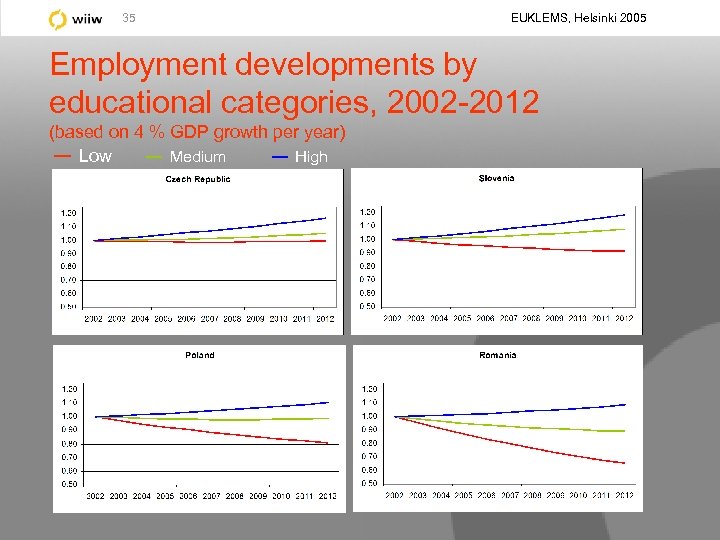 35 EUKLEMS, Helsinki 2005 Employment developments by educational categories, 2002 -2012 (based on 4 % GDP growth per year) Low Medium High
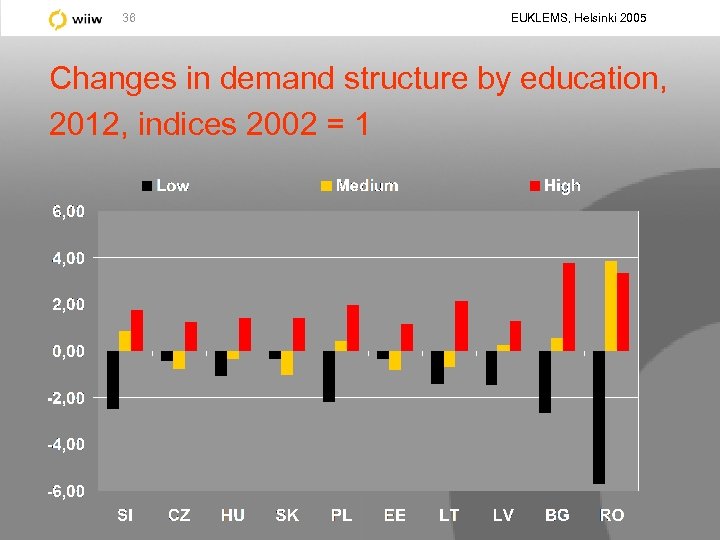 36 EUKLEMS, Helsinki 2005 Changes in demand structure by education, 2012, indices 2002 = 1
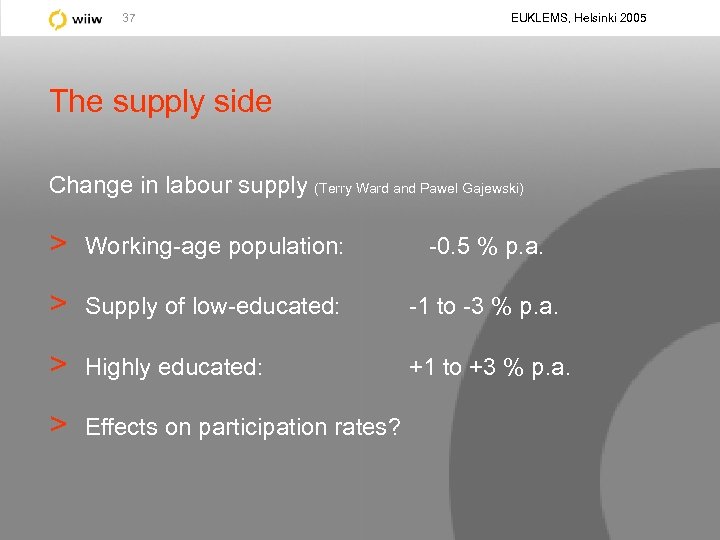 37 EUKLEMS, Helsinki 2005 The supply side Change in labour supply (Terry Ward and Pawel Gajewski) > Working-age population: -0. 5 % p. a. > Supply of low-educated: -1 to -3 % p. a. > Highly educated: +1 to +3 % p. a. > Effects on participation rates?
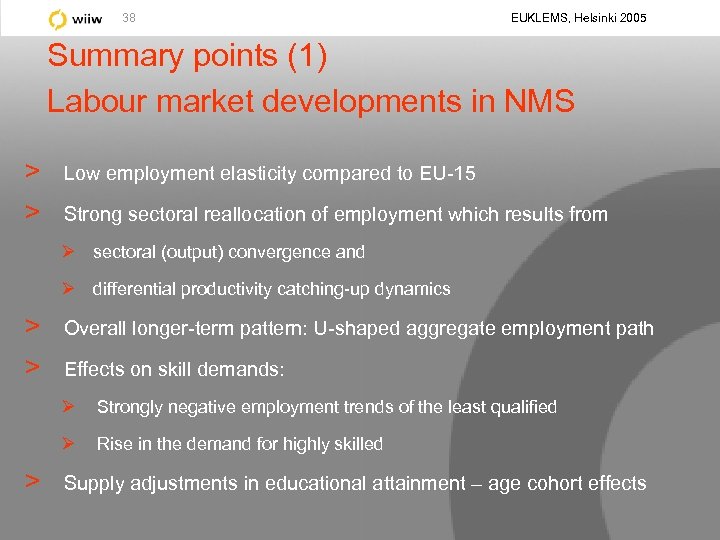 38 EUKLEMS, Helsinki 2005 Summary points (1) Labour market developments in NMS > Low employment elasticity compared to EU-15 > Strong sectoral reallocation of employment which results from Ø sectoral (output) convergence and Ø differential productivity catching-up dynamics > Overall longer-term pattern: U-shaped aggregate employment path > Effects on skill demands: Ø Ø > Strongly negative employment trends of the least qualified Rise in the demand for highly skilled Supply adjustments in educational attainment – age cohort effects
 39 EUKLEMS, Helsinki 2005 Summary points (2): Future developments > Tension between productivity catching-up (potential is still high), sectoral convergence and employment growth > Jobless growth may continue > How to transform high productivity growth rates in even higher output growth rates? > Structural problems: 1. Low educated 2. Regional imbalances 3. Age cohorts