Скачать презентацию Wie orde zaait zal chaos oogsten Een vertoog
a7250b034948347479297e6e39a4c359.ppt
- Количество слайдов: 39
 Wie orde zaait zal chaos oogsten: Een vertoog over de lerende mens Een chautauqua door Prof dr Walter Baets Euromed Marseille – Ecole de Management The Nyenrode Institute for Knowledge Management and Virtual Education
 Een Chautauqua is een ouderwetse reeks populaire praatjes die de bedoeling hebben te stichten en te vermaken, de geest te scherpen en cultuur en inzicht te brengen aan de oren en gedachten van de luisteraar
 Het verhaal van Walter Baets Speelt God met de dobbelstenen ? Heeft materie bewustzijn ?
 Flatland: Edwin Abbott, 1884 A. Square op zoek naar de derde dimensie
 Wanderer, your footprints are the path, and nothing more; Wanderer, there is no path, it is created as you walk. By walking, you make the path before you, and when you look behind you see the path which after you will not be trod again. Wanderer, there is no path, but the ripples on the waters Antonio Machado, Chant XXIX Proverbios y cantares, Campos de Castilla, 1917
 De traditionele methode is altijd op zijn best bijziende geweest. Je kunt ermee zien waar je geweest bent. Het is een goede methode om te testen wat je meent te weten, maar hij kan je niet vertellen waarheen je zou moeten gaan, tenzij waar je heen moet gaan een voortzetting is van waar je in het verleden naar toe ging. Robert Pirsig: Zen en de kunst van het motoronderhoud
 A very great musician came and stayed in our house, He made one big mistake … He was determined to teach me music and consequently, no learning took place. Nevertheless, I did casually pick up from him a certain amount of stolen knowledge Rabindranath Tagore
 Om het concreter uit te drukken: wanneer je een fabriek wilt opbouwen, een motorfiets wilt repareren, of een land in juiste banen wilt brengen zonder te blijven steken, dan is klassieke gestructureerde, dualistische, subject-objectkennis alleen, ofschoon noodzakelijk, toch niet voldoende. Je moet over enig gevoel beschikken voor de kwaliteit van het werk. Je moet kunnen voelen wat het is. Dat brengt je vooruit. Robert Pirsig: Zen en de kunst van het motoronderhoud
 Sometimes small differences in the initial conditions generate very large differences in the final phenomena. A slight error in the former could produce a tremendous error in the latter. Prediction becomes impossible; we have accidental phenomena. Poincaré in 1903
 Spoken zijn onwetenschappelijk. Ze bezitten geen materie en ze hebben geen energie en daarom bestaan ze, volgens de wetten der wetenschap, slechts in de gedachten van de mensen. Natuurlijk bevatten de wetten der wetenschap evenmin materie en bezitten ze evenmin energie en ze bestaan derhalve ook slechts in de gedachten van mensen. Je kunt de hele zaak het best volkomen wetenschappelijk beschouwen en weigeren om zowel in spoken als in de wetten der wetenschap te geloven. Op zo’n moment zit je veilig. Het laat je weinig over om in te geloven, maar ook dat is wetenschap. O, de natuurkundewetten en de logica… het numerieke systeem… het beginsel van de algebraïsche substitutie. Dat zijn spoken. We geloven er alleen zo diep in dat ze werkelijk schijnen te zijn. Robert Pirsig: Zen en de kunst van het motoronderhoud
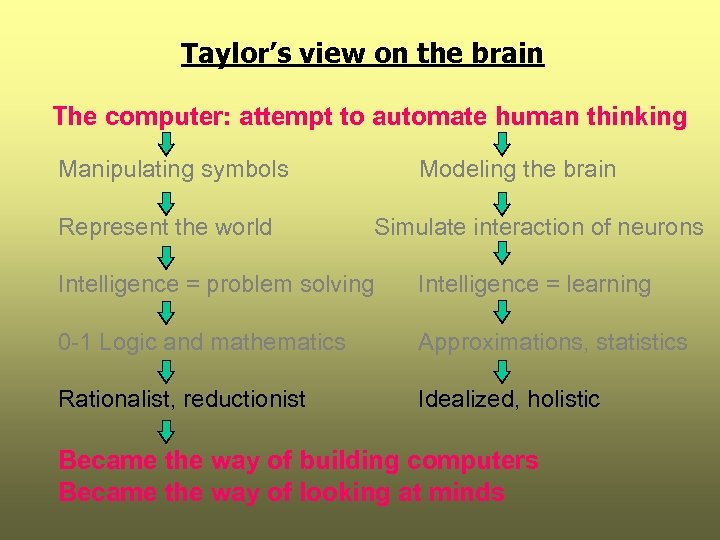 Taylor’s view on the brain The computer: attempt to automate human thinking Manipulating symbols Represent the world Modeling the brain Simulate interaction of neurons Intelligence = problem solving Intelligence = learning 0 -1 Logic and mathematics Approximations, statistics Rationalist, reductionist Idealized, holistic Became the way of building computers Became the way of looking at minds
 De wetenschapsfilosofen, de pragmatici en de postmodernen
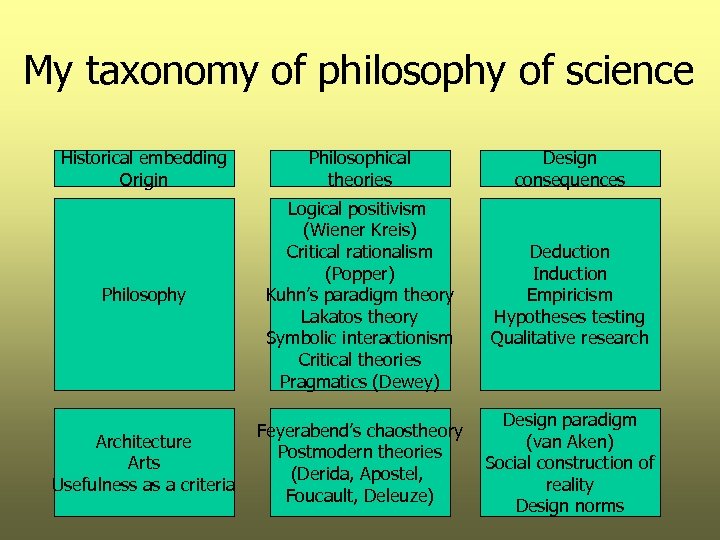 My taxonomy of philosophy of science Historical embedding Origin Philosophical theories Design consequences Philosophy Logical positivism (Wiener Kreis) Critical rationalism (Popper) Kuhn’s paradigm theory Lakatos theory Symbolic interactionism Critical theories Pragmatics (Dewey) Deduction Induction Empiricism Hypotheses testing Qualitative research Architecture Arts Usefulness as a criteria Feyerabend’s chaostheory Postmodern theories (Derida, Apostel, Foucault, Deleuze) Design paradigm (van Aken) Social construction of reality Design norms
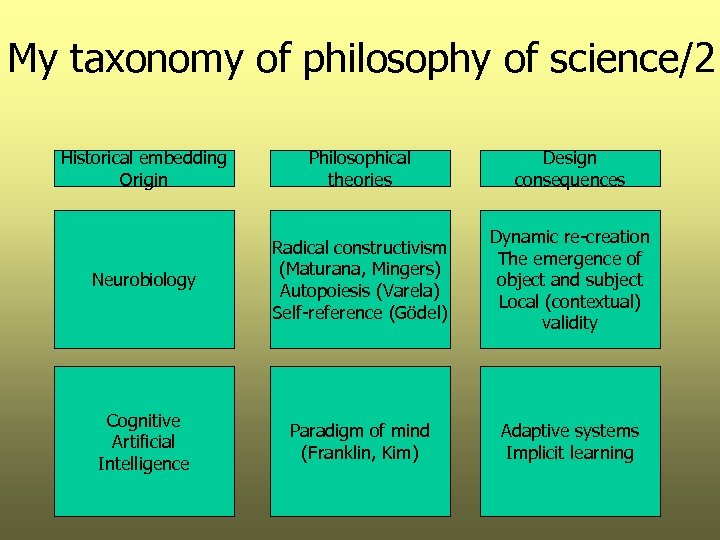 My taxonomy of philosophy of science/2 Historical embedding Origin Philosophical theories Design consequences Neurobiology Radical constructivism (Maturana, Mingers) Autopoiesis (Varela) Self-reference (Gödel) Dynamic re-creation The emergence of object and subject Local (contextual) validity Cognitive Artificial Intelligence Paradigm of mind (Franklin, Kim) Adaptive systems Implicit learning
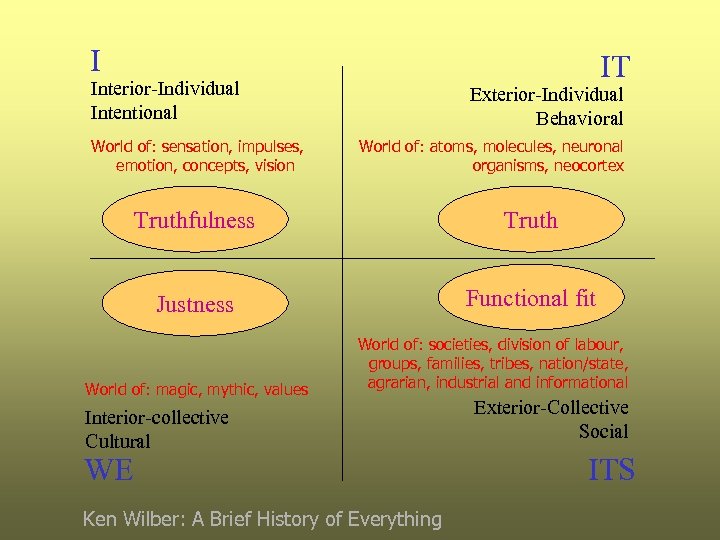
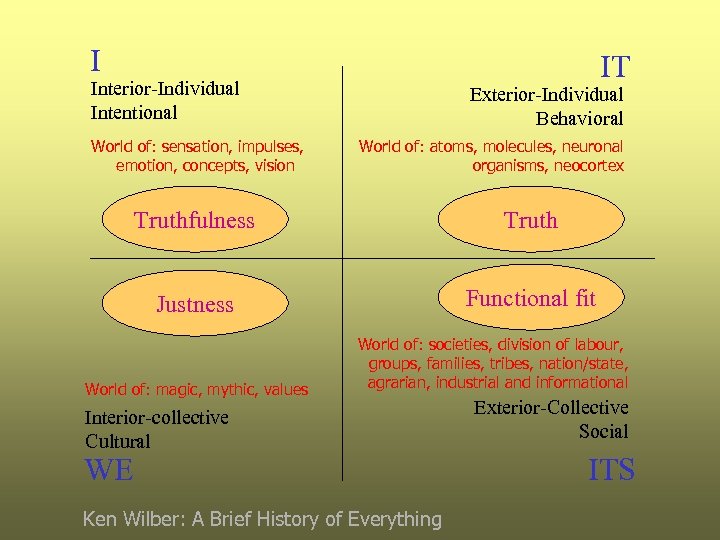 I IT Interior-Individual Intentional World of: sensation, impulses, emotion, concepts, vision Exterior-Individual Behavioral World of: atoms, molecules, neuronal organisms, neocortex Truthfulness Truth Justness Functional fit World of: magic, mythic, values World of: societies, division of labour, groups, families, tribes, nation/state, agrarian, industrial and informational Interior-collective Cultural WE Ken Wilber: A Brief History of Everything Exterior-Collective Social ITS
 Zelforganisatie in netwerken (wie chaos zaait, oogst orde ? )
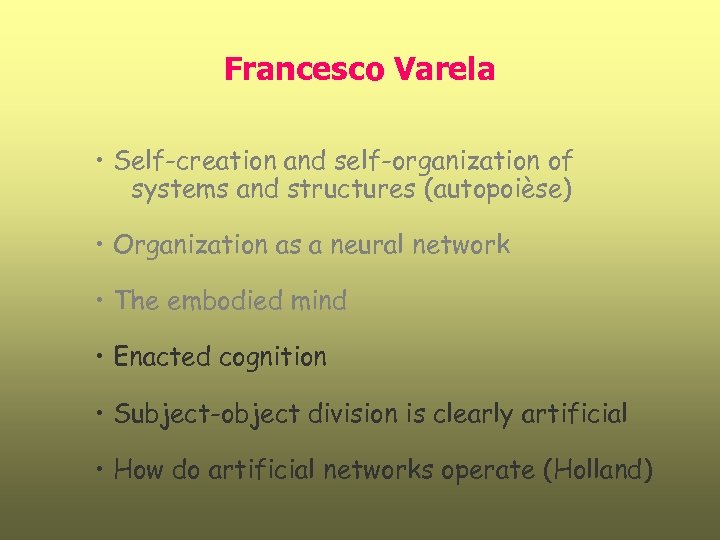 Francesco Varela • Self-creation and self-organization of systems and structures (autopoièse) • Organization as a neural network • The embodied mind • Enacted cognition • Subject-object division is clearly artificial • How do artificial networks operate (Holland)
 Complexiteitstheorie
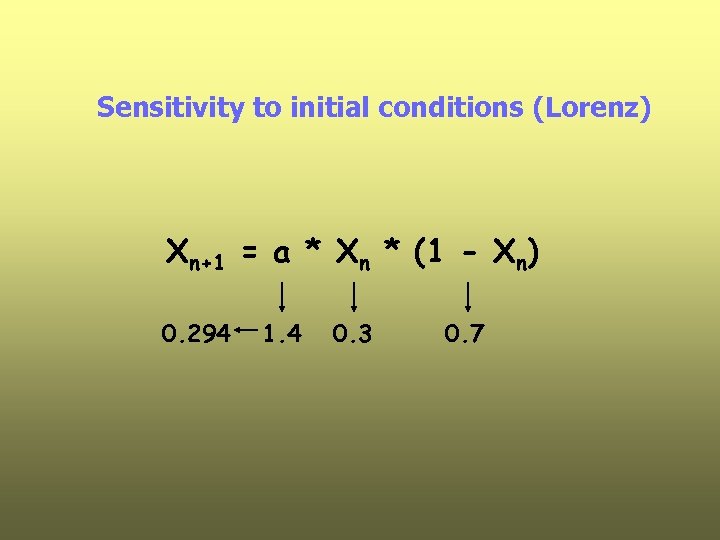 Sensitivity to initial conditions (Lorenz) Xn+1 = a * Xn * (1 - Xn) 0. 294 1. 4 0. 3 0. 7
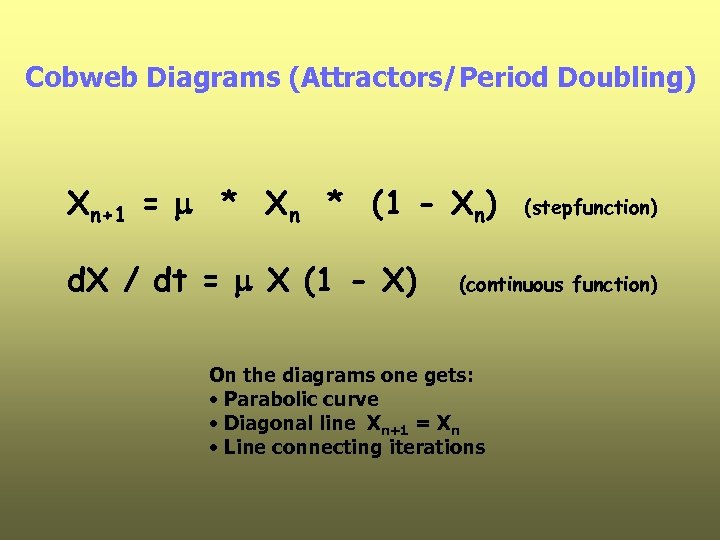 Cobweb Diagrams (Attractors/Period Doubling) Xn+1 = * Xn * (1 - Xn) d. X / dt = X (1 - X) (stepfunction) (continuous function) On the diagrams one gets: • Parabolic curve • Diagonal line Xn+1 = Xn • Line connecting iterations
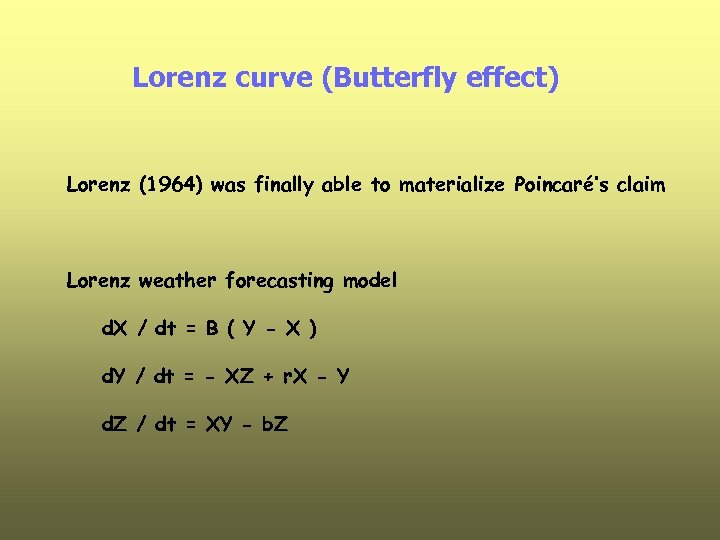 Lorenz curve (Butterfly effect) Lorenz (1964) was finally able to materialize Poincaré’s claim Lorenz weather forecasting model d. X / dt = B ( Y - X ) d. Y / dt = - XZ + r. X - Y d. Z / dt = XY - b. Z
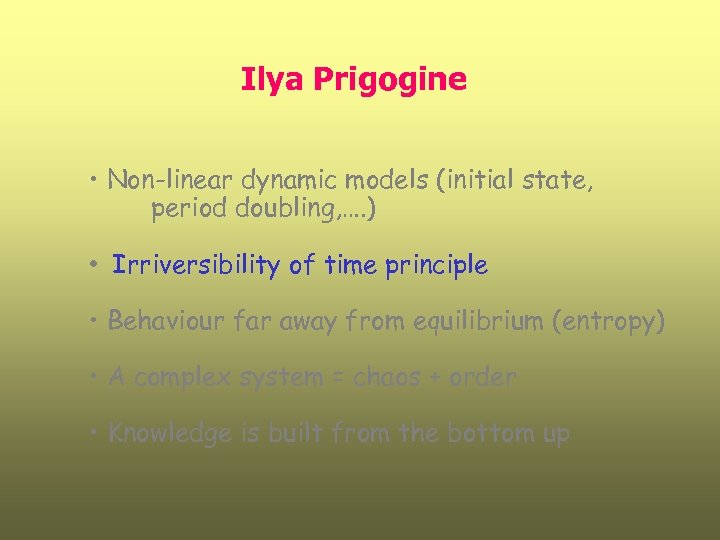 Ilya Prigogine • Non-linear dynamic models (initial state, period doubling, …. ) • Irriversibility of time principle • Behaviour far away from equilibrium (entropy) • A complex system = chaos + order • Knowledge is built from the bottom up
 Waarom is chaos onvermijdelijk ? • Sociale systemen zijn altijd dynamisch en niet-lineair • Men kan nooit precies meten • Elke managementbenadering is een discontinue benadering van een continue fenomeen
 Gödel voor beginners: Zelf-referentie
 Self - Reference Gödel theorem (1931) ‘All consistent axiomatic formulations of the number theory contains propositions on which one cannot decide. ’ It all boils down to a ‘loop’ problem (being self-referential) (Esher drawings) Language is self-referential. Can we make numbers self-referential ? Number theory
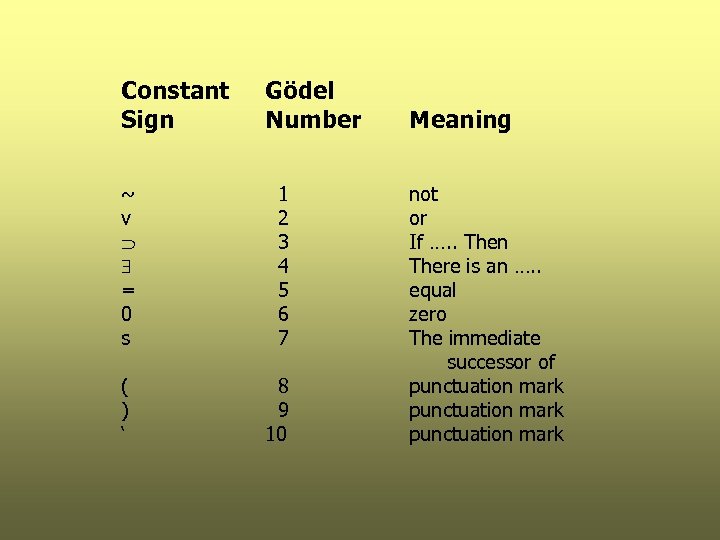 Constant Sign ~ v = 0 s ( ) ‘ Gödel Number 1 2 3 4 5 6 7 8 9 10 Meaning not or If …. . Then There is an …. . equal zero The immediate successor of punctuation mark
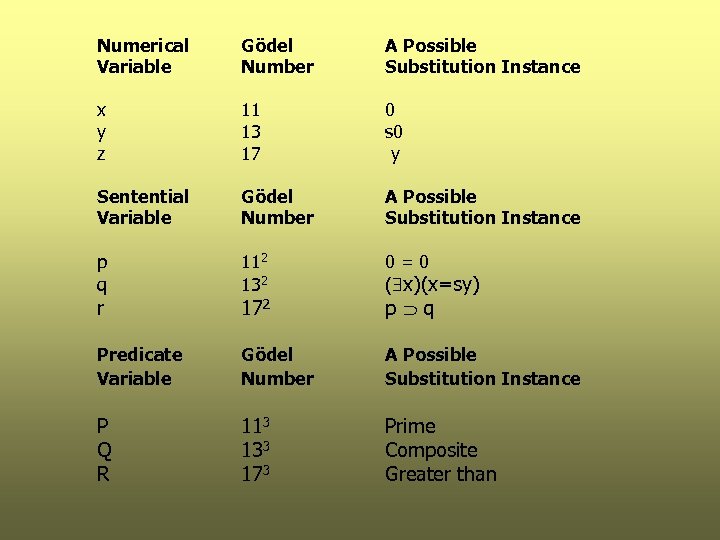 Numerical Variable Gödel Number A Possible Substitution Instance x y z 11 13 17 0 s 0 y Sentential Variable Gödel Number A Possible Substitution Instance p q 112 132 r 172 0=0 ( x)(x=sy) Predicate Variable Gödel Number A Possible Substitution Instance P Q R 113 133 173 Prime Composite Greater than p q
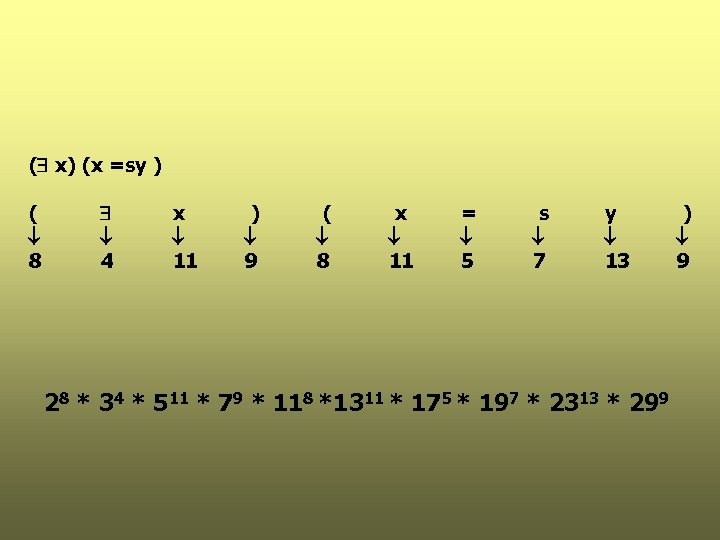 ( x) (x =sy ) ( 8 4 x 11 ) 9 ( 8 x 11 = 5 s 7 y 13 28 * 34 * 511 * 79 * 118 *1311 * 175 * 197 * 2313 * 299 ) 9
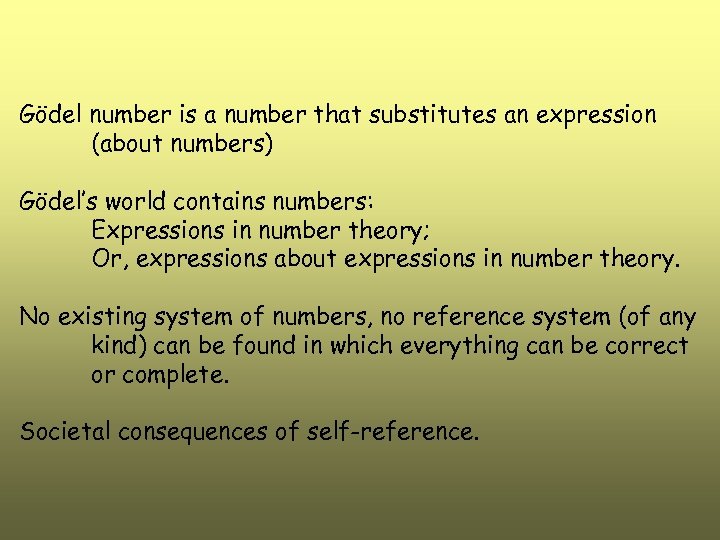 Gödel number is a number that substitutes an expression (about numbers) Gödel’s world contains numbers: Expressions in number theory; Or, expressions about expressions in number theory. No existing system of numbers, no reference system (of any kind) can be found in which everything can be correct or complete. Societal consequences of self-reference.
 Kennis en leren
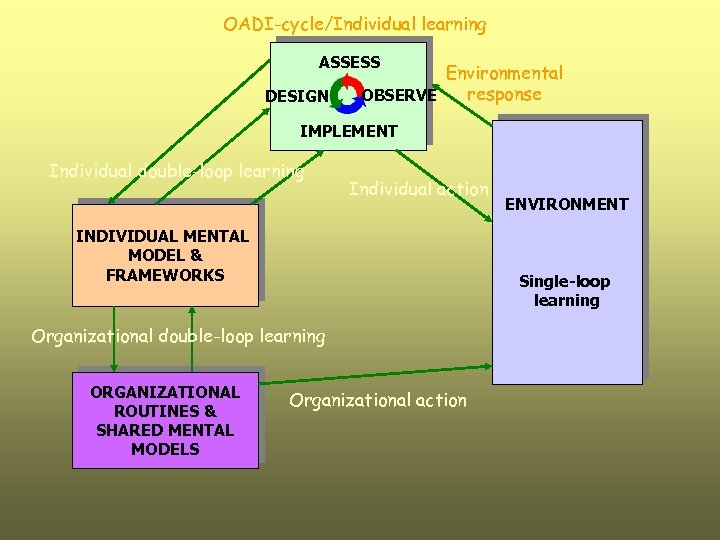 OADI-cycle/Individual learning ASSESS DESIGN Environmental response OBSERVE IMPLEMENT Individual double-loop learning Individual action INDIVIDUAL MENTAL MODEL & FRAMEWORKS Single-loop learning Organizational double-loop learning ORGANIZATIONAL ROUTINES & SHARED MENTAL MODELS ENVIRONMENT Organizational action
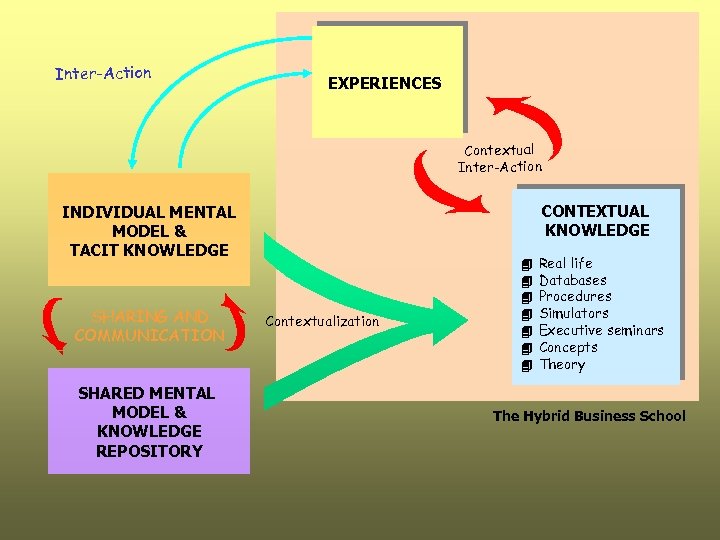 Inter-Action EXPERIENCES Contextual Inter-Action CONTEXTUAL KNOWLEDGE INDIVIDUAL MENTAL MODEL & TACIT KNOWLEDGE SHARING AND COMMUNICATION SHARED MENTAL MODEL & KNOWLEDGE REPOSITORY Contextualization 4 4 4 4 Real life Databases Procedures Simulators Executive seminars Concepts Theory The Hybrid Business School
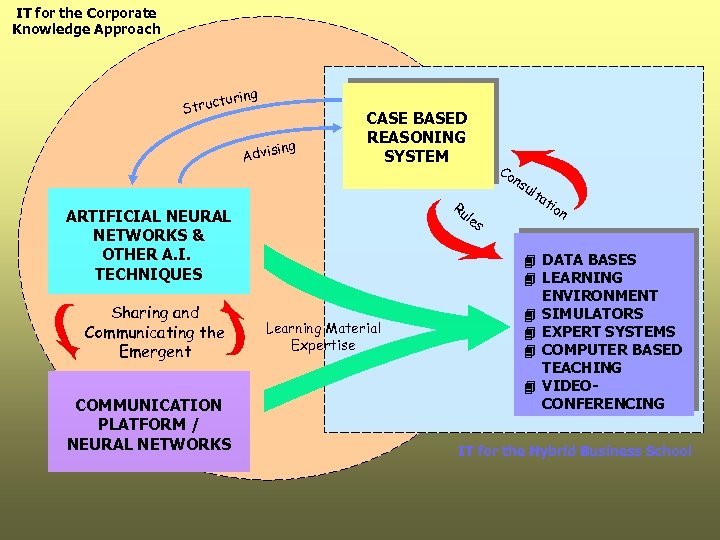 IT for the Corporate Knowledge Approach t Struc uring Advis CASE BASED REASONING SYSTEM Sharing and Communicating the Emergent ult Ru le ARTIFICIAL NEURAL NETWORKS & OTHER A. I. TECHNIQUES Co ns at io s 4 DATA BASES 4 LEARNING Learning Material Expertise 4 4 COMMUNICATION PLATFORM / NEURAL NETWORKS n ENVIRONMENT SIMULATORS EXPERT SYSTEMS COMPUTER BASED TEACHING VIDEOCONFERENCING IT for the Hybrid Business School
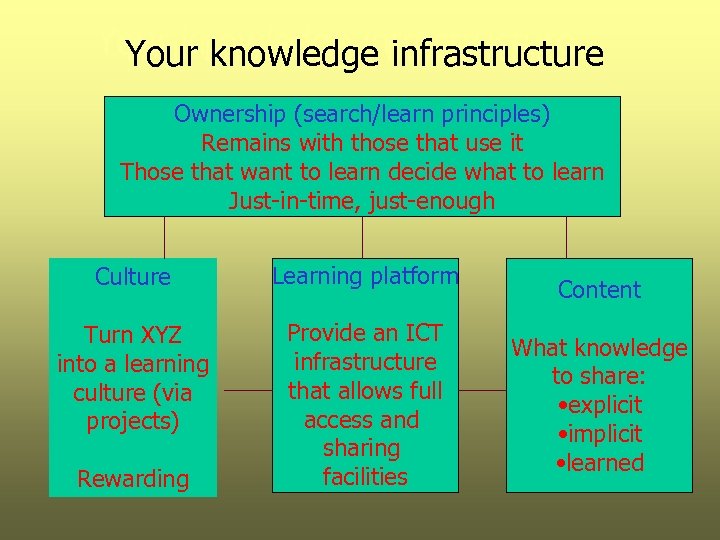 Your knowledge infrastructure Ownership (search/learn principles) Remains with those that use it Those that want to learn decide what to learn Just-in-time, just-enough Culture Learning platform Turn XYZ into a learning culture (via projects) Provide an ICT infrastructure that allows full access and sharing facilities Rewarding Content What knowledge to share: • explicit • implicit • learned
 En de maatschappij, leert die ook ?
 Na het vertoog, de ervaring
 I IT Interior-Individual Intentional World of: sensation, impulses, emotion, concepts, vision Exterior-Individual Behavioral World of: atoms, molecules, neuronal organisms, neocortex Truthfulness Truth Justness Functional fit World of: magic, mythic, values World of: societies, division of labour, groups, families, tribes, nation/state, agrarian, industrial and informational Interior-collective Cultural WE Ken Wilber: A Brief History of Everything Exterior-Collective Social ITS