 Скачать презентацию WI PBIS Conference August 2016 Session D-10 Building
6874f5cd974f4815303922f9f6e5087e.ppt
- Количество слайдов: 65



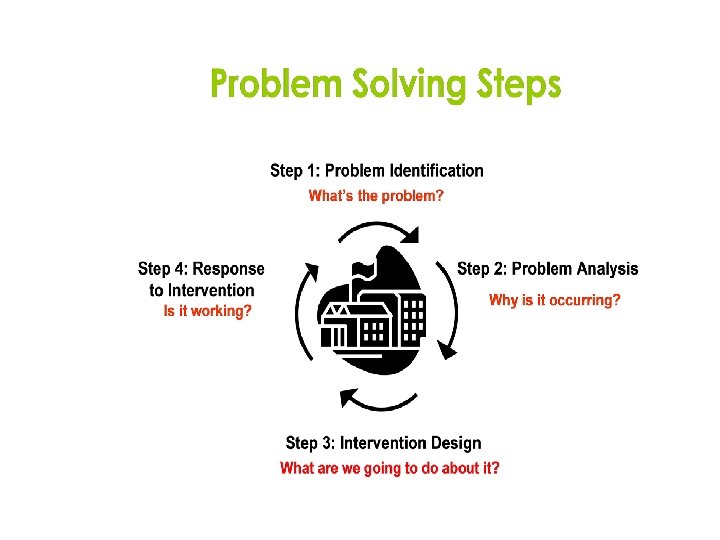
WI PBIS Conference August 2016 Session D-10 Building Interventions for Students with Serious problem Behavior within a School-wide System of Positive Behavior Supports Lucille Eber Ed. D Midwest PBIS Network and National PBIS TA Center Partner lucille. eber@midwestpbis. org
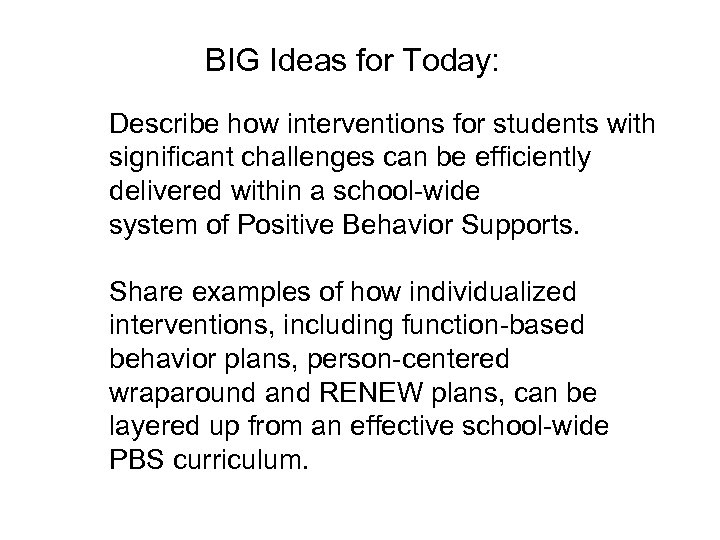
BIG Ideas for Today: Describe how interventions for students with significant challenges can be efficiently delivered within a school-wide system of Positive Behavior Supports. Share examples of how individualized interventions, including function-based behavior plans, person-centered wraparound and RENEW plans, can be layered up from an effective school-wide PBS curriculum.
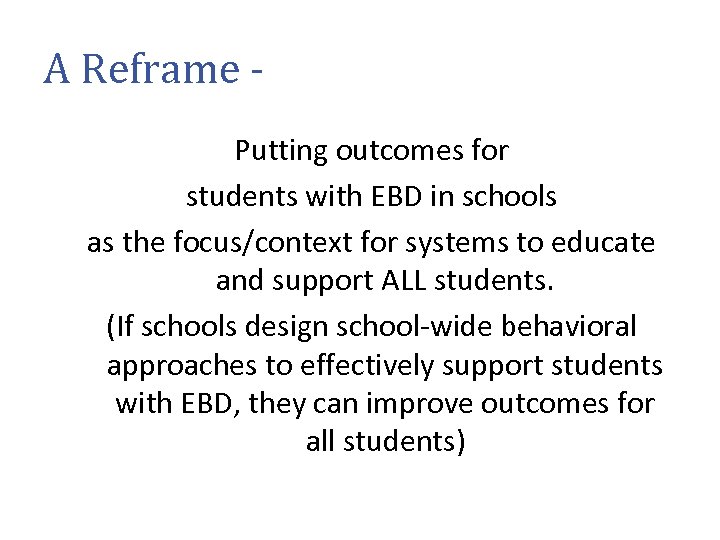
A Reframe Putting outcomes for students with EBD in schools as the focus/context for systems to educate and support ALL students. (If schools design school-wide behavioral approaches to effectively support students with EBD, they can improve outcomes for all students)
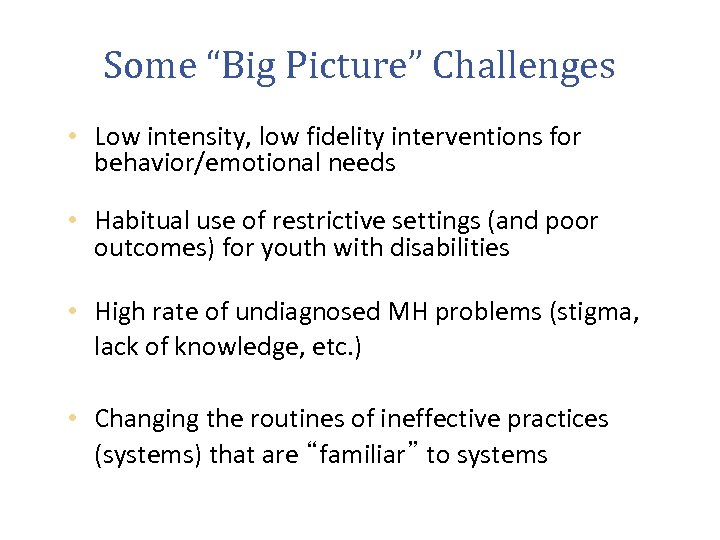
Some “Big Picture” Challenges • Low intensity, low fidelity interventions for behavior/emotional needs • Habitual use of restrictive settings (and poor outcomes) for youth with disabilities • High rate of undiagnosed MH problems (stigma, lack of knowledge, etc. ) • Changing the routines of ineffective practices (systems) that are “familiar” to systems
We Know the Practices that Work for Students with EBD… • Proactive, strength-based; “set kids up” to experience success • High rates of consistent, supported instruction; teach/practice/reinforce • Predictable and consistent environments • Know unique “why? ” for each student/problem • Contextual fit: Strategic use of natural supports, and settings • Careful monitoring of data over time with ongoing revisions to guide incremental improvements in quality of life
• Behavior support is the redesign of environments, not the redesign of individuals. • Positive behavior support plans define changes in the behavior of those who will implement the plan. A behavior support plan describes what we will do differently. Do ALL staff understand the context for effective behavior interventions?
It Takes a System… …. . that builds system capacity for advanced tiers
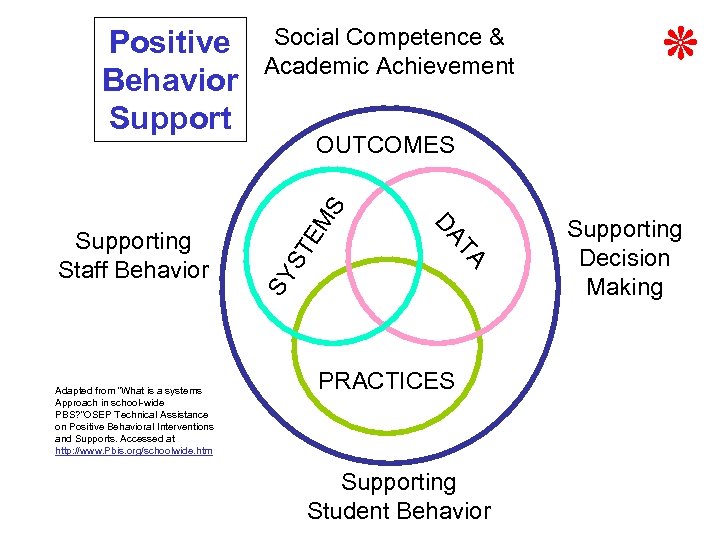
EM S ST TA Adapted from “What is a systems Approach in school-wide PBS? ”OSEP Technical Assistance on Positive Behavioral Interventions and Supports. Accessed at http: //www. Pbis. org/schoolwide. htm ٭ OUTCOMES DA Supporting Staff Behavior Social Competence & Academic Achievement SY Positive Behavior Support PRACTICES Supporting Student Behavior Supporting Decision Making
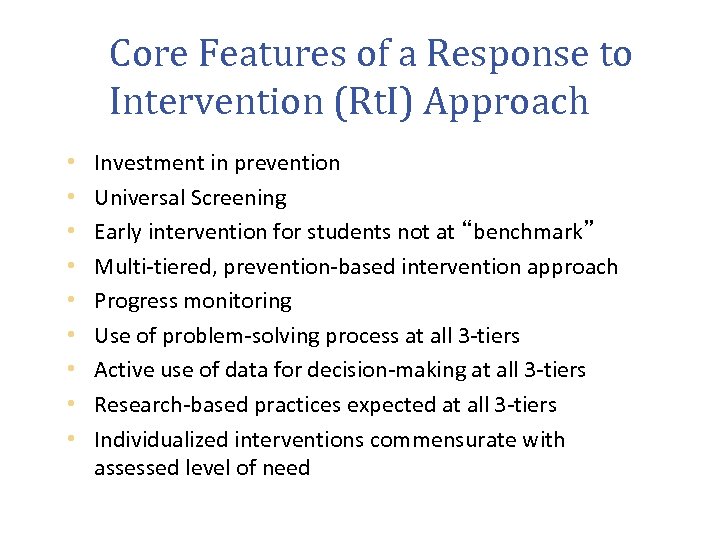
Core Features of a Response to Intervention (Rt. I) Approach • • • Investment in prevention Universal Screening Early intervention for students not at “benchmark” Multi-tiered, prevention-based intervention approach Progress monitoring Use of problem-solving process at all 3 -tiers Active use of data for decision-making at all 3 -tiers Research-based practices expected at all 3 -tiers Individualized interventions commensurate with assessed level of need
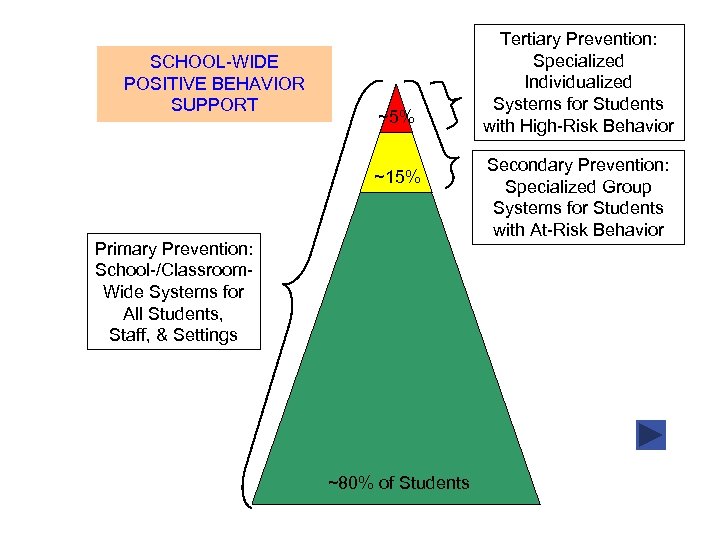
SCHOOL-WIDE POSITIVE BEHAVIOR SUPPORT ~5% ~15% Primary Prevention: School-/Classroom. Wide Systems for All Students, Staff, & Settings ~80% of Students Tertiary Prevention: Specialized Individualized Systems for Students with High-Risk Behavior Secondary Prevention: Specialized Group Systems for Students with At-Risk Behavior
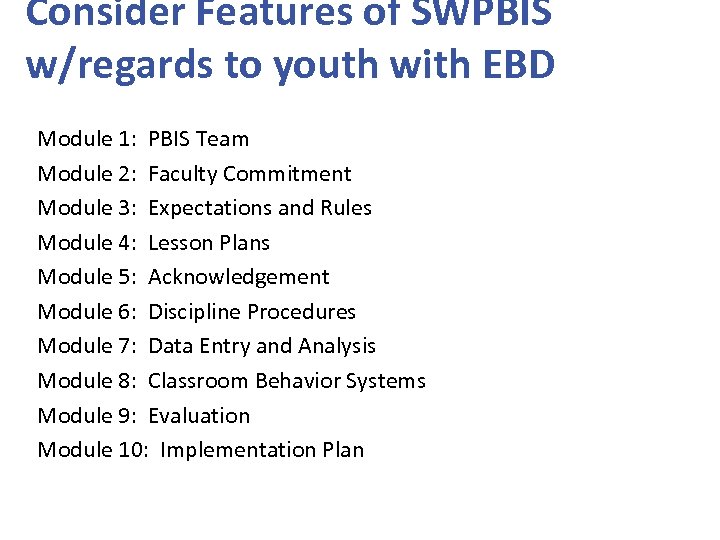
Consider Features of SWPBIS w/regards to youth with EBD Module 1: PBIS Team Module 2: Faculty Commitment Module 3: Expectations and Rules Module 4: Lesson Plans Module 5: Acknowledgement Module 6: Discipline Procedures Module 7: Data Entry and Analysis Module 8: Classroom Behavior Systems Module 9: Evaluation Module 10: Implementation Plan
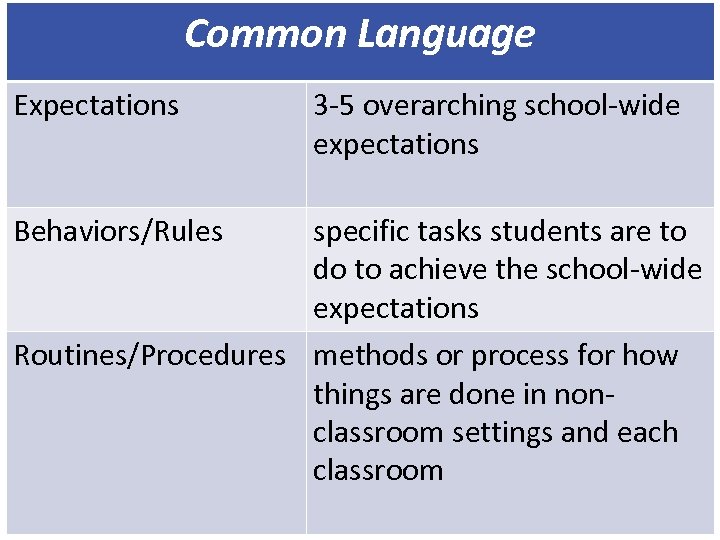
Common Language Expectations Behaviors/Rules 3 -5 overarching school-wide expectations specific tasks students are to do to achieve the school-wide expectations Routines/Procedures methods or process for how things are done in nonclassroom settings and each classroom
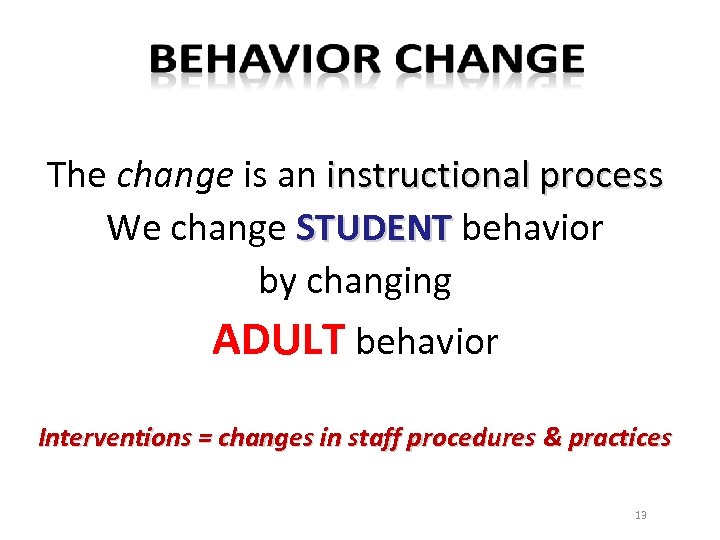
The change is an instructional process We change STUDENT behavior by changing ADULT behavior Interventions = changes in staff procedures & practices 13
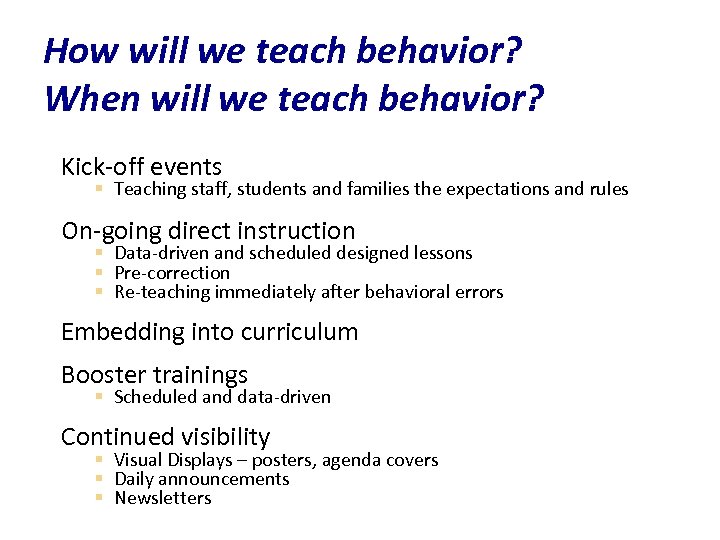
How will we teach behavior? When will we teach behavior? Kick-off events § Teaching staff, students and families the expectations and rules On-going direct instruction § Data-driven and scheduled designed lessons § Pre-correction § Re-teaching immediately after behavioral errors Embedding into curriculum Booster trainings § Scheduled and data-driven Continued visibility § Visual Displays – posters, agenda covers § Daily announcements § Newsletters
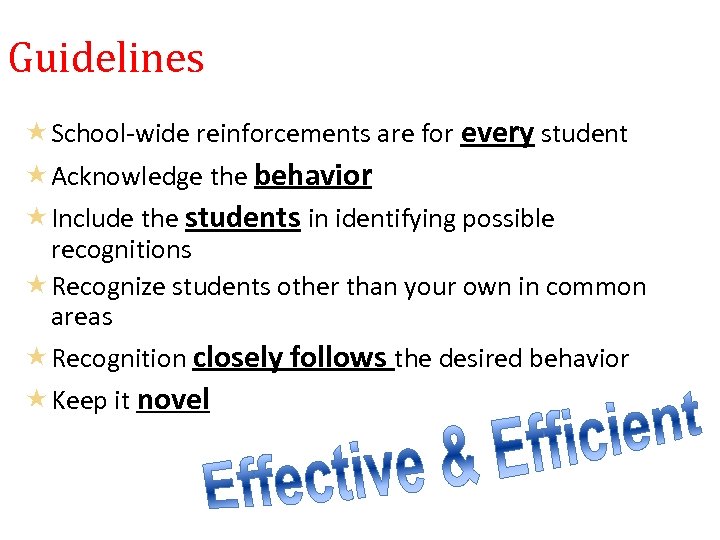
Guidelines School-wide reinforcements are for every student Acknowledge the behavior Include the students in identifying possible recognitions Recognize students other than your own in common areas Recognition closely follows the desired behavior Keep it novel
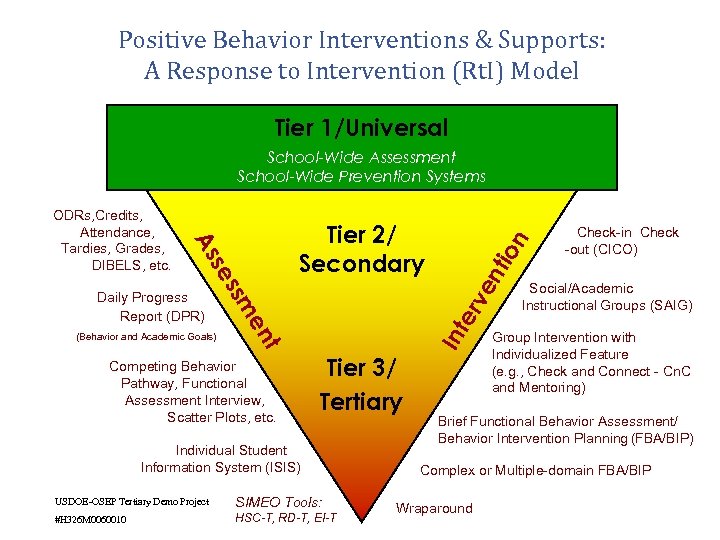
Positive Behavior Interventions & Supports: A Response to Intervention (Rt. I) Model Tier 1/Universal School-Wide Assessment School-Wide Prevention Systems (Behavior and Academic Goals) Competing Behavior Pathway, Functional Assessment Interview, Scatter Plots, etc. n nti o er ve t Int Daily Progress Report (DPR) Tier 2/ Secondary en ssm se As ODRs, Credits, Attendance, Tardies, Grades, DIBELS, etc. Tier 3/ Tertiary Individual Student Information System (ISIS) USDOE-OSEP Tertiary Demo Project SIMEO Tools: #H 326 M 0060010 HSC-T, RD-T, EI-T Check-in Check -out (CICO) Social/Academic Instructional Groups (SAIG) Group Intervention with Individualized Feature (e. g. , Check and Connect - Cn. C and Mentoring) Brief Functional Behavior Assessment/ Behavior Intervention Planning (FBA/BIP) Complex or Multiple-domain FBA/BIP Wraparound
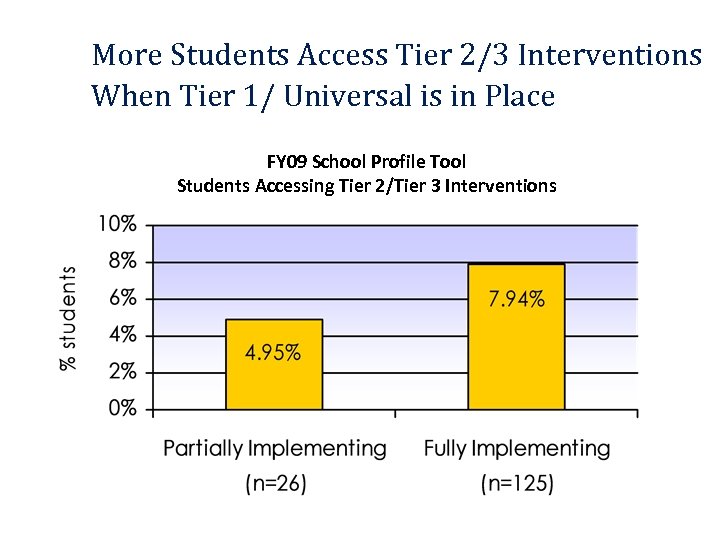
More Students Access Tier 2/3 Interventions When Tier 1/ Universal is in Place FY 09 School Profile Tool Students Accessing Tier 2/Tier 3 Interventions
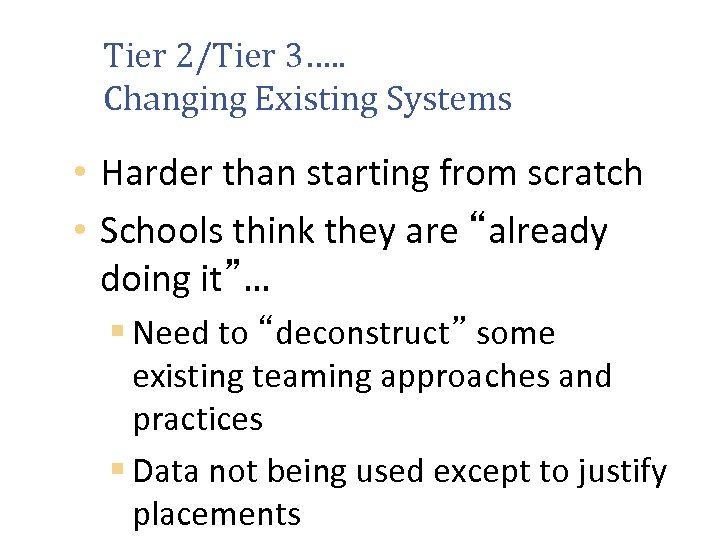
Tier 2/Tier 3…. . Changing Existing Systems • Harder than starting from scratch • Schools think they are “already doing it”… § Need to “deconstruct” some existing teaming approaches and practices § Data not being used except to justify placements
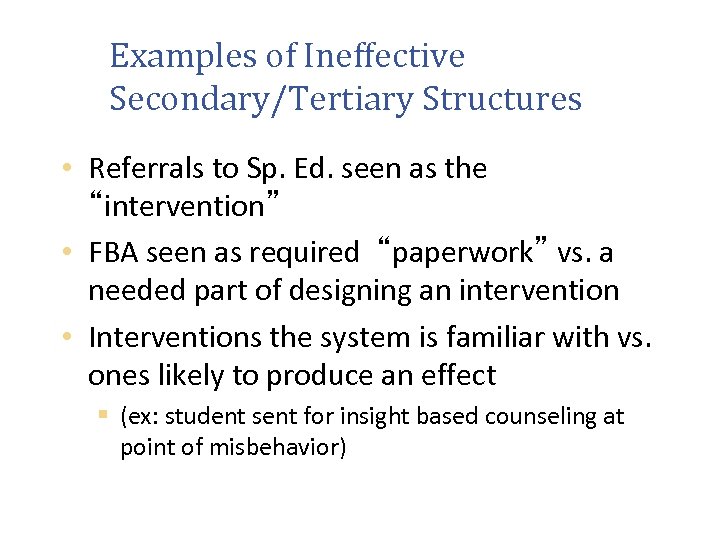
Examples of Ineffective Secondary/Tertiary Structures • Referrals to Sp. Ed. seen as the “intervention” • FBA seen as required “paperwork” vs. a needed part of designing an intervention • Interventions the system is familiar with vs. ones likely to produce an effect § (ex: student sent for insight based counseling at point of misbehavior)
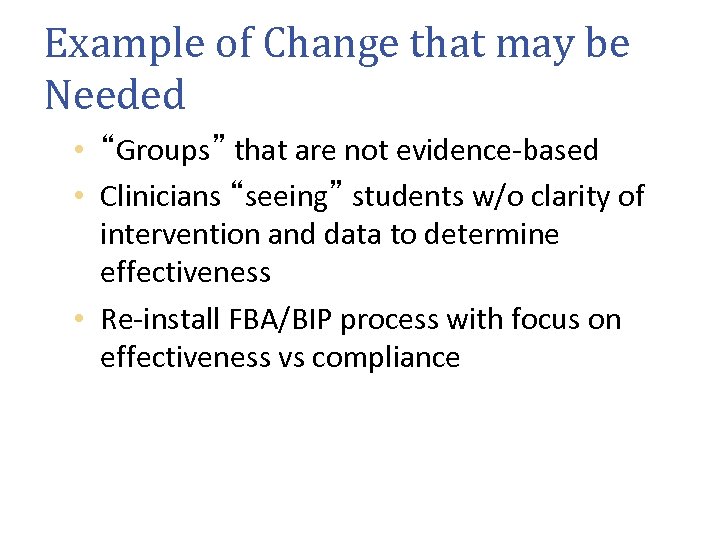
Example of Change that may be Needed • “Groups” that are not evidence-based • Clinicians “seeing” students w/o clarity of intervention and data to determine effectiveness • Re-install FBA/BIP process with focus on effectiveness vs compliance
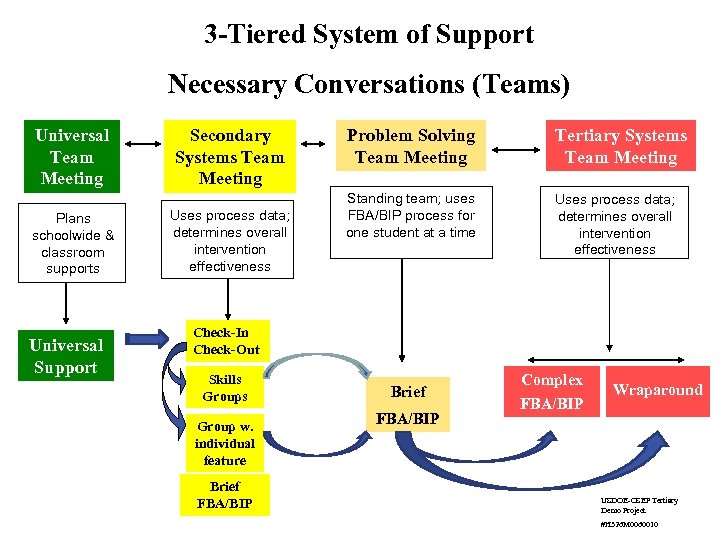
3 -Tiered System of Support Necessary Conversations (Teams) Universal Team Meeting Plans schoolwide & classroom supports Universal Support Secondary Systems Team Meeting Uses process data; determines overall intervention effectiveness Problem Solving Team Meeting Tertiary Systems Team Meeting Standing team; uses FBA/BIP process for one student at a time Uses process data; determines overall intervention effectiveness Check-In Check-Out Skills Group w. individual feature Brief FBA/BIP Complex FBA/BIP Wraparound USDOE-OSEP Tertiary Demo Project #H 326 M 0060010
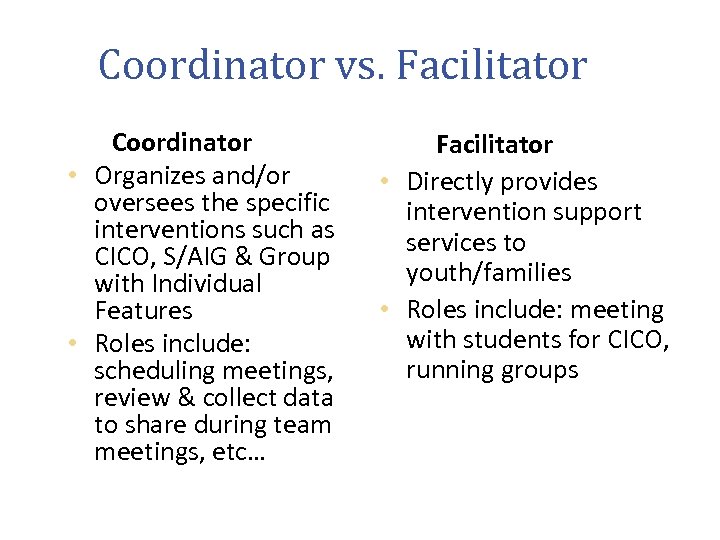
Coordinator vs. Facilitator Coordinator • Organizes and/or oversees the specific interventions such as CICO, S/AIG & Group with Individual Features • Roles include: scheduling meetings, review & collect data to share during team meetings, etc… Facilitator • Directly provides intervention support services to youth/families • Roles include: meeting with students for CICO, running groups
USDOE-OSEP Tertiary Demo Project #H 326 M 0060010
USDOE-OSEP Tertiary Demo Project #H 326 M 0060010
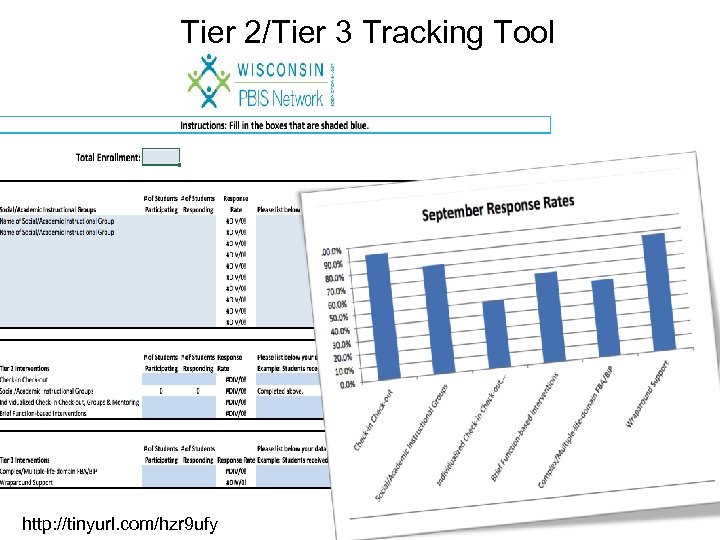
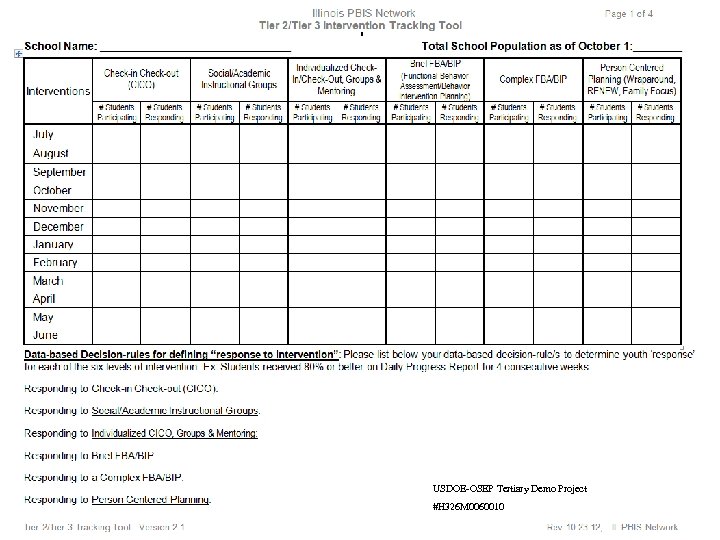
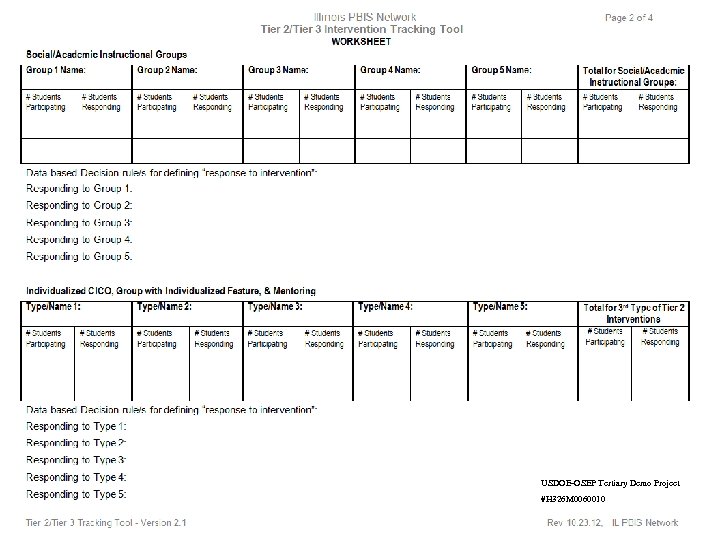
Tier 2/Tier 3 Tracking Tool http: //tinyurl. com/hzr 9 ufy
Quick Reflection: Do Teaming Structures in your school(s) need to change? 1. How many kids have been talked about at ‘______’ meeting this year? 2. How many of those discussed got an intervention that you have data to indicate they got an intervention that is working? Have you ever been at a meeting where you talked about one youth for an hour and at the end you were no closer to having effective strategies than when you started?
Did Henry “need” a restrictive placement?
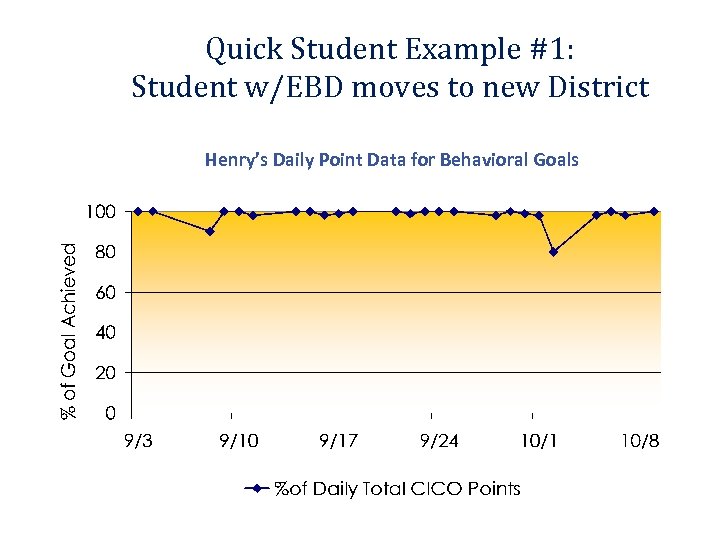
Quick Student Example #1: Student w/EBD moves to new District Henry’s Daily Point Data for Behavioral Goals
Did Henry “need” a restrictive placement? Or effective interventions?
Failed Interventions are Not Neutral • They leave a residual effect…
TIER 2/3: Intervention Examples, Decision-Rules and Tools
Check-in-Check-out (CICO) • Merely an extension of Tier 1 • Some get high frequency scheduled positive contact with adults • Youth solicit the positive contact/feedback • Low effort for teacher if built on Tier 1 • Need to have 7 -12% accessing if it is to come to be a routine in your school(s) • If you only have 1 -2% on CICO, those are likely to be kids who need more….
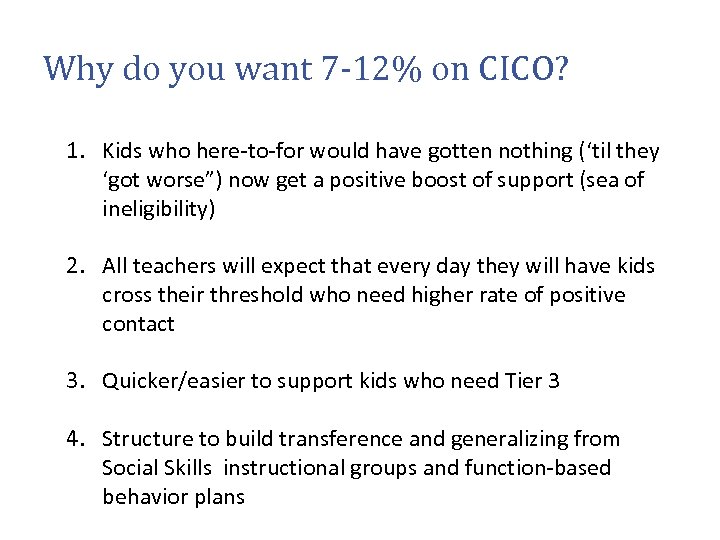
Why do you want 7 -12% on CICO? 1. Kids who here-to-for would have gotten nothing (‘til they ‘got worse”) now get a positive boost of support (sea of ineligibility) 2. All teachers will expect that every day they will have kids cross their threshold who need higher rate of positive contact 3. Quicker/easier to support kids who need Tier 3 4. Structure to build transference and generalizing from Social Skills instructional groups and function-based behavior plans
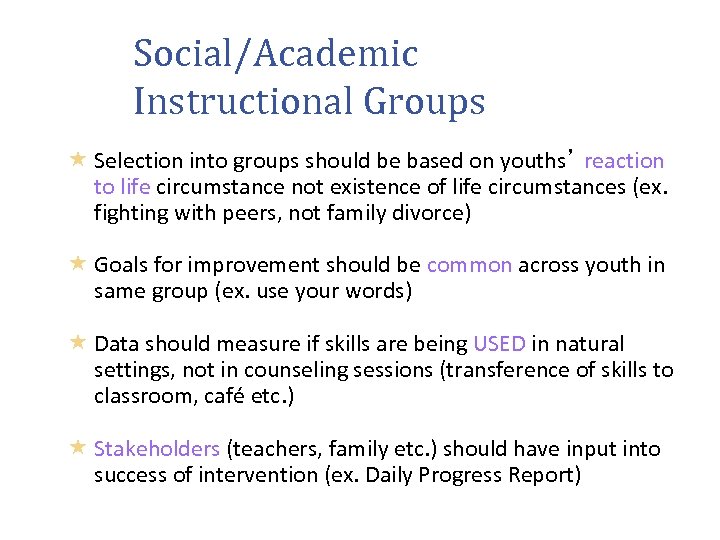
Social/Academic Instructional Groups Selection into groups should be based on youths’ reaction to life circumstance not existence of life circumstances (ex. fighting with peers, not family divorce) Goals for improvement should be common across youth in same group (ex. use your words) Data should measure if skills are being USED in natural settings, not in counseling sessions (transference of skills to classroom, café etc. ) Stakeholders (teachers, family etc. ) should have input into success of intervention (ex. Daily Progress Report)
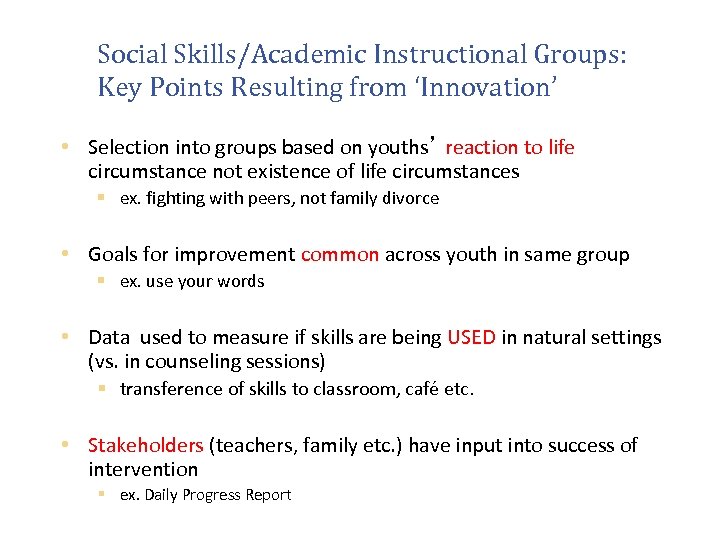
Social Skills/Academic Instructional Groups: Key Points Resulting from ‘Innovation’ • Selection into groups based on youths’ reaction to life circumstance not existence of life circumstances § ex. fighting with peers, not family divorce • Goals for improvement common across youth in same group § ex. use your words • Data used to measure if skills are being USED in natural settings (vs. in counseling sessions) § transference of skills to classroom, café etc. • Stakeholders (teachers, family etc. ) have input into success of intervention § ex. Daily Progress Report
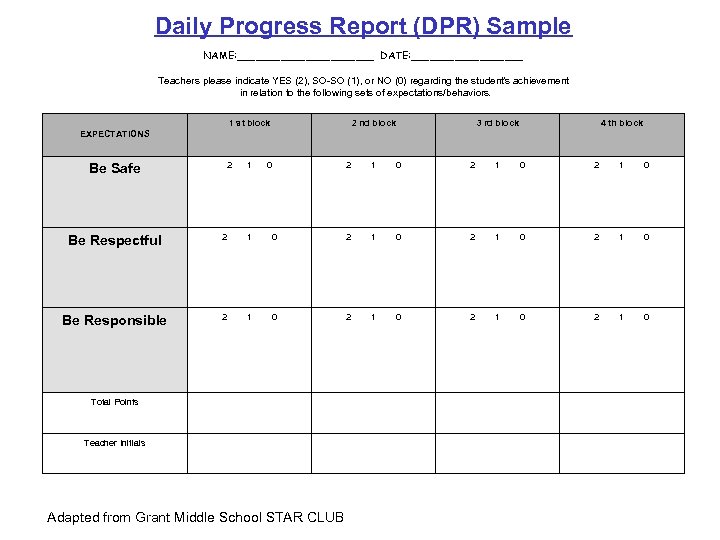
Daily Progress Report (DPR) Sample NAME: ___________ DATE: _________ Teachers please indicate YES (2), SO-SO (1), or NO (0) regarding the student’s achievement in relation to the following sets of expectations/behaviors. 1 st block 2 nd block 3 rd block 4 th block EXPECTATIONS Be Safe 2 1 0 Be Respectful 2 1 0 Be Responsible 2 1 0 Total Points Teacher Initials Adapted from Grant Middle School STAR CLUB
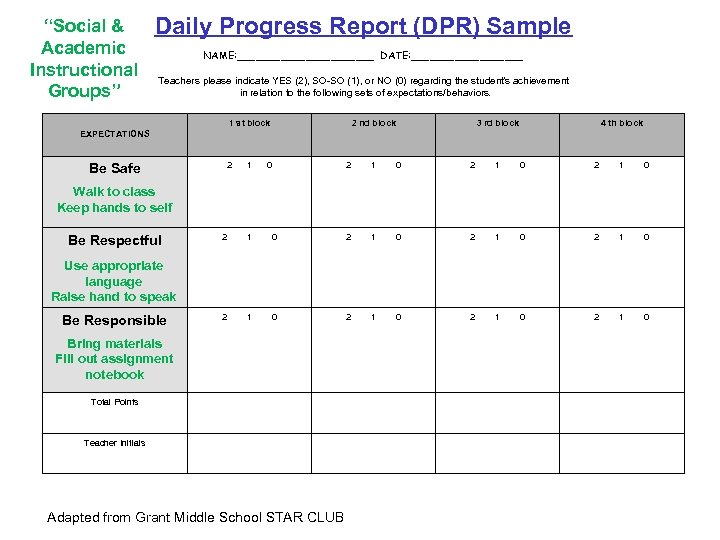
“Social & Academic Instructional Groups” Daily Progress Report (DPR) Sample NAME: ___________ DATE: _________ Teachers please indicate YES (2), SO-SO (1), or NO (0) regarding the student’s achievement in relation to the following sets of expectations/behaviors. 1 st block 2 nd block 3 rd block 4 th block EXPECTATIONS Be Safe 2 1 0 Walk to class Keep hands to self Be Respectful 2 1 0 2 1 0 Use appropriate language Raise hand to speak Be Responsible Bring materials Fill out assignment notebook Total Points Teacher Initials Adapted from Grant Middle School STAR CLUB
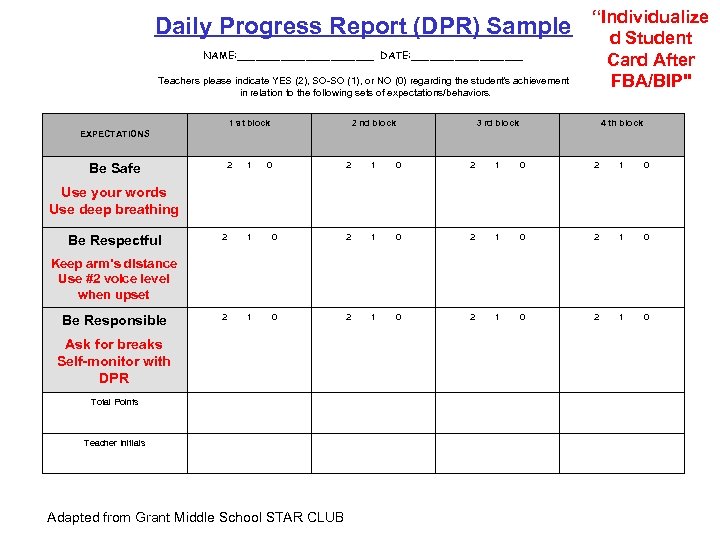
Daily Progress Report (DPR) Sample NAME: ___________ DATE: _________ Teachers please indicate YES (2), SO-SO (1), or NO (0) regarding the student’s achievement in relation to the following sets of expectations/behaviors. 1 st block 2 nd block “Individualize d Student Card After FBA/BIP" 3 rd block 4 th block EXPECTATIONS Be Safe 2 1 0 Use your words Use deep breathing Be Respectful 2 1 0 2 1 0 Keep arm’s distance Use #2 voice level when upset Be Responsible Ask for breaks Self-monitor with DPR Total Points Teacher Initials Adapted from Grant Middle School STAR CLUB
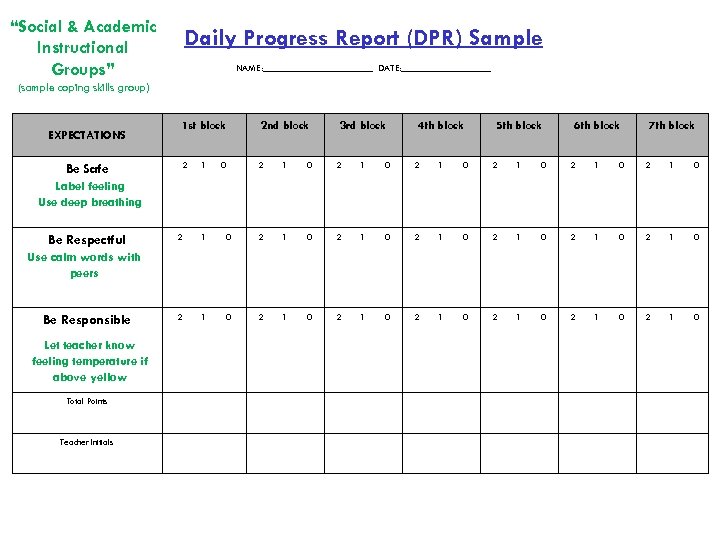
“Social & Academic Instructional Groups” Daily Progress Report (DPR) Sample NAME: ___________ DATE: _________ (sample coping skills group) 1 st block EXPECTATIONS 2 Be Safe 1 2 nd block 0 3 rd block 4 th block 5 th block 6 th block 7 th block 2 1 0 2 1 0 Label feeling Use deep breathing Be Respectful 2 1 0 2 1 0 2 1 0 2 1 0 Use calm words with peers Be Responsible Let teacher know feeling temperature if above yellow Total Points Teacher Initials
We Know the Practices that Work… • Proactive, strength-based; “set kids up” to experience success • High rates of consistent, supported instruction; teach/practice/reinforce • Predictable and consistent environments • Know unique “why? ” for each student/problem • Contextual fit: Strategic use of natural supports, and settings • Careful monitoring of data over time with ongoing revisions to guide incremental improvements in quality of life
We Know the System Features Needed to Support the Effective Practices… • A Team unique to each individual child & family § Blend the family/natural supports with the school representatives who know the child best • A defined Meeting Process § Meet frequently and use data § Develop, implement, review range of interventions • Facilitator Role § Bringing team together § Blending perspectives; guiding consensus § Systematic use of data (strengths and needs)
Interventions… Ownership & Voice: A Key to Intervention Design The person who is supposed to implement the strategy needs to be actively involved in designing it; or it probably won’t work!
Tier 3 Interventions • Person-Centered (voice and choice) • Highly individualized (unique team per student) • Multiple Data Sources (add Tier 3 data- Perception data) • Complex function-based behavior plans • Wraparound/RENEW/Family Focused Plans
Do All Staff Understand the Context for PBIS? • Behavior support is the redesign of environments, not the redesign of individuals. • Positive behavior support plans define changes in the behavior of those who will implement the plan. A behavior support plan describes what we will do differently.
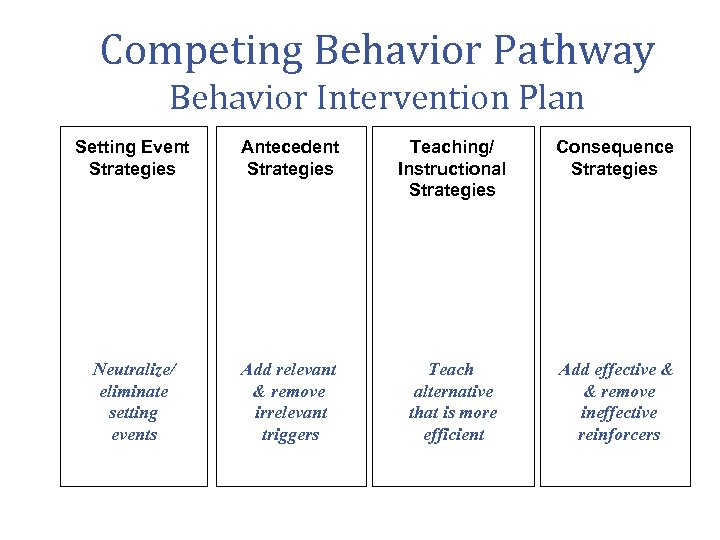
Competing Behavior Pathway Behavior Intervention Plan Setting Event Strategies Antecedent Strategies Teaching/ Instructional Strategies Consequence Strategies Neutralize/ eliminate setting events Add relevant & remove irrelevant triggers Teach alternative that is more efficient Add effective & & remove ineffective reinforcers
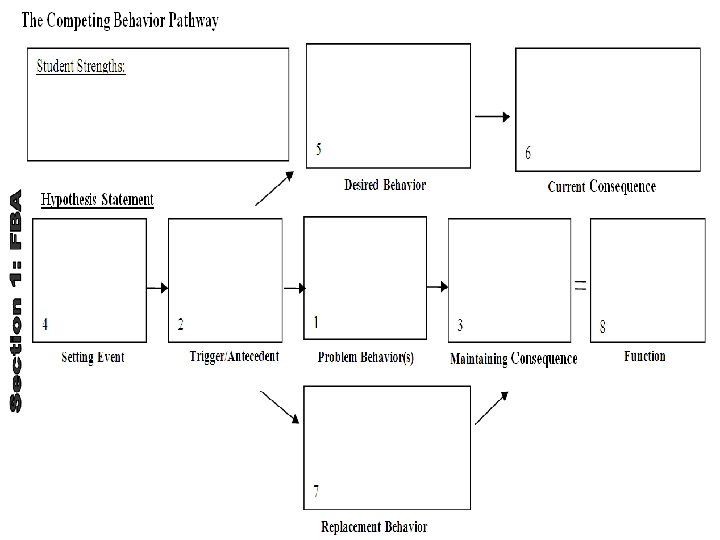
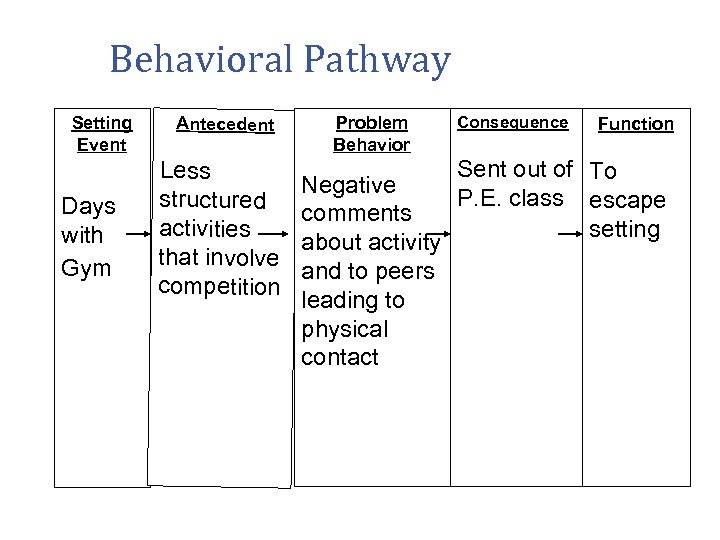
Behavioral Pathway Setting Event Days with Gym Antecedent Less structured activities that involve competition Problem Behavior Negative comments about activity and to peers leading to physical contact Consequence Function Sent out of To P. E. class escape setting
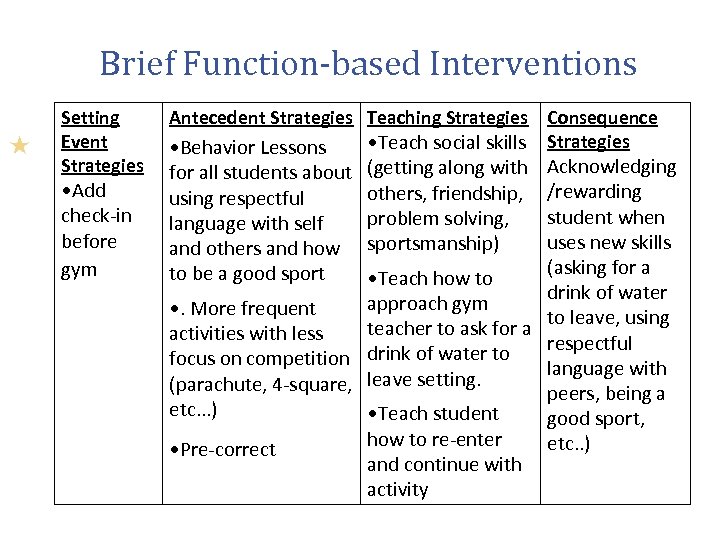
Brief Function-based Interventions Setting Event Strategies • Add check-in before gym Antecedent Strategies Teaching Strategies Consequence • Teach social skills Strategies • Behavior Lessons Acknowledging /rewarding student when uses new skills (asking for a • Teach how to drink of water approach gym • . More frequent to leave, using teacher to ask for a activities with less respectful drink of water to focus on competition language with leave setting. (parachute, 4 -square, peers, being a etc. . . ) • Teach student good sport, how to re-enter etc. . ) • Pre-correct and continue with activity for all students about using respectful language with self and others and how to be a good sport (getting along with others, friendship, problem solving, sportsmanship)
Person-Centered Planning: Highly Individualized Tier 3 Intervention Wraparound-based RENEW
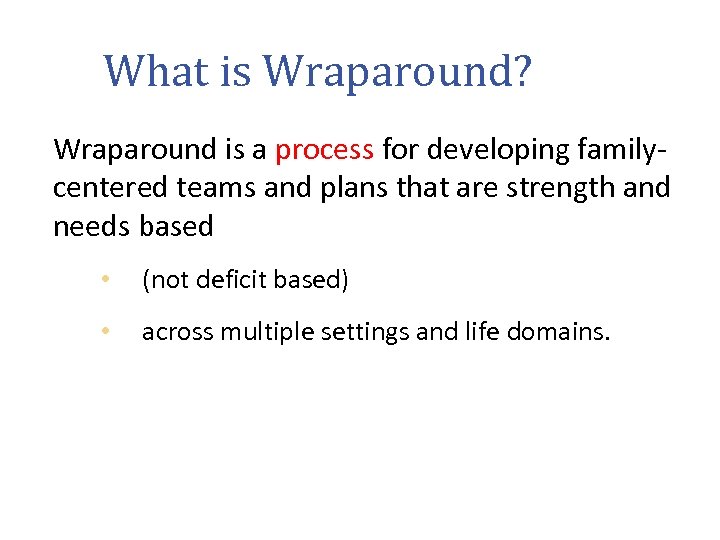
What is Wraparound? Wraparound is a process for developing familycentered teams and plans that are strength and needs based • (not deficit based) • across multiple settings and life domains.
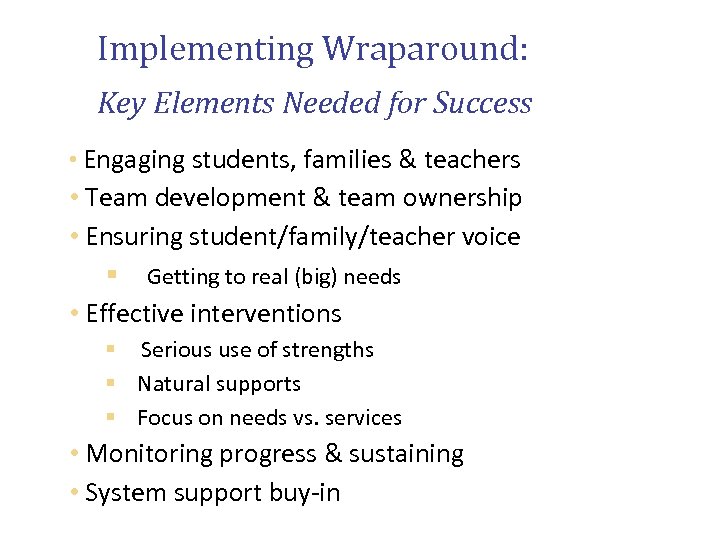
Implementing Wraparound: Key Elements Needed for Success • Engaging students, families & teachers • Team development & team ownership • Ensuring student/family/teacher voice § Getting to real (big) needs • Effective interventions § Serious use of strengths § Natural supports § Focus on needs vs. services • Monitoring progress & sustaining • System support buy-in
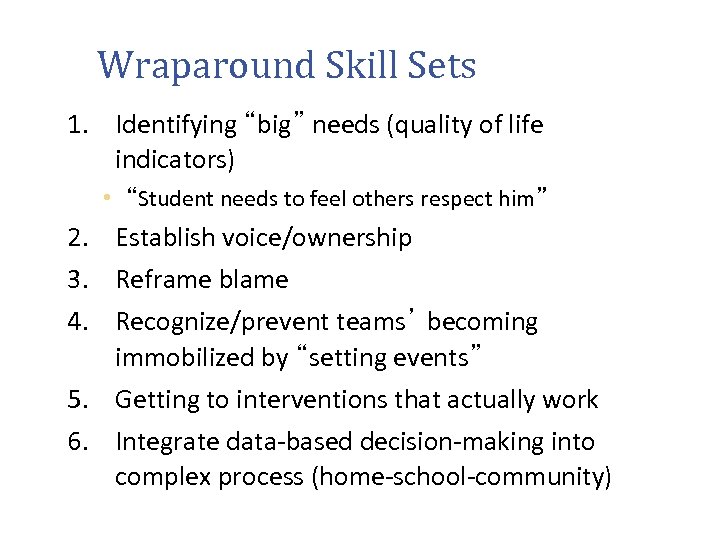
Wraparound Skill Sets 1. Identifying “big” needs (quality of life indicators) • “Student needs to feel others respect him” 2. Establish voice/ownership 3. Reframe blame 4. Recognize/prevent teams’ becoming immobilized by “setting events” 5. Getting to interventions that actually work 6. Integrate data-based decision-making into complex process (home-school-community)
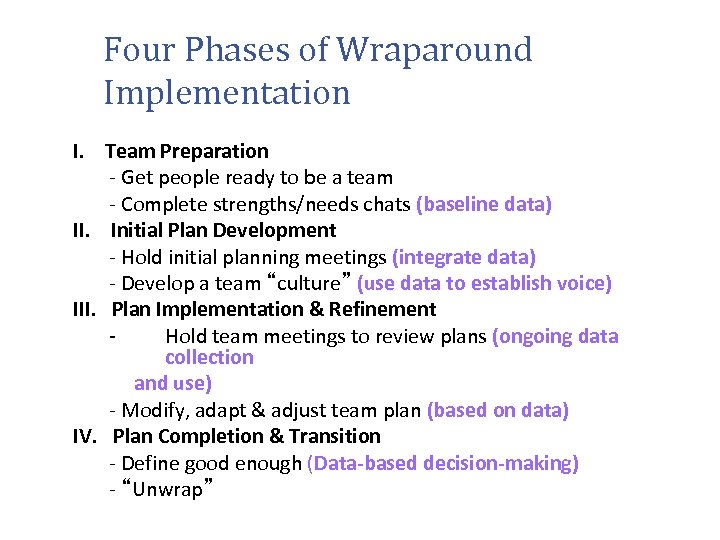
Four Phases of Wraparound Implementation I. Team Preparation - Get people ready to be a team - Complete strengths/needs chats (baseline data) II. Initial Plan Development - Hold initial planning meetings (integrate data) - Develop a team “culture” (use data to establish voice) III. Plan Implementation & Refinement Hold team meetings to review plans (ongoing data collection and use) - Modify, adapt & adjust team plan (based on data) IV. Plan Completion & Transition - Define good enough (Data-based decision-making) - “Unwrap”
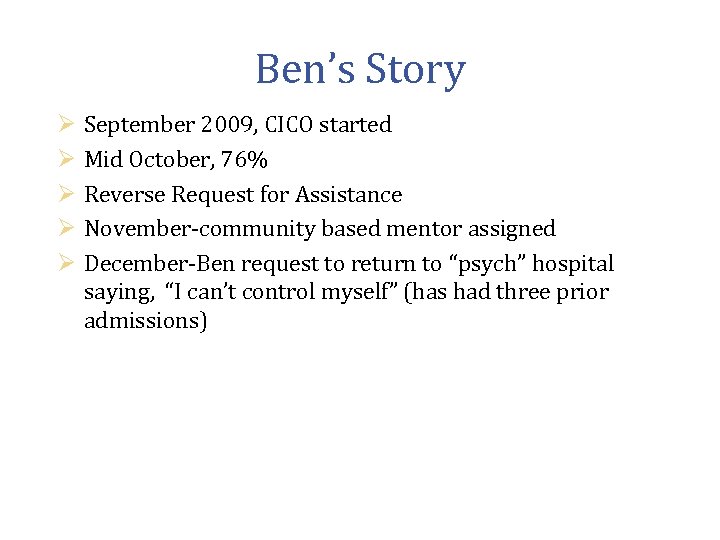
Ben’s Story Ø Ø Ø September 2009, CICO started Mid October, 76% Reverse Request for Assistance November-community based mentor assigned December-Ben request to return to “psych” hospital saying, “I can’t control myself” (has had three prior admissions)
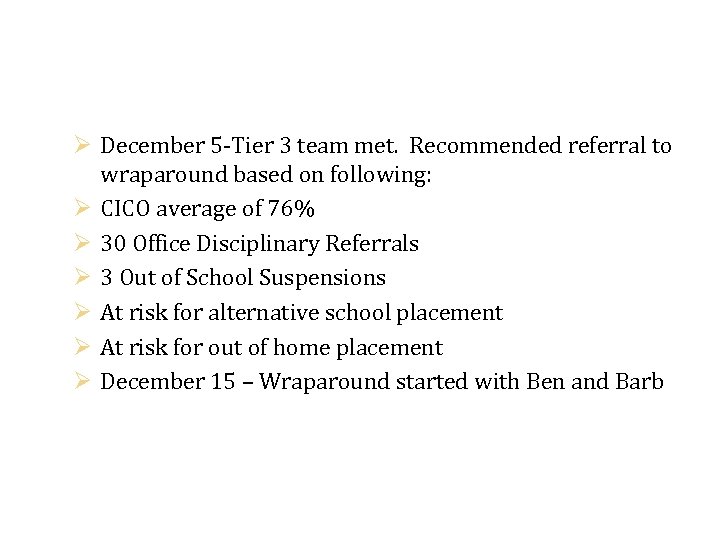
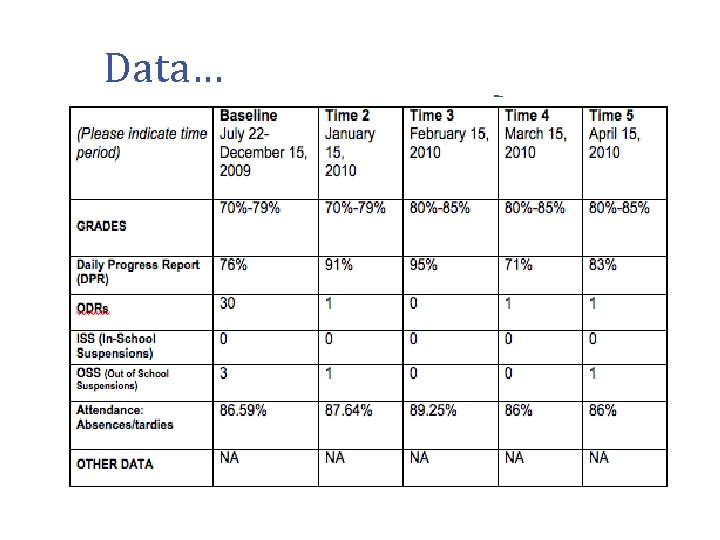
Ø December 5 -Tier 3 team met. Recommended referral to wraparound based on following: Ø CICO average of 76% Ø 30 Office Disciplinary Referrals Ø 3 Out of School Suspensions Ø At risk for alternative school placement Ø At risk for out of home placement Ø December 15 – Wraparound started with Ben and Barb
Moving Forward • In December, Ben began asking his mother if he could be admitted to the hospital so he “could get better”. He was experiencing anger, thoughts of hurting himself and he was physically aggressive with classmates and peers. He was verbalizing “I can’t control himself. ” • Ben had three prior psychiatric hospitalizations (before coming to ‘G’ Elementary).
Child and Family Strengths • Ben’s Strengths identified in the first meeting included: § “Ben”: Smart, good at math, reading, writing and playing video games § Mom: Very organized § He’s creative and enjoys drawing cartoons § Teacher: writing and math; • Family Strengths: § Mom consistently takes “Ben” to his mental health appointments. § This might include getting the city bus for an hour ride, attending an hour appointment, waiting another 30 minutes for the bus and then riding home and then bringing him to school. § Mom is an active participant at the school, follows through with suggestions.
MISSION STATEMENT: ‘A Happy Home’ The mission statement was developed by the team, Ben, and his mom. Ben stated that his hopes were “he would yell less at home so that he would see more smiling from his family. ” Mom agreed.
Wrap process builds on lower tiered interventions Ø At the first team meeting family agreed to: Ø Continue CICO Ø Continue mentoring Ø Continue MH services Ø Improved communication with Mental Health Ø FBA to be completed (home and school) Ø Family YMCA (schedule present at LANS for funding)
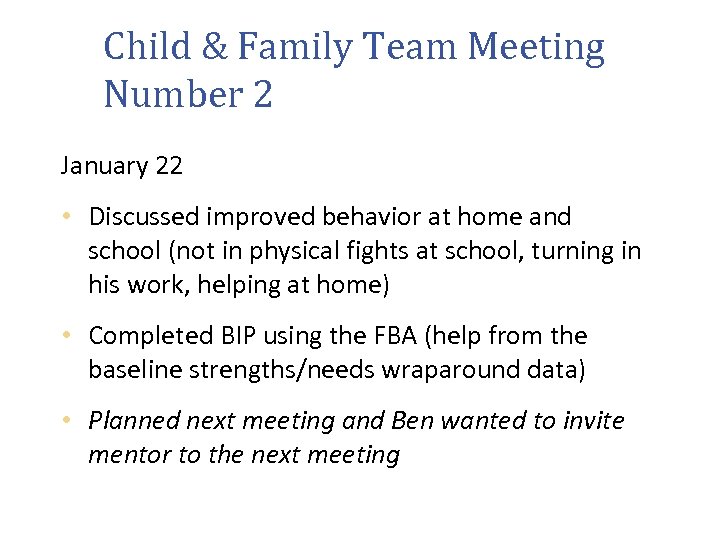
Child & Family Team Meeting Number 2 January 22 • Discussed improved behavior at home and school (not in physical fights at school, turning in his work, helping at home) • Completed BIP using the FBA (help from the baseline strengths/needs wraparound data) • Planned next meeting and Ben wanted to invite mentor to the next meeting
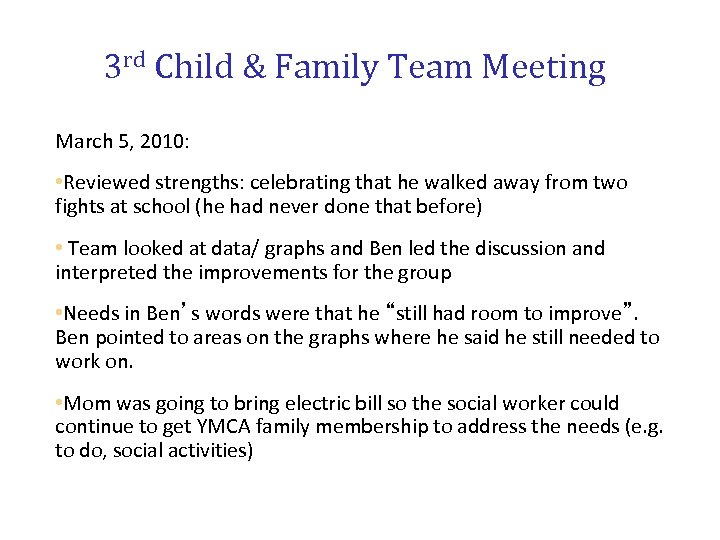
3 rd Child & Family Team Meeting March 5, 2010: • Reviewed strengths: celebrating that he walked away from two fights at school (he had never done that before) • Team looked at data/ graphs and Ben led the discussion and interpreted the improvements for the group • Needs in Ben’s words were that he “still had room to improve”. Ben pointed to areas on the graphs where he said he still needed to work on. • Mom was going to bring electric bill so the social worker could continue to get YMCA family membership to address the needs (e. g. to do, social activities)
Data…
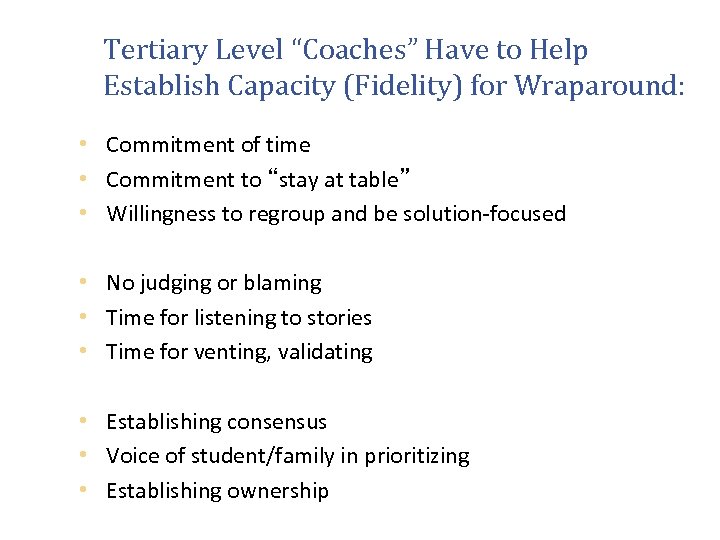
Tertiary Level “Coaches” Have to Help Establish Capacity (Fidelity) for Wraparound: • Commitment of time • Commitment to “stay at table” • Willingness to regroup and be solution-focused • No judging or blaming • Time for listening to stories • Time for venting, validating • Establishing consensus • Voice of student/family in prioritizing • Establishing ownership
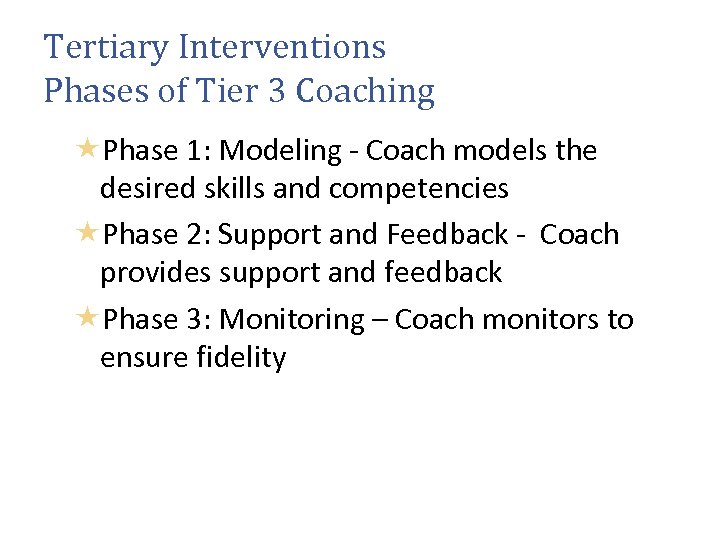
Tertiary Interventions Phases of Tier 3 Coaching Phase 1: Modeling - Coach models the desired skills and competencies Phase 2: Support and Feedback - Coach provides support and feedback Phase 3: Monitoring – Coach monitors to ensure fidelity
Скачать презентацию WI PBIS Conference August 2016 Session D-10 Building
6874f5cd974f4815303922f9f6e5087e.ppt