 Скачать презентацию Wi MAX for Broadband Wireless Access By Karim
5a32f1f5d575b2b5173a76c3766f518f.ppt
- Количество слайдов: 46



Wi. MAX for Broadband Wireless Access By: Karim M. El Defrawy ICS UCI-2005
Outline What is Wi. MAX ¡ 802. 16 Introduction ¡ 802. 16 MAC Highlights ¡ 802. 16 Reference Model ¡ MAC Convergence Sub-Layer (CS) ¡ MAC Common Part Sub-Layer (CPS) ¡ MAC Privacy Sub-Layer (PS) ¡ Questions ¡
What is Wi. MAX? ¡ Worldwide Interoperability for Microwave Access (Wi. MAX) is the common name associated to the IEEE 802. 16 a/REVd/e standards. ¡ These standards are issued by the IEEE 802. 16 subgroup that originally covered the Wireless Local Loop technologies with radio spectrum from 10 to 66 GHz.
IEEE 802. 16 -- Introduction ¡ IEEE 802. 16 (2001) l l l ¡ IEEE 802. 16 a (January 2003) l l l ¡ Amendment to 802. 16, MAC Modifications and Additional PHY Specifications for 2 – 11 GHz (NLo. S) Three PHYs: OFDM, OFDMA, Single Carrier Additional MAC functions: OFDM and OFDMA PHY support, Mesh topology support, ARQ IEEE 802. 16 d (July 2004) l l ¡ Air Interface for Fixed Broadband Wireless Access System MAC and PHY Specifications for 10 – 66 GHZ (Lo. S) One PHY: Single Carrier Connection-oriented, TDM/TDMA MAC, Qo. S, Privacy Combines both IEEE 802. 16 and 802. 16 a Some modifications to the MAC and PHY IEEE 802. 16 e (2005? ) l l Amendment to 802. 16 -2004 MAC Modifications for limited mobility
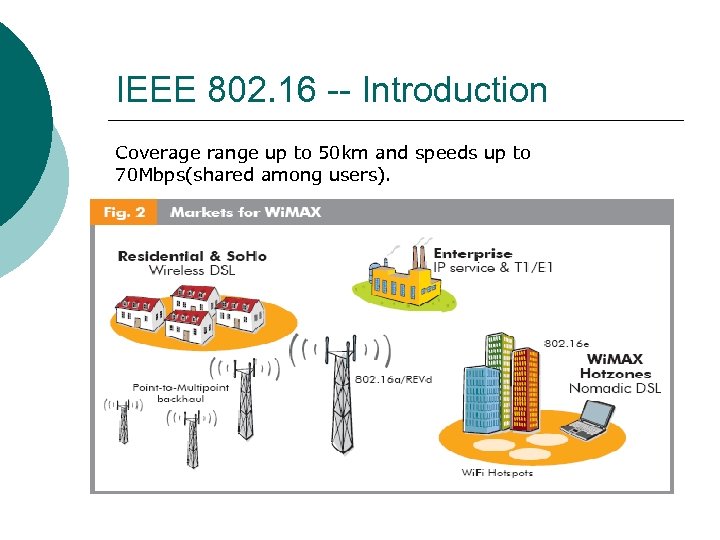
IEEE 802. 16 -- Introduction Coverage range up to 50 km and speeds up to 70 Mbps(shared among users).
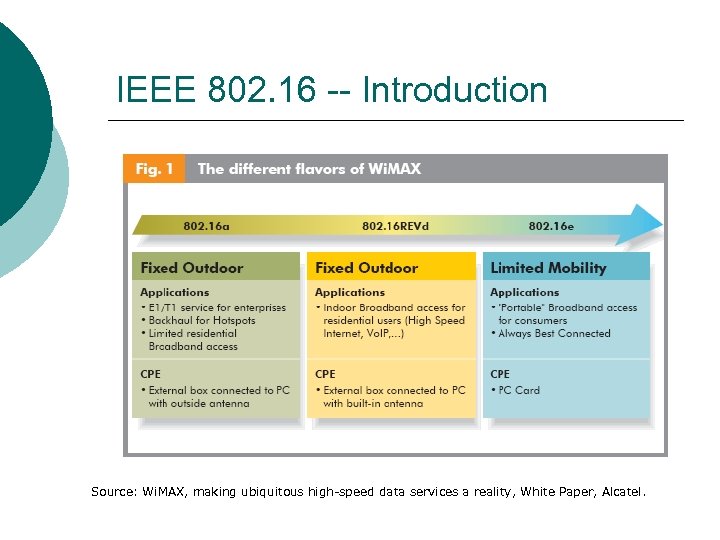
IEEE 802. 16 -- Introduction Source: Wi. MAX, making ubiquitous high-speed data services a reality, White Paper, Alcatel.
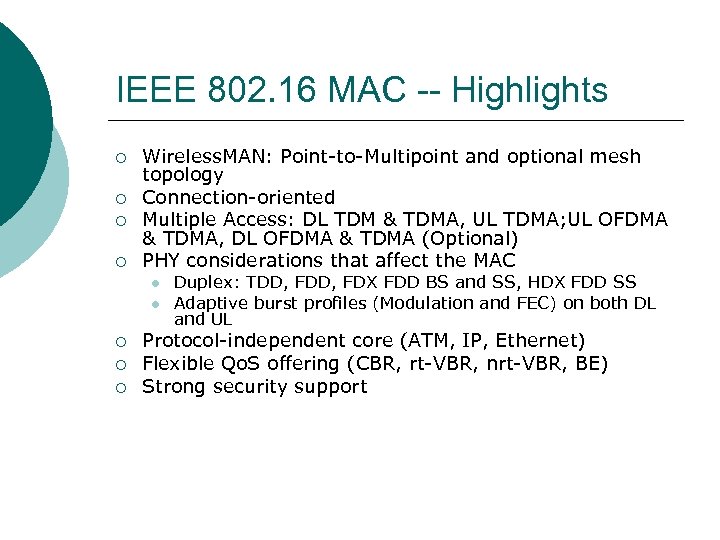
IEEE 802. 16 MAC -- Highlights ¡ ¡ Wireless. MAN: Point-to-Multipoint and optional mesh topology Connection-oriented Multiple Access: DL TDM & TDMA, UL TDMA; UL OFDMA & TDMA, DL OFDMA & TDMA (Optional) PHY considerations that affect the MAC l l ¡ ¡ ¡ Duplex: TDD, FDX FDD BS and SS, HDX FDD SS Adaptive burst profiles (Modulation and FEC) on both DL and UL Protocol-independent core (ATM, IP, Ethernet) Flexible Qo. S offering (CBR, rt-VBR, nrt-VBR, BE) Strong security support
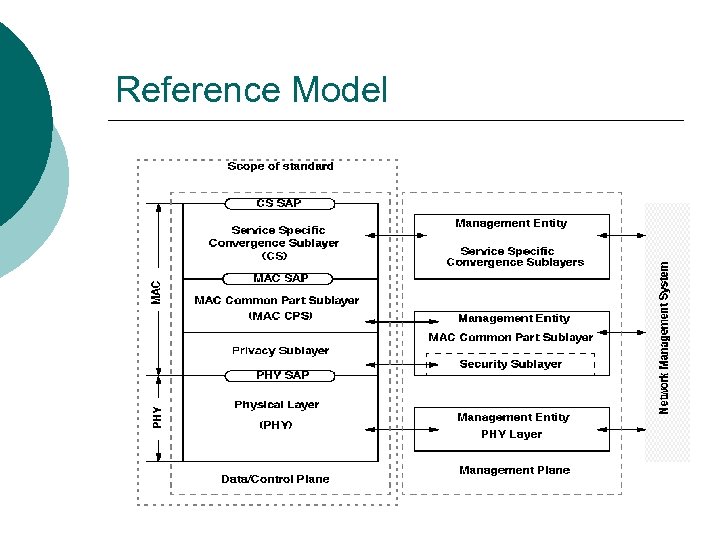
Reference Model
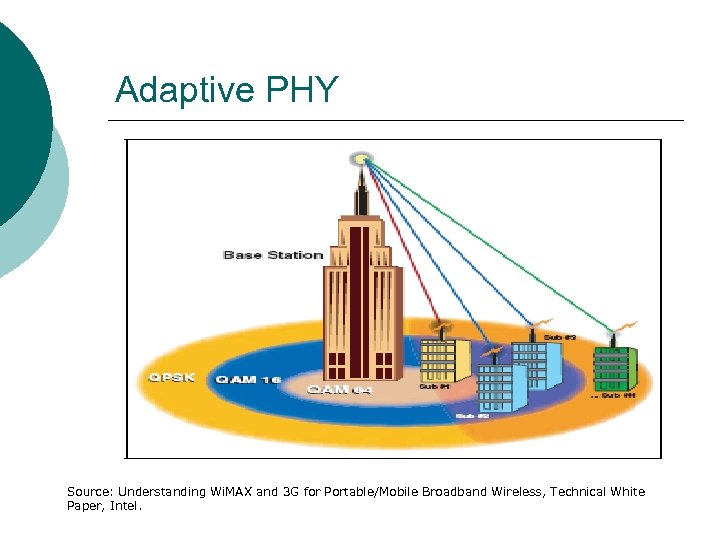
Adaptive PHY Source: Understanding Wi. MAX and 3 G for Portable/Mobile Broadband Wireless, Technical White Paper, Intel.
Adaptive Burst Profiles ¡ ¡ Burst profile: Modulation and FEC On DL, multiple SSs can associate the same DL burst On UL, SS transmits in an given time slot with a specific burst Dynamically assigned according to link conditions l l Burst by burst Trade-off capacity vs. robustness in real time
Duplex Scheme Support ¡ ¡ The duplex scheme is Usually specified by regulatory bodies, e. g. , FCC Time-Division Duplex (TDD) l l l ¡ Downlink & Uplink time share the same RF channel Dynamic asymmetry does not transmit & receive simultaneously (low cost) Frequency-Division Duplex (FDD) l l l Downlink & Uplink on separate RF channels Full Duplexing (FDX): can Tx and Rx simultaneously; Half-duplexing (HDX) SSs supported (low cost)
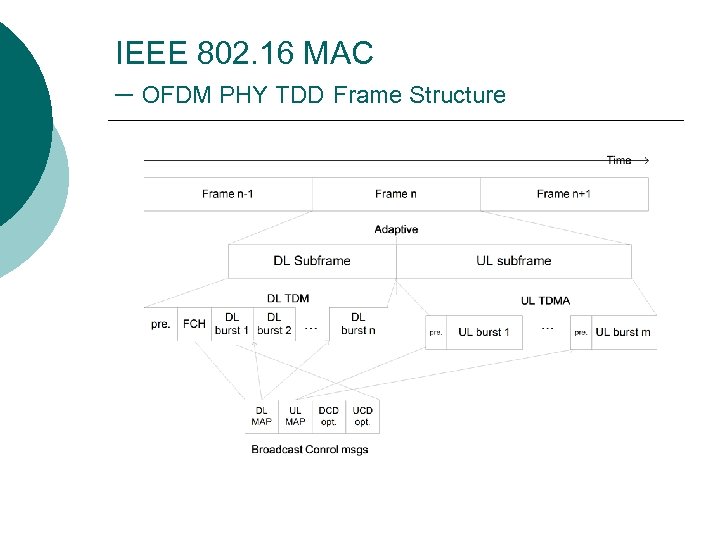
IEEE 802. 16 MAC – OFDM PHY TDD Frame Structure
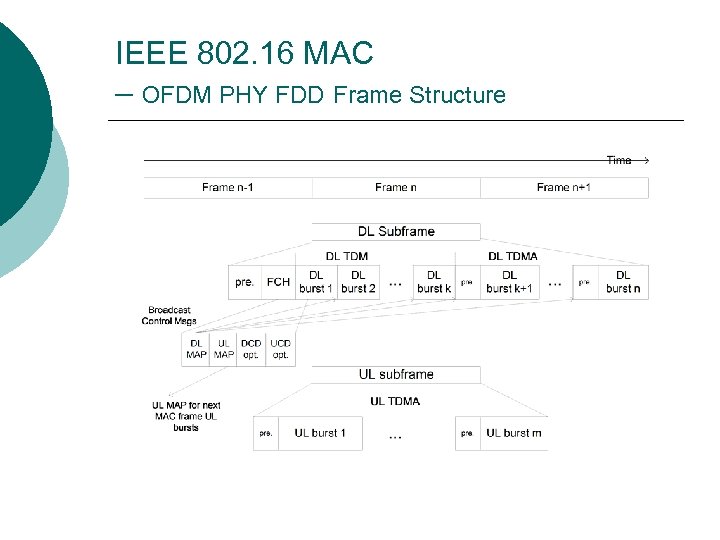
IEEE 802. 16 MAC – OFDM PHY FDD Frame Structure
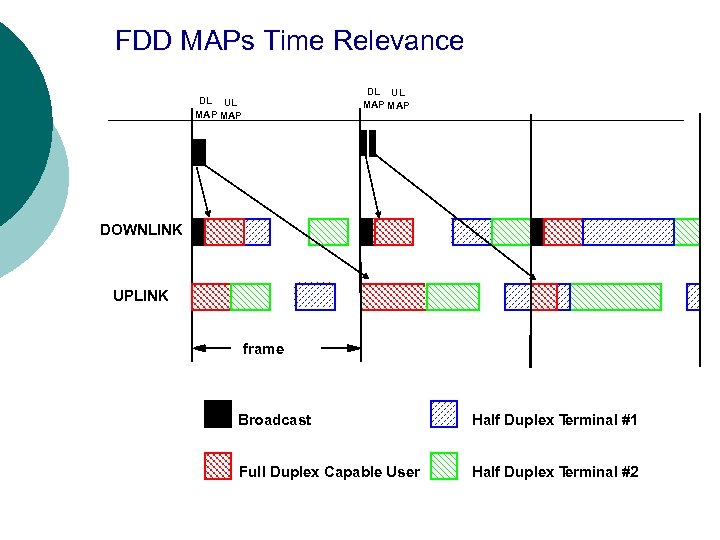
FDD MAPs Time Relevance DL UL MAP MAP DOWNLINK UPLINK frame Broadcast Half Duplex T erminal #1 Full Duplex Capable User Half Duplex T erminal #2
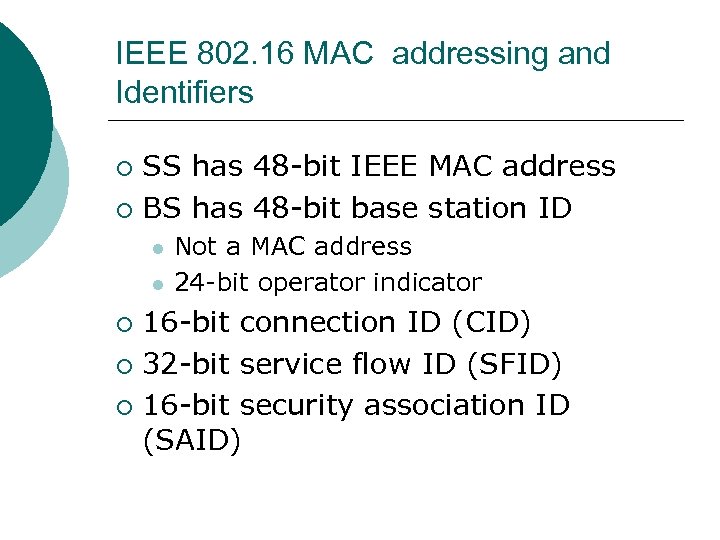
IEEE 802. 16 MAC addressing and Identifiers SS has 48 -bit IEEE MAC address ¡ BS has 48 -bit base station ID ¡ l l Not a MAC address 24 -bit operator indicator 16 -bit connection ID (CID) ¡ 32 -bit service flow ID (SFID) ¡ 16 -bit security association ID (SAID) ¡
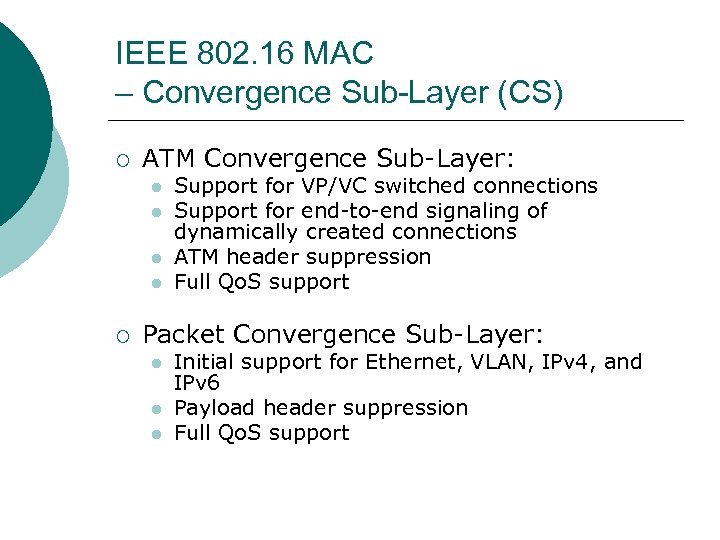
IEEE 802. 16 MAC – Convergence Sub-Layer (CS) ¡ ATM Convergence Sub-Layer: l l ¡ Support for VP/VC switched connections Support for end-to-end signaling of dynamically created connections ATM header suppression Full Qo. S support Packet Convergence Sub-Layer: l l l Initial support for Ethernet, VLAN, IPv 4, and IPv 6 Payload header suppression Full Qo. S support
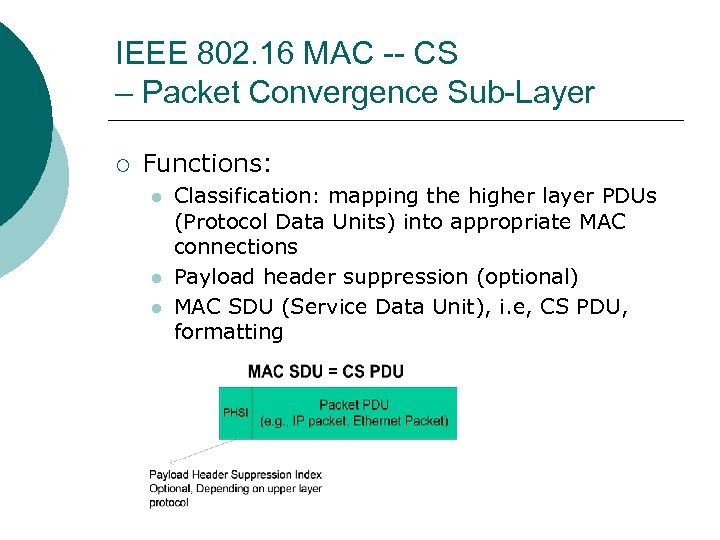
IEEE 802. 16 MAC -- CS – Packet Convergence Sub-Layer ¡ Functions: l l l Classification: mapping the higher layer PDUs (Protocol Data Units) into appropriate MAC connections Payload header suppression (optional) MAC SDU (Service Data Unit), i. e, CS PDU, formatting
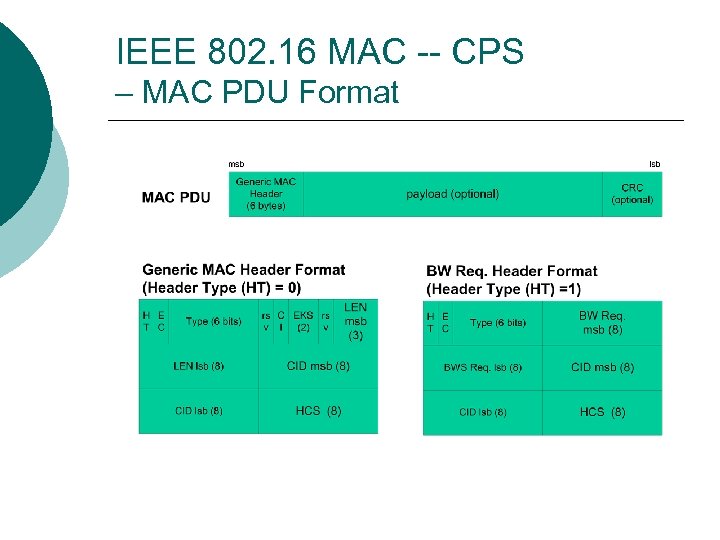
IEEE 802. 16 MAC -- CPS – MAC PDU Format
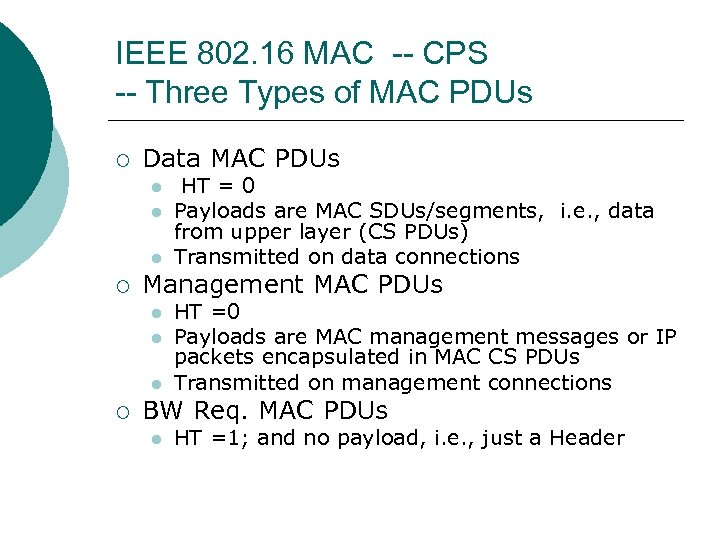
IEEE 802. 16 MAC -- CPS -- Three Types of MAC PDUs ¡ Data MAC PDUs l l l ¡ Management MAC PDUs l l l ¡ HT = 0 Payloads are MAC SDUs/segments, i. e. , data from upper layer (CS PDUs) Transmitted on data connections HT =0 Payloads are MAC management messages or IP packets encapsulated in MAC CS PDUs Transmitted on management connections BW Req. MAC PDUs l HT =1; and no payload, i. e. , just a Header
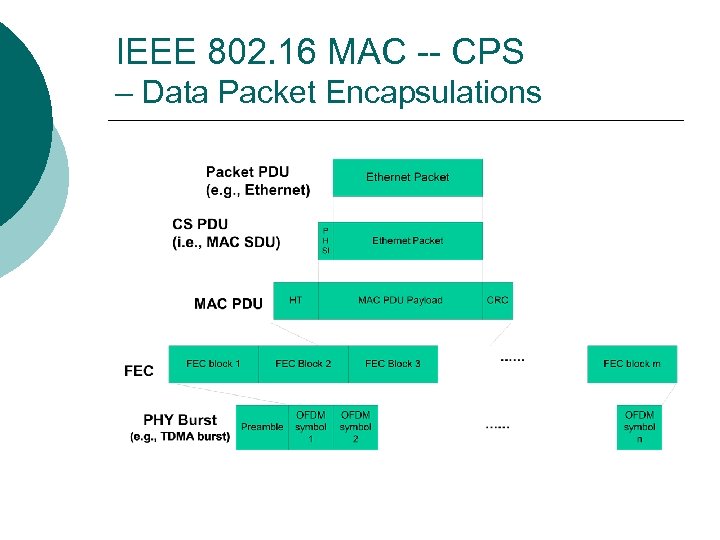
IEEE 802. 16 MAC -- CPS – Data Packet Encapsulations
IEEE 802. 16 MAC – CPS -- MAC Management Connections ¡ Each SS has 3 management connections in each direction: l Basic Connection: ¡ ¡ l Primary Management connection: ¡ ¡ l short and time-urgent MAC management messages MAC mgmt messages as MAC PDU payloads longer and more delay tolerant MAC mgmt messages as MAC PDU payloads Secondary Management Connection: ¡ ¡ Standard based mgmt messages, e. g. , DHCP, SNMP, …etc IP packets based CS PDU as MAC PDU payload
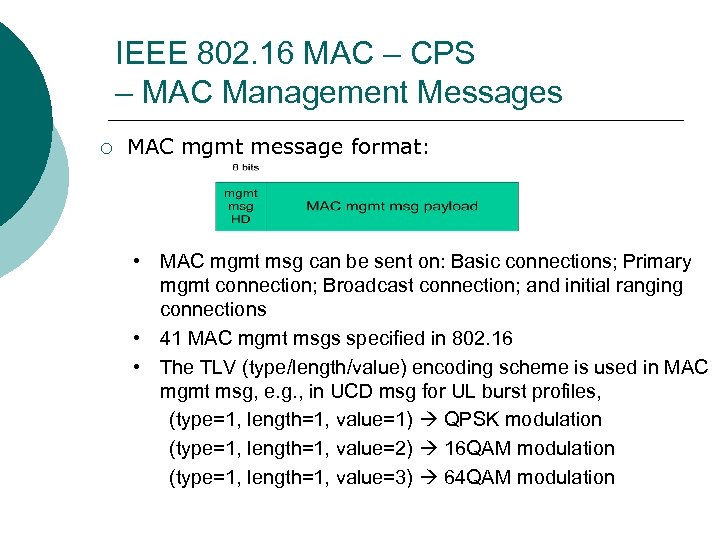
IEEE 802. 16 MAC – CPS – MAC Management Messages ¡ MAC mgmt message format: • MAC mgmt msg can be sent on: Basic connections; Primary mgmt connection; Broadcast connection; and initial ranging connections • 41 MAC mgmt msgs specified in 802. 16 • The TLV (type/length/value) encoding scheme is used in MAC mgmt msg, e. g. , in UCD msg for UL burst profiles, (type=1, length=1, value=1) QPSK modulation (type=1, length=1, value=2) 16 QAM modulation (type=1, length=1, value=3) 64 QAM modulation
IEEE 802. 16 MAC – CPS – MAC PDU Transmission ¡ ¡ ¡ ¡ MAC PDUs are transmitted in PHY Bursts The PHY burst can contain multiple FEC blocks MAC PDUs may span FEC block boundaries Concatenation Packing Segmentation Sub-headers
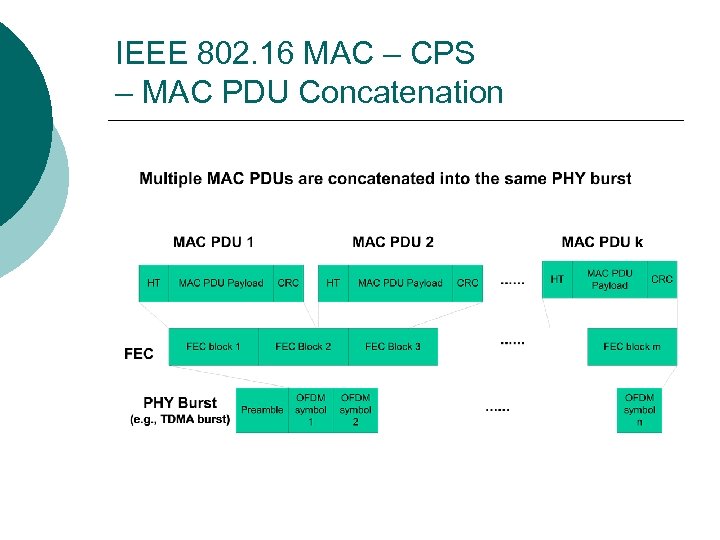
IEEE 802. 16 MAC – CPS – MAC PDU Concatenation
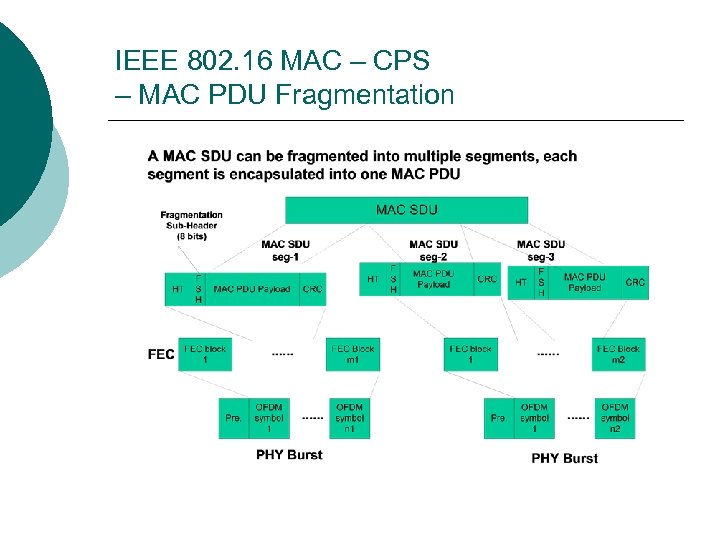
IEEE 802. 16 MAC – CPS – MAC PDU Fragmentation
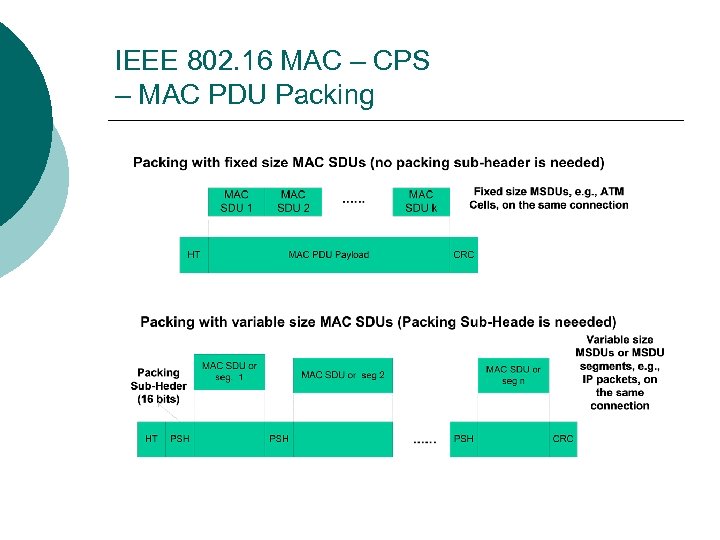
IEEE 802. 16 MAC – CPS – MAC PDU Packing
IEEE 802. 16 MAC – CPS Qo. S ¡ Three components of 802. 16 Qo. S l l l ¡ Service Flow l l ¡ Service flow Qo. S scheduling Dynamic service establishment Two-phase activation model (admit first, then activate) A unidirectional MAC-layer transport service characterized by a set of Qo. S parameters, e. g. , latency, jitter, and throughput assurances Identified by a 32 -bit SFID (Service Flow ID) Three types of service flows l l l Provisioned: controlled by network management system Admitted: the required resources reserved by BS, but not active Active: the required resources committed by the BS
IEEE 802. 16 MAC – CPS – Uplink Service Classes ¡ UGS: Unsolicited Grant Services ¡ rt. PS: Real-time Polling Services ¡ nrt. PS: Non-real-time Polling Services ¡ BE: Best Effort
IEEE 802. 16 MAC – CPS – Uplink Services: UGS ¡ UGS: Unsolicited Grant Services For CBR-like services, e. g. , T 1/E 1. l The BS scheduler offers fixed size UL BW grants on a real-time periodic basis. l The SS does not need to send any explicit UL BW req. l
IEEE 802. 16 MAC – CPS – Uplink Services: rt. PS ¡ rt. PS: l l Real-time Polling Services For rt-VBR-like services, e. g. , MPEG video. The BS scheduler offers real-time, periodic, UL BW request opportunities. The SS uses the offered UL BW req. opportunity to specify the desired UL BW grant. The SS cannot use contention-based BW req.
IEEE 802. 16 MAC – CPS – Uplink Services: nrt. PS ¡ nrt. PS: non-real-time polling services l l l For nrt-VBR-like services, such as, bandwidth-intensive file transfer. The BS scheduler shall provide timely (on a order of a second or less) UL BW request opportunities. The SS can use contention-based BW req. opportunities to send BW req.
IEEE 802. 16 MAC – CPS – Uplink Services: BE ¡ BE: Best Effort For best-effort traffic, e. g. , HTTP, SMTP. l The SS uses the contention-based BW request opportunities. l
IEEE 802. 16 MAC – CPS – Bandwidth Grant ¡ BW grants are per Subscriber Station: l l Allows real-time reaction to Qo. S need, i. e. , SS may redistribute bandwidth among its connections, maintaining Qo. S and service-level agreements Lower overhead, i. e. , less UL-MAP entries compare to grant per connection Off- loading base station’s work Requires intelligent subscriber station to redistribute the allocated BW among connections
IEEE 802. 16 MAC – CPS – BW Request/Grant Mechanisms ¡ ¡ Implicit requests (UGS): No actual requests BW request messages, i. e. , BW req. header l l l ¡ Piggybacked request (for non-UGS services only) l l l ¡ Sends in either a contention-based BW req. slot or a regular UL allocation for the SS; he special B Requests up to 32 KB with a single message Request Incremental or aggregate, as indicated by MAC header– Presented in Grant Management (GM) sub-header in a data MAC PDU of the same UL connection is always incremental Up to 32 KB per request for the CID Poll-Me bit l l Presented in the GM sub-header on a UGS connection request a bandwidth req. opportunity for non-UGS services
IEEE 802. 16 MAC – CPS -- Contention UL Access ¡ Two types of Contention based UL slots l l ¡ Initial Ranging ¡ Used for new SS to join the system ¡ Requires a long preamble BW Request ¡ Used for sending BW req ¡ Short preamble Collision Detection and Resolution l l Detection: SS does not get the expected response in a given time Resolution: a truncated binary exponential backoff window
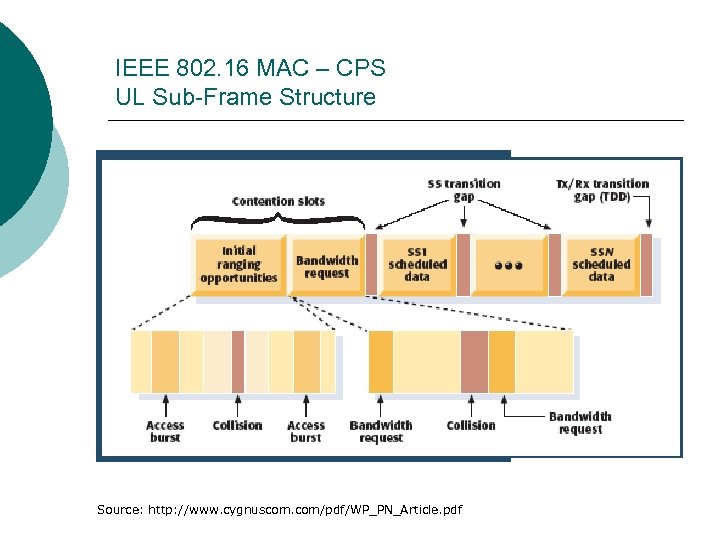
IEEE 802. 16 MAC – CPS UL Sub-Frame Structure Source: http: //www. cygnuscom. com/pdf/WP_PN_Article. pdf
IEEE 802. 16 MAC – CPS – Ranging ¡ ¡ Ranging is a process of acquiring the correct timing offset, and PHY parameters, such as, Tx power level, frequency offset, etc. so that the SS can communicate with the BS correctly. BS performs measurements and feedback. SS performs necessary adjustments. Two types of Ranging: l l Initial ranging: for a new SS to join the system Periodic ranging (also called maintenance ranging): dynamically maintain a good RF link.
IEEE 802. 16 MAC – CPS – Automatic Repeat re. Quest (ARQ) ¡ ¡ ¡ ¡ A Layer-2 sliding-window based flow control mechanism. Per connection basis. Only effective to non-real-time applications. Uses a 11 -bit sequence number field. Uses CRC-32 checksum of MAC PDU to check data errors. Maintain the same fragmentation structure for Retransmission. Optional.
IEEE 802. 16 MAC – Privacy Sub-layer (PS) ¡ Two Major Functions: l l ¡ Secures over-the-air transmissions Protects from theft of service Two component protocols: l l Data encryption protocol A client/server model based Key management protocol (Privacy Key Management, or PKM)
IEEE 802. 16 MAC – PS -- Security Associations ¡ ¡ A set of privacy information, e. g. , encryption keys, used encryption algorithm Three types of Security Associations (SAs) l l l ¡ ¡ Primary SA: established during initial registration Static SA: provisioned within the BS Dynamic SA: dynamically created on the fly Identified by a 16 -bit SAID Connections are mapped to SAs
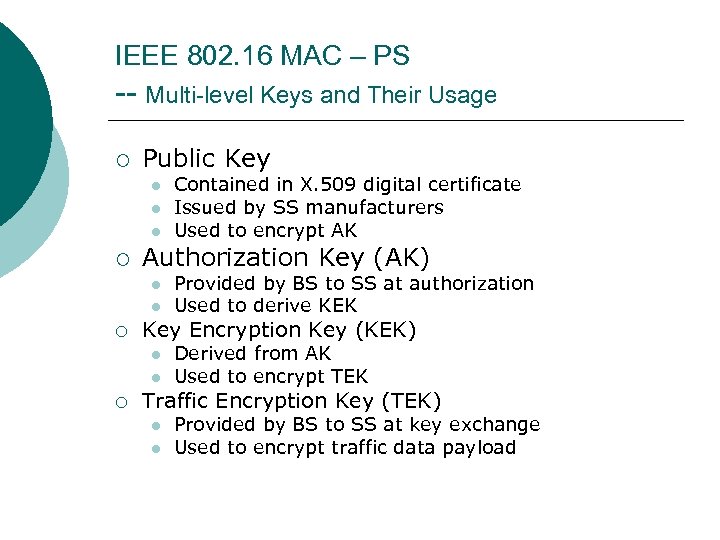
IEEE 802. 16 MAC – PS -- Multi-level Keys and Their Usage ¡ Public Key l l l ¡ Authorization Key (AK) l l ¡ Provided by BS to SS at authorization Used to derive KEK Key Encryption Key (KEK) l l ¡ Contained in X. 509 digital certificate Issued by SS manufacturers Used to encrypt AK Derived from AK Used to encrypt TEK Traffic Encryption Key (TEK) l l Provided by BS to SS at key exchange Used to encrypt traffic data payload
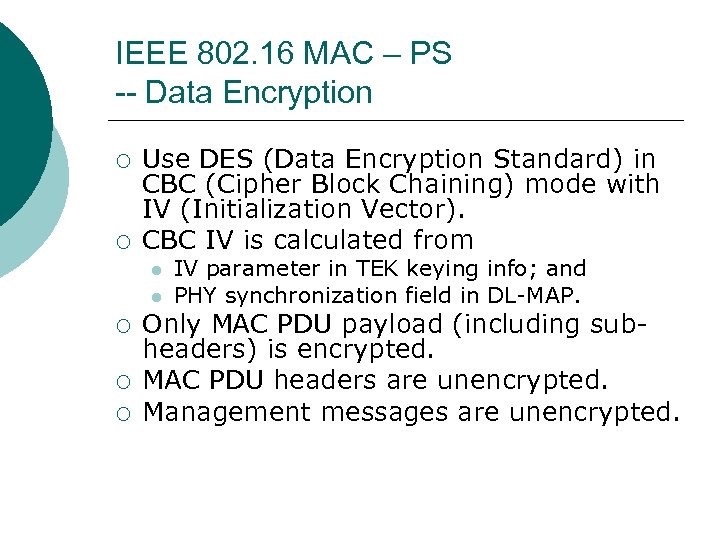
IEEE 802. 16 MAC – PS -- Data Encryption ¡ ¡ Use DES (Data Encryption Standard) in CBC (Cipher Block Chaining) mode with IV (Initialization Vector). CBC IV is calculated from l l ¡ ¡ ¡ IV parameter in TEK keying info; and PHY synchronization field in DL-MAP. Only MAC PDU payload (including subheaders) is encrypted. MAC PDU headers are unencrypted. Management messages are unencrypted.
IEEE 802. 16 MAC – one big item is out of scope Scheduler
Questions ? ?
References ¡ ¡ ¡ IEEE 802. 16 -2004 Alcatel White Paper: Wi. MAX, making ubiquitous high-speed data services a reality Intel White Paper: Understanding Wi. MAX and 3 G for Portable/Mobile Broadband Wireless Wi. MAX Forum: www. wimaxforum. com http: //en. wikipedia. org/wiki/Wi. Max
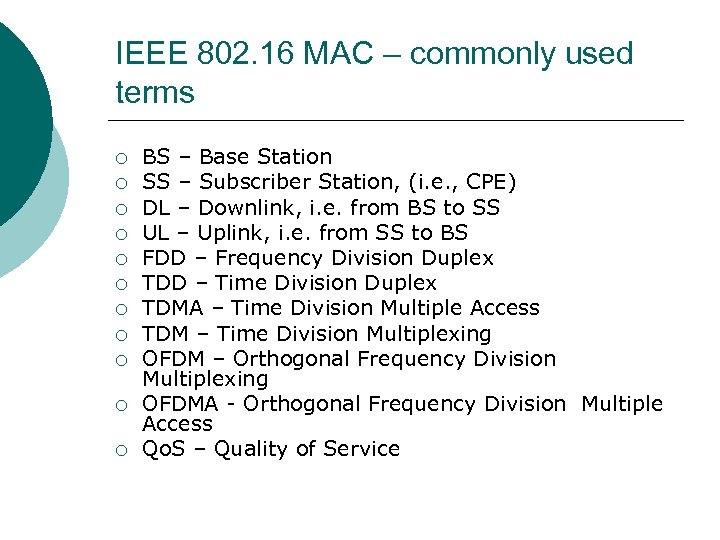
IEEE 802. 16 MAC – commonly used terms ¡ ¡ ¡ BS – Base Station SS – Subscriber Station, (i. e. , CPE) DL – Downlink, i. e. from BS to SS UL – Uplink, i. e. from SS to BS FDD – Frequency Division Duplex TDD – Time Division Duplex TDMA – Time Division Multiple Access TDM – Time Division Multiplexing OFDM – Orthogonal Frequency Division Multiplexing OFDMA - Orthogonal Frequency Division Multiple Access Qo. S – Quality of Service
Скачать презентацию Wi MAX for Broadband Wireless Access By Karim
5a32f1f5d575b2b5173a76c3766f518f.ppt