 Скачать презентацию WI Coaches forum August 2013 Building Tier 2 3
04abd1b7e19191bc25c8d3c0bb25d205.ppt
- Количество слайдов: 61



WI Coaches forum August 2013 Building Tier 2/3 Capacity Within School -wide Systems of PBIS Lucille Eber IL PBIS Network www. pbisillinois. org This is a presentation of the IL PBIS Network. All rights reserved.
Content • • • Context for Tier 2/3 systems development The Tier 2/3 Readiness Process Teaming Model & Examples of Interventions Tools to Support Tier 2/3 A Tier 3 Coaching and TA Process
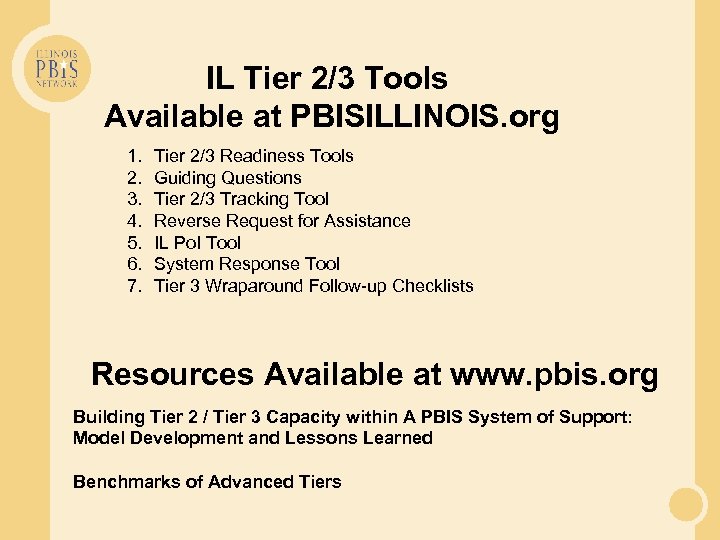
IL Tier 2/3 Tools Available at PBISILLINOIS. org 1. 2. 3. 4. 5. 6. 7. Tier 2/3 Readiness Tools Guiding Questions Tier 2/3 Tracking Tool Reverse Request for Assistance IL Po. I Tool System Response Tool Tier 3 Wraparound Follow-up Checklists Resources Available at www. pbis. org Building Tier 2 / Tier 3 Capacity within A PBIS System of Support: Model Development and Lessons Learned Benchmarks of Advanced Tiers
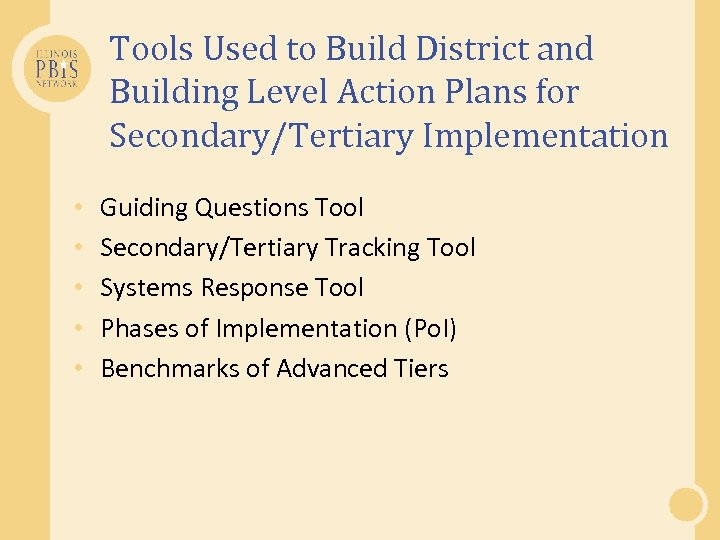
Tools Used to Build District and Building Level Action Plans for Secondary/Tertiary Implementation • • • Guiding Questions Tool Secondary/Tertiary Tracking Tool Systems Response Tool Phases of Implementation (Po. I) Benchmarks of Advanced Tiers
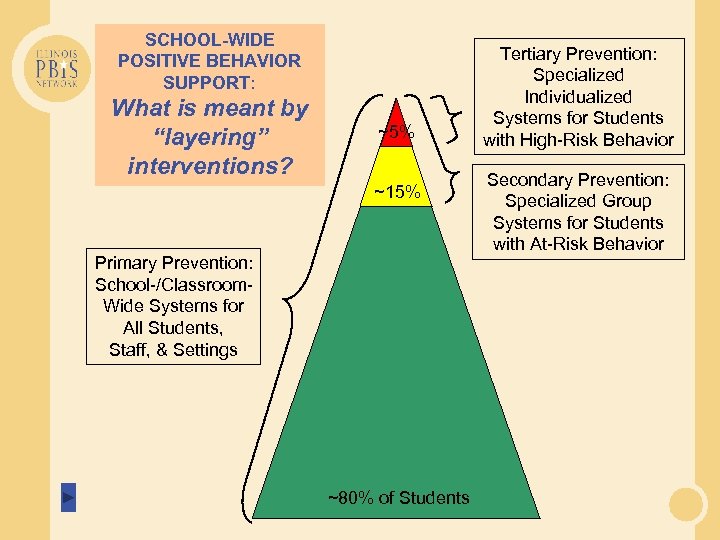
SCHOOL-WIDE POSITIVE BEHAVIOR SUPPORT: What is meant by “layering” interventions? ~5% ~15% Primary Prevention: School-/Classroom. Wide Systems for All Students, Staff, & Settings ~80% of Students Tertiary Prevention: Specialized Individualized Systems for Students with High-Risk Behavior Secondary Prevention: Specialized Group Systems for Students with At-Risk Behavior
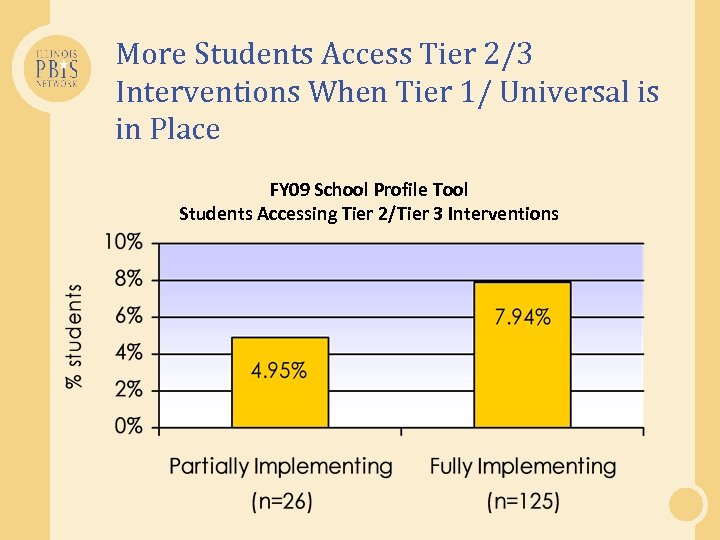
More Students Access Tier 2/3 Interventions When Tier 1/ Universal is in Place FY 09 School Profile Tool Students Accessing Tier 2/Tier 3 Interventions
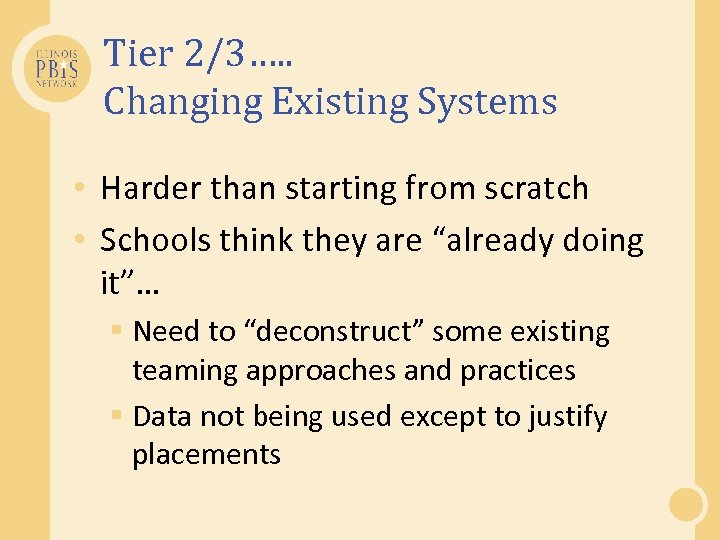
Tier 2/3…. . Changing Existing Systems • Harder than starting from scratch • Schools think they are “already doing it”… § Need to “deconstruct” some existing teaming approaches and practices § Data not being used except to justify placements
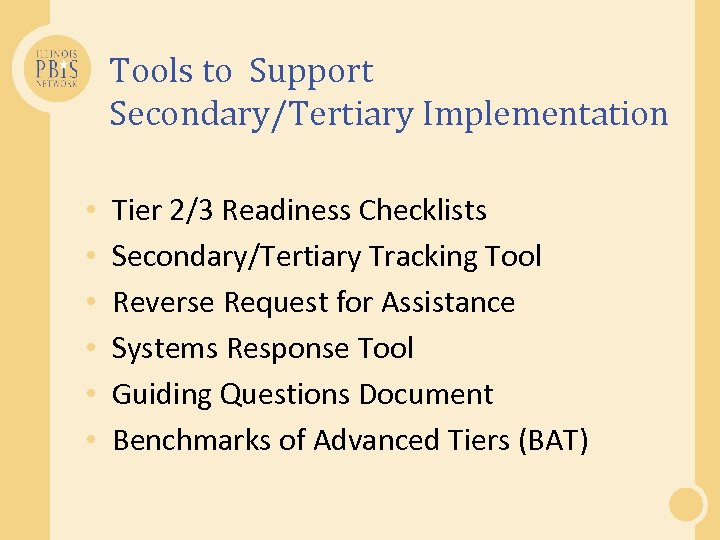
Tools to Support Secondary/Tertiary Implementation • • • Tier 2/3 Readiness Checklists Secondary/Tertiary Tracking Tool Reverse Request for Assistance Systems Response Tool Guiding Questions Document Benchmarks of Advanced Tiers (BAT)
Some “Big Picture” Challenges • Low intensity, low fidelity interventions for behavior/emotional needs • Habitual use of restrictive settings (and poor outcomes) for youth with disabilities • High rate of undiagnosed MH problems (stigma, lack of knowledge, etc. ) • Changing the routines of ineffective practices (systems) that are “familiar” to systems
Examples of Ineffective Secondary/Tertiary Structures 1. Referrals to Sp. Ed. seen as the “intervention” 2. FBA seen as required “paperwork” vs. a needed part of designing an intervention 3. Interventions the system is familiar with vs. ones likely to produce an effect § (Ex: student sent for insight based counseling at point of misbehavior)
Tier 2/3 Readiness District-level support is necessary for successful building-level Tier 2 & 3 implementation § District commitments should be in place before Tier 2/3 training occurs Building-level leaders should be aware and supportive of what Tier 2/3 requires
District-wide Tertiary Implementation Process • District meeting quarterly § District outcomes § Capacity/sustainability § Other schools/staff • Building meeting monthly § Check on all levels § Cross-planning with all levels § Effectiveness of practices (FBA/Wrap) • Tertiary Coaching Capacity • Facilitators for complex FBA/BIP and wraparound teams
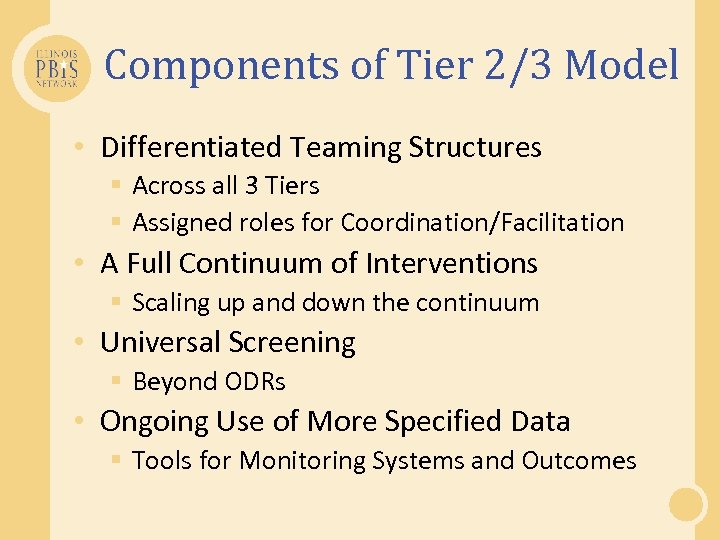
Components of Tier 2/3 Model • Differentiated Teaming Structures § Across all 3 Tiers § Assigned roles for Coordination/Facilitation • A Full Continuum of Interventions § Scaling up and down the continuum • Universal Screening § Beyond ODRs • Ongoing Use of More Specified Data § Tools for Monitoring Systems and Outcomes
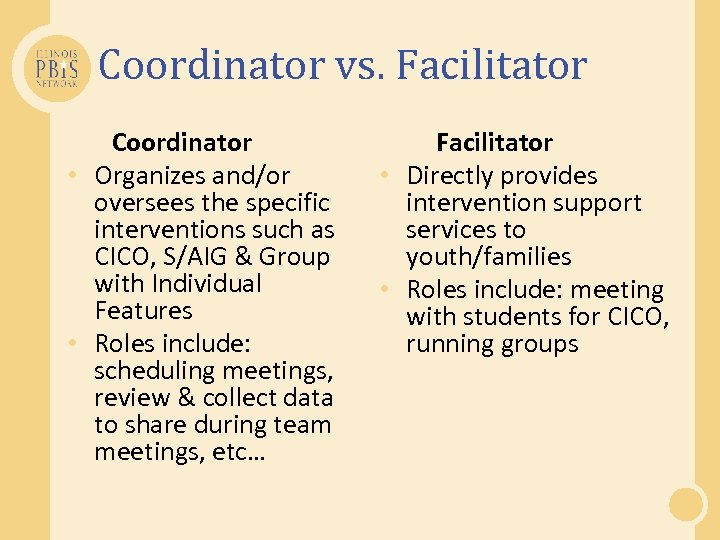
Coordinator vs. Facilitator Coordinator • Organizes and/or oversees the specific interventions such as CICO, S/AIG & Group with Individual Features • Roles include: scheduling meetings, review & collect data to share during team meetings, etc… Facilitator • Directly provides intervention support services to youth/families • Roles include: meeting with students for CICO, running groups
QUICK Reflection Where is your district/school(s) with regards to the readiness criteria?
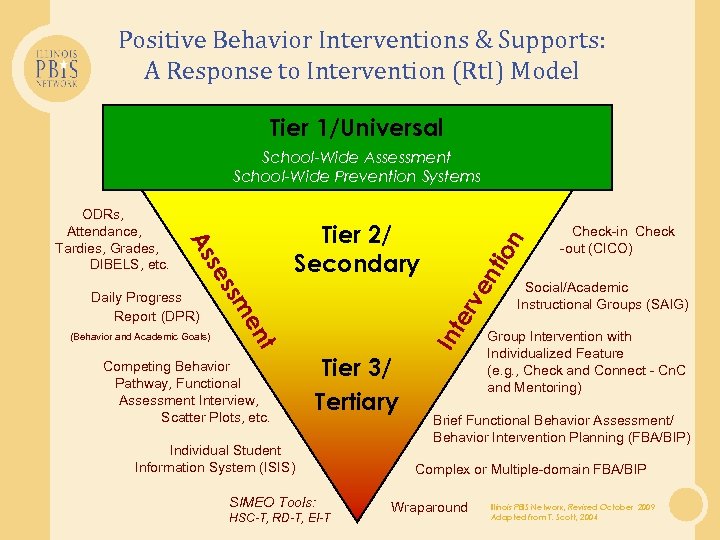
Positive Behavior Interventions & Supports: A Response to Intervention (Rt. I) Model Tier 1/Universal School-Wide Assessment School-Wide Prevention Systems (Behavior and Academic Goals) Competing Behavior Pathway, Functional Assessment Interview, Scatter Plots, etc. n nti o er ve t Int Daily Progress Report (DPR) Tier 2/ Secondary en ssm se As ODRs, Attendance, Tardies, Grades, DIBELS, etc. Tier 3/ Tertiary Individual Student Information System (ISIS) SIMEO Tools: HSC-T, RD-T, EI-T Check-in Check -out (CICO) Social/Academic Instructional Groups (SAIG) Group Intervention with Individualized Feature (e. g. , Check and Connect - Cn. C and Mentoring) Brief Functional Behavior Assessment/ Behavior Intervention Planning (FBA/BIP) Complex or Multiple-domain FBA/BIP Wraparound Illinois PBIS Network, Revised October 2009 Adapted from T. Scott, 2004
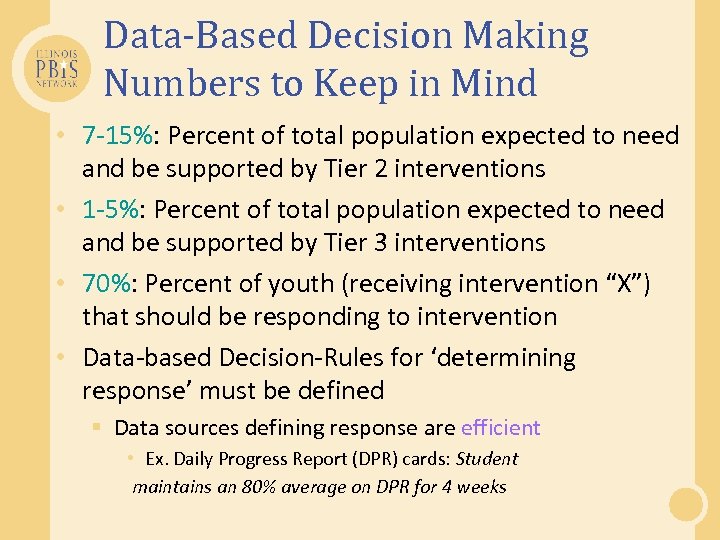
Data-Based Decision Making Numbers to Keep in Mind • 7 -15%: Percent of total population expected to need and be supported by Tier 2 interventions • 1 -5%: Percent of total population expected to need and be supported by Tier 3 interventions • 70%: Percent of youth (receiving intervention “X”) that should be responding to intervention • Data-based Decision-Rules for ‘determining response’ must be defined § Data sources defining response are efficient • Ex. Daily Progress Report (DPR) cards: Student maintains an 80% average on DPR for 4 weeks
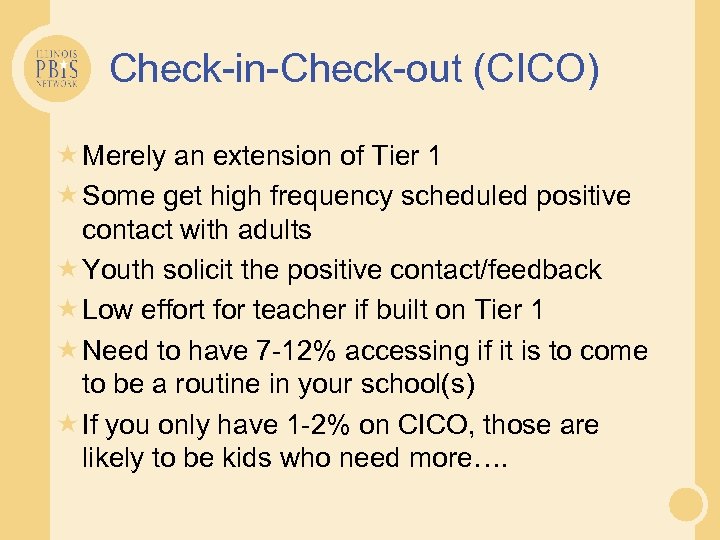
Check-in-Check-out (CICO) Merely an extension of Tier 1 Some get high frequency scheduled positive contact with adults Youth solicit the positive contact/feedback Low effort for teacher if built on Tier 1 Need to have 7 -12% accessing if it is to come to be a routine in your school(s) If you only have 1 -2% on CICO, those are likely to be kids who need more….
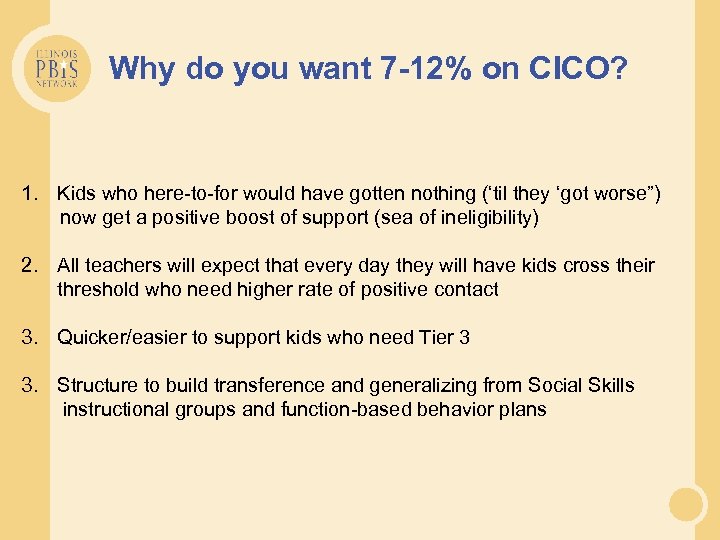
Why do you want 7 -12% on CICO? 1. Kids who here-to-for would have gotten nothing (‘til they ‘got worse”) now get a positive boost of support (sea of ineligibility) 2. All teachers will expect that every day they will have kids cross their threshold who need higher rate of positive contact 3. Quicker/easier to support kids who need Tier 3 3. Structure to build transference and generalizing from Social Skills instructional groups and function-based behavior plans
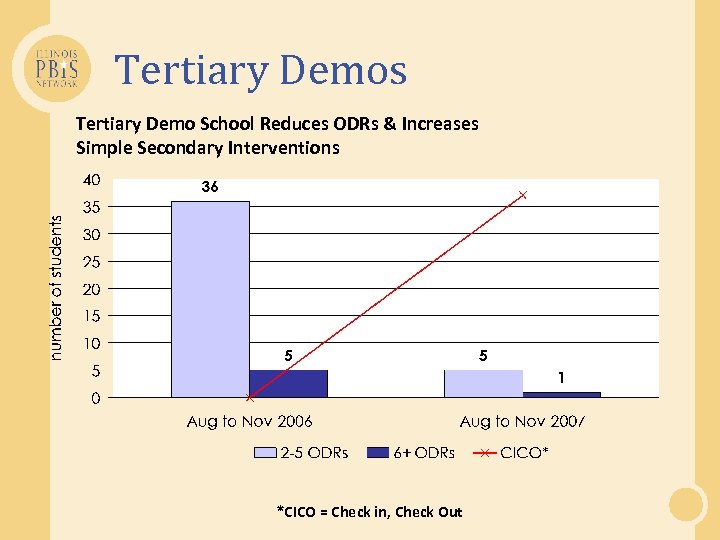
Tertiary Demos Tertiary Demo School Reduces ODRs & Increases Simple Secondary Interventions *CICO = Check in, Check Out
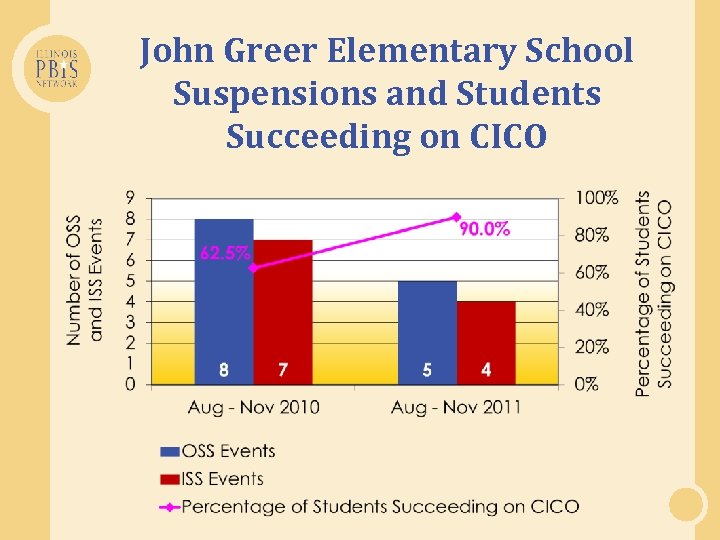
John Greer Elementary School Suspensions and Students Succeeding on CICO
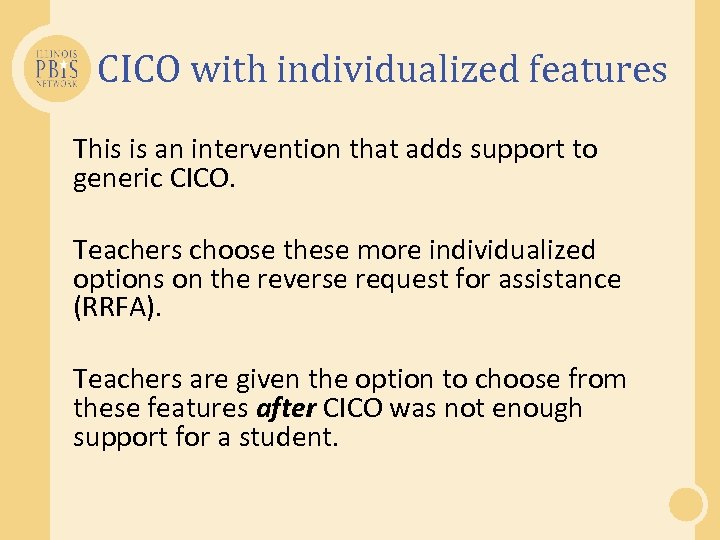
CICO with individualized features This is an intervention that adds support to generic CICO. Teachers choose these more individualized options on the reverse request for assistance (RRFA). Teachers are given the option to choose from these features after CICO was not enough support for a student.
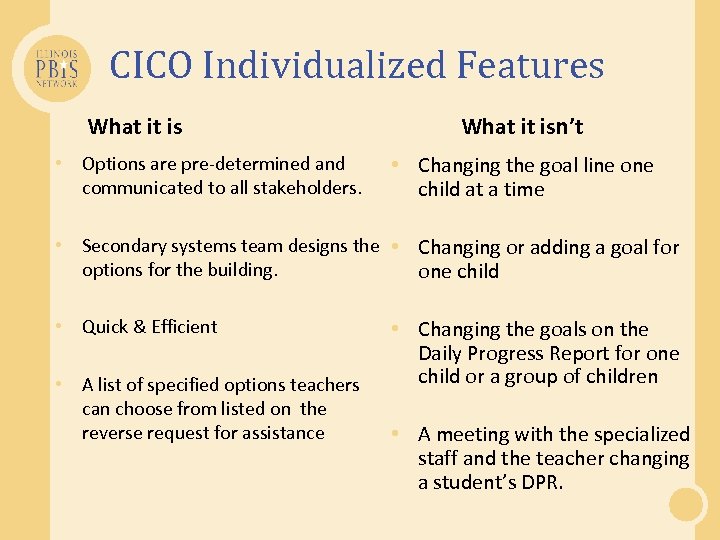
CICO Individualized Features What it is • Options are pre-determined and communicated to all stakeholders. What it isn’t • Changing the goal line one child at a time • Secondary systems team designs the • Changing or adding a goal for options for the building. one child • Quick & Efficient • A list of specified options teachers can choose from listed on the reverse request for assistance • Changing the goals on the Daily Progress Report for one child or a group of children • A meeting with the specialized staff and the teacher changing a student’s DPR.
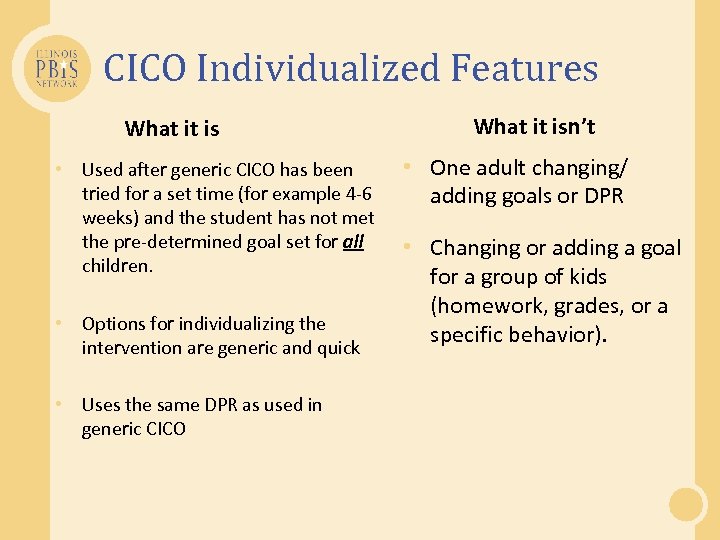
CICO Individualized Features What it is • Used after generic CICO has been tried for a set time (for example 4 -6 weeks) and the student has not met the pre-determined goal set for all children. • Options for individualizing the intervention are generic and quick • Uses the same DPR as used in generic CICO What it isn’t • One adult changing/ adding goals or DPR • Changing or adding a goal for a group of kids (homework, grades, or a specific behavior).
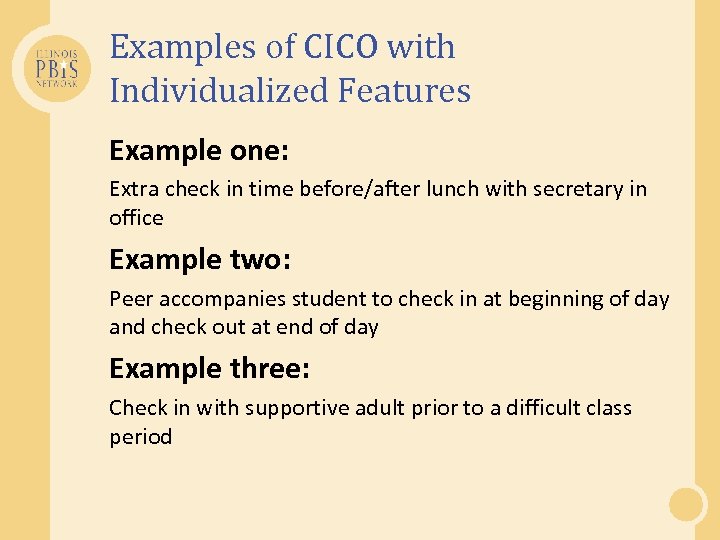
Examples of CICO with Individualized Features Example one: Extra check in time before/after lunch with secretary in office Example two: Peer accompanies student to check in at beginning of day and check out at end of day Example three: Check in with supportive adult prior to a difficult class period
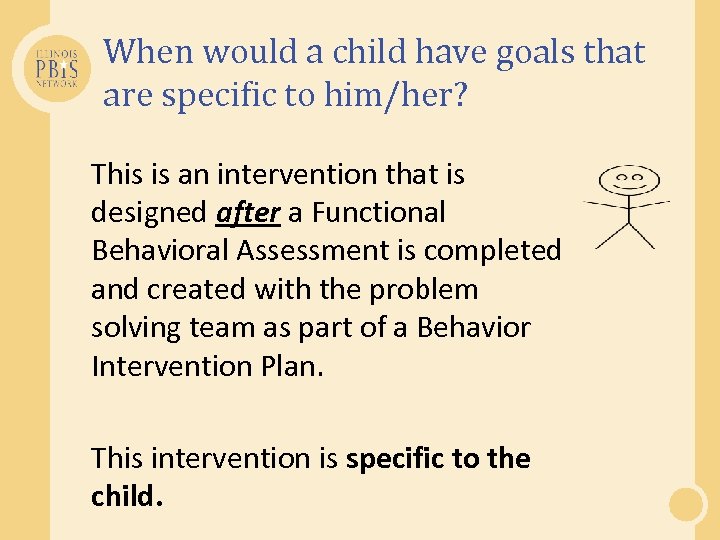
When would a child have goals that are specific to him/her? This is an intervention that is designed after a Functional Behavioral Assessment is completed and created with the problem solving team as part of a Behavior Intervention Plan. This intervention is specific to the child.
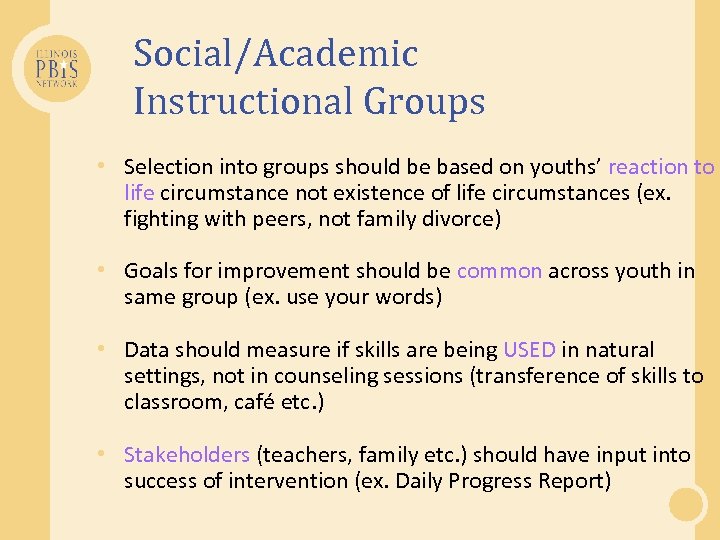
Social/Academic Instructional Groups • Selection into groups should be based on youths’ reaction to life circumstance not existence of life circumstances (ex. fighting with peers, not family divorce) • Goals for improvement should be common across youth in same group (ex. use your words) • Data should measure if skills are being USED in natural settings, not in counseling sessions (transference of skills to classroom, café etc. ) • Stakeholders (teachers, family etc. ) should have input into success of intervention (ex. Daily Progress Report)
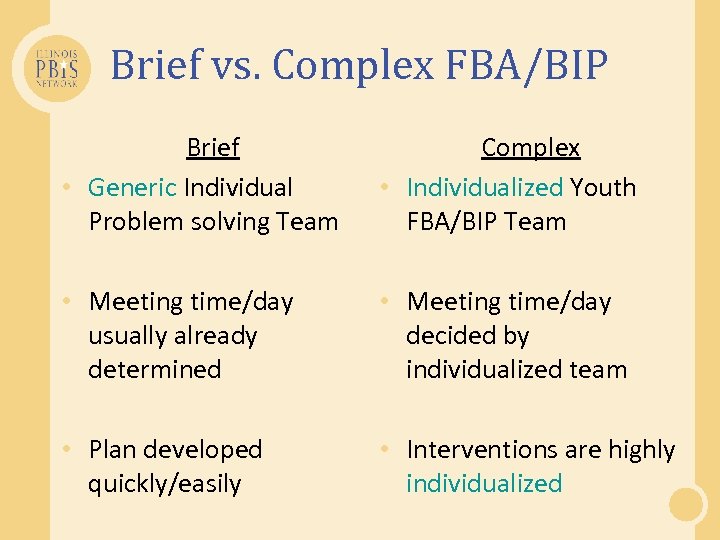
Brief vs. Complex FBA/BIP Brief • Generic Individual Problem solving Team Complex • Individualized Youth FBA/BIP Team • Meeting time/day usually already determined • Meeting time/day decided by individualized team • Plan developed quickly/easily • Interventions are highly individualized
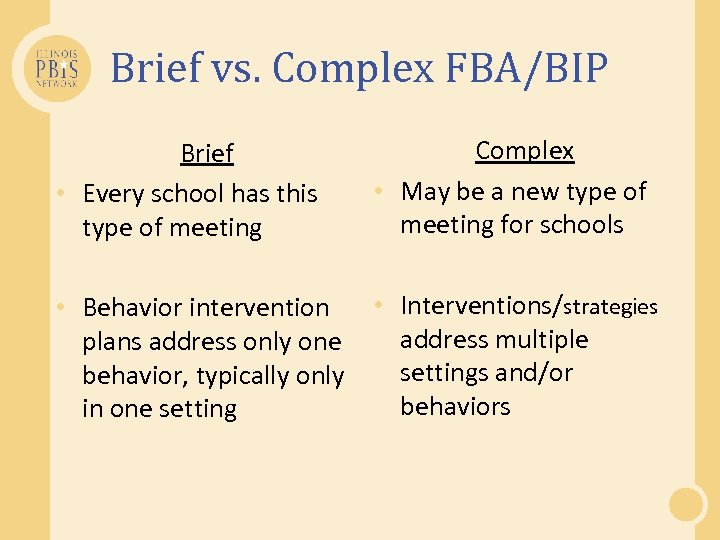
Brief vs. Complex FBA/BIP Brief • Every school has this type of meeting Complex • May be a new type of meeting for schools • Behavior intervention plans address only one behavior, typically only in one setting • Interventions/strategies address multiple settings and/or behaviors
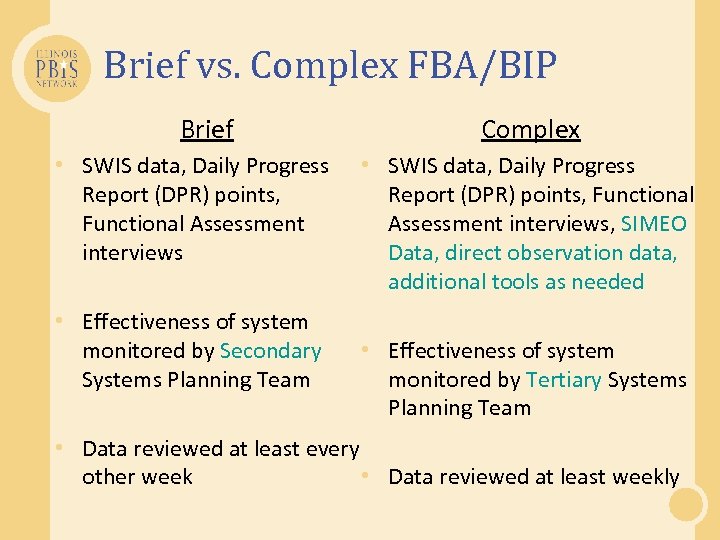
Brief vs. Complex FBA/BIP Brief • SWIS data, Daily Progress Report (DPR) points, Functional Assessment interviews • Effectiveness of system monitored by Secondary Systems Planning Team Complex • SWIS data, Daily Progress Report (DPR) points, Functional Assessment interviews, SIMEO Data, direct observation data, additional tools as needed • Effectiveness of system monitored by Tertiary Systems Planning Team • Data reviewed at least every other week • Data reviewed at least weekly
Quick Assessment of Student Access to Intervention • Total enrollment of your school? • Number of students accessing CICO? • Number of students on complex functionbased or wraparound plans? • Percent of total population of the school?
Individualized Teams at the Tertiary Level • Are unique to the individual child & family § Blend the family’s supports with the school representatives who know the child best • Meeting Process § Meet frequently § Regularly develop & review interventions • Facilitator Role § Role of bringing team together § Role of blending perspectives
Individualized Comprehensive Teams/Plans • Who? Youth with multiple needs across home, school, community § Youth with multiple life domain needs § The adults in youth’s life are not effectively engaged in comprehensive planning (i. e. adults not getting along very well) § • What? § The development of a very unique, individualized, strength-based team & plan with the youth family that is designed to improve quality of life as defined by the youth/family.
Individualized, Comprehensive Teams/Plans What Do Tertiary Plans include? Supports and interventions across multiple life domains and settings (i. e. behavior support plans, academic interventions, basic living supports, multi-agency strategies, family supports, community supports, etc. ) What’s Different? Natural supports and unique strengths are emphasized in team and plan development. Youth/family access, voice, ownership are critical features. Plans include supports for adults/family, as well as youth.
What is Wraparound? • Wraparound is a tool (e. g. a process) used to implement interagency systems of care in achieving better outcomes for youth and their families. • The wraparound process is similar to person-centered planning, the individualized Positive Behavior Support (PBS) planning process.
What is Wraparound? • Wraparound is a process for developing family-centered teams and plans that are strength and needs based. § § (Not deficit based) Across multiple settings and life domains. • Wraparound plans include natural supports, are culturally relevant, practical and realistic.
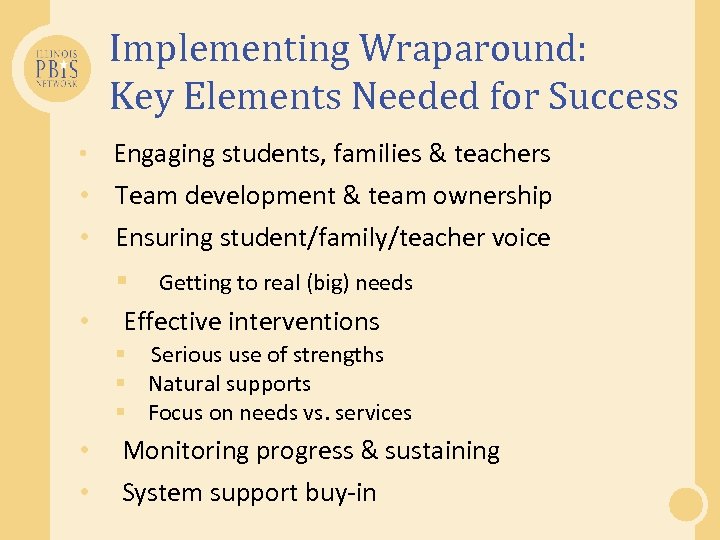
Implementing Wraparound: Key Elements Needed for Success • Engaging students, families & teachers • Team development & team ownership • Ensuring student/family/teacher voice § Getting to real (big) needs • Effective interventions § Serious use of strengths § Natural supports § Focus on needs vs. services • • Monitoring progress & sustaining System support buy-in
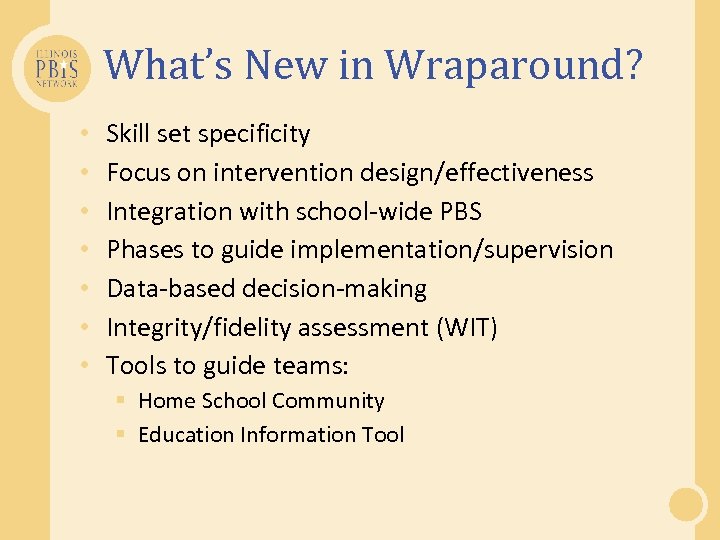
What’s New in Wraparound? • • Skill set specificity Focus on intervention design/effectiveness Integration with school-wide PBS Phases to guide implementation/supervision Data-based decision-making Integrity/fidelity assessment (WIT) Tools to guide teams: § Home School Community § Education Information Tool
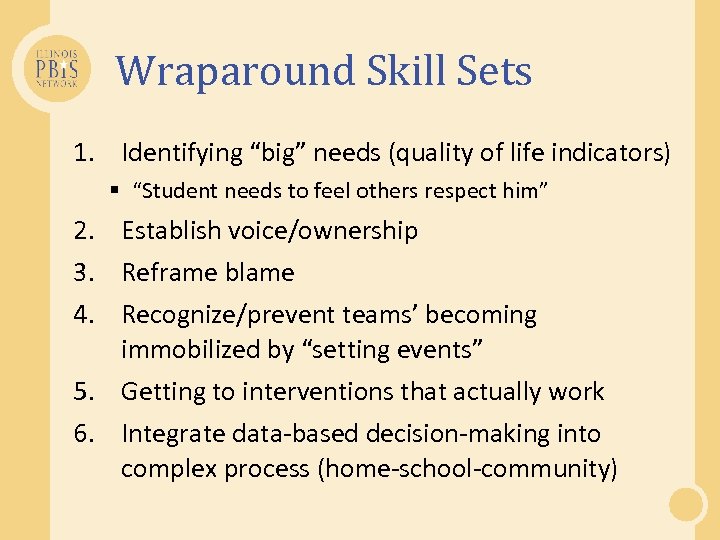
Wraparound Skill Sets 1. Identifying “big” needs (quality of life indicators) § “Student needs to feel others respect him” 2. Establish voice/ownership 3. Reframe blame 4. Recognize/prevent teams’ becoming immobilized by “setting events” 5. Getting to interventions that actually work 6. Integrate data-based decision-making into complex process (home-school-community)
It Takes a System… …. . that builds system capacity for advanced tiers
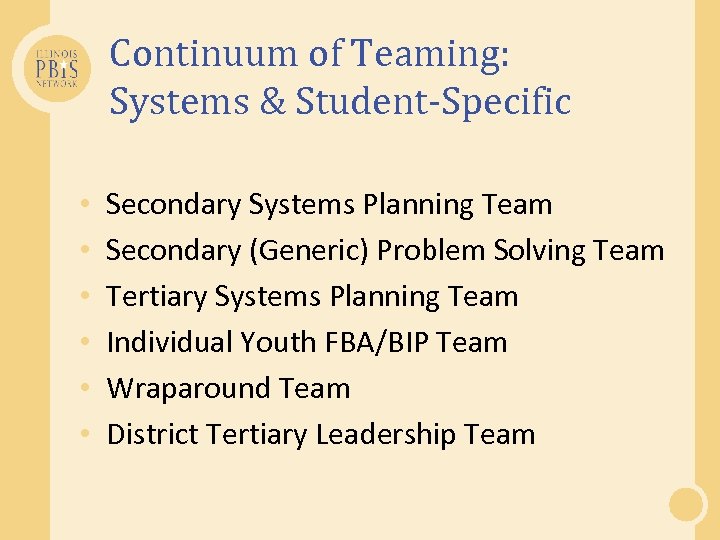
Continuum of Teaming: Systems & Student-Specific • • • Secondary Systems Planning Team Secondary (Generic) Problem Solving Team Tertiary Systems Planning Team Individual Youth FBA/BIP Team Wraparound Team District Tertiary Leadership Team
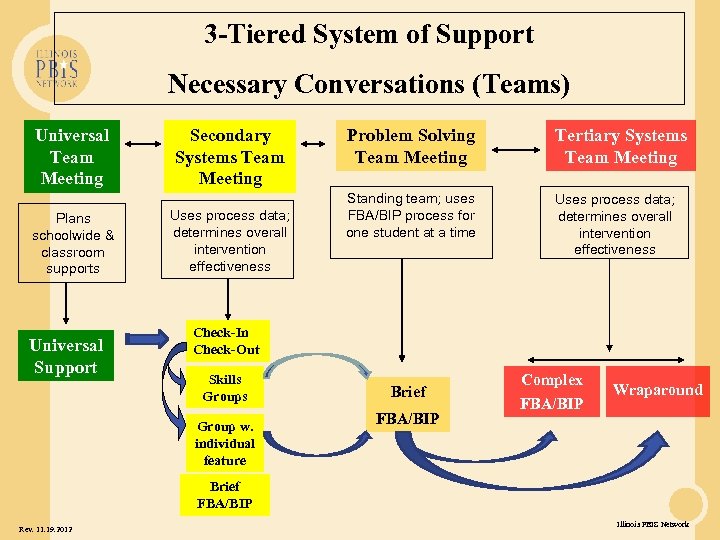
3 -Tiered System of Support Necessary Conversations (Teams) Universal Team Meeting Plans schoolwide & classroom supports Universal Support Secondary Systems Team Meeting Uses process data; determines overall intervention effectiveness Problem Solving Team Meeting Tertiary Systems Team Meeting Standing team; uses FBA/BIP process for one student at a time Uses process data; determines overall intervention effectiveness Check-In Check-Out Skills Group w. individual feature Brief FBA/BIP Complex FBA/BIP Wraparound Brief FBA/BIP Rev. 11. 19. 2012 Illinois PBIS Network
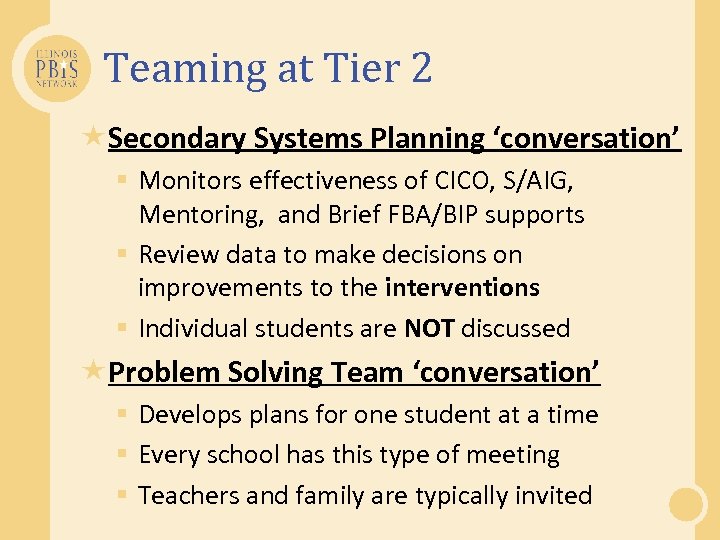
Teaming at Tier 2 Secondary Systems Planning ‘conversation’ § Monitors effectiveness of CICO, S/AIG, Mentoring, and Brief FBA/BIP supports § Review data to make decisions on improvements to the interventions § Individual students are NOT discussed Problem Solving Team ‘conversation’ § Develops plans for one student at a time § Every school has this type of meeting § Teachers and family are typically invited
Question Is the idea of separating out functions (progress monitoring, brief problemsolving, complex interventions, etc) new to your districts/schools?
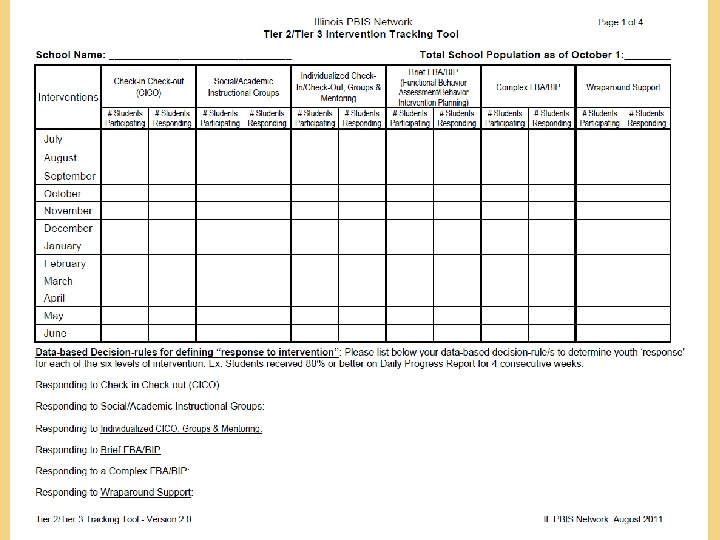
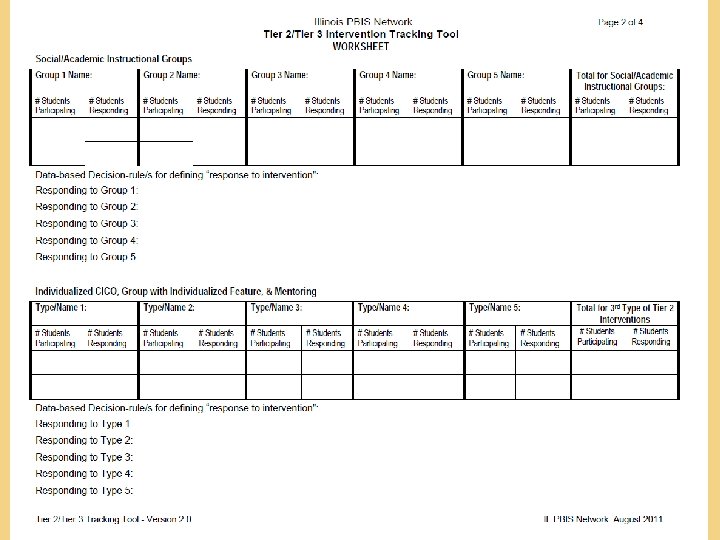
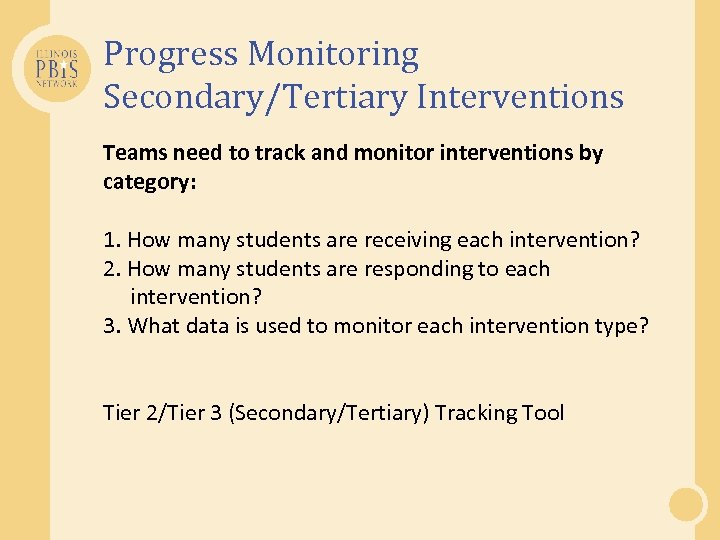
Progress Monitoring Secondary/Tertiary Interventions Teams need to track and monitor interventions by category: 1. How many students are receiving each intervention? 2. How many students are responding to each intervention? 3. What data is used to monitor each intervention type? Tier 2/Tier 3 (Secondary/Tertiary) Tracking Tool
Activity : Using Data to Improve Tier 2/Tier 3 Systems of Support • • • Review Tracking Tool & Systems Response Tools. How can these tools help your school(s) to identify strengths and weaknesses of their Tier 2/3 systems of support? How will you encourage/prompt others to use these data for progress monitoring system responses that need to change? How will you encourage/prompt others to use data for progress monitoring Interventions at Tiers 2/3?
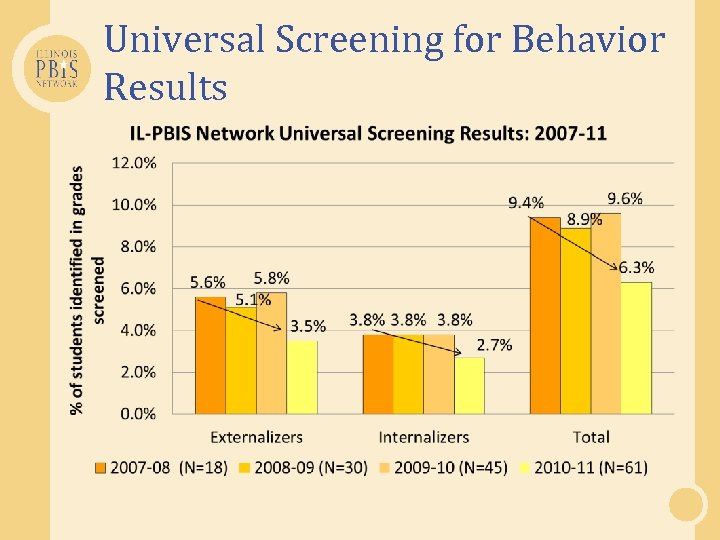
Universal Screening for Behavior Results
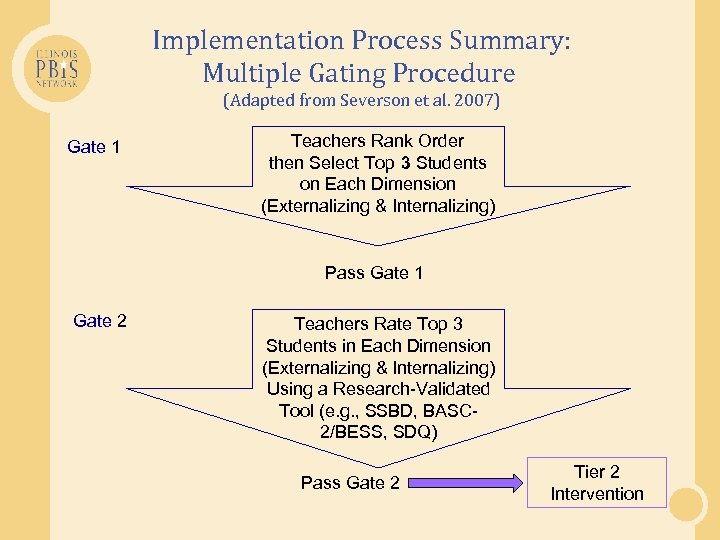
Implementation Process Summary: Multiple Gating Procedure (Adapted from Severson et al. 2007) Gate 1 Teachers Rank Order then Select Top 3 Students on Each Dimension (Externalizing & Internalizing) Pass Gate 1 Gate 2 Teachers Rate Top 3 Students in Each Dimension (Externalizing & Internalizing) Using a Research-Validated Tool (e. g. , SSBD, BASC 2/BESS, SDQ) Pass Gate 2 Tier 2 Intervention
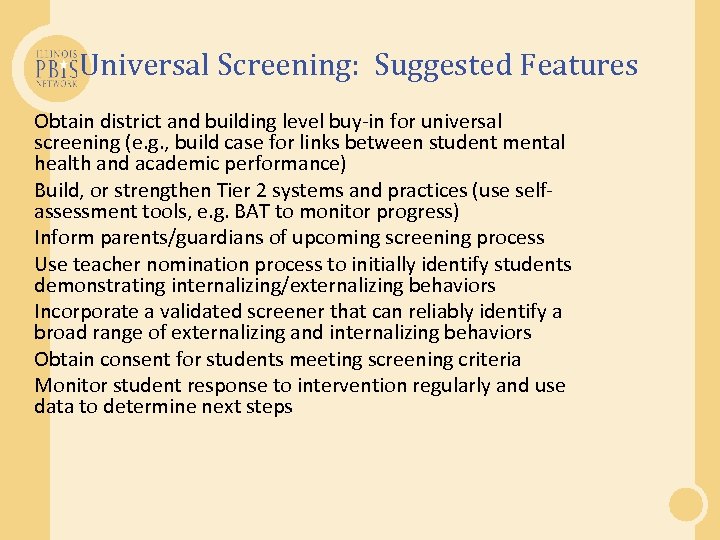
Universal Screening: Suggested Features • Obtain district and building level buy-in for universal screening (e. g. , build case for links between student mental health and academic performance) • Build, or strengthen Tier 2 systems and practices (use selfassessment tools, e. g. BAT to monitor progress) • Inform parents/guardians of upcoming screening process • Use teacher nomination process to initially identify students demonstrating internalizing/externalizing behaviors • Incorporate a validated screener that can reliably identify a broad range of externalizing and internalizing behaviors • Obtain consent for students meeting screening criteria • Monitor student response to intervention regularly and use data to determine next steps
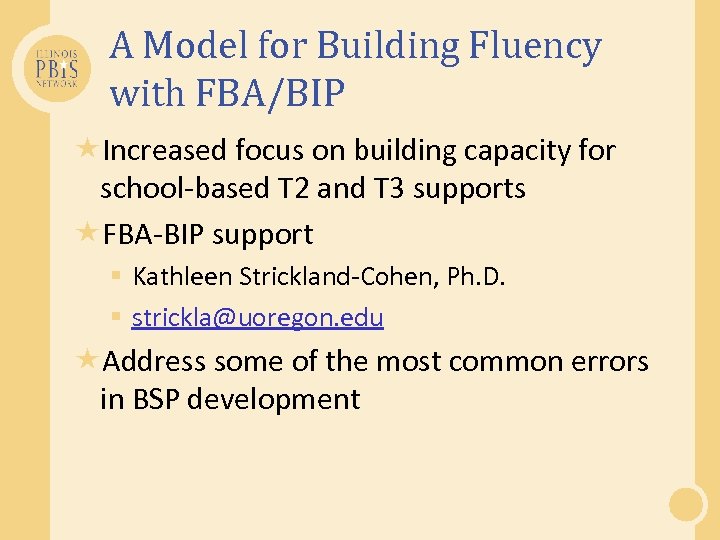
A Model for Building Fluency with FBA/BIP Increased focus on building capacity for school-based T 2 and T 3 supports FBA-BIP support § Kathleen Strickland-Cohen, Ph. D. § strickla@uoregon. edu Address some of the most common errors in BSP development
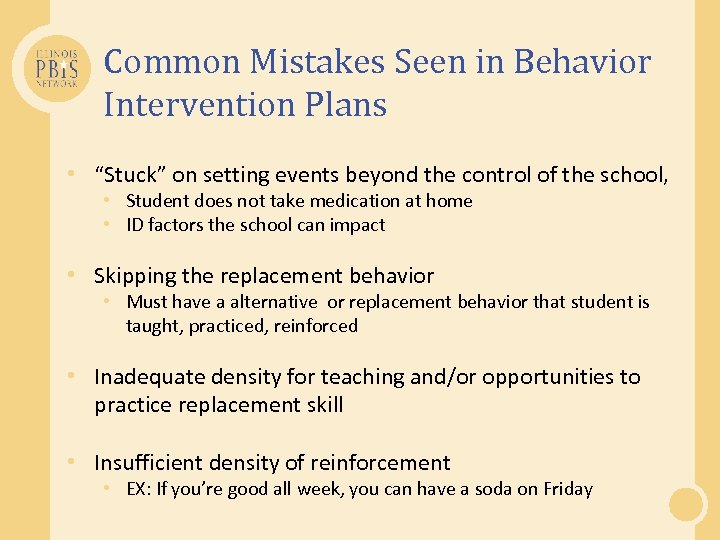
Common Mistakes Seen in Behavior Intervention Plans • “Stuck” on setting events beyond the control of the school, • Student does not take medication at home • ID factors the school can impact • Skipping the replacement behavior • Must have a alternative or replacement behavior that student is taught, practiced, reinforced • Inadequate density for teaching and/or opportunities to practice replacement skill • Insufficient density of reinforcement • EX: If you’re good all week, you can have a soda on Friday
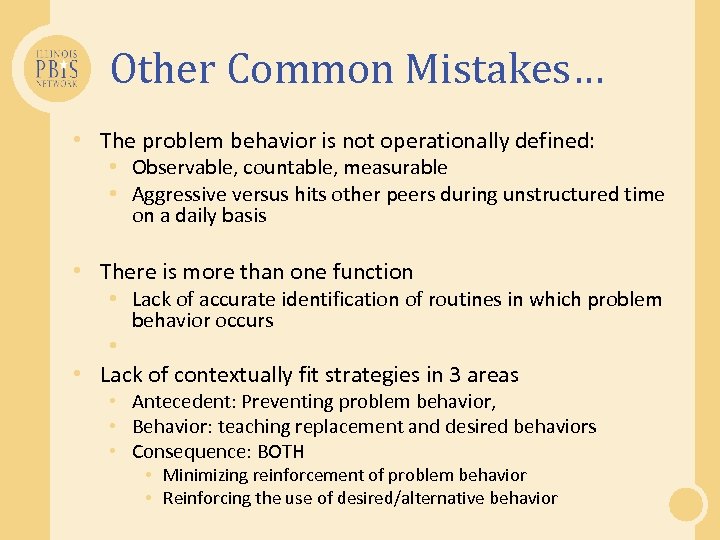
Other Common Mistakes… • The problem behavior is not operationally defined: • Observable, countable, measurable • Aggressive versus hits other peers during unstructured time on a daily basis • There is more than one function • Lack of accurate identification of routines in which problem behavior occurs • • Lack of contextually fit strategies in 3 areas • Antecedent: Preventing problem behavior, • Behavior: teaching replacement and desired behaviors • Consequence: BOTH • Minimizing reinforcement of problem behavior • Reinforcing the use of desired/alternative behavior
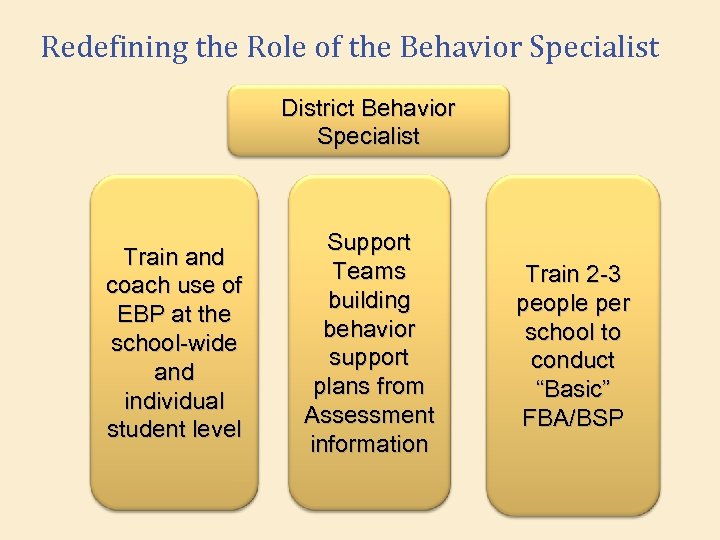
Redefining the Role of the Behavior Specialist District Behavior Specialist Train and coach use of EBP at the school-wide and individual student level Support Teams building behavior support plans from Assessment information Train 2 -3 people per school to conduct “Basic” FBA/BSP
Reflection How would this model of rethinking District Behavior Specialist work within your district? Can you think of a handful of teachers who could conduct basic FBAs? Could your team use support in aligning BSPs with FBAs? How do/can you apply principles of instruction to supporting your team / staff?
Coaching Tier 3 Implementation Complex FBA/BIP Wraparound Wrap-based RENEW
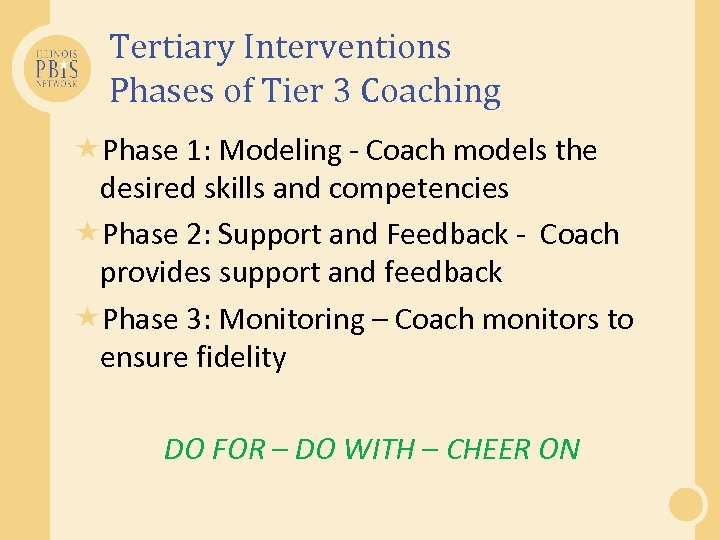
Tertiary Interventions Phases of Tier 3 Coaching Phase 1: Modeling - Coach models the desired skills and competencies Phase 2: Support and Feedback - Coach provides support and feedback Phase 3: Monitoring – Coach monitors to ensure fidelity DO FOR – DO WITH – CHEER ON
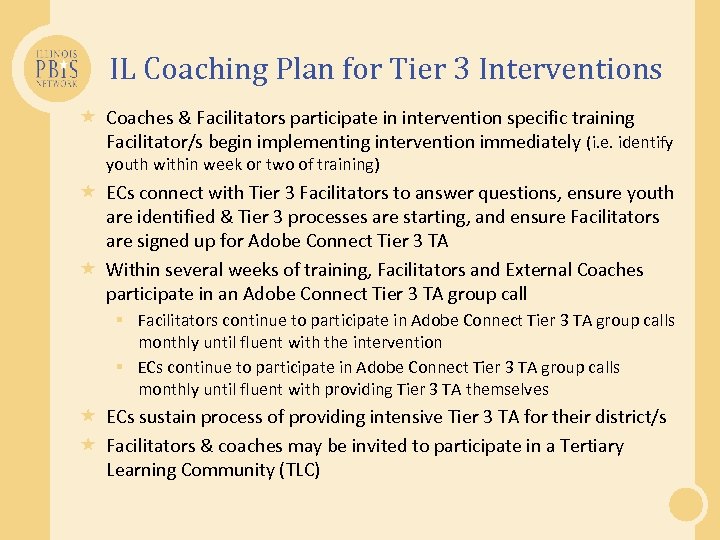
IL Coaching Plan for Tier 3 Interventions Coaches & Facilitators participate in intervention specific training Facilitator/s begin implementing intervention immediately (i. e. identify youth within week or two of training) ECs connect with Tier 3 Facilitators to answer questions, ensure youth are identified & Tier 3 processes are starting, and ensure Facilitators are signed up for Adobe Connect Tier 3 TA Within several weeks of training, Facilitators and External Coaches participate in an Adobe Connect Tier 3 TA group call § Facilitators continue to participate in Adobe Connect Tier 3 TA group calls monthly until fluent with the intervention § ECs continue to participate in Adobe Connect Tier 3 TA group calls monthly until fluent with providing Tier 3 TA themselves ECs sustain process of providing intensive Tier 3 TA for their district/s Facilitators & coaches may be invited to participate in a Tertiary Learning Community (TLC)
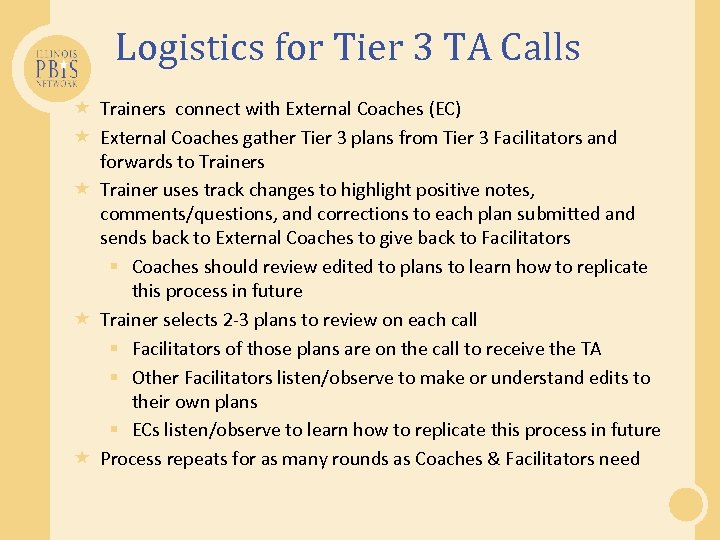
Logistics for Tier 3 TA Calls Trainers connect with External Coaches (EC) External Coaches gather Tier 3 plans from Tier 3 Facilitators and forwards to Trainers Trainer uses track changes to highlight positive notes, comments/questions, and corrections to each plan submitted and sends back to External Coaches to give back to Facilitators § Coaches should review edited to plans to learn how to replicate this process in future Trainer selects 2 -3 plans to review on each call § Facilitators of those plans are on the call to receive the TA § Other Facilitators listen/observe to make or understand edits to their own plans § ECs listen/observe to learn how to replicate this process in future Process repeats for as many rounds as Coaches & Facilitators need
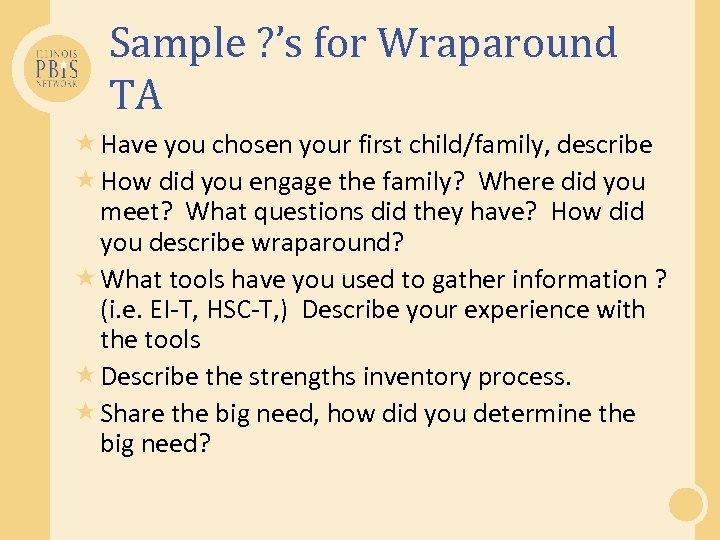
Sample ? ’s for Wraparound TA Have you chosen your first child/family, describe How did you engage the family? Where did you meet? What questions did they have? How did you describe wraparound? What tools have you used to gather information ? (i. e. EI-T, HSC-T, ) Describe your experience with the tools Describe the strengths inventory process. Share the big need, how did you determine the big need?
Скачать презентацию WI Coaches forum August 2013 Building Tier 2 3
04abd1b7e19191bc25c8d3c0bb25d205.ppt