


 Скачать презентацию Why We are Changing the Army 130930 May
ba4b9941d4f727585dd396026ae57839.ppt
- Количество слайдов: 25
 Why We are Changing the Army 130930 May 04 1
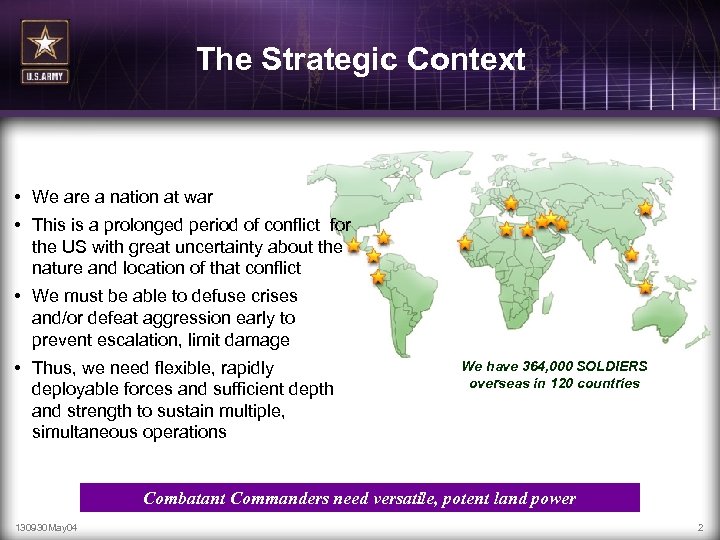 The Strategic Context • We are a nation at war • This is a prolonged period of conflict for the US with great uncertainty about the nature and location of that conflict • We must be able to defuse crises and/or defeat aggression early to prevent escalation, limit damage • Thus, we need flexible, rapidly deployable forces and sufficient depth and strength to sustain multiple, simultaneous operations We have 364, 000 SOLDIERS overseas in 120 countries Combatant Commanders need versatile, potent land power 130930 May 04 2
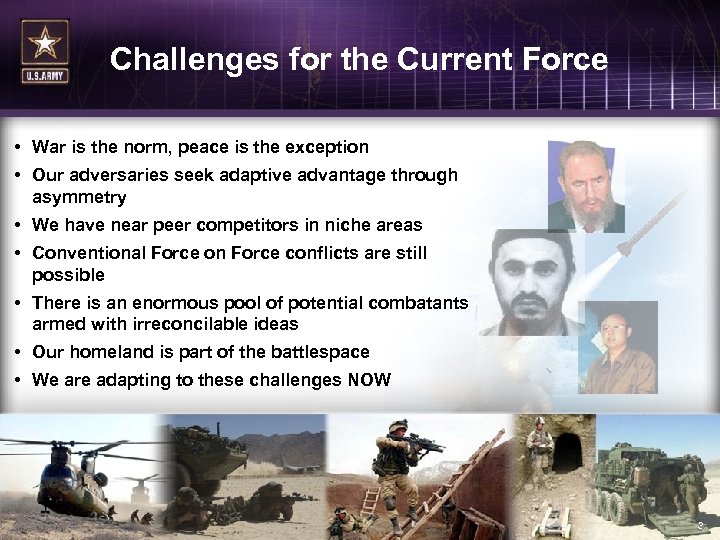 Challenges for the Current Force • War is the norm, peace is the exception • Our adversaries seek adaptive advantage through asymmetry • We have near peer competitors in niche areas • Conventional Force on Force conflicts are still possible • There is an enormous pool of potential combatants armed with irreconcilable ideas • Our homeland is part of the battlespace • We are adapting to these challenges NOW 130930 May 04 3
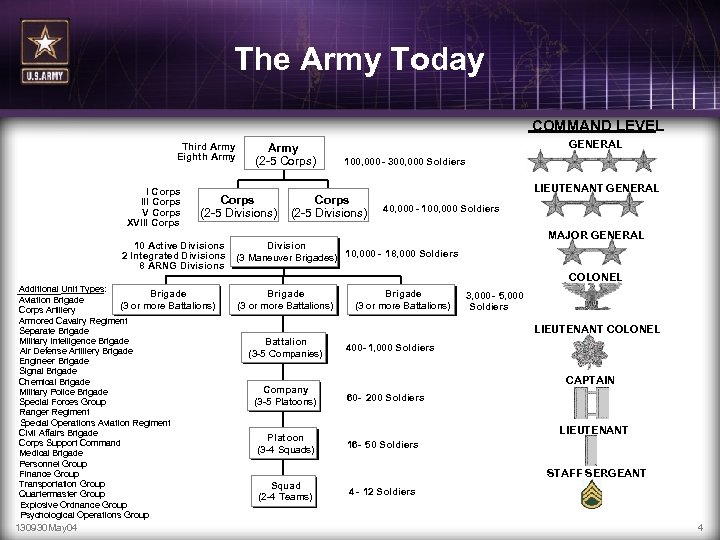 The Army Today COMMAND LEVEL Third Army Eighth Army I Corps III Corps V Corps XVIII Corps (2 -5 Divisions) 10 Active Divisions 2 Integrated Divisions 8 ARNG Divisions Additional Unit Types: Brigade Aviation Brigade (3 or more Battalions) Corps Artillery Armored Cavalry Regiment Separate Brigade Military Intelligence Brigade Air Defense Artillery Brigade Engineer Brigade Signal Brigade Chemical Brigade Military Police Brigade Special Forces Group Ranger Regiment Special Operations Aviation Regiment Civil Affairs Brigade Corps Support Command Medical Brigade Personnel Group Finance Group Transportation Group Quartermaster Group Explosive Ordnance Group Psychological Operations Group 130930 May 04 Army (2 -5 Corps) GENERAL 100, 000 - 300, 000 Soldiers Corps (2 -5 Divisions) LIEUTENANT GENERAL 40, 000 - 100, 000 Soldiers MAJOR GENERAL Division (3 Maneuver Brigades) 10, 000 - 18, 000 Soldiers COLONEL Brigade (3 or more Battalions) 3, 000 - 5, 000 Soldiers LIEUTENANT COLONEL Battalion (3 -5 Companies) 400 - 1, 000 Soldiers CAPTAIN Company (3 -5 Platoons) 60 - 200 Soldiers Platoon (3 -4 Squads) 16 - 50 Soldiers LIEUTENANT STAFF SERGEANT Squad (2 -4 Teams) 4 - 12 Soldiers 4
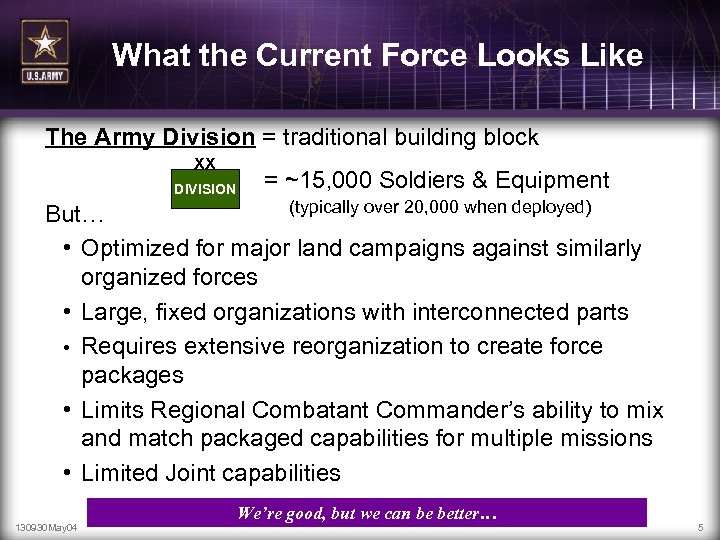 What the Current Force Looks Like The Army Division = traditional building block XX DIVISION = ~15, 000 Soldiers & Equipment (typically over 20, 000 when deployed) But… • Optimized for major land campaigns against similarly organized forces • Large, fixed organizations with interconnected parts • Requires extensive reorganization to create force packages • Limits Regional Combatant Commander’s ability to mix and match packaged capabilities for multiple missions • Limited Joint capabilities 130930 May 04 We’re good, but we can be better… 5
 Clear Need for Change We need to generate more versatile combat power because… • We have extended worldwide commitments • We will remain at war for the foreseeable future • We must be more responsive to Combatant Commanders’ needs A Campaign Quality Army with Joint and Expeditionary Capabilities 130930 May 04 6
 How to Change We must create units that are more relevant to Regional Combatant Commanders and generate versatile combat power with units that are… • More self-contained, sustainable, lethal force packages • Organized with capabilities for the full range of missions • Truly joint interdependent – a trained and ready member of the joint force • Comprised of adaptive, competent, and confident Soldiers and leaders A Campaign Quality Army with Joint and Expeditionary Capabilities 130930 May 04 7
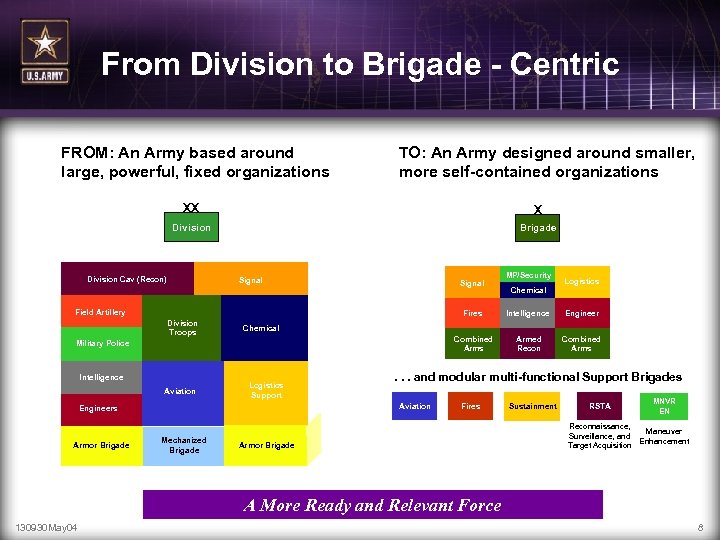 From Division to Brigade - Centric FROM: An Army based around large, powerful, fixed organizations TO: An Army designed around smaller, more self-contained organizations XX X Division Brigade Division Cav (Recon) Signal Field Artillery Chemical Logistics Fires Division Troops Intelligence Aviation Engineer Combined Arms Logistics Support Armed Recon Combined Arms . . . and modular multi-functional Support Brigades Aviation Engineers Mechanized Brigade Intelligence Chemical Military Police Armor Brigade MP/Security Fires Armor Brigade Sustainment RSTA MNVR EN Reconnaissance, Maneuver Surveillance, and Enhancement Target Acquisition A More Ready and Relevant Force 130930 May 04 8
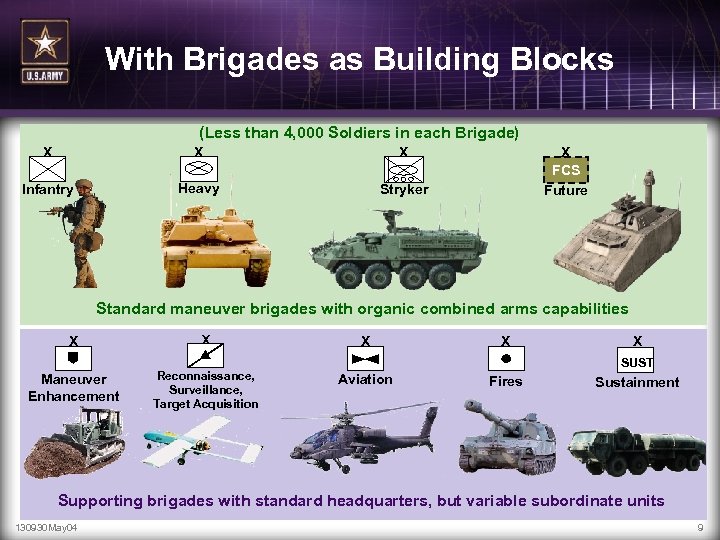 With Brigades as Building Blocks (Less than 4, 000 Soldiers in each Brigade) X X X Infantry Heavy X FCS Future Stryker Standard maneuver brigades with organic combined arms capabilities X X Maneuver Enhancement Reconnaissance, Surveillance, Target Acquisition X X X SUST Aviation Fires Sustainment Supporting brigades with standard headquarters, but variable subordinate units 130930 May 04 9
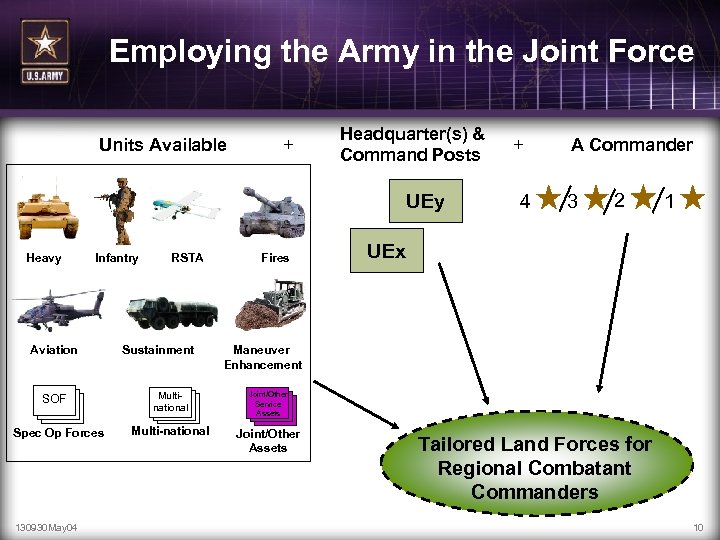 Employing the Army in the Joint Force Units Available + Headquarter(s) & Command Posts UEy Heavy Infantry Aviation SOF Spec Op Forces 130930 May 04 RSTA Sustainment Fires + 4 A Commander 3 2 1 UEx Maneuver Enhancement Multinational Joint/Other Service Assets Multi-national Joint/Other Assets Tailored Land Forces for Regional Combatant Commanders 10
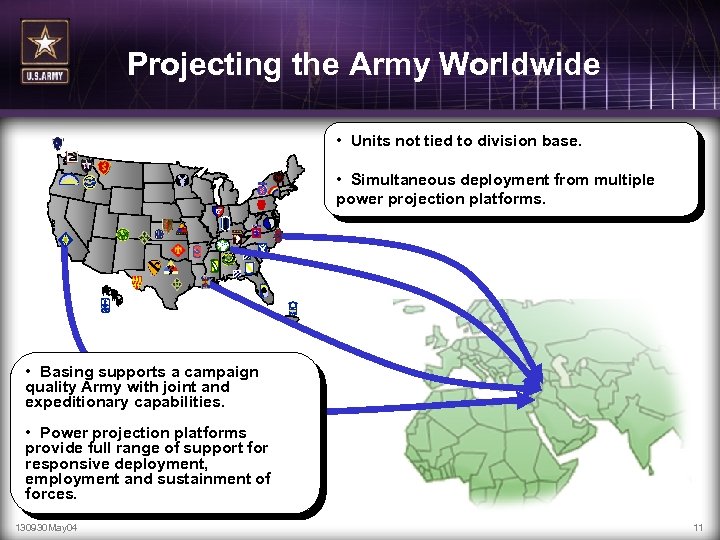 Projecting the Army Worldwide • Units not tied to division base. C Y • Simultaneous deployment from multiple power projection platforms. • Basing supports a campaign quality Army with joint and expeditionary capabilities. • Power projection platforms provide full range of support for responsive deployment, employment and sustainment of forces. 130930 May 04 11
 We Call This Approach Modularity • Modularity is packaging units into flexible configurations • Modular units are rapidly deployable, responsive, agile, tailorable and discrete packages of land force combat power 130930 May 04 12
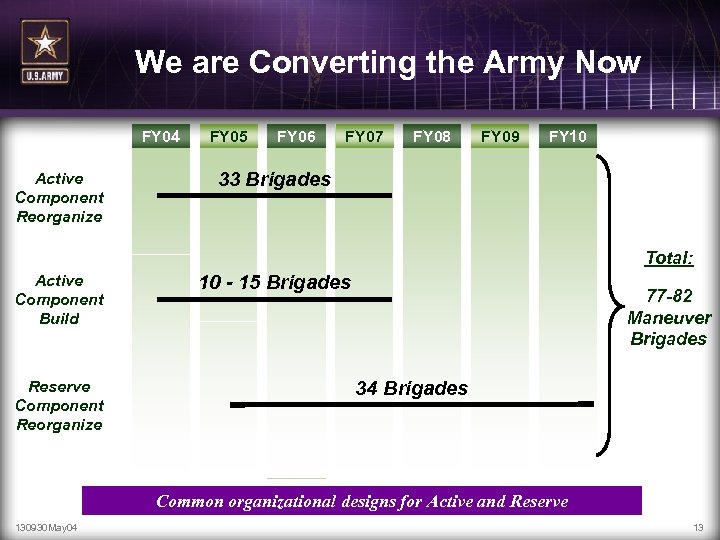 We are Converting the Army Now FY 04 Active Component Reorganize FY 05 FY 06 FY 07 FY 08 FY 09 FY 10 33 Brigades Total: Active Component Build Reserve Component Reorganize 10 - 15 Brigades 77 -82 Maneuver Brigades 34 Brigades Common organizational designs for Active and Reserve 130930 May 04 13
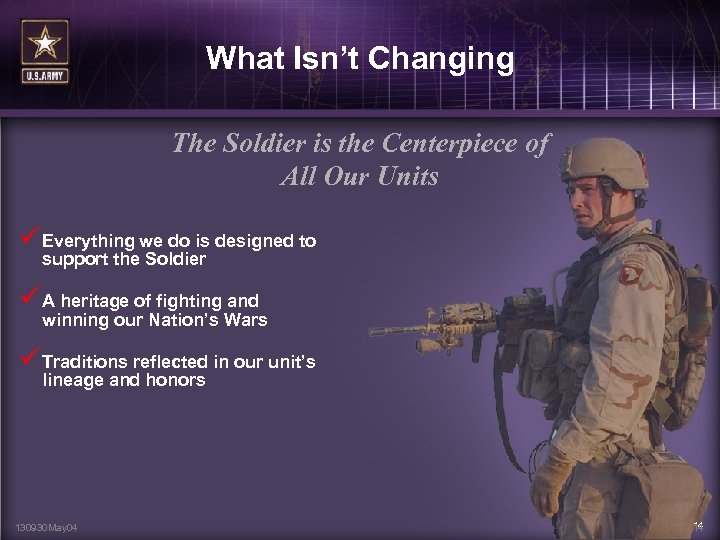 What Isn’t Changing The Soldier is the Centerpiece of All Our Units üEverything we do is designed to support the Soldier üA heritage of fighting and winning our Nation’s Wars üTraditions reflected in our unit’s lineage and honors 130930 May 04 14
 Conclusion • We are adapting to the current and projected operational environment • We are creating modular brigades and command control headquarters to better meet Combatant Commanders’ requirements • Modularity is the foundation for building a Campaign Quality Army with Joint and Expeditionary capabilities 130930 May 04 15
 Why We are Changing the Army Back Up Slides 130930 May 04 16
 Briefing Coordination ü John Mc. Donald ü Congressional Staff ü John Gingrich üSASC Maren Leed ü BG Ralston üSAC-D Betsy Schmidt ü LTG(R) Jordan üSAC-D Nicole Diresta ü EOH Stratcoms (Patti Benner & staff) ü OCLL (staff) ü Sec. Army speechwriter ü OFT (staff) ü G-3 Army Transformation Office (staff) ü TRADOC CPG and Stratcoms ü TF Modularity 130930 May 04 17
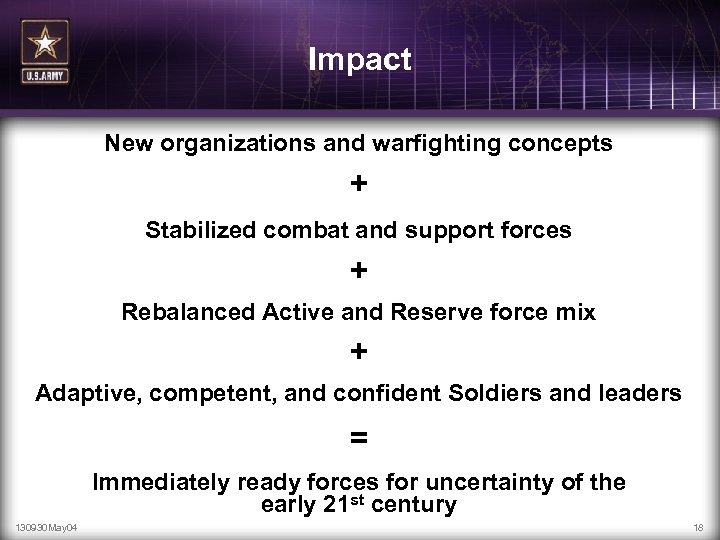 Impact New organizations and warfighting concepts + Stabilized combat and support forces + Rebalanced Active and Reserve force mix + Adaptive, competent, and confident Soldiers and leaders = Immediately ready forces for uncertainty of the early 21 st century 130930 May 04 18
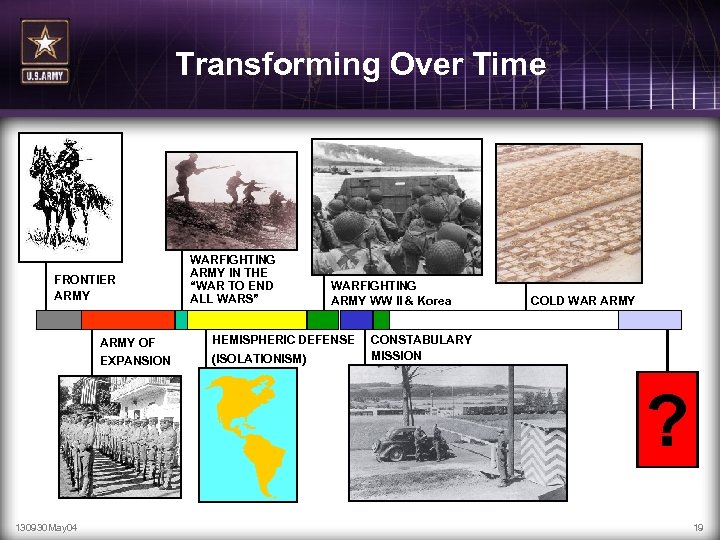 Transforming Over Time FRONTIER ARMY OF EXPANSION WARFIGHTING ARMY IN THE “WAR TO END ALL WARS” WARFIGHTING ARMY WW II & Korea HEMISPHERIC DEFENSE (ISOLATIONISM) COLD WAR ARMY CONSTABULARY MISSION ? 130930 May 04 19
 Restructuring Today’s Army • Modularity: creating brigade sized building blocks of combat power • Stabilization: creating more cohesive and capable units and providing predictability to Soldiers by extending the length of assignments • Rebalancing: adjusting the types and mix of AC and RC units To produce more combat power for Combatant Commanders 130930 May 04 20
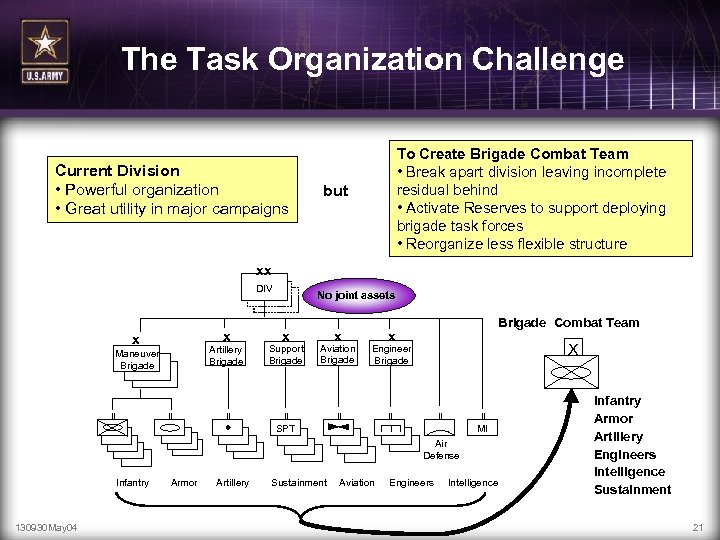 The Task Organization Challenge Current Division • Powerful organization • Great utility in major campaigns To Create Brigade Combat Team • Break apart division leaving incomplete residual behind • Activate Reserves to support deploying brigade task forces • Reorganize less flexible structure but xx DIV x x x Maneuver x ll ll ll Infantry 130930 May 04 x x Brigade Combat Team x Artillery Brigade ll ll ll Armor Support Brigade Aviation Brigade ll ll SPT ll ll X Engineer Brigade ll No joint assets ll ll ll Artillery ll ll Sustainment ll ll ll Aviation ll ll MI Air Defense Engineers Intelligence Infantry Armor Artillery Engineers Intelligence Sustainment 21
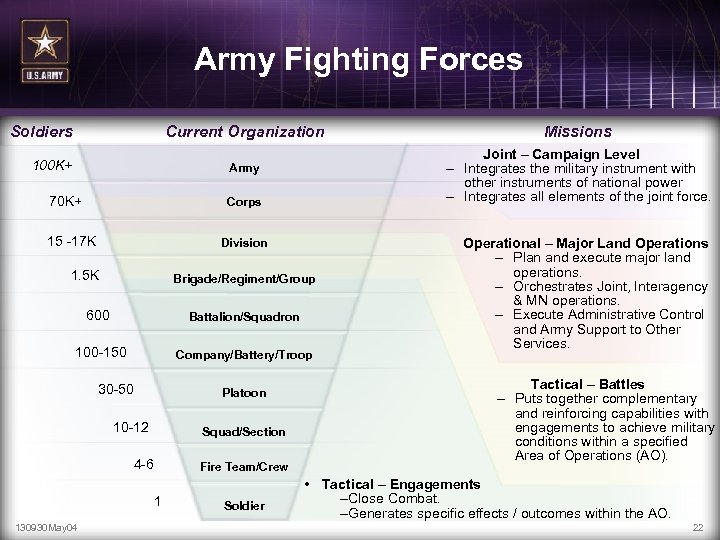 Army Fighting Forces Soldiers Current Organization 100 K+ Joint – Campaign Level – Integrates the military instrument with other instruments of national power – Integrates all elements of the joint force. Army 70 K+ Corps 15 -17 K Division 1. 5 K Brigade/Regiment/Group 600 Battalion/Squadron 100 -150 Company/Battery/Troop 30 -50 Platoon 10 -12 Squad/Section 4 -6 Fire Team/Crew 1 130930 May 04 Soldier Missions Operational – Major Land Operations – Plan and execute major land operations. – Orchestrates Joint, Interagency & MN operations. – Execute Administrative Control and Army Support to Other Services. Tactical – Battles – Puts together complementary and reinforcing capabilities with engagements to achieve military conditions within a specified Area of Operations (AO). • Tactical – Engagements –Close Combat. –Generates specific effects / outcomes within the AO. 22
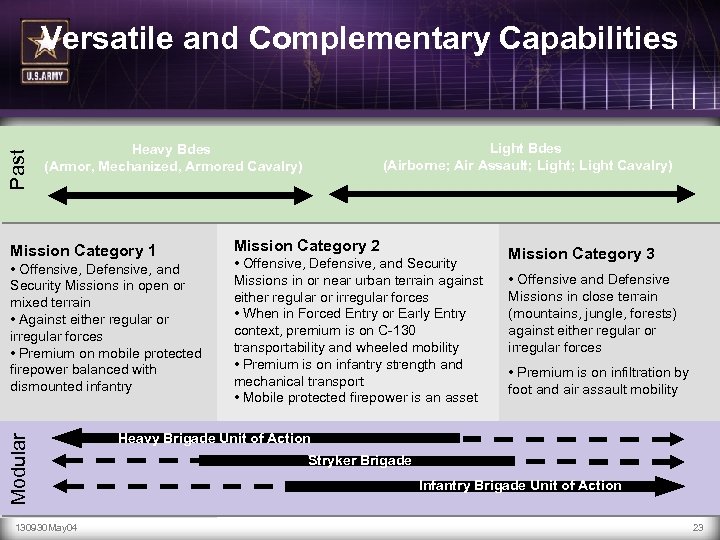 Past Versatile and Complementary Capabilities Light Bdes (Airborne; Air Assault; Light Cavalry) Heavy Bdes (Armor, Mechanized, Armored Cavalry) Mission Category 1 Modular • Offensive, Defensive, and Security Missions in open or mixed terrain • Against either regular or irregular forces • Premium on mobile protected firepower balanced with dismounted infantry 130930 May 04 Mission Category 2 • Offensive, Defensive, and Security Missions in or near urban terrain against either regular or irregular forces • When in Forced Entry or Early Entry context, premium is on C-130 transportability and wheeled mobility • Premium is on infantry strength and mechanical transport • Mobile protected firepower is an asset Mission Category 3 • Offensive and Defensive Missions in close terrain (mountains, jungle, forests) against either regular or irregular forces • Premium is on infiltration by foot and air assault mobility Heavy Brigade Unit of Action Stryker Brigade Infantry Brigade Unit of Action 23
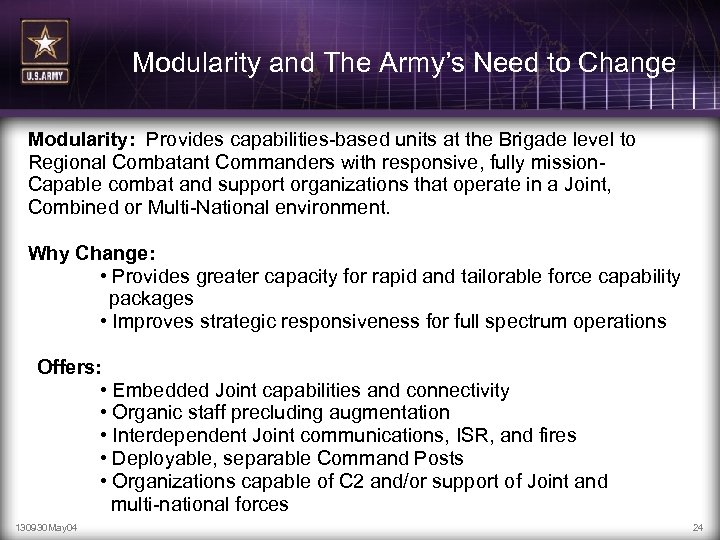 Modularity and The Army’s Need to Change Modularity: Provides capabilities-based units at the Brigade level to Regional Combatant Commanders with responsive, fully mission. Capable combat and support organizations that operate in a Joint, Combined or Multi-National environment. Why Change: • Provides greater capacity for rapid and tailorable force capability packages • Improves strategic responsiveness for full spectrum operations Offers: • Embedded Joint capabilities and connectivity • Organic staff precluding augmentation • Interdependent Joint communications, ISR, and fires • Deployable, separable Command Posts • Organizations capable of C 2 and/or support of Joint and multi-national forces 130930 May 04 24
 Joint Interdependence • The Army, as well as each service, are indispensable, and vital components of the Joint Team • The Army will always conduct operations—offensive, defensive, stability, and support—in a joint and expeditionary context • Prompt, sustained, and decisive land combat power acts in concert with air and naval power to ensure a synergy that gives the Joint Force capabilities and power well beyond the sum of its parts • In a few short years, the Joint Force has moved from independent, de-conflicted operations to sustained interoperability • The Joint Force must now move rapidly to joint interdependence 130930 May 04 25