


 Скачать презентацию Why Value-Added Widespread support from SOAR
34ef91ed2bcc70e99b79f8b167ea334b.ppt
- Количество слайдов: 14
 Why Value-Added? ? ? Widespread support from SOAR districts, Ohio’s teachers’ unions, education associations, educators and business and community leaders led to the passage of Ohio House Bill 3 in August 2003. Receiving overwhelming bipartisan support, this legislation adopted the implementation of a value-added progress measure as an official metric in Ohio’s education accountability system in 2007 -2008. All Ohio school districts will receive 4 th-8 th-grade reading and math value-added reports. Source: Battelle For Kids website
 Value-Added Leadership Team Jan Broughton Deborah Call Rebecca Blume Dana Pollock ? ? ?
 Value-Added Analysis Our goal – Is to assist everyone in using valueadded data for the benefit of one main objective – HELPING OUR STUDENTS !
 What is Value Added? • A method to measure a school’s impact on the rate of student progress from year to year. • Value-added should not be seen just as another indicator, but a more reliable indicator of a school’s impact on student learning across grades and subject levels. • Value-added offers another lens to access whether instructional methods, programs, and practices are working.
 What is Value Added? • NOT AN EVALUATION TOOL! – The purpose of applying data is not to prove, but rather to improve. – The goal in reviewing results is not to name, blame and shame, but rather to help others uncover, discover, and recover. – But, we will approach student results “headon” (together), and allow the data to help us make changes for the betterment of a child’s performance.
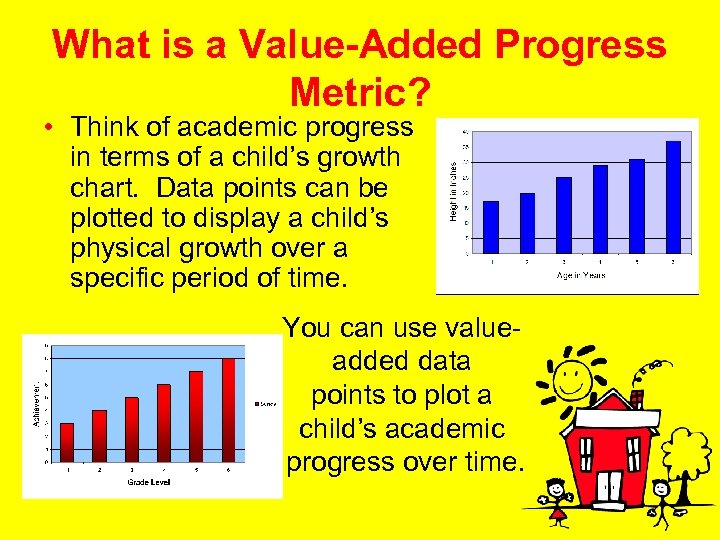 What is a Value-Added Progress Metric? • Think of academic progress in terms of a child’s growth chart. Data points can be plotted to display a child’s physical growth over a specific period of time. You can use valueadded data points to plot a child’s academic progress over time.
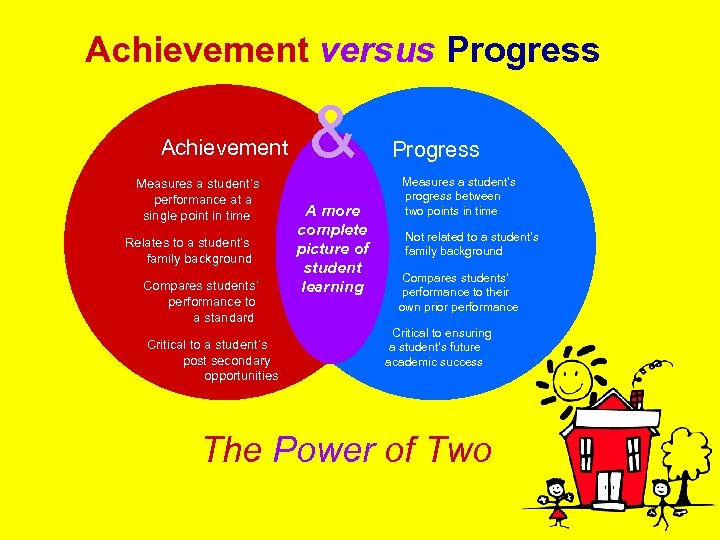 Achievement versus Progress Achievement Measures a student’s performance at a single point in time Relates to a student’s family background Compares students’ performance to a standard Critical to a student’s post secondary opportunities & A more complete picture of student learning Progress Measures a student’s progress between two points in time Not related to a student’s family background Compares students’ performance to their own prior performance Critical to ensuring a student’s future academic success The Power of Two
 With value-added information. . • Teachers are better able to: – Monitor students’ progress – Modify instruction – Align professional development • District administrators and principals are better able to: – Measure impact – Make better-informed, data-driven decisions – Benchmark progress against other districts and schools – Identify best practices and implement more effective programs
 Why is Value Added Analysis Important? • It’s right for KIDS • Provides data, which can be used at the administrative level or at grade level/department team meetings to help strengthen classroom or school improvement strategies (intervention or enrichment) • Identifies strengths and weaknesses, and allows individuals to celebrate and/or establish new individual classroom goals • Value-added information includes projections of future academic performance.
 When will the Value-Added Metric Arrive? • We currently have the 4 th grade results for 2005 -2006 • For grades 3 through 8 -- Fall, 2007 • Being piloted in high schools.
 Steps Taken by the Leadership Team 1) Leadership team has completed four (4) out of five (5) days of Value-Added Training. 2) Presented an overview to administrative team, guidance counselors, and 4 th grade staff members. 3) Analyzed 4 th grade data with administrative team, guidance counselors. 4 th grade staff members will get a chance to analyze their data on April 25. 4) Met with administrative team and counselors a final time to examine student data charts and asked participants to draw conclusions/ assumptions from the charts.
 What are the Next Steps? 1) Meet with 4 th grade staff members and ask them to look at the student data charts and draw conclusions/ assumptions from the charts. 2) Plan similar fall meetings with staff members teaching in Grades 3 -8. 3) Continue to train and support staff during the implementation of Value-Added.
 Resources: http: //battelleforkids. com/home http: //www. ode. state. oh. us/GD/Templates/Pages/ODEPrimary. as px? page=2&Topic. ID=1065&Topic. Relation. ID=1065 http: //www. nsba. org/site/docs/12000/11966. pdf http: //www. aasa. org/publications/saarticledetail. cfm? Item. Number=1066 http: //www. teacherqualitypartnership. org/valueaddedassessment. html http: //www. iu 13. k 12. pa. us/inst_init_vaas. shtml http: //www. nea. org/teachexperience/ask 040402. html Do a search on: Value-Added Assessment William Sanders
 Questions ? ? ?