


 Скачать презентацию Why two or more parties PS 450
5f6703783b60ba6a85c0be4dd4d9ca1c.ppt
- Количество слайдов: 44
 Why two (or more) parties? PS 450
 Duverger’s Law • Part societal cleavages – Capital v. workers – Wealthy vs. less wealthy – owners vs. producers – Dichotomous divisions = two main political forces
 Duverger’s Law • Part institutional, part behavioral – Psychological issues – Single Member Districts
 Duverger’s Law Psychological / behavioral: • fear of wasted vote • vote second choice to avoid least preferred candidate from winning • When do people vote for “third” party in US presidential elections?
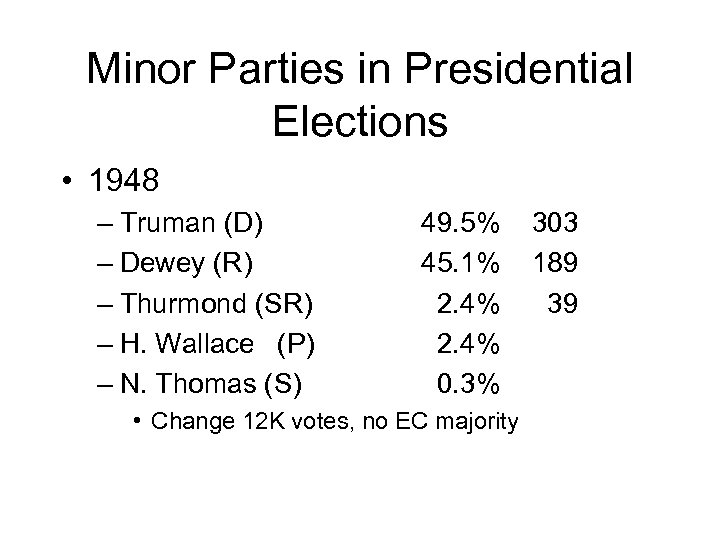 Minor Parties in Presidential Elections • 1948 – Truman (D) – Dewey (R) – Thurmond (SR) – H. Wallace (P) – N. Thomas (S) 49. 5% 45. 1% 2. 4% 0. 3% • Change 12 K votes, no EC majority 303 189 39
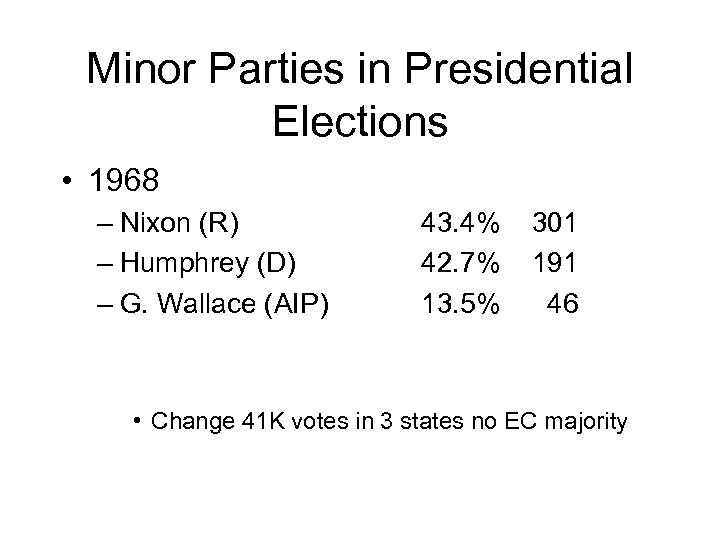 Minor Parties in Presidential Elections • 1968 – Nixon (R) – Humphrey (D) – G. Wallace (AIP) 43. 4% 42. 7% 13. 5% 301 191 46 • Change 41 K votes in 3 states no EC majority
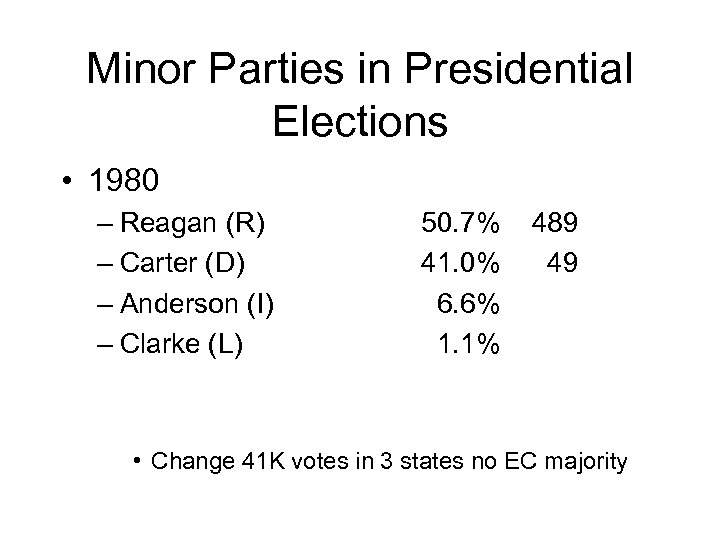 Minor Parties in Presidential Elections • 1980 – Reagan (R) – Carter (D) – Anderson (I) – Clarke (L) 50. 7% 41. 0% 6. 6% 1. 1% 489 49 • Change 41 K votes in 3 states no EC majority
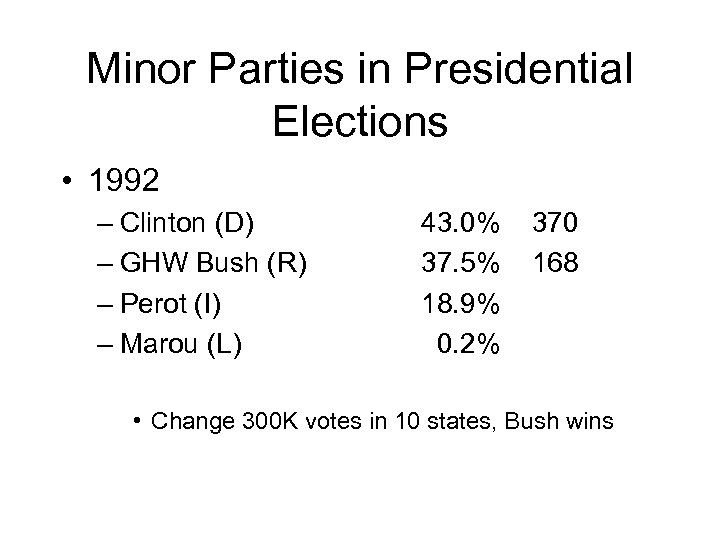 Minor Parties in Presidential Elections • 1992 – Clinton (D) – GHW Bush (R) – Perot (I) – Marou (L) 43. 0% 37. 5% 18. 9% 0. 2% 370 168 • Change 300 K votes in 10 states, Bush wins
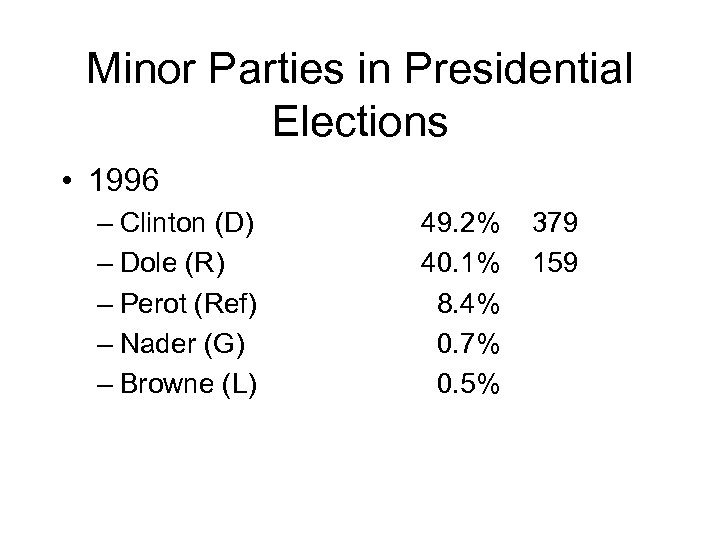 Minor Parties in Presidential Elections • 1996 – Clinton (D) – Dole (R) – Perot (Ref) – Nader (G) – Browne (L) 49. 2% 40. 1% 8. 4% 0. 7% 0. 5% 379 159
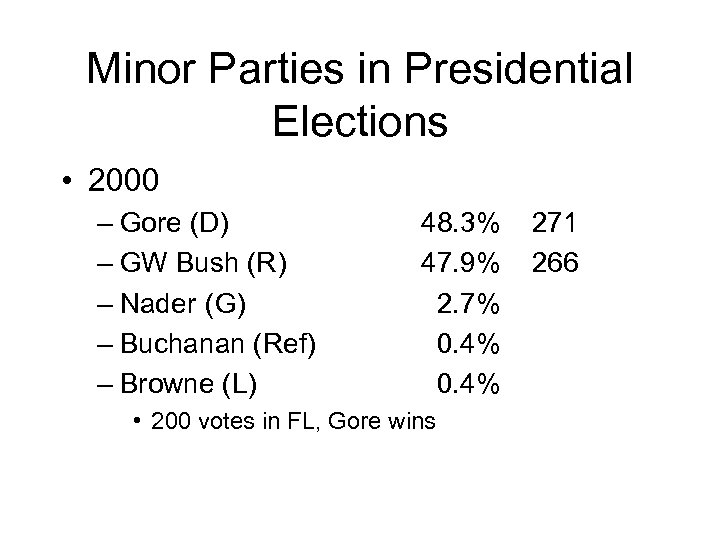 Minor Parties in Presidential Elections • 2000 – Gore (D) – GW Bush (R) – Nader (G) – Buchanan (Ref) – Browne (L) 48. 3% 47. 9% 2. 7% 0. 4% • 200 votes in FL, Gore wins 271 266
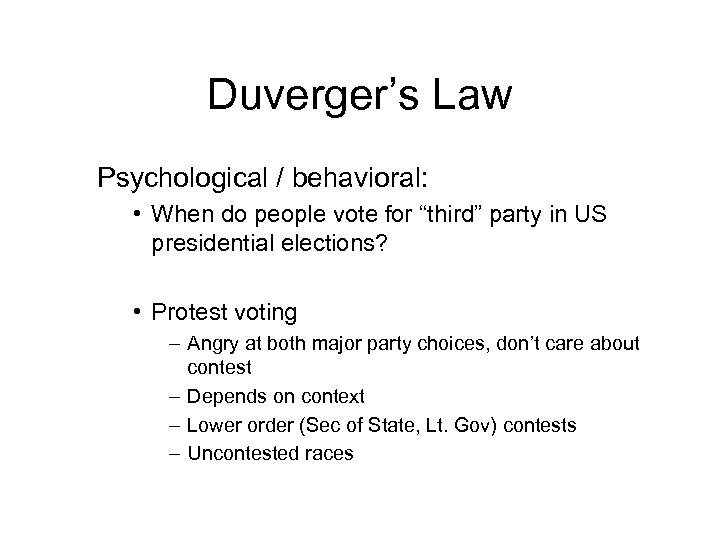 Duverger’s Law Psychological / behavioral: • When do people vote for “third” party in US presidential elections? • Protest voting – Angry at both major party choices, don’t care about contest – Depends on context – Lower order (Sec of State, Lt. Gov) contests – Uncontested races
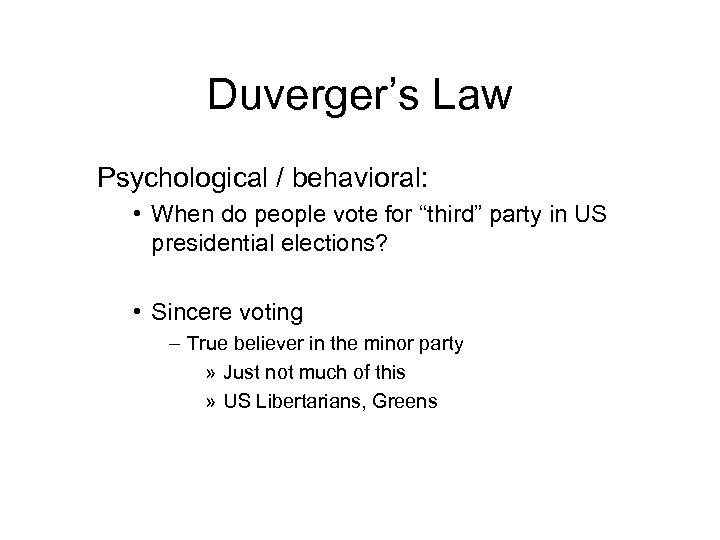 Duverger’s Law Psychological / behavioral: • When do people vote for “third” party in US presidential elections? • Sincere voting – True believer in the minor party » Just not much of this » US Libertarians, Greens
 Duverger’s Law Psychological / behavioral: • When do people vote for “third” party in US presidential elections? • Strategic voting – Higher when fear of wasted vote is greatest – Lower if state not close in Pres. Contest – Information demands: » How do people know if race is close?
 Duverger’s Law Psychological / behavioral: • Strategic voting (Burden) • Perot 1992 – Final polls showed less support than actual votes • Perot 1995 – Final polls showed less support than actual votes • Nader 2000 – As election day grew close, support for Nader declined » More so in closest states
 Minor parties in US • Did Nader elect Bush in 2000? • Did Perot elect Clinton in 1996? • Did Wallace elect Nixon in 1968? • Who might run in 2012? • Vote ‘stealing’ vs. vote mobilizing
 Duverger’s Law: Why only 2 major parties? • Institutional Forces – Electoral Systems that facilitate 2 party systems • Single Member Simple Plurality – US, UK, Canada, India • Majoritarian – France, Australia (lower house)
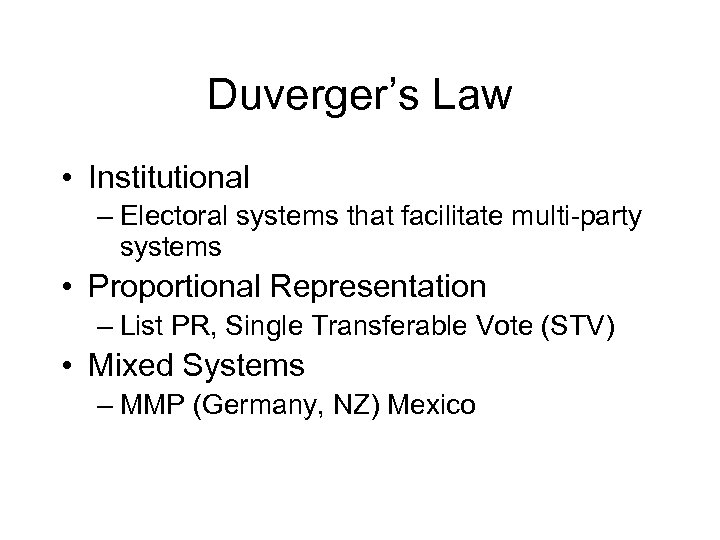 Duverger’s Law • Institutional – Electoral systems that facilitate multi-party systems • Proportional Representation – List PR, Single Transferable Vote (STV) • Mixed Systems – MMP (Germany, NZ) Mexico
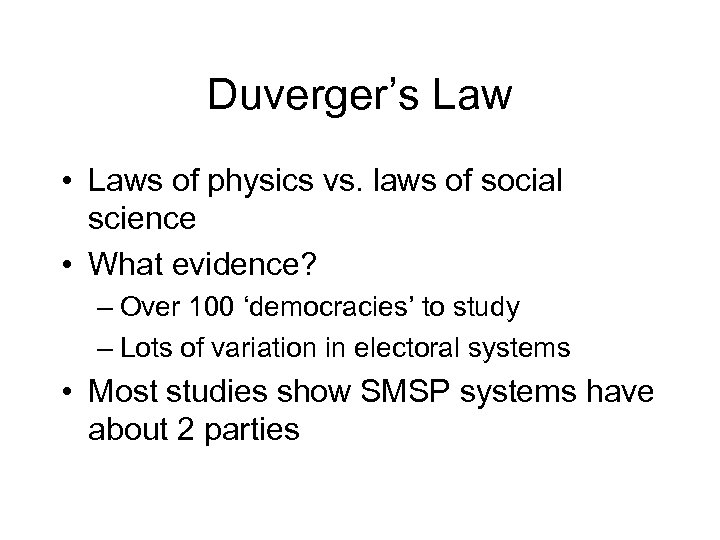 Duverger’s Law • Laws of physics vs. laws of social science • What evidence? – Over 100 ‘democracies’ to study – Lots of variation in electoral systems • Most studies show SMSP systems have about 2 parties
 Duverger’s Law • OK, so it’s not a “law” • Other factors drive number of parties in system • Are the mostly institutional, or social / cultural?
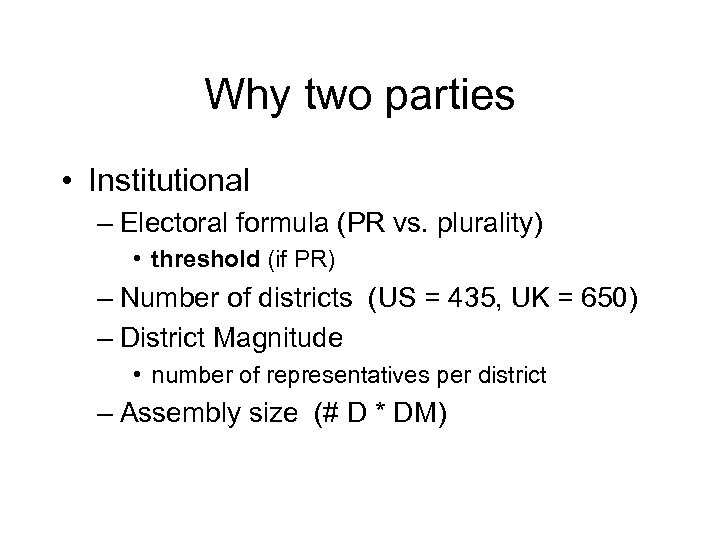 Why two parties • Institutional – Electoral formula (PR vs. plurality) • threshold (if PR) – Number of districts (US = 435, UK = 650) – District Magnitude • number of representatives per district – Assembly size (# D * DM)
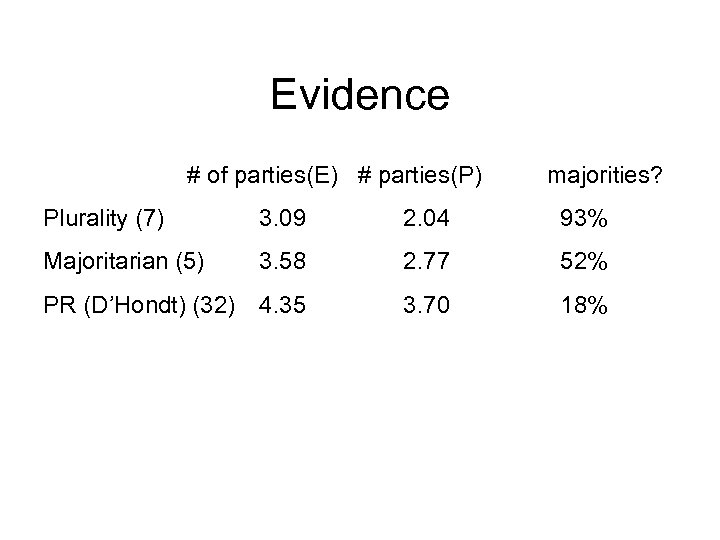 Evidence # of parties(E) # parties(P) majorities? Plurality (7) 3. 09 2. 04 93% Majoritarian (5) 3. 58 2. 77 52% PR (D’Hondt) (32) 4. 35 3. 70 18%
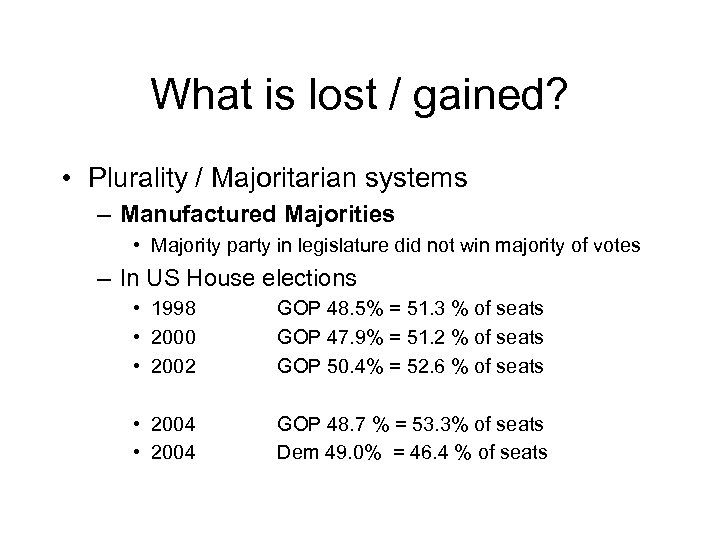 What is lost / gained? • Plurality / Majoritarian systems – Manufactured Majorities • Majority party in legislature did not win majority of votes – In US House elections • 1998 • 2000 • 2002 GOP 48. 5% = 51. 3 % of seats GOP 47. 9% = 51. 2 % of seats GOP 50. 4% = 52. 6 % of seats • 2004 GOP 48. 7 % = 53. 3% of seats Dem 49. 0% = 46. 4 % of seats
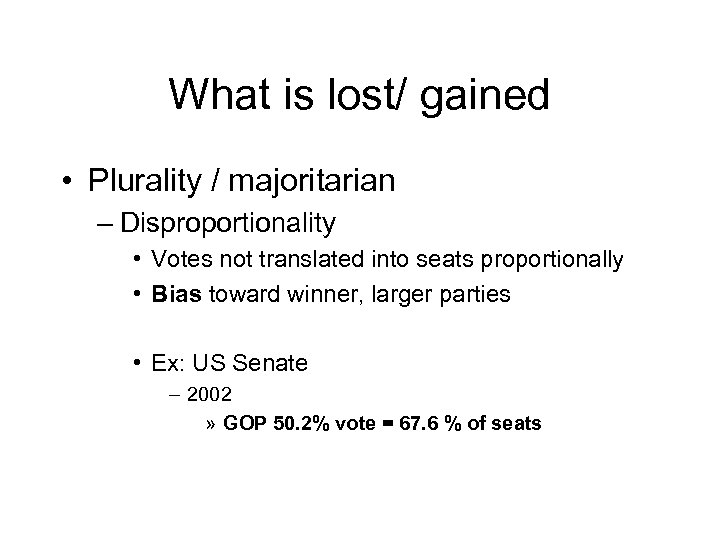 What is lost/ gained • Plurality / majoritarian – Disproportionality • Votes not translated into seats proportionally • Bias toward winner, larger parties • Ex: US Senate – 2002 » GOP 50. 2% vote = 67. 6 % of seats
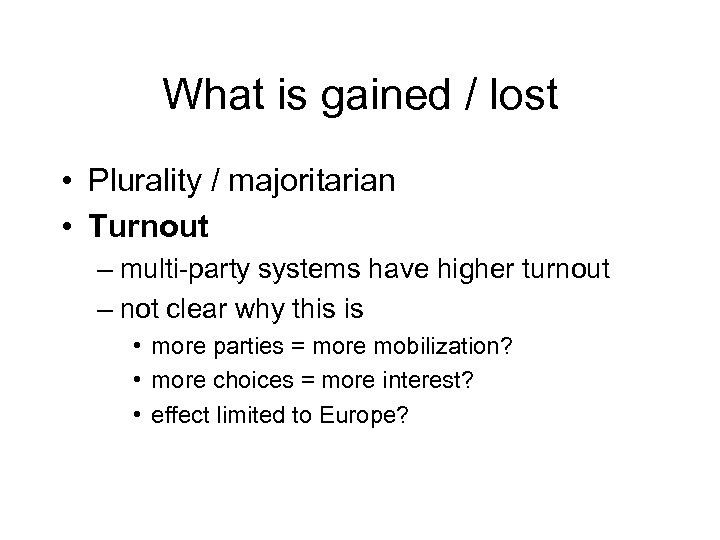 What is gained / lost • Plurality / majoritarian • Turnout – multi-party systems have higher turnout – not clear why this is • more parties = more mobilization? • more choices = more interest? • effect limited to Europe?
 What is gained / lost • Fairness? • Stability of government (greater under plurality (? ) • Minority representation, representation of women (? )
 Exceptions to Duverger’s Law • Where doesn’t it work, and why? • Why some plurality systems w/ multiple parties? – Canada now – The US in the 19 th Century – The UK (sort of)
 Exceptions to Duverger’s Law • Why multi-parties where they aren’t supposed to be? • Assembly size • Regionalism / Federalism
 Exceptions to Duverger’s Law • PR at other levels of election – Australia (senate); UK (EUP, regions) • Pure Majoritarian rules – vote ‘sincere’ in 1 st round, serious in 2 nd • Fusion rules – New York State
 Multi-party politics in the US • Types of ‘third’ parties – Doctrinial • “small bands of dedicated souls” • not playing the game to win • Prohibition Party, Right to Life Party, Libertarians (? ), Greens, Socialist Workers Party, Socialist Labor, Taxpayers Party, etc.
 Multi-party politics in US • Types of Third parties – Transient • Parties that tap into major social clevage that major parties miss • Often regional basis • Major parties eventually absorb the issue • Greenbacks, People’s Party, Populists,
 Multi-party Politics in the US • Types of Third Parties – Secessionist • Major figure leaves established party to start new party • Transient, but not regional / issue based • TR and Bull - Moose party; George Wallace and American Independent Party, John Anderson (1980)
 Multi Party Politics in US • Types of third parties – ‘independent’ candidate organizations • Attempt at party-building by outsider candidates • Ross Perot’s Reform Party 1992, 1996
 Multi-Party Politics • Barriers to Third Parties in US: – See Duverger’s Law – Assembly Size (US Congress tiny) – Ballot Access Laws • Rules governing territory on Nov. ballot • USSC: states have ‘legitimate interest in state laws protecting two party system’
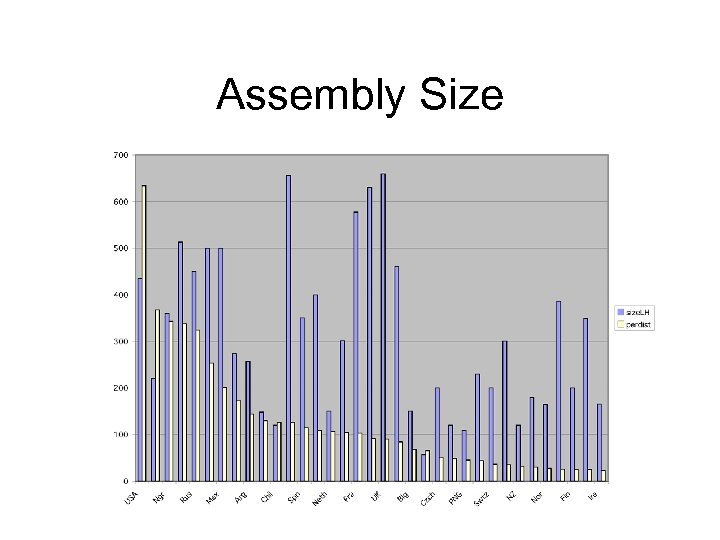 Assembly Size
 Multi-partry politics in US • Ballot Access Laws • Set by State legislators – Catch 22 – Minor party must post X% in statewide race to have access for their candidate in next election • 1% some places,
 Ballot Access • • US Presidential Elections If no existing access, petition Minor party vs. ‘independent’ Varies greatly by state – 1000 signatures <-> 10% of votes cast in last election – CA = 178, 000 sigs; NC 60, 000; GA 50, 000
 Ballot Access • How get on for 2012 – Start last year – Use ballot slots of existing parties – Run in different states under different party names (Constitution Party, Taxpayer Party, Libertarian Party) – Run in some states as independent, some as under party line
 Ballot Acces • 2008. . as of Nov. 2007 • CA deadline for party has passed – Unity ‘ 08 (1 state) – Libertarians (21 states) – Constitution (14 states) – Greens (21 states)
 Support for Multi-party politics • In United States – keep 2 party system – no parties – more parties 38% 28% 34%
 Support for Multi Party Politics • Support PR for US Congress? – US – WA 44% yes, 49% no 56% yes, 40% no q • Who? – – – independents who ‘lean’ D or R not strong liberal Ds not strong liberal Rs Men people who distrust government
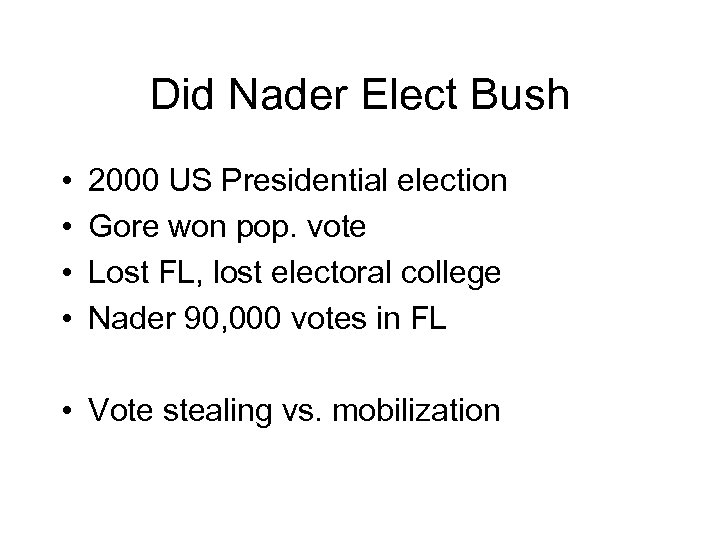 Did Nader Elect Bush • • 2000 US Presidential election Gore won pop. vote Lost FL, lost electoral college Nader 90, 000 votes in FL • Vote stealing vs. mobilization
 Did Nader Elect Bush • Can we assume that minor party voters would have supported major party candidate? • Can we assume minor party voters would have voted?
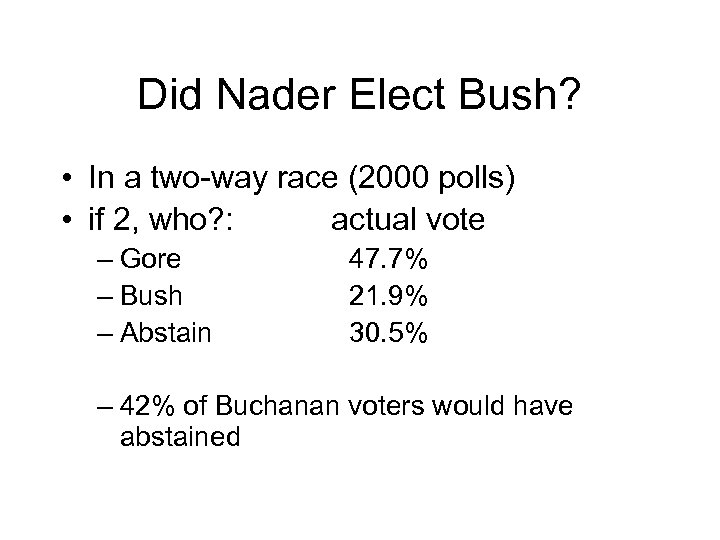 Did Nader Elect Bush? • In a two-way race (2000 polls) • if 2, who? : actual vote – Gore – Bush – Abstain 47. 7% 21. 9% 30. 5% – 42% of Buchanan voters would have abstained
 Prospects • For multi-party politics in US • Dim, but. . . – regional divisions emerge – major party splits – Institutional change • at state or local level? • via ballot measures?