


 Скачать презентацию Why Train Health Professionals in Community Health Centers
17c9675bd214512ef6c8a3d50b98646e.ppt
- Количество слайдов: 35
 Why Train Health Professionals in Community Health Centers? Working for Healthy Communities since 1972 David N. Katz, MD
 “Training more Country Doctors” Video: http: //www. youtube. com/watch? v=l. BN-EB 3 wlf 8&NR=1
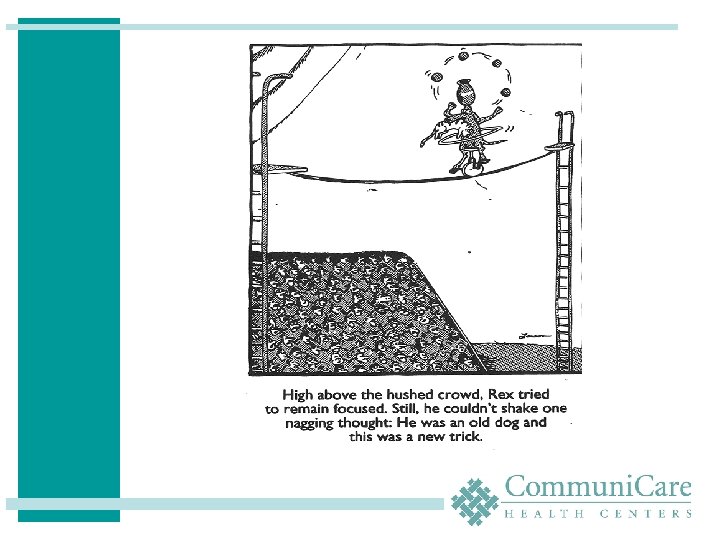
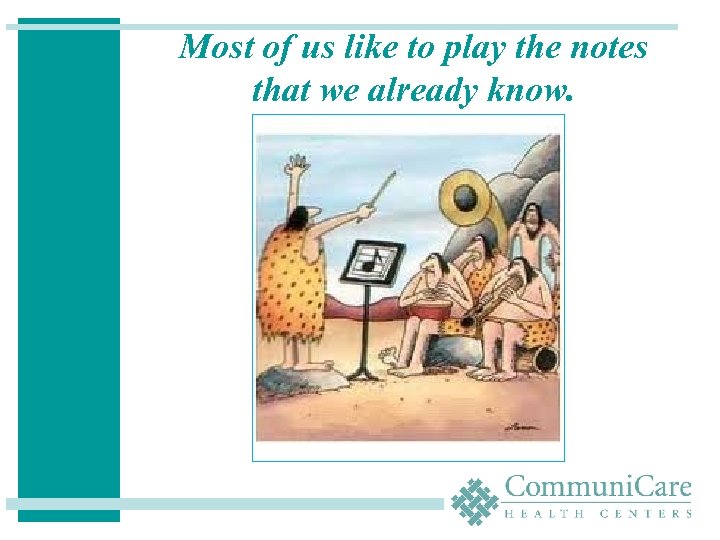 Most of us like to play the notes that we already know.
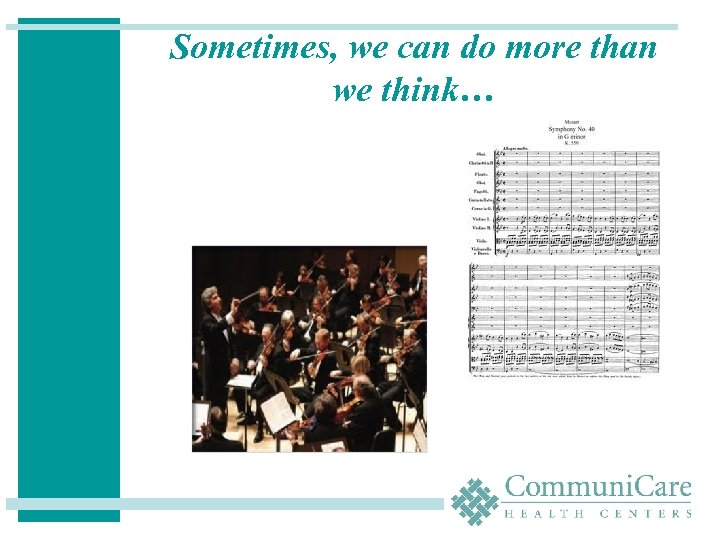 Sometimes, we can do more than we think…
 What is the PRIME Program? VIDEO: http: //www. youtube. com/watch? v=EABi 6 pd. B 3 Hs
 UC Davis Rural-PRIME: Curriculum Plan 2011 Don Hilty, M. D. Director, Rural-PRIME Suzanne Eidson-Ton, M. D. /M. S. Co-Director, Rural-PRIME
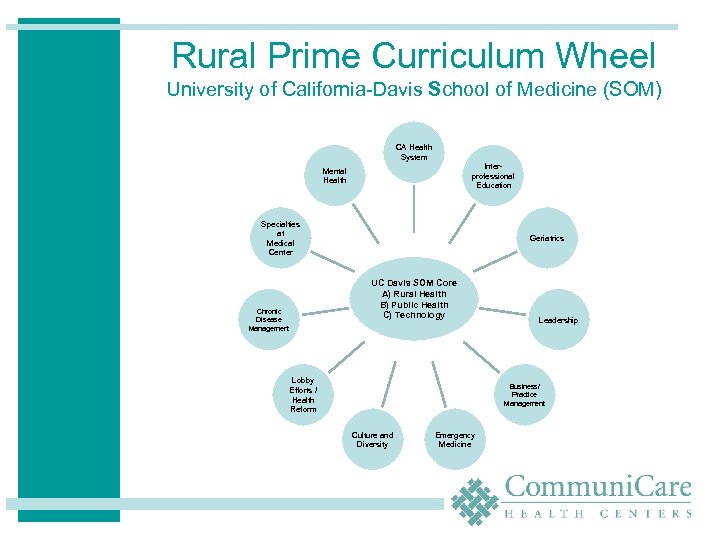 Rural Prime Curriculum Wheel University of California-Davis School of Medicine (SOM) CA Health System Interprofessional Education Mental Health Specialties at Medical Center Geriatrics UC Davis SOM Core A) Rural Health B) Public Health C) Technology Chronic Disease Management Lobby Efforts / Health Reform Leadership Business/ Practice Management Culture and Diversity Emergency Medicine
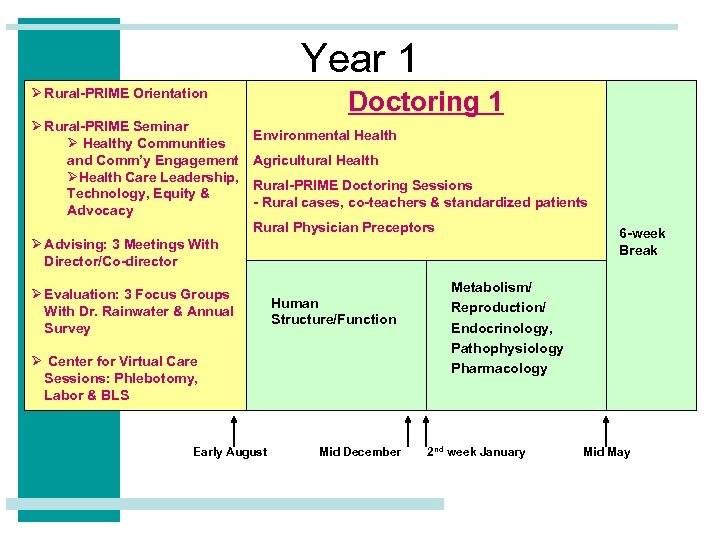 Year 1 Ø Rural-PRIME Orientation Ø Rural-PRIME Seminar Ø Healthy Communities and Comm’y Engagement ØHealth Care Leadership, Technology, Equity & Advocacy Doctoring 1 Environmental Health Agricultural Health Rural-PRIME Doctoring Sessions - Rural cases, co-teachers & standardized patients Rural Physician Preceptors 6 -week Break Ø Advising: 3 Meetings With Director/Co-director Ø Evaluation: 3 Focus Groups With Dr. Rainwater & Annual Survey Human Structure/Function Ø Center for Virtual Care Sessions: Phlebotomy, Labor & BLS Early August Mid December Metabolism/ Reproduction/ Endocrinology, Pathophysiology Pharmacology 2 nd week January Mid May
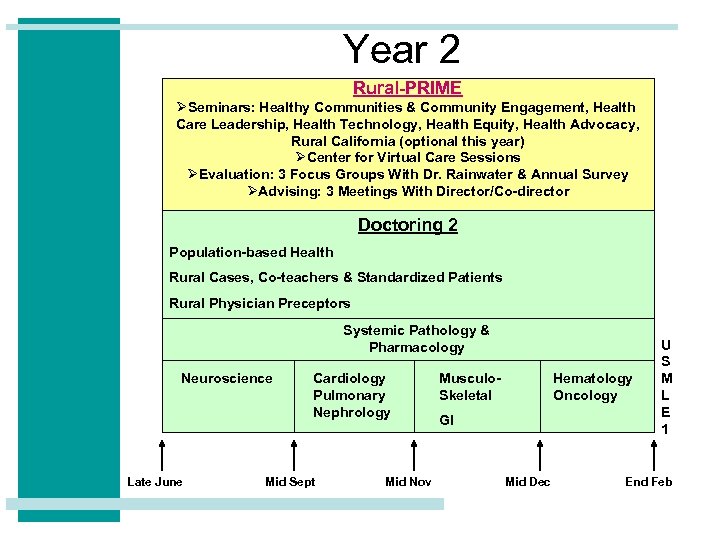 Year 2 Rural-PRIME ØSeminars: Healthy Communities & Community Engagement, Health Care Leadership, Health Technology, Health Equity, Health Advocacy, Rural California (optional this year) ØCenter for Virtual Care Sessions ØEvaluation: 3 Focus Groups With Dr. Rainwater & Annual Survey ØAdvising: 3 Meetings With Director/Co-director Doctoring 2 Population-based Health Rural Cases, Co-teachers & Standardized Patients Rural Physician Preceptors Systemic Pathology & Pharmacology Neuroscience Late June Cardiology Pulmonary Nephrology Mid Sept Mid Nov Musculo. Skeletal Hematology Oncology GI Mid Dec U S M L E 1 End Feb
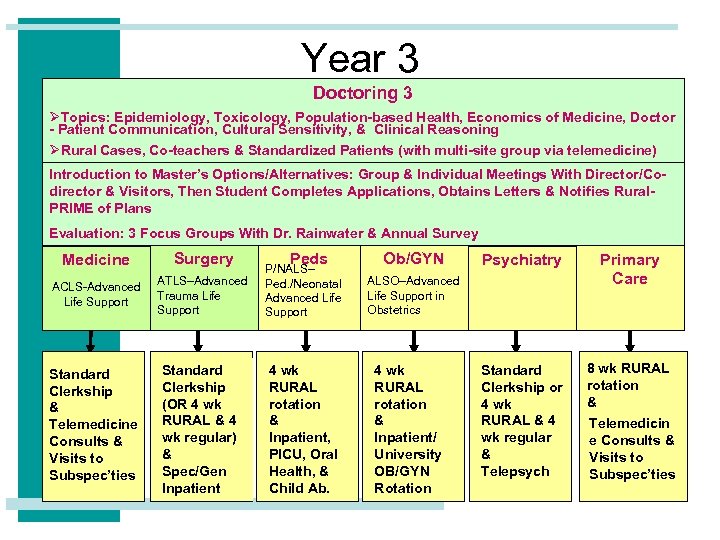 Year 3 Doctoring 3 ØTopics: Epidemiology, Toxicology, Population-based Health, Economics of Medicine, Doctor - Patient Communication, Cultural Sensitivity, & Clinical Reasoning ØRural Cases, Co-teachers & Standardized Patients (with multi-site group via telemedicine) Introduction to Master’s Options/Alternatives: Group & Individual Meetings With Director/Codirector & Visitors, Then Student Completes Applications, Obtains Letters & Notifies Rural. PRIME of Plans Evaluation: 3 Focus Groups With Dr. Rainwater & Annual Survey Medicine Surgery ACLS-Advanced Life Support ATLS–Advanced Trauma Life Support Standard Clerkship & Telemedicine Consults & Visits to Subspec’ties Standard Clerkship (OR 4 wk RURAL & 4 wk regular) & Spec/Gen Inpatient Peds P/NALS– Ped. /Neonatal Advanced Life Support 4 wk RURAL rotation & Inpatient, PICU, Oral Health, & Child Ab. Ob/GYN Psychiatry Primary Care Standard Clerkship or 4 wk RURAL & 4 wk regular & Telepsych 8 wk RURAL rotation & ALSO–Advanced Life Support in Obstetrics 4 wk RURAL rotation & Inpatient/ University OB/GYN Rotation Telemedicin e Consults & Visits to Subspec’ties
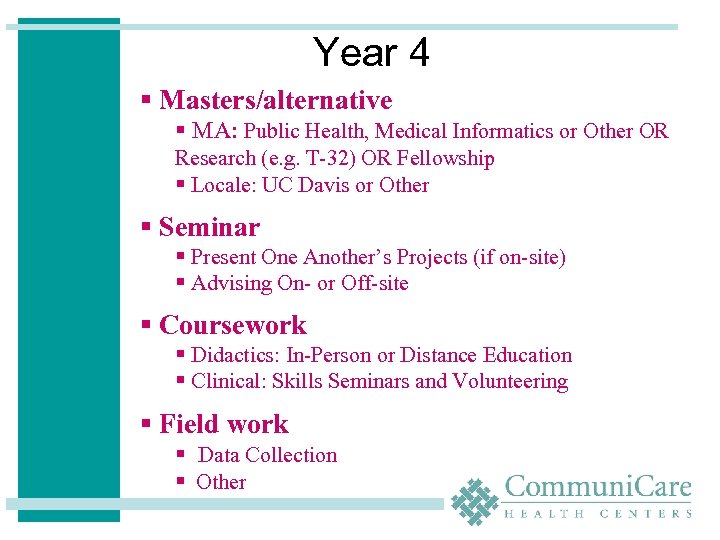 Year 4 § Masters/alternative § MA: Public Health, Medical Informatics or Other OR Research (e. g. T-32) OR Fellowship § Locale: UC Davis or Other § Seminar § Present One Another’s Projects (if on-site) § Advising On- or Off-site § Coursework § Didactics: In-Person or Distance Education § Clinical: Skills Seminars and Volunteering § Field work § Data Collection § Other
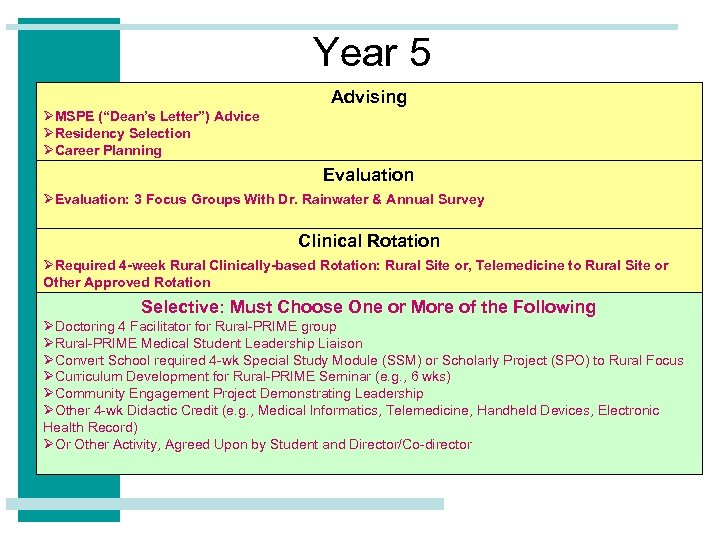 Year 5 Advising ØMSPE (“Dean’s Letter”) Advice ØResidency Selection ØCareer Planning Evaluation ØEvaluation: 3 Focus Groups With Dr. Rainwater & Annual Survey Clinical Rotation ØRequired 4 -week Rural Clinically-based Rotation: Rural Site or, Telemedicine to Rural Site or Other Approved Rotation Selective: Must Choose One or More of the Following ØDoctoring 4 Facilitator for Rural-PRIME group ØRural-PRIME Medical Student Leadership Liaison ØConvert School required 4 -wk Special Study Module (SSM) or Scholarly Project (SPO) to Rural Focus ØCurriculum Development for Rural-PRIME Seminar (e. g. , 6 wks) ØCommunity Engagement Project Demonstrating Leadership ØOther 4 -wk Didactic Credit (e. g. , Medical Informatics, Telemedicine, Handheld Devices, Electronic Health Record) ØOr Other Activity, Agreed Upon by Student and Director/Co-director
 From the Medical School • “Academic--Community Partnerships are the present and the future. In the past, academics shared what they thought was important. Now, the best academics talk at length, and do needs assessments, for research and educational collaborations. The focus of quality medical education has shifted from giving good ideas to students, to showing students clinical skills. In the future, linking those skills to actual patient outcomes in the community will be necessary. ” Donald Hilty, MD UC-Davis School of Medicine, Professor of Clinical Psychiatry • ”I was hugely excited about starting a program that would generate health care providers for people in rural areas. There are different amenities in rural and urban areas but health care is a basic need and everyone should be able to access it. “ Sneha Patel, MA, Manager, Rural-PRIME and UC Merced San Joaquin Valley PRIME.
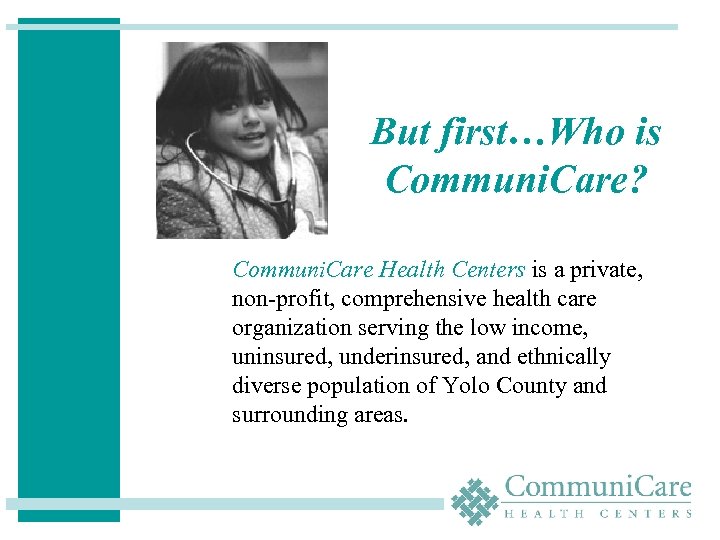 But first…Who is Communi. Care? Communi. Care Health Centers is a private, non-profit, comprehensive health care organization serving the low income, uninsured, underinsured, and ethnically diverse population of Yolo County and surrounding areas.
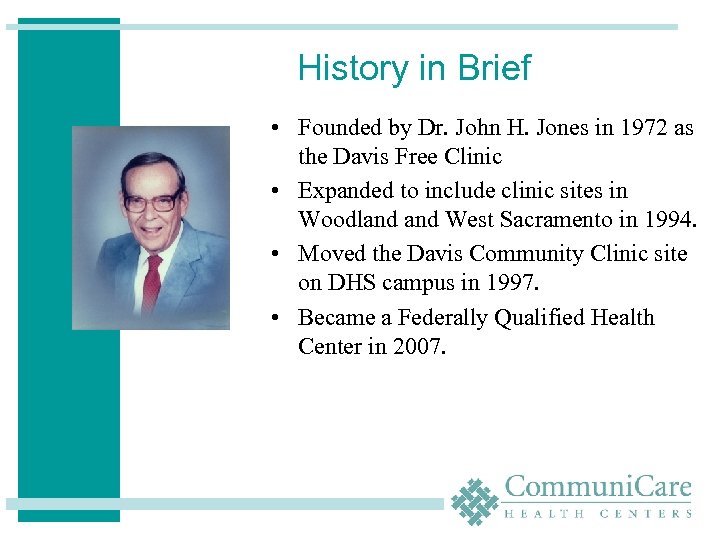 History in Brief • Founded by Dr. John H. Jones in 1972 as the Davis Free Clinic • Expanded to include clinic sites in Woodland West Sacramento in 1994. • Moved the Davis Community Clinic site on DHS campus in 1997. • Became a Federally Qualified Health Center in 2007.
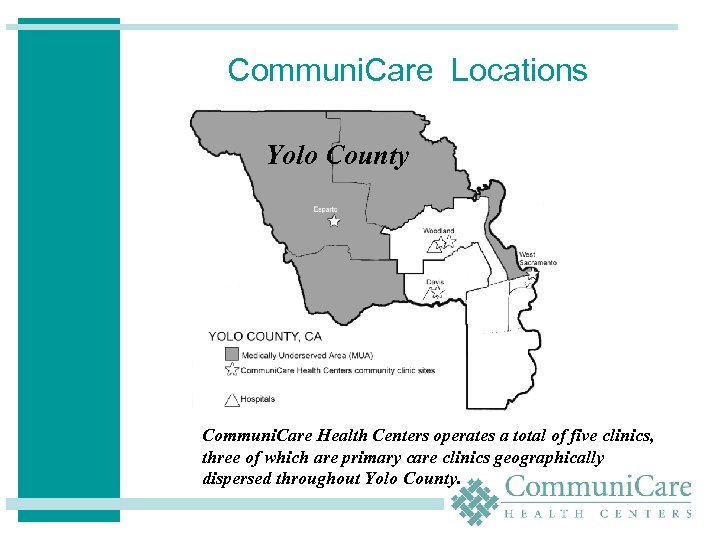 Communi. Care Locations Yolo County Communi. Care Health Centers operates a total of five clinics, three of which are primary care clinics geographically dispersed throughout Yolo County.
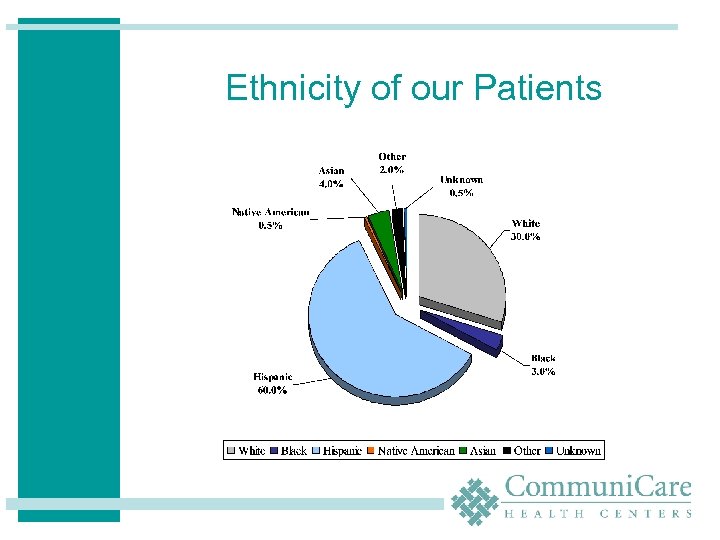 Ethnicity of our Patients
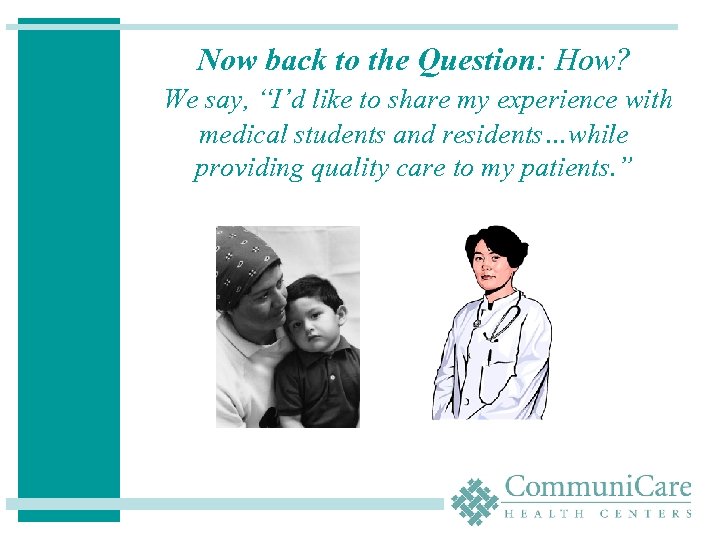 Now back to the Question: How? We say, “I’d like to share my experience with medical students and residents…while providing quality care to my patients. ”
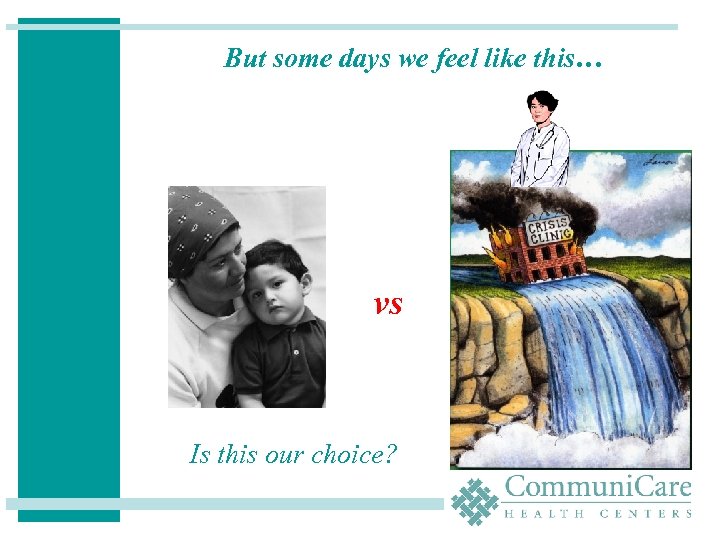 But some days we feel like this… vs Is this our choice?
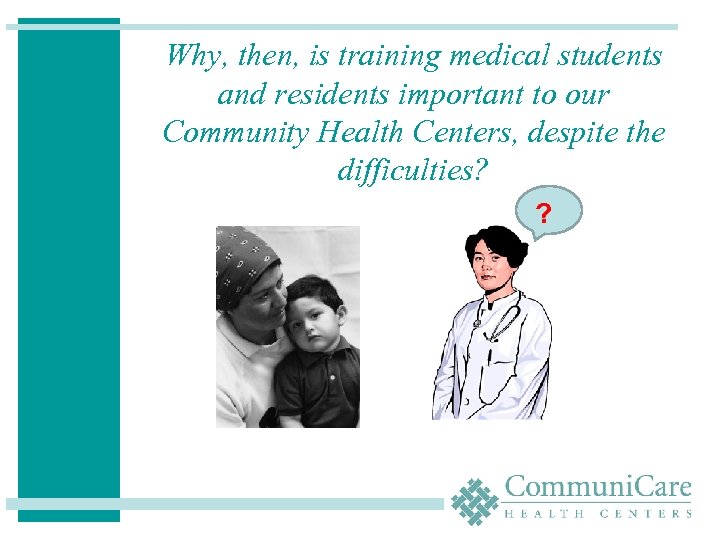 Why, then, is training medical students and residents important to our Community Health Centers, despite the difficulties? ?
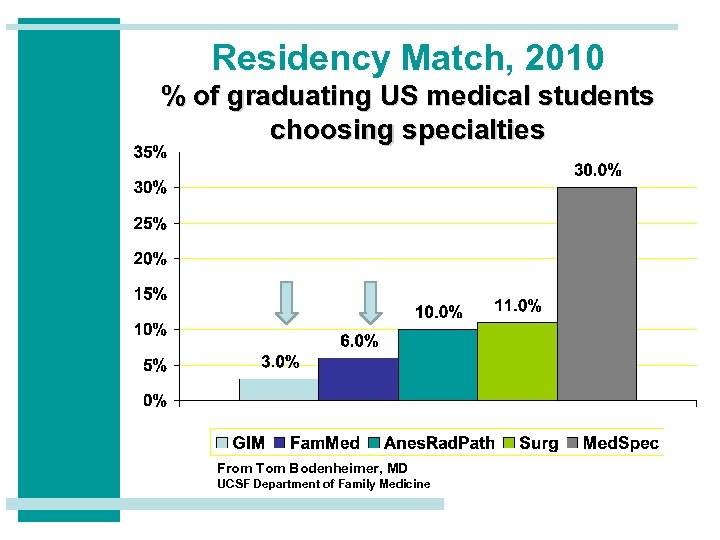 Residency Match, 2010 % of graduating US medical students choosing specialties From Tom Bodenheimer, MD UCSF Department of Family Medicine
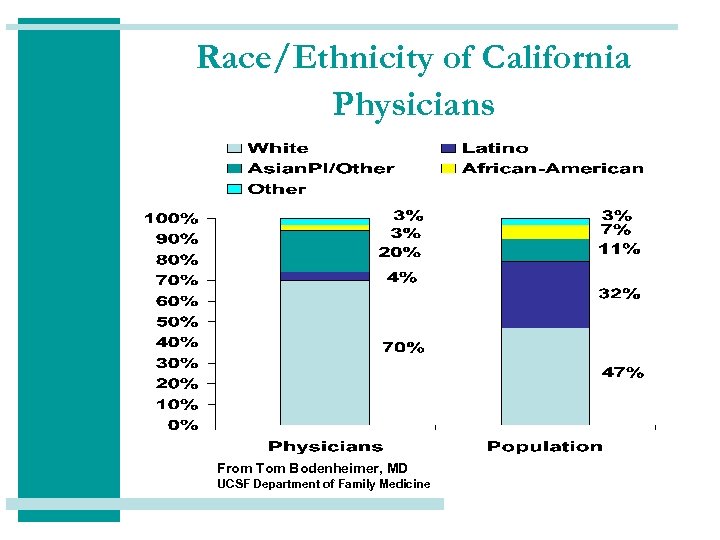 Race/Ethnicity of California Physicians From Tom Bodenheimer, MD UCSF Department of Family Medicine
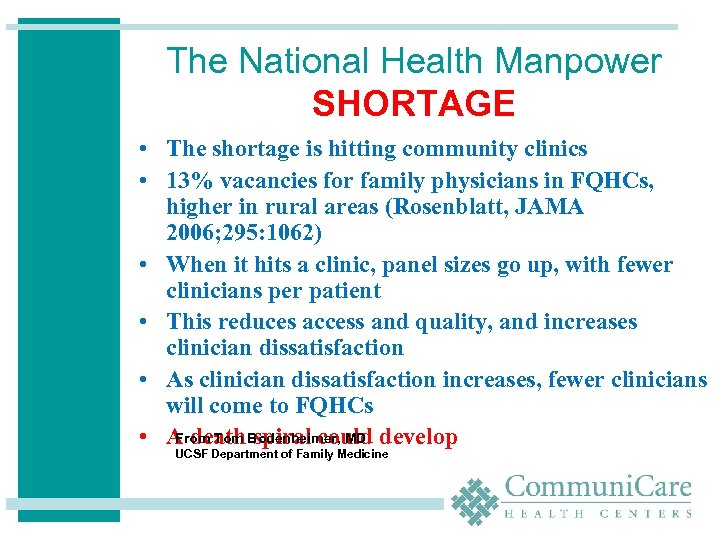 The National Health Manpower SHORTAGE • The shortage is hitting community clinics • 13% vacancies for family physicians in FQHCs, higher in rural areas (Rosenblatt, JAMA 2006; 295: 1062) • When it hits a clinic, panel sizes go up, with fewer clinicians per patient • This reduces access and quality, and increases clinician dissatisfaction • As clinician dissatisfaction increases, fewer clinicians will come to FQHCs From Tom spiral could • A death. Bodenheimer, MD develop UCSF Department of Family Medicine
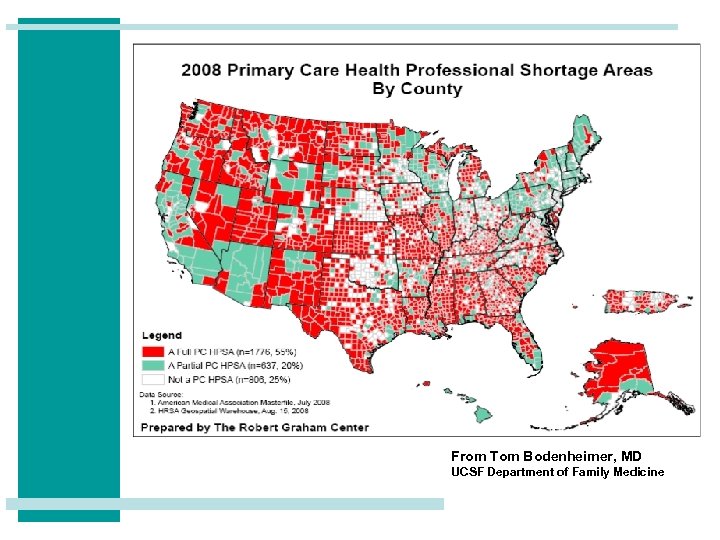 From Tom Bodenheimer, MD UCSF Department of Family Medicine
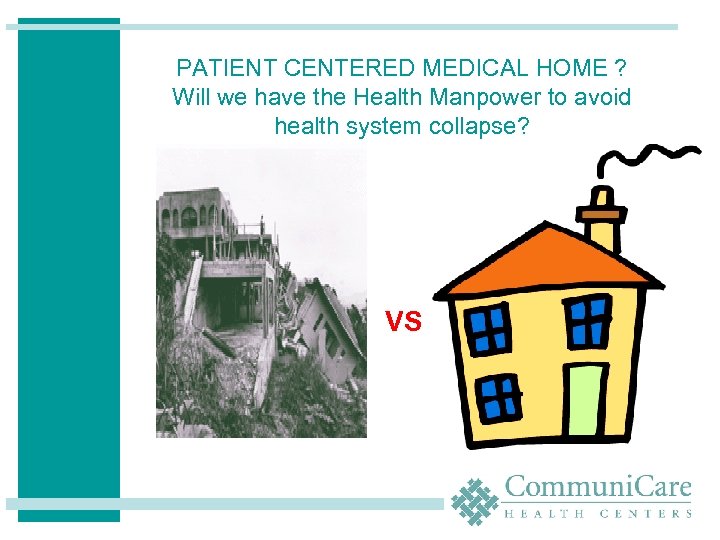 PATIENT CENTERED MEDICAL HOME ? Will we have the Health Manpower to avoid health system collapse? VS
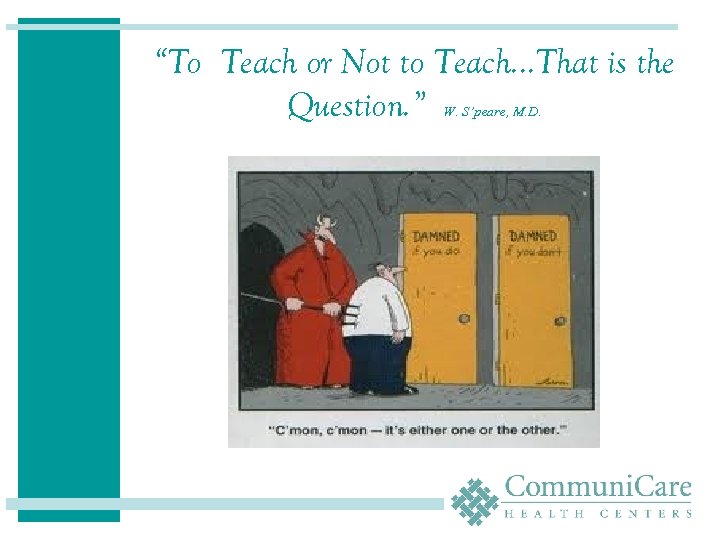 “To Teach or Not to Teach…That is the Question. ” W. S’peare, M. D.
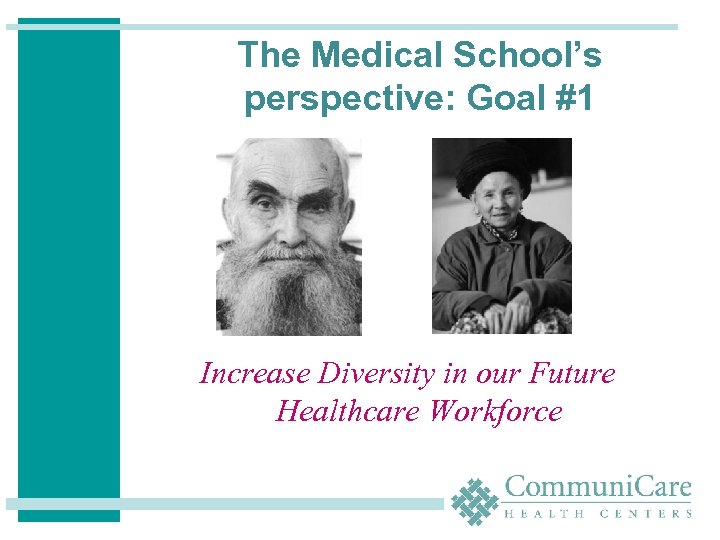 The Medical School’s perspective: Goal #1 Increase Diversity in our Future Healthcare Workforce
 The Case for Diversity in Health Care Education Increasing the diversity of health sciences faculty and students will: v. Enrich the learning environment for all participants v. Enhance the overall education and cultural competence of health professionals v. Improve access to care for medically underserved groups and communities v. Help reduce racial/ethnic health disparities From Cathryn L. Nation, MD Associate Vice President-Health Sciences UC Office of the President
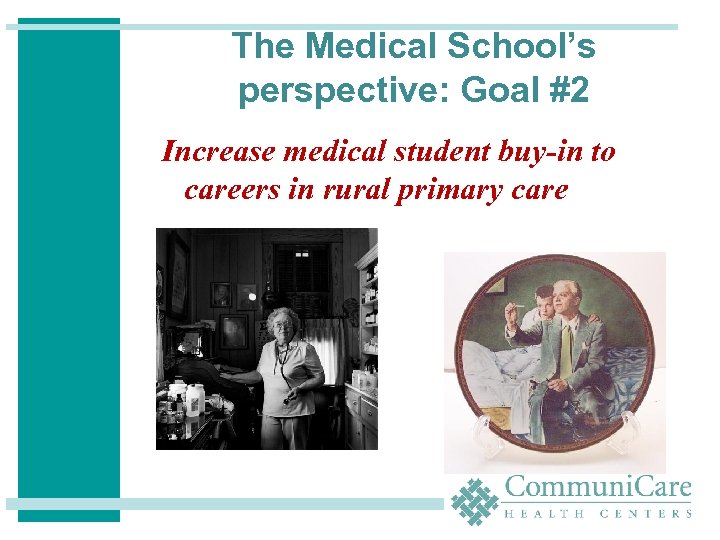 The Medical School’s perspective: Goal #2 Increase medical student buy-in to careers in rural primary care
 The Medical School’s perspective: Goal #3 Present the CHC as a Role model: student exposure to our successful health care teams
 The Community Clinic Perspective: Goal #1 For Our Mission: to pass on our experience and skills to the next generation of safety net healers (It can’t hurt med students who will become specialists, either. )
 The Community Clinic Perspective: Goal #2 Recruitment and Retention of community clinicians v For the satisfaction and intellectual challenge of being a teacher v hiring our own students and residents
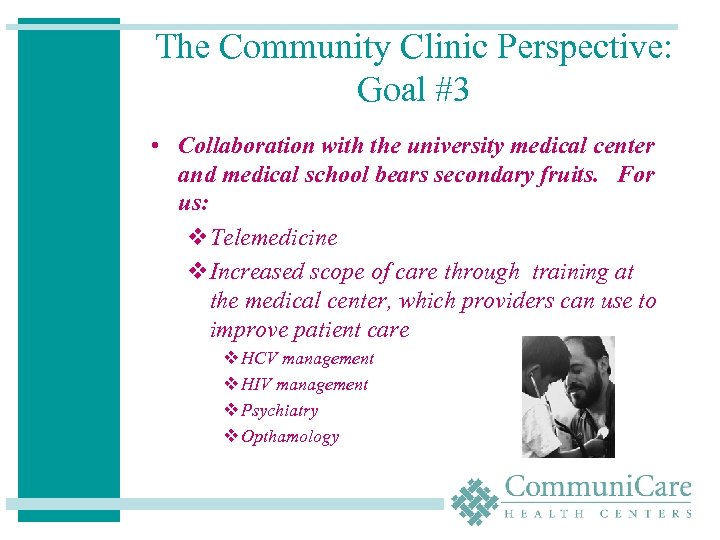 The Community Clinic Perspective: Goal #3 • Collaboration with the university medical center and medical school bears secondary fruits. For us: v. Telemedicine v. Increased scope of care through training at the medical center, which providers can use to improve patient care v HCV management v HIV management v Psychiatry v Opthamology
 Thank you!
 Questions? Visit our website to learn more about us: http: //www. communicarehc. org