 Скачать презентацию WHY TOBACCO CONTROL Smoking has been promoted
c576e64b5ba730c0d79c908c871b298d.ppt
- Количество слайдов: 35



WHY TOBACCO CONTROL?
Smoking has been promoted as being: glamorous sophisticated fun romantic sexy healthy sporty fashionable sociable relaxing calming emancipated liberating rebellious slimming cool
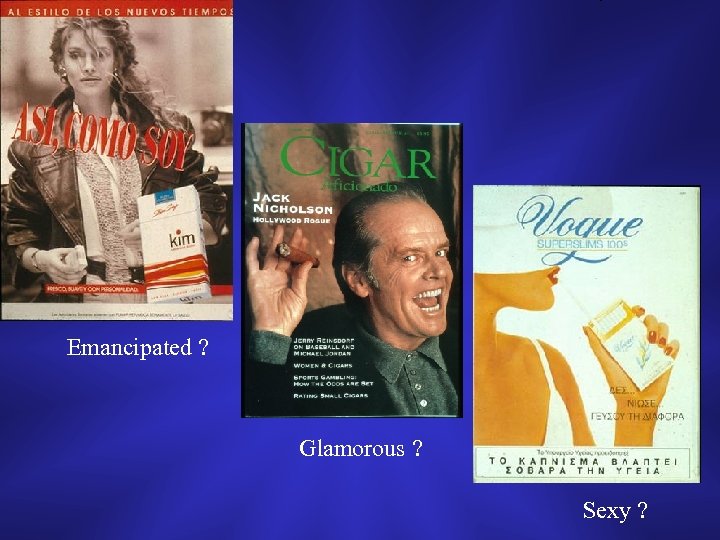
Emancipated ? Glamorous ? Sexy ?
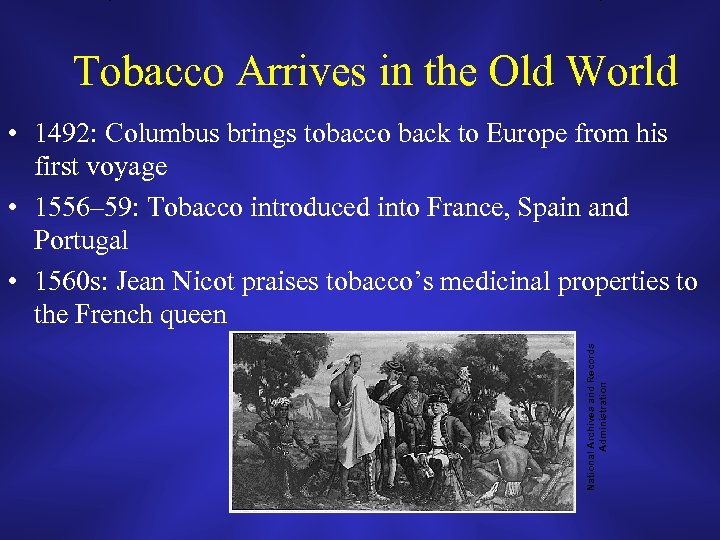
Tobacco Arrives in the Old World National Archives and Records Administration • 1492: Columbus brings tobacco back to Europe from his first voyage • 1556– 59: Tobacco introduced into France, Spain and Portugal • 1560 s: Jean Nicot praises tobacco’s medicinal properties to the French queen
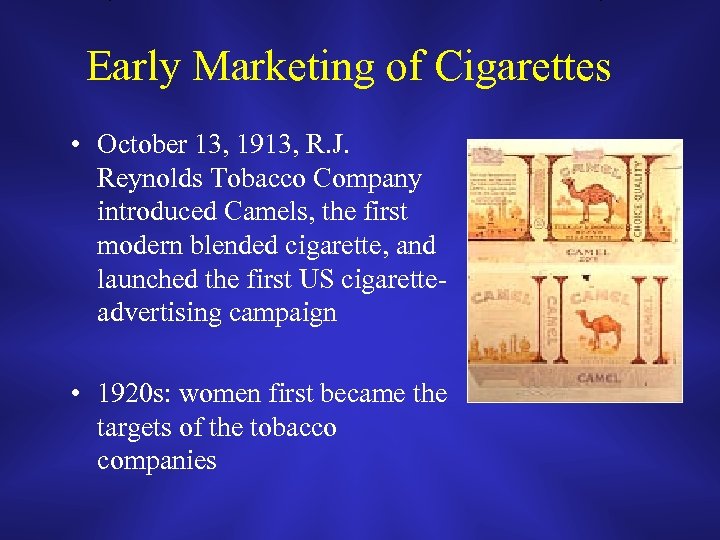
Early Marketing of Cigarettes • October 13, 1913, R. J. Reynolds Tobacco Company introduced Camels, the first modern blended cigarette, and launched the first US cigaretteadvertising campaign • 1920 s: women first became the targets of the tobacco companies
Early Efforts to Control Tobacco Use King James I of England on active smoking: ‘’Smoking is a custom loathsome to the eye, hateful to the nose, harmful to the brain, dangerous to the lungs, and in the black, stinking fume thereof nearest resembling the horrible Stygian smoke of the pit that is bottomless’’ King James I of England on passive smoking: ‘’The wife must either take up smoking or resolve to live in a perpetual stinking torment’’
Early Indications of Tobacco-related Disease • 1600 s China: philosopher Fang Yizhi points out “long years of smoking scorches one’s lung” • 1701: N. A Boiseregard warns that young people taking too much tobacco have trembling, unsteady hands, staggering feet and suffer a withering of “their noble parts” • 1761: John Hill warns of cancer of the nose for snuff users • 1795: Sammuel Thomas von Soemmering reports cancers of the lip in pipe smokers Borio G. Tobacco Timeline, 1998
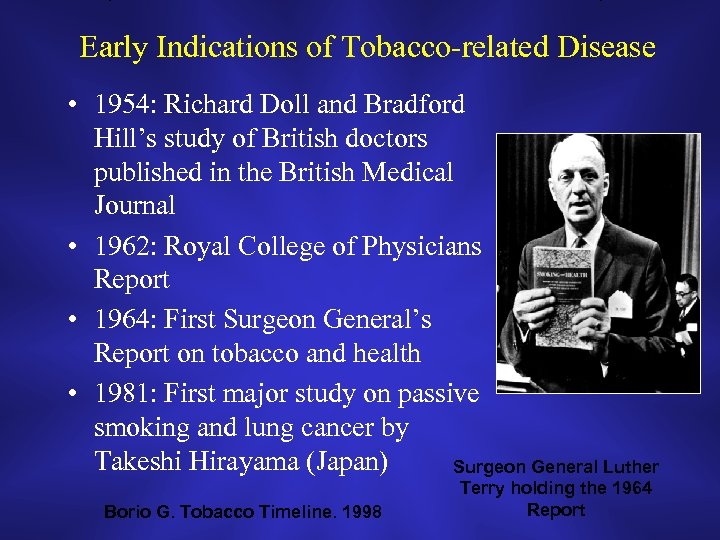
Early Indications of Tobacco-related Disease • 1954: Richard Doll and Bradford Hill’s study of British doctors published in the British Medical Journal • 1962: Royal College of Physicians Report • 1964: First Surgeon General’s Report on tobacco and health • 1981: First major study on passive smoking and lung cancer by Takeshi Hirayama (Japan) Surgeon General Luther Borio G. Tobacco Timeline. 1998 Terry holding the 1964 Report
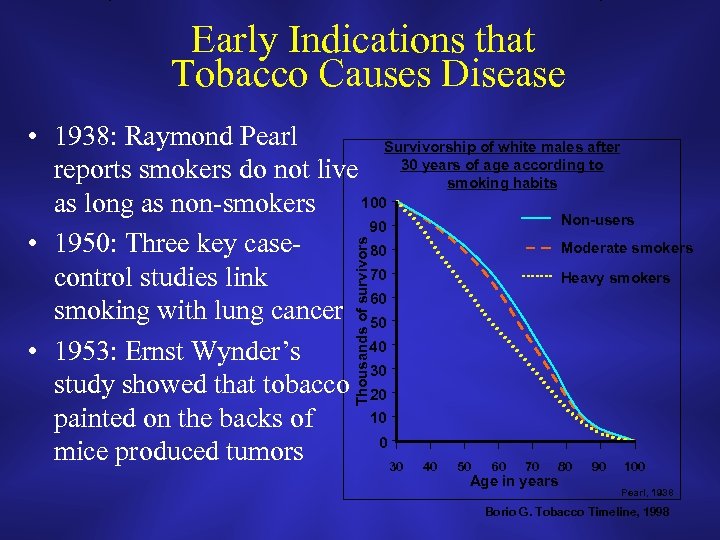
Early Indications that Tobacco Causes Disease Thousands of survivors • 1938: Raymond Pearl Survivorship of white males after 30 years of age according to reports smokers do not live smoking habits 100 as long as non-smokers Non-users 90 • 1950: Three key case. Moderate smokers 80 70 Heavy smokers control studies link 60 smoking with lung cancer 50 40 • 1953: Ernst Wynder’s 30 study showed that tobacco 20 10 painted on the backs of 0 mice produced tumors 60 70 80 90 100 30 40 50 Age in years Pearl, 1938 Borio G. Tobacco Timeline, 1998
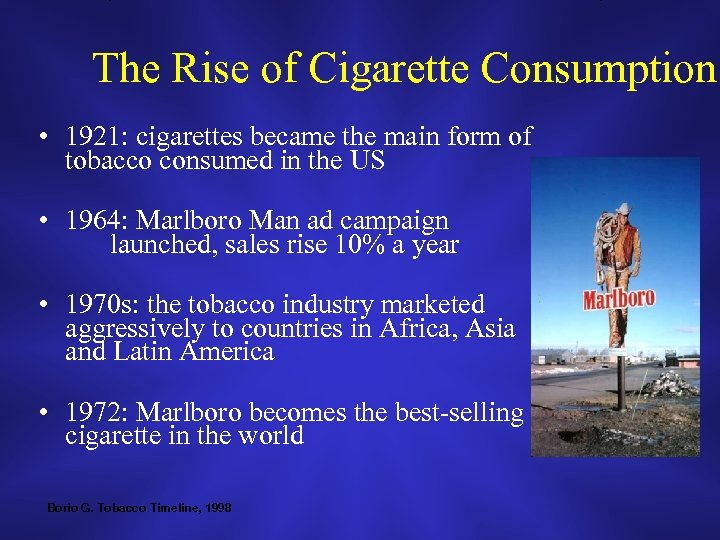
The Rise of Cigarette Consumption • 1921: cigarettes became the main form of tobacco consumed in the US • 1964: Marlboro Man ad campaign launched, sales rise 10% a year • 1970 s: the tobacco industry marketed aggressively to countries in Africa, Asia and Latin America • 1972: Marlboro becomes the best-selling cigarette in the world Borio G. Tobacco Timeline, 1998
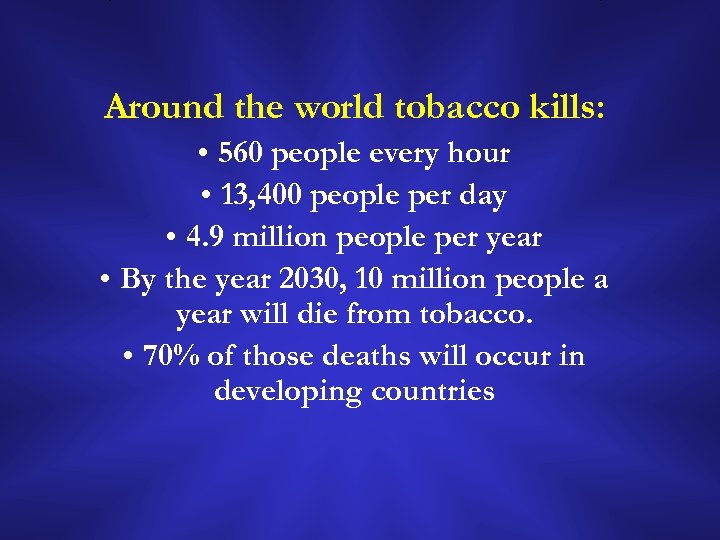
Around the world tobacco kills: 560 people every hour 13, 400 people per day 4. 9 million people per year By the year 2030, 10 million people a year will die from tobacco. 70% of those deaths will occur in developing countries
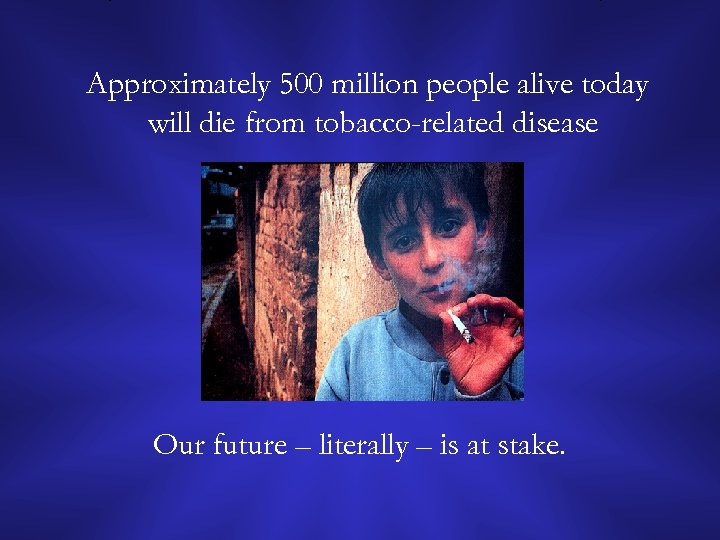
Approximately 500 million people alive today will die from tobacco-related disease Our future – literally – is at stake.
Tobacco and Health • Reducing the global disease and economic burden of tobacco use is one of the greatest public health challenges of our time • Effective tobacco control strategies exist that are cost effective • Strong national and international actions are critical to stem the course of the tobacco pandemic
Health Consequences of Tobacco Use • Each year tobacco kills 3 million people worldwide • WHO estimates that by 2020– 2030, tobacco will be responsible for 10 million deaths per year – 70% will occur in developing countries • Half of all long-term smokers will be killed by tobacco – half of these will die in middle age, losing 20– 25 years of life
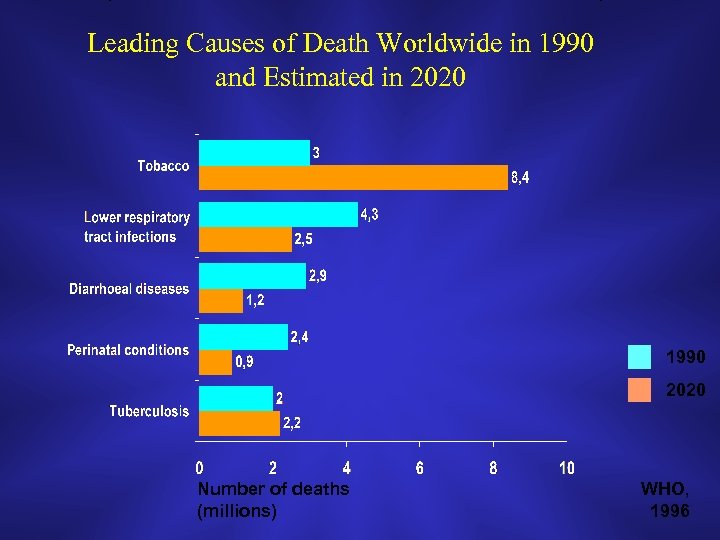
Leading Causes of Death Worldwide in 1990 and Estimated in 2020 1990 2020 Number of deaths (millions) WHO, 1996
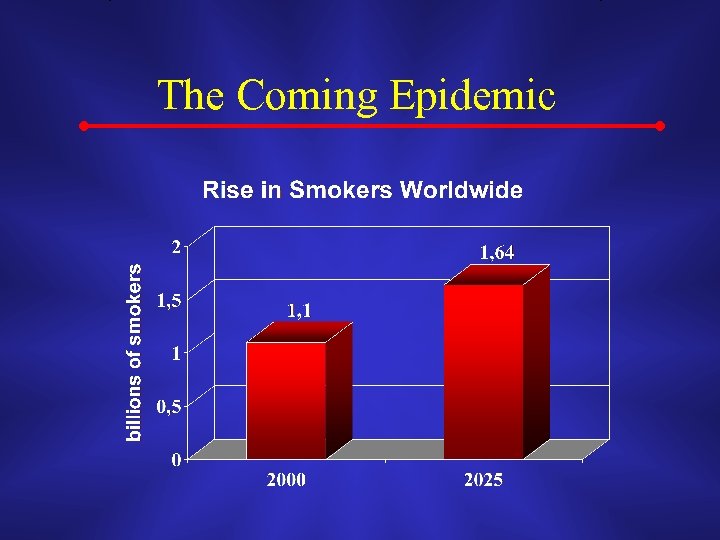
The Coming Epidemic
Economic Consequences of Tobacco Use • Medical costs • Productivity losses due to: – morbidity – disability – premature mortality • Global net loss of US$ 200 billion per year
Changing Trends in Tobacco Use • Cigarette smoking is a 20 th century phenomenon • Cigarette smoking by females was very uncommon until the 1930 s in countries like the US • The smoking epidemic is spreading in lowincome countries • In most countries, the poor are more likely to smoke than the rich
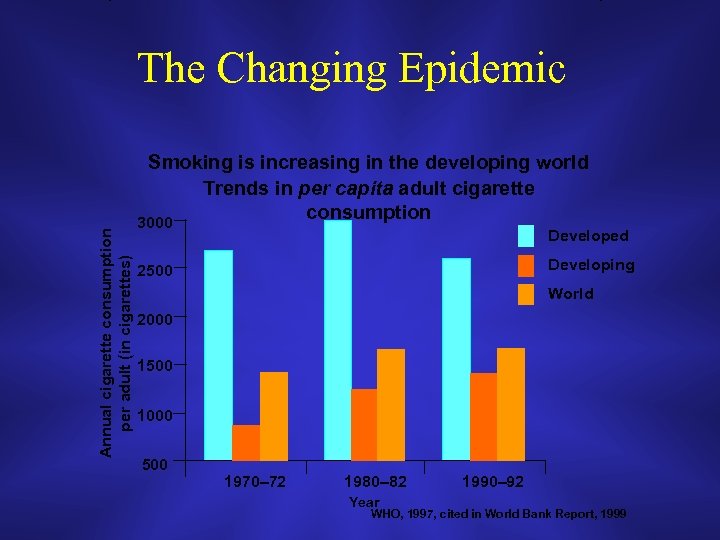
Annual cigarette consumption per adult (in cigarettes) The Changing Epidemic Smoking is increasing in the developing world Trends in per capita adult cigarette consumption 3000 Developed Developing 2500 World 2000 1500 1000 500 1970– 72 1980– 82 Year 1990– 92 WHO, 1997, cited in World Bank Report, 1999
“Tobacco use is unlike other threats to global health. Infectious diseases do not employ multinational public relations firms. There are no front groups to promote the spread of cholera. Mosquitoes have no lobbyists. ” WHO Zeltner Report, 2000
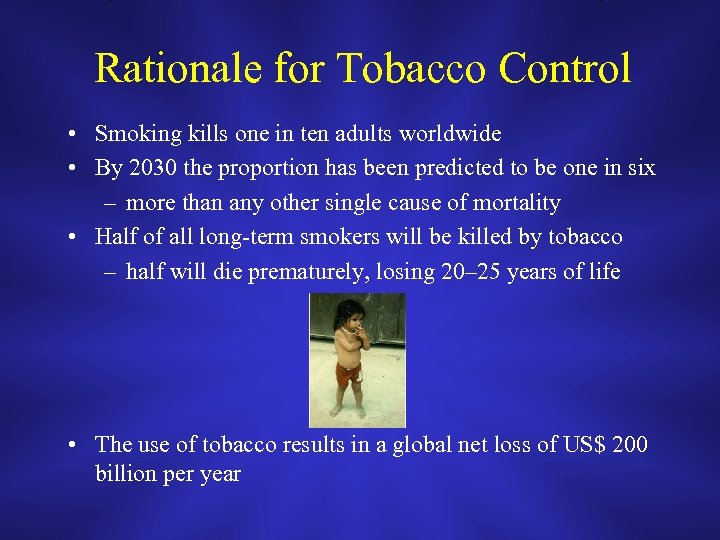
Rationale for Tobacco Control • Smoking kills one in ten adults worldwide • By 2030 the proportion has been predicted to be one in six – more than any other single cause of mortality • Half of all long-term smokers will be killed by tobacco – half will die prematurely, losing 20– 25 years of life • The use of tobacco results in a global net loss of US$ 200 billion per year
Obstacles to Tobacco Control • Tobacco contains nicotine, which is addictive • The tobacco industry uses its economic and political influence to oppose tobacco control efforts • Tobacco sales contribute to government revenues • In some populations, there is a lack of knowledge of tobacco-related health risks
Policy Maker’s Concerns on Taking Action to Control Tobacco Use • Job losses • Loss of government revenue • Increased smuggling • Disproportionate impact of increased price measures on lowincome tobacco users World Bank, 1999
Tobacco Industry Strategies The tobacco industry: – uses public relations to present itself in positive ways – uses money to fund political events and access the political process – gives money to various organizations that are sometimes used as more ‘credible’ advocates – uses more respectable economic allies such as farmers and retailers to argue its case – employs well-connected lobbyists – uses various intimidation tactics to frighten advocates, law-makers and journalists away from pursuing tobacco control policies The Advocacy Institute, 1998
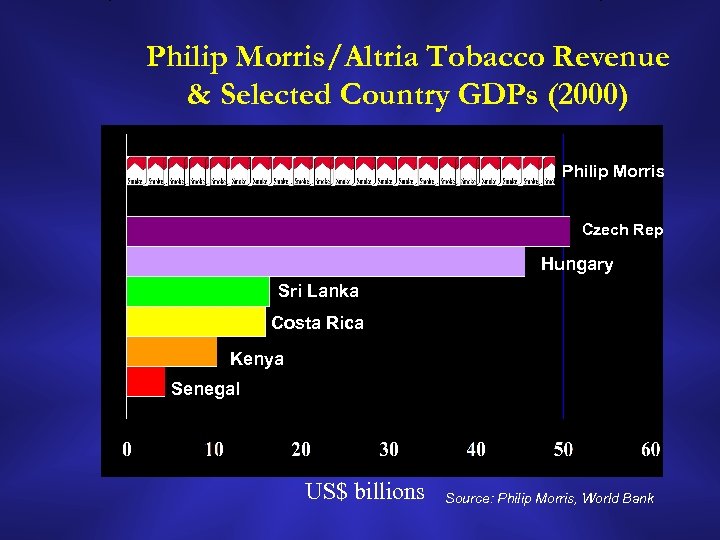
Philip Morris/Altria Tobacco Revenue & Selected Country GDPs (2000) Philip Morris Czech Rep Hungary Sri Lanka Costa Rica Kenya Senegal US$ billions Source: Philip Morris, World Bank
Key Tobacco Control Strategies to Reduce Demand • • Raising the price of tobacco Banning advertising and promotion Creating smoke-free indoor environments Conducting mass media campaigns Including strong warning labels on all tobacco products Increasing access to treatment Implementing youth-based programs – school-based programs – media literacy – youth advocacy
Raising the Price of Tobacco • Price is probably the single most powerful factor influencing short-term tobacco consumption • Price plays an important role in determining the number of young people who start smoking • Tax should represent two-thirds of the selling price
Banning Advertisement and Promotion • Advertising, sponsorship and promotion are all used to boost sales • Bans on advertising and promotion are fiercely contested by the tobacco industry • Sponsorship is the method most commonly used to circumvent advertising bans • Brand stretching (using cigarette brand colors and logos on non-tobacco products) is the fastest growing form of indirect tobacco advertisement in Europe • Comprehensive bans on advertising, sponsorship and promotion are most effective
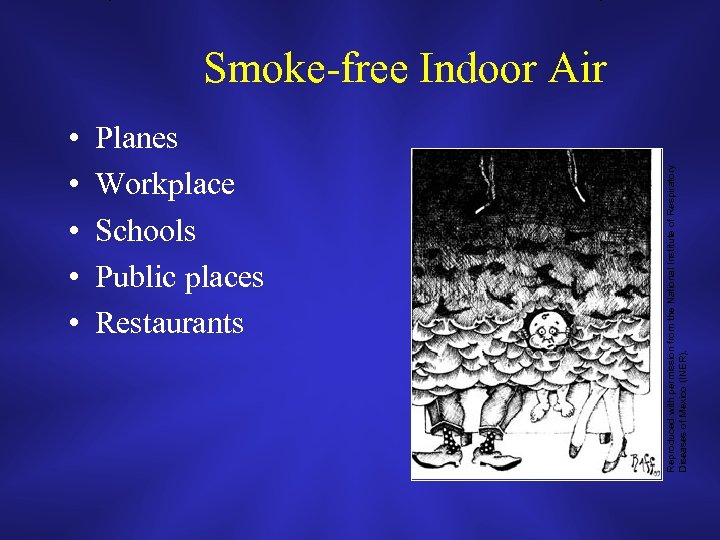
• • • Planes Workplace Schools Public places Restaurants Reproduced with permission from the National Institute of Respiratory Diseases of Mexico (INER). Smoke-free Indoor Air
Reg ulati on o f To bacc o • Nicotine is currently most widely available in its deadliest form • Move to develop innovative regulatory approaches • Suggestions for change include: – establishing a single regulatory framework for all nicotine delivery products – prohibiting the use of misleading terms such as ‘light’ – requirement that manufacturers disclose constituents and their effects – seeking genuine harm reduction strategies – studying reduction over time of nicotine and other potentially addictive constituents as harm reduction strategy – increasing access to effective treatment Prod ucts
Tobacco Control Efforts to Reduce Supply • • • Prohibition of tobacco Restrictions on youth access Crop substitution and diversification Restrictions on international trade Action against smuggling
Crop Substitution • Economies of some developing countries’ depend on tobacco production • Tobacco provides high net income per hectare • Tobacco industry provides incentives to farmers • Arguments for substitution have been made based on deforestation Restrict Minors’ Access • Increase age for legal purchase of cigarettes and increase compliance by vendors • Restrict vending machine use • Prohibit sales of single cigarettes
Smuggling • Drives down prices and makes sought-after international brands more affordable • 30% of internationally exported cigarettes lost to smuggling • Industry involvement • Anti-smuggling measures: – increased penalties – prominent tax stamps – special packaging
Goal of Tobacco Control Programs ‘‘To reduce the mortality and morbidity caused by the use of tobacco products’’
Summary: WHO Recommendations for Comprehensive Tobacco Control • Comprehensive national programs should employ multiple strategies, including fiscal policy, information policy, establishment of smoke-free public places and provision of treatment • Adequate support is critical and should include support for capacity building, applied research, surveillance and evaluation • Public/media debate on tobacco control-related issues should be encouraged
Скачать презентацию WHY TOBACCO CONTROL Smoking has been promoted
c576e64b5ba730c0d79c908c871b298d.ppt